seat adjustment AUDI A5 COUPE 2011 User Guide
[x] Cancel search | Manufacturer: AUDI, Model Year: 2011, Model line: A5 COUPE, Model: AUDI A5 COUPE 2011Pages: 362, PDF Size: 84.88 MB
Page 176 of 362
1111....__D_ r_iv _i_ n_, g=-- S_ a _ f_e _,Ly _ ______________________________________________ _
& WARNING (continued)
• Never drive with the backrest reclined or tilted far back! The
farther the backrests are tilted back, the greater the risk of injury due to incorrect positioning of the safety belt and improper
seating position.
• Children must always ride in child safety seats~
page 215.
Special precautions apply when installing a child safety seat on
the front passenger seat~
page 190. •
Proper seating positions for passengers in
rear seats
Rear seat passengers must sit upright with both feet on
the floor consistent with their physical size and be prop
erly restrained whenever the vehicle is in use.
To reduce the risk of injury caused by an incorrect seating
position in the event of a sudden braking maneuver or an
accident , your passengers on the rear bench seat must
always observe the following :
- Make sure that the seatback is securely latched in the
upright position ~
page 84.
-Keep both feet flat in the footwell in front of the rear seat.
- Fasten and wear safety belts properly~
page 185.
-Make sure that children are always properly restrained in a
child restraint that is appropriate for their size and age
~page 215.
& WARNING
Passengers who are improperly seated on the rear seat can be seri
ously injured in a crash.
& WARNING (continued)
• Each passenger must always sit on a seat of their own and
properly fasten and wear the safety belt belonging to that seat.
• Safety belts only offer maximum protection when the seatback
is securely latched in the upright position and the safety belts are
properly positioned on the body. By not sitting upright, a rear seat
passenger increases the risk of personal injury from improperly
positioned safety belts!
• Always adjust the head restraint properly so that it can give
maximum protection. •
Proper adjustment of head restraints
Correctly adjusted head restraints are an important part
of your vehicle 's occupant restraint system and can help
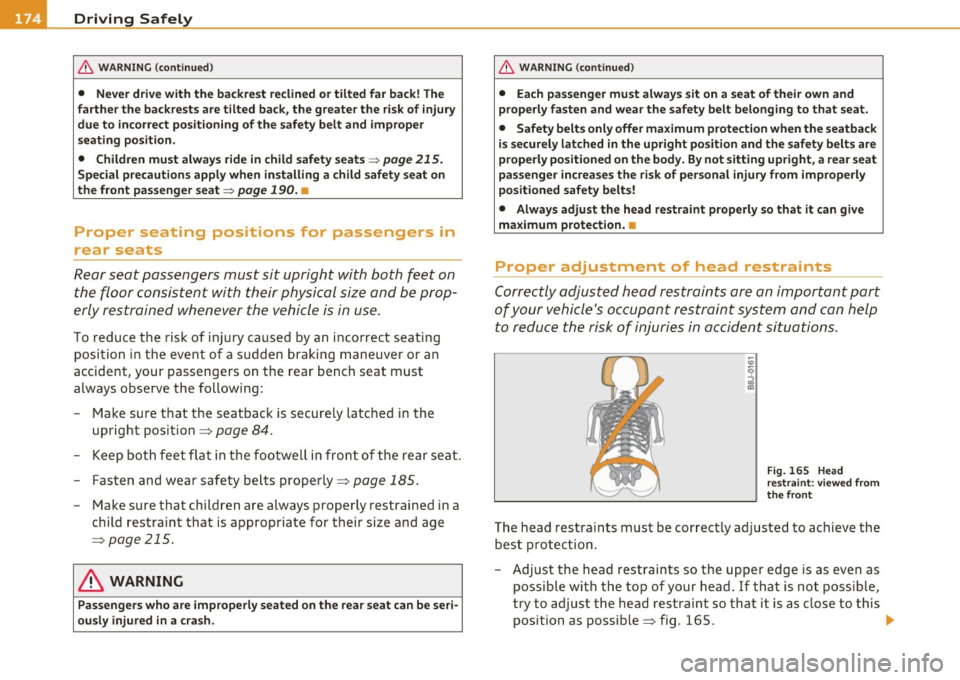
to reduce the risk of injuries in accident situations .
Fig. 165 Head
restraint: viewed from
the front
The head restraints must be correctly adjusted to achieve the
best protection.
- Adjust the head restraints so the upper edge is as even as
possible with the top of your head. If that is not possible,
try to adjust the head restraint so that it is as close to this
position as possible~ fig . 165. .,
Page 192 of 362
........ _A_ i_rb _ a_,g,:;._ s_, y'- s_ t_e _m ________________________________________________ _
Airbag system
Important things to know
Importance of wearing safety belts and
sitting properly
Airbags are only supplemental restraints. For airbags to
do their job, occupants must always properly wear their
safety belts and be in a proper seating position.
For your safety and the safety of your passengers, before
driving off, always:
- Adjust the driver's seat and steering wheel properly
~ page 172,
-Adjust the front passenger's seat properly~ page 74,
- Wear safety belts properly~
page 184,
-Always properly use the proper child restraint to protect
children~
page 215.
In a collision airbags must inflate within the blink of an eye and with
considerable force. The supplemental airbags can cause injuries if the
driver or the front seat passenger is not seated properly. Therefore in
order to help the airbag to do its job, it is important, both as a driver
and as a passenger to sit properly at all times.
By keeping room between your body and the steering wheel and the
front of the passenger compartment, the airbag can inflate fully and
completely and provide supplemental protection in certain frontal
collisions =>
page 172, "Proper occupant seating positions". For
details on the operation of the seat adjustment controls=>
page 76.
It's especially important that children are properly restrained
=>
page 215.
There is a lot that the driver and the passengers can and must do to help the individual safety features installed in your Audi work
together as a system.
Proper seating position is important so that the front airbag on the
driver side can do its job. If you have a physical impairment or condi
tion that prevents you from sitting properly on the driver seat with
the safety belt properly fastened and reaching the pedals, special
modifications to your vehicle may be necessary .
Contact your authorized Audi dealer, or call Audi Customer Relations
at 1-800-822-2834.
When the airbag system deploys, a gas generator will fill the airbags, break open the padded covers, and inflate between the steering
wheel and the driver and between the instrument panel and the front passenger. The airbags will deflate immediately after deployment so
that the front occupants can see through the windshield again
without interruption.
All of this takes place in the blink of an eye, so fast that many people
don't even realize that the airbags have deployed. The airbags also
inflate with a great deal of force and nothing should be in their way
when they deploy . Front airbags in combination with properly worn
safety belts slow down and limit the occupant's forward movement.
Together they help to prevent the driver and front seat passenger
from hitting parts of the inside the vehicle while reducing the forces acting on the occupant during the crash. In this way they help to
reduce the risk of injury to the head and upper body in the crash.
Airbags do not protect the arms or the lower parts of the body.
Both front airbags will not inflate in all frontal collisions. The trig
gering of the airbag system depends on the vehicle deceleration rate
caused by the collision and registered by the electronic control unit .
If this rate is below the reference value programmed into the control
unit, the airbags will not be triggered, even though the car may be
badly damaged as a result of the collision. Vehicle damage, repair _,.
Page 195 of 362
_________________________________________________ A_ ir_ b_ a_,,g :;..__ s-=y '"- s_ t_ e_ m __ _
defined in the electronic contro l unit~ page 202, "PASSE NGER
AI RB AG OF F ligh t".
Always remember, a c hild safety seat or infa nt ca rr ie r i nstalled on th e
front seat may be str uck and k noc ked out of position by the ra pidly
in flating p assenge r's ai rbag in a frontal coll is io n. T he a irbag could
great ly reduce the effect iveness of the c hild restraint and even seri
o us ly i njur e the chi ld dur ing inflation.
For this reason, and because t he back seat is the safest place for chil
dren -whe n properly restrained according to their age an d size -we
st rong ly recommend t hat childre n always sit in the back seat
~ page 21 5, "C hild Safety" .
& WARNING
A child in a rearward-facing child safety seat installed on the front
passenger seat will be ser iously injured and can be killed if the
front airbag inflates - even with an Advanced Airbag System .
• The inflat ing airbag w ill hit the child safety seat or infant
carrier with great force and will smash the child safety seat and
child against the backrest, center armrest, door or roof .
• Always install rear-facing child safety seats on the rear seat .
• If you must install a rearward facing child safety seat on the
front passenger seat because of exceptional circumstances and
the PASSENGER AIR BAG OFF light does not come on and stay on,
immediately install the rear-facing child safety seat in a rear
seating position and have the airbag system inspected by your
authorized Audi dealer.
• Forward-facing child safety seats installed on the front
pa ssenger 's seat may interfere with the deployment of the airbag
and cause ser ious personal injury to the child.
& WARNING
If , in exceptional circumstances , you must install a forward-facing
c hild restraint on the front passenger's seat:
Controls and equip ment Safety first Vehicle operation
& WARNING
(co ntinued )
• Always make sure the forward-facing seat has been designed
and certified by its manufacturer for use on a front seat with a
passenger front and side airbag.
• Never put the forward-facing child restraint up against or very
near the instrument panel.
• Always move the passenger seat into its rearmost position in
the seat's fore and aft adjustment range, as far away from the
airbag as possible before installing the forward-facing child
restraint. The backrest must be ad justed to an upright position.
• Make sure that the PASSENGER AIR BAG OFF light comes on
and stays on all the time whenever the ignition is switched on.
& WARNING
To reduce the risk of serious injury, make sure that the
PASSENGER AIR BAG OFF light will be displayed whenever a child
re straint is installed on the front passenger seat and the ignition
is switched on.
• If the PASSENGER AIR BAG OFF light does not stay on, perform
the checks described~
page 201, "Monitoring the Advanced
Airbag System ".
• Take the child restra int off the front passenger seat and install
it properly at one of the rear seat positions if the PASSENGER AIR BAG OFF light does not stay on .
• Have the airbag system inspected by your authorized Audi
dealer immediately.
• Always carefully follow instructions from child restraint manu
facturers when installing child restraints .
& WARNING
If, in exceptional circumstances , you must install a forward or
rearward-facing child restraint on the front passenger's seat :
Vehicle care Do-it-yourself service Technical data
Page 199 of 362

_______________________________________________ A_ ir_ b_ a_,,,g '--- s.:.y _s _t_ e _ m ___ ffl'II
& WARNING (co ntinued )
• The inflating airbag will hit the child safety seat or infant
carrier with great force and will smash the child safety seat and
c hild against the backrest, center arm rest , door, or roof .
• Always install rearwa rd-facing child restraints in the back seat.
• If you must install a rearward facing child safety seat on the
front passenger seat because of except ional circumstances and
the PASSENGER AIR BAG OFF light does not come on and stay on ,
immediately install the rear-facing child safety seat in a rear
seating position and have the airbag system inspected by your
authorized Audi dealer.
& WARNING
If, in except ional circumstances, you must install a forward-facing
child re straint on the front pa ssenger's seat:
• Always make sure the forward-facing seat has been designed
and certified by its manufacturer for us e on a front seat with a
passenger front and s ide airbag.
• Never put the forward-facing child restraint up again st or very
near the instrument panel.
• Always move the passenger seat into its rearmost position
in
the seat's fore and aft adjustment range, as far away from the
airbag a s po ssible, before installing the forward-facing child
restraint. The backrest must be adjusted to an upr ight position.
• Make sure that the PASSENGER AIR BAG OFF light comes on
and stays on all the time whenever the ignition is switched on .•
Advanced Airbag System components
Th e front passenger seat i n your ve hicle has a lot of very im portant
parts o f th e Ad van ced A irbag System in it. These parts include t he
we ight-sens ing mat, sensors, wir ing, brackets, and mo re . The func-
Controls and equip
ment Safety first Vehicle operation
tion of the system
in the front passenger seat is checked by the elec
t ronic contro l unit whe n t he ignit io n is on. The con tro l u nit mon itors
t he Advanced A irbag System and tu rns th e airbag indicator light on
when a malfunction in the system components is detected. The func
tion of the a irbag indicator light is descr ibed in greater deta il below.
Beca use the front passen ger seat contains importa nt parts of the
Advance d Ai rbag System, you mus t take care to p revent i t fro m be ing
dama ged. Damage to the seat may prevent t he Advance d Airbag for
t he front p assenge r seat fro m d oin g its job in a cra sh.
The front Advanced Airbag System consists of the
following:
• Cras h sensors in the front of the vehicle t hat measure vehicle
acc ele ra tio n/d ecele ration to prov ide info rmat io n t o the Adva nced
Airbag System about t he severity of the crash.
• An elec tron ic con tro l unit, w it h i nteg rated crash senso rs fo r front
and side impacts . The contro l unit " dec ides" w het her to fire the front
a irbag s base d on th e informa tion re ceived from t he cr ash sensors.
The control unit also "decides" whether the safety be lt pretens ioners
s ho uld b e activa ted.
• An Advanced Airbag with gas generator and cont rol va lve for the
dr ive r inside t he st eer ing whee l hub .
• An Advanced Air ba g with gas gene rator and control valve inside
t he inst rume nt pan el for the front pass enger.
• A weig ht-sensing mat unde r the upholste ry paddin g of the front
passenger seat c ushi on that measures the tota l weigh t on the seat .
T he information registe red is se nt co ntin u ously to the electronic
cont rol uni t t o reg ulate deployment of t he front Advanc ed A irbag o n
the passenger side .
• An a irbag mon itoring system and ind icator light in the inst rume nt
cluster =>
page 201.
• A sensor in each fro nt seat reg isters the distance between t he
res pective seat and the s teer ing whee l o r i nst rume nt pane l. The
information reg iste red is sent co ntin uously to the e lectro nic cont rol
uni t to reg ulate dep loyment o f the front Advanced Airbags . .,_
Vehicle care Do-it-yourself service Technical data
Page 218 of 362
-Child Safety _____ ____;_..:::.:!.----------------------------
& WA RNING (conti nued)
• Alway s in stall rearwa rd-facing child safety seats on the rear
seat.
• If you must install a rearward facing child safety seat on the
front passenger seat in exceptional circumstance s and the
PASSENGER AIR BAG OFF light does not come on and stay on ,
immed iately install the rearward-facing child safety seat in a rear
seating position and have the airbag system inspected immedi
ately by your authorized Audi dealer .
& WARNING
If, in exceptional circumstances, you must install a forward-facing
child res traint on the front pas senger's seat:
• Always make sure the forward-facing seat has been designed
and certified by it s manufacturer for use on a front seat with a
passenger front and side airbag.
• Always follow the manufacturer 's instruction s provided with
the child safety seat or carrier.
• Always move the passenger seat into it s rearmost position in
the seat 's fore and aft adjustment range, as far away from the
airbag as possible before installing the child restraint. The back rest must be adjusted to an upright position.
• Always make sure that the PASSENGER AIR BAG OFF light
comes on and stays on all the time whenever the ignition is
switched on .•
Advanced front airbag system and children
Your vehicle is equi pped wi th a fron t "Advanced Airbag System" in
compliance with United States Federal Motor Vehicle Safety Standard
( F MVSS) 2 08 as appli ca ble at t he time your ve hicle was manufa c
tured. The Advanced A
irbag system in yo ur vehicle has been certif ied to
mee t the "low -r is k" requiremen ts fo r 3-and 6-ye ar old ch ildre n on
t he passenger side and small adults on the dr iver side . The low risk
dep loyment criteria are inten ded to reduce the risk of injury through
interaction with the a irbag t hat can occur, for example, by being too
close to the stee ring wheel an d instr ument panel when the airbag
inflates. In addi tion, the system has been certified to comp ly with t he
"suppression" requirements of the Safety Standa rd, to t urn off the
fron t air bag for infan ts up to 1 2 months who a re res train ed on the
front passenger seat in child restrai nts that are listed in the Stan
d ar d.
Even thoug h your vehicle is equipped with an Advanced Airbag
system , a ll ch ildren, especially those 12 years and yo unger, should
always r ide in t he back seat p roperly restrained for t heir ag e and si ze .
Th e ai rbag on the passenge r si de makes the front seat a potentia lly
dange rous p lace for a child to r ide. Th e front seat is not th e safest
place fo r a child in a forward-facing c hild safety seat. It can be a very
d an ge rous p lace for a n infan t or a large r chil d i n a rea rwa rd-facing
seat. •
Advanced Airbags and the weight-sensing
mat in the front seat
Th e Advanced A irbag System i n your ve hicle de tects t he p resence o f
an infa nt o r ch ild in a child rest rai nt on the fro nt passenger sea t using
the we ight-sens ing mat in the seat cushion and the senso r be low the
saf ety belt la tch o n th e front passenge r seat tha t measur es t he
tension on the safety belt.
Th e weigh t-sens ing ma t me asures tot al we ight of the child and the
child safety seat and a child blanket on the fro nt passe nger seat . The
we ight on the fro nt passenger se at is re lated to t he design of the
child res traint and i ts "footpri nt", the size and shape of t he bottom
of the ch ild restraint as it sits o n the seat . The weight of a child
restrain t an d its "foo tpr int" vary for differe nt k inds of child res tra ints .,_
Page 222 of 362
____ C_ h_ il_d _ S_a_ f_ e_ t-= y;....._ ____________________________________________ _
& WARNING (continued)
• If exceptional circumstances require the use of a forward
facing child restraint on the front passenger's seat, the child's safety and well-being require that the following special precau
tions be taken:
-Make sure the forward-facing seat has been designed and
certified by its manufacturer for use on a front seat with a passenger front and side airbag.
- Always carefully follow the manufacturer's instructions
provided with the child safety seat or carrier.
- Always move the front passenger seat into the rearmost
position of the passenger seat's fore and aft adjustment range ,
and as far away from the airbag as possible before installing
the child restraint.
- Always make sure that nothing prevents the front
passenger's seat from being moved to the rearmost position in
its fore and aft adjustment range .
-Always make sure that the backrest is in the upright posi
tion .
• Always buckle the child safety seat firmly in place even if a
child is not sitting in it. A loose child safety seat can fly around
during a sudden stop or in a collision.
• Always read and heed all WARNINGS whenever using a child
restrained in a vehicle is being used~
page 181, "Safety belts ",
~ page 190 , "Airbag system " and ~ page 215, "Child Safety".
& WARNING
To reduce the risk of serious injury, make sure that the
PASSENGER AIR BAG OFF light comes on and stays on whenever a
child restraint is installed on the front passenger seat and the
ignition is switched on.
& WARNING (co ntinued )
• Take the child restraint off the front passenger seat and install
it properly at one of the rear seat positions if the PASSENGER AIR
BAG OFF light does not
stay on.
• Have the airbag system inspected by your authorized Audi
dealer immediately.
& WARNING
• A child in a child restraint installed with the LATCH lower
anchorages or with the standard safety belt on the rear seat may
play with unused rear seat safety belts and become entangled
resulting in serious personal injury and even death.
• Always buckle unused rear seat safety belts out of reach of chil
dren in child seats and properly activate the convertible locking
retractor so that the child cannot unreel the safety belt from the
retractor. •
Page 225 of 362
& WARNING (continued)
• Always install rearward-facing child safety seats on the rear
seat.
• If you must install a rearward facing child safety seat on the
front passenger seat because of exceptional circumstances and
the PASSENGER AIR BAG
OFF light does not come on and stay on,
immediately install the rearward-facing child safety seat in a rear
seating position and have the airbag system inspected by your
authorized Audi dealer.
• Always read and heed all WARNINGS whenever using a child
restrained in a vehicle is being used~
page 181, "Safety belts",
~ page 190, "Airbag system" and~ page 215, "Important
things to know".
& WARNING
If exceptional circumstances require the use of a forward-facing
child restraint on the front passenger's seat, the child's safety and
well-being require that the following special precautions be
taken:
• Make sure the forward-facing seat has been designed and certi
fied by its manufacturer for use on a front seat with a passenger
front and side airbag.
• Always follow the manufacturer's instructions provided with
the child safety seat or infant carrier.
• Always move the front passenger seat into the rearmost posi
tion of the passenger seat's fore and aft adjustment range, and as
far away from the airbag as possible before installing the child
restraint.
• Always make sure that nothing prevents the front passenger's
seat from being moved to the rearmost position in its fore and aft
adjustment range.
• Always make sure the backrest is in an upright position.
Safety first Vehicle OP-eration
Child Safety
& WARNING (continued)
• Make sure that the PASSENGER AIR BAG OFF light comes on
and stays on all the time whenever the ignition is switched on.
• If the light does not stay on, perform the checks~
page 201,
"Monitoring the Advanced Airbag System".
• Take the child restraint off the front passenger seat and install
it properly at one of the rear seat positions if the PASSENGER AIR
BAG
OFF light does not stay on whenever the ignition is switched
on.a
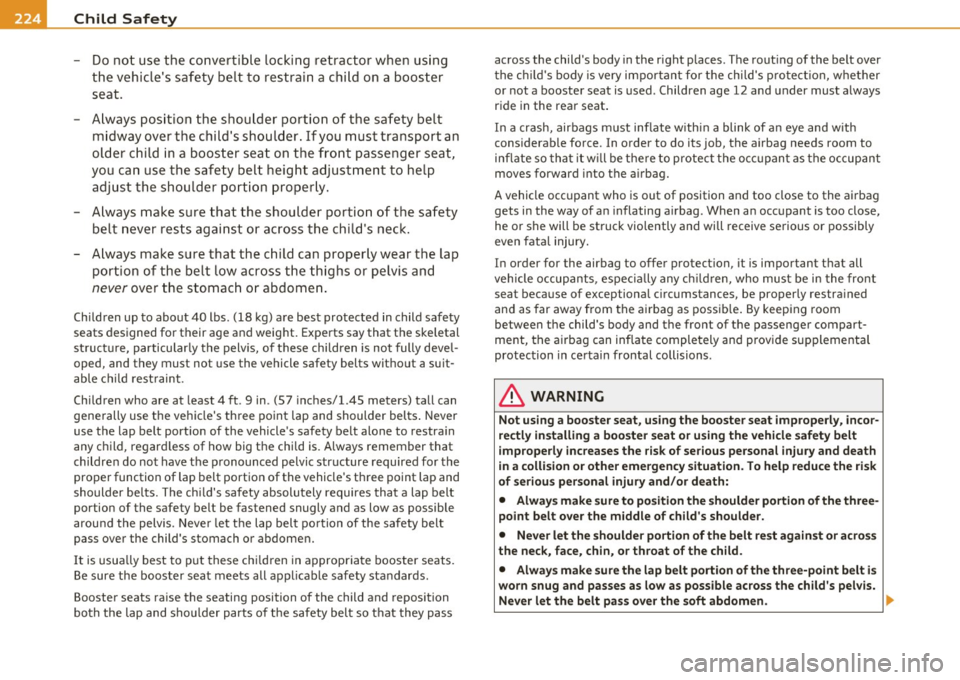
Booster seats and safety belts
Properly used booster seats can help protect children
weighing between about 40 lbs. and 80 lbs. (18 kg and
36 kg) who are less than 4 ft. 9 in.
(57 inches/1.45 meters) tall.
Fig. 190 Rear seat:
child properly
restrained in a booster
seat
The vehicle's safety belts alone will not fit most children until
they are at least 4 ft. 9 in. (57 inches/1.45 meters) tall and
weigh about 80 lbs. (36 kg). Booster seats raise these chil
dren up so that the safety belt will pass properly over the
stronger parts of their bodies and the safety belt can help
protect them in a crash.
~
Vehicle care Do-it-yourselt service iTechnical data
Page 226 of 362
-L~C:_.!:h~ i~ld ~ S~ a:!: f~ e~ t~ y ~ ------------------------------------------
- Do not use the convertible locking retractor when using
the vehicle's safety belt to restrain a child on a booster
seat.
- Always position the shoulder portion of the safety belt midway over the child's shoulder . If you must transport an
older child in a booster seat on the front passenger seat,
you can use the safety belt height adjustment to help
adjust the shoulder port ion properly .
- Always make s ure that the shoulder por tion of the safety
belt never rests against or across the child's neck .
- Always make sure that the child can properly wear the lap portion of the belt low across the thighs or pelvis and
never over the stomach or abdomen .
Children up to about 40 lbs. (18 kg) are best protected in child safety
seats designed for their age and weight. Experts say that the skeletal
st ruct ure, particularly the pelv is, of these chi ldren is not fully deve l
oped, and they must not use the vehicle safety belts without a suit
able child rest raint .
Children who are at least 4 ft. 9 in . (57 inches/1.45 meters) tall can
generally use the vehicle's three point lap and shoulder belts . Never
use the lap belt port ion of the vehicle's safety belt alone to restra in
any child, regard less of how big the child is. Always remember that
childre n do not have the pronounced pelvic structure required for the
proper function of lap belt portion of the vehicle's three point lap and
shoulder belts. The ch ild's safety absolutely requires that a lap belt
portion of the safety belt be fastened snugly and as low as possible
around the pelvis. Neve r let the lap belt po rtion of the safety bel t
pass over the child's stomach or abdomen.
It is usua lly best to p ut these ch ildren in appropriate booster seats.
Be sure the booster seat meets all appl icable safety standards .
Booster seats raise the seating position of the child and reposition
both the lap and shoulder parts of the safety belt so that they pass across the child
's body in the right places . The rout ing of the belt over
t he c hild's body is very impo rtan t for the chi ld's p ro tect io n, whether
or not a booster seat is used. Children age 12 and under must always
ride in the rear seat .
In a crash, airbags m ust inflate with in a blink of an eye and with
considerable force. In order to do its job, the airbag needs room to
infl ate so that it w ill be t he re to protect t he oc cupan t as the occupant
moves forward into the a irbag.
A vehicle occupant who is out of position and too close to the airbag gets in the way of an inflating a irbag . When a n occupant is too close,
he or she will be struck violently and will receive serious or possibly
even fatal injury.
In order for the airbag to offer protection, it is important that all
veh icle occupants , espec ia lly any ch ild ren, who must be in the front
seat because of exceptional c ircumstances, be properly restra ined
and as far away from the airbag as possib le . By keeping room
between the child's body and the front of the passenger compart
ment, the airbag can inflate completely and provide supplemental
protection in certa in frontal collisions.
& WARNING
Not using a booste r sea t, using th e boo ste r seat improp erl y, inc or
rectl y installing a boo ste r seat or u sing the vehicle saf ety b elt
i mp roperly increa se s the risk of serio us per sonal injur y and death
i n a colli sion or oth er emergenc y situatio n. To he lp red uce the ri sk
of s eriou s pers onal injury and /or d eath:
• Alway s make su re to po sition the shoulder portion of the three
point b elt ove r the middl e of child' s sho ulder.
• Never l et the shoulder p orti on of the b elt re st again st or acro ss
th e neck, fa ce, chin , or thro at of the ch ild.
• Alwa ys make sure the lap belt portion of th e thr ee -point belt i s
worn snug and pa sses as low a s pos sible across the ch ild 's pel vis.
N ever le t th e be lt pa ss over the soft abdomen .
liJ>
Page 229 of 362
Child Safety --------------------"'----
& WARNING (continued)
• Always move the passenger seat into its rearmost position in
the seat's fore and aft adjustment range, as far away from the airbag as possible before installing the forward-facing child
restraint. The backrest must be adjusted to an upright position.
• Make sure that the PASSENGER AIR BAG OFF light comes on
and stays on all the time whenever the ignition is switched on.
& WARNING
Rearward-facing child restraints:
• A child in a rearward-facing child safety seat installed on the
front passenger seat will be seriously injured and can be killed if
the front airbag inflates -even with an Advanced Airbag System.
• The inflating airbag will hit the child safety seat or infant
carrier with great force and will smash the child safety seat and
child against the backrest, center armrest, door or roof.
• Always be especially careful if you must install a rearward
facing child safety seat on the front passenger seat in exceptional
circumstances.
• A tight tether strap on a rearward-facing child restraint
attached to the front passenger seat can put too much pressure on
the weight-mat in the seat and register a heavier weight in the
Advanced Airbag System. The heavier weight registered can make
the system work as though an adult were on the seat and deploy the Advanced Airbag when it must be suppressed causing serious
or even fatal injury to the child.
• Make sure that the PASSENGER AIR BAG OFF light comes on
and stays on all the time whenever the ignition is switched on.
• If the PASSENGER AIR BAG OFF light does not come on and
stay on, immediately install the rearward-facing child safety seat
in a rear seating position and have the airbag system inspected by
your authorized Audi dealer. •
Controls and equip ment Safety first Vehicle operation
Activating the convertible Locking retractor
Use the convertible locking retractor to secure
a child
restraint.
Always heed the child safety seat manufacturer's instruc
tions when installing a child restraint in your vehicle. To acti
vate the convertible locking retractor:
- Place the child restraint on a seat, preferably on the rear
seat .
- Slowly pull the belt
all the way out.
- Route it around or through the child restraint belt path
::::>& .
- Push the child safety seat down with your full weight to
get the safety belt really tight.
- Insert the belt tongue into the buckle for that seating
position.
- Guide the safety belt back into the retractor until the belt
lies flat and snug on the child safety seat .
- You should hear a "clicking" noise as the belt winds back
into the inertia reel. Test the convertible locking retractor
by pulling on the belt. You should no longer be able to pull
the belt out of the retractor. The convertible locking
retractor is now activated.
- Make sure that the red release button is facing away from
the child restraint so that it can be unbuckled quickly.
- Pull on the belt to make sure the safety belt is properly
tight and fastened so that the seat cannot move forward
or sideways more than one inch (2.5 cm) . .,
Vehicle care Do-it-yourself service Technical data
Page 288 of 362
___ C_ h_ e_c _k _i _ n _g ~ a_n _d_ f_il _l_in _ g _________________________________________ _
Have the battery checked when you take your vehicle in for service.
You are well advised to replace a battery that is older than 5 years.
With certain types of a irbag deployment, the battery is disconnected
from the vehicle e lectrical system for safety reasons=>
& in "Repair,
care and disposal of the airbags" on
page 204.
Disconnecting the battery terminals
Some vehicle functions (power window regulators, for example) are
lost if the battery terminals are disconnected. These functions have
to be relearned after the battery terminals are connected aga in . To
prevent this, the battery should only be disconnected from the
vehicle electrical system when absolutely necessary for repairs.
Vehicles not driven for long periods
If you do not dr ive your vehicle over a period of several days or weeks,
electrical components are gradually cut back or switched off. This
reduces energy consumption and maintains starting capability over a
longer period=>
page 243.
Take into consideration that when you unlock you r vehicle, some
convenience functions, such as the master key remote function or
power seat adjustment, may not be available. The convenience func
tions will be available again when you turn on the ign ition and start
the engine.
W inter operation
During the w inte r months, battery capacity tends to decrease as
temperatures drop. This is because more power is also consumed
wh ile starting, and the headlights, rear window defogger, etc., are
used more often.
Avoid unnecessary power consumption, particularly in city traffic or
when traveling only short distances. Let your authorized Audi dealer
check the capacity of the vehicle battery before winter sets in
=> page 288. A well charged battery will not only prevent starting
problems when the weather is cold, but will also last longer.
W Tips
If your vehicle is left standing for several weeks at extremely low
temperatures, the vehicle battery should be removed and stored
where it will not freeze. This will prevent it from being damaged and
having to be replaced .•
Working on the battery
Be especially careful when working on or near the
battery.
The battery is located in the luggage compartment under the
floor. Before you check anyth ing in the lu~gage compart
ment,
read and heed all WARNINGS:=>& .
Always heed the safety warnings, when working on the vehicle
battery or the vehicle electrical system to prevent injury .
The following WARNINGS are very important when
working on the battery:
Always heed the following WARNING SYMBOLS and safety pre
cautions when working on the battery.
Always wear eye protection.
Battery acid contains sulfuric acid. Always wear
gloves and eye protection . .,,_