instrument panel AUDI A5 COUPE 2011 Owner's Manual
[x] Cancel search | Manufacturer: AUDI, Model Year: 2011, Model line: A5 COUPE, Model: AUDI A5 COUPE 2011Pages: 362, PDF Size: 84.88 MB
Page 201 of 362
situations. Be sure to read the important information about safety
and heed the WARNINGS in this chapter.
Deployment of the Advanced A irbag System and the activation of the
safety belt pretensioners depend on the deceleration measured by
the crash sensors and registered by the electron ic control unit. T he
amount of inflation of the front airbags can a lso be adapted to the
front seat position, depending on the distance between the respec
tive front seat and the steering wheel or instrument panel as regis
tered by sensors in the seats. Crash severity depends on speed and
deceleration as well as the mass and stiffness of the vehicle or object
involved in the crash .
On the passenger side, regardless of safety belt use, the air bag w ill
be turned off if the weight on the passenger seat is less than the
amount programm ed in the electronic control unit . The front airbag
on the passenger side will also be turned off if one of the chi ld safety
seats that has been certified under Federal Motor Vehicle Safety
Standard 208 has been recognized on the seat. The
PASSENGER AIR
BAG OFF
light comes on and stays on to tell you when the front
Advanced Airbag on the passenger side has been turned off
=> page 192, "Child rest raints on the front seat -some important
things to know".
& WARNING
To reduce the risk of injury when an airbag inflates, always wear
safety belts properly.
• If you are unrestrained, leaning forward, sitting sideways or
out of position in any way, your risk of injury is much higher .
• You will also receive serious injuries and could even be killed if
you are up against the airbag or too close to it when it inflates •
even with an Advanced Airbag=>
page 190. •
Safety first Vehicle OP-eration
Airbag system
More important things to know about front
airbags
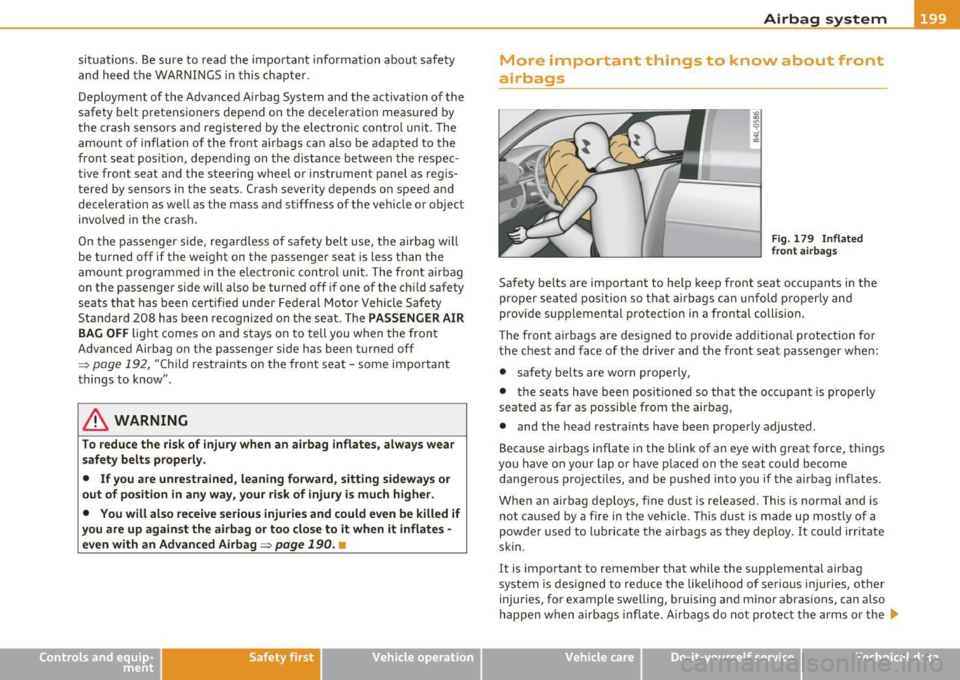
Fig. 17 9 Inflated
front airbags
Safety belts are important to help keep front seat occupants in the
proper seated position so that airbags can unfold properly and
prov ide supplemental protection in a frontal collision.
Th e front airbags are designed to provide additiona l protection for
the chest and face of the driver and the front seat passenger when:
• safety belts are worn properly,
• the seats have been positioned so that the occupant is properly
seated as far as possible from the airbag ,
• and the head restraints have been properly adjusted .
Because airbags inflate in the blink of an eye with great force, things
you have on your lap o r have placed on the seat could become
dangerous projectiles, and be pushed into you if the airbag inflates.
When an airbag deploys, fine dust is released. This is normal and is
not caused by a fire in the vehicle. This dust is made up mostly of a
powder used to lubricate the airbags as they deploy .
It could irritate
skin.
It is important to remember that while the supplemental airbag
system is desig ned to reduce the likelihood of serious injur ies, other
injuries, for example swell ing, bruising and m inor abrasions, can also
happen when airbags inflate. Airbags do not protect the arms or the •
Vehicle care Do-it-yourselt service iTechnical data
Page 202 of 362
-L___:_A~ i r'....: b~ a ::::: gL:: s~y -=s ::..:t :.:e :..: m..:..:.. ______________________________________________ _
lower parts of the body. Front airbags only supplement the three
point s afety be lts i n some fro ntal c ollisions in which t he vehicle de ce l
eratio n is h igh enough to dep loy the a irbags.
Front airbags will not deploy:
• if the ignition is sw itched off when a cras h occu rs,
• in s ide collisions,
• in rea r-end collisions,
• in rollovers,
• when the cras h deceleration me asured by the ai rbag syste m is less
than t he m in imum threshold needed for airbag dep loyment as regis
t ere d by the e lectro nic cont rol unit.
The front passenger airbag will also not deploy:
• when the fron t pa sse nger sea t is not o ccupied,
• when the we ight on the front passenge r seat as sense d by the
Advanced Airbag Sys tem in dicates t hat the front airbag on the
passenger side has to be turned off by t he e lectron ic control un it (the
PASSENGER AIR BAG OFF light comes on and st ay s on).
& WARNING
Sitt ing in the wrong posit ion can increa se the risk of serious injury
in crashes .
• To reduce the risk of injury when the airbags inflate , the driver
and passengers must always sit in an upright position , must not
lean against or place any part of their body too close to the ar ea
where the airbags are located.
• Occupants who are unbelted, out of position or too close to the
airbag can be ser iously injured by an airbag as it unfolds with
great force in the blink of an eye=>
page 192.
& WARNING
A child in a rearward-facing ch ild safety seat installed on the front
pa ssenger seat will be seriou sly injured and can be killed if the
front airbag inflates -even with an Advanced Airbag System.
• The inflating airbag will hit the child safety seat or infant
carrier with great force and will smash the child safety seat and
child against the backrest, center armrest , door or roof.
• Always install rear-f acing child safety seats on the rear seat.
• If you must install a rearward facing child safety seat on the
front p assenger seat because of e xceptional circumstances and
the PASSENGER AIR BAG OFF light does not come on and stay on,
i mmediately install the rear-facing child safety seat in a rear
seating position and have the airbag system inspected by your
authorized Audi dealer.
& WARNING
Objects between you and the airb ag wilt increase the risk of injury
in a crash by interfering with the way the airbag unfolds or by
being pushed into you as the airbag inflates.
• N ever hold things in your hands or on your lap when the vehicle
is in use.
• Never tran sport items on or in the area of the front passenger
seat . Object s could move into the area of the front airbag s during
brak ing or other sudden maneuver and become dangerous projec
tiles that can cause serious personal injury if the airbags inflate.
• Never place or attach accessories or other objects (such as
cupholders , telephone bra ckets , large, heavy o r bulky objects) on
the doors, over or near the area marked "AIRBAG " on the steering
wheel, instrument panel , seat backrests or between those areas
and yourself . The se obj ect s could cause injury in a crash , especially
when the airbags inflate .
• Never recl ine the front passenger's seat to transport objects.
Items can also move into the area of the side airbag or the front ..,
Page 206 of 362
111 ....... _A_ i_rb _ a_,g,:;._ s_, y'- s_ t_e _m ________________________________________________ _
& WARNING (conti nued)
seating position and have the airbag system inspected by your
authorized Audi dealer .
• A tight tether or othe r strap on a rearward-facing child
restraint attached to the front passenger seat can put too much
pressure on the weight-sensing mat in the seat and register more
weight than i s actually on the seat. The heav ier weight registered
can make the system work as though an adult were on the seat
and deploy the Advanced Airbag when it must be suppressed
causing serious or even fatal injury to the child .
• If, in ex ceptional circumstances, you must install a forward·
facing child restraint on the front passenger seat, always move
the seat into i ts rearmo st po sition in the seat's fore and aft adjust ·
ment range, as far away from the airbag as possible . The backrest
must be adjusted to an upright position. Make sure that the
PASSENGER AIR BAG OFF light comes on and stays on all the time
whenever the ignition is switched on.
& WARNING
• If the PASSENGER AIR BAG OFF light do es not go out when an
adult is sitting on the front passenger seat after taking the steps
de scribed above, make sure the adult i s properly seated and
restrained at one of the rear seating positions.
• Have the airbag system inspected by your authorized Audi
dealer before transporting anyone on the front passenger seat.
[ i ] Tips
If the we ight-sens ing mat in the front passenger seat detects an
empty seat, the front a irbag on the passenger side w ill be t urne d off,
and PASS ENGER AIR BAG OFF will stay on.•
Repair, care and disposal of the airbags
Parts of the a irbag system a re installed at many different p laces on
your Audi. Inst all in g, remov ing, servic ing or repa iring a part in an
area of the ve hicle can damage a part of an airbag system and preve nt
t ha t system from working pro perl y in a coll is ion.
T here are some important thi ngs you have to know to make sure that
the effectiveness of the system will not be impa ired an d that
discarded components do no t cause injury or poll ute the enviro n
ment .
& WARNING
Improper care , servicing and repair procedures can increase the
risk of personal injury and death by preventing an airbag from
deploying when needed or deploying an airbag unexpectedly:
• Never cover, obstruct , or change the steering wheel horn pad or
airbag cover or the instrument panel or modify them in any way.
• Never attach any objects such as cupholders or telephone
mountings to the surfaces covering the airbag unit s.
• For cleaning the horn pad or instrument panel, use only a soft,
dry cloth or one moistened with plain water. Solvent s or cleaners
could damage the airbag cover or change the stiffness or strength
of the material so that the airbag cannot deploy and protect prop·
erly .
• Never repair, adjust, or change any part s of the airbag system .
• All work on the steering wheel, instrument panel , front seats
or electrical sy stem (including the installation of audio equip·
ment , cellular telephones and CB radios, etc .) must be performed
by a qualified technician who ha s the training and special equip ·
ment necessary .
• For any work on the airbag system, we strongly re commend
that you see your autho rized Audi dealer or qualified workshop.
• Never modify the front bumper or parts of the vehicle body.
liJ,,
Page 208 of 362
..,. Airbag system
PAWi-- --=------------------------------
& WARNING
Changing th e vehicle 's su sp en sion including use of unappro ved
tire -rim c ombination s can change Advan ced Airbag performan ce
and increas e the risk of serious personal injury in a cra sh .
• Never install suspension component s that do not have the
same performance characteristics as the components or iginally
installed on your veh icle.
• Never u se tir e-rim combinations that have not been approved
b y Audi.
& WARNING
Item s stored b etween the safety belt buckl e and the center
console can cause the sensors in the buckle to send the wrong
information to the ele ctroni c control module and prevent the
Advanced Airbag System from w orking properl y.
• Always make sure that nothing can interfere with the safety
belt buckles and that they a re not obstru cted .
<£> For the sake of the environment
Undeployed airbag modu les and pretensioners might be class ified as
Perch lorate Mate rial -special handling may app ly, see
www.dtsc.ca.gov/hazardouswaste/pe rchlorate . When the vehicle or
p arts of t he rest raint sys tem including a irbag mod ules safe ty belts
w ith pretens ioners are scrapped, all applicable laws and regulat ions
must be observed. Your authorized Audi dealer is familiar with these
requ irements and we recommend that you have your dealer perform
this se rvice for yo u.•
Knee airbags
Applies to veh icles: w ith knee a irbags
Description of knee airbags
The airbag system can provide supplemental protection
to properly restrained front seat occupants.
....
! 00 m
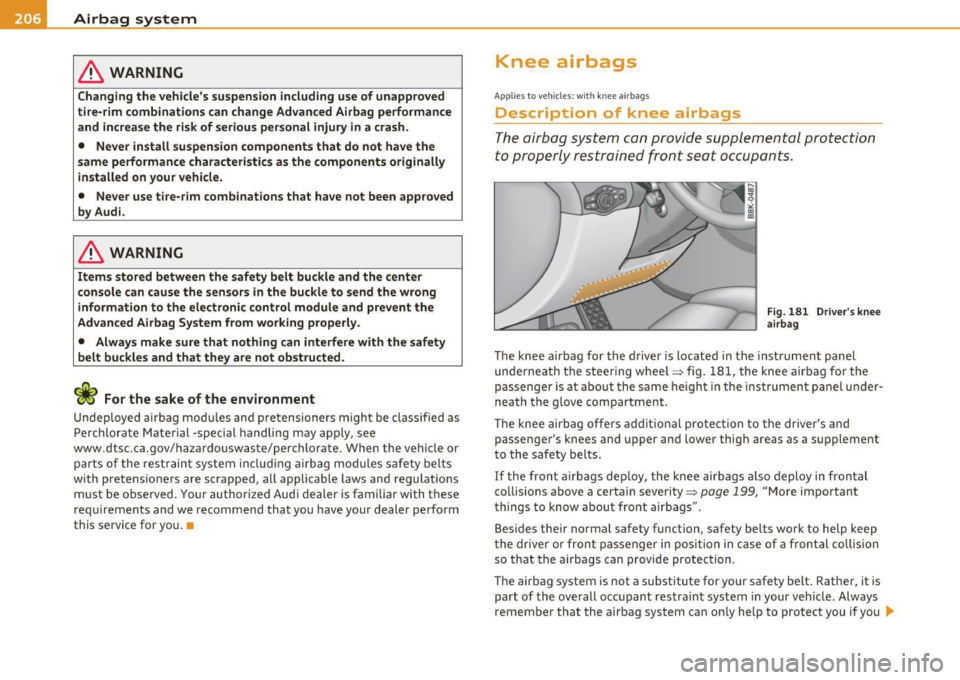
Fig. 181 D riv er's kn ee
a ir ba g
The knee airbag for the driver is located in the instrume nt panel
unde rneath the steering whee l:::> fig. 181, the knee airbag for the
passenge r is at about the same he ight in the instrument panel u nder
neath the g love compartment .
Th e knee airbag offers addit ional protec tion to the dr ive r's and
passenger's knees and upper and lower thigh areas as a supplement
t o the sa fety bel ts.
If the front a irbags dep loy, the knee airbags a lso deploy i n frontal
co llisions above a certain severity=>
page 199, "More importan t
things to know about front airbags" .
Besides the ir normal safety function, safety be lts work to help keep
t he drive r o r front passenger in po sit ion in c ase o f a frontal collision
so that the a irbags can provide protection .
Th e airbag system is not a substitute for your safety belt . Rather, it is
part of the overall occ upant restra int system in your veh icle . Always
remember t hat the airbag system can on ly help to protect you if you
~
Page 209 of 362
are wearing your safety belt and wear ing it properly . This is why you
should always wear your safety belt, not just because the law requires
you to do so=>
page 181, "General notes".
The safety belt buckle for the driver and front seat passenger have
switches that tell the airbag control module if the safety belt is being
used or not. If the safety belt is being used, the knee airbag will
dep loy at a slightly higher rate of deceleration than if the belt is not
being used. Therefore, in a particular collision, it is poss ible that an
airbag will not deploy at a seating position where the safety belt is
being used but will inflate at the position whe re the safety be lt is not
being used.
Remember too, airbags w ill deploy only once and only in certa in kinds
of accidents -your safety belts are always there to offer protection in
t hose accidents in which airbags are not supposed to deploy or when
they have already deployed, for example when your vehicle strikes or
is struck by another after the first collision.
This is just one of the reasons why an airbag is not a substitute for the
safety belt. The airbag system wo rks most effective ly when used with
the safety belts. Therefore, always wear your safety belts correctly .
It is important to remember that while the supplemental airbag
system is desig ned to reduce the likelihood of serious injuries, other
injuries, for example, swe lling, bruis ing, and minor abrasions can
also be associated with airbags.
The knee airbag system basically consists of:
• Th e electronic control module
• T wo inflatable airbags (airbag and gas generator), one for the
driver and one for the front passenger
• The airbag indicator light in the instrument panel
The knee airbag system will not deploy:
• when the ignition is turned off
• in front-end collis ions when the decelerat ion measured by the
control unit is too low
• in s ide collisions
Safety first Vehicle OP-eration
Airbag system
• in rear-end collisions
• in rollovers
• in the event of a system ma lfunction (warning/indicator light illu
minated)=>
page 16 .
& WARNING
• Safety belts and the airbag system can only provide protection
when occupants are in the proper seating position =>
page 199.
• If the airbag indicator light comes when the vehicle is being
used, have the system inspected immediately by your authorized
Audi dealer. The airbag may not work properly when the vehicle
acceleration in a side collision is high enough to deploy the airbag.
See also =>
page 16. •
A pp lies to vehi cles: w ith knee a irbags
How knee airbags work
The risk of injury to the leg area is reduced by fully
deployed knee airbags.
Fig . 182 Inflated
airbags protecting
in a
frontal collision
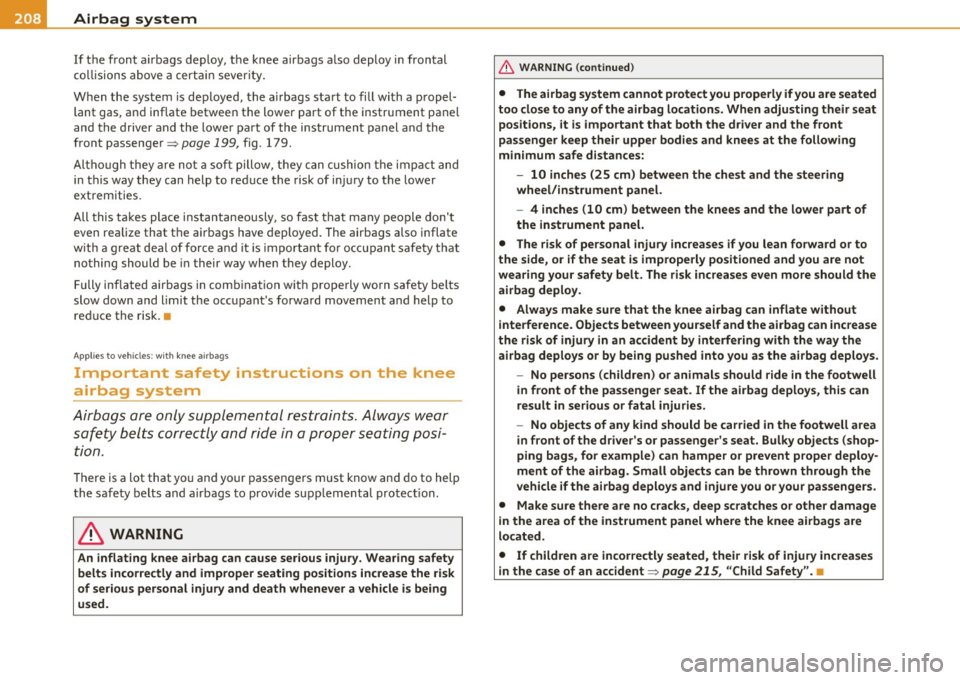
The knee air bag system has been designed so that the airbags for the
dr iver and front passenger are deployed in certa in but not all frontal
co llisions .
ti-
Vehicle care Do-it-yourselt service iTechnical data
Page 210 of 362
........ _A_ ir_ b_ a-=g ,__ s,,.,y _s _t _e_ m _______________________________________________ _
If the front airbags deploy, the knee airbags also deploy in frontal
collisions above a certain severity.
When the system is deployed, the a irbags start to fill with a propel
lant gas, and inflate between the lower part of the instrument panel
and the driver and the lower part of the instrument panel and the
front passenger =>
page 199, fig. 179.
Altho ugh they are not a soft pillow, they can cushion the impact and
in this way they can help to reduce the risk of injury to the lower
extremities.
All this takes place instantaneously, so fast that many people don't
even realize that the airbags have deployed. The airbags also inflate
w ith a great deal of force and it is important fo r occupant safety that
nothing should be in their way when they deploy.
Fully inflated airbags in combination with properly worn safety belts
slow down and limit the occupant's forward movement and help to
red uce the risk.•
Appli es to ve hicl es: w it h kn ee a irbags
Important safety instructions on the knee
airbag system
Airbags are only supplemental restraints. Always wear
safety belts correctly and ride in a proper seating posi
tion.
Th ere is a lot that yo u and your passengers must know and do to help
the safety belts and a irbags to prov ide supp lemental protection.
& WARNING
An inflating knee airbag can cause serious injury. Wearing safety
belts incorrectly and improper seating positions increase the risk
of serious personal injury and death whenever a vehicle is being
used.
& WARNING (continued)
• The airbag system cannot protect you properly if you are seated
too close to any of the airbag locations. When adjusting their seat
positions, it is important that both the driver and the front
passenger keep their upper bodies and knees at the following
minimum safe distances:
- 10 inches (25 cm) between the chest and the steering
wheel/instrument panel.
- 4 inches (10 cm) between the knees and the lower part of
the instrument panel.
• The risk of personal injury increases if you lean forward or to
the side, or if the seat is improperly positioned and you are not
wearing your safety belt. The risk increases even more should the
airbag deploy.
• Always make sure that the knee airbag can inflate without
interference. Objects between yourself and the airbag can increase
the risk of injury in an accident by interfering with the way the
airbag deploys or by being pushed into you as the airbag deploys .
- No persons (children) or animals should ride in the footwell
in front of the passenger seat. If the airbag deploys, this can
result in serious or fatal injuries.
- No objects of any kind should be carried in the footwell area
in front of the driver's or passenger's seat. Bulky objects (shop
ping bags, for example) can hamper or prevent proper deploy
ment of the airbag. Small objects can be thrown through the
vehicle if the airbag deploys and injure you or your passengers.
• Make sure there are no cracks, deep scratches or other damage
in the area of the instrument panel where the knee airbags are
located.
• If children are incorrectly seated, their risk of injury increases
in the case of an accident =>
page 215, "Child Safety". •
Page 228 of 362
•L_---=C:..:h..:.. i:..: l .=d ~S=-= a..:..f .= e ~ty ~ --------------------------------------------
& WARNING (cont inued)
• Always buckle the child safety seat firmly in place even if a
child is not sitting in it. A loose child safety seat can fly around
during a sudden stop or in a collision.
• Always make sure that the rear seat backrest to which the
center rear safety belt is attached is securely latched whenever the
rear center safety belt is being used to secure a child restraint.
• If the backrest is not securely latched, the child and the child restraint will be thrown forward together with the backrest and
will strike parts of the vehicle interior. The child can be seriously
injured or killed.
• Never install rearward-facing child safety seats or infant
carriers on the front passenger seat. A child will be seriously injured and can be killed when the passenger airbag inflates .
• The inflating airbag will hit the child safety seat or infant
carrier with great force and will smash the child safety seat and
child against the backrest, center armrest , door or roof.
• Always install rearward-facing child safety seats or infant
carriers on the rear seat.
• Forward-facing child safety seats or infant carriers installed on
the front passenger's seat may interfere with the deployment of
the airbag and cause serious injury to the child.
• It is safer to install a forward-facing child safety seat on the
rear seat.
• Always read and heed all WARNINGS whenever using a child
restrained in a vehicle is being used=>
page 215. Special precau
tions apply when installing a child safety seat on the front
passenger seat=>
page 192, "Child restraints on the front seat -
some important things to know".
& WARNING
Always take special precautions if you must install a forward or
rearward-facing child restraint on the front passenger's seat in
exceptional situations :
• Whenever a forward or rearward-facing child restraint is
installed on the front passenger seat, the PASSENGER AIR BAG
OFF light must come on and stay on whenever the ignition is
switched on.
• If the PASSENGER AIR BAG OFF light does not come on and
stay on, perform the checks described =>
page 201, "Monitoring
the Advanced Airbag System".
• Take the child restraint off the front passenger seat and install
it properly at one of the rear seat positions if the PASSENGER AIR
BAG OFF light does not stay on whenever the ignition is switched
on .
• Improper installation of child restraints can reduce their effec
tiveness or even prevent them from providing any protection.
• An improperly installed child restraint can interfere with the
airbag as it deploys and seriously injure or even kill the child.
• Always carefully follow the manufacturer 's instructions
provided with the child safety seat or carrier.
• Never place additional items on the seat that can increase the
total weight registered by the weight-sensing mat and can cause
injury in a crash .
& WARNING
Forward-facing child restraints:
• Always make sure the forward-facing seat has been designed
and certified by its manufacturer for use on a front seat with a
passenger front and side airbag .
• Never put the forward-facing child restraint up, against or very
near the instrument panel. .,_
Page 266 of 362
-~_C_ le_ a_n_ i_ n_ g=- a_ n_d___. p_ro _t_e _c_ t_ i_o _n ___________________________________________ _
Normal surface stains can be cleaned using a comme rcially avai lab le
fo am cle aner. Spread t he fo am o n th e sur fa ce of the fabr ic wit h a soft
sponge and work it in gently . Do not saturate the fabr ic . T hen pat the
foam dry using absorbent, dry cloths (e .g . m icrofiber cloth) a nd
vacuum it afte r it has dr ied com plete ly.
Cleaning stains
Sta ins caused by beverages (e .g . coffee, fruit juice, etc .) can be
t re ate d wi th a mild detergen t sol utio n. Apply the dete rgent solu tion
w ith a s ponge . In the case o f stubbo rn stains, a detergent pas te ca n
be applied directly to the stain an d wo rked into the fabric . Afte r
wa rds, use copious amo unts o f clean water to remove the rema ining
detergent . App ly t he water with a damp cloth o r sponge an d pat the
f abr ic dr y wi th a n absorbe nt, dr y cloth .
Sta ins from choco late or makeup sho uld have detergent paste
r u bbed into the m. Afte rw ards, remove the so ap wi th w ate r (dam p
sponge) .
Alcoho l can be used to treat stains from grease, oil, lipstic k or a ba ll
point pen . M elte d gre as e o r dye mus t be pa tted off using abso rbe nt
material. It may be necessary to ret reat t he a reas with detergent
p ast e and water.
In the case of ge nera l soiling o f the upholste ry and cover mater ia l, we
recommend hiring a specialis t that has the equ ipmen t to clean the
seat covers and other fa bric surfaces by shampoo ing and sp ray
extraction .
& WARNING
Always read and heed all WARNINGS and the information
~page 256 .
[I] Tips
Open Velcro fasteners on your clothing can damage the seat cover.
Please make s ure t hat Velcro fasteners are close d.•
Plastic parts and instrument panel
Always use a clean cloth moistened in clear wate r to clean these
a reas . For pe rsis te nt di rt use an A udi appr ove d
solvent-free plastic
cleaner /protectant.
& WARNING
Solvents can change the propert ies of some plastics and make it
harder for the airbag to deploy.
• Never clean the instrument panel or the surface of airbag
modules with cleaning products that contain solvents.
• Products containing solvents will make the surface of this part
porous.
• Serious injuries can result if pla stic parts come loose when the
airbag is deployed .
• Alway s read and heed all WARNINGS and other information
~ page 256 .
0 Note
Cleaning agents contai ning solvents will attac k the material and can
ch ange the w ay i t be have s. •
Appli es to veh icl es: wit h nat ura l leather
Natural leather
A udi makes gre at e ffo rts t o m ain tain the prop ert ies,
n a tu ra l loo k and fee l of inte rio r leat her .
General
We offe r many differen t types o f leat he r on our vehi cles. Most are
different types of nappa leather, wh ich has a smooth s urface and
comes in va rious co lo rs . _,,,
Page 276 of 362
___ C_h_ e_c _k _i_n -=g :a,__ a_n_ d_ f_ i_ l _li _n _,g;._ __________________________________________ _
Checking and filling
Engine hood
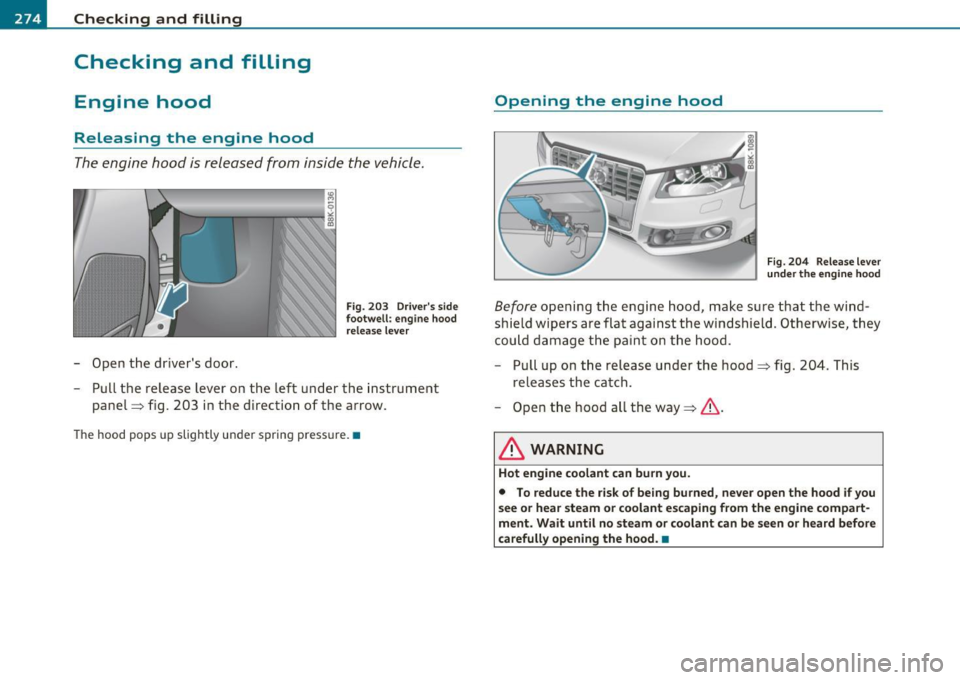
Releasing the engine hood
The engine hood is released from inside the vehicle.
- Open the dr iver's door.
F ig . 20 3 Driver 's sid e
f oo twell : e ng in e ho od
r elease leve r
-Pull the re lease lever on the left under the instrument
panel ~ fig. 203 in the directio n of the arrow.
The hood pops up slightly under spring press ure. •
Opening the engine hood
Fig. 204 Rel ease le ver
unde r th e eng in e hood
Before opening the eng ine hood, make sure that the wi nd
shield wipers are flat against the win dshiel d. Otherwise, they
cou ld damage the paint on the hood .
Pull up on t he release under the hood~ fig. 20 4. T his
releases the catch.
- Open t he hood all the way~& .
& WARNING
Hot eng ine coolant can burn you.
• To redu ce the r isk o f be ing burned, never open the hood if you
see or hear steam or coolant escaping from the engine compa rt
ment. Wait until no ste am or co olant can be seen or heard before
carefully opening the hood .•
Page 327 of 362
Fuses and bulbs -----------------------=---==-=-=--=.:..:..:::...:....:.:..:....-EWII
No. Consumer Amps
8 Vehicle electrical system control module 1
30
--
9 sunroof 20
10 Vehicle electrical system control module 1 30
11 sunroof shade (Avant)
20
12 Convenience electronics 5
•
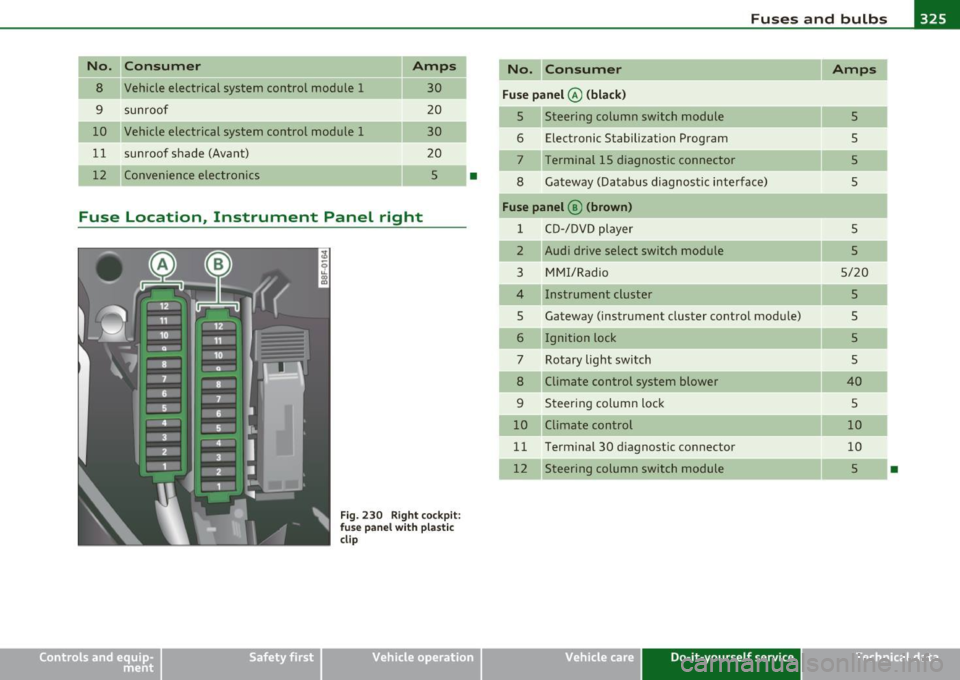
Fuse Location, Instrument Panel right
Fig. 230 Right cockpit:
f use panel with plastic
clip
Vehicle OP-eration
No. Consumer Amps
Fuse panel @ (black)
5 Steering column switch module
5
6 Electronic Stabilization Program
5
7 Terminal 15 diagnostic connector 5
8 Gateway (Databus diagnostic interface)
5
Fuse panel @ (brown)
1 CD-/DVD player
5
2 Audi drive select switch module 5
3 MMI/Radio 5/20
4 Instrument cluster 5
5 Gateway (instrument cluster control module)
5
6 Ignition lock 5
7 Rotary light switch 5
8 Climate control system blower 40
9 Steering column lock
5
10 Climate control 10
11 Terminal 30 d
iagnostic connector
10
12 Steering column switch module 5
•
Vehicle care Do-it-yourself service iTechnical data