steering AUDI A5 COUPE 2011 Owner's Guide
[x] Cancel search | Manufacturer: AUDI, Model Year: 2011, Model line: A5 COUPE, Model: AUDI A5 COUPE 2011Pages: 362, PDF Size: 84.88 MB
Page 206 of 362
111 ....... _A_ i_rb _ a_,g,:;._ s_, y'- s_ t_e _m ________________________________________________ _
& WARNING (conti nued)
seating position and have the airbag system inspected by your
authorized Audi dealer .
• A tight tether or othe r strap on a rearward-facing child
restraint attached to the front passenger seat can put too much
pressure on the weight-sensing mat in the seat and register more
weight than i s actually on the seat. The heav ier weight registered
can make the system work as though an adult were on the seat
and deploy the Advanced Airbag when it must be suppressed
causing serious or even fatal injury to the child .
• If, in ex ceptional circumstances, you must install a forward·
facing child restraint on the front passenger seat, always move
the seat into i ts rearmo st po sition in the seat's fore and aft adjust ·
ment range, as far away from the airbag as possible . The backrest
must be adjusted to an upright position. Make sure that the
PASSENGER AIR BAG OFF light comes on and stays on all the time
whenever the ignition is switched on.
& WARNING
• If the PASSENGER AIR BAG OFF light do es not go out when an
adult is sitting on the front passenger seat after taking the steps
de scribed above, make sure the adult i s properly seated and
restrained at one of the rear seating positions.
• Have the airbag system inspected by your authorized Audi
dealer before transporting anyone on the front passenger seat.
[ i ] Tips
If the we ight-sens ing mat in the front passenger seat detects an
empty seat, the front a irbag on the passenger side w ill be t urne d off,
and PASS ENGER AIR BAG OFF will stay on.•
Repair, care and disposal of the airbags
Parts of the a irbag system a re installed at many different p laces on
your Audi. Inst all in g, remov ing, servic ing or repa iring a part in an
area of the ve hicle can damage a part of an airbag system and preve nt
t ha t system from working pro perl y in a coll is ion.
T here are some important thi ngs you have to know to make sure that
the effectiveness of the system will not be impa ired an d that
discarded components do no t cause injury or poll ute the enviro n
ment .
& WARNING
Improper care , servicing and repair procedures can increase the
risk of personal injury and death by preventing an airbag from
deploying when needed or deploying an airbag unexpectedly:
• Never cover, obstruct , or change the steering wheel horn pad or
airbag cover or the instrument panel or modify them in any way.
• Never attach any objects such as cupholders or telephone
mountings to the surfaces covering the airbag unit s.
• For cleaning the horn pad or instrument panel, use only a soft,
dry cloth or one moistened with plain water. Solvent s or cleaners
could damage the airbag cover or change the stiffness or strength
of the material so that the airbag cannot deploy and protect prop·
erly .
• Never repair, adjust, or change any part s of the airbag system .
• All work on the steering wheel, instrument panel , front seats
or electrical sy stem (including the installation of audio equip·
ment , cellular telephones and CB radios, etc .) must be performed
by a qualified technician who ha s the training and special equip ·
ment necessary .
• For any work on the airbag system, we strongly re commend
that you see your autho rized Audi dealer or qualified workshop.
• Never modify the front bumper or parts of the vehicle body.
liJ,,
Page 208 of 362
..,. Airbag system
PAWi-- --=------------------------------
& WARNING
Changing th e vehicle 's su sp en sion including use of unappro ved
tire -rim c ombination s can change Advan ced Airbag performan ce
and increas e the risk of serious personal injury in a cra sh .
• Never install suspension component s that do not have the
same performance characteristics as the components or iginally
installed on your veh icle.
• Never u se tir e-rim combinations that have not been approved
b y Audi.
& WARNING
Item s stored b etween the safety belt buckl e and the center
console can cause the sensors in the buckle to send the wrong
information to the ele ctroni c control module and prevent the
Advanced Airbag System from w orking properl y.
• Always make sure that nothing can interfere with the safety
belt buckles and that they a re not obstru cted .
<£> For the sake of the environment
Undeployed airbag modu les and pretensioners might be class ified as
Perch lorate Mate rial -special handling may app ly, see
www.dtsc.ca.gov/hazardouswaste/pe rchlorate . When the vehicle or
p arts of t he rest raint sys tem including a irbag mod ules safe ty belts
w ith pretens ioners are scrapped, all applicable laws and regulat ions
must be observed. Your authorized Audi dealer is familiar with these
requ irements and we recommend that you have your dealer perform
this se rvice for yo u.•
Knee airbags
Applies to veh icles: w ith knee a irbags
Description of knee airbags
The airbag system can provide supplemental protection
to properly restrained front seat occupants.
....
! 00 m
Fig. 181 D riv er's kn ee
a ir ba g
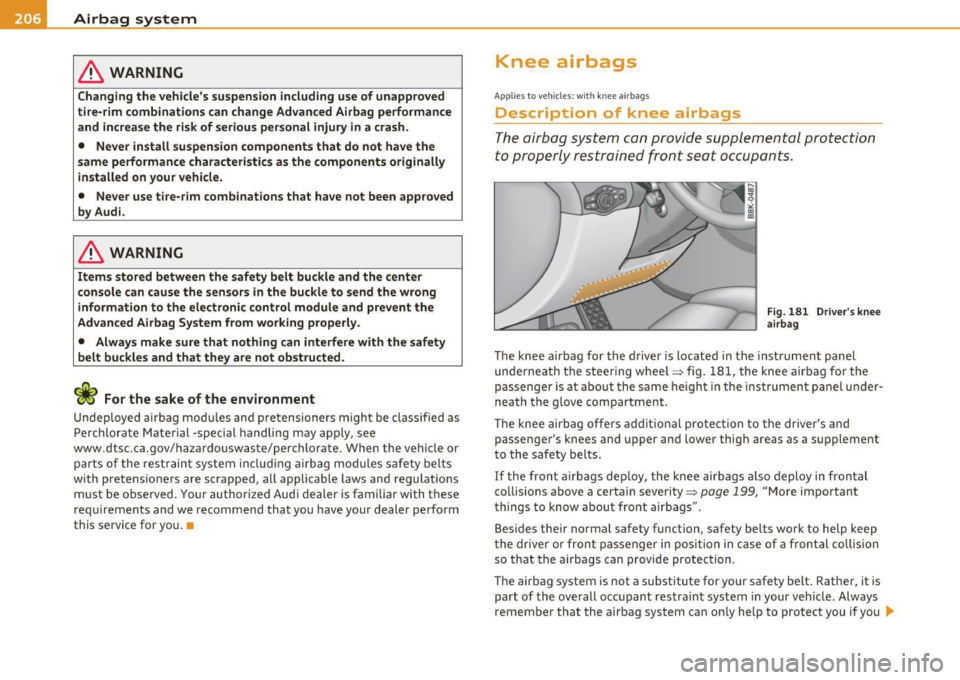
The knee airbag for the driver is located in the instrume nt panel
unde rneath the steering whee l:::> fig. 181, the knee airbag for the
passenge r is at about the same he ight in the instrument panel u nder
neath the g love compartment .
Th e knee airbag offers addit ional protec tion to the dr ive r's and
passenger's knees and upper and lower thigh areas as a supplement
t o the sa fety bel ts.
If the front a irbags dep loy, the knee airbags a lso deploy i n frontal
co llisions above a certain severity=>
page 199, "More importan t
things to know about front airbags" .
Besides the ir normal safety function, safety be lts work to help keep
t he drive r o r front passenger in po sit ion in c ase o f a frontal collision
so that the a irbags can provide protection .
Th e airbag system is not a substitute for your safety belt . Rather, it is
part of the overall occ upant restra int system in your veh icle . Always
remember t hat the airbag system can on ly help to protect you if you
~
Page 210 of 362
........ _A_ ir_ b_ a-=g ,__ s,,.,y _s _t _e_ m _______________________________________________ _
If the front airbags deploy, the knee airbags also deploy in frontal
collisions above a certain severity.
When the system is deployed, the a irbags start to fill with a propel
lant gas, and inflate between the lower part of the instrument panel
and the driver and the lower part of the instrument panel and the
front passenger =>
page 199, fig. 179.
Altho ugh they are not a soft pillow, they can cushion the impact and
in this way they can help to reduce the risk of injury to the lower
extremities.
All this takes place instantaneously, so fast that many people don't
even realize that the airbags have deployed. The airbags also inflate
w ith a great deal of force and it is important fo r occupant safety that
nothing should be in their way when they deploy.
Fully inflated airbags in combination with properly worn safety belts
slow down and limit the occupant's forward movement and help to
red uce the risk.•
Appli es to ve hicl es: w it h kn ee a irbags
Important safety instructions on the knee
airbag system
Airbags are only supplemental restraints. Always wear
safety belts correctly and ride in a proper seating posi
tion.
Th ere is a lot that yo u and your passengers must know and do to help
the safety belts and a irbags to prov ide supp lemental protection.
& WARNING
An inflating knee airbag can cause serious injury. Wearing safety
belts incorrectly and improper seating positions increase the risk
of serious personal injury and death whenever a vehicle is being
used.
& WARNING (continued)
• The airbag system cannot protect you properly if you are seated
too close to any of the airbag locations. When adjusting their seat
positions, it is important that both the driver and the front
passenger keep their upper bodies and knees at the following
minimum safe distances:
- 10 inches (25 cm) between the chest and the steering
wheel/instrument panel.
- 4 inches (10 cm) between the knees and the lower part of
the instrument panel.
• The risk of personal injury increases if you lean forward or to
the side, or if the seat is improperly positioned and you are not
wearing your safety belt. The risk increases even more should the
airbag deploy.
• Always make sure that the knee airbag can inflate without
interference. Objects between yourself and the airbag can increase
the risk of injury in an accident by interfering with the way the
airbag deploys or by being pushed into you as the airbag deploys .
- No persons (children) or animals should ride in the footwell
in front of the passenger seat. If the airbag deploys, this can
result in serious or fatal injuries.
- No objects of any kind should be carried in the footwell area
in front of the driver's or passenger's seat. Bulky objects (shop
ping bags, for example) can hamper or prevent proper deploy
ment of the airbag. Small objects can be thrown through the
vehicle if the airbag deploys and injure you or your passengers.
• Make sure there are no cracks, deep scratches or other damage
in the area of the instrument panel where the knee airbags are
located.
• If children are incorrectly seated, their risk of injury increases
in the case of an accident =>
page 215, "Child Safety". •
Page 239 of 362
Intelligent technology
--------------------------------------------------' "---.L==--
The system operates across the entire speed range in combination
w ith the ABS sys tem. If the A nti-L o ck Brak e System (A BS) mal fun c
tions, the ESP will also shut down.
How the system works
The Anti-Lock Brake System (ABS), Elect ronic D ifferential Lock (EDL)
and the Anti-Slip Regul ation System (AS R) are in teg rated in the e lec
tronic stab ilizat ion program . In addition to the data prov ided by
th ese fun ctions, the ESP control unit re quires addi tional meas ure
ment data provided by hig h pe rformance senso rs . The ro tat ional
speed of the vehicle about its vertical axis, veh icle acceleration in the
fore-and-a ft and lateral d irect ions, the brake pressure , a nd the
steerin g ang le are all measured .
Th e d irec tion in whi ch the driver w ishes to tra ve l is d ete rm ined wi th
the a id of the steering a ngle and ve hicle speed and is con tinually
c omp ared wi th the a ctu al b ehavior o f the ve hicl e. If t he two do no t
match, for example, when the vehicle starts hydroplani ng on a wet
roa d, E SP w ill automatica lly bra ke the approp riate whee l to correct
the problem.
Th e ve hicle is t hen stab ilized by the fo rces acting on the whee l during
bra king .
If the ve hicl e is oversteering (the vehicle tu rns too s harp ly
and the rear whee ls slide toward the outside of a curve), the brakes
a re mainly a pplied on the whee l tha t is o n the o uts ide of t he curve. In
the case of a vehicle that is
understeering (the vehicle does not turn
shar ply enough and push es out o f a curve), the b rakes are ap plied as
needed on the whee l th at is on the inside of the curve or additionally
on the ot her wheels . An acoustic s ignal indicates w hen ESP bra ke
applica tion cuts in=> &.
T he system operates across the entire speed range in combination
w ith the A BS system =>
page 241. If the A nti-Lo ck Br ake Sys tem
(ABS) ma lfunctions, the ESP w ill be o ut of act ion as we ll.
Activating
When you turn on the engine, ESP wi ll automatica lly be activated and
w ill pe rfor m a self- tes t. As soo n as t he tes t is co mplete d, th e sys tem
is in normal operating mo de.
Controls and equip
ment Safety first Vehicle operation
Yo
u can activate a deactivated ESP or deactivated ESP/ ASR if required
b y pressi ng the =>
page 236, fi g. 1 9 8 => page 236, fig . 19 7 bu tton.
Wh en they are activated, the message
Stabilisation program on
appears briefly in t he di sp lay .
Deactivating
The ES P shoul d no rma lly be acti va te d a ll the tim e. I f necess ary, y ou
can deact ivate A nti-Slip Reg ulat io n (ASR) or th e Electro nic Sta biliza
t ion Progr am ( ES P) by p ress ing the button =>
page 23 6, fig. 198.
• Deactivating ASR: Tap th e button . In cer tain exceptional s itua
t ions (e.g. driving with tire chains), the Anti -Slip Reg ulation (ASR) can
be dea ct iva te d =>
page 238. The m ess age ASR off Caution! Limited
driving stability
a pp ears in the d isp lay as well.
• Deactivating ESP/ASR Press the but ton for mor e tha n 3 seconds .
With the ESP/ ASR deactivated, the indicator light comes on, see
=>
p age 15. The m ess age Warning! Restri cted stability ap pears in
the display as we ll.
& WARNING
The Electronic Stabilization Program is nevertheless subje ct to the
laws of physics . It is particularly important to pay attention to
this fact on wet and slippery roads. It is therefore important that
you always adapt your driving to the condition of the road and
traffic conditions . Do not allow the increased safety provided by
the Electronic Stabilization Program system to lull you into accepting additional safety risks .
u
Vehicle care Do-it-yourself service Technical data
Page 244 of 362
Intelligent t echnology L ______________________________________ _
Servotronic® - advanced power
steering system
The power steering systems uses the power of the
running engine to allow precise steering with little effort .
The advanced Servotronic® power steering system senses the road
speed and ele ct ronically adjusts power assistance to provide
comfortable and safe steering response exactly matched to the
veh icle speed .
Power steering will not work if the engine is off . As a resu lt, the
steeri ng wheel will be hard to turn.
T he power steeri ng fluid level is checked du ring the sched uled main
tenance services .
0 Note
If there is an electronic malfunction, servotronic will still function
like a conventional power s teer ing system, provid ing a cons tant
steering support force that is no longer proportionate to the vehicle
speed. This is most noticeable when t urning the s teer ing wheel at low
speeds (for example when park ing) , - more effor t will be required
than us ua l.
• Be aware of the d ifferent than usual steering response and adjust
your stee ring force accord ingly .
• Have the prob lem checked and set r ight by an Audi dealer as soon
as possib le.
[ i ] Tips
• When the e ngine is running, neve r hold the stee ring whee l turned
all the way to the rig ht or to the left for longer than 15 seconds. The
powe r steering pump wi ll overheat the hydra ulic fluid if yo u keep
holding the steering wheel turned all the way . This is likely to damage
t he power s teer ing system . •
If the power steering system s hou ld fa il entirely, or if the engine
is no t ru nning (fo r examp le, while be ing towed), you will st ill be able
to steer the vehicle. However,
considerably more effort will be
req uired to do so .
• If the power steering system should have a leak, or is not func
tioning prope rly, con tact your au thor ized A udi dealer immedia tely.
• The power steer ing system requires a specia lly formulated
hyd raulic fluid. The power steer ing rese rvoir is the one loc ated
farthest to the rear on the left s ide of the eng ine compartme nt
=>
page 2 76 . T he correct fluid leve l in the reservo ir is im port an t fo r
proper functioning of the power steeri ng .•
Dr"ving with your quattro®
With all wheel drive, all four wheels ore driven.
General information
With all wheel d rive, power is d istributed to all four wheels. This
h appens a utomatically depending on your dr iv ing style and t he road
conditions at the time . See also =>
page 238, "Electronic different ial
loc k (ED L)".
T he all whee l dr ive concept is designed for high engine power . Your
veh icle is except ionally powe rf ul and has excellent driving character
istics both under normal driving condit ions and on snow and ice .
Always read an d fo llow safety precautions =>& .
Winter tires
When driving in the winter, your vehicle with a ll whee l drive has an
adva ntage, even w ith regular t ires . In winter road cond it io ns it may
be advisable to mount winte r tires (or all-seaso n tires) for improved
dr iveability a nd b rak ing: t hese tires mus t be mounted on
all four
wheels . See also => page 307, "Winter ti res" .
Tire chains
Where tire chains are mandatory on certa in roa ds, this norma lly a lso
applies to veh icles with a ll w heel drive =>
page 308, "Snow chains" . Iii-
Page 279 of 362
___________________________________________ C_ h_e _c _k_ i_n ~g_ a_n_ d_ f_ i_ll _i_n _g __ ,n
© Windshield/headlight* washer container (W ) . . . . . . . 290
(J) Power steering reservoir . . . . . . . . . . . . . . . . . . . . . . . . . 242
The position of the engine oil filling hole=:> fig. 205 (item@) can
differ depending on the engine design .
& WARNING
Before you check anything in the engine compartment, always
read and heed all WARNINGS=:>
& in "Working in the engine
compartment" on
page 275. •
Engine oil
Engine oil specifications
The engine oil used in your Audi needs the right kind of oil.
The engine in your Audi is a sophisticated power plant that was built
to exacting specifications. This engine needs the right kind of engine
oil that meets specifications regarding quality and viscosity so that it
can run smoothly and reliably. Choosing the right oil and changing oil
within the time and mileage intervals printed in your vehicle's
Warranty
& Maintenance booklet matters a lot more today than it did
years ago. Audi has developed a special quality standard for engine oil
that will help assure that your vehicle's engine will get the lubrication
it needs for proper operation.
Modern engine lubrication has taken a quantum leap in the last few
years. Many synthetic oils available today provide better engine lubri
cation that can outlast traditional petroleum-based oils, making
them a smart choice for use throughout the life of your Audi.
Whether you use synthetic or petroleum-based engine oil, the oil that
you use must conform to Audi's oil quality standard VW 502 00 to help keep your vehicle's engine running smoothly and help prevent
the formation of harmful deposits, sometimes called "sludge", that
over time can lead to expensive repairs.
Safety first
At the time of printing, engine oils available in the U.S. and Canada
that meet the exacting specifications of Audi oil standard VW 502 00
are synthetic engine oils. This does not mean, however, that every
synthetic engine oil will meet Audi oil standard VW 502 00. So always
be sure that you use an approved oil.
To help prevent the formation of harmful deposits use only oil with
the following specifications printed on the oil container:
Audi oil standard VW 502 00
Oil container labels may carry the specification singly or in combina
tion with other designations and oil quality standards.
Viscosity
Engine oils are graded according to their viscosity. The proper
viscosity grade oil for your engine depends on climactic or seasonal conditions where you drive. You can use oil with a viscosity grade of
SAE SW40 across all temperature ranges for normal driving condi
tions.
However, if engine oil viscosity grade SAE SW40 is not available, you
can also use viscosity grade SAE SW-30 or SAE OW-40 as long as it
meets Audi oil quality standard VW 502 00 specifications.
Because engine oil that meets the Audi oil standard may not be avail
able everywhere when you need it, we strongly recommend that you
always carry with you an extra quart (liter) of oil that expressly
conforms to the VW 502 00 specification, in case you have to top off
the oil while on the road.
Only if the level of the oil is at or below the minimum mark - and no
oil that expressly conforms to Audi oil standard VW 502 00 specifica
tions is available -may you top off with a high quality engine oil, pref
erably synthetic-based, that meets ACEA A3, ACEA AS or ACEA BS or
API SL specifications, but even then, only in viscosity grades SAE SW-
40, SAE SW-30, or SAE OW-40. However, during the entire time
between oil change intervals, never top off with more than a total of
0.5 qt/liter engine oil that does not conform to Audi oil specification
vw 502 00. ..
Vehicle care Technical data
Page 294 of 362
-~_T_ ir_e_ s_ a_ n_ d_ w_ h_e_ e_ ls _______________________________________________ _
& WARNING (conti nu ed )
• Tire s age even if they are not being used and can fail suddenly ,
especially at high speeds . Tires that are more than 6 year s old can
only be used in an emergency and then with special care and at low
s peed .
Glossary of tire and loading terminology
Accessory weight
means the combined we ight (in excess of those sta nda rd items which
may be rep lace d) of automatic transmission, power steering, power
bra kes, powe r w indows , power seats, radio, and heater, to the extent
that these items are avai lab le as factory- installed equipment
(w het he r i nsta lled or no t).
Aspect ratio
me ans the ratio of t he he ight to t he w id th of the tir e in percent .
Numbe rs of 55 o r lower indicate a low sidewa ll for improved steer ing
respo nse an d be tter overa ll handling on dry p avemen t.
Bead
means the part o f the tire that is made of stee l w ires , wrap ped o r
re in forced by ply cords and that is shaped to fit the rim.
Bead separation
means a brea kdown of the bon d between components in the bead .
Cord
means the st rands forming the plies in the tire.
& W ARNING (continued )
• Never mount used tire s on your vehicle if you are not sure of
their "previous hi story ." Old used tires may have been damaged
eventhoughthedamagecannotbeseenthatcanleadtosudden
tire failure and lo ss of vehicle control.
• If you notice unu sual vibration or if the vehicle pull s to one side
when driving, alway s stop as soon as it is safe to do so and check
the wheels and tires for damage. •
Cold tire inflation pressure
means the tire pressure recommended by the vehicle ma nufa cturer
for a tire of a des ignated size t hat has not been driven for more than
a couple of m iles ( kilomete rs) a t low speeds in the t hree ho ur period
before the tire pressure is measured or ad justed.
Curb weight
mea ns the weig ht of a motor vehicle wit h standard equ ipment
including the max imum cap aci ty of f ue l, oil, and coo lan t, air condi
tioning and additiona l weight of optional equipment.
Extra load tire
means a tire design to operate at higher loa ds and at higher inflation
pressures than the co rrespo nd ing standard tire. Extra load tires may
be identified as "XL", "xl", "EXTRA LOAD", or "RF" on the sidewal l.
Gross Axle Weight Rating ( "GAWR ")
means the load -ca rry ing capacity of a s ingle ax le system, measured at
t he t ire-grou nd inte rfaces .
Gross Vehicle Weight Rating ("GVWR")
means the max imum total loaded we ight of the vehicle .
Page 304 of 362

-~_T_ i_ re _ s_ a_n _ d_ w_ h _e_ e_ ls _________________________________________________ _
Tire pressure
Incorrect tire pressure causes premature wea r a nd can cause sudden
t ire blow-out. For this reason, ti re p ressure must be checked at least
once a month ~
page 297.
Driving style
Driving fast around curves, heavy acce le ra tion and hard brak ing
increase tire wear .
Rotating tires for more even wear
For all four tires on your veh icle to have the same service life, we
re commend that the fron t and re a r tires are rotate d according to the
tire manufact urer's suggested tire rotation interva ls . Please
remember the fo llow ing:
• Tir e rotat ion inte rvals may differ from t he ve hicl e service intervals
outlined in your Maintenance and War ranty Booklet .
• T he longer one tire is used in one location on the veh icle, the more
it wears at certa in points; therefore, we recommend that you follow
t he t ire m anufac ture r's suggested tire rotation in terva ls.
• V ehicles with front-whee l drive expe rience mo re tread wea r on t he
fron t wheels compa red to all-whee l drive (quattro
® ).
• Please rotate tires as s hown ~fig. 215.
• Extra care must be taken when rotating d irection-specific tires
~ page 321.
Wheel balancing
The w heels on new vehicles are balanced. Howeve r, va rious sit uat io ns
dur ing eve ryday dr iv ing can cause them to become unbalanced,
re su lt ing in v ibr ations yo u can usually fee l throug h the steering
wheel.
Unbalanced wheels must be rebalanced to avoid excessive wea r on
steeri ng, suspension and t ires . A wheel must also be rebalanced
w hen a new tire is installed.
Incorrect wheel alignment
Incorrec t whee l alignment can ca use excessive tire wear, impai ring
t he sa fety of the veh icle . If tires show excess ive wear, have the wheel
alignment checked by an authorized A udi dealer or qualified wo rk
shop .
All wheel drive
Vehicles w ith q uattro ® must always have ti res of the same size,
const ructio n and trea d type. For details see~
page 242 .
& WARNING
Sudden tire failure can lead to loss of control , a crash and serious
personal injury!
• Never drive a vehicle when the tread on any tire is worn down
to the wea r ind icato rs.
• Worn tire s are a safety hazard, they do not grip well on wet
roads and in crease your risk of "hydroplaning" and lo ss of control.
• Always keep chemicals that can cause tire damage, such as
grease , oil , gasoline and brake fluid away from tires.
• Tires age even if they are not being used and can fail suddenly,
especially at high speeds . Tires that are more than 6 years old can
only be used in an emergency and then with special care and at
lower speeds.
• Never mount used tire s on your vehicle if you are not sure of
their "previous history ." Old used tires may have been damaged
even though the damage cannot be seen that can lead to sudden
tire failure and loss of vehicle control. •
Page 313 of 362
Tires and wheels -_____________________ ,,...
Applie s to vehicl es: wi th t ir e pr essure mon itor ing syste m
Tire pressure indicator appears
The tire pressure indicator in the instrument cluster
informs you if the tire pressure is too low or if there is a
system malfunction.
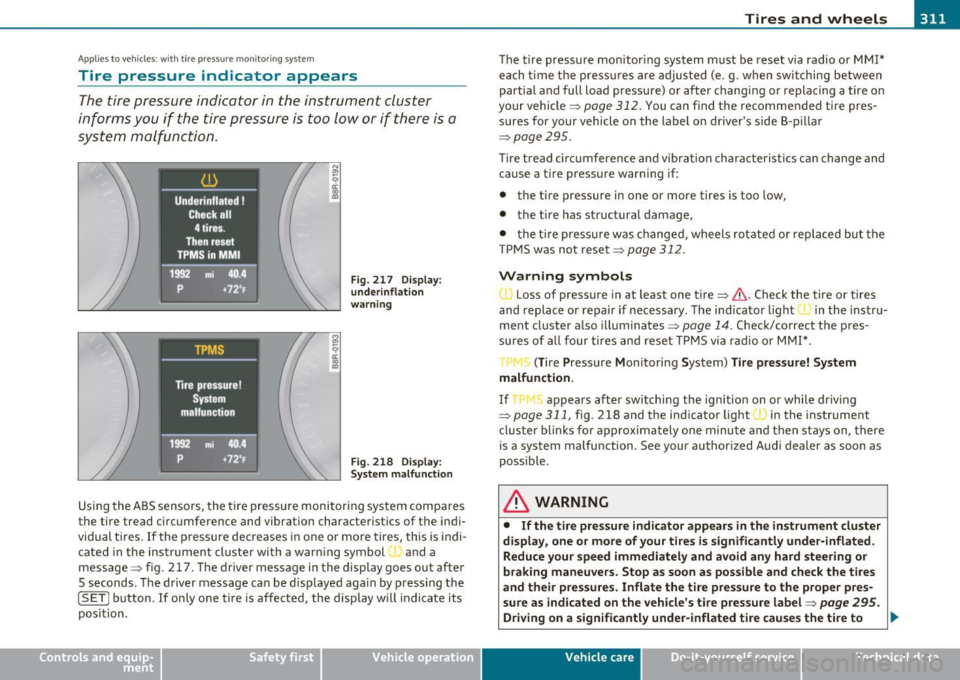
F ig . 217 Displ ay:
un derinfl ation
wa rn ing
Fi g. 218 Disp la y:
S yst em m alf unction
Us ing the A BS sensors, the tire pressure monitor ing system com pa res
the tire tread circumference and vibrat ion characterist ics of the ind i
vidual tires .
If the pressure decreases in one or more tires, this is indi-
cated in the instrument cluster with a warn ing symbol and a
message => fig . 217 . T he driver message in the display goes out after
5 seconds. T he driver message can be d isp layed again by p ressing the
[SETj button. If on ly one tire is affected, the display will indicate its
posi tion.
Vehicle OP-eration T
he tire pressure mon itor ing system must be reset via radio or MMI*
e ach t ime the press ures a re adjus ted (e.g . when switching between
partia l a nd full load pressure) or after chang ing or replacing a tire on
your vehicle =>
page 312. You ca n find the recommended tire pres
sures for your vehicle on the label on dr iver's side B-p illar
=> page 295.
Tir e tread ci rcumference and vibrat ion ch aracterist ics ca n change and
cause a tire pressure warn ing if:
• the tire pressure in one o r more tires is too low,
• the t ire has structura l damage,
• t he ti re pressure w as changed, wheels rotated or replaced bu t the
TP MS was not reset=>
page 312.
Warning symbols
• Loss of pressure in at least one tire => & . Check the tire or tires
and replace or repa ir if necessary . The ind icator light
I in the instru
ment cl uster a lso illuminates =>
page 14. Check/correct the pres
s u res of a ll four tires and reset TPMS via r adio or MM I*.
il (T ire Pressure Monitoring System) Tire pressure! System
malfunction.
If appears after sw itching the ignition on o r while dr iv ing
=> page 311 , fig. 218 and the ind icator light (1 in the instrument
cl uster blinks for a pprox imately one minu te and then s tays on, there
is a system malfunction. See your author ized Audi dealer as soon as
poss ible.
& WARNING
• If the tire pressure indi cator appears in the instrument cluster
display, one or more of your tires is significantly under -inflated.
Reduce your speed immediately and avoid any hard steering or
braking maneuvers . Stop as soon as possible and check the tires
and their pre ssure s. Inflate the tire pre ssure to the proper pre s
sur e as ind icated on the vehicle's tire pres sure label =>
page 295.
Driving on a significantly under-inflated tire causes the tire to _,,.
Vehicle care Do-it-yourselt service iTechnical data
Page 326 of 362
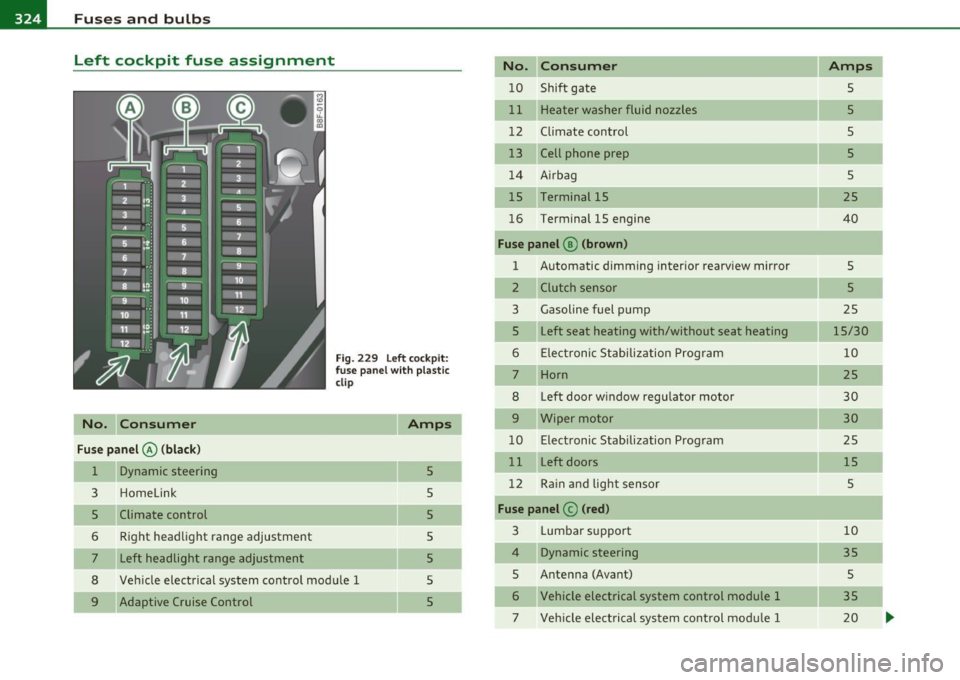
-Fuses and bulbs
~-;,_;__:_:_;..:..:.:....::~=---------------------------
Left cockpit fuse assignment
No. C onsumer
Fu se p anel@ (bla ck )
1 Dynamic steering
3 Homelink
5 Climate control
6 Right headlight range adjustment
7 Left headlight range adjustment
F ig. 229 Left cockpit:
f use panel w ith p lastic
clip
Amps
5
5
5
8 Vehicle electrical system control module 1
5
5
5
5 9 Adaptive Cruise Control No. Con
sumer Amps
10 Shift gate 5
11 Heater washer fluid nozzles 5
12 Climate control 5
13 Cell phone prep 5
14 A irbag 5
15 Terminal 15 25
16 Terminal 15 engine
40
Fuse panel ® (brow n)
1 Automatic dimming interior rearv
iew mirror
5
2 Clutch sensor 5
3 Gasoline fuel pump
25
5 Left
seat heating with/without seat heating
15/30
6 Elect ronic Stabilization Program 10
7 Horn
25
8 Left door w
indow regulator motor
30
9 Wiper motor 30
10 Electronic Stabilization Program 25
11 Left doors 15
12 Ra in and light sensor 5
Fuse p an el © (red )
3 Lumbar support 10
4 Dynamic steering 35
5 Antenna (Avant)
5
6 Vehicle electrical system control module 1 35
7 Vehicle electrical system control modu le 1 20