tires AUDI A5 COUPE 2011 Owner's Guide
[x] Cancel search | Manufacturer: AUDI, Model Year: 2011, Model line: A5 COUPE, Model: AUDI A5 COUPE 2011Pages: 362, PDF Size: 84.88 MB
Page 311 of 362
________________________________________________ T_i_re _ s_ a _ n_d_ w_ h_ e_ e_l_s __ _
wheels are fitted secure ly and that the brake system func tions
cor rectly.
I n certa in circumsta nces, yo u may not use wheel bo lts from a
different vehicle -even if it is the same model =>
page 342 .
& WARNING
Improperly tightened or maintained wheel bolts can become
loose causing loss of control, a collision and serious personal
injury .
• Always keep the wheel bolts and the threads in the wheel hubs
clean so the wheel bolts can turn easily and be properly tightened.
• Never grease or oil the wheel bolts and the threads in the wheel
hubs. They can become loose while driving if greased or oiled, even
if tightened to the specified torque.
• Only use wheel bolts that belong to the rim being installed .
• Never use different wheels bolts on your vehicle.
• Always maintain the correct tightening torque for the wheel
bolts to reduce the risk of a wheel loss. If the tightening torque of
the wheel bolts is too low, they can loosen and come out when the
vehicle is moving. If the tightening torque is too high, the wheel
bolts and threads can be damaged and the wheel can become
loose.
0 Note
The specified torque for the wheel bolts is 90 ft lbs. (120 Nm) wit h a
tol eran ce o f± 7,4 ft lbs.( ± 10 Nm ). Tor qu e wheel bolts di ag on ally.
After chang ing a wheel, the to rque must be checked as soon as
p ossib le wi th a tor qu e wrench - prefer ably by an authorized Audi
dealer or qualified wo rkshop .•
Safety first
Low aspect ratio tires
Your Audi is factory-equipped with low aspect rat io tires. These tires
h ave bee n t horo ugh ly te st ed a nd bee n sele cted spe cifica lly for your
mode l for their supe rb performance, road fee l and hand ling u nder a
v ariety o f dr iv ing co ndi tio ns . Ask your author ized A udi d ealer for
more deta ils.
Th e low as pect rat io of these tires is indicated by a numera l o f
55 or
less
in t he ti re 's s ize des ig nation. The nu meral represen ts the ratio o f
the t ire's si dewall height in relat io n to its tread wi dth expressed in
per ce nta ge. Conve ntiona l t ires h ave a heigh t/w idt h rat io of 60 or
more.
The performance of low-aspect-ratio tires is particularly sensitive to
improper inflation pressure . It is therefore important that low
aspect ratio tires are inflated to the specified pressure and that the
inflation pressure is regularly checked and maintained. Tire pre s
sures should be checked at least once a month and always before a
long trip~ pag e 297, "Ch ecking tire pre ss ur e".
What you can do to avoid tire and rim damage
Low as pect ratio t ires ca n be damaged more easi ly by impact w ith
potholes, curbs, gullies or ridges on the road, pa rtic ularly if t he tire is
unde rinflated.
I n order to minim ize the occurrence of impact damage to the t ires of
your vehicle, we re co mmend that y ou o bserve the f ollowin g pre ca u
tions :
• Always maintai n recommen ded in flation p ressures. Chec k your
tire pressu re e very 2,0 00 m ile s (3,0 00 km) an d add air if n ecess ary .
• D rive ca refu lly on roads with potholes, deep gulli es o r ridges. The
impact from d riving thro ugh or over such obs tacles can damage your
tires. Im pact w it h a cu rb may also cause damage to your tires .
• After a ny impact , immediately inspect you r tir es o r have t hem
inspected by the nea rest author ized Aud i dealer . Replace a damage d
t ire as soon as possib le. _.,
Vehicle care Technical data
Page 312 of 362
-~_T_ i_ re _ s_ a_n _ d_ w_ h _e_ e_ ls _________________________________________________ _
• Inspect your tires every 2,000 miles (3,000 km) for damage and
wear . Damage is not always easy to see. Damage can lead to loss of
air and underinflat ion, which could eventually cause tire failure. If
you believe that a tire may have been damaged, replace the tire as
soon as poss ible .
• Th ese tires may wear more quickly than others.
• Please also remember that, whi le these tires deliver responsive
hand ling, they may ride less comfortably and make more noise than
other choices.
Reduced performance in winter/cold season
conditions
All tires are designed for certain purposes. The low aspect rat io, ultra
high performance tires originally installed on your vehicle are
intended for maxim um dry and wet road performance and handling.
They are not suitable for cold, snowy or icy weather conditions . If you
drive under those circumstances, you should equip your vehicle with
all-season or winter tires, which offer better traction under those
conditions. We suggest you use the recommended snow or all-season
tires specified for your vehicle, or their equivalent.
Refer to=:,
page 307for more detailed information regarding winter
tires .•
Tire pressure monitoring system
Ap plies to ve hicl es : w it h t ire pressur e m onito rin g syst em
General notes
Each tire , including the spare (if provided), shou ld be checked
month ly when cold and inflated to the inflation pressure recom
mended by the veh icle manufacturer on the vehicle placard or t ire
inf lation pressure label. (If your vehicle has t ires of a diffe rent size
than the siz e indicated on the vehicle placard or tire inflation pressure
label, you should determine the proper tire inflation pressure for
those tires). As
an added safety feature, your vehicle has been equipped with a tire
pressure monitoring system (TPMS) that illumi nates a lo w tire pres
sure telltale when one or more of your tires is significantly under
inflated. Accordingly, when the low tire pressure telltale illuminates,
you should stop and check your tires as soon as possible, and inflate
them to the proper pressure. Driving on a significantly under-inflated
tire causes the tire to overheat and can lead to tire failure . Under
inf lation also reduces fuel efficiency and tire tread life, and may
affect the vehicle's handling and stopping ability.
Please note tha t the TPMS is not a substitute for proper tire mainte
nance, and it is the driver's responsibility to maintain correct tire
pressure, even if under-inflation has not reached the level to trigger
illumination of the TPMS low tire pressure telltale.
Your vehicle has also been equipped with a TPMS malfunction indi
cator to indicate when the system is not operating properly. The
TPMS malfunction indicator is comb ined with the low tire pressure
telltale. When the system detects a malfunction, the telltale will
flash for approximately one minute and then remain continuously
illuminated. This sequence will continue upon subsequent vehicle
start-ups as long as the malfunction exists.
When the ma lfunction ind icator is illuminated, the system may not
be able to detect or signal low tire pressure as intended. TPMS
malfunctions may occur for a variety of reasons, including the insta l
lation of replacement or alternate tires or wheels on the veh icle that
prevent the TPMS from functioning properly. Always check the TPMS
malfunction telltale after replacing one or more tires or wheels on
your vehicle to ensure that the replacement or alternate tires and
wheels allow the TPMS to cont inue to function properly. •
Page 313 of 362
Tires and wheels -_____________________ ,,...
Applie s to vehicl es: wi th t ir e pr essure mon itor ing syste m
Tire pressure indicator appears
The tire pressure indicator in the instrument cluster
informs you if the tire pressure is too low or if there is a
system malfunction.
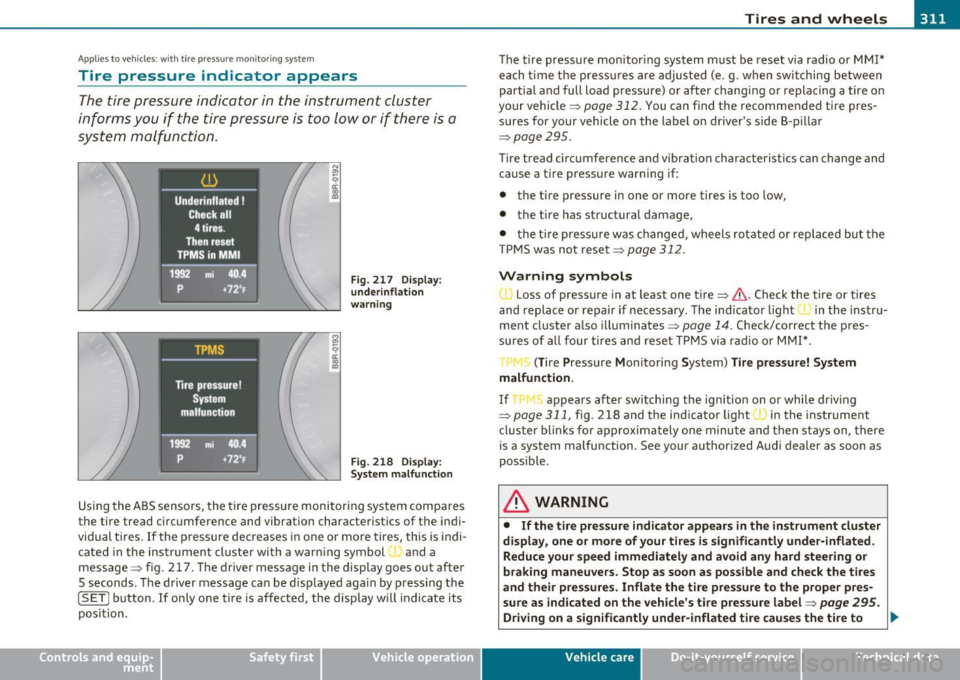
F ig . 217 Displ ay:
un derinfl ation
wa rn ing
Fi g. 218 Disp la y:
S yst em m alf unction
Us ing the A BS sensors, the tire pressure monitor ing system com pa res
the tire tread circumference and vibrat ion characterist ics of the ind i
vidual tires .
If the pressure decreases in one or more tires, this is indi-
cated in the instrument cluster with a warn ing symbol and a
message => fig . 217 . T he driver message in the display goes out after
5 seconds. T he driver message can be d isp layed again by p ressing the
[SETj button. If on ly one tire is affected, the display will indicate its
posi tion.
Vehicle OP-eration T
he tire pressure mon itor ing system must be reset via radio or MMI*
e ach t ime the press ures a re adjus ted (e.g . when switching between
partia l a nd full load pressure) or after chang ing or replacing a tire on
your vehicle =>
page 312. You ca n find the recommended tire pres
sures for your vehicle on the label on dr iver's side B-p illar
=> page 295.
Tir e tread ci rcumference and vibrat ion ch aracterist ics ca n change and
cause a tire pressure warn ing if:
• the tire pressure in one o r more tires is too low,
• the t ire has structura l damage,
• t he ti re pressure w as changed, wheels rotated or replaced bu t the
TP MS was not reset=>
page 312.
Warning symbols
• Loss of pressure in at least one tire => & . Check the tire or tires
and replace or repa ir if necessary . The ind icator light
I in the instru
ment cl uster a lso illuminates =>
page 14. Check/correct the pres
s u res of a ll four tires and reset TPMS via r adio or MM I*.
il (T ire Pressure Monitoring System) Tire pressure! System
malfunction.
If appears after sw itching the ignition on o r while dr iv ing
=> page 311 , fig. 218 and the ind icator light (1 in the instrument
cl uster blinks for a pprox imately one minu te and then s tays on, there
is a system malfunction. See your author ized Audi dealer as soon as
poss ible.
& WARNING
• If the tire pressure indi cator appears in the instrument cluster
display, one or more of your tires is significantly under -inflated.
Reduce your speed immediately and avoid any hard steering or
braking maneuvers . Stop as soon as possible and check the tires
and their pre ssure s. Inflate the tire pre ssure to the proper pre s
sur e as ind icated on the vehicle's tire pres sure label =>
page 295.
Driving on a significantly under-inflated tire causes the tire to _,,.
Vehicle care Do-it-yourselt service iTechnical data
Page 314 of 362
Ill Tires and wheels
-------------------
& WARNING (continued)
overheat and can lead to tire failure . Under-inflation also is likely
to impair the vehicle's handling and stopping ability.
• The driver is responsible for maintaining the correct tire pres·
sures. You must check the tire pressures regularly.
• Under certain conditions (such as a sporty driving style, winter
conditions or unpaved roads), the pressure monitor indicator may
be delayed.
• Ask your authorized Audi dealer if run-flat tires may be used on
your vehicle. Your vehicle registration becomes invalid if you use
these tires when not permitted. Damage to your vehicle or acci
dents could also result.
[ i J Tips
• The tire pressure monitoring system stops working when there is
an ESP/ABS malfunction.
• Using snow chains may resu lt in a system ma lfunction .
• To ensure a proper TPMS function use AUDI Original Tires which
are marked with "AO" or "RO" on the tire sidewall. =>
page 303.
• The tire pressure monitor ing system on your Audi was calibrated
using tires with the "AO" or "RO" identification. We recommend
using these tires.•
Applies to vehicles: with tir e pressure monitoring system
Reset tire pressure monitoring system
If the tire pressure is adjusted, wheels are rotated or
changed, the TPMS must be reset via radio or MMI*.
-Turn on the ignition.
- Select: the [ CAR] function button
> Tire pressure
monitoring
> Store now.
W Tips
Before resetting the TPMS, the current pressures of all four t ires
must correspond to the specified values . Adjust the tire pressure and
reset the pressure in the tire pressure monitoring system according
to the load you are carrying=>
page 295. •
Page 315 of 362
Tires and wheels -________________ Effll
Safety first Vehicle care Technical data
Page 317 of 362
What do I do now? -________________ PfWII
Removing the spare tire
- Lift th e carg o floo r by the plas tic h andle ~ page 314,
fig . 2 20.
- H ook the hand le into t he luggage compa rtment weathe r
stri p.
- Tur n th e la rge screw~
page 314 , fig . 220 cou nter -clock-
w ise .
- Ta ke out the sp are t ire.
- U nho ok the c arg o flo or b efo re clos ing th e rear lid .
Securing the replaced tire
- Pla ce the w heel w it h t ire in t he spa re wheel we ll and
secu re t he wheel wit h the large sc rew.
- Unhook the c arg o floor before closing the re ar lid.
Using the spare tire (compact spare tire)
T he compact s pare tire is only inte nded for em er gen cie s until you can
reac h a repa ir sh op. R epl ace it as quickly as poss ible wit h a standar d
w he el a nd t ire.
Th ere are some rest rict io ns o n th e use of the compact s pare tire . The
compa ct spar e tir e has b een d esign ed spe cific ally f or your t ype of
vehicle. It must n ot be swa pped with a compact spare tire from
an other ty p e of vehi cle.
Snow chains
Fo r te chni cal re ason s, the use of snow ch ain s on th e compact s par e
t ire is not permitted .
I f y ou do h ave to dr ive wi th sno w chains an d a
front t ire fails, mount
t he spare wh eel w it h t ire instead of a rear tire. Ins tall the s now chai ns
on t he rear tire and use it to repla ce the defective fro nt tire .
Safety first
& WARNING
• Never use the spare tire if it is damaged or if it is worn down to
the tread wear indicators.
• If the spare tire is more than 6 years old, use it only in an emer
gency and with extreme caution and careful driving.
• The spare tire is intended only for temporary and short-term
use. It should be replaced as soon as possible with the normal
wheel and tire .
• After mounting the compact spare tire, the tire pressure must
be checked as soon as possible. The tire pressure of the compact
spare tire must be 4.2 bar; otherwise, you risk having an accident.
• Do not drive faster than 50 mph (80 km/h) . You risk having an
accident.
• Avoid full-throttle acceleration, heavy braking, and fast
cornering. You risk having an accident.
• Never drive using more than one spare wheel and tire. You risk
having an accident.
• Normal summer or winter tires must not be mounted on the
compact spare wheel rim.
• For technical reasons, the use of tire chains on the spare tire is
not permitted. If it is necessary to drive with tire chains, the spare
wheel must be mounted on the front axle in the event of a flat in
a rear tire. The newly available front wheel must then be installed
in place of the rear wheel with the flat tire . Installing the tire
chain before mounting the wheel and tire is recommended.
• Loose items in the passenger compartment can cause serious
personal injury during hard braking or in an accident.
- Never store the inflatable spare tire or jack and tool s in the
passenger compartment.
- Always store all jacking equipment, tools, and the inflatable spare tire in the luggage compartment.
- Tighten the knurled retaining screw for the inflatable spare
tire securely. •
Vehicle care Do-it-yourself service Technical data
Page 323 of 362
What do I do now? Ill
----------------
- Screw the threaded end of the alignment pin from the
tool kit hand-tight into the empty bo lt hole~
page 320 ,
fig. 227.
- Then re m ove the o ther wheel bolts as described above.
- Take off t he w heel leaving the alignment pin i n the bolt
hole~ 0-
Putting on the inflatable spare tire
- Push t he spare tire over the a lignmen t pin.
- Screw on th e whe el bo lts and t ight en them
slightly using
the hexagonal soc ket .
- Remove the alignment pin and insert and tighten the
remaini ng whee l bol t slig htly like the rest .
- Turn the jack handle counter-clockwise to lower t he
vehicle unt il the jack is fully released.
- Use the wheel bolt wrench to t ighten a ll whee l bolts firmly
~ page 318 . Tighte n th em in a crisscross pattern, from
one bolt to the (approx imately) opposite one , to keep the
wheel centered.
- Perform the steps required after changing the wheel
~ page 317, "After c hanging a wheel".
T he hexagona l socket makes it easier to remove the whee l bolts from
the rim. Care should be take n when remov ing the reve rsib le blade .
0 Note
When removing or installing the wheel, the r im could hit the brake
rotor and damage the rotor . Work caref ully and have a second person
to he lp you.
Safety first
(I] Tips
• Whe n mounting tires with unidirection al tread de sign make sure
the tread pattern is pointed the rig ht way~
page 321.
• T he wheel bolts should be clea n and easy to turn. Check for dirt
and corrosion on the mating surfaces of both the whee l and the hub .
Remove all d irt from these surfaces before remounting the whee l.
• Do not use the hexagonal socket in the screwdriver hand le to
loose n or tig hten the wheel bolts .•
Tires with unidirectional tread design
Tires with unidirectional tread design mus t be mounte d
with their tread pattern pointed in the right direc tio n .
Using a spare tire with a tread pattern intended for
use in a specific direction
Whe n using a spare tire with a tread patte rn intended fo r use in a
specific direction, p lease note the fo llow ing:
• T he direction of ro ta t ion is ma rked by an
arrow on th e side of the
t ir e.
• If the spare tire has to be installed in the incorrect d irect ion, use
the spare t ire only temporar ily since the tire w ill not be ab le to
achieve its optimum pe rformance characterist ics with rega rd to
aquaplaning, noise and wear.
• We recommend tha t you pay particular attent ion to th is fact
dur ing wet weather and that you adjust your speed to match road
condi tions.
• Replace the flat ti re with a new one and have it installed on your
veh icle as soon as possible to restore the handling adva ntages of a
unidirect ional tire. •
Vehicle care Do-it-yourself service Technical data
Page 324 of 362
-What do I do now? Pffl...__ ______________ _
Notes on wheel changing
Please read the in formation => page 303, "New t ires and replacing
t ires and wheel s" i f yo u ar e going t o use a sp are tir e w hich is differe nt
from t he tires on yo ur vehicle.
After you c hange a ti re:
• Check the tire pressure on the spare immediately after installa·
tion.
• Have the wheel bolt tightening torque checked with a torque
wrench as soon as possible by your authorized Audi dealer or a qual· ified workshop.
• With steel and alloy wheel rims , the wheel bolts are correctly
tightened at a torque of 90 ft lbs. (120 Nm).
• If you notice that the wheel bolts are corroded and difficult to
turn while changing a tire, they should be replaced before you check
the tightening torque .
• Replace the flat tire with a new one and have it installed on your
vehicle as soon as possible. Remount the wheel cover.
Until then, drive with extra care and at reduced speeds.
& WARNING
• If you are going to equip your vehicle with tire s or rims which
differ from those which were factory in stalled, then be sure to
read the information =>
page 303, "New tires and replacing tires
and wheels".
• Always make sure the damaged wheel or even a flat tire and
the jack and tool kit are properly secured in the luggage compart
ment and are not loose in the passenger compartment .
• In an accident or sudden maneuver they could fly forward,
injuring anyone in the vehicle .
• Always store damaged wheel , ja ck and tools securely in the
luggage compartment. Otherwise, in an accident or sudden
& WARNING (c on tinued )
maneuver they could fly forward , causing injury to passengers in
the vehicle.
0 Note
Do not use commerci ally ava ilable tire se alants . O th erwi se, the ele c
trical components of the t ire pressure monitoring system* w ill no
longer wor k properly and the se nsor for the tire pressure moni to ring
system* wi ll have to be rep laced by a q ua lified wor kshop .•
Page 355 of 362
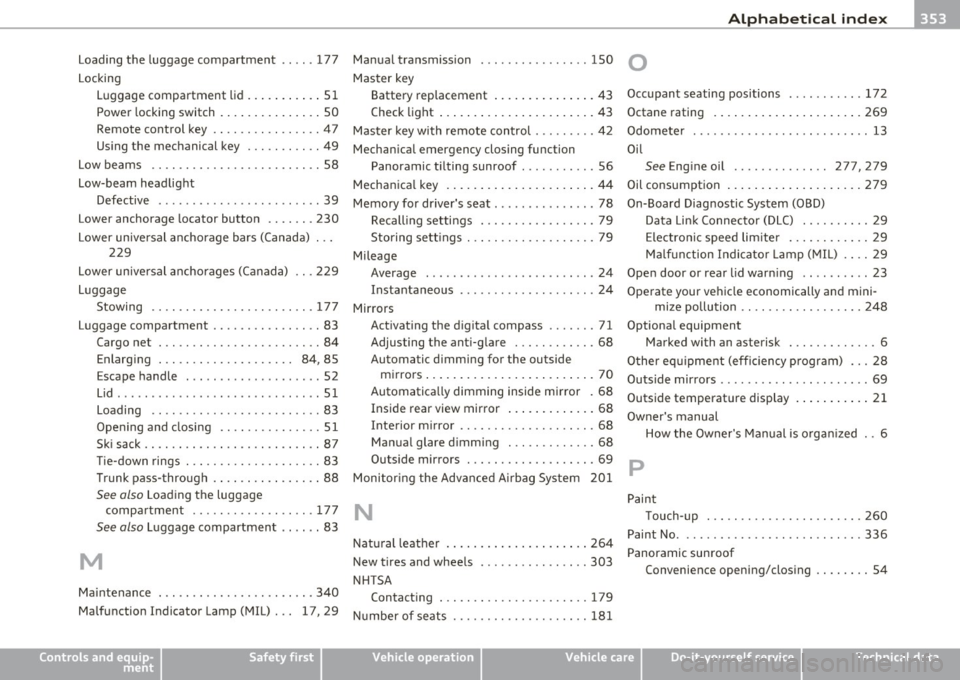
Alphabetical index -________________ fWI
Loading the luggage compartment .. .. . 177
Locking Luggage compartment lid ...... ... .. 51
Power locking switch ............... SO
Remote control key ................ 47
Using the mechanical key ........... 49
Low beams .. .. ................. .. .. 58
Low-beam headlight Defective .......... ... ... ... . .. .. 3 9
Lower anchorage locator button ....... 230
Lower universal anchorage bars (Canada) ... 229
Lower unive rsal anchorages (Canada) .. . 229
Luggage Stowing .. ............. .. .... ... 177
L uggage compartment ...... .. .... .. .. 83
Cargo net . .. .. ............... ... . 84
Enlarging . . . . . . . . . . . . . . . . . . . . 84, 85
Escape handle ..... ............... 52
Lid ........ ............. .... .... . 51
Loading .. .. .. ... .... ... .. .. ..... 83
Opening and closing .. .. .. .. ....... 51
Sk i sack .......................... 87
T ie-down rings ... .. .. .. ........... 83
Tru nk pass-through .. .. .. .. .. ..... . 88
See also Loading the luggage
compartment .............. .... 177
See also Luggage compartment .... .. 83
M
Maintenance ..... .... ...... .... ... . 340
Malfunction Indicator Lamp (MIL) ... 17, 29
Controls and equip
ment Safety first
Manual transmission
... .......... ... 150 0
Mast er key
Battery rep lac eme nt ............ .. . 43 Occupant seating positions
........... 172
Check light ... .. .................. 43 Octane rating .................... .. 269
Master key with remote control . .. ...... 42 Odometer .................. .. .. .. .. 13
Mechanical emergency closing function
Oil
Panoramic tilting sunroof ........... 56 See Engine oil ........... ... 277,279
Mechanica l key .. ................ .... 44 Oil consumption ............. ....... 279
Memory for driver's seat ............... 78 On-Board Diagnostic System (OBD)
Recalling settings ................ . 79 Data Link Connector (DLC) .......... 29
Storing sett ings ... .. .. .. ... ....... 79 Electronic speed limiter .......... .. 29
Mileage Ma
lfunction Indicator Lamp (MIL) .... 29
Average ............. ........ .... 24 Open door or rear lid warning ......... . 23
Instantaneous ............ .... ... . 24
Operate your vehicle economically and mini-
Mirrors mize pollution
.................. 248
Activating the digita l compass ....... 71 Optional equipment
Adjusting the anti-glare ..... .. .. .. . 68 Marked with an asterisk ............. 6
Automatic dimming for the outside
Other equipment (effic iency program) ... 28
mirrors ................ .. ... .... 70
Outside mirrors ....... ........ ....... 69
Automatically dimming inside mirror . 68
Ins ide rear view mirror ... .......... 68
Inte rior mirror .... ....... ...... .. . 68
Manual glare dimming . .. .. ........ 68 Outside
temperat ure display ........ ... 21
Owner's manual How the Owner's Manual is organized . . 6
Outside mirrors ... ............. ... 69
Monitor ing the Advanced A irbag System 201
p
N
Paint
Touch-up . .. .. .. .. ..... ........ . 260
Natural leather .................. ... 264
New tires and wheels .... ...... .. .. .. 303
NHTSA Paint No .
............ ........ ... ... 336
Panoramic sunroof Convenience opening/closing ........ 54
Contacting . .. .. ........ ......... 1 79
Number of seats .............. .... .. 181
Vehicle operation Vehicle care Do-it-yourself service Technical data
Page 357 of 362
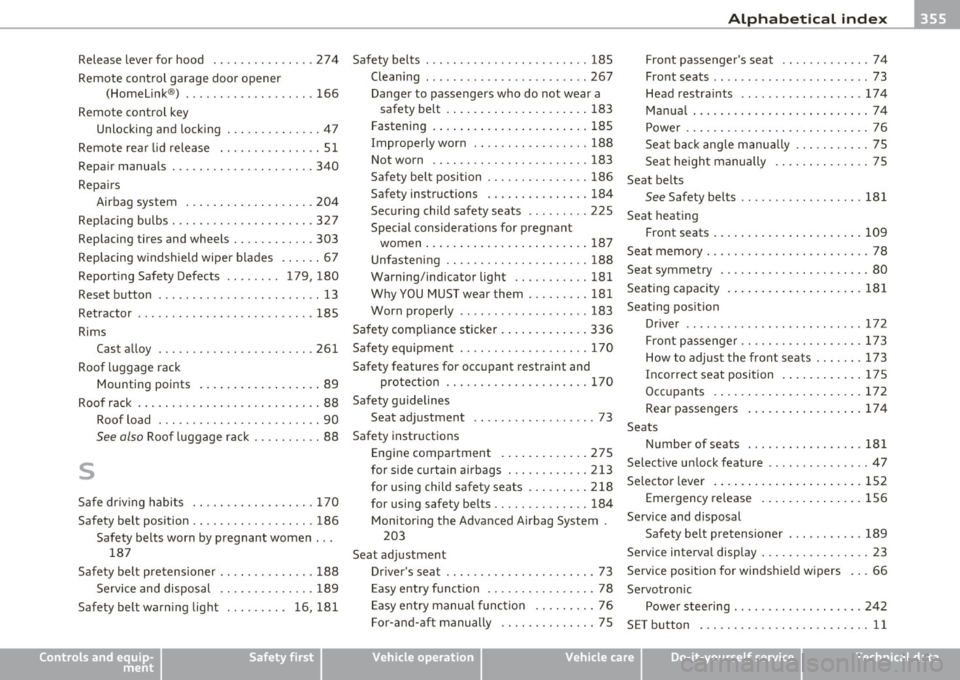
Alphabetical index -________________ fNi'II
Release lever for hood ...... .. .. .. .. . 274 Safety belts .... ..... ... ......... ... 185
Remote control garage door opener Cleaning ... ................ ..... 267
(Homel ink ®) ........... .... ... . 166 Danger to passengers who do not wear a
Remote control key safety belt ..................... 183
Unlocking and locking ... .. .. ....... 47 Fastening .... .. .... .. ........... 185
Remote rear lid release ........... .. .. 51 Improperly worn · · · · . · · · · · · · · .... 188
Repair manuals ................ ..... 340 Not worn · · · · · · · · · · · · · · · · · · · · · · · 183
Safety belt position ............. .. 186
Repairs
Airbag system .................. . 204
Rep lacing bulbs ........ .... .. .. .. .. . 327
Replacing tires and wheels ......... .. . 303
Replacing windshield wiper blades ...... 67
Reporting Safety Defects ........ 179, 180
Reset button .......... ...... .. .. .. .. 13
Retractor ....... .. .... .. ... ... ..... 185
Rims Cast alloy .............. .. .... .. . 261
Roof luggage rack Mounting points .................. 89
Roof rack ............. ...... ... . .. .. 88
Roof load . ............. ...... .. .. 90
See also Roof luggage rack .......... 88
s
Safe dr iving habits ............... ... 170
Safety belt position .. .. .. ........ .... 186
Safety belts worn by pregnant women . ..
187
Safety belt pretensioner .. .. ... .... ... 188
Service and disposal ............. . 189
Safety belt warning light . . . . . . . . . 16, 181 Safety instructions
.. .. .. ...... .. . 184
Securing child safety seats . ........ 225
Special considerat ions for pregnant
women ........................ 187
Unfastening .. ................... 188
Warning/indicator light .. ....... .. 181
Why YOU MUST wear them ......... 181
Worn properly .. ..... ......... .. . 183
Safety compliance sticker ............. 336
Safety equipment .... ............. .. 170
Safety features for occupant restraint and
protection ................... .. 170
Safety guidelines Seat adjustment .................. 73
Safety instructions
Engine compartment ... .......... 275
for side curtain airbags ... .. .. ..... 213
for using child safety seats ....... .. 218
for using safety bel ts ...... ...... .. 184
Monitoring the Advanced Airbag System .
203
Seat adjustment Driver's seat .... ....... .... ...... . 73
Easy entry funct ion ............. .. . 78
Easy entry manual function ......... 76
For-and-aft manually .. .. .. ........ 7 5 Front passenger's seat .
... .. .. .. ... 7 4
Front seats ...... ................. 73
Head restraints ................ .. 17 4
Manual . ........... .. .... .. .. .. .. 74
Power ............. .. .... .... .. .. 76
Seat back angle manual ly ....... .. .. 75
Seat height manually ............ .. 75
Seat belts
See Safety belts .................. 181
Seat heating
Front seats ...................... 109
Seat memory ... ...... ............... 78
Seat symmetry ... .. .. ... ... .. .. ... .. 80
Seating capacity ............. ....... 181
Seat ing position
Driver ............. .. .. .. .... .. . 172
Front passenger .. .. ............. . 173
How to adjust the front seats ....... 173
Incorrect seat position . ........... 175
Occupants .................... .. 172
Rear passengers ................. 174
Seats Number of seats . .. ............. . 181
Selective unlock feature ............... 47
Selector lever . ... .. .. ............ .. 152
Emergency release ............... 156
Service and disposal Safety belt pretensioner .......... . 189
Service interval display ................ 23
Service position for windshie ld wipers ... 66
Servotron ic
Power steering ........... ... ... .. 242
SET button . ...... .... .. .. .. .. .. .. .. 11
Controls and equip
ment Safety first Vehicle operation
Vehicle care Do-it-yourself service Technical data