wheel AUDI A5 COUPE 2011 Workshop Manual
[x] Cancel search | Manufacturer: AUDI, Model Year: 2011, Model line: A5 COUPE, Model: AUDI A5 COUPE 2011Pages: 362, PDF Size: 84.88 MB
Page 294 of 362
-~_T_ ir_e_ s_ a_ n_ d_ w_ h_e_ e_ ls _______________________________________________ _
& WARNING (conti nu ed )
• Tire s age even if they are not being used and can fail suddenly ,
especially at high speeds . Tires that are more than 6 year s old can
only be used in an emergency and then with special care and at low
s peed .
Glossary of tire and loading terminology
Accessory weight
means the combined we ight (in excess of those sta nda rd items which
may be rep lace d) of automatic transmission, power steering, power
bra kes, powe r w indows , power seats, radio, and heater, to the extent
that these items are avai lab le as factory- installed equipment
(w het he r i nsta lled or no t).
Aspect ratio
me ans the ratio of t he he ight to t he w id th of the tir e in percent .
Numbe rs of 55 o r lower indicate a low sidewa ll for improved steer ing
respo nse an d be tter overa ll handling on dry p avemen t.
Bead
means the part o f the tire that is made of stee l w ires , wrap ped o r
re in forced by ply cords and that is shaped to fit the rim.
Bead separation
means a brea kdown of the bon d between components in the bead .
Cord
means the st rands forming the plies in the tire.
& W ARNING (continued )
• Never mount used tire s on your vehicle if you are not sure of
their "previous hi story ." Old used tires may have been damaged
eventhoughthedamagecannotbeseenthatcanleadtosudden
tire failure and lo ss of vehicle control.
• If you notice unu sual vibration or if the vehicle pull s to one side
when driving, alway s stop as soon as it is safe to do so and check
the wheels and tires for damage. •
Cold tire inflation pressure
means the tire pressure recommended by the vehicle ma nufa cturer
for a tire of a des ignated size t hat has not been driven for more than
a couple of m iles ( kilomete rs) a t low speeds in the t hree ho ur period
before the tire pressure is measured or ad justed.
Curb weight
mea ns the weig ht of a motor vehicle wit h standard equ ipment
including the max imum cap aci ty of f ue l, oil, and coo lan t, air condi
tioning and additiona l weight of optional equipment.
Extra load tire
means a tire design to operate at higher loa ds and at higher inflation
pressures than the co rrespo nd ing standard tire. Extra load tires may
be identified as "XL", "xl", "EXTRA LOAD", or "RF" on the sidewal l.
Gross Axle Weight Rating ( "GAWR ")
means the load -ca rry ing capacity of a s ingle ax le system, measured at
t he t ire-grou nd inte rfaces .
Gross Vehicle Weight Rating ("GVWR")
means the max imum total loaded we ight of the vehicle .
Page 298 of 362
-~_T_ ir_e_ s_ a_ n_ d_ w_ h_e_ e_ ls _______________________________________________ _
vehicle at its maximum capacity weight and tires that were on your
vehicle at the tim e it was manufactured.
If you wish to improve comfort when operating the vehicle at
normal load (up to 3 occupants) , you can adjust tire pressures to
those specified for normal vehicle load. Before operating the
vehicle at maximum load, you must increase the tire pressures to
those specified for maximum vehicle load
=> &.
Bear in mind that the tire pressure monitoring system* ca n only
monitor the tire pressures you have stored. The system does not
recogn ize the load condit ion of your vehicle.
The effectiveness of the tire pressure monitoring system* wi ll be
impaired if you store normal load pressures but then operate the
vehicle at its maximum load
=> &.
See the illustration => page 295, fig. 212 for the locat ion of the label
either on driver's side B-pillar or inside the fuel filler flap (color of the
actual label and exact location on the vehicle will vary slightly).
Note that the following tab le is accurate at the time of going to press
and is subject to change. In the event of discrepancies, the tire pres
sure label (On USA vehicles, the tire pressure label is located on the
dr iver's side B-pillar. On Canada vehicles, the tire pressure label is
located e ither on the driver's s ide B-pillar or inside the fuel filler flap)
always takes precedence.
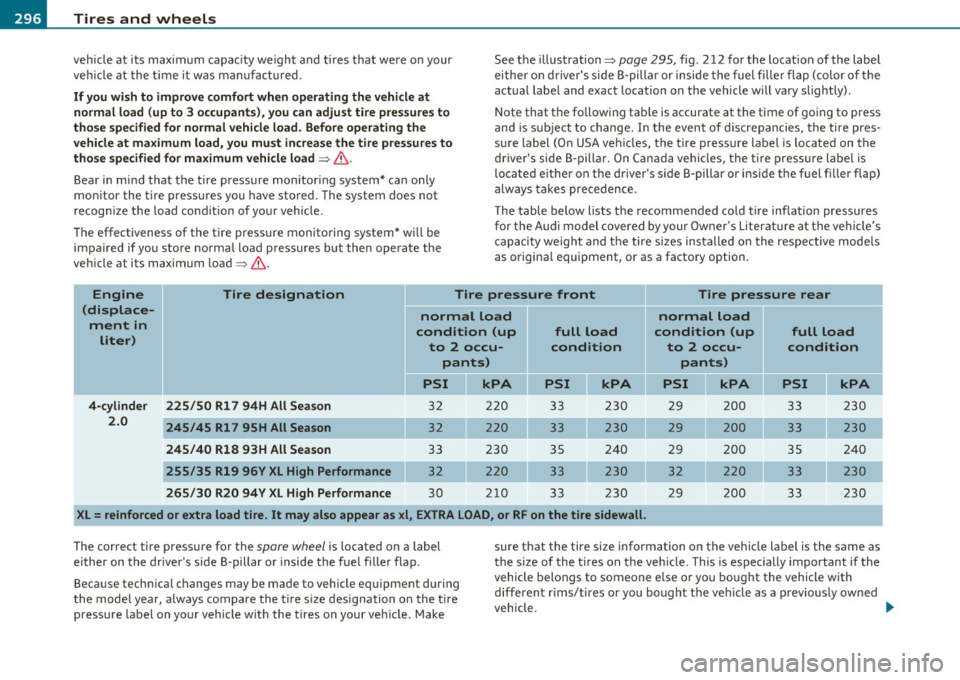
The table below lists the recommended cold tire inflation pressures
for the Audi model covered by your Owner's Literature at the vehicle's
capacity weight and the tire sizes installed on the respective models
as origina l equipment, or as a factory option.
Engine
(displace ment in liter) Tire designation
Tire pressure front Tire pressure rear
normal load normal load
condition (up full load condition
(up
full load
to 2 occu- condition to 2 occu- condition pants) pants)
PSI Jl kPA PSI kPA PSI kPA PSI II kPA
4-cylinder 225/50 Rl 7 94H All Season 32 220 33 230 29 200 33 230
2.0
245/45 Rl 7 95H All Season 32 220 33 230 29
200 33 230
245/40 R18
93H All Season 33 230 35 240 29 200 35 240
255/35 R19 96V XL High Performance 32 220 33 230 32 220 33 230
265/30 R20 94Y XL High Performance 30 210
33 230 29 200
33 230
XL=
reinforced or extra load tire. It may also appear as xi, EXTRA LOAD, or RF on the tire sidewall.
The correct tire pressure for the spare wheel is located on a label
either on the driver's s ide B-pillar or inside the fuel filler flap.
Beca use technica l changes may be made to vehicle equipment during
the model year, always compare the tir e s ize designation on the tir e
pressure label on your vehicle with the tires on your vehicle. Make sure that the tire size information on the vehicle label is the same as
the
size of the tires on the vehicle. This is especially important if the
vehicle belongs to someone e lse or you bought the vehicle with
different rims/tires or you bought the veh icle as a previous ly ow ned
vehicle. _.,,
Page 300 of 362

-~_T_ ir_e_ s_ a_ n_ d_ w_ h_e_ e_ ls _______________________________________________ _
pressure for a trip -even one that you would not consider to be
" long. " See =>
page 299, "Tires and vehicle load limits" for more
important information.
Always use an accurate tire pressure gauge when checking and
adjusting inflation pressures. Check all of the tires and be sure not to
forget the spare tire. If the pressure in any tire is too high when the
tire is "cold ," let air out of the tire slowly with the edge of the tire
gauge and keep checking the pressure until you reach the pressure
that is correct for the load (passengers and luggage) and kind of
driving you plan to do .
If the pressure in any tire is too low, note the difference between the
pressure in the cold tire and the pressure you need and add the air
that you need to reach the correct pressure for the vehicle load
(passengers and luggage) for the tires on your vehicle as listed on the
on your vehicle and in this manual and the kind of driving you plan to
do.
Never exceed the maximum inflation pressure listed on the tire
sidewall for any reason.
Remember that the vehicle manufacturer, not the tir e manufacturer,
determines the correct tire pressure for the t ires on your veh icle.
It is important to check the tire pressure when the tires are cold.
• Read the required tire pressure from the tir e pressure label. On
USA vehicles, the tire pressure label is located on the driver's side 8-
pillar. On Canada vehicles, the tire pressure label is located either on
the driver 's side 8 -pillar or inside the fuel filler flap. The tire pressure
label lists the recommended cold t ire inflation pressures for the
vehicle at its maximum capac ity weight and the tires that were on
your vehicle at the time it was manufactured. For recommended tire
p ressures for normal load cond it ions, please see chapter
==> page 295.
• Turn the valve stem cap counter-clockw ise to remove it from the
tire valve.
• Place the air pressure gauge on the valve. •
The tire pressures should only be checked and adjusted when the
ti res are cold . Th e slightly raised pressures of warm tires must not be
reduced .
• Adjust the tire pressure to the load you are carrying .
• Reinstall the valve stem cap on the valve .
When should I check the tire pressure?
The correct tire pressure is especially important at high speeds . The
pressure shou ld therefore be checked at least once a month and
always before starting a journey . Do not forget to check the tire pres
sure for the spare wheel.
When should I adjust the tire pressures?
Adjust the t ire pressure to the load you are carrying . After chang ing a
wheel
or replacing whee ls you have to adjust the tire pressures on all
wheels. In addition, you must then initialize the new tire pressures in
the tire pressure monitoring system*=>
page 310.
& WARNING
Incorrect tire pressures and/or underinflation can lead sudden tire
failure, loss of control, collision, serious personal injury or even
death.
• When the warning symbol appears in the instrument
cluster, stop and inspect the tires .
• Incorrect tire pressure and/or underinflation can cause
increased tire wear and can affect the handling of the vehicle and
stopping ability .
• Incorrect tire pressures and/or underinflation can also lead to
sudden tire failure, including a blowout and sudden deflation,
causing loss of vehicle control.
• The driver is responsible for the correct tire pressures for all
tires on the vehicle. The applicable pressure values are located on
a sticker on the driver's side B-pillar or on the inside of the fuel
filler flap. .,_
Page 301 of 362
________________________________________________ T_i_r _e _s _ a_n _ d_ w_ h_ e _ e_l_s __ _
& WARNING (co ntinued )
• Only when all tire s on the vehicle are filled to the correct pre s
sure, the tire pressure monitoring sy stem* can work correctly .
• The u se of incorrect tire pressure values can lead to accidents or
other damage. Therefore it is essential that the driver observe the
specified tire pressure values for the tires and the correct pres
sures for the function of the tire pre ssure monitoring system *.
• Always inflate tires to the recommended and correct ti re pre s
sure before driving off.
• Driving with underinflated tire s bend more , letting them get
too hot resulting in tread separat ion, sudden tire failure and loss
of control.
• Excessive speed and /overload ing can cause heat build-up ,
sudden tire failure and loss of control.
• If the tire pressure is too low or too high , the tires will wear
prematurely and the vehicle will not handle well.
• If the tire is not flat and you do not have to change a wheel
immediately, drive at reduced speed to the neare st service station
to check the tire pressure and add air as requ ired.
0 Note
Dr iv ing without valve stem caps can cause damage to the tire valves.
T o preven t this, a lways make su re t hat fac tory ins talle d va lve stem
caps on all wheels a re securely mo unted on the valve.
'£> For the sake of the environment
Under inflated t ires will a lso increase the fuel consumption .•
Tires and vehicle Load Limits
T here are lim its to the amount of load or we ight that any vehicle a nd
any t ire can c arry . A veh icle t hat is over loaded w ill not hand le well an d
Safety first
is more difficult to stop . Overloading can not only lead to loss of
veh icle co ntro l, bu t ca n also d amage important p art s o f the ve hicl e
and can lead to sudden ti re failure, including a blowout and sudden
deflation that can cause the vehicle to crash.
Your safety a nd tha t of you r passe ngers also depe nds o n mak ing s ure
that load limits are not exceeded. Vehicle load incl udes everybody
and everyt hing in and on t he ve hicle. T hese lo ad lim its are techn ic a lly
referred to as the vehicle's
Gross Vehicle Weight Rating ("GVWR").
Th e "GVWR" includes the weight of the basic vehi cle, all facto ry
installed accessories, a fu ll tank of fue l, o il, coo la nt and other fluids
plus maxim um loa d. Th e maxim um loa d includes t he nu mber of
passeng ers th at t he ve hicl e is intended to car ry ("sea ting capa city ")
with an ass umed weig ht of 150 lbs . (68 kg) for each passenger at a
design ated seating posit ion a nd the to tal weig ht of any luggage in
the vehicle. If yo u tow a tra iler, the weight of the trailer hitch and the
t ongue weig ht of the lo ad ed t railer mus t be include d as pa rt of the
vehicle load.
Th e
Gross Axle Weight Rating ("GAWR") is the maximum load that
can be a pplied at each of t he ve hicle's two axles .
The Gross Vehicle We ight Rating and the Gross Ax le We ight Rating
are li sted on the safety comp lia nce s tick er label loca ted either on the
dr ive r's side B-pilla r o r on the inside of the fuel filler flap . Aud i has
4 se ating posi tions, 2 in the fron t and 2 in the rea r for tot al s eating
capacity of 4. Each seating position has a seat belt~
page 181,
"Safety be lts".
Th e fact t hat there is an upper lim it to your v eh icle 's Gross Vehicle
Weight Rating means that t he tota l weight of whatever is being
c a rried in th e veh icle ( in cl ud ing the w eight of a t railer hitch and the
tongue weight of the loaded tra iler) is limited. The mo re passengers
in the veh icle or p assengers who are heavier th an the sta ndar d
we ights assumed mean that less we ight can be carried as luggage.
Th e ti re pressure label on yo ur Audi also lis ts th e maxim um combined
we ight of all of the occupants and luggage or other cargo that the
vehicle can car ry. For the location o f the labe l~
p age 2 95, fig . 21 2. ~
Vehicle care Technical data
Page 302 of 362
-Tires and wheels
in. WARNING
Overloading a vehicle can cause loss of vehicle control, a crash or
other accident, serious personal injury, and even death.
• Carrying more weight than your vehicle was designed to carry
will prevent the vehicle from handling properly and increase the risk of the loss of vehicle control.
• The brakes on a vehicle that has been overloaded may not be
able to stop the vehicle within a safe distance.
• Tires on a vehicle that has been overloaded can fail suddenly,
including a blowout and sudden deflation, causing loss of control
and a crash.
• Always make sure that the total load being transported -
including the weight of a trailer hitch and the tongue weight of a
loaded trailer -does not make the vehicle heavier than the
vehicle's Gross Vehicle Weight Rating. •
Determining correct load limit
Use the example below to calculate the
total weight of the passengers and luggage
or other things that you plan to transport so
that you can make sure that your vehicle
will not be overloaded.
Steps for Determining Correct
Load Limit
1.Locate the statement "THE COMBINED WEIGHT OF OCCUPANTS AND CARGO
SHOULD NEVER EXCEED XXX KG OR XXX LBS"on your vehicle's placard (tire infla
tion pressure label)==>
page 295J
fig. 212.
2. Determine the combined weight of the driver and passengers that will be riding
in your vehicle.
3. Subtract the combined weight of the driver and passengers from
"XXX" kilo
grams or
"XXX" pounds shown on the
sticker==>
page 295J fig. 212.
4. The resulting figure equals the available amount of cargo and luggage load
capacity. For example, if the
"XXX"
amount equals 1400 lbs. and there will
be five 150 lbs. passengers in your
vehicle, the amount of available cargo
and luggage load capacity is 650 lbs. (1400- 7 SQ (5
X 150) = 650 lbs.) ~
Page 304 of 362

-~_T_ i_ re _ s_ a_n _ d_ w_ h _e_ e_ ls _________________________________________________ _
Tire pressure
Incorrect tire pressure causes premature wea r a nd can cause sudden
t ire blow-out. For this reason, ti re p ressure must be checked at least
once a month ~
page 297.
Driving style
Driving fast around curves, heavy acce le ra tion and hard brak ing
increase tire wear .
Rotating tires for more even wear
For all four tires on your veh icle to have the same service life, we
re commend that the fron t and re a r tires are rotate d according to the
tire manufact urer's suggested tire rotation interva ls . Please
remember the fo llow ing:
• Tir e rotat ion inte rvals may differ from t he ve hicl e service intervals
outlined in your Maintenance and War ranty Booklet .
• T he longer one tire is used in one location on the veh icle, the more
it wears at certa in points; therefore, we recommend that you follow
t he t ire m anufac ture r's suggested tire rotation in terva ls.
• V ehicles with front-whee l drive expe rience mo re tread wea r on t he
fron t wheels compa red to all-whee l drive (quattro
® ).
• Please rotate tires as s hown ~fig. 215.
• Extra care must be taken when rotating d irection-specific tires
~ page 321.
Wheel balancing
The w heels on new vehicles are balanced. Howeve r, va rious sit uat io ns
dur ing eve ryday dr iv ing can cause them to become unbalanced,
re su lt ing in v ibr ations yo u can usually fee l throug h the steering
wheel.
Unbalanced wheels must be rebalanced to avoid excessive wea r on
steeri ng, suspension and t ires . A wheel must also be rebalanced
w hen a new tire is installed.
Incorrect wheel alignment
Incorrec t whee l alignment can ca use excessive tire wear, impai ring
t he sa fety of the veh icle . If tires show excess ive wear, have the wheel
alignment checked by an authorized A udi dealer or qualified wo rk
shop .
All wheel drive
Vehicles w ith q uattro ® must always have ti res of the same size,
const ructio n and trea d type. For details see~
page 242 .
& WARNING
Sudden tire failure can lead to loss of control , a crash and serious
personal injury!
• Never drive a vehicle when the tread on any tire is worn down
to the wea r ind icato rs.
• Worn tire s are a safety hazard, they do not grip well on wet
roads and in crease your risk of "hydroplaning" and lo ss of control.
• Always keep chemicals that can cause tire damage, such as
grease , oil , gasoline and brake fluid away from tires.
• Tires age even if they are not being used and can fail suddenly,
especially at high speeds . Tires that are more than 6 years old can
only be used in an emergency and then with special care and at
lower speeds.
• Never mount used tire s on your vehicle if you are not sure of
their "previous history ." Old used tires may have been damaged
even though the damage cannot be seen that can lead to sudden
tire failure and loss of vehicle control. •
Page 305 of 362
________________________________________________ T_ i_ re _ s_ a_ n_d_ w_ h_ e_ e_l _s _ ....... JIII
New tires and replacing tires and wheels
New tires and wheels have to be broken in.
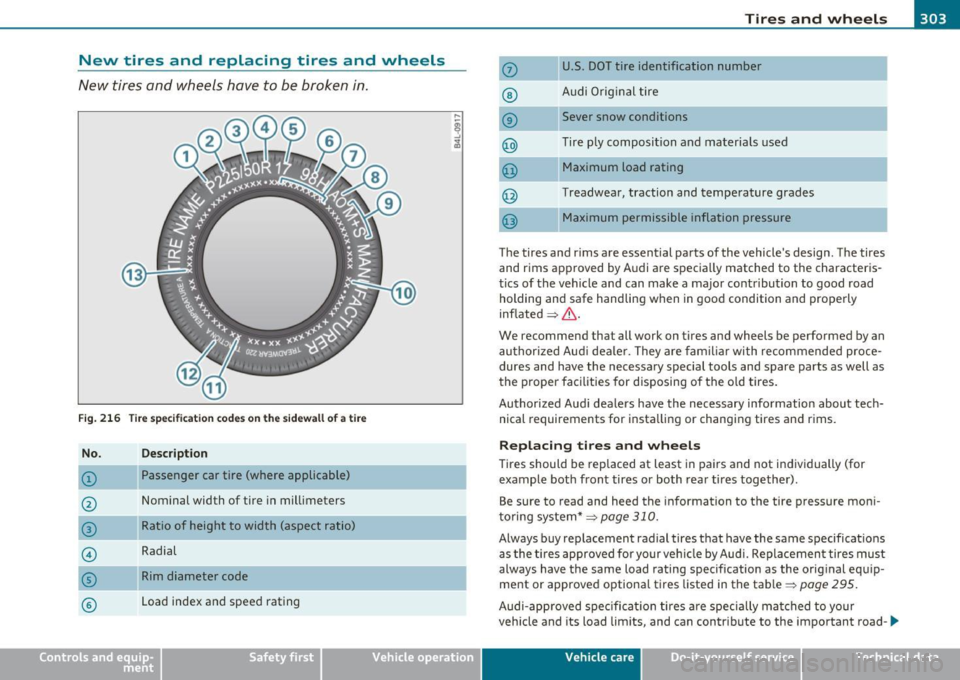
Fig. 21 6 Tire s pecificati on co des on th e sidew all of a tire
No .
©
@
®
©
©
©
Descript ion
Passenger car tire (where applicable)
Nominal width of tire in mil limeters
Ratio of height to width (aspect ratio)
Radial
Rim diameter code
Load index an d speed rating
Vehicle OP-eration
(j)
®
®
@
@
U.S. DOT tire identification number
Audi Orig inal tire
Sever snow conditions
Tire p ly composition and materia ls used
Maximum load rating
@ Treadwear, traction and temperature grades
@ Maximum permissible inflation pressure
T he tires and rims are essential pa rts of the vehicle's design . The tires
and r ims approved by Audi are specially matched to the character is
t ics of the vehicle and can make a major contribut ion to good road
holding and safe handling when in good condition and properly
inflated
=> & .
We recommend that all work on t ires and wheels be performed by an
authori zed Au di deale r. They are fam il ia r with recommended proce
dures and have the necessary special tools and spare parts as well as
the proper facilities for disposing of the o ld tires.
Authorized Aud i dea lers have the necessary info rmation about tech
nical requirements for insta lling or changing tires and rims .
Replacing tires and wheels
Tires should be replaced at least in pa irs and not ind iv idually (for
example both front tires or both rea r tires together) .
Be sure to read and heed the in formation to the tire pressure mon i
t o ring system *=>
page 310.
Always b uy replacement radial tires t hat have the same specificat ions
a s t he tires approved for yo ur ve hicl e by Audi. Re placemen t tires must
always have the same load rating specification as the orig inal eq uip
me nt or approved optiona l tires listed in the table =>
page 295.
Audi -app roved spe cifica tion tires are spec ially ma tched to yo ur
vehicle and its load lim its, and can contrib ute to the important road- _,.
Vehicle care Do-it-yourselt service Technical data
Page 306 of 362
-~_T_ i_ re _ s_ a_n _ d_ w_ h _e_ e_ ls _________________________________________________ _
holding, driving characteristics, and safety of the vehicle . The table
(::::>
page 295) lists specifications of the tires approved for the Audi
models covered by your Owner's Literature.
The tire pressure label (On USA vehicles, the tire pressure label is
located on the driver's side B-pillar. On Canada vehicl es, the tire pres
sure label is located either on the driver's side B-pillar or inside the
fuel filler flap)(=>
page 295, fig. 213) l ists the specifications of the
orig inal equipment tires installed on your vehicle at the time it was
manufactured.
Federal law requires tire manufacturers to place standardized infor
mation on the sidewall of all tires =>
page 303, fig. 216. This infor
mation identifies and descr ibes the fundamental characteristics, the
quality grade of the tire and also provides a tire identification number
for safety standard cert ification and in case of a reca ll.
Tire specifications
Knowledge of tire specifications makes it easier to choose the correct
tires. Radia l tires have the tire specifications marked on the sidewall,
for examp le:
P255 / 35 Rl9 96V XL
This contains the following information:
P Indicates the tire is for passenger cars (where applicable)
255 Nominal tire width in mm of the tire from sidewall edge to side -
wall edge . In general, the larger the number, the wider the tire
35 Height/w idth ratio in percent (aspect ratio)
R Tire construction: Radial
19 Rim diameter code (in inches)
96 Load rating code
Y Speed rating letter code
XL (or "xl", "E XTRA LOAD", or "RF" Indicates that the tire is a"Rein
forced" or an "Extra Load" tire
M+S (or "M/S") Indicates that the tire has some mud and snow capa
bility The tires could a
lso have the information of direction of rotation
=>
page 291 .
Tire manufacturing date
The manufacturing date is also indicated on the tire sidewall
(poss ibly only on the
inner side of the wheel):
"DO T ... 2209 ... "means, for example, that the tire was produced in
the 22nd week of 2009.
Speed rating (letter code)
The speed rating letter code on the wheels ind icates the maximum
permissible road speeds =>
& in "Winter tires" on page 307.
P up to 93 mph (150 km/h)
Q up to 99 mp h (158 km/h)
R up to 106 mph (1 70 km/h)
S up to 110 mph (180 km/h)
T up to 118 mph (190 km/h)
U up to 124 mph (200 km/h) H up to 130 mph (210 km/h)
V up to 149 mph (240 km/h)
3
)
Z over 149 mph (240 km/h)3
)
W up to 168 mph (270 km/h)3
)
Y up to 186 mph (298 km/h)3>
Your vehicle is normally factory equipped with tires, which possess
excellent driving characterist ics and give yo ur Audi optimum driv in g
comfort. An electronic speed limiter=>
page 29 will normally prevent
your vehicle from go ing faster than the tire speed rating::::>
&-
U.S. DOT Tire Identification Number (TIN) and tire
manufacture date
This is the tire's "serial number". It begins with the letters "DOT" and
ind icat es that the tire meets all federal standards. The next two
~
3l For tires w ith a maximum speed capability over 149 mph (240 km/h), t ire
man ufact urer s sometimes use the letters "ZR."
Page 307 of 362
________________________________________________ T_i_re _ s_ a _ n_d_ w_ h_ e_ e_l_s __ _
numbers or letters indicate the plant where it was manufactured, and
t he last f our num be rs represen t the wee k an d ye ar of man ufacture.
For examp le, t he numbers 2209 mean that the t ire was prod uced in
the 2 2nd week of 2009. The ot her num bers are marketing co des that
may or may not be used by the t ire manufacturer . Th is information is
used to contact consumers if a tire defect requires a reca ll.
Audi Original tire
Tir es wi th the identifi cat io n "A O" or "RO" have bee n specially
matched w it h your Aud i. W e recommend using only these t ires
because t hey meet the hig hest standards regard ing safety and
driv ing c ha racteris tics when used correct ly . Yo ur aut ho rize d Aud i
dealer wi ll gladly p rovide you with more information.
Tire ply composition and materials used
T he num ber o f plies ind ica tes the numbe r of layers o f rubber -coa ted
fab ric in the tire. I n ge neral, th e greater the n umber of plies, the
more weight a tire can support . Tire manufacture rs a lso must in di
cate the mater ials in the t ire, which incl ude stee l, nylon, polyes ter,
and others .
Maximum Load Rating
This num ber indicates t he maximum load in kilog rams and pounds
tha t can be carr ied by the t ire.
Tire quality grading for treadwear, traction, and
temperature resistance
T read wea r, traction and tempe rat ure gra des => page 306 .
Maximum Permissible Inflation Pressure
This number is the g rea tes t a mou nt o f air pressure th at sh ould ever
be put in the t ire under normal driv ing cond itions.
Safety first
& WARNING
• Using incorrect or unmatched tires and/ or wheels or improper
tire and wheel combination s can lead to loss of control, collision
and serious personal injury.
• Always u se tire s, rim s and wheel bolts that meet the specifica
tions of original factory -installed tires or other combinations that
have been specifically approved by the vehicle manufacturer.
• Tires age even if they are not being used and can fail suddenly,
e specially at high speed s. Tires that are more than 6 years old can
only be used in an emergency and then with special care and at
lower speed s.
• Never mount used tires on your vehicle if you are not sure of
their "previous history ." Old u sed tires may have been damaged
eventhoughthedamage cannotbeseenthatcanleadtosudden
tire failure and loss of vehicle control.
• All four wheels must be fitted with radial t ires of the same
type , size (rolling circumference ) and the same tread pattern .
Driving with different tires reduces vehicle handling and can lead
to a loss of control.
• If the spare ti re is not the same as the t ires that are mounted
on the vehicle -for example with winter tires -only use the spare
tire for a short period of time and drive with extra care. Refit the
normal road wheel as soon as safely possible .
• Never drive faster than the ma ximum speed for which the tires
on your vehicle are rated becau se tire s that are driven faster than
their rated speed can fail suddenly .
• Overloading tire s cau se heat build-up, sudden tire failure,
including a blowout and sudden deflation and loss of control.
• Temperature grades apply to tires that are properly inflated
and not over or unde rinflated.
• For technical reasons it is not always possible to u se wheels
from other vehicles- in some cases not even wheels from the same
vehicle model. ..,_
Vehicle care Technical data
Page 308 of 362
-~_T_ i_ re _ s_ a_n _ d_ w_ h _e_ e_ ls _________________________________________________ _
& WARNING (conti nu ed )
• If you install wheel trim disc s on the vehicle wheels , make sure
that the air flow to the brakes is not blocked . Reduced airflow to
the brakes can them to ove rhe at, increasing stopping distances
and cau sing a collision .
0 Note
• For tech nical reasons, it is not ge ne rally poss ib le to use the wheel
r ims from other vehicles. This can hold true for whee ls of the same
veh icle type.
• If the spare tire is different from the t ires that you have mounted
on yo ur veh icle (for examp le w inte r tir es or wide profile tires), then
use the spare tire for a short per iod of t ime on ly and drive with extra
c are . Replace the fla t ti re wi th t he tire matc hing the o thers on you r
vehicle as soon as possible .
• If you should put differen t wheel s and tires o n yo ur vehicle (e.g.
w inter whee ls and t ires), you must be certa in that the wheels and
ti res are comp atib le with the t ire pressure mon ito ring system*.
Otherwise the system will register a malfu nction and a fau lt message
w ill be displ ayed. Fo r more informa tion, conta ct your au thori zed Au di
dealer.
• N ever drive wi tho ut the valve s tem cap. The valves co uld get
damaged .
Uniform tire quality grading
• Tread wear
• Tr act io n AA A B C
• T emperature A B C Quality grades can be fo
und where app licab le on the tire s ide wall
betwee n tre ad sho uld er and m aximum se ct io n width =>
page 3 03,
fig .216.
Fo r example : Tread wea r 200, Tract ion AA , Temperat ure A.
All passenge r car ti res mus t confo rm to Fe d er al Safety Requireme nts
in addition to these grades.
Tread wear
T he tread wear grade is a comparative rating based on the wear rate
of the t ire whe n tes ted under cont rolle d conditions on a specifie d
government test co urse.
F or example, a tire graded 150 would wear one a nd one hal f (1 1/2)
t imes as well on t he government course as a tire graded 100 .
The relat ive performance o f tires depen ds upon the act ua l conditions
of their use, however, and may de pa rt sign ifican tly from the no rm
due to variat ions in dr iv ing hab its, se rvice practices and differences in
ro ad characte ris tic s and climat e.
Traction
Th e traction grades, from high est to lowest, ar e AA, A, Band C. Those
grades represent the tire's ability to stop on wet pavement as
me asu red under con trolled conditions on spe cifie d gove rnme nt te st
surfaces of asphalt and conc rete . A tire marked C may have poo r trac
ti on perfo rm an ce =>& .
Temperature
The temperature grades a re A (the h ig hest), B, and C, represen ting
the t ire's resistance to the generation of heat and its ab ility to d issi
p ate he at when teste d und er co ntro lled condition s on a s pecifie d
indoor laboratory test wheel.
Susta ined high tempera ture can cause the materi al of the tire to
degenerate and red uce tire life, and excessive te mperature ca n lead
to sudden tire failure=> & .
Th e g ra d e C c orresponds to a level of pe rforman ce which all
passenge r ca r tires must meet under the Federal Motor Veh icle