seats AUDI A5 COUPE 2012 User Guide
[x] Cancel search | Manufacturer: AUDI, Model Year: 2012, Model line: A5 COUPE, Model: AUDI A5 COUPE 2012Pages: 316, PDF Size: 78.59 MB
Page 72 of 316
70 Seats and storage
A WARNING
For reasons of strength, only objects with
a maximum weight of 5 kg should be car
ried in the storage net. Heavier objects are
not adequately secured. There is risk of
personal injury.
Enlarging cargo capacity of the vehicle
interior
Appl ies to vehicles: with folding rear seatback
The seat backs can be folded forward to en
large the cargo capacity.
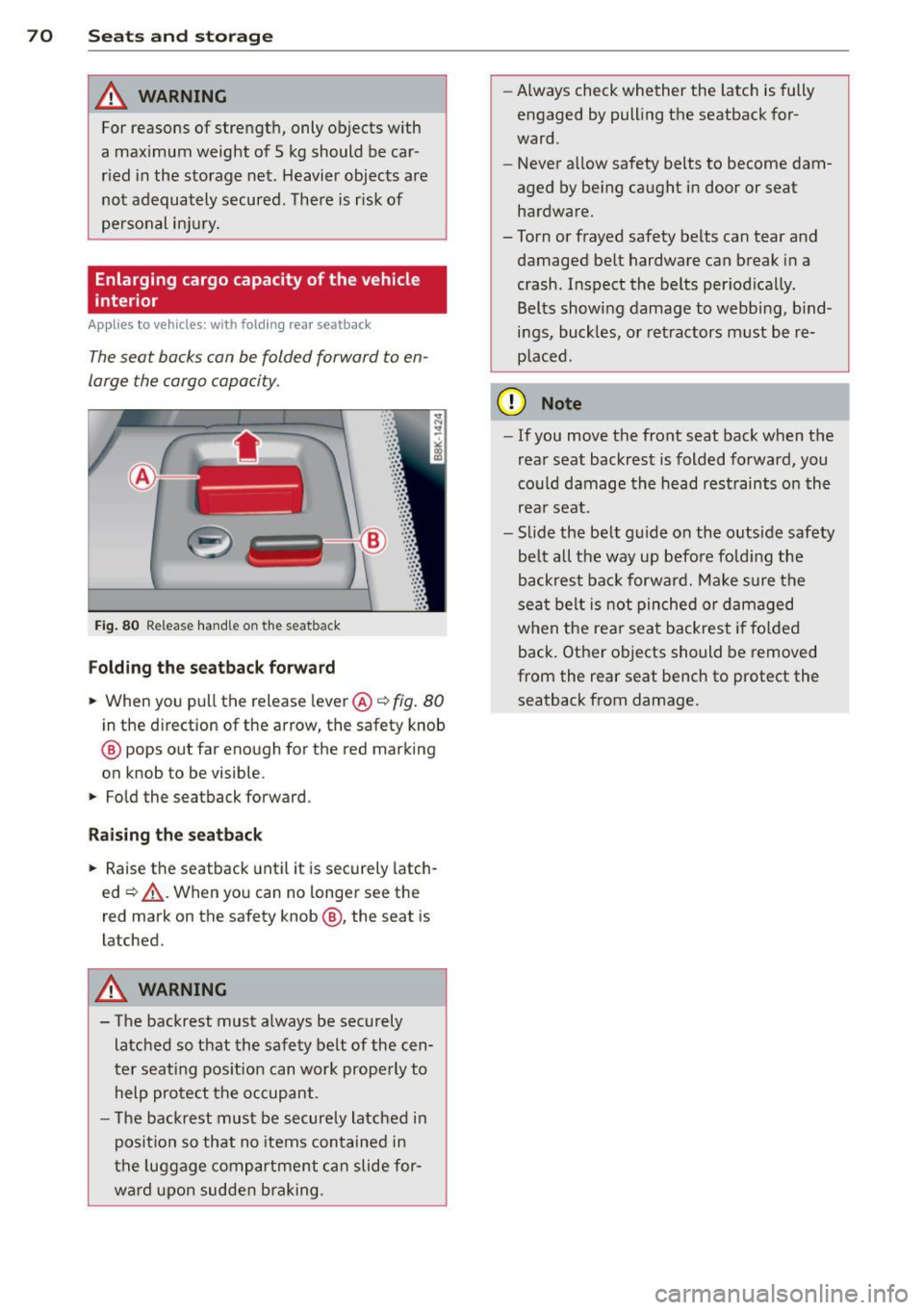
Fig. 80 Release handle on the seatback
Folding the seatback forward
., When you pull the release lever @ c::> fig. 80
in the direction of the arrow, the safety knob
@ pops out far enough for the red marking
on knob to be visible .
., Fold the seatback forward.
Raising the seatback
., Raise the seatback until it is securely latch
ed ~,&.. . When you can no longer see the
red mark on the safety knob@, the seat is
latched.
A WARNING
- The backrest must always be securely
latched so that the safety belt of the cen
ter seating position can work properly to
help protect the occupant.
- The backrest must be securely latched in
position so that no items contained in
the luggage compartment can slide for
ward upon sudden braking . -
Always check whether the latch is fully
engaged by pulling the seatback for
ward.
- Never allow safety belts to become dam
aged by being caught in door or seat hardware.
-Torn or frayed safety belts can tear and
damaged belt hardware can break in a
crash . Inspect the belts periodically.
Belts showing damage to webbing, bind
ings, buckles, or retractors must be re
placed.
(D Note
- If you move the front seat back when the
rear seat backrest is folded forward, you
could damage the head restraints on the
rear seat.
- Slide the belt guide on the outside safety
belt all the way up before folding the
backrest back forward. Make sure the
seat belt is not pinched or damaged
when the rear seat backrest if folded
back. Other objects should be removed
from the rear seat bench to protect the
seatback from damage.
Page 73 of 316
Enlarging cargo capacity of the luggage
compartment
Applies to vehicles: with fold ing rear sea tback
The seat backs can be folded forward to en
large the cargo capacity .
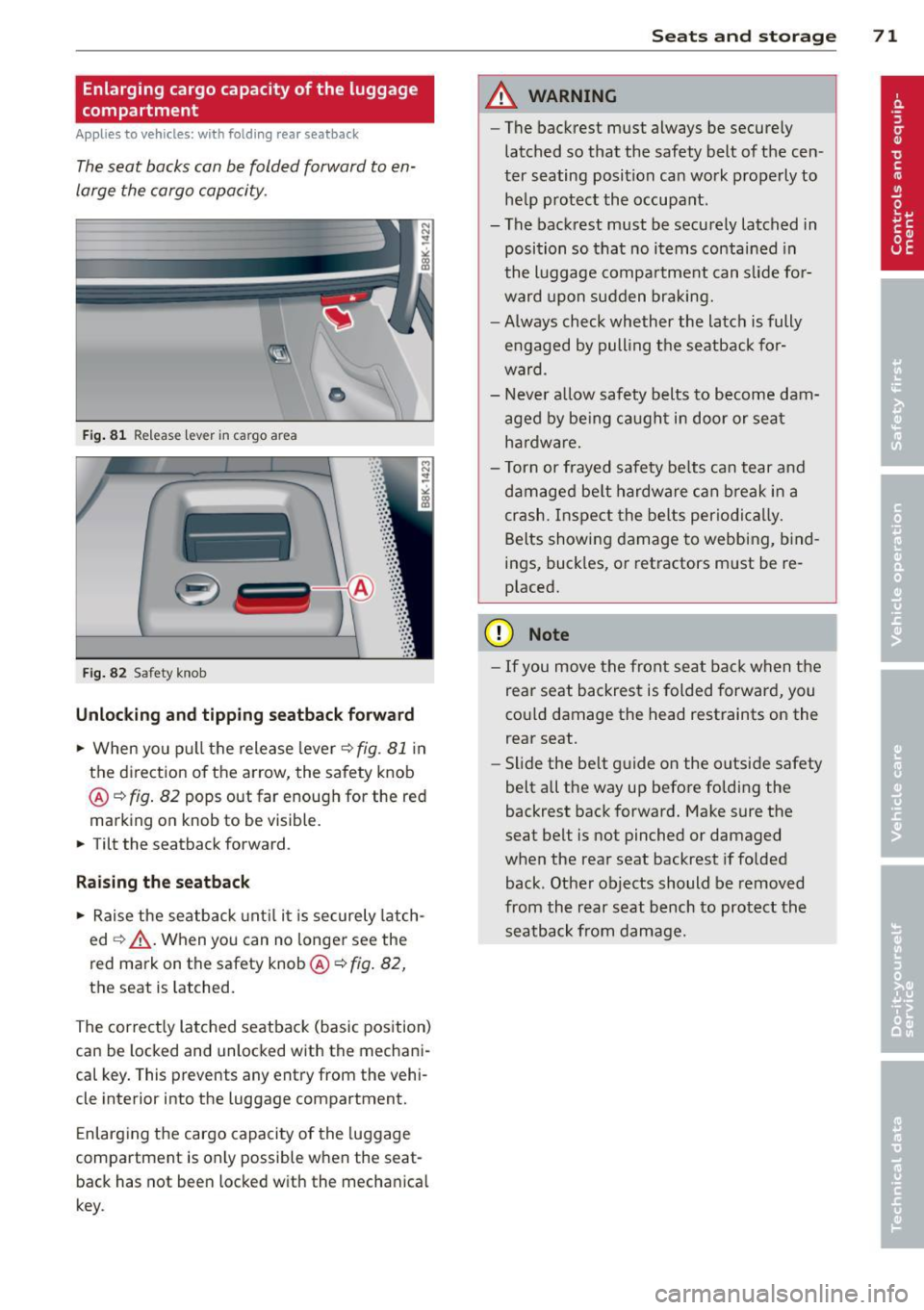
Fig. 81 Release lever in cargo area
'
-
-
. -~ .
Fig. 82 Safety knob
•
·:: ·:: ·:: · : : ·::
· ::
... : :·: ·::
· ::
·:: ·:: · ::
· ::
· :: ·:: ~: :
· ::
· ::
· ::
· :: ... .. ...
Unlocking and tipping seatback forward
.. When you pu ll the release lever c::> fig . 81 in
the direction of the arrow, the safety knob
@ c::>
fig. 82 pops out far enough for the red
marking on knob to be visible.
.. Tilt the seatback forward .
Raising the seatback
.. Raise the seatback until it is securely latch
ed
c::> _& . When you can no longer see the
red mark on the safety knob @c::>
fig. 82,
the seat is Latched.
The correct ly Latched seatback (basic pos ition)
can be Locked and unlocked with the mechani
cal key. This prevents any entry from the vehi
cle inter ior into the Luggage compartment.
Enlarging the cargo capacity of the luggage
compartment is only possible when the seat back has not been locked with the mechanical
key .
Seats and storage 71
A WARNING
-The backrest must always be secure ly
latched so that the safety belt of th e cen
ter seating position can work properly to
he lp protect the occupant.
- The backrest must be securely Latched in
position so that no items contained in
the Luggage compartment can slide fo r
ward upon sudden braking.
- Always check whether the Latch is fully
e ngaged by pull ing the seatback for
ward.
- Never allow safety belts to become dam
aged by being caught in door or seat
hardware.
- Torn or frayed safety be lts can tear and
damaged belt hardware can break in a
crash. Inspect the belts periodically.
Belts showing damage to webbing, bind
ings, buckles, or retractors must be re
placed.
(D Note
- If you move the front seat back when the
rear seat backrest is folded forward, you
co uld damage the head restraints on the
rear seat .
- Slide the be lt guide on the outside safety
belt all the way up before folding the
backrest back forward. Make sure the
seat belt is not pinched or damaged
when the rear seat backrest if folded
back . Other objects should be removed
from the rear seat bench to protect the
seatback from damage.
Page 74 of 316
7 2 Seats and storage
locking the seatback
Appli es to vehicles: with fold ing rear seatback
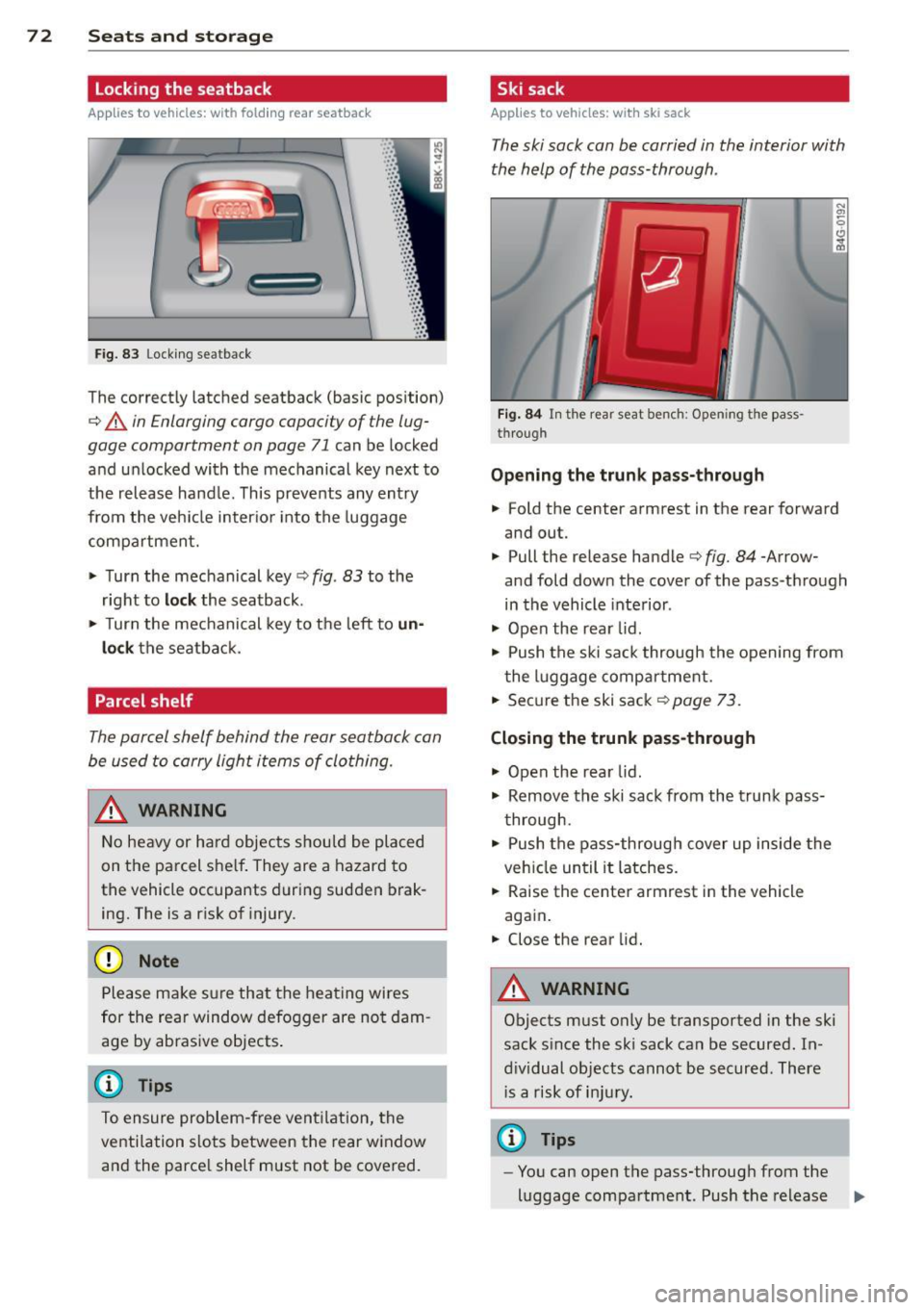
Fig. 83 Lock ing seatback
.. ... ,:: ·:: ·: : ·:: • :: ... ,: ·: ... .. ·::
· ::
•: : ·:: · :: ·:: · ::
· ::
· ::
· :: ·:: ·:: · :: ...
The correctly latched seatback (basic pos ition)
¢ A in Enlarging cargo capacity of the lug
gage compartment on page 71
can be locked
and unlocked with the mechanical key next to
the release hand le . This prevents any entry
from the vehi cle inter io r i nto the luggage
compartment.
.. Turn the mechanical key¢
fig. 83 to the
r ight to
loc k the seatback .
.. Turn the mec hani cal key to the left to
un
lock
the seatba ck.
Parcel shelf
The parcel shelf behind the rear seatback can
be used to carry light items of clothing.
A WARNING
N o heavy or ha rd objec ts shou ld be placed
on the parcel she lf . They are a hazard to
the vehicle occupants during sudden brak
ing. The is a r is k of injury .
(D Note
Please ma ke s ure that the heating wires
for the rear window defogger are no t dam
age by abrasive objects .
@ Tips
To ensure problem-free ventilation, the
ventilation s lots between the rear window
and the parce l shelf must not be cove red.
Ski sack
Applies to vehicles: w ith ski sack
The ski sack can be carried in the interior with
the help of the pass-through .
Fig . 84 In t he rear seat bench: Opening the pass
through
Opening the trunk p ass-through
.. Fold the center armrest in the rear forward
and out.
.. Pull the release handle¢
fig. 84 -Arrow
and fold dow n the cover of the pass -through
in the vehicle inte rior .
.. Open the rea r lid.
.. Push the ski sa ck through the opening from
the l uggage compar tment.
.. Secure the ski sack¢
page 73.
Closing the trunk pass -through
.. Open the rear lid .
.. Remove the ski sack from the trunk pass
through .
.. Push the pass-through cover up inside the
veh icle until it latches.
.. Raise the center armrest in the vehicle
aga in .
.. Close the rear lid.
A WARNING
=
Objects must only be transported in the ski
sack s ince the ski sack can be secured. In
d iv idual objects cannot be secured. There
i s a risk of in ju ry.
@ Tips
- You can open the pass-through from the
luggage compartment. Push the release
II>
Page 75 of 316
button down and push the cover for
ward.
- The pass-through can be locked and un
l ocked with the vehicle mechanical key
r=;, fig. 84.
Securing the ski sack
Applies to vehicles: with ski sack
The ski sack must be secured in the luggage
compartment.
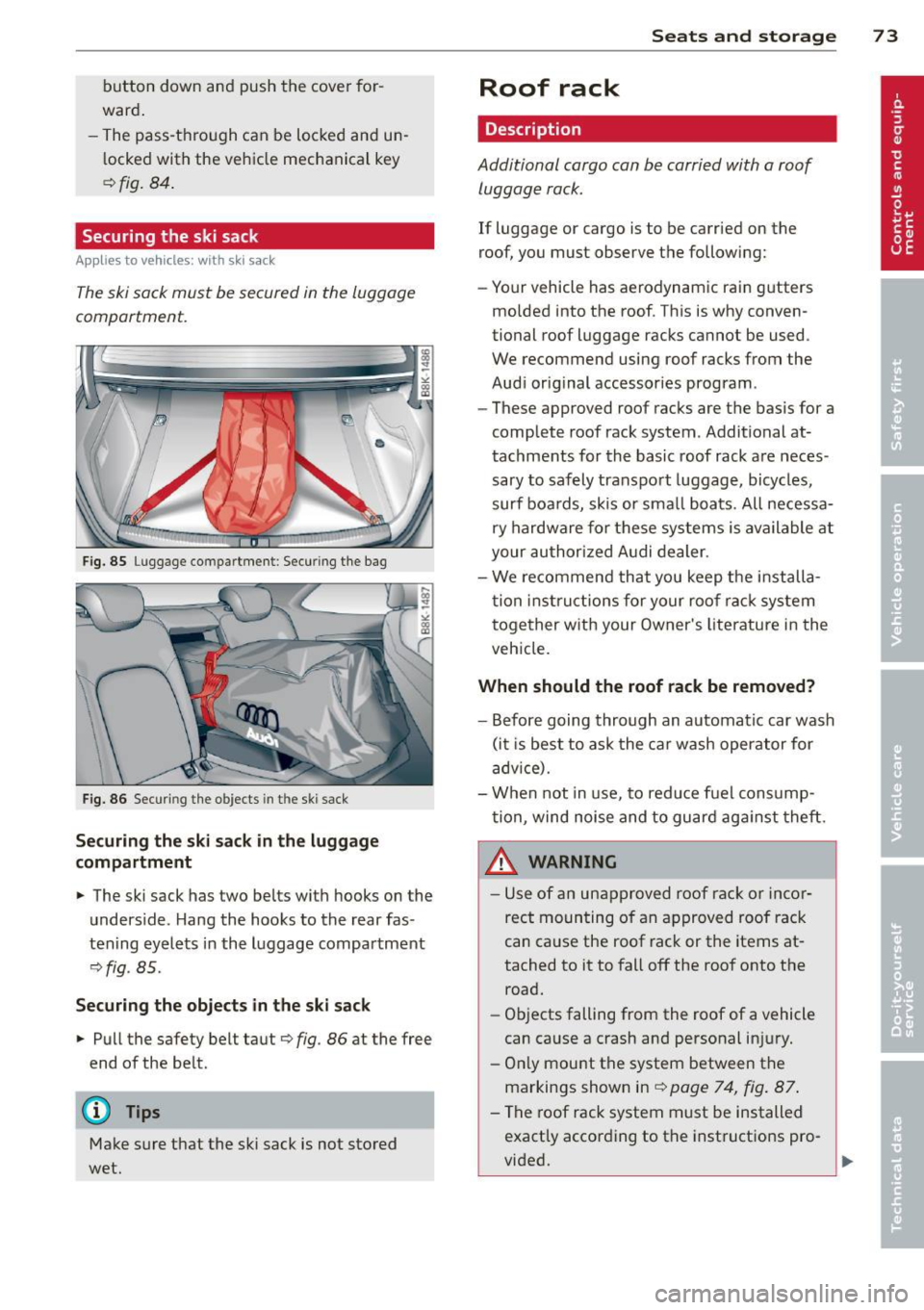
F ig. 85 Luggage compartment : Securing the bag
Fig. 86 Securing the objects in t he ski sack
Securing the ski sack in the luggage
compartment
.,. The ski sack has two belts with hooks on the
underside . Hang the hooks to the rear fas
tening eyelets in the luggage compartment
¢ fig . 85.
Securing the objects in the ski sack
.,. Pull the safety belt taut ¢ fig. 86 at the free
end of the be lt.
(D Tips
Make sure that the ski sack is not stored
wet.
Seats and storage 73
Roof rack
Description
Additional cargo can be carried with a roof
luggage rack .
If luggage or cargo is to be carried on the
roof, you must observe the following:
- Your vehicle has aerodynamic rain gutters
molded into the roof . This is why conven
tional roof luggage racks cannot be used .
We recommend using roof racks from the
Aud i original accessories program .
- These approved roof racks are the basis for a
complete roof rack system. Additional at
tachments for the basic roof rack are neces
sary to safely transpo rt luggage, bicycles,
surf boards, skis or sma ll boats. All necessa
ry hardware for these systems is available at
your authorized Audi dealer.
- We recommend that you keep the installa
tion instructions for your roo f rack system
together with your Owner's literature in the
vehicle.
When should the roof rack be removed?
-Before going through an automatic car wash
(it is best to ask the car wash operator for
advice).
- When not in use, to reduce fuel consump
tion, wind noise and to guard aga inst theft.
8_ WARNING
- Use of an unapproved roof rack or incor
rect mounting of an approved roof rack
can cause the roof rack or the items at
tached to it to fall off the roof onto the
road.
- Objects falling from the roof of a vehicle
can cause a crash and personal in jury.
- Only mount the system between the
markings shown in
r=;, page 74, fig. 87 .
- The roof rack system must be installed
exactly according to the instructions pro-
-
vided. .,,.
Page 76 of 316
7 4 Seats and storage
(D Note
- Your vehicle warranty does not cover any
damages to the vehicle caused by using
roof racks or mounting structures not
approved by Audi for your vehicle . The
same applies to damage resulting from incorrect roof rack installation .
- Always check the roof rack mountings
and hardware before each trip and dur
ing a trip to make sure everything is se
curely tightened. If necessary, retighten
the mountings and check the ent ire sys
tem from time to time.
- After mounting a roof rack system, or
when you transport objects on the roof
of your vehicle, the height of the vehicle
is naturally increased. Be careful when
driving under low bridges or in parking
garages for example. This could cause
damage to the load and even the vehicle itself.
Mounting points
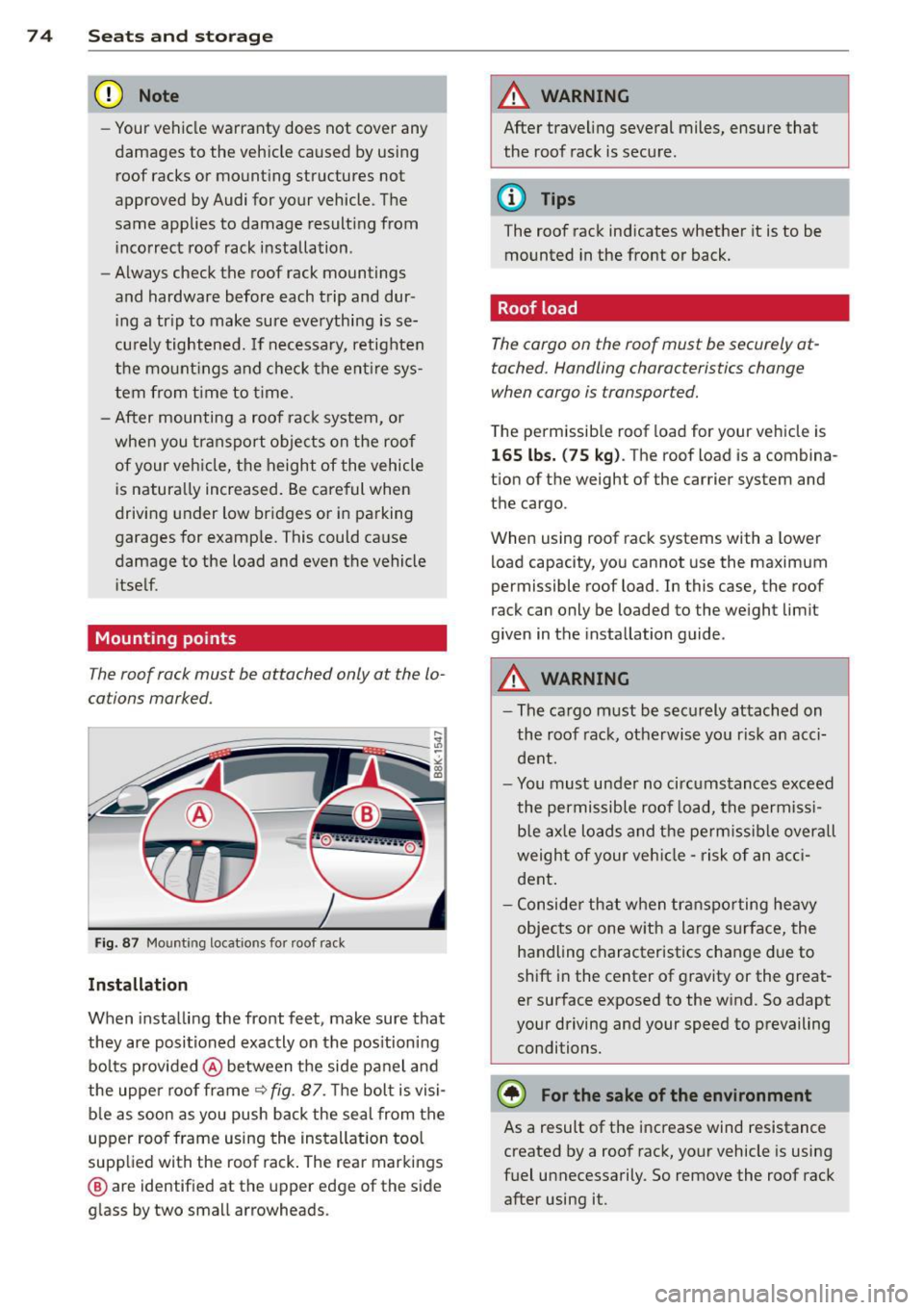
T he roof rack must be attached only at the lo
cations marked .
Fig. 87 Mounting locations for roof rack
Installation
When installing the front feet , make sure that
they are positioned exactly on the positioning
bolts provided @between the side panel and
the uppe r roof frame¢
fig . 87. Th e bolt is visi
ble as soon as you push back the seal from the
upper roof frame using the installation tool
supplied with the roof rack . The rear markings
@ are identified at the upper edge of the side
glass by two small arrowheads.
A WARNING
-After traveling several miles, ensure that
the roof rack is secure.
(D Tips
The roof rack indicates whether it is to be mounted in the front or back.
Roof load
The cargo on the roof must be securely at
tached. Handling characteristics change
when cargo is transported.
The permissible roof load for your vehicle is
165 lbs. (75 kg) . The roof load is a combina
tion of the weight of the carrier system and the cargo.
When using roof rack systems with a lower
load capacity, you cannot use the maximum
permissible roof load . In this case, the roof
rack can only be loaded to the weight limit
given in the installation guide.
A WARNING
- The cargo must be securely attached on
the roof rack, otherwise you risk an acci
dent.
- You must under no circumstances exceed
the permissible roof load, the permissi
ble axle loads and the permissible overall
weight of your vehicle -risk of an acci
dent.
- Consider that when transporting heavy
objects or one with a large surface, the
handling characteristics change due to
shift in the center of gravity or the great
er surface exposed to the wind. So adapt
your driving and your speed to prevailing conditions.
~ For the sake of the environment
As a result of the increase wind resistance
created by a roof rack, your vehicle is using
fuel unnecessarily. So remove the roof rack
after using it.
Page 77 of 316
Beverage holders
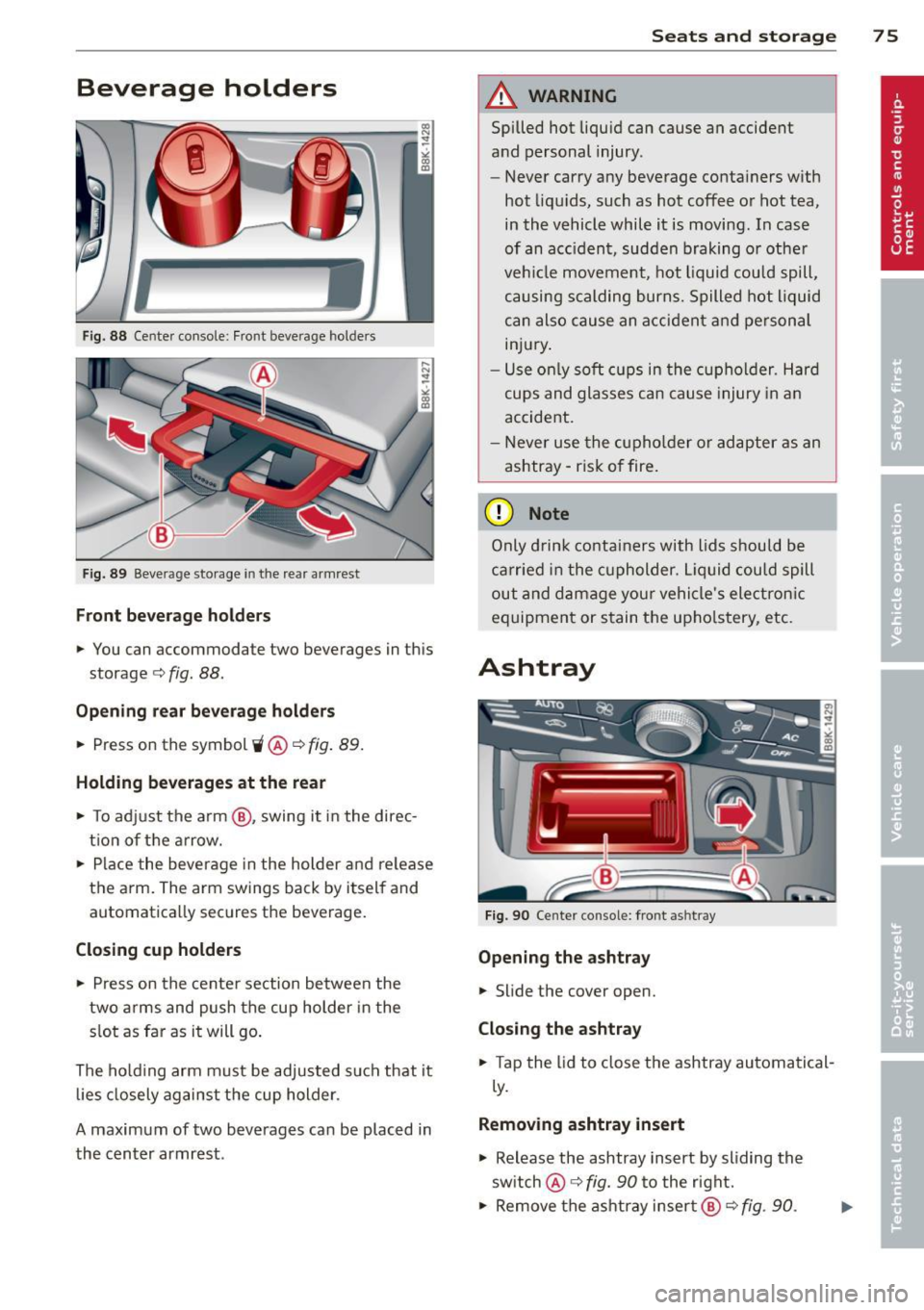
Fig. 88 Center console: Front beverage holders
Fig. 89 Beve rage storage in the rear armrest
Front beverage holders
... You can accommodate two beverages in this
storage c::>
fig. 88.
Opening rear beverage holders
... Press on the symbol~ @c::> fig. 89.
Holding beverages at the rear
.,. To adjust the arm @, swing it in the direc
tion of the arrow .
.,. Place the beverage in the holder and release
the arm. The arm swings back by itself and
automatically secures the beverage.
Closing cup holders
.,. Press on the center section between the
two arms and push the cup holder in the
slot as far as it will go.
The holding arm must be adjusted such that it
lies closely against the cup holder.
A maximum of two beverages can be placed in
the center armrest .
Seats and storage 75
A WARNING
Spilled hot liquid can cause an accident
and personal injury.
- Never carry any beverage containers with
hot liquids, such as hot coffee or hot tea,
in the vehicle while it is moving. In case
of an accident, sudden braking or other
vehicle movement, hot liquid could spill,
causing scalding burns. Spilled hot liquid
can also cause an accident and personal
injury.
- Use only soft cups in the cupholder. Hard
cups and glasses can cause injury in an
accident.
- Never use the cupholder or adapter as an
ashtray -risk of fire.
(D Note
Only drink containers with lids should be
carried in the cupholder. Liquid could spill
out and damage your vehicle's electronic
equipment or stain the upholstery, etc.
Ashtray
Fig. 90 Center console: front ashtray
Opening the ashtray
... Slide the cover open.
Closing the ashtray
.,. Tap the lid to close the ashtray automatical
ly.
Removing ashtray insert
.,. Release the ashtray insert by sliding the
switch @ c::>
fig. 90 to the rig ht .
.,. Remove the ashtray insert@ c::>
fig. 90 .
Page 78 of 316
76 Seats and storage
Reinst alling ashtray insert
> Press the ashtray insert into its holder .
A WARNING
Never put waste paper in the ashtray. Hot
ashes or other hot objects in the ashtray
co uld set waste paper on fire.
Cigarette lighter/outlet
Cigarette lighter
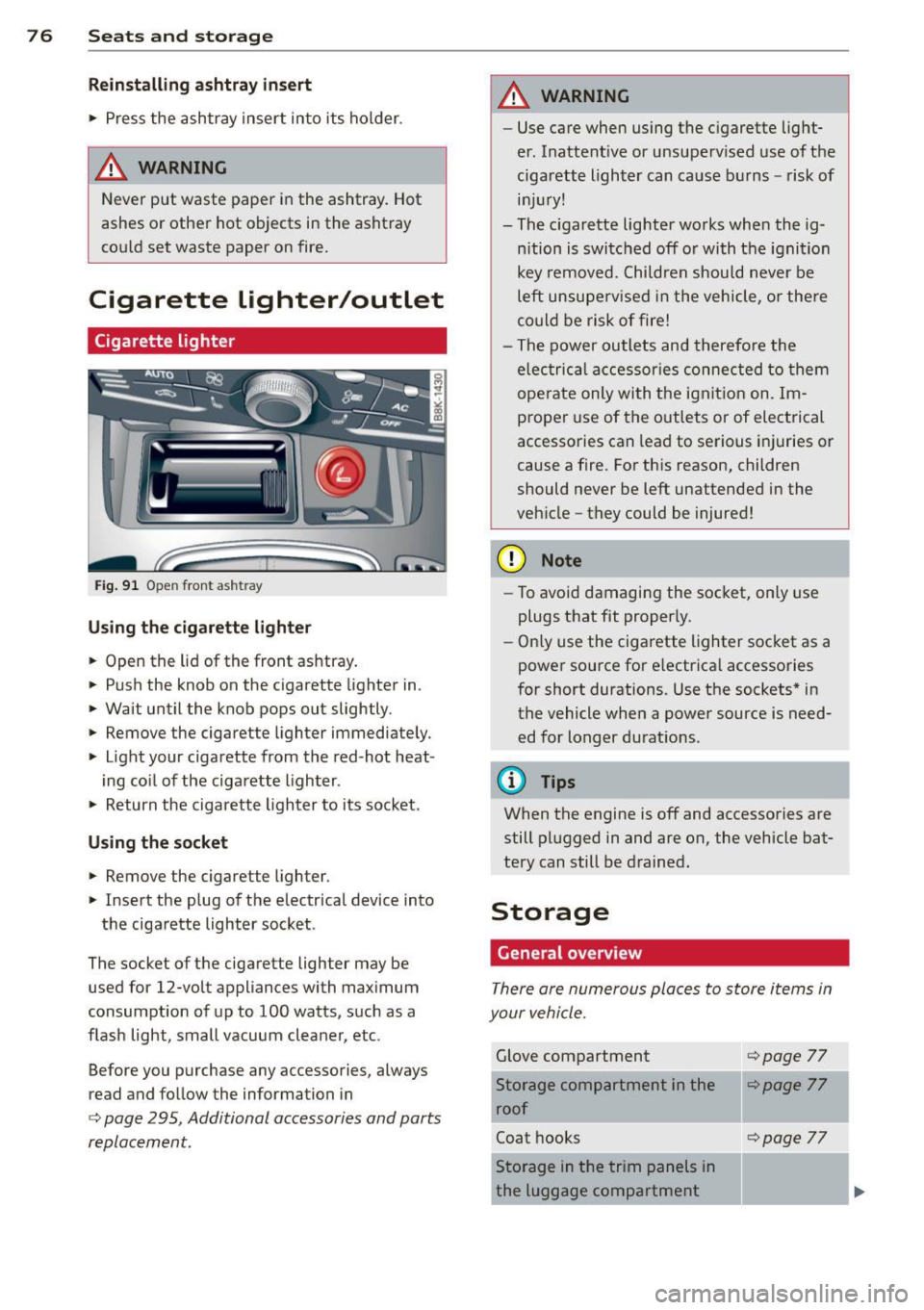
Fig . 9 1 Open front asht ray
Using th e cig arett e light er
> Open the lid of the front ashtray .
> Push the knob on the cigarette lighter in.
> Wait until the knob pops out slightly .
> Remove the cigarette lighter immediately.
> Light your cigarette from the red-hot heat -
ing coil of the cigarette lighter .
> Return the cigarette ligh ter to its socket.
Using the socket
> Remove the cigarette lighter.
> Insert the plug of the electrical device into
t h e ciga rette lighter socket .
The socket of the cigarette lighter may be
used for 12-volt appliances with max imum
consumption of up to 100 watts, such as a
flash light, small vacuum cleane r, etc.
Before you purchase any accessories, always
read and follow the information in
¢ page 295, Additional accessories and parts
replacement.
A WARNING
-
- Use care when using the c igarette light-
er . Inattent ive or unsuperv ised use of the
cigarette lighter can ca use burns -risk of
in jur y!
- The cigarette lighter works when the ig nition is switched off o r with the ignition
key removed. Child ren shou ld never be
left unsuperv ised in the vehicle, or the re
co uld be risk of fire!
- T he power outlets and therefore the
elec tric al accessor ies connec ted to them
operate only with t he ignit ion on. Im
p roper use of the outlets or of elect rical
accessories can lead to serious i nju ries or
cause a fire . For th is reason, children
should never be left unattended in the
veh icle -they could be injured!
(D Note
- To avoid damagi ng the socket, only use
plugs that fit proper ly.
- Only use the cigarette lighter socket as a
power source for e lectr ica l accessories
for short durations. Use the sockets * in
the vehicle when a power source is need
ed for longer du rat io ns.
(!) Tips
When the engine is off and accessories are
still plugged in and are on, the vehicle bat
tery can still be d rained.
Storage
General overview
T here are numerous places to store items in
your vehicle.
Glove compartment
Storage compartment in the roof
Coat hooks
-Storage in the trim panels in
the luggage compartment
i:>page 77
i:>page 7 7
i:>page 77
Page 80 of 316
78 Seats and stor age
- Do not use coat hangers to hang the
clothing otherw ise the efficacy of the
head air bags* is compromised.
Page 91 of 316

Warm and cold 89
Air vents
Applies to vehicles: w it h Deluxe automatic climate control plus
Air distribution determines the air flow from the individual vents.
Fig. 102 Instrument pa nel: Locat ion of air vents
Vents @and @
• Ro tat e the thumbwheel located next to the
outlet to open or close it.
• To adjust the direction of the airflow from
the outlet, move the tab in the center of the
outlet in the desired direct ion. The direction
of the air delivered from the vents can be
adjusted horizontally and vertically.
The air out lets are actuated either automati
cally or manually depending on the operating
mode selected. Heated or unheated fresh air
or cooled a ir flows from vents(!) through @.
(D Tips
If the climate control is running in cooling
mode, air flows mainly from vents @and
@. To achieve adequate cooling, you
should never close these vents complete ly .
Rear air vents
Applies to vehicles: with Del uxe automatic climate con
tro l pl us
The rear air vents ore located in the center
console.
• Rotate the thumbwheel to open and close
the vents .
• To adjust the direction of the airflow from
the outlet , move the tab in the center of the
outlet in the desired direction. The direction
of the a ir delivered from the vents can be
adjusted hor izonta lly and vert ically .
The air vents are actuated either automat ical
ly or manually depending on the operat ing
mode selected . Heated or unheated fresh air,
or cooled air flows from the vents .
The air vents to heat the rear footwell are lo
cated under the front seats.
Page 92 of 316

90 Warm and cold
If the climate control is operating in cool
ing mode, a ir flows primarily from the
vents in the center console. To achieve ad
equate cooling, you should never close
these vents completely.
Economical use of the climate control
system
A ppl ies to vehicles: w it h Deluxe au toma tic clima te co n
tro l p lus
Economical use of the climate control system
helps save fuel.
When the climate contro l system is working in
coo ling mode, engine performance is reduced
and fuel consumption is affected. To keep the
time the cl imate control system is on as short
as possible, you should do the follow ing:
.. To save fuel, turn off cooling mode by press
ing the AC button (indicator light goes out) .
.. In add ition, if you open the window or the
panoramic sliding/tilt ing sunroof* while
dr iv ing, turn off cooling mode by pressing
the AC button (indicator light goes out) .
.. If the vehicle is extremely hot due to the
heat of the sun, briefly open doors and win
dows.
@ For the sake of the environment
When you save fuel, you reduce em ission s
from the vehicle.
Deluxe automatic
climate control plus -
basic settings
General information
Ap plies to veh icles: w it h Deluxe automat ic climate co n
tro l p lus
The basic climate control settings can be ad
justed in the radio or MM!*.
.. Select: Funct ion button ICARI > Control but
ton
AC .
The follow ing funct ions can be selected: -
Auto reci rculat.
q page 90
- Synchronization
q page 90
Automatic recirculation
App lies to vehicles : with Del uxe a uto mat ic clima te con
tro l pl us
An air quality sensor detects increased con
centrations of pollutants in the outside air
and automatically switches to recirculation
mode.
We recommend that you always keep auto
matic recirculation ON to prevent polluted
outside air from entering the vehicle interior.
If the
air quality sensor located in the climate
control system detects polluted outside air,
the sensor dec ides whether the air pollut io n
can be reduced by the factory-installed pollu
tant filter or w hether it is necessary to switc h
to recirculation. With heavy concentr ations of
po llutants, the climate control system is
switched automatica lly to recirc ulation mode
and the supply of o utside air is blocked . As
soon as the concentration of pollutants in the
outside air drops, fresh air is supplied to the
vehicle interior aga in .
In the event that the windows fog up during
automatic recircu lation, press the~ button
immediately .
Under certain operating conditions, automatic
recirculation is switched off automatically.
When outside temperatures are below about
SO °F (+10 °C), automatic recirculat ion is lim
ited to 30 seconds. When outside tempera
tures are be low about 30 °F (-1 °C), automatic
recirculation is lim ited to 15 seconds .
Synchronization
Applies to veh icles : with Del uxe a uto mat ic climate con
tr ol pl us
One climate control setting for all seats.
After Syn chronization is set to On , all of the
subsequent climate control settings (except
for seat heating *) for the driver are transfer-
red to the front passenger. ..,.