steering wheel AUDI A5 COUPE 2012 User Guide
[x] Cancel search | Manufacturer: AUDI, Model Year: 2012, Model line: A5 COUPE, Model: AUDI A5 COUPE 2012Pages: 316, PDF Size: 78.59 MB
Page 133 of 316
until near maxim um RPM is reached, or unt il
the driver shifts into 2nd gear .
I f y ou ta ke your foo t off the acceler ator ped al
when dr iving down a steep in cline, tiptronic
will downshift from the se lected gea r into the
next lowe r gear until it reaches 1st gea r,
based on road speed and eng ine RPM. A uto
mat ic downshifting is interrupted as soon as
you apply the thrott le aga in.
@ Tips
- When yo u shift into the next lower gear,
t h e transmiss io n will downs hift only
when there is no possibility of over-rev
v ing the e ngine.
- When t he kick-down comes on, the
transmission will sh ift down to a lower
gear, d epe nding on vehicle a nd e ngine
s peeds .
- tiptron ic is inoperative when the trans
mission is in th e fail-safe mode .
Steering wheel with tiptronic
Applies to vehicles: with tiptronic steer ing wheel
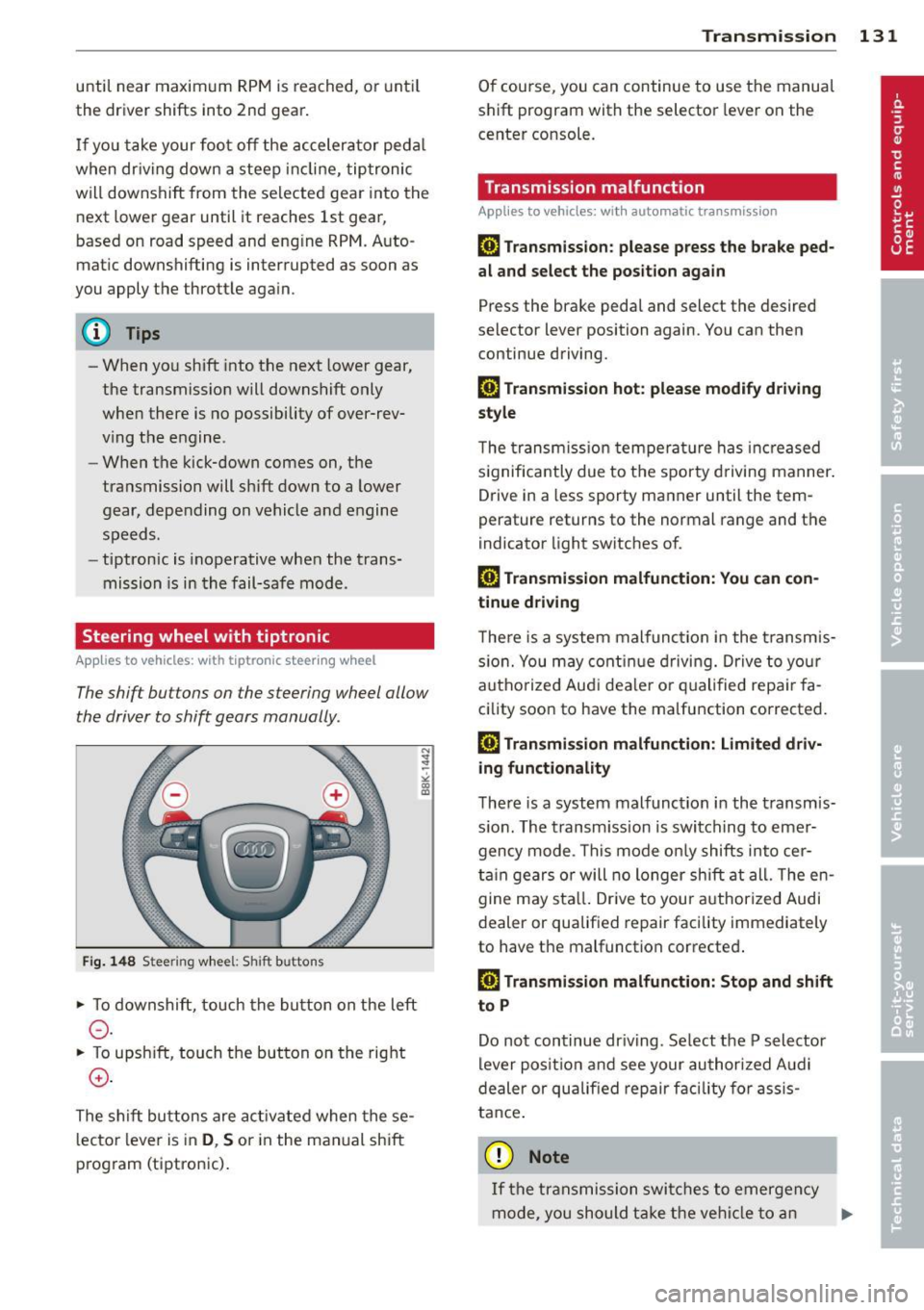
The shift buttons on the steering wheel allow
the driver to shift gears manually .
Fig. 148 S tee rin g w hee l: S hift buttons
• To downshift, to uch the button on the left
0 -
• To upsh ift, touch the but ton on the rig ht
0 -
The s hift buttons are ac tivated when the se
l ecto r lever is in
D , S or in the manual shift
p rog ram (tiptron ic) .
Transm ission 131
O f course, you can continue to use the manua l
s h ift pr ogram with the selector lever on the
cente r co nsole.
Transmission malfunction
Applies to vehicles: wit h automatic transmission
[O] Transmission : please press the brake ped
al and select the position again
Press the bra ke pedal and select the desired
selector lever position again. You can then
continue driving.
[O] Transmi ssion hot: please modify driving
style
T he trans mission tempe ra tur e has increased
s ignifica ntly due to t he spor ty dr ivin g manner .
Drive in a less sporty ma nner until the tem
perature returns to the normal range and the
indicator light switches o f.
[O] Transmission malfunction: You can con
tinue driv ing
T here is a system malfunc tion in the transm is
s io n. You may con tinu e dr ivin g. D rive to yo ur
a utho rize d Au di dea le r or qu alified repa ir fa
c ility soon to have the ma lfunction corrected .
[O] Transmission malfunction: Limited driv
ing functionality
T he re is a system mal func tion in the t ransmis
s io n. The transm iss ion is swi tching to emer
gency m ode . Th is mode o nly shifts into cer
t ain gears o r will no longer shi ft at all. The en
g ine m ay sta ll. Drive to you r author ized Audi
dealer or qualif ied repair facility immediately
to have the malfunction corrected .
[O] Transmission malfunction: Stop and shift
to P
Do n ot continue dr iving. Se lect t he P selector
lever posi tion an d see your au thori zed A udi
de aler or qu alified re pair facili ty for assis
ta nc e.
(D Note
If th e tra ns missi on swit ches to emer gen cy
mode, y ou sh oul d tak e th e ve hicl e to an
IJll>
Page 139 of 316
switched on, or the start-up phase is
completed.
- Keep the sensors in the rear b umper and
the rear view camera lens clean and free
of snow and ice, so that the parking sys
tem can work properly. Please follow the
additional notes on
c:;, page 139.
Reverse Parking
A ppl ies to vehicles: with parkin g system (rear, with rea r
view ca mera)
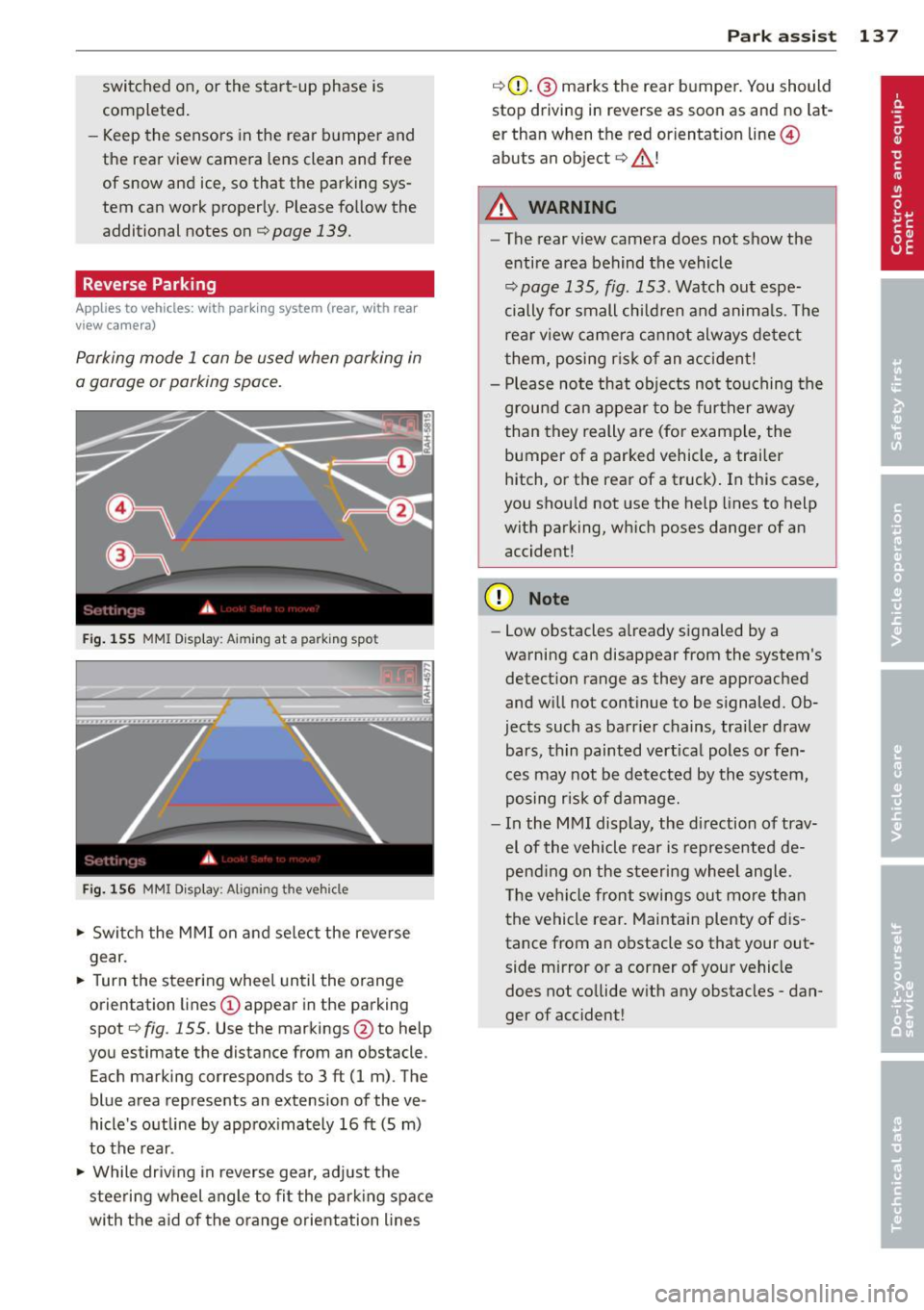
Parking mode 1 can be used when parking in
a garage or parking space.
F ig . 155 MMI Disp lay: Aiming at a parking spot
Fi g. 156 MMI Display: Aligning the vehicle
.,. Switc h the MMI on and se lect the reverse
gear.
.,. Turn the steering wheel until the orange
orientation lines
(D appear in the parking
spot
c:;, fig. 155. Use the markings @to help
you estimate the distance from an obstacle .
Each marking corresponds to 3
ft (1 m). The
blue area represents an extension of the ve
hicle's outline by approx imately 16
ft (5 m)
to the rear.
.,. While driving in reverse gear, adj ust the
steering wheel angle to fi t the park ing space
with the aid of the orange orientation lines
Par k ass ist 137
c:;,G)_ @ marks the rear bumper. You should
stop driving in reverse as soon as and no lat
er than when the red orientat ion line ©
abuts an object
c:;, _&. !
A WARNING
- The rear view camera does not show the
entire area behind the vehicle
c:;, page 135, fig. 153. Watch out espe
cially for small children and anima ls. The
rear view camera ca nnot always detect
them, posing r is k of an accident!
- Please note that objects not touching the
g rou nd can appear to be further away
than they really are (for example, the
bumper of a parked vehicle, a trailer
hitch, or the rear of a truck). In this case,
you shou ld not use the help lines to help
with parking, which poses danger of an accident!
(D Note
- Low obstacles a lready signaled by a
warning can disappear from the system's detection range as they are approached
and w ill not continue to be signaled. Ob
jects such as barrier chains, trailer draw bars, th in painted vert ica l poles or fen
ces may not be detected by the system,
posing risk of damage.
- In the MMI display, the di rection of trav
el of the vehicle rear is represented de
pend ing on the s teering wheel angle.
The vehi cle front swings out mo re than
the vehicle rear. Maintain plenty of dis
tance from an obstacle so that your out
side mirror or a corner of your vehicle
does not co llide w ith any obstacles -dan
ger of accident!
Page 140 of 316
138 Park ass is t
Parallel Parking
App lies to vehicles: with park ing system (rear, with rear
view camera)
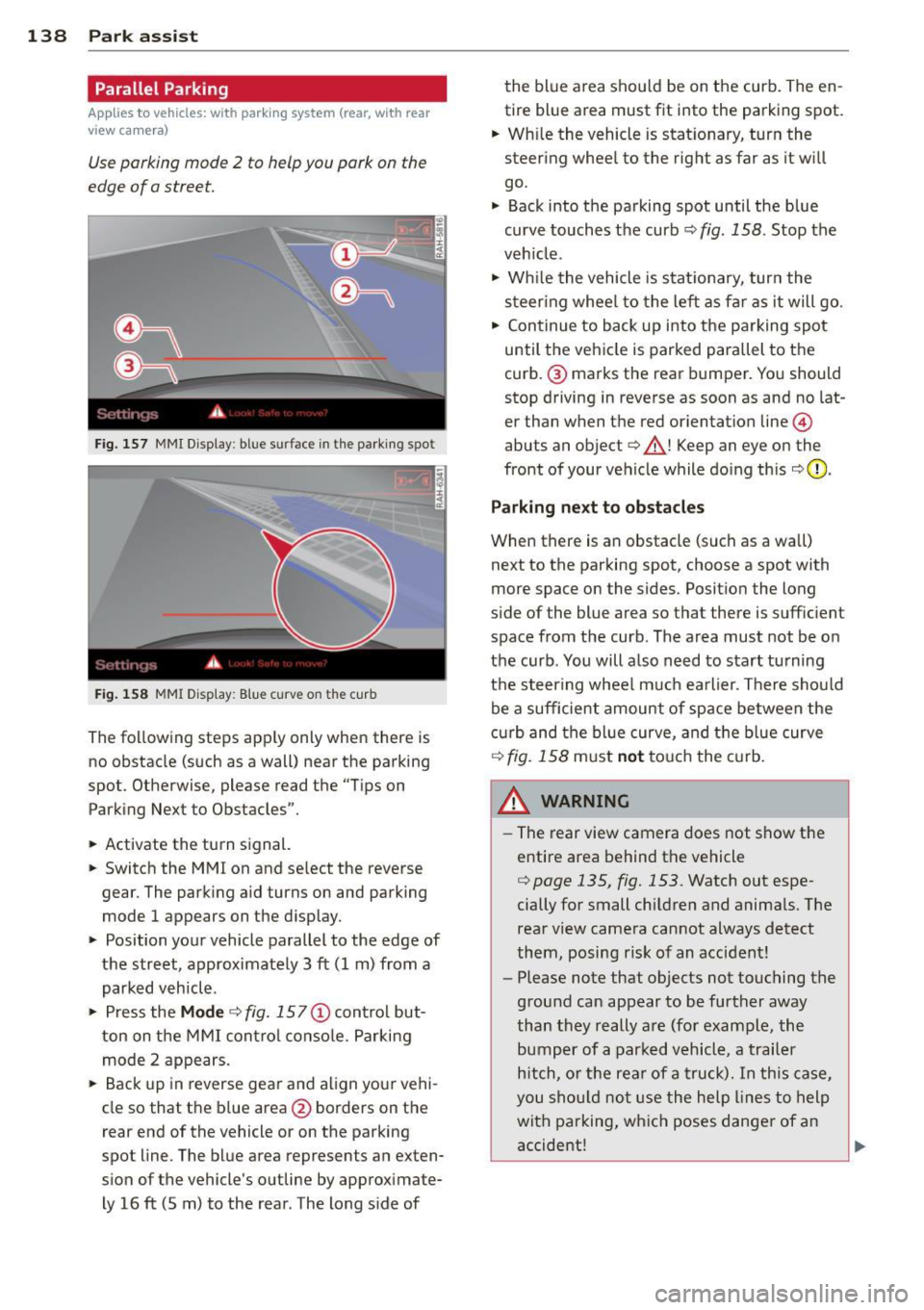
Use parking mode 2 to help you park on the
edge of a street.
..
-...;~ !!!!la-lP.!""" --3.::JI
Fig. 157 MMI Display : blue surfa ce in the parking spot
Fi g. 158 MMI Display: Blue curve on the curb
The following steps apply only when there is
no obstacle (such as a wall) near the parking
spot. Otherwise, please read the "Tips on
Parking Next to Obstacles".
.. Activate the turn signal.
.. Switch the MMI on and select the reverse
gear. The parking aid turns on and parking
mode 1 appears on the disp lay.
.. Position your vehicle parallel to the edge of
the street, approximately 3 ft (1 m) from a
parked vehicle .
" Press the
Mod e ¢ fig. 15 7@ control but
ton on the MMI contro l conso le. Parking
mode 2 appears.
.. Back up in reverse gear and align your vehi
cle so that the blue area
@ borders on the
rear end of the vehicle or on the parking
spot line. The blue area represents an exten
sion of the vehicle's outline by approximate
ly 16 ft (5 m) to the rear . The long side of the blue area
should be on the curb. The en
tire blue area must fit into the parking spot.
.. Wh ile the vehicle is stat ionary, turn the
steering whee l to the rig ht as far as it will
go.
" Back into the parking spot until the blue
curve touches the curb~
fig. 158. Stop the
vehicle .
" Wh ile the vehicle is s ta ti onary, tur n the
steer ing whee l to the left as f ar as it will go .
.. Continue to back up into the pa rking spot
until the vehicle is parked parallel to the
curb .@ marks the rear bumper. You should
stop driving in reverse as soon as and no lat
er than when the red orientation line@
abuts an object¢_&. ! Keep an eye on the
front of your vehicle while do ing this
¢ 6) .
Parking ne xt to obstacl es
When there is an obstacle (such as a wa ll)
next to the parking spot, choose a spot with
more space on the sides. Positio n the long
s ide of the blue area so that there is suff ic ient
space from the curb . The area must not be on
the curb . You will a lso need to start tu rning
t h e steer ing wheel much ea rlier . There should
be a sufficient amount of space between the
curb and the bl ue curve, and t he b lue curve
¢ fig. 158 m ust not to uch the c urb.
A WARNING
- The rear view camera does not show the
entire area behind the vehicle
¢ page 135, fig. 153. Watch out espe
cially for small children and anima ls. The
rea r view camera ca nnot always detect
them, posing risk of an accident!
- Please note that objects not touching the
ground can appear to be further away
than th ey really are (for example, the
bumper of a parked vehicl e, a trail er
h itch, o r th e rea r of a truck). In this case,
you s hould not use the help l ines to help
with parking, which poses dange r of an
accident!
'---------------_J ""
Page 141 of 316
(D Note
In the MMI display, the direction of travel
of the vehicle rear is represented depend
ing on the steering wheel angle. The vehi
cle front sw ings out more than the vehicle
rear. Maintain plenty of distance from an
obstacle so that you r outside m irror or a
corner of your veh icle does not co llide w ith
any obsta cles -danger of acc ident!
(D Tips
The left or r ight orientation li nes and sur
faces will be displayed, depend ing on the
tur n signa l be ing used.
Adjusting the display and warning tones
A ppl ies to vehicles: with pa rk in g system (rear, with rea r
view camera)
The display and warning tones are adjusted in
the radio or MM!*.
~ Select: ICARI > Pa rking system .
Display
-Off -when the pa rking system is switched
off, only aud ib le signals are given.
- On -when the parking system is switched
on, the pict ure from the rear view camera is
displayed.
Warning tones
- Rear volume -rear sensor volume
-Rear frequency -rear sensor frequency
-In -car entertainment fader -when the park-
ing system is sw itched on, the volume of the
active audio source is lowered .
The newly adjusted value is briefly heard from
the signal generator. The settings are auto
mat ically stored and assigned to the remote
control key.
A WARNING
- Always make sure that the volume and
frequency of t he warning tones is adjust
ed so that you can easily hea r th e acous
ti c dis tance s ign al even if the r adio is
playing, the a ir-conditioner b lower is on
-
P ark a ssis t 139
High o r there is a high level of outside
noise.
- Check the settings whenever someone
else has driven the vehicle before you.
(D Tips
- T he war ning tones can also be adjus ted
directly from t he rear view camera im
age. S imply press the
I Sett ings !* contro l
button.
- Changed settings are activated when
parking assist is switched on again .
' Error messages
Applies to vehicles: wit h parking system (rear, wit h rear
v iew camera)
If a warning tone is aud ible for about five sec
onds when yo u turn on the ignition, there is a
malfunction in the system. Have the problem
corrected by your author ized Audi dealer.
Keep the senso rs in the rea r bu mpe r clean and
free from ice so that the acoustic park assist
system can function properly .
Page 147 of 316
.. Sit properly in your seat and make sure that
your passengers do the same ¢
page 61,
General recommendations.
.. Fasten your safety belt and wear it properly.
Also instruct your passengers to fasten their
safety belts properly¢
page 154.
What impairs driving safety?
Safe driving is directly related to the condi
tion of the vehicle , the driver as well as the
driver's ability to concentrate on the road
without being distracted .
The driver is responsible for the safety of the
vehicle and all of its occupants. If your ability
to drive is impaired, safety r isks for everybody
in the vehicle increase and you a lso become a
hazard to everyone else on the road
~ .&,.
Therefo re:
.. Do not let yourself be distracted by passen
gers or by using a cellular telephone .
.. NEVE R drive when yo ur driv ing ability is im
paired (by medicat ions, alcohol, drugs, etc.).
.. Observe all traffic laws, rules of the road
and speed limits and plain common sense .
.. ALWAYS adjust your speed to road, traffic
and weather conditions .
.,. Take frequent breaks on long trips. Do not
drive for more than two hours at a stretch.
.. Do NOT drive when you are tired, under
pressure or when you are stressed .
& WARNING
Impaired driving safety increases the risk
of serious personal injury and death when
ever a vehicle is being used.
Driving Safely 145
Proper occupant
seating positions
Proper seating position for the driver
The proper driver seating position is impor
tant for safe, relaxed driving.
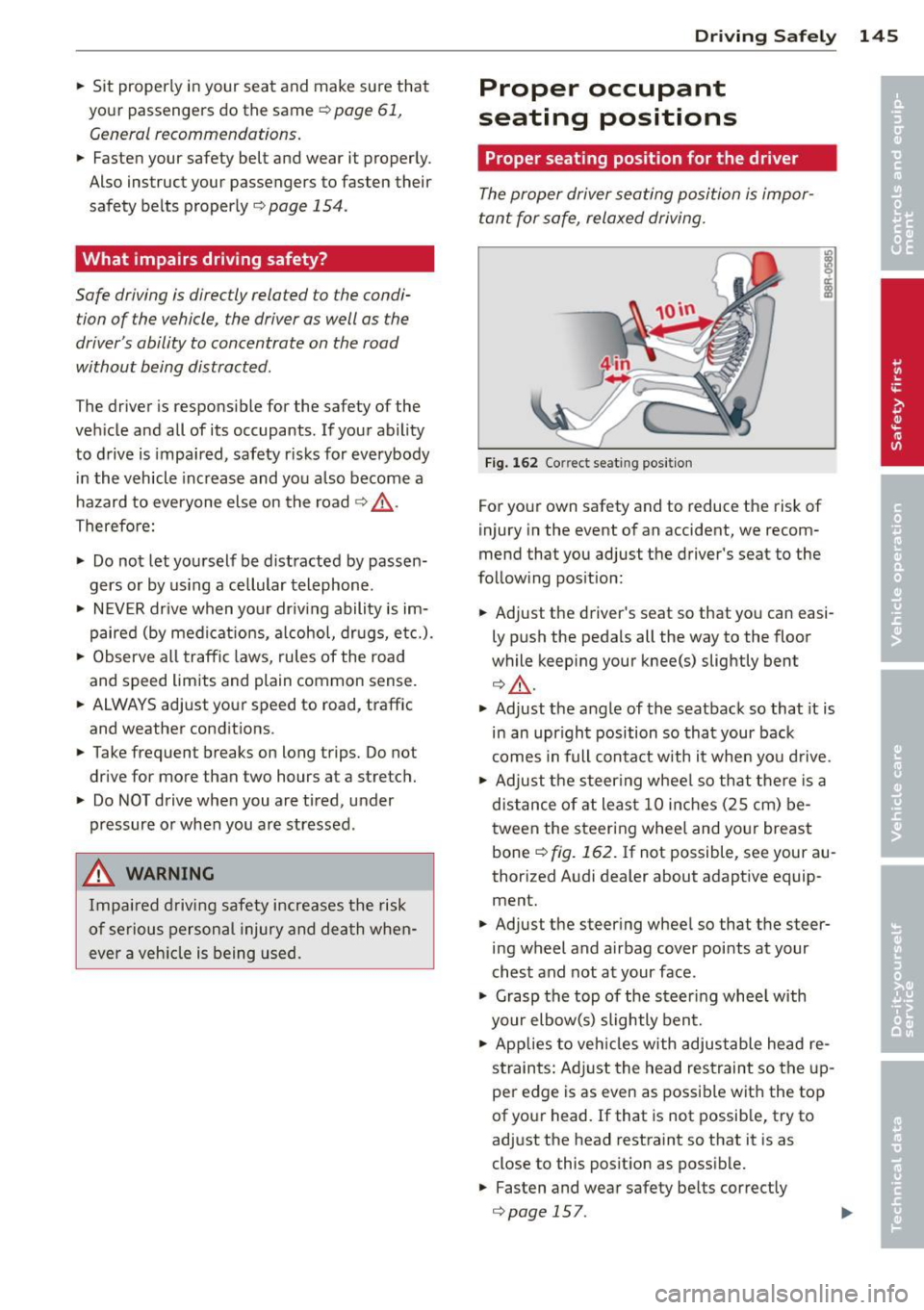
Fig. 162 Correct seat ing pos it ion
For your own safety and to reduce the risk of
injury in the event of an accident, we recom
mend that you adjust the driver's seat to the
follow ing pos ition:
.. Adjust the driver's seat so that you can easi
ly push the pedals all the way to the floor
wh ile keeping your knee(s) slightly bent
¢&, .
.. Adjust the angle of the seatback so that it is
in an upr ight position so that your back
comes in full contact w ith it when you drive.
.. Adjust the steering wheel so that there is a
distance of at least 10 inches (25 cm) be
tween the steering wheel and yo ur breast
bone
~ fig. 162. If not possible, see your au
thorized Audi dealer about adaptive equip
ment.
.. Adjust the steer ing wheel so that the steer
ing wheel and airbag cover points at your
chest and not at your face .
.,. Grasp the top of the steering whee l with
your elbow(s) slightly bent .
.. App lies to vehicles with adjustable head re
s tra ints: Ad just the head restraint so the up
per edge is as even as possible with the top
of your head. If that is not possible, try to
adjust the head restraint so that it is as
close to this pos it ion as possible .
.. Fasten and wear safety be lts correctly
¢ page 15 7 . .,.
Page 148 of 316
146 Driving Safely
• Always keep both feet in the footwell so
that you are in control of the vehicle at all
times.
For detailed information on how to adjust the
driver's seat, see
¢ page 63.
A WARNING
Drivers who are unbelted, out of position
or too close to the airbag can be seriously
injured by an airbag as it unfolds. To help
reduce the risk of serious personal injury:
- Always adjust the driver's seat and the
steering wheel so that there are at least
10 inches (25 cm) between your breast
bone and the steering wheel.
- Always hold the steering wheel on the
outside of the steering wheel rim with
your hands at the 9 o'clock and 3 o'clock positions to help reduce the risk of per
sonal injury if the driver's airbag inflates.
- Never hold the steering wheel at the
12 o'clock position or with your hands at
other positions inside the steering wheel
rim or on the steering wheel hub. Hold
ing the steering wheel the wrong way
can cause serious injuries to the hands,
arms and head if the driver's airbag de
ploys.
- Pointing the steering wheel toward your
face decreases the ability of the supple
mental driver 's airbag to protect you in a
collision .
- Always sit in an upright position and nev
er lean against or place any part of your
body too close to the area where the air
bags are located.
- Before driving, always adjust the front
seats and head restraints properly and
make sure that all passengers are prop
erly restrained.
- Never adjust the seats while the vehicle
is moving . Your seat may move unexpect
edly and you could lose control of the ve
hicle.
- Never drive with the backrest reclined or
tilted far back! The farther the backrests
are tilted back, the greater the risk of in- jury due to incorrect positioning of the
safety belt and improper seating posi
tion.
- Children must always ride in child safety
seats ¢
page 186. Special precautions
apply when installing a child safety seat
on the front passenger seat¢
page 162 .
Proper seating position for the front
passenger
The proper front passenger seating position
is important for safe, relaxed driving .
For your own safety and to reduce the risk of
injury in the event of an accident, we recom
mend that you adjust the seat for the front
passenger to the following position :
• Move the front passenger seat back as far
as possible . There must be a minimum of
10 inches (25 cm) between the breastbone
and the instrument panel¢,&. .
• Adjust the angle of the seatback so that it is
in an upright position and your back comes
in full contact with it whenever the vehicle is
moving.
• Applies to vehicles with adjustable head re
straints: Adjust the head restraint so the up
per edge is as even as possible with the top
of your head. If tha t is not possible, try to
adjust the head restraint so that it is as
close to this position as possible.
• Keep both feet flat on the floor in front of
the front passenger seat.
• Fasten and wear safety belts correctly
¢page 157.
For detailed information on how to adjust the
front passenger's seat, see
¢ page 61.
A WARNING
-
Front seat passengers who are unbelted,
out of position or too close to the airbag
can be seriously injured or killed by the air
bag as it unfolds. To help reduce the risk of
serious personal injury:
Page 164 of 316
162 Airbag sys tem
Airbag system
Important things to know
Importance of wearing safety belts and
sitting properly
Airbags are only supplemental restraints. For
airbags to do their job , occupants must al
ways properly wear their safety belts and be
in a proper seating position.
F or your safety and the safety of your passen
gers, before driving off, a lways:
• Adjust the dr iver's seat and steering wheel
properly ¢
page 145,
• Adjust the front passenger's seat properly
¢page 62,
• Wear safety be lts properly ¢ page 15 7,
• Always properly use the proper child re-
stra int to protect children¢
page 186.
In a collision airbags must inflate within the
blink of an eye and with considerable force .
The supplementa l airbags can cause injuries if
the dr iver or the front seat passenger is not
seated properly . Therefore in order to he lp the
a irbag to do its job, it is important, both as a
d river and as a passenge r to sit properly at all
times.
By keeping room between your body and the
steering wheel and the front of the passenger
compartment, the airbag ca n inflate fully and
comp letely and provide supp lemental p rotec
tion in ce rtain frontal collisions¢
page 145,
Proper occupant seating positions .
For detai ls
on the operat ion of the seat adjustment con
trols ¢
page 63.
It's especially important that children a re
properly restrained ¢
page 186.
There is a lot that the driver and the passen
gers can and must do to help the individua l
safety features ins talled in your A udi work to
gether as a system.
Prope r seat ing pos ition is important so that
the front airbag on the driver s ide can do i ts
job. If yo u have a physical impa irment or con- dition that prevents you from sitting properly
on the driver seat with the safety belt properly
fastened and reaching the peda ls , spec ial
modifications to your vehicle may be necessa
ry.
Contact your a uthorized Audi dea ler, or call
Audi C ustomer Re lations at 1-800-822-2834 .
When the airbag system dep loys, a gas gener
ator will f ill the ai rbags, break open the pad
ded covers, and inf late between the steering
whee l and the dr iver and between the instru
ment pane l and the front passenger. The air
bags will deflate immediately after dep loy
ment so that the front occupants can see
th rough the w indshield aga in without inter
ruption .
All of th is take s place in the blink of an eye, so
fast that many people don't even realize that
the a irbags have dep loyed . The airbags also
inflate with a g reat dea l of force and nothing
shou ld be in their way when they deploy.
F ront a irbags in combination with properly
worn safety bel ts slow down and lim it the oc
c u pant's forward movement. Together they
help to prevent the drive r and front seat pas
senger from hitting parts of the inside the ve
hicle while reducing the forces acting on the
occupant dur ing the crash. In this way they
help to reduce the risk of injury to the head
and uppe r body i n the c rash . A irbags do not
protect the a rms or the lower parts of the
body.
Both front a irbags w ill not i nflate in all fronta l
collisions . The t rigge ring of the a irbag system
depends on the vehicle dece lerat ion rate
c aused by the co llision and reg istered by the
elect ron ic cont ro l u nit. If t his rate is below
the re ference value programmed into the con
trol unit, the airbags will not be trigge red ,
even though the car may be bad ly damaged as
a res ult of the collision . Veh icle damage, re
pair costs or even the lack of veh icle damage
is no t necessarily an indication of whether an
airbag should inflate or not .
It is not possib le to define a range of vehicle
speeds that w ill cover every possib le kind and .,.
Page 165 of 316
angle of impact that will always trigger the
airbags, since the circumstances will vary con
siderably between one collision and another.
Important factors include, for example, the nature (hard or soft) of the object which the
car hits, the angle of impact, vehicle speed,
etc. The front airbags will also not inflate in
side or rear collisions, or in ro ll-overs .
Alwa ys rem ember : Airbags will deploy only
once, and only in certa in kinds of collisions .
Your safety belts are always there to offer pro
tection in those s ituations in which airbags
are not supposed to deploy , or when they have
a lready deployed ; fo r example , when yo ur ve
h icle strikes or is struck by another after the
first collision .
This is just one of the reasons why an a irbag is
a supplementary restra int and is not a s ubst i
tute for a safety belt . The airbag system
works most effectively when used with the
safety belts. Therefore, always properly wear
your safety belts
¢ page 154.
A WARNING
Sitting too close to the steer ing wheel or
instrument panel will decrease the effec
tiveness of the airbags and will increase
the risk of pe rsonal injury in a co llision .
- Never sit closer than
10 inches (25 cm)
to the stee ring wheel or instrument pan
el.
- If you cannot sit more than
10 i nches
(25 cm) from the steer ing wheel, investi
gate whether adaptive equipment may
be available to help you reach the pedals
and increase your seating dis tance from
the steering wheel.
- If you are unrestrained, lean ing fo rward,
sitting sideways or out of position in any
way, yo ur risk of inj ury is much highe r.
- You w il l also receive serio us inju ries and
cou ld even be killed if you are up against
the airbag or too close to it when it in
flates -even with an Advanced Airbag.
- To reduce the r isk o f injury when an air
bag inflates, a lways wear safety belts
proper ly ¢
page 157, Safety belts .
Airbag system 163
-Always make certain that chi ld ren age 12
or younger a lways ride in the rear seat. If
children are not properly restrained, they may be severe ly inju red or killed when an
airbag inf lates .
- Never let ch ildren ride unrestra ined or
improperly restrained in the vehicle . Ad
just the front seats prope rly.
- Never ride with the backrest reclined.
- Always sit as far as possible from the
steer ing whee l or the instrument pane l
¢page 145.
-Always sit upright with your back against
the backrest of your seat.
- Never p lace your feet on the instrument
panel or on the seat. Always keep both
feet on the f loor in front of the seat to
he lp prevent serio us in juries to the legs
a nd h ips if the airbag inflates.
- Never recline the front passenger 's seat
to tra nsport objects. Items can a lso
move i nto the area of the s ide a irbag or
the front a irbag du ring bra king or in a
sud den maneuve r. Obje cts ne ar the air
bags can become projectiles and cause
injury when an airbag inflates.
_&. WARNING ~
A irbags that have de ployed in a crash must
be replaced.
- Use on ly original equipment airbags ap
proved by Audi and installed by a trai ned
technician who has the necessary too ls
and d iagnost ic equipment to properly re
place any airbag in your vehicle and as
sure system effectiveness in a crash .
- Never perm it salvaged or recycled air
bags to be installed in your vehicle .
Child restraints on the front seat - some
important things to know
.,. Be su re to read t he important information
and head the WARNINGS fo r important de
tails about children and Advanced Airbags
¢ page 186. ..,.
•
•
Page 168 of 316
166 Airbag system
-Never place additiona l items on the seat
that can increase the total weight regis
tered by the weight-sensing mat and can
cause injury in a crash.
Front airbags
Description of front airbags
The airbag system can provide supplemental
protection to properly restrained front seat
occupants.
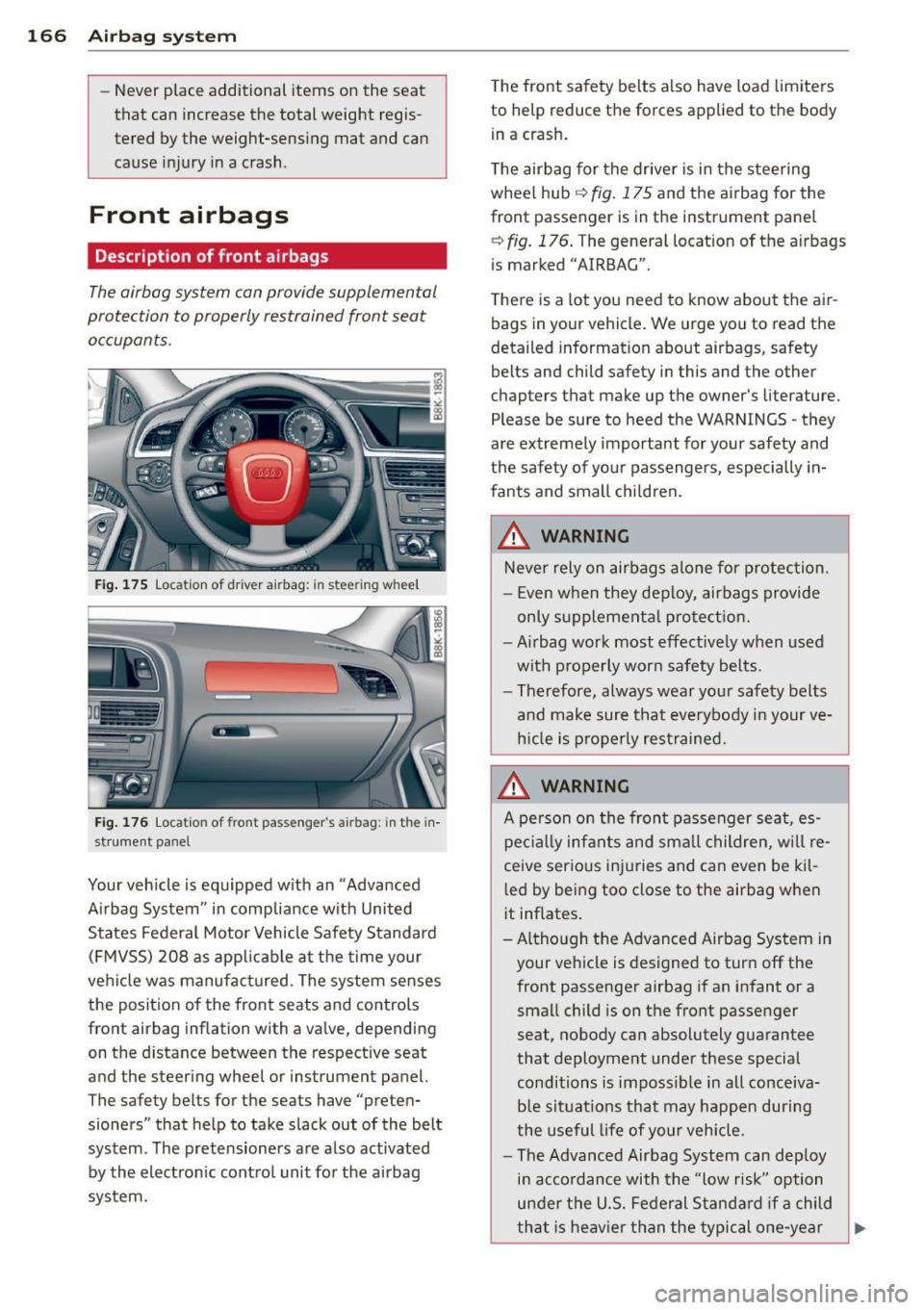
F ig . 175 Location of driver airbag: in steer ing whee l
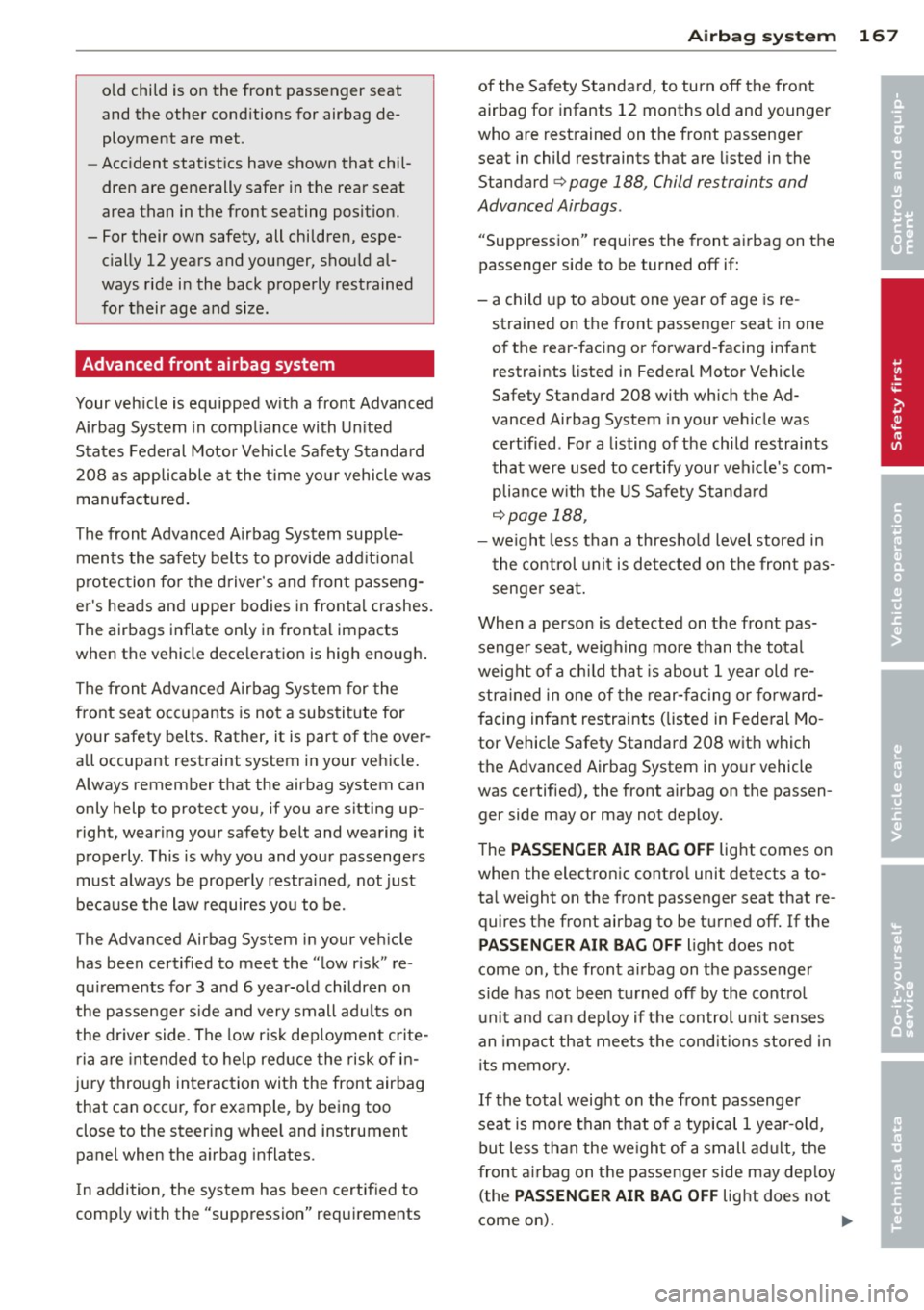
Fig. 176 Location of front passenger's airbag: in the in
strument panel
Your veh icle is equipped with an "Advanced
A irbag System" in compliance with United
States Federal Motor Vehicle Safety Standard ( FM VSS) 208 as app licab le at the time your
ve hicl e was manufac tured. The system senses
the position of the front seats and controls
front airbag inflation with a valve, depending
on the distance between the respect ive seat
and the steering wheel or instrument panel.
The safety belts for the seats have "preten
sioners" that he lp to take slack out of the belt
system . The pretensioners a re also activated
by the electron ic cont ro l unit for the ai rbag
system. T
he front safety belts also have load limiters
to help reduce the forces applied to the body
i n a crash .
T he airbag for the drive r is in the stee ring
whee l hub¢
fig. 175 and the airbag for the
front passenger is in the instrument panel
~ fig. 176. The general locat ion of the a irbags
is marked "AIRBAG".
T here is a lot you need to know about the ai r
bags in your vehicle. We urge you to read the
detailed information about airbags, safety
belts and child safety in this and the other
chapters that make up th e owner's literature.
P lease be sure to heed the WARNINGS -they
are extremely importa nt for your safety and
the safety of your passengers, especially in
fants and small chi ldren.
_&. WARNING
Neve r rely on airbags alone for p rotection.
- Even w hen they deploy, airbags provide
only s upplement al pro te ctio n.
- Airbag work most effect ive ly when used
with p roperly wor n safety bel ts.
- Therefore, always wea r you r safety belts
a nd make sure tha t eve rybody in your ve
h icle is properly res trained.
_&. WARNING
A pe rson on the front passenger seat, es
pe cial ly infa nts and sm all ch ildren, w ill re
ceive serio us inju ries and can even be kil
l ed by being too close to the airbag when
it inflates .
- Although t he Advanced Airbag System in
your veh icle is designed to tur n off the
front passenger airbag if an infant or a
small child is on the front passe nger
seat, nobody can absolutely guarantee
that deployment under these special
conditions is imposs ible in all conceiva
b le sit uat ions that may happen dur ing
the useful life of your vehicle.
- The Advanced Airbag System can dep loy
i n acco rdance with the "low risk" option
unde r the U.S . Feder al Standa rd if a child
th at is heav ie r than the typical one -year
-
.
Page 169 of 316
old child is on the front passenger seat
and the other conditions for airbag de
ployment are met.
- Accident statistics have shown that chil
dren are generally safer in the rear seat
area than in the front seating position.
- For their own safety, all children, espe cially 12 years and younger, should al
ways ride in the back properly restrained
for their age and size.
Advanced front airbag system
Your vehicle is equipped with a front Advanced
Airbag System in compliance with United
States Federal Motor Vehicle Safety Standard
208 as applicable at the time your vehicle was
manufactured.
The front Advanced Airbag System supple ments the safety belts to provide additional
protection for the driver's and front passeng
er's heads and upper bodies in frontal crashes.
The airbags inflate only in frontal impacts
when the vehicle deceleration is high enough .
The front Advanced Airbag System for the
front seat occupants is not a substitute for
your safety belts. Rather, it is part of the over
all occupant restraint system in your vehicle.
Always remember that the ai rbag system can
only help to protect you, if you are sitting up right, wearing your safety belt and wearing it
properly . This is why you and your passengers
must always be properly restrained, not just
because the law requires you to be.
T he Advanced Airbag System in your vehicle
has been certified to meet the "low risk" re
quirements for 3 and 6 year-old children on
the passenger side and very small adults on
the driver side. The low risk deployment crite
ria are intended to help reduce the risk of in
jury through interaction with the front airbag
that can occur , for example , by being too
close to the steering wheel and instrument panel when the airbag inflates.
In addition, the system has been certified to
comply with the "suppression" requirements
Airbag system 167
of the Safety Standard, to turn off the front
airbag for infants 12 months old and younger
who are restrained on the front passenger
seat in child restraints that are listed in the
Standard ¢
page 188 , Child restraints and
Advanced Airbags .
"Suppression" requires the front airbag on the
passenger side to be turned off if:
- a child up to about one year of age is re
strained on the front passenger seat in one
of the rear-facing or forward-facing infant restraints listed in Federal Motor Vehicle
Safety Standard 208 with which the Ad
vanced Airbag System in your vehicle was
certified . For a listing of the child restraints
that were used to certify your vehicle's com pliance with the US Safety Standard
¢page 188,
-weight less than a threshold level stored in
the control unit is detected on the front pas
senger seat.
When a person is detected on the front pas
senger seat, weighing more than the total
weight of a child that is about 1 year old re
strained in one of the rear-facing or forward
facing infant restraints (listed in Federal Mo
tor Vehicle Safety Standard 208 with which
the Advanced Airbag System in your vehicle
was certified), the front airbag on the passen ger side may or may not deploy.
The
PASSENGER AIR BAG OFF light comes on
when the electronic control unit detects a to
tal weight on the front passenger seat that re
quires the front airbag to be turned off. If the
PASSENGER AIR BAG OFF light does not
come on, the front airbag on the passenger
side has not been turned off by the control unit and can deploy if the control unit senses
an impact that meets the conditions stored in
its memory.
If the total weight on the front passenger
seat is more than that of a typical 1 year-old ,
but less than the weight of a small adult, the
front airbag on the passenger side may deploy
(the
PASSENGER AIR BAG OFF light does not
come on). ..,. •
•