brakes AUDI A5 COUPE 2012 Owner's Manual
[x] Cancel search | Manufacturer: AUDI, Model Year: 2012, Model line: A5 COUPE, Model: AUDI A5 COUPE 2012Pages: 316, PDF Size: 78.59 MB
Page 220 of 316

218 Trailer towing
Trailer towing
Driving with a trailer
General information
Your Audi was designed primarily for passen
ger transportation .
If you plan to tow a trailer, p lease remember
that the additional load will affect durability,
economy and performance .
Trailer towing not on ly places more stress on
the vehicle, it also calls for more concentra
tion from the driver.
For this reason, always fo llow the operating
and driving instructions provided and use
common sense.
Technical requirements
Trailer hitch Use a weight-carrying hitch conforming to the
gross trailer weight. The hitch must be suita
ble for your vehicle and trailer and must be
mounted securely on the veh icle's chassis at a
technically sound location. Use only a trailer
hitch with a removable ball mount. Always
check with the trailer hitch manufacturer to
make sure that you are using the correct
hitch.
Do not use a bumper hitch.
The hitch must be installed in such a way that
it does not interfere with the impact-absorb
ing bumper system . No modifications should
be made to the vehicle exhaust and brake sys
tems . From time to time, check that all hitch
mounting bolts remain securely fastened.
When you are not towing a trailer, remove the
trailer hitch ball mount. This prevents the
hitch from causing damage should your vehi
cle be struck from behind
¢ A.
Trailer brakes
If your trailer is equipped with a braking sys
tem, check to be sure that it conforms to all
regulations . The trailer
hydraulic brake system must not be
direct ly connected to the vehicle's hydraulic
brake system
~ A.
Safety chains
Always use safety chains between your vehicle
and the trai le r.
Trailer lights
T railer lights must meet all regulations. Be
sure to check w ith your authorized Audi dealer
for correct wiring, switches, and relays.
Mirrors
If you are unable to see the traffic behind you
using the regular outside mirrors, then you
must install extended mirrors . It is important
that you
always have clear vis ion to the rear.
,8. WARNING
- If a trailer has electrical brakes please
note that these brakes are not activated
by the factory-fitted control unit -risk of
accident!
- Afte r removing the trailer hitch, do not
store it in your vehicle. In case of sudden
braking, the hitch could fly forward and
injure you or your passengers.
Operating instructions
Maximum trailer weight
-
A trailer for your vehicle is limited to a typical
class 1 or class 2 tra iler.
Trailer load distribution Be sure the load in the trailer is held secure ly
in place to prevent it from shifting forward,
backward or sideways.
Never allow a passenger to ride in a trailer
¢ A in Driving instructions on page 219.
Engine cooling system
T owing a trailer makes the engine work hard
er. It is important that the cooling system's
performance is up to the additional load.
Make sure that the cooling system has enough
fluid . .,..
Page 221 of 316
Tire pressure
When towing a tra ile r, inflate the t ires of your
vehi cle to the co ld tire pressure listed under
"Full load" on the label located either on the
driver's side B-pillar (visible when the doo r is
open) or inside the f uel f iller flap. Inf late
trailer tires to trailer and tire manufact urers'
specifications .
Lights
The headlight settings should be chec ked w ith
the t railer attached before dr iv ing off. Check
to make sure both vehicle and trai ler lights
are working properly.
Safety chains
Be s ure trai le r sa fety chains are p roperly con
nected from the t railer to the hitch on the ve
h icle. Leave enough s lack in the chains to per
mit turn ing corners . When you install safety
chains, make su re they w ill not drag on the
road when you are driving.
T he chains shou ld cross under the trai ler
tongue to prevent it from droppi ng in case of
separat io n from the hitch .
Driving instructions
Driving with a trailer always requires extra
care and consideration.
To obtain the best poss ible handling of vehicle
and trai ler, p lease note the following:
.,. Do no t tow a loa ded tra iler whe n your car i t
self is no t loaded .
.,. Be especia lly careful when passing other ve
hicles.
.,. Observe speed limits.
.,. Do not drive at the maximum permissible
speed.
.,. Always apply brakes early .
.,. Monito r the t em perature gauge.
Weight distribution
Tow ing a loaded trai ler with an empty car re
sults in a highly unstable distribution of
weight . If this ca nnot be avo ided, drive at very
Trailer towin g 219
low speeds on ly to avo id t he ris k of losing
steering cont ro l.
A "b alanced " rig i s ea sier to op erat e and con
tr ol. T his means t hat t he tow vehi cle should
be loaded to the extent possible and permissi
ble, while keep ing the trai ler as light as possi
ble under the c ircu mstances . Whenever poss i
ble, transfer some ca rgo to the luggage com
partment of the tow vehicle while obse rvi ng
tongue load requirements and vehicle load ing
cons idera tions .
Speed
The higher the speed, the more d iff icu lt it be
comes for the driver to contro l the rig. Do not
drive at the maxim um permissib le speed. Re
duce your speed even more if load, weather o r
wind conditions are unfavo rable -pa rticula rly
whe n going downhill .
Red uce ve hicle speed
immediately if the trail
er shows the slig htest s ign of sway ing .
Do not
try to stop the swaying by accelerating .
Observe speed limits. In some areas, speeds
for vehicles tow ing tra ile rs are lowe r than for
regular ve hicles .
A lways apply brakes early. When driving
down hill, shift into a lowe r gear to use the en
gine braking effect to s low the vehicle. Use of
the b rakes alone ca n cause them to overhea t
and fail.
Coo lant temperature
The coo lant temperat ure ga uge ¢ page 10
must be observed carefu lly. If the need le
m oves cl ose to t he upper end of t he scale, re
duce speed immediately and/or turn off t he
a ir condi tioner .
If the coolant temperature warning light .
in the instrument cluster starts flashing, pull
off the road , stop and let the engine
i dle for
abo ut two minutes to prevent heat build-up .
A WARNING
Anyone no t properly restra ined in a mov
in g ve hicle i s at a much gre ater r isk in an
a cci dent . N ever le t anyone rid e in yo ur car
-
•
•
Page 222 of 316
220 Trailer towing
who is not properly wearing the restraints
provided by Aud i.
Trailer towing tips
Important to know
Your vehicle hand les different ly when towing
a trailer because of the additional weight and
different weight distribution. Safety, perform
ance and economy wi ll greatly depend on how
carefully you load your trailer and operate
your rig.
Before you actually tow your trailer, practice
turning, stopp ing and backing up in an area
away from traffic. Keep practicing until you have become completely familiar with the way
your vehicle-trailer combination behaves and responds.
Backing up is difficult and requires practice.
Backing up with a trai ler genera lly requires
steering action opposite to that when backing up your vehicle without a trailer.
Maintain a greater distance between your ve
hicle and the one in front of you. You will need
more room to stop. To compensate for the
trailer, you will need a larger than normal
turn ing radius .
When passing, remember that you cannot ac
celerate as fast as you normally would be
cause of the added load. Make sure you have
enough room to pass . After passing, allow
plenty of room for your tra iler before chang
ing lanes aga in.
Avoid jerky starts, sharp turns or rapid lane
changes .
(D Tips
-Do not tow a tra iler during the break-in
period of your vehicle.
- If you tow a trailer, your Audi may re
quire more frequent maintenance due to
the extra load
q page 293.
Parking on a slope
Do not park on a slope with a trailer . If it can
not be avoided, do so only after doing the fol lowing:
When parking:
.. App ly the foot brake.
.. Have someone place chocks under both the
vehicle and the trailer wheels .
.,. With chocks in place, slowly release the
brakes until the wheel chocks absorb the
load.
.. Turn the wheels towards the curb.
.. App ly the parking brake.
.. Place an automatic transmission* in
P, re
spectively a manual transmission in first or reverse gear.
When restarting after parking:
.. App ly the foot brake.
.. Start the engine.
.. Move the se lector lever to
D , respectively a
manual transmission in first gear .
.. Release the parking brake and slow ly pu ll
out and away from the wheel chocks.
.. Stop and have someone retr ieve the wheel
chocks .
(D Tips
If you move the selector lever of the auto
matic transmission* to
P before applying
the parking brake and before blocking the
whee ls, you may have to use more force
lat er to move the lever out of the
P posi
tion.
Page 223 of 316
Cleaning and protect ion
General information
Regular core preserves vehicle value.
Any automobile is exposed to industrial
fumes , corrosive road salt, etc. A well cared
for Audi can look like new many years after purchase . Regu lar and correct care w ill con
tr ibute to maintaining the beauty and value of
your Aud i.
F u rth ermor e, good c are may be a conditi on
for subs tantiati ng a w arrant y claim sho uld
c orrosion d amag e or paint d efects oc cur.
Your authorized Audi dealer has a variety of
dedic ated veh icle-car e products and can ad
vise which ones to use for cleaning the exter i
or and interior of your vehicle.
Whether you use products recommended by
Aud i or other commercially available clean ing
agents, please make sure you apply them cor
rectly .
.&, WARNING
-Cleaning agents may be poisonous. Keep
them out of the reach of children.
- Heed all caut ion labels.
- Always read directions on the container
before using any product. Follow the di
rect ions carefu lly.
- Most chemical cleaners are concentrated
and have to be diluted .
- Use spot removing fluids only in well
ventilated areas.
- Do not use gasoline, kerosene, d iesel
fuel, nail polish remover or other volatile
fluids. They may be toxic, flammab le or
haza rdous in other ways. Do not wash,
wax or dry the vehicle with the ign it ion
on or the engine running.
- Do not clean the undersides of chassis,
fenders, wheel covers, e tc. w ithout pro
tecting your hands and arms. You may c u t yourself on sharp -edged metal parts .
Cleaning and protec tion 221
- Moisture and ice on brakes may impair
brak ing effic iency¢
page 207, General
information.
Test the brakes carefully
each time you wash the vehicle.
@) For the sake of the environment
Select on ly environmentally friend ly clean
i ng products . Leftover cleaning products
should not d isposed of in the household
waste.
Care of exterior
Washing
Frequent washing protects the vehicle .
The best protection against environmental i n
fluences is
frequent washing and waxing . How
often t his is required depends on:
- How much the veh icle is used
- Where the veh icle is parked (garage, in the
open under trees, etc.)
- The seasonal and weather conditions
- Environmental infl uences
T he longer b ird droppings, insects, tree resin,
road and indus tria l gr ime, ta r, soot, road salt
and other materials remain on the vehicle body, the more lasting their destructive ef
fects wi ll be . High temperatures caused by ex
posure to intense sun light intens ify the corro
s ive effect, particularly when humid ity is high
as well.
Under certain circumstances,
weekl y washing
may be necessary. Under other cond itions, a
monthly washing and waxing may be ade
quate .
After the winter, the underside of the vehicle
should be thoroughly washed, preferab ly in a
professional car wash .
.&, WARNING ,_
A lways read and heed all WARNINGS and
other information ¢
page 221.
•
•
Page 228 of 316
226 Cleaning and protec tio n
8_ WARNING
- Moisture and ice on brakes may affect
braking efficiency¢
page 207, General
information.
Test the brakes carefully
each time you wash the veh icle .
- Always read and heed all WARNINGS and
-
other information ¢ page 221.
Body cavity sealing
The body cavity sealing does not need to be
checked .
All body cavities wh ich could be affected by
corrosion have been thoroughly protected at
the factory.
This sea ling does not require any inspection or
additional treatment. If any wax should seep
out of the cav ity when the ambient tempera
ture is high, it can be removed w it h a plastic
scraper and a suitable solvent.
8_ WARNING , ~
Solvents can be dangerous .
- Benzine is flammable and toxic . If you
use benzine for removing the wax, keep
spar ks, flame and lighted c igarettes
away. Never dump benzine on t he
ground, into ope n streams or down sew
age drains.
- Be sure to observe all safety and env iro n
me ntal regulations. Follow all instruc
t ions on the con tainer .
- Always read and hee d all WARN INGS and
other information
¢ page 221 .
Chassis
Have the undercoating checked for damage
from time to time.
The lower body shell of your Audi is also thor
ough ly protected against corrosion .
Any damage to the undercoating caused by road hazards shou ld be repa ired promptly .
8_ WARNING
Too much undercoating in the wrong p la
ces can cause a fire.
- Do not app ly additional undercoating or
rustp roofing on or near the exhaust
manifold, exhaust pipes, catalytic con
ver ter or heat shields. While driv ing, the
substance used fo r undercoating could
overheat and cause a fire.
- Always read and heed a ll WARNINGS and
other info rmation ¢
page 221.
Exhaust tail pipes
Road salt and o ther co rrosive materials w ill
damage the material in the e xhaus t tail pipes
i f they a re not cleaned regular ly . Do not clean
the tail pipes with w hee l cleaner, paint polish,
chrome polish or other abras ive cleaners .
Clean the tail pipes with car care products
that are suitable for sta inless steel.
Your a uthorized Audi dea ler can provide clean
ing products that have been tested and ap
proved for your vehicle .
Care of interior
MMI display
Applies to vehicles: with MMI
.,.. Clean the MM I d isplay with a soft clean
cloth and an LC D cleaner .
T he M MI display can be cleaned wit h a profes
s io nally available " LCD cleane r". The cloth
sho uld be slightly dampened with the clean
ing fluid to clean the disp lay.
(J) Note
To avoid sc ratching the M MI disp lay, yo u
shou ld neve r clean it dry.
MMI control console
Appl ies to vehicles: wit h MMI
.,.. First clean the MMI contro l conso le w ith a
brush to remove dust from the housing . .,..
Page 249 of 316
~ Read the brake fluid level from the brake
fluid reservoir ¢
fig. 207. The brake fluid
level must be between the "MIN" and
"MAX" markings .
The brake f luid reservoir is located at the rear
partition of the engine compartment on the
l eft side ¢
page 239 .
The fluid level may drop slightly after some
time due to the automatic adjustment of the brake pads . This is not cause for alarm .
If the brake fluid level falls considerably be
l ow the "M IN" mark, the brake wa rning/indi
cator light (U .S . mode ls: . , Canadian
models: . will come on
¢page 18 and
¢
page 30. Do not continue to operate the ve
h icle. The complete brake system shou ld be
thoroughly checked by an authorized Aud i
dealer or qualified workshop and the cause
corrected . If the brake fluid level is too low,
the brake warning/ind icator light will illum i
nate. Contact an autho rized Aud i deale r
im
mediately .
(D Tips
The brake f luid rese rvoir is located unde r
neath the cove r.
Changing brake fluid
Hove the broke fluid changed by an experi
enced technician .
Brake fluid absorbs moistu re from the a ir . If
the water content in the brake fluid is too
hi gh, cor rosion in the b rake system may result
after a per iod of t ime . The bo ili ng po int of the
b rake fluid w ill also decrease considerab ly and
decrease b raking performance.
Therefore, the brake flu id must be changed
e ver y two year s. Always use new b ra ke fluid
which confo rms to Federal Motor Vehicle
S tandard "FMVSS 1 16 DOT 4".
The brake flu id rese rvoi r can be difficult to
reac h, therefo re , we recommend that yo u
h ave the br ake fl uid changed by yo ur autho r
ized
Audi dealer . Your deale r has the co rrect
Checkin g and fillin g 247
tools, the right brake fl uid and t he know -how
to do this for you .
A WARNING
-Brake fl uid is poisonous. It must be stor
ed only in the closed or iginal container
out of the reach of children!
- Brake failure can res ult from o ld or inap
propriate brake f lu id. Observe these pre
cautions:
- Use only b rake fluid th at mee ts SA E
spe cificat ion
J 17 03 and conforms to
Fe dera l Mo to r Ve hicl e Standard 1 16.
Always check with yo ur authorized Au di
dealer to make sure yo u are using the
correct brake fluid. The cor rect type of
brake f luid is also ind icated on t he
brake f luid reservoir .
- The bra ke fl uid must be new. Heavy use
of the brakes ca n cause a vapor lock if
the b rake fluid is left i n the system too
long. This can se riously affect the effi
c iency of the b rakes as well as your
safety , T his could result in an accide nt.
(!) Note
Brake fluid will damage the pai nt of your
vehicle.
@) For the sake of the environment
Because of the prob lem of proper disposal
of brake fluid as well as the spec ial too ls
r equired an d the nec essary expertise, w e
r ecomme nd that yo u have th e brake flu id
c hanged by yo ur aut ho rize d Aud i dea le r.
Battery
General information
U nder normal oper ating cond itions, the bat
tery in your Audi does not need any ma inte
nance . With
high outside temperat ures or
lo ng da ily drives we recommend that you have
t h e e lectrolyte leve l che cked by an autho riz ed
A udi de aler or qu alified workshop. The elec
tro lyte leve l should also be checked e ach time
the battery is charged
¢ page 250 . 1J1>
•
•
Page 256 of 316
254 Tires and wheels
Maximum loaded vehicle weight
means the sum of:
(a) Curb weight
(b) Accessory weight
(c) Vehicle capacity weight, and
(d) Production options weight
Maximum (permissible) inflation pressure
means the maximum cold inflation pressu re
to which a tire may be inflated. Also called
"maximum inflation p ressure."
Normal occupant weight
means 150 lbs. (68 kilograms) times the
number of occupants seated in the vehicle up
to the total seating capacity of your vehicle.
Occupant distribution means distribution of occupants in a vehicle .
Outer diameter means the overa ll diameter of an inf lated new
tire.
Overall width
means the linear distance between the exteri
ors of the sidewalls of an inflated tire, includ
ing e levations due to labeling, decorations, or
protective bands or ribs.
Ply
means a layer of rubber-coated parallel cords.
Production options weight
means the comb ined weight of those installed
regular production options weighing over 5
lbs . (2 .3 kg) in excess of those standard items
which they replace, not previously considered
in curb weight or accessory weight, including
heavy duty brakes, r ide leve lers, roof rack,
heavy duty battery, and specia l trim .
Radial ply tire
means a pneumatic tir e in which the p ly cords
that extend to the beads are laid at substan
tially 90 degrees to the centerline of the
tread . Recommended inflation pressure
see
~
page 253, Cold tire inflation pressure.
Reinforced tire
means a t ire design to operate at higher loads
and at h igher inflation pressures than the cor
responding standard tire. Reinforced tires
may be identified as "XL", "xl", "EXTRA LOAD",
o r "R F" on the sidewall.
Rim
means a metal support for a tire or a t ire and
tube assembly upon which the tire beads are
seated.
Rim diameter
means nom inal d iameter of the bead seat.
If
you change your wheel s ize, you will have to
purchase new tires to match the new rim di
ameter .
Rim size designation
means rim diameter and width.
Rim width
means nominal distance between rim flanges.
Sidewall
means that portion of a tire between the
t read and bead.
Speed rating (letter code)
means the speed at which a tire is designed to
be driven for extended periods of time. The
ratings range from 93 mph (150 km/h) to
186 mph (298 km/h)
~ page 264 . You may
not find this information on all tires because
it is not requ ired by law.
The speed rating letter code, where applica
ble , is molded on the tire sidewall and indi
cates the max imum perm issible road speeds
~ A in Winter tires on page 268.
Tire pressure monitoring system*
means a system that detects when one or
more of a veh icle's tires are underinflated and
illuminates a low tire pressure warning tell
tale.
Page 260 of 316
258 Tire s and whee ls
vehicle from handling properly and in
crease the risk of a loss of vehicle
control.
- The brakes on a vehicle that has been
overloaded may not be able to stop the
vehicle within a safe distance.
- Tires on a vehicle that has been overload ed can fail suddenly causing loss of con
tro l and a crash.
- Always make sure that the tota l load be
ing transported -including the weight of
a tra iler hitch and the tongue weight of a
loaded trailer -does not make the veh i
cle heav ier than the veh icle's Gross Vehi
cle Weight Rating.
_& WARNING
- Incorrect tire pressures and/or underin
flation can lead to a serious o r fatal acci
dent.
- Incorrect tire pressures and/or underin
flation cause increased tire wear and can
affect the handling of the vehicle.
- Incorrect tire pressures and/or underin
flation can also lead to sudden tire fai l
ure, including a blowo ut and sudden de
flation, causing loss of vehicle control.
Checking tire pressure
.
The correct tire pressure for the tires original
ly installed on your vehicle is listed on the tire
pressure label located either on driver's side 8-pillar or inside the fuel filler flap.
The recommended tire pressures are on the
tire pressure labe l and in the tab le
¢ page 256, Cold tire inflation pressure .This
means that the pressure must be checked and
adjusted when the tire has not been driven for
more than a couple of miles (kilometers) at
low speeds during the previous three hours .
A ir in the tires expands when the tire heats up
as a result of inte rna l fr iction as it flexes in
use. The ti re p ress ure is higher when the tire
has warmed up than when it is "cold."
It is the inflat ion pressure in a "cold" tire that
counts. Therefo re, you should never let air out of a warm tire to match "Cold tire
inflation
pressure" recommendations ¢
page 256. The
t ires wo uld then be underinf lated and co uld
fail suddenly.
The tire pressure label on your Audi lists the
recommended co ld tire inflation pressures at
maximum capacity for the new, orig inal
equipment tires that were on your vehicle at
the time it was manufactured. For the loca
t ion of the labe l
¢page 256, fig . 210 .
Most tires lose air natura lly over t ime. They
can a lso lose some air if you drive over a pot
hole or hit a curb while park ing. It is usually
not possible to see whether the rad ial tires
used today are underinflated just by look ing
at them.
Therefore, be sure to check t ire pressures at
least once a month and a lways before going
on a long trip . Make sure to take the number
of peop le and the amount of luggage into ac
count when adjust ing ti re pressu re for a trip -
even one that yo u wou ld not consider to be
" long." See
¢ page 260, Tires and vehicle
load limits
for mo re important information.
Always use an accurate tire p ressu re ga uge
when checking and ad justing inflat ion pres
sures . Check a ll of the tires and be s ure not to
forget the spare tire. If the pressure in any tire
is too high when the tire is "cold," let air o ut
of the tire s low ly with the edge of the tire
gauge and keep checking the pressure until
you reach the pressure that is correct for the load (passengers and luggage) and k ind of
dr iv ing you plan to do .
If the pressure in any tire is too low, note the
difference between the pressure in the co ld
t ire and the pressure you need and add the air
that you need to reach the correct pressure for
the vehicle load (passengers and luggage) for
the tires on your vehi cle as listed on the on
yo ur vehicle and in th is m anu al and the kind
of d riving you plan to do.
Ne ver e xceed th e maximum infl ation pre s
sure lis ted o n the tir e side wall for any rea
s on.
Page 268 of 316
26 6 T ire s and whee ls
- Never mount used tires on yo ur vehicle if
you are not sure of their "previous histo
ry." Old used tires may have been dam
aged even though the damage cannot be
seen that can lead to sudden tire failure
and loss of vehicle control.
- All four wheels must be fitted with radial
tires of the same type, size (roll ing c ir
cumference) and the same tread pattern.
Driv ing with different ti res reduces veh i
cle handling and can lead to a loss of
control.
- If the spare t ire is not the same as the
t ires that are mounted on the veh icle -
f or example with winte r tires -on ly use
the spare tire for a short period of time
and dr ive with extra care. Refit the nor
ma l road whee l as soon as safely possi
ble.
- Never drive faster than the maximum speed for which the tires on your veh icle
are rated because tires that are driven
faster than their rated speed can fail
suddenly.
- Overloading t ires cause heat build-up,
sudden tire failure, including a blowout
and sudden deflation and loss of control.
- Temperature grades apply to tires that
are properly inflated and not over or un
derinflated .
- For technical reasons it is not always
poss ible to use wheels from other vehi
cles -in some cases not even whee ls
from the same vehicle model.
- If you install wheel tr im discs on the ve
hicle whee ls, make sure that the air flow
to the brakes is not blocked. Reduced air
flow to the brakes can them to overheat, increasing stopping distances and caus
ing a collision.
0 Note
- For technical reasons , it is not general ly
possib le to use the whee l rims from oth
er vehicles . This can ho ld true for wheels
of the same vehicle type.
- If the spare tire is different from the
tires that you have mounted on your ve- hicle (fo
r example winter tires or wide
profi le tires), then use the spare tire for a
short period of time only and drive w ith
extra care. Replace the flat tire with the
tire matching the others on your vehicle
as soon as possib le.
- Never drive without the valve stem cap.
The va lves could get damaged.
@ For the sake of the env ironment
D ispose of o ld tires in accordance with the
l ocal requirements.
Uniform tire quality grading
- Tread wear
- Traction AA A B C
- Temperature ABC
Quality g rades can be found where applicab le
on the tire side wall between tread sho ulder
and maximum section width
~ page 263,
fig . 214.
For exampl e: Tread wear 200, Trac tion AA ,
Tempe rature A.
All passenge r car t ires must conform to Feder
al Safety Requirements in add ition to these
grades .
Tread w ear
The tread wear grade is a comparative rating
based on the wear rate of the t ire when tested
under controlled conditions o n a specified
government test course.
For example, a tire graded 150 would wear
one and one ha lf (1 1/2) times as well on the
gover nment course as a ti re g raded 100 .
The relative performance of tires depends upon the actual conditions of their use, how
ever, and may depart s ignificantly from the
no rm due to va riations i n driving hab its, se rv
ice practices and differences in road charac ter
istics and cl imate.
Traction
The traction grades, from highest to lowest,
are AA, A, Band
C. Those grades represent the ..,.
Page 301 of 316
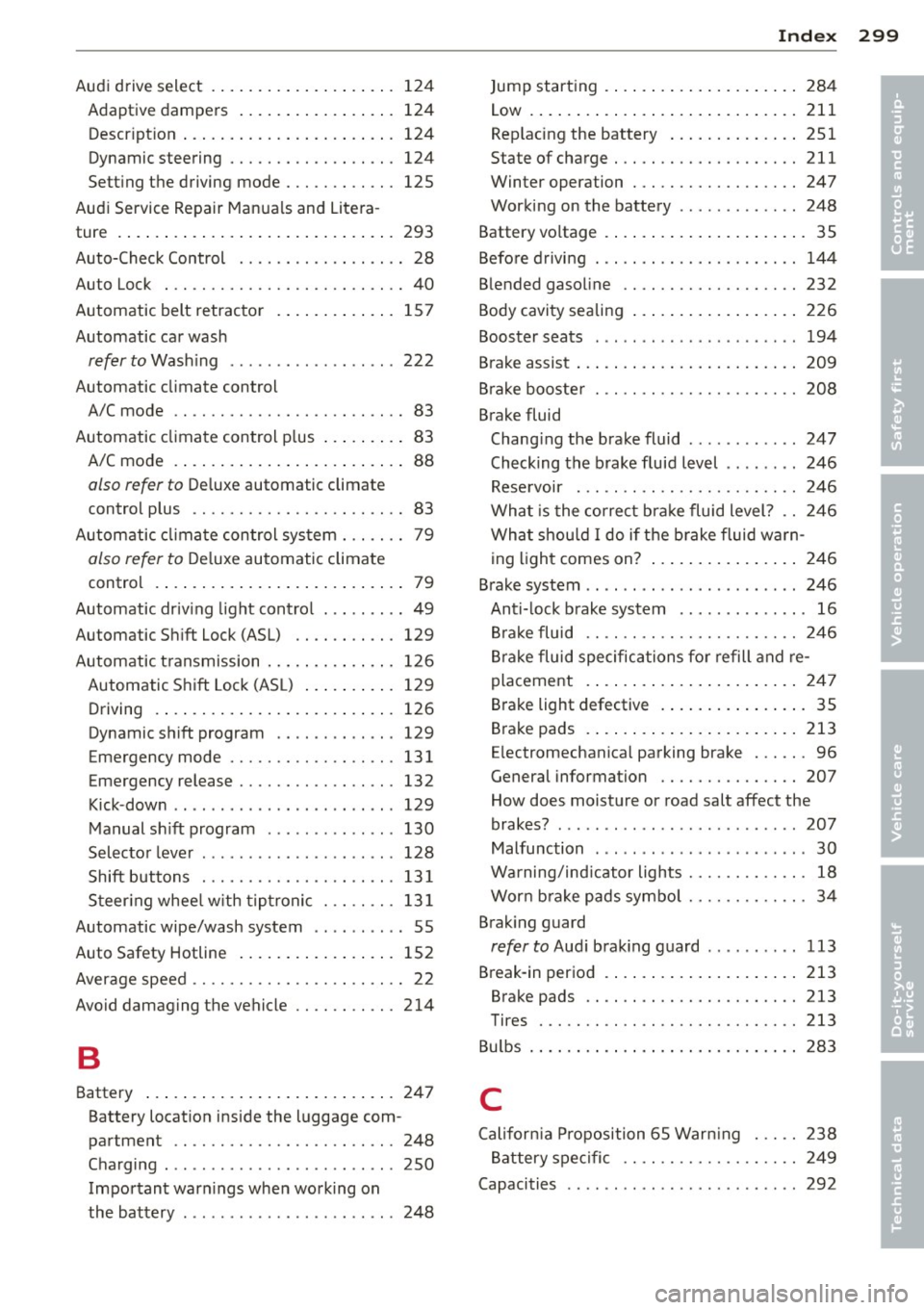
Audi drive select . ... .... ... .. .. .. ... 124
Adaptiv e dampers ..... ... .. .. .. .. . 124
Descr ipt ion ..... ........ ... .. .. .. . 124
Dynamic steering ......... .. .. .. .. . 124
Se tting the driving mode ... .. .. .. .. . 125
Aud i Service Repair Ma nua ls and Litera-
ture . ..... .. .. .... .. .... ... .. .. ... 293
Auto-Check Control . . . . . . . . . . . . . . . . . . 28
Auto Lock . . . . . . . . . . . . . . . . . . . . . . . . . . 40
Automatic belt retrac tor . ... .. .. .. .. . 15 7
Automatic ca r wash
refer to Wash ing ............ .... .. 222
Automatic climate control A/C mode .. ............. .... .. .... 83
Automatic clima te control p lus ... .. .. .. 83
A/C mode . ... ... ..... ... .. .. .. .... 88
also refer to Deluxe automatic climate
contro l plus . . . . . . . . . . . . . . . . . . . . . . . 83
Automatic clima te control sys tem . .. .. .. 79
also refer to D eluxe automatic clima te
control .... ... .. ..... ... .. .. .. .... 79
Automatic driv ing light contro l ... .. .. .. 49
Automatic S hift Lock (ASL) .. .. .. .. .. . 129
Autom atic t ransmission .. ... .. .. .. .. . 126
Automatic S hift Lock (ASL) . . . . . . . . . . 129
Driving .... .. .... .... ... .. .. .. ... 126
Dynamic shift program . . . . . . . . . . . . . 129
Emergency mode . . . . . . . . . . . . . . . . . . 131
Emergency release ........ .. .. .. .. . 132
Kick-dow n ............ ...... .... .. 129
Manual sh ift program . .... .. .. .. .. . 130
Selector leve r ............... ... ... 128
Shift buttons ............ .. .. .. .. . 13 1
S teer ing whee l w ith tiptronic . .. .. .. . 13 1
Automatic wipe/wash system . . . . . . . . . . 55
Auto Safety Hotline ..... ... .. .. .. .. . 152
Average speed . . . . . . . . . . . . . . . . . . . . . . . 2 2
Avoid damaging the vehicle .. .. .. .. .. . 214
B
Battery ..... .. .. .. .. .... ... .. .. ... 247
Battery locat ion inside the luggage com-
partment .. ............. .... .. ... 248
Cha rging . ................ ... ... .. 250
Impo rtant war nings when wo rking on
the battery . . . . . . . . . . . . . . . . . . . . . . . 248
Inde x 299
Jump start ing . ..... . .. .. ..... ... .. 284
Low . ... .. .. .. .... . ... ...... ... .. 211
Rep lacing the battery .. ..... ... .. .. 251
State of charge . .. ................. 211
Winter operation . ................. 247
Working on the battery ............. 248
Battery vo ltage . ...... .. .. ..... ... .. . 35
Befo re d rivi ng . .. .. .... ........... .. 144
B lended gasoline .. .. ........... .... 232
Body cavity sealing ... . .. ..... ... .. .. 226
Boos ter seats ... .. .. . .. .... .... .. .. 194
Brake assist ... .. .. .. .. .. ...... ... .. 209
B rake booste r ... ...... ............. 208
Brake fluid Changi ng the brake fluid ............ 247
Checking the brake fluid level ........ 246
Rese rvoir . .. .. .. .... ........... .. 246
What is the correct b ra ke fluid level? .. 24 6
Wha t shou ld I do i f the brake flui d war n-
ing ligh t comes on? .. ... .... ... .. .. 246
B rake system .. .. .... ... ....... ..... 246
Anti- lock b rake system .. .... ... .. .. . 16
Br ake fluid .. .. .. ................. 246
Br ake fluid specifications fo r refill and re-
placement . ..... ... .. .. ..... ... .. 2 47
Brake light defective . .. ..... ... .. .. . 35
B rake pads .. .... .. . .. .. ..... ... .. 213
E lectromechanica l parking brake ... .. . 96
General information ............... 207
How does moisture or road salt affect the
brakes? ......... .. ............... 207
Malfunction . . . . . . . . . . . . . . . . . . . . . . . 30
Wa rning/ind icator lights ........ .... . 18
Wor n bra ke pads symbo l . . . . . . . . . . . . . 34
Brak ing guard
refer to Aud i brak ing guard ......... . 113
Break -in period . ...... .. .. ..... ... .. 213
Brake pads .. .. .. .. ............... 213
Tires ..... .. .. .. .. .. ........... .. 213
Bu lbs . ... .. .. .. .... .. .. ...... ... .. 283
C
Cali for nia Pr oposition 65 War ning . .. .. 238
B attery spe cific . . . . . . . . . . . . . . . . . . . 249
Capacities .. .. .. .. .. . .. .... .... .. .. 292
•
•