instrument panel AUDI A5 COUPE 2012 Owner's Manual
[x] Cancel search | Manufacturer: AUDI, Model Year: 2012, Model line: A5 COUPE, Model: AUDI A5 COUPE 2012Pages: 316, PDF Size: 78.59 MB
Page 179 of 316
dealer is familiar with these requirements
and we recommend that you have your
dealer perform this service for you.
Other things that can affect Advanced
Airbag performance
Changing the vehicle's suspension system can
change the way that the Advanced Airbag Sys
tem performs in a crash. For example, using
tire-r im combinations not approved by Audi,
lowering the vehicle, changing the stiffness of
the suspension, including the springs, suspen
sion struts, shock absorbers etc. can change
the forces that are measured by the airbag sensors and sent to the electronic control
unit. Some suspension changes can, for exam
ple, increase the force levels measured by the
sensors and make the airbag system deploy in
crashes in which it would not deploy if the
changes had not been made . Other kinds of
changes may reduce the force levels meas
ured by the sensors and prevent the airbag
from deploying when it should .
The sensors in the safety belt buckle for the
d river and front passenger seat tell the elec
tronic control module if the safety belt is
latched or not. If the safety belt is being used,
the front airbag will deploy at a slightly high
er rate of vehicle deceleration than if the safe
ty belt is not being used. Therefore, in a par
ticular collision, it is possible that an airbag
will not deploy at a seating position where the safety belt is being used but will inflate at the
position where the safety belt is not being
used. It is important that nothing interfere
with the safety belt buckles so that the sen
sors can send the correct information about
safety belt use to the electronic control unit.
.&_ WARNING
Changing the vehicle 's suspension includ
ing use of unapproved tire-rim combina
tions can change Advanced Airbag per
formance and increase the risk of serious personal injury in a crash.
- Never install suspension components
that do not have the same performance
Airbag system 177
characteristics as the components origi
nally installed on your vehicle .
- Never use tire-rim combinations that
have not been approved by Audi.
.&_ WARNING
= -
Items stored between the safety belt buckle and the center console can cause
the sensors in the buckle to send the
wrong information to the electronic con
trol module and prevent the Advanced Air bag System from working properly.
-Always make sure that nothing can inter-
fere with the safety belt buckles and that
they are not obstructed.
Knee airbags
Description of knee airbags
Applies to vehicles: wit h knee airbags
The knee airbag system can provide supple
mental protection to properly restrained
front seat occupants.
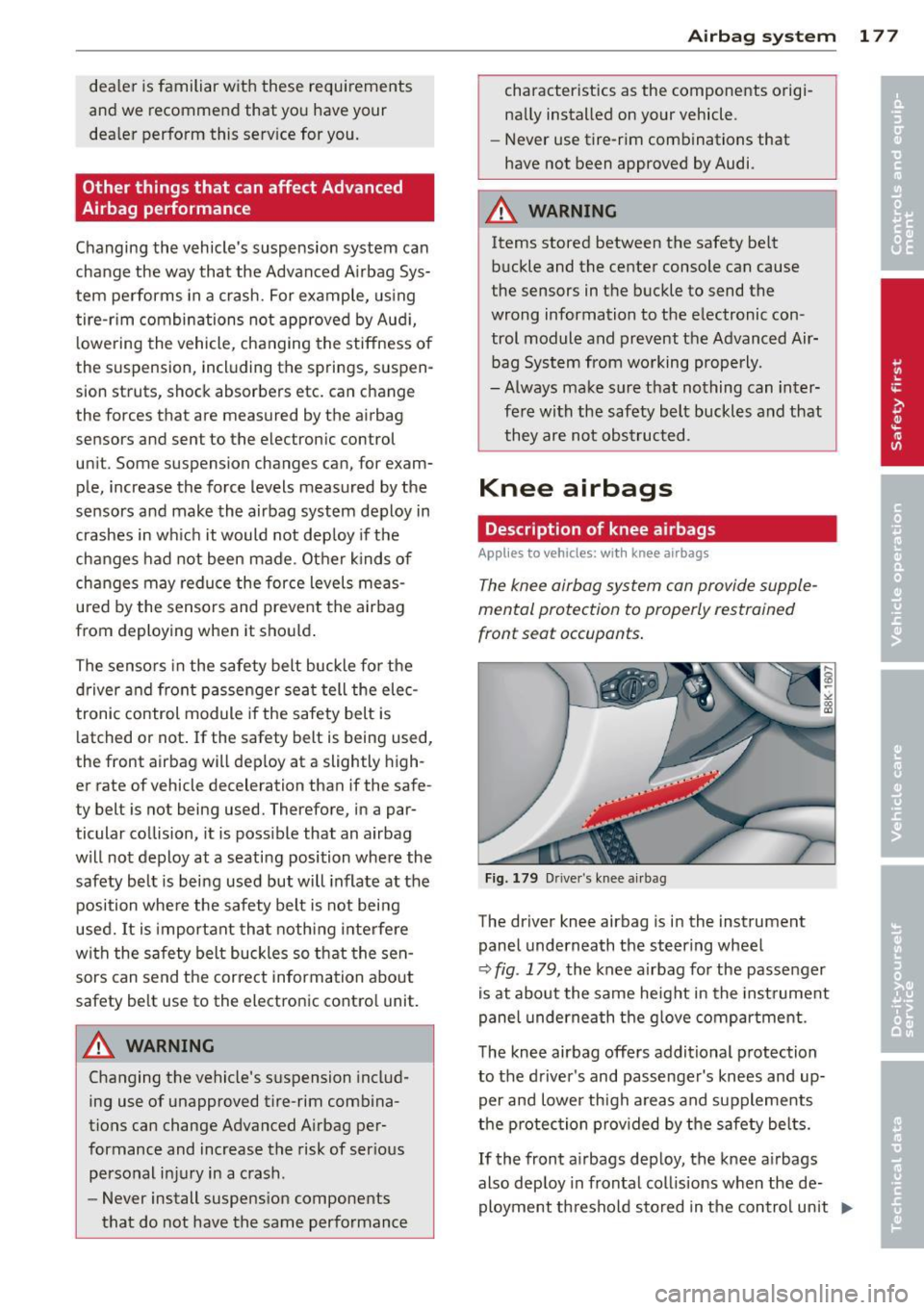
Fig. 179 Driver 's knee airbag
The driver knee airbag is in the instrument
panel underneath the steering wheel
Q fig . 179, the knee airbag for the passenger
is at about the same height in the instrument
panel underneath the glove compartment .
The knee airbag offers additional protection
to the driver's and passenger's knees and up
per and lower thigh areas and supplements
the protection provided by the safety belts.
If the front airbags deploy, the knee airbags
also deploy in frontal collisions when the de ployment threshold stored in the control unit
I),-
Page 181 of 316
The knee airbag system has been designed so
that the airbags for the driver and front pas
senger deploy in certain but not all frontal
collis ions .
I f the front airbags deploy , the knee airbags
also deploy in fronta l collis ions when the de
p loyment threshold stored in the control unit
ist met.
When the system dep loys, the airbags fill
with a prope llant gas, and inflate between the
l ower part of the instrument panel and the
driver and the lower part of the instrument panel and the fron t passenger <=>
page 171,
fig . 17 7.
Although they are not a soft pillow, they can
cushion the impact and in this way they can
he lp to reduce the r isk of injury to the lower
extremities .
All of this takes place in the blink of an eye, so
fast that many people don't even reali ze that
t he airbags have deployed . The airbags also
inflate w it h a great deal of force and it is im
portant for occ upant safety that not hing
should be in the ir way when they dep loy .
Fully infla ted airbags in comb ination with
properly worn safety belts slow down and lim
it the occupant's forward movement and help
to reduce the r isk of injury .
Important safety instructions on the
knee airbag system
Applies to vehicles: with knee a irbags
Airbags are only supplemental restraints. Al
ways wear safety belts correctly and ride in a
proper seating position .
There is a lot that you and your passenge rs
must know and do to help the safety be lts a nd
ai rbags to provide supp lemen tal protection .
_.6 WARNING
An inflating knee airbag can cause ser ious
injury. Wear ing safety belts incorrectly and
improper seating positions increase the
r isk of serious personal injury and death
whenever a veh icle is being used.
A irbag system 179
-The knee a irbag system cannot p rotect
you proper ly if you a re seated too close
to any of the airbag locat ions. When ad
justing their seat pos itions, it is impor
tant that both the driver and the front passenger keep the ir upper bod ies and
knees at the following m inimum safe
distances :
- at least 10 inches (25 cm) between the
chest and the steering wheel/instru
ment panel.
- at least 4 inches (10 cm) between the knees and the lower part of the instru
ment panel.
- The risk of personal in jury increases if
you lean forward or to the s ide, or if the
seat is improperly positioned and you are
not wearing yo ur safety belt . The risk i n
creases even more should the ai rbag de
ploy .
- Always ma ke sure that the knee a irbag
can inflate without inte rfe rence. Objects
between yo u and the airbag can inc rease
the risk of in jury in an accident by inte r
fering w ith the way the a irbag deploys or
by being p ushed into you as the airbag
deploys.
- Never let anybody, especia lly children
or anima ls ride in the footwell in front
of the passenge r seat. If the airbag de
ploys, th is can result in serious or fa tal
i njur ies.
- Never carry obje cts of any kind in the
footwe ll area in front of the dr iver' s or
passenger 's sea t. Bulky objects (shop
ping bags , fo r example) can interfere
with o r prevent proper deployment of
the airbag. Small objects can be
thrown through the ve hicle if the air
bag deploys and injure you or your pas
sengers .
- Make sure there are no cracks, deep
scratches or other damage in the area of
the instrument panel where the knee air
bags are located.
- If ch ildren are incorrectly seated, their
risk of injury increases in a collision
<=> page 186, Child Safety .
•
•
Page 189 of 316
-If you must install a rearward facing
child safety seat on the front passenger
seat in exceptional circumstances and
the
PASSENGER AIR BAG OFF light does
not come on and stay on, immediately
install the rearward-facing child safety
seat in a rear seating position and have
the airbag system inspected immediately by your authorized Audi dealer.
,& WARNING
If, in exceptional circumstances, you must
install a forward-facing child restraint on
the front passenger's seat:
- Always make sure the forward-facing
seat has been designed and certified by
its manufacturer for use on a front seat
with a passenger front and side airbag.
- Always follow the manufacturer's in
structions provided with the child safety
seat or carrier.
- Always move the passenger seat into its
rearmost position in the seat's fore and
aft adjustment range, as far away from
the airbag as possible before installing
the child restraint. The backrest must be adjusted to an upright position .
- Always make sure that the
PASSENGER
AIR BAG OFF
light comes on and stays
on all the time whenever the ignition is
switched on.
@ Tips
Always replace child restraints that were
installed in a vehicle during a crash. Dam
age to a child restraint that is not visible
could cause it to fail in another collision
situation.
Advanced front airbag system and children
Your vehicle is equipped with a front "Ad
vanced Airbag System" in compliance with
United States Federal Motor Vehicle Safety
Standard (FMVSS) 208 as applicable at the
time your vehicle was manufactured .
Child Safety 187
The Advanced Airbag system in your vehicle
has been certified to meet the "low-risk" re
quirements for 3- and 6-year old children on
the passenger side and small adults on the driver side. The low risk deployment criteria
are intended to reduce the risk of injury
through interaction with the airbag that can
occur, for example, by being too close to the
steering wheel and instrument panel when
the airbag inflates. In addition, the system
has been certified to comply with the "sup
pression" requirements of the Safety Stand
ard, to turn off the front airbag for infants up
to 12 months who are restrained on the front passenger seat in child restraints that are list
ed in the Standard.
Even though your vehicle is equipped with an
Advanced Airbag system, all children, espe
cially those 12 years and younger, should al
ways ride in the back seat properly restrained
for their age and size . The airbag on the pas
senger side makes the front seat a potentially
dangerous place for a child to ride . The front
seat is not the safest place for a child in a for
ward-facing child safety seat. It can be a very
dangerous place for an infant or a larger child
in a rearward-facing seat.
Advanced Airbags and the weight
sensing mat in the front seat
The Advanced Airbag System in your vehicle
detects the presence of an infant or child in a
child restraint on the front passenger seat us
ing the weight-sensing mat in the seat cush
ion and the sensor below the safety belt latch
on the front passenger seat that measures the
tension on the safety belt.
The weight-sensing mat measures total
weight of the child and the child safety seat
and a child blanket on the front passenger
seat. The weight on the front passenger seat
is related to the design of the child restraint
and its "footprint", the size and shape of the
bottom of the child restraint as it sits on the
seat. The weight of a child restraint and its "footprint" vary for different kinds of child re -
straints and for the different models of the ..,. •
•
Page 229 of 316
~ Then wipe the MMI contro l conso le with a
clean, soft, slightly damp cloth.
The MM I control console shou ld be cleaned
with a brush first so that no dirt is trapped be
tween the buttons and the housing . We rec
ommend giving the MMI contro l console a fi
na l wipe with a cloth moistened with water
and d ish washing detergent.
(D Note
To prevent damage, make sure that no flu
id ever gets into the MMI control console .
Aluminum trim
Use only neutral-pH products to remove spots
and depos its from alum inum surfaces.
Ch rome care products and alkaline cleaners
will attack alum inum su rfaces and can dam
age them ove r time.
A WARNING
Always read and heed a ll WARNINGS and
other information
¢ page 2 2 1.
Fabrics and fabric coverings
Fabrics and fabric coverings (e .g. seats, door
trim panels, etc.) should be cleaned at reg ular
interva ls with a vacuum cleaner. Th is removes
surface dirt particles which could become em
bedded in the fabr ic through use. Steam
cleane rs should not be used, because the
steam tends to push the dirt deeper into the
fabric and lock it there.
Norm al cleaning
Generally, we recommend using a soft sponge
or a lint-free microfiber cloth to the clean fab
ric. Brushes should o nly be used for carpets
and floor mats, s ince other fab ric su rfaces
could be harmed by b rushes .
Normal surface sta ins can be cleaned using a
commercially available foam cleaner . Spread
the foam on the surface of the fab ric with a
soft sponge and work it in gently. Do not satu
r ate the fabric. Then pat the foam d ry using
Cleaning and protec tion 22 7
absorbent, dry cloths (e .g . m icrofiber cloth)
and vac uum it after it has dried completely .
Cleaning stains
Stains caused by beverages (e.g. coffee, fr uit
j u ic e, etc.) ca n be treated w ith a mild de ter
gen t solu tion. Apply the detergent sol ution
with a sponge. In the case o f stubborn stains,
a detergent paste can be applied directly to
the stain and worked into the fabric . After
wards, use copious amounts of clean water to remove the rema ining detergent. Apply the
water wit h a damp cloth or sponge and pat
the fabr ic dry with an absorbent, dry clot h.
Stains from choco late or makeup should have
detergent paste rubbed into them . After
wards, remove the soap with water (damp
sponge) .
Alcohol can be used to treat stains from grease, o il, lipstick or a ballpoint pen. Melted
grease or dye must be patted off using ab
sorbent mater ial. It may be necessary to re
treat the areas with detergent paste and wa
te r.
In the case of general soiling of the up hols
te ry and cover material, we recommend hir ing
a spec ia list t hat has the equipment to clean
the seat cove rs and othe r fabr ic surfa ces by
shampooing a nd spray extraction.
A WARNING ~ -
Always read and heed all WARN INGS and
the information
~ page 221 .
(D Tips
Open Ve lcro fas teners on yo ur clothing can
d am age the sea t cover. Please m ake su re
that Ve lcro fasteners are closed .
Plastic parts and instrument panel
Always use a clean cloth moistened in clear
water to clean these areas. For persistent d irt
use an Aud i approved
sol vent -free p lastic
cleaner/protectant. ..,. •
•
Page 230 of 316
228 Cleaning and protec tio n
8_ WARNING
So lvents can c hange the properties of
some plas tics and ma ke it ha rder for the
a irbag to deploy .
-
-Never clean the instrument panel or the
surface of airbag modules with cleaning
products that contain solvents .
- Products containing solvents w ill make
the surface of th is part porous.
- Serious injur ies can result if plastic parts
come loose when the airbag is deployed.
- Always read and heed all WARNINGS and
other information ¢
page 221.
(D Note
Cleaning agents containing solvents will
attack the mater ial and can change the
way it behaves.
Natural leather
App lies to vehicles: with natura l leather
Audi makes great efforts to maintain the
properties, natural look and feel of interior
leather.
General
We offer many different types of leather on
our veh icles. Most are different types of nappa
l eather, which has a smooth surface and
comes in var ious colors.
The intensity of the color determines the visu a l characteristics and appearance . If the sur
face of the leather has a typical natural look,
then the leather is a nappa leather that has
been left in a relatively natural cond ition. This
leather offers particularly good comfort and
breathes well. F ine veins, closed g rains, insect
b ites, ski n folds , and subtle var iations in co lor
remain visible. These c haracte ris tics demon
stra te that the mater ia l is na tural.
Natural nappa leather is not covered by a col
or finish.
It is therefore more sensitive to soil
ing and wear, w hich is something you need to
conside r if ch ild ren, anim als or othe r fa ctors
might p rove to be particular ly hard on the
leather . By cont
rast, leather types that are covered by
a colo red finish layer are more durab le . T his
has a positive effect on the leather's resist
ance to wear and soiling in dai ly use. On the
other hand, the typical characteristics of natu
ral leather a re barely or not apparent . Howev
er, th is does not mean that the leathe r itself
is of inferior quality .
Care and handling
Because of the exclusive nature of the types of
leather that Audi uses and their unique prop
erties (such as sensit ivity to oils, grease, soil
i ng, etc.), you will need to be somewhat ca re
ful with these leathers, and a ce rtain type of
ca re is req uired. Fo r example , da rk clothing
mater ials can dis co lor le athe r seats (especia l
l y if such clothing is damp and was not dyed
correct ly). Dust and dirt parti cles in pores,
folds, and seams can have an abrasive effect and can damage the leather surface as we ll as
wea ken seams.
The leather should be cleaned regularly as neede d. After having been used for a relatively
l ong time, your leather seats will acq uire a
rich aged fin ish. This is a characteristic of nat
ural leather and a sign of true quality.
In order to maintain the val ue of this nat ural
product over the life of your veh icle, you
shou ld follow the recommendat ions be low:
(D Note
- To keep your leather from b leaching out,
do not allow it to be exposed to b right
sunlight for long periods of time. If you
have to leave the ve hicle parked outside
for long per iods, cover the leather to
pro tect i t from direct expos ure to sun
light.
- Sharp objects o n cloth ing, such as z ip
pers, rivets o r sharp pieces on belts can
leave permanent s cratches or s crape
ma rk s on the s urfa ce o f th e leathe r.
(D Tips
-Aft er each time you clean the leather and
a t regular intervals, use a leathe r
1111>
Page 239 of 316

Checking and filling Engine hood
Releasing the engine hood
The engine hood is released from inside the
vehicle .
Fig. 201 Dr iver's s ide footwell: engine hood release
lever
"' Open the driver's door .
"' Pull the release lever on the left under the
instrument panel
i=:> fig. 201 in the d irection
of the arrow.
The hood pops up slight ly under spring pres
sure.
Opening the engine hood
F ig . 202 Re lease lever under the engine hood
Before opening the engine hood, make sure
that the windshie ld wipers are flat against the
windshie ld. Otherwise, they could damage the
paint on the hood.
"' Pull up on the release under the hood
r::!> fig. 202 . This releases the catch.
"' Open the hood all the way
c::> &,.
Checkin g and fillin g 237
A WARNING
Hot engine coolant can burn you.
- To reduce the risk of being burned, never
open the hood if you see or hear steam
or coolant escaping from the eng ine
compartment. Wait unt il no steam or
coolant can be seen or heard before care
fu lly opening the hood.
Closing the engine hood
"' Pull the hood down un til the pressure from
the struts is reduced.
"' Let the hood
drop down and latch in p lace.
Do not try to push it shut; it may fail to en
gage
c;, &, .
A WARNING
--
A hood that is not completely latched
could fly up and b lock your view while dr iv
ing.
- When you close the engine hood, check it
to make sure the safety catch has p roper
ly engaged. The hood should be flush
with the surround ing vehicle body parts.
- If you notice while driv ing that the hood
is not secured prope rly, stop at once and
close it .
Working in the engine compartment
Be especially careful whenever you work in
the engine compartment.
Whene ver y ou must pe rform any wo rk in the
eng ine compartment, for e xample checking
and filling different fluids, th ere is a risk of
injury, burns and accid ent s. To pr event per
s o nal injury always observe the following
WARNINGS . The engine compa rtment of an y
vehicle i s a hazardou s are a
c;, Lh,.
A WARNING ~
To help avoid injury, be fo re yo u check any
thing under the hood:
- Tu rn off the engine.
- Remove the ignition key.
Page 283 of 316

Fuses and bulbs 281
No. Fuse Location, Instrument Panel right
8
Vehicle electrical system control
5
module 1
9 Adaptive Cruise Control
10 Shift gate
11 Heater washer flu id nozzles
12 Climate control
13 Cell phone prep 5
14 Airbag
s
15 Terminal 15 25
16 Terminal 15 engine
40
Fuse panel@ (brown)
1 Automatic dimming
interior s rearview mirror
2 Clutch sensor 5
3 Gasoline fuel pump 25
5 Left seat heating with/without
15/30
seat heating
Fig. 228 Righ t cockpi t: fuse panel wi th pla stic clip
6 Electronic Stabilization Program 10 No. Consumer
7 Horn 25 Fuse panel@ (black)
8
Left door window regulator mo-
30
tor 5
Steering column switch module
5
6 Electronic Stabilization Program 5
9 Wiper motor 30
10 Electronic Stabilization Program
25
7
Terminal 15 diagnostic connec-
5
tor
11 Left doors 15
12 Rain and light sensor 5
8
Gateway (Databus diagnostic in-
5
terface)
Fuse panel © (red)
Fuse panel@ (brown)
3 lumbar support
10
1 C0-/DVD player
5
4 Dynamic steering 35
2 Audi drive select switch module 5
5 Antenna (Avant)
5
3 MMI/Radio
5/20
6
Vehicle electrical system control
35
module
1
7
Vehicle electrical system control
20
module 1 Instrument cluster
5
5 Gateway (instrument cluster
5
control module)
6 Ignition lock 5
8
Vehicle electrical system control
30
module 1
9 sunroof 20
10 Vehicle electrical system control
30
module 1
7 Rotary light switch 5
8 Climate control system blower
40
9 Steering column lock 5
10 Climate control 10
11 sunroof shade (Avant) 20 11 Terminal 30
diagnostic connec-
tor 10
12 Convenience electronics
5
12 Steering column switch module
5