transmission AUDI A5 COUPE 2012 Owner's Manual
[x] Cancel search | Manufacturer: AUDI, Model Year: 2012, Model line: A5 COUPE, Model: AUDI A5 COUPE 2012Pages: 316, PDF Size: 78.59 MB
Page 131 of 316
Automatic Shift Lock (ASL)
Applies to vehicles: with a utomat ic transm ission
The Automatic Shift Lock safeguards you
against accidentally shi~ing into a forward or
the reverse gear and causing the vehicle to
move unintentionally .
;_ '"''1
·- I , . ,......._
W'.o ,)
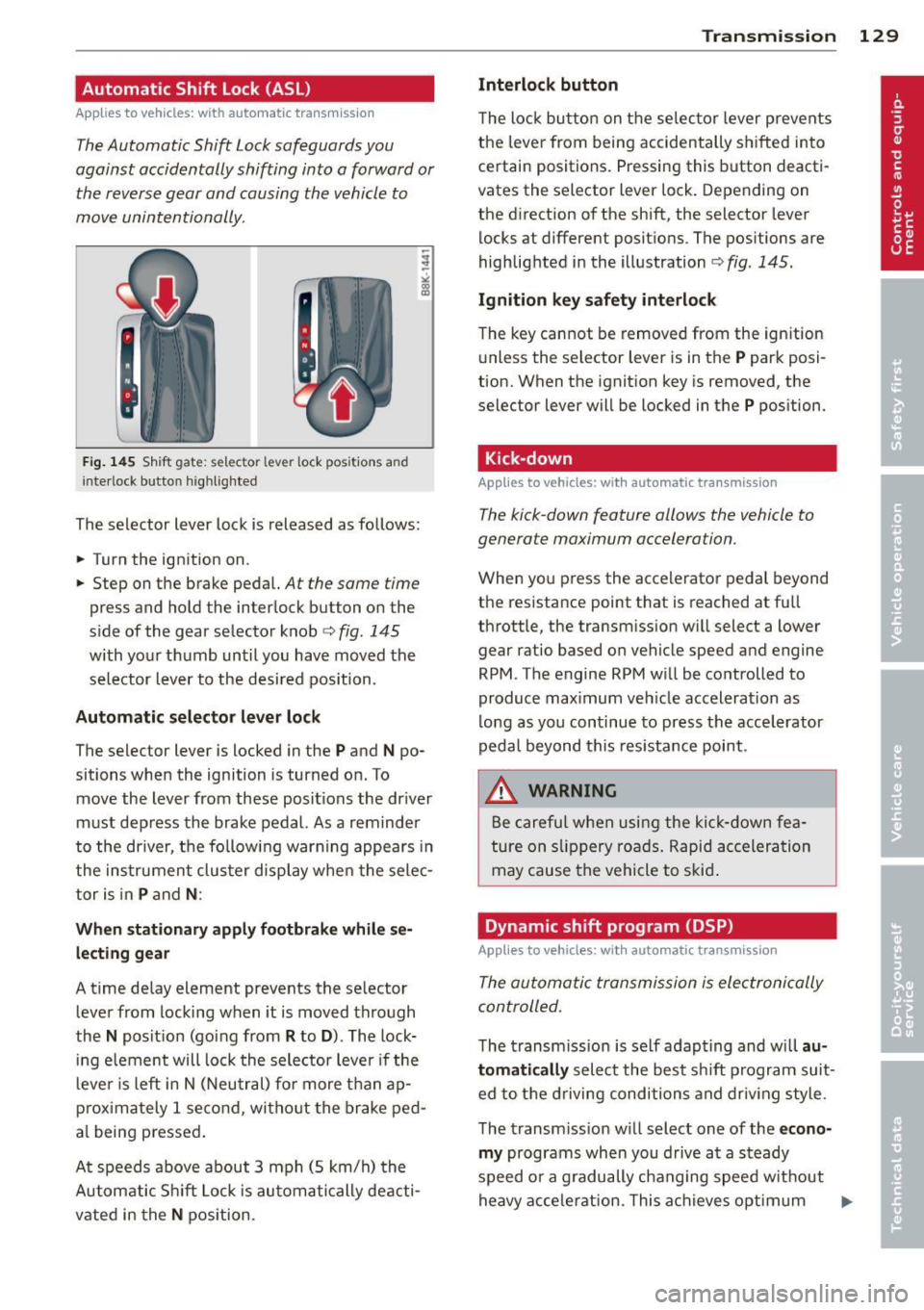
Fig. 145 Shift gate: selector lever lock positions and
in terlock b utto n highlighted
The selector lever lock is released as follows:
.. Turn the ignition on.
.. Step on the brake pedal.
At the same time
press and hold the interlock button on the
s ide of the gear selector knob
c::> fig. 145
with your thumb until you have moved the
selector lever to the desired position.
Automatic selector lever lock
The select or lever is Locked in the P and N po
sitions when the ignition is turned on. To
move the lever from these positions the driver
must depress the brake pedal. As a reminder
to the driver, the following warning appears in
the instrument cluster display when the selec
tor is in
P and N:
When stationary apply footbrake while se
lecting gear
A time delay element prevents the selector
lever from locking when it is moved through
the
N position (going from R to D ). The lock
ing element will lock the selector lever if the
lever is left in N (Neutral) for more than ap
proximately 1 second , without the brake ped
a l being pressed.
At speeds above about 3 mph (5 km/h) the
Automatic Shift Lock is automatically deacti
vated in the
N position.
Transmission 129
Interlock button
The lock button on the selector lever prevents
the lever from being accidentally shifted into
certain positions. Pressing this button deacti
vates the selector lever lock. Depending on
the direction of the shift, the selector lever
locks at different positions. The positions are
highlighted in the illustration
c::> fig . 145.
Ignition key safety interlock
The key cannot be removed from the ignition
unless the selector lever is in the
P park posi
tion. When the ignition key is removed, the
se lec tor Lever will be locked in the
P position.
Kick-down
App lies to vehicles: with automatic transmission
The kick-down feature allows the vehicle to
generate maximum acceleration .
When you press the accelerator pedal beyond
the resistance point that is reached at full
throttle, the transmission will select a lower
gear ratio based on vehicle speed and engine
RPM . The engine RPM will be controlled to
produce maximum vehicle acceleration as
long as you continue to press the accelerator
pedal beyond this resistance point.
.&, WARNING
Be careful when using the kick-down fea
ture on slippery roads. Rapid acceleration
may cause the vehicle to skid .
Dynamic shift program (DSP)
Applies to vehicles: wit h automatic transmission
The automatic transmission is electronically
controlled.
-
The transmission is self adapting and will au
tomatically
select the best sh ift program suit
ed to the driving conditions and driving style .
The transmission will select one of the
econo
my
programs when you drive at a steady
speed or a gradually changing speed w ithout
heavy acceleration. This achieves optimum ..,.
Page 132 of 316
130 Transmi ssion
fuel efficiency, with ear ly upshifting and
de layed downshifting.
The transmission will a utomat ica lly select the
s port y shift prog rams when you drive at high
e r speeds, or w ith heavy acceleration and fre
quent ly changing speeds. Upshifts are de layed
to make full use of eng ine power. Downsh ift
ing takes p lace at h igher engine speeds than
in the economy programs .
The selection of the most suitab le shift pro
gram is a cont inuous, automatic process. The
driver can also make the transmission switch
to a sporty program by quickly pressing down
the gas pedal.
This causes the transmission to shift down to
a lower gear to achieve rapid acceleration, e.g.
for quickly passing another vehicle. You do not need to press the gas pedal into the kick -down
range . After the transmission has upshifted,
the orig inal program is se lected acco rding to
your d riving s tyle.
A n addit ional shift program allows the auto
mat ic transm iss ion to select the proper gear
for uphill and downhill gradients .
This keeps the transmission from shifting up
a nd down unnecessar ily on hills . The trans
miss ion will shift down to a lowe r gear when
the dr iver presses the brake pedal on a down
hill grad ient. This makes use of t he b raking ef
fe ct of the eng ine wi thout the need to shift
down manua lly. Manual shift program
Applies to
vehicles: with automatic transmission
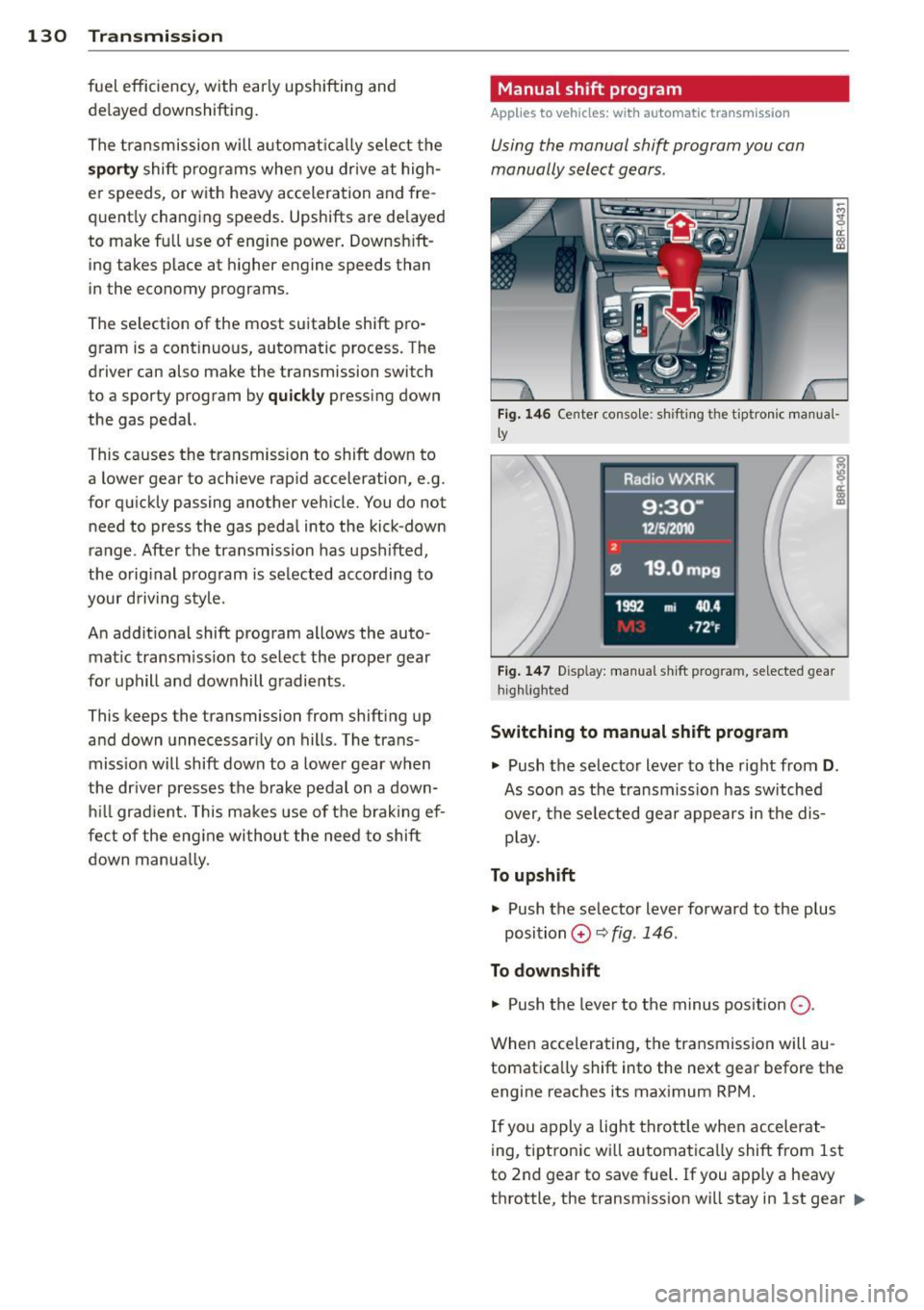
Using the manual shift program you can
manually select gears .
Fig . 14 6 Ce nter conso le: sh ift ing the t iptron ic m an ua l·
l y
F ig. 14 7 Disp lay: manu al shi ft p rog ra m , se lected gear
hi ghlight ed
Switching to manual shift program
.,. Push the selector lever to the right from
D.
As soon as the transmiss ion has sw itched
over, the se lected gea r appears in the dis
p lay .
To upshift .,. Push the selecto r lever forwa rd to the p lus
position
0 ¢ fig . 146 .
To down shift
.,. Push the lever to the minus pos ition
0 -
When accelerating, t he transmission will au
tomatica lly shift into the next gear before the
engine reaches its maximum RPM.
If you apply a light throttle whe n accelerat-
ing, tiptronic wi ll automatica lly shift from 1st
to 2nd gear to save fuel. If you apply a heavy
throttle , the transm iss ion wi ll stay in 1st gear .,.
Page 133 of 316
until near maxim um RPM is reached, or unt il
the driver shifts into 2nd gear .
I f y ou ta ke your foo t off the acceler ator ped al
when dr iving down a steep in cline, tiptronic
will downshift from the se lected gea r into the
next lowe r gear until it reaches 1st gea r,
based on road speed and eng ine RPM. A uto
mat ic downshifting is interrupted as soon as
you apply the thrott le aga in.
@ Tips
- When yo u shift into the next lower gear,
t h e transmiss io n will downs hift only
when there is no possibility of over-rev
v ing the e ngine.
- When t he kick-down comes on, the
transmission will sh ift down to a lower
gear, d epe nding on vehicle a nd e ngine
s peeds .
- tiptron ic is inoperative when the trans
mission is in th e fail-safe mode .
Steering wheel with tiptronic
Applies to vehicles: with tiptronic steer ing wheel
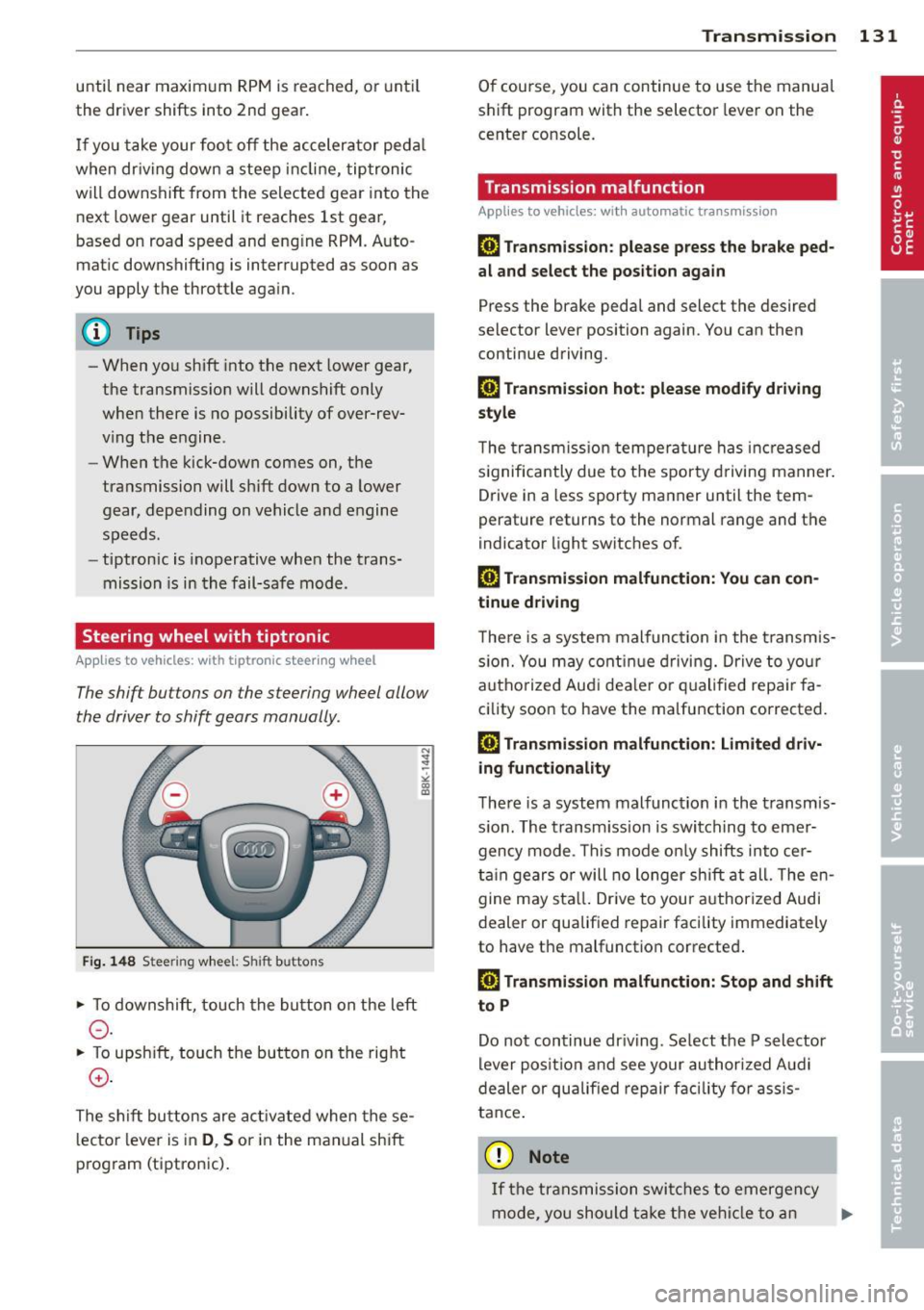
The shift buttons on the steering wheel allow
the driver to shift gears manually .
Fig. 148 S tee rin g w hee l: S hift buttons
• To downshift, to uch the button on the left
0 -
• To upsh ift, touch the but ton on the rig ht
0 -
The s hift buttons are ac tivated when the se
l ecto r lever is in
D , S or in the manual shift
p rog ram (tiptron ic) .
Transm ission 131
O f course, you can continue to use the manua l
s h ift pr ogram with the selector lever on the
cente r co nsole.
Transmission malfunction
Applies to vehicles: wit h automatic transmission
[O] Transmission : please press the brake ped
al and select the position again
Press the bra ke pedal and select the desired
selector lever position again. You can then
continue driving.
[O] Transmi ssion hot: please modify driving
style
T he trans mission tempe ra tur e has increased
s ignifica ntly due to t he spor ty dr ivin g manner .
Drive in a less sporty ma nner until the tem
perature returns to the normal range and the
indicator light switches o f.
[O] Transmission malfunction: You can con
tinue driv ing
T here is a system malfunc tion in the transm is
s io n. You may con tinu e dr ivin g. D rive to yo ur
a utho rize d Au di dea le r or qu alified repa ir fa
c ility soon to have the ma lfunction corrected .
[O] Transmission malfunction: Limited driv
ing functionality
T he re is a system mal func tion in the t ransmis
s io n. The transm iss ion is swi tching to emer
gency m ode . Th is mode o nly shifts into cer
t ain gears o r will no longer shi ft at all. The en
g ine m ay sta ll. Drive to you r author ized Audi
dealer or qualif ied repair facility immediately
to have the malfunction corrected .
[O] Transmission malfunction: Stop and shift
to P
Do n ot continue dr iving. Se lect t he P selector
lever posi tion an d see your au thori zed A udi
de aler or qu alified re pair facili ty for assis
ta nc e.
(D Note
If th e tra ns missi on swit ches to emer gen cy
mode, y ou sh oul d tak e th e ve hicl e to an
IJll>
Page 215 of 316
Driving and
environment
The first 1
1000
miles
(11500 km) and
afterwards
New engine
The engine needs to be run-in during the first
1,000 miles (1 ,500 km) .
For the fir st 600 mile s (1,000
kilometers ):
.,. Do not use full throttle.
.,. Do not d rive at engine speeds that are more
than 2/3 of the max imum permitted RPM .
From 600 to 1,000 miles (1 ,000 to
1,500 kilometers ):
.. Speeds ca n gradually be increased to the
maximum perm iss ible road or eng ine speed .
During and after br eak-in period
.. Do not rev the eng ine up to h igh speeds
when it is cold. Th is applies whether the
transmission is in N (Neutral) or in gear.
After the break- in peri od
.. Do not exceed maximum eng ine speed un
der any circumstances.
.. Upshift into the next higher gear
before
reaching the red area at the end of the tach
ometer scale
c.> page 10.
During the first few hours of driving, the en
g ine's internal friction is higher than later
when all the moving parts have been broken
in . How well this break -in process is done de
pends to a considerable extent on the way the
vehicle is driven du ring the first 1,000 miles
(1,500 kilome ters).
(D Note
Extremely h igh engine speeds are auto
mat ica lly reduc ed. However, t hese rpm
lim its are programmed for a n engine well
r u n- in, not a new engine.
Driving and environment 213
@) For the sake of the environment
Do not drive with unnecessarily high en
g ine speeds -upshifting ear ly saves f uel,
reduces noise and protects the environ
ment.
New tires
If your vehicle is running on new tires, drive
very carefully for the first 350 miles (500 ki lo
meters) after fitting.
.&, WARNING
N ew tires tend to be sl ippery and mus t al
so be "b roken -in" . Be sure to remember
this dur ing the f irst 350 m iles (500 kilo
meters) . Brake gently . Avoid fo llowing
closely behind other vehicles or other sit
uations that m ight require sudden, hard
b raking .
New brake pads
Remember that new brake pads do not have a
full brak ing effect dur ing the first 250 m iles
(400 ki lomete rs) afte r they are installed.
New brake pads have to be "burnished in" be
fore they have optima l grab
c.> .&. .
During the brea k-in period, yo u should avo id
putting severe loads on the brakes. Severe
l oads include , for example, sudden hard brak
i ng, in particular at very h igh speeds or, for
example, on mountain passes .
.&, WARNING
New b rake pads don 't have the best stop
p ing power and must be "broken-i n" dur
ing the initi al 100 to 150 miles (150 to
200 kilometers) o f no rma l ci ty driving . You
can compensate for this by pressing the b rake peda l more firm ly . This also applies
later when new pads are installed.
•
•
Page 222 of 316
220 Trailer towing
who is not properly wearing the restraints
provided by Aud i.
Trailer towing tips
Important to know
Your vehicle hand les different ly when towing
a trailer because of the additional weight and
different weight distribution. Safety, perform
ance and economy wi ll greatly depend on how
carefully you load your trailer and operate
your rig.
Before you actually tow your trailer, practice
turning, stopp ing and backing up in an area
away from traffic. Keep practicing until you have become completely familiar with the way
your vehicle-trailer combination behaves and responds.
Backing up is difficult and requires practice.
Backing up with a trai ler genera lly requires
steering action opposite to that when backing up your vehicle without a trailer.
Maintain a greater distance between your ve
hicle and the one in front of you. You will need
more room to stop. To compensate for the
trailer, you will need a larger than normal
turn ing radius .
When passing, remember that you cannot ac
celerate as fast as you normally would be
cause of the added load. Make sure you have
enough room to pass . After passing, allow
plenty of room for your tra iler before chang
ing lanes aga in.
Avoid jerky starts, sharp turns or rapid lane
changes .
(D Tips
-Do not tow a tra iler during the break-in
period of your vehicle.
- If you tow a trailer, your Audi may re
quire more frequent maintenance due to
the extra load
q page 293.
Parking on a slope
Do not park on a slope with a trailer . If it can
not be avoided, do so only after doing the fol lowing:
When parking:
.. App ly the foot brake.
.. Have someone place chocks under both the
vehicle and the trailer wheels .
.,. With chocks in place, slowly release the
brakes until the wheel chocks absorb the
load.
.. Turn the wheels towards the curb.
.. App ly the parking brake.
.. Place an automatic transmission* in
P, re
spectively a manual transmission in first or reverse gear.
When restarting after parking:
.. App ly the foot brake.
.. Start the engine.
.. Move the se lector lever to
D , respectively a
manual transmission in first gear .
.. Release the parking brake and slow ly pu ll
out and away from the wheel chocks.
.. Stop and have someone retr ieve the wheel
chocks .
(D Tips
If you move the selector lever of the auto
matic transmission* to
P before applying
the parking brake and before blocking the
whee ls, you may have to use more force
lat er to move the lever out of the
P posi
tion.
Page 232 of 316
230 Cleaning and protec tio n
• Dab at the stain . Start at the outside and
work inwards .
• Once the stain is no longer visible, use a
soft dry cloth or t issue to soak up the mois
ture.
Do not use leather cleaning products on Al
cantara ®.
You may use a suitable shampoo for removing
dust and dirt .
Dust and gr it in the pores and seams can
scratch and damage the surface. If the car is
l eft standing in the sun for long periods, the
A lcantara ® should be protected against direct
sunlight to prevent it from fading. Slight color
variations will develop in normal use and are not an indication of material deterioration .
- Never use chemical solvents (e.g . lighter
fluid, turpentine), waxes, shoe polish or
s imilar products on Alcantara ® surfaces .
- To avoid damage, have stubborn stains
removed by a commerc ial cleaning spe
cia list.
- Do not use br ushes, stiff sponges or sim
i larly abrasive cleaning aids.
Safety belts
Only well-maintained safety belts work relia
bly when needed.
• Keep be lts clean.
• For cleaning, use a mild soap and water sol
ution. Let be lts dry thoroughly and away
from direct sunlight.
• Do not allow inertia reel safety belts to re
tract before they are completely dry.
• Check the condition of your safety belts
reg
ularly.
Heavily soiled safety belts may not retract
properly .
A WARNING
Damaged safety belts can b reak in a crash . -
Anything that might damage your safety
be lts could mean that you and your pas
sengers would not be adequately pro
tected in an accident.
- Safety belt performance depends on cor
rect insta llation. Never remove be lts
from the veh icle to clean them .
- Do not use chemical clean ing agents,
bleach or dyes. They have corrosive prop
erties which weaken the webb ing.
- When clean ing your safety belts, inspect
them for damage . If you discover dam
age, see your authorized Audi dealer .
- Always read and heed all WARNINGS and
other information
c> page 221.
' Engine compartment
Be especially careful when cleaning the en
gine comportment.
Alwa ys switch off the ign ition before cle an
i ng the eng ine
c> .&, .
Plenum pan el
Remove leaves from the plenum panel in front
of the windshield under the engine hood . This
prevents the water drain holes from becoming
blocked, and it prevents debris from enter ing
the vehicle interior through the heating and
ventilat ion ducts.
Cor rosi on protec tion
The engine compartment and transmission
have been corrosion -protected at the factory .
Good anti- corrosion treatment is very impor
tant, particu larly in the w inter.
If the vehicle
is frequently driven on salt treated roads, the
entire engine compartment and plenum panel
shou ld be thoroughly cleaned at the end of
winter and retreated to prevent salt damage.
At the same time, the underside of the vehicle
should be washed as well. ..,_
Page 240 of 316
238 Check ing and filling
- Apply the parking brake.
- Move selector lever of automatic trans- mission to "P" (Park); put manual trans
mission in Neutral.
- Always let the engine coo l down . Hot
components will burn skin on contact.
- To reduce the risk o f being burned, never
open the hood if you see or hear steam
or coolant escaping from the engine
compartment. Wait until no steam or
coolant can be seen or heard before care
fully opening the hood.
- Keep children away from the engine com
partment .
- Never spill flu ids on hot engine compo
nents. They can cause a fire.
- Never touch the radiator fan. The auxili
ary electr ic fan is temperature controlled
and can switch on suddenly.
- Never open the coolant reservoir cap when the eng ine is still warm. The cool
ant system is pressur ized and hot coo l
ant could spray out .
-Protect your face, hands and arm from
steam or hot eng ine coolant by placing a
thick rag over the cap when you open the coolant reservoir .
-If work on the fuel system or the electri
cal system is necessary :
- A lways disconnect the battery.
- Never smo ke or work near heaters or
open flames . Fluids in the engine com
partment co uld start a fire.
- Keep an approved fire ext inguisher im
mediately available.
- T o avoid ele ctrical shock and persona l in
jury while the engine is running or being
started, never touch:
- Ignition cables
- Other components of the high voltage
electronic ignition system.
- If you must perform a check or repa ir
with the engine running:
- Fi rst, fully apply the parking bra ke,
move se lec to r l ever o f automat ic trans- mission to
"P" (Park); put manua l
transmission in Neutra l.
- Always use extreme caution to p revent
clothing, jewelry, or long hair from get
ting caught in the radiator fan, V-belts
or other moving parts, or from contact ing hot parts. Tie back hair before
starting, and do not wea r clothing that
will hang o r droop into the engine.
- M inim ize exposure to em iss ion and
chemical hazards
~ &, .
A WARNING
=
Ca lifo rnia Proposition 65 Warning:
- Engine exhaust, some of its const ituents,
and certain vehicle components contain
or emit chemicals known to the State of
California to cause cance r and birt h de
fects and reproductive harm. In addition,
certain fl uids contained in veh icles and
certain products of component wear con
tain or emit chemicals known to the
State of California to cause cancer and
b irth defects or other reproductive harm.
- Battery posts, terminals and related ac
cessories conta in lead and lead com
pounds, chemicals known to the State of
California to cause cancer and reproduc
tive harms. Wash hands after handling.
(D Note
When adding flu ids, always make sure that
they are poured into the proper conta iner
or fil ler opening, otherwise serious dam
age to vehicle systems w ill occur.
@) For the sake of the environment
To detect leaks in time, inspect the vehicle
floor pan from underneath regular ly. If
you see spots from oil or o ther ve hicle flu
i ds, have your vehicle insp ected by a n au
thorized Audi dealer.
Page 277 of 316
A WARNING ,~ -
You or your passengers could be injured
while changing a wheel if you do not fol
low these safety precautions:
- If you have a flat tire, move a safe dis
tance off the road. Turn off the engine,
turn the emergency flashers on and use
other warning devices to alert other mo
torists.
- Make sure that passengers wait in a safe
place away from the vehicle and well
away from the road and traffic.
- To help prevent the vehicle from moving
suddenly and possibly slipping off the
jack, always fully set the parking brake
and block the wheel diagonally opposite
the wheel being changed with the fold
ing chocks or other objects. When one
front wheel is lifted off the ground, plac
ing the Automatic Transmission in "P"
(Park) will
not prevent the vehicle from
moving .
- Before you change a wheel, be sure the
ground is level and firm. If necessary,
use a sturdy board under the jack.
- After installing the inflatable spare tire,
make sure that you replace the flat tire/
wheel in its storage area properly and
tighten the knurled retaining screw se
curely.
0 Note
If you are changing the wheel on a steep
incline, use a rock or similar object to
block the opposite wheel to prevent the
vehicle from moving.
(D Tips
Obey all laws.
Changing a wheel
When you change a wheel, follow these
quence described below step-by-step and in
exactly that order .
1. Remove the decorative wheel cover* or
the
wheel bolt caps* . For more details see
What do I do now? 275
also ~ page 2 76, Decorative wheel cov
ers
or ¢ page 2 76, Wheels with wheel
bolt caps.
2. Loosen the wheel bolts ¢ page 276.
3. Locate the proper mounting point for the
jack and align the jack below that point
¢page 277 .
4.
Lift the car with the jack ¢ page 2 77.
5. Remove the
wheel with the flat tire and
then install the
spare tire ¢page 278.
6. Tighten all wheel bolts lightly.
7.
Lower the vehicle with the jack.
8. Use the wheel bolt wrench and
firmly
tighten all wheel bolts in a crisscross pat
tern ¢
page 2 76.
9. Replace the
decorative wheel cover* or
the
wheel bolt caps* .
A WARNING
Always read and follow all WARNINGS and
information ~.&.
in Raising the vehicle on
page
277 and ¢page 279.
After changing a wheel
A wheel change is not complete without the
doing the following.
"' Store and secure the wheel you replaced in
the spare wheel well.
"' Replace the tools and the jack in their prop
er location.
"' Check the
tire pressure of the spare tire as
soon as possible.
"' As soon as possible, have the
tightening
torques
on all wheel bolts checked with a
torque wrench. The correct tightening tor
que is 90 ft lbs. (120 Nm).
"' Have the flat tire
replaced as soon as possi
ble.
(D Tips
- If you notice that the wheel bolts are
corroded and difficult to turn while
changing a tire, they should be replaced
before you check the tightening torque .
- Drive at reduced speed until you have the
tightening torques checked. •
•
Page 279 of 316
@ Tips
-Never use the hexagonal socket in the
handle of the screwdriver to loosen or
tighten the wheel bolts.
- If a whee l bolt is very tight, you may find
it easier to loosen by carefully pushing
down on the end of the wheel bolt
wrench with
one foot only. As you do so,
hold on to the car to keep your balance
and take ca re not to slip.
Raising the vehicle
The vehicle must be li~ed with the jack first
before the wheel can be removed .
*
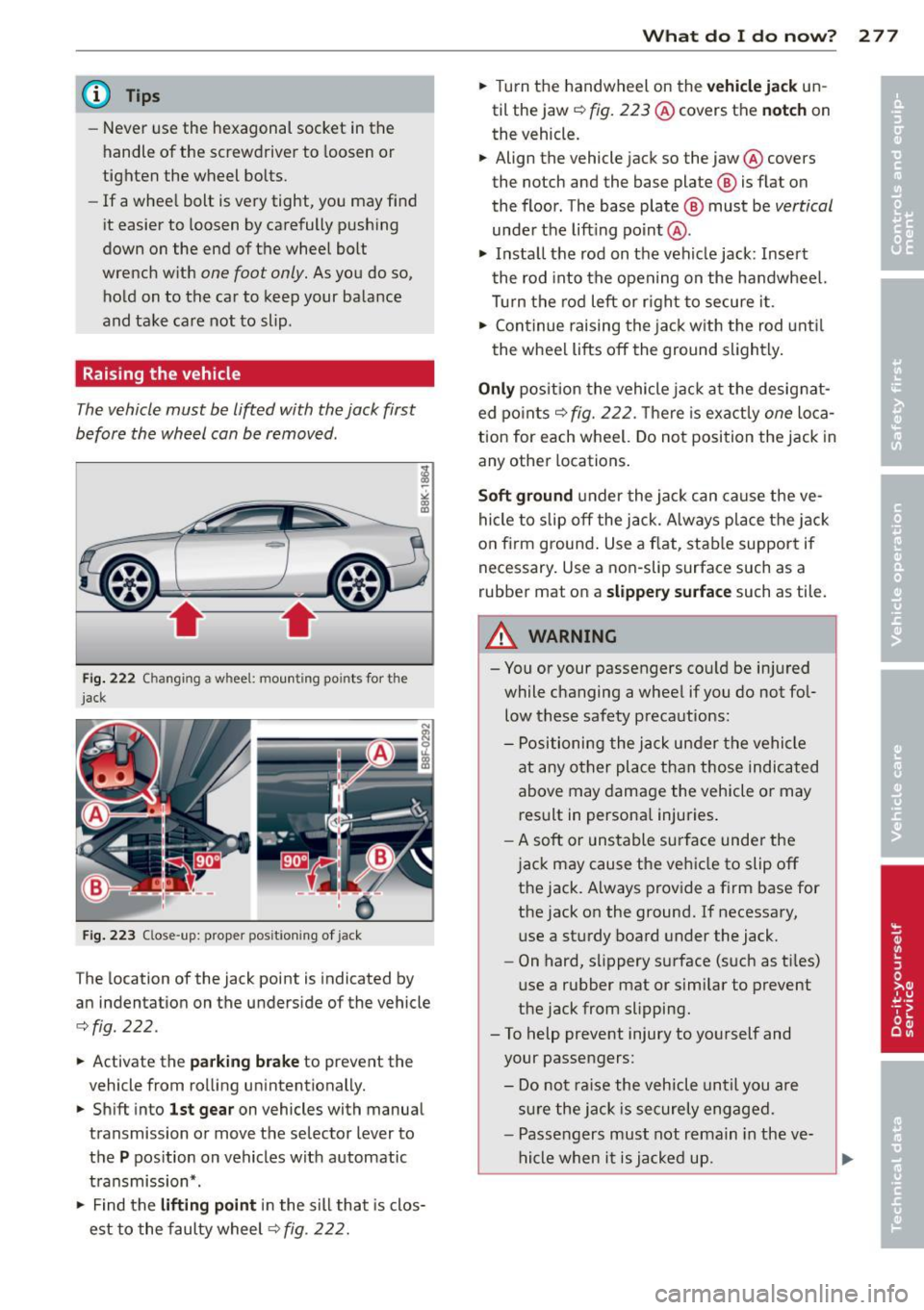
Fig. 2 22 Changing a whee l: moun ting po ints for the
jack
F ig . 223 C lose -up: proper positioning of jack
The location of the jack point is indicated by
an indentation on the underside of the vehicle
¢ fig. 222 .
.. Activate the parking b rake to prevent the
vehicle from rolling unintentionally.
.. Shi ft into
1st gea r on vehicles with manual
transmission or move the selector lever to
the
P pos ition on vehicles with automatic
t ransmission* .
.,. Find the
liftin g point in the sill that is clos
est to the faulty wheel~
fig. 222.
What do I d o now ? 277
.. Turn the handwheel on the ve hicl e jac k un
til the jaw
c::, fig. 223@covers the not ch on
the vehicle.
.. Align the vehicle jack so the jaw @covers
the notch and the base plate ® is flat on
the floor. The base plate
@ must be vertical
under the lift ing po int @ .
.,. Insta ll the rod on the vehicle jack: Inse rt
the rod into the opening on the handwheel.
Turn the rod left or r ight to secure i t.
.. Continue raising the jac k w ith the rod unti l
the wheel lifts off the ground slightly.
O nly pos ition the vehicle jack at the designat
ed po ints
c::, fig. 222. T here is exactly one loca
tion for each wheel. Do not position the jack in
any other locations .
Soft ground under the jack can cause the ve
hicle to slip off the jack. A lways place the jack
on f irm ground . Use a flat, stab le support if
necessary. Use a non-slip surface such as a
rubber mat on a
s lippery surface such as tile.
A WARNING
- You or your passengers cou ld be in jured
while changing a wheel if you do not fol
low these safety precautions:
- Positioning the jack un der the vehicle
at any other place than those indicated
above may damage the vehicle or may result in persona l injuries .
- A soft or unstable surf ace under the
jac k may cause the veh icle to slip off
the jack. Always prov ide a f irm base for
the jack on the ground. If necessary,
use a sturdy board under the jack.
- On hard, slippery surface (such as ti les)
use a rubber mat or similar to prevent
the jack from slipping.
- To help prevent injury to yourself and
your passengers:
- Do not ra ise the vehicle until you are
s u re the jack is securely engaged .
- Passengers must not remain in the ve
h icle when it is ja cked up.
Page 286 of 316

284 Emergency situations
Emergency situations
General
This chapter is intended for trained emer
gency crews and working personnel who
have the necessary tools and equipment to perform these operations.
Starting by pushing or
towing
Q;) Note
Vehicles with an automatic transmission
cannot be started by pushing or towing.
Starting with jumper
cables
If necessary , the engine can be started by
connecting it to the battery of another vehi
cle.
If the engine should fail to start because of a
discharged or weak battery, the battery can be
connected to the battery of
another vehicle,
using a
pair of jumper cables to start the en
gine .
Jumper cables
Use only jumper cables of sufficiently
large cross section to carry the starter current
safely. Refer to the manufacturer's specifica
ti ons.
Use only jumper cables with
insulated termi
nal clamps which are distinctly marked :
plus(+) cable in most cases colored red
minus (-) cable
in most cases colored black .
A WARNING
Batteries contain electricity, acid, and gas.
Any of these can cause very serious or fatal
injury. Follow the instructions below for
safe handling of your vehicle's battery.
- Always shield your eyes and avoid lean
ing over the battery whenever possible. -
A discharged battery can freeze at tem
peratures just below
32 °F (0 °(). Before
connecting a jumper cable, you must
thaw the frozen battery completely, oth
erwise it could explode.
- Do not allow battery acid to contact eyes
or skin . Flush any contacted area with
water immediately .
- Improper use of a booster battery to
start a vehicle may cause an explosion.
- Vehicle batteries generate explosive gas
es . Keep sparks, flame and lighted ciga
rettes away from batteries .
- Do not try to jump start any vehicle with
a low acid level in the battery .
- The voltage of the booster battery must
also have a 12-Volt rating. The capacity
(Ah) of the booster battery should not be
lower than that of the discharged bat
tery . Use of batteries of different voltage
or substantially different "Ah" rating
may cause an explosion and personal in
jury.
- Never charge a frozen battery. Gas trap
ped in the ice may cause an explosion.
- Never charge or use a battery that has
been frozen. The battery case may have
be weakened.
- Use of batteries of different voltage or
substantially different capacity (Ah) rat
ing may cause an explosion and injury.
The capacity (Ah) of the booster battery
should not be lower than that of the dis
charged battery.
- Before you check anything in the engine
compartment, always read and heed all
WARNINGS¢
page 230, Engine com
partment.
@ Note
- Applying a higher voltage booster bat
tery will cause expensive damage to sen
sitive electronic components, such as
control units, relays, radio, etc.
- There must be no electrical contact be
tween the vehicles as otherwise current
could already start to flow as soon as the
positive(+) terminals are connected. ..,.