transmission AUDI A5 COUPE 2012 Owner's Guide
[x] Cancel search | Manufacturer: AUDI, Model Year: 2012, Model line: A5 COUPE, Model: AUDI A5 COUPE 2012Pages: 316, PDF Size: 78.59 MB
Page 287 of 316
@ Tips
-The discharged battery must be properly
connected to the vehicle's electrical sys
tem. When jump start ing or charging the
battery, never connect the negative
ground cable to the battery negative
post because the battery manager sys
tem must be able to detect the battery's
state of cha rge . A lways connect the neg
ative g round cab le to the negative
gro und post o f the battery manage r con
trol uni t.
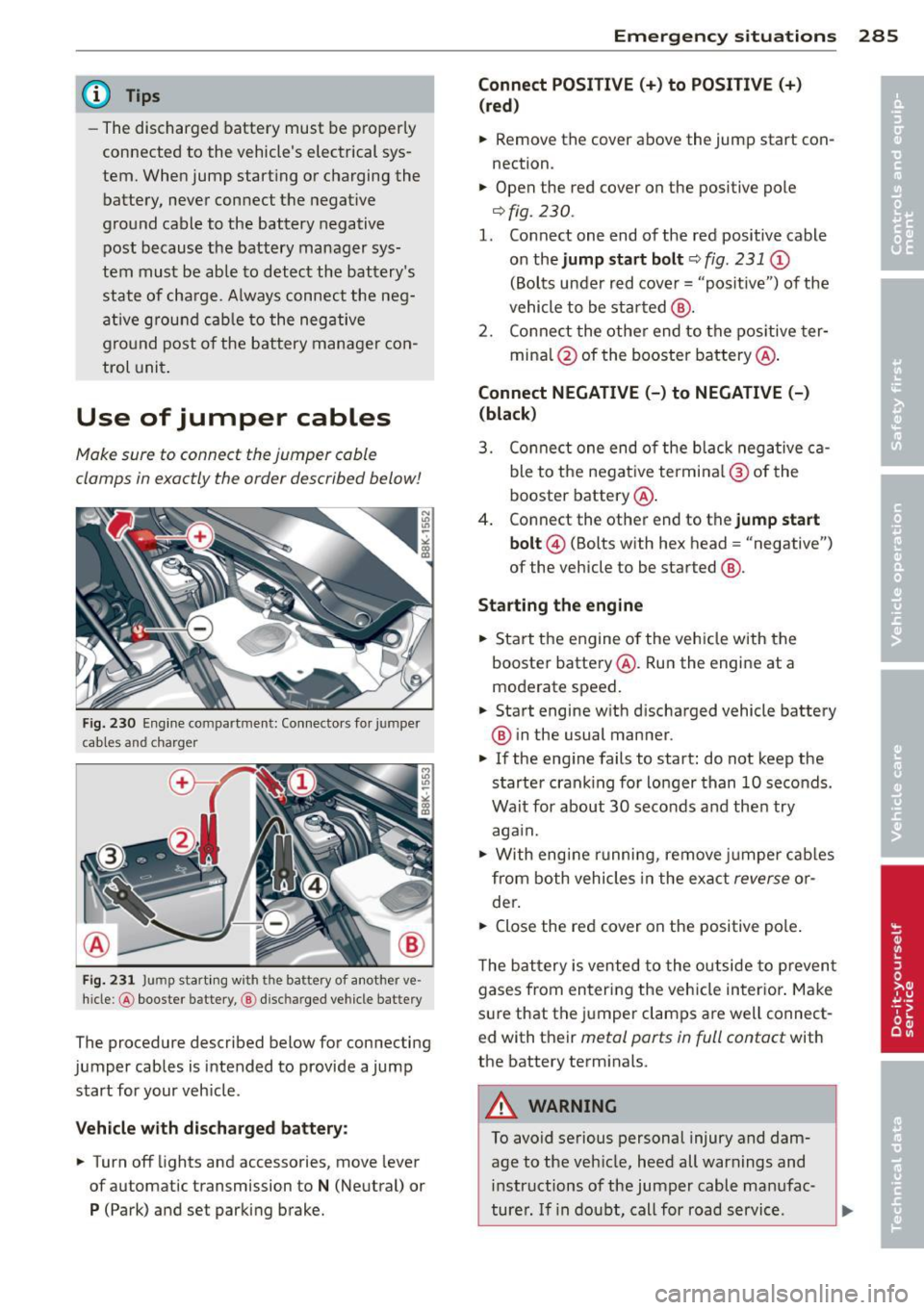
Use of jumper cables
Make sure to connect the jumper cobl e
clomps in exactly the order describ ed b elow!
Fig. 230 Engine co mpartmen t: Con ne ctors fo r jum per
c ables a nd char ger
Fi g. 231 Jump s tart in g w ith t he ba ttery of a not her ve
hi cle :@ booster battery, @ disc harged vehicle bat tery
The procedure described below for connecting
jumper cables is intended to provide a jump
start for your veh icle .
Vehicle with discharged batter y:
.. Turn off lights and accessories , move lever
of automatic transmission to
N (Neutral) or
P (Park) and set parking brake.
Emergenc y situ ation s 285
Connect POSI TIVE(+ ) to POSITIVE (+ )
(red )
.. Remove the cover above the jump start con
nection .
.. Open the red cover on the positive pole
¢fig. 230 .
1. Connect one end of the red positive cable
on the
jump sta rt bolt ¢ fig. 231 (D
(Bolts under red cover= "positive ") of the
vehicle to be star ted @.
2. Connect the othe r end to the pos itive ter -
mina l@ of the booster battery @.
Connect NEGATIVE (-) to NEGATIVE (-)
(black )
3. Connect one end of the b lack negative ca
ble to the nega tive te rmi na l@ of the
booster battery @.
4 . Connect the other end to the
jump start
bolt @
(Bolts with hex head = "negative")
of the vehicle to be started @.
Sta rting the engine
.. Start t he engine of the veh icle w ith the
booster battery @. Run the engine at a
moderate speed .
.. Start engine w ith d ischarged vehicle battery
® in the usual manner .
.. If the eng ine fails to start: do not keep the
starter crank ing for lo nger than 10 seconds .
Wait for about 30 seconds and the n try
aga in .
.,. With engi ne runni ng , remove j umper cab les
from both vehicles in the exact
reverse o r
der .
.. Close the red cover on the positive pole .
T he battery is vented to the o utside to p revent
gases from entering the veh icle in ter ior . Make
s ur e that the j umper clamps a re well connect
e d with their
metal ports in full contact with
the batte ry terminals.
A WARNING
To avoid serious personal injury and dam
age to the vehicle, heed all warnings and
instructions of the jumper cable manufac-
turer . If i n doubt, call for road service .
Ill>
Page 291 of 316
fall f rom a lift if the re is a change in ve
h icle we ight d istr ibut ion and balance.
This might happen, for examp le, when
heavy components such as the engi ne
b lock or transmiss io n are removed .
- Whe n removing heavy components like
these, ancho r vehicle to ho ist o r add cor
r e spond ing w eig hts to ma intai n the cen
te r of g ravity . Othe rwise, the vehicl e
mi ght til t or slip off th e hoi st, causi ng
s er ious perso nal inju ry.
(D Note
- Be awa re of th e f ollowing po in ts b efore
li fting t he vehi cle:
- The vehicle should never be lifted or
jacked up from underneath the engine oil pan, the transmission housing, the
front or rear axle or the body side
members. This could lead to serious
damage .
- To avoid damage to the underbody or
chassis frame, a rubber pad must be
inserted between the floor jack and
the lift points.
- Before driving over a workshop hoist,
check that the vehicle weight does not
exceed the permissible lifting capacity
of the hoist.
- Before driving over a workshop hoist,
ensure that there is sufficient clear ance between the hoist and low parts
of the vehicle .
Emergency situations 289
•
•
Page 292 of 316
2 90 General information
General information Explanation of
technical data
Some of the technical data listed in this man
ual requires further explanation .
The technical data for your vehicle is listed in
the charts starting on
r:::> page 292. This sec
tion provides general information, notes and restrictions which apply to this data .
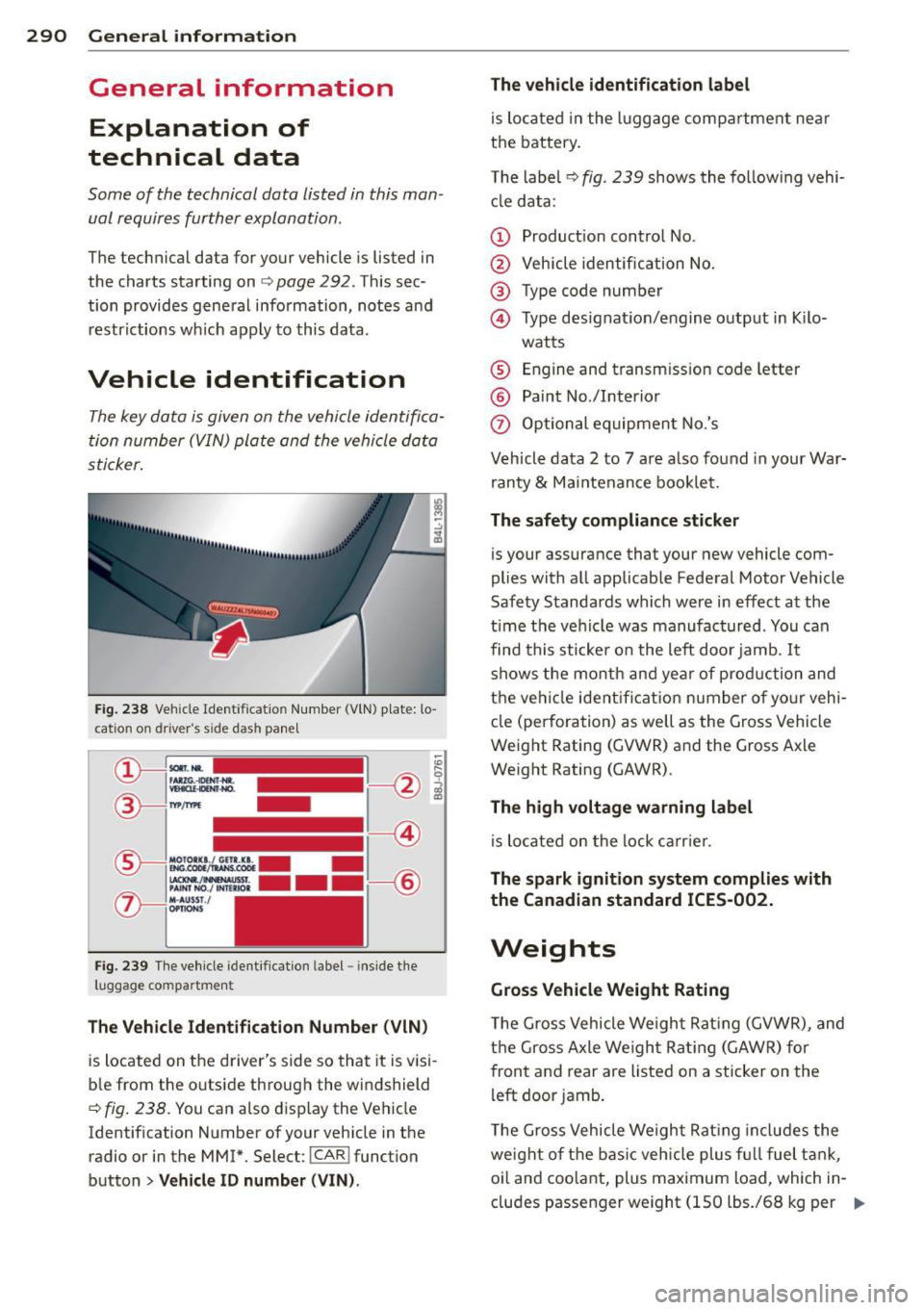
Vehicle identification
The key data is given on the vehicle identifica
tion number (VIN) plate and the vehicle data
sticker.
Fig. 238 Veh icle Ide ntific atio n Number (VlN) p late: lo
cation on driver 's sid e das h panel
Fig. 239 The vehicle identi fication label -inside the
luggage co mpa rtmen t
The Vehicle Identification Number (VIN)
is located on the driver's side so that it is visi
b le from the outside through the windshield
r:::> fig . 238. You can also display the Vehicle
Identification Number of your vehicle in the
radio or in the MM!*. Select :
!CAR ! function
button> Vehicle ID number (VIN). The
vehicle identification label
is located in the luggage compartment near
the battery .
The label¢
fig. 239 shows the following vehi
cle data :
(D Production control No.
@ Vehicle identification No.
® Type code number
@ Type designation/engine output in Kilo-
watts
® Engine and transmission code letter
@ Paint No./Interior
(f) Optional equipment No.'s
Vehicle data 2 to 7 are also found in your War
ranty
& Maintenance booklet.
The safety compliance sticker
is you r assurance that your new vehicle com
plies with all applicable Federal Motor Vehicle
Safety Standards which were in effect at the
t ime the vehicle was manufactured . You can
find this sticker on the left door jamb.
It
shows the month and year of production and
the ve hicle ident ification number of your vehi
cle (perforation) as well as the Gross Vehicle
Weight Rating (GVWR) and the Gross Axle
Weight Rating (GAWR) .
The high voltage warning label is located on the lock carr ier .
The spark ignition system complies with
the Canadian standard ICES-002.
Weights
Gross Vehicle Weight Rating
The Gross Vehicle Weight Rating (GVWR), and
the Gross Axle Weight Rating (GAWR) for
front and rear are Listed on a sticker on the
left door jamb.
The Gross Vehicle Weight Rating includes the
weight of the basic vehicle plus full fuel tank,
oi l and coolant, plus maximum load , wh ich in
cludes passenger weight (150 lbs./68 kg per
Ill>
Page 297 of 316
-Always make sure the transm ission se
lector lever (automatic transmiss ion) is
in "P" (Park position) or Neutral (manual
transmission) and the park brake is firm
ly appl ied .
® For the sake of the environment
-Changing the eng ine settings w ill ad
versely affect em ission levels. This is det
rimental to the environment and increas
es fuel consumption .
- Always observe env ironmental regula
tions when d ispos ing of old engine oil,
used brake fluid, dirty engine coolant,
spent batter ies or worn out t ires.
- Undeployed airbag modules and p reten
s ioners might be classified as Perchlo
rate Material -special handling may ap
ply, see www.dtsc.ca .gov/hazardous
waste/perch lorate . When the veh icle or
parts of the restraint system including
airbag modules safety belts with preten
s ioners are scrapped, all applicable laws
and regulations must be observed. Your
authorized Audi dealer is familiar w ith
these requirements and we recommend
that you have your dealer perform this
serv ice for you .
Additional accessories,
modifications and
parts replacement
Additional accessories and parts
replacement
Always consult on authorized Audi dealer be
fore purchasing accessories.
Your veh icle incorporates the latest safety de
sign featu res ensu ring a high standard of ac
tive and passive safety.
This safety could be compromised by non-ap
proved changes to the veh icle. For this reason ,
if parts have to be replaced, p lease observe
the following points when installing addition
al accessories:
Con sumer In formation 295
Approved Audi accessories and genuine Audi
parts are available from authorized Audi deal
ers.
T hese dea lers a lso have the necessary facili
ties, tools and trained specialists to install the
parts and accessories proper ly.
A WARNING
Using the wrong spare parts or using non
approved accessories can cause damage to
the vehicle and serious persona l injury.
- Use on ly accessories express ly approved
by Audi and genuine Audi spare parts
- These parts and accessories have been
specially designed to be used on your ve
hicle.
- Never install accessories such as tele
phone cradles or beverage holders on air
bag covers or within the airbag deploy
ment zones . Do ing so will increase the
risk of injury if a irbags are triggered in an
accident!
- Before you check anything in the engine
compartment, always read and heed all
WARNINGS ~
page 230.
(D Note
-If items other than genuine Audi spare
parts, add-on equipment and accessory
items are used or if repair work is not
performed accord ing to specified meth
ods, this can result in severe damage to
your vehicle's engine and body (such as
corrosion) and adversely affect your vehi
cle's warranty .
- If emergency repairs must be performed
elsewhere, have the vehicle examined by
an authorized Audi dealer as soon as
possible.
- The manufacturer cannot be held liable
for damage wh ich occurs due to failure
to comply with these stipulations.
•
•
Page 305 of 316

Index 303
-----------------------------------.......
Unleaded fuel ..................... 232
What should I do with an old battery? . 251
Environmental note
Rear window defogger . . . . . . . . . . . 83, 88
Roof rack .. .. ........... .. .. .. .... 74
EPC
refer to Electronic power control .... .. 15
E SP
refer to Electronic stabili zation program
(ESP) .... .. ................. .. .... 15
Event Data Recorder (EDR) ............ 204
Exhaust tail pipes Cleaning . .. ............. .. .. .. .. . 226
Expansion tank ............ .... .. ... 244
Exterior mirrors
Adjusting . ................. ... .... 57
Dimming ... ................ ... .... 58
Heating .. .. ............. .... .. .. .. 57
Eyeglasses compartment .... .. .. .. .. .. 77
F
Fan
Deluxe automatic climate control .. .. .. 81
Deluxe automatic climate control plus . . 87
Radiator ... .. .............. ... ... 246
Fastening Booster seats ............ .. .. .. .. . 194
Convertible child safety seats . .. .. .. . 192
I nfant seats ............. .... .. .. . 191
Flat tire Changing .. .. ........ ... .. .. .. .. . 274
Floor mats . . . . . . . . . . . . . . . . . . . . . . . . . 149
F og lights . . . . . . . . . . . . . . . . . . . . . . . . . . 50
Foot pedals . . . . . . . . . . . . . . . . . . . . . . . . 149
For the sake of the environment
Gasoline fumes and the environment .. 234
Reducing engine noise by early upshift-
ing .. .. .. .. .. .. ........... .. .. .... 11
Refueling .. .. ........ ... .. .. .. .. . 234
Saving fuel by early upshifting .. . ... .. 11
Front airbags
Description . .. ........... .. .. .. ... 166
Howtheywork .................... 171
Fr ontal collisions and the laws of physics 155
Front ashtray ............... ... ... ... 75 Front seats
. . . . . . . . . . . . . . . . . . . . . . . . . 61
Adjusting ..... .... ............... 146
Child restraints in the front seat .... .. 163
Convenience side view . . . . . . . . . . . . . . . 66
Symmetrical seat positions . . . . . . . . . . . 66
Fuel Additives ... ..... .. ............... 232
Blended gasoline ... .............. . 232
Consumption .. .. .... ......... .. .. . 22
Filler neck . .. .. .. .. . .............. 233
Fuel gauge . . . . . . . . . . . . . . . . . . . . . . . . 12
Gasoline .. .. .. .. .. . .. .... ........ 232
Gasoline additives .. .............. . 233
Octane rating .. .. ................. 232
Recommendation . .... ......... .. .. 232
Refuelling ..... .. .. ............... 234
Reserve ....... .... ................ 12
Tank capacity .................... . 292
Unlocking the fuel filler flap by hand .. 235
Fuel economy messages (efficiency pro-
gram) .... .. .. .. .. .. . .............. . 26
Fuel filler flap Unlocking the fuel filler flap by hand .. 235
Fuel supply too low ................. . 35
Fuses Assignment . . . . . . . . . . . . . 280, 281, 282
Replacing ........................ 280
G
Garage door opener (Homelink ®) .. .. .. 140
Gas discharge lamps .. ..... .......... 283
Gauges Engine coolant temperature . . . . . . . . . . 10
Fuel gauge .. .. .. ............... .. . 12
Tachometer . . . . . . . . . . . . . . . . . . . . . . . 11
Gear recommendation .............. .. 25
Gearshift indicator . .. ... ....... ...... 20
Gearshift lever 6-speed manual transmission ...... .. 126
General illustration Instruments and controls .......... ... 8
Glossary of tire and loading terminology 253
Glove compartment . . . . . . . . . . . . . . . . . . 77
Gross Vehicle Weight Rating (GVWR) . .. 290
•
•
Page 308 of 316
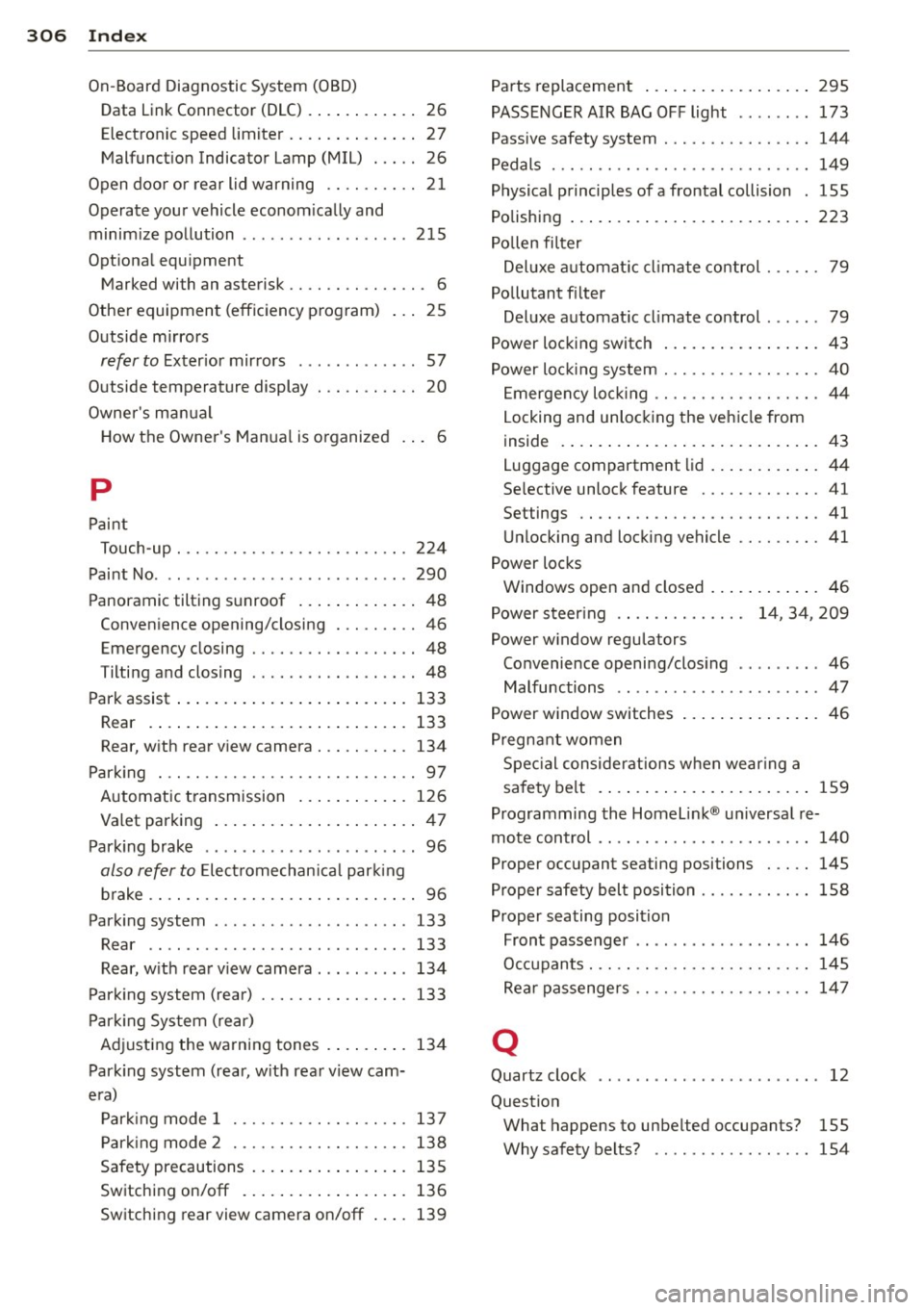
306 Index
------------------------------------
On-Board Diagnostic System (OBD) Data Link Connector (DLC) .. .. ... ... .. 26
Electronic speed limiter ...... .. .... .. 27
Malfunction Indicator Lamp (MIL) . . . . . 26
Open doo r or rear lid warning . . . . . . . . . . 21
Operate your vehicle econom ically and
minimize pollution .......... ... .. ... 215
Optiona l equipment
M arked with an asterisk . . . . . . . . . . . . . . . 6
Other equipment (efficiency program) 25
Outside mirrors
refer to Exterior mirrors ....... .. .. .. 57
Outside temperature display . .. .. .. .. . . 20
Owner 's manual
H ow the Owner's Manual is o rganized . . . 6
p
Paint
Touch-up ....... .. ....... .. .. .. .. . 224
Paint No ..... ................ ... .. . 290
Panoramic tilting sunroof ............. 48
Convenience opening/closing ... .. .. .. 46
Emergency clo sing .......... .. .... .. 48
Tilting and closing ........ .. .. .. .. .. 48
Park assist .................. .. .... . 133
Rear .. .... ................ ..... . 133
Rea r, with rear view camera . .. .. .... . 134
Parking ... ........ ....... .. .. .... .. 97
Automatic transmission ............ 126
Valet parking ................ .... .. 47
Parking brake ................ ... ... . 96
also refer to Electromechan ica l park ing
brake .. .. .. ... .......... .. .. .. .. .. 96
Park ing system .. ... .... ..... .. .. .. . 133
Rear .. .. .. ..... ........... ... .. . 133
Rear, w ith rear v iew camera ..... .. .. . 134
Parking system (rear) ......... .. .. .. . 133
Parking System (rear)
Adjusting the warning tones . ..... .. . 134
Parking system (rear, w ith rear view cam-
era)
Parking mode 1 .............. .... . 137
Parking mode 2 .......... .. .. .... . 138
Safety precautions ......... ... .... . 135
Switching on/off .......... ... .... . 136
Switching rear view camera on/off ... . 139 Parts
replacement .............. .... 295
PASSENGER AIR BAG OFF light ........ 173
Passive safety system . . . . . . . . . . . . . . . . 144
Pedals . .... .... .. ............. .... 149
Physical principles of a frontal collision . 155
Polishing ......... ................ . 223
Pollen filter
Deluxe automatic climate control . .. .. . 79
Pollutant filter Deluxe automat ic climate control ..... . 79
Power locking switch ................. 43
Power locking system ............ .... . 40
Emergency locking .. ........... .. .. . 44
Locking and unlocking the vehicle from
inside ........ .. .................. 43
Luggage compartment lid ........ ... . 44
Se lective unlock feature .......... .. . 41
Settings .. .. .. .. ............. .... . 41
Unlocking and locking vehicle .... .. .. . 41
Power locks Windows open and closed ........ ... . 46
Power steering . . . . . . . . . . . . . . 14, 34, 209
Power window regulators Convenience opening/closing ........ . 46
Malfunctions .. .. ..... ........... .. 47
Power window switches ............... 46
Pregnant women
Special considerations when wear ing a
safety belt . . . . . . . . . . . . . . . . . . . . . . . 159
Programming the Homelink ® un iversal re
mote control . . . . . . . . . . . . . . . . . . . . . . . 140
Proper occupant seating posi tions . .. .. 145
Proper safety belt position .......... .. 158
Proper seating position Front passenger . . . . . . . . . . . . . . . . . . . 146
Occupants . .. .. .. ... ... ... .... .... 145
Rear passengers .. ............. .. .. 147
Q
Quartz clock .. .. .. .......... ...... .. 12
Question Wha t happens to unbelted occupant s? 155
Why safety belts? ....... ...... .. .. 154
Page 311 of 316
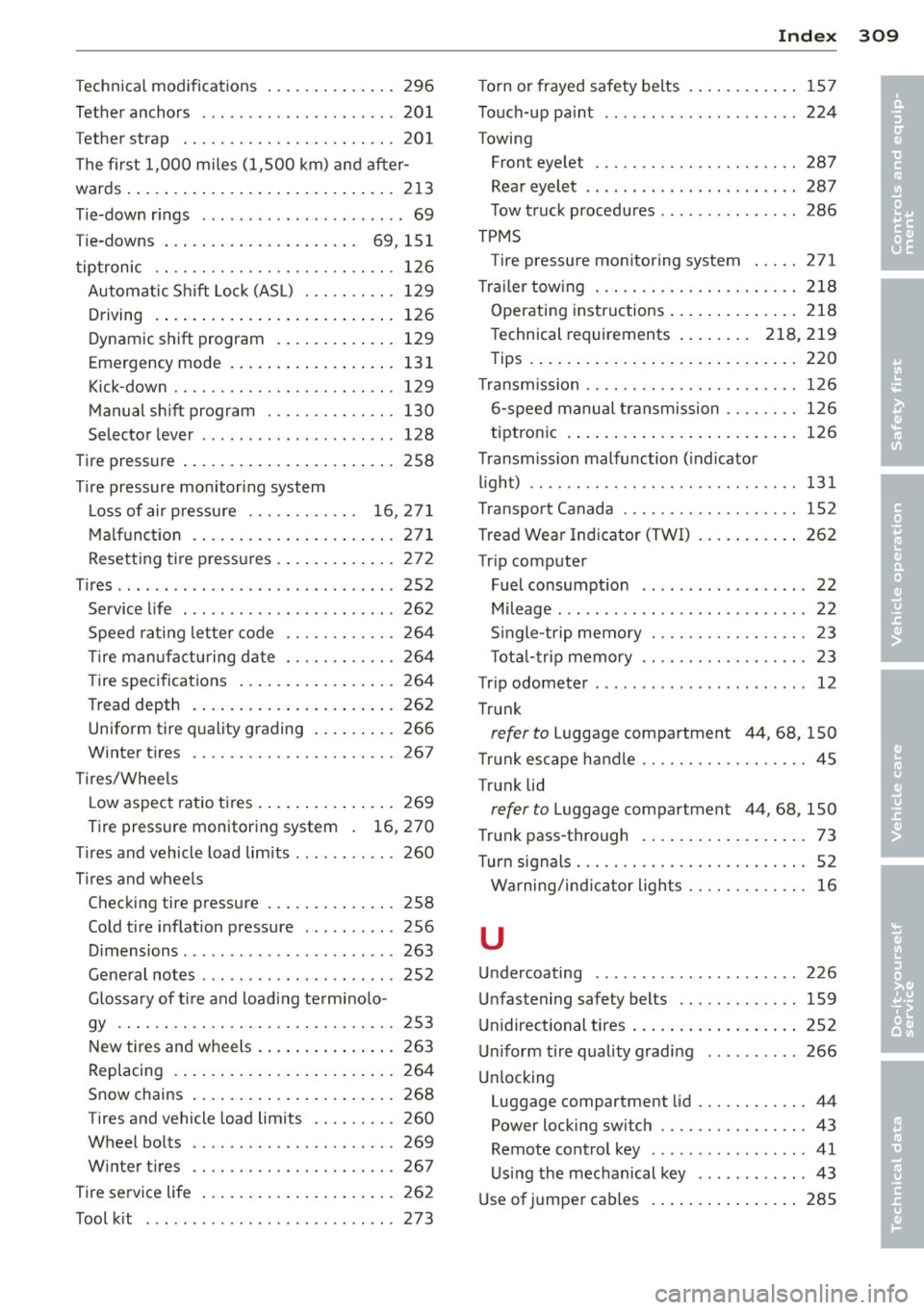
Technical modifications ..... .. .. .. .. . 296
Tether anchors ............... ... ... 201
T ether strap . ............. .... .. .. . 201
The first 1,000 miles (1 ,500 km) a nd after-
wards ..... .. .. .. .. .. .... ... .. .. ... 213
Tie-down r ings ............. ... ... ... 69
T ie-downs . . . . . . . . . . . . . . . . . . . . . 69, 15 1
tiptronic .. .. ............. .. .. .. ... 126
Automatic S hift Lock (ASL) . .. .. .. .. . 129
D riving .... .... .. .... ... .. .. .. ... 126
Dynamic s hift program . ... .. .. .. .. . 129
Emergency mode . ..... ... .. .. .. .. . 13 1
Kick-down . . . . . . . . . . . . . . . . . . . . . . . . 129
Manual sh ift program ..... .. .. .. .. . 130
Selector lever ......... ...... .... .. 128
Tire pressure ... ... ..... ... .. .. .. ... 258
T ire pressure monitor ing system
L oss of air pressure . . . . . . . . . . . . 16, 27 1
M alf unc tion ............. .... .. ... 27 1
Rese tting tire p ressures . ... .. .. .. .. . 272
Tires ...... ... ............. ...... .. 252
Service life . .... .. .... ... .. .... .. . 262
Speed rat ing let ter code ... .. .. .. .. . 264
Tire manufacturing date ... .. .. .. .. . 264
Tire specifica tions ..... ... .. .. .. .. . 264
Tread depth . .... ..... ... .. .. .. ... 262
Uniform t ire quality grading . ... .. .. . 266
W inter t ires ............. .... .. ... 267
T ires/Whee ls
L ow aspect ratio t ires ... ... .. .. .. .. . 269
Tire pressure monitoring system . 16, 270
Tires and vehicle load lim its ... ... . ... . 260
Tires and whee ls
Checking tire pressure ..... .. .. .. .. . 258
Cold tire i nflat ion pressure ..... ... .. 256
D imensions ............... ... ... .. 263
Ge neral notes ............... ... ... 252
Glossa ry of t ire and load ing te rm inolo-
gy .. .. .. .. .. .. ........... .. .. ... 253
N ew tires and wheels ... ... .. .. .. .. . 263
Replacing . ..... ...... ... .. .. .. ... 264
Snow chains . .... ..... ... .. .. .. ... 268
T ires and vehicle load limits .. .. .. .. . 260
Wheel bolts ............. .... .. .. . 269
W inter t ires .. ........... .. .. .. ... 267
Tire se rvice life ... .. .... ... .. .. .. ... 262
Tool kit ... ... ............. ...... .. 273
Inde x 309
To rn o r frayed safety belts ..... ... .. .. 157
Touch-up pa int .. ... ................ 224
Towing Front eye let . . . . . . . . . . . . . . . . . . . . . . 287
Rear eyelet .. .. .. .. . ... ...... ... .. 287
T ow t ruck procedures .......... .... . 286
TPMS Tire pressure monitoring system ... .. 271
T ra ile r tow ing . .. .. .... ........... .. 218
Operating instr uctions .. ..... ... .. .. 218
Technical requirements . . . . . . . . 218, 219
T ips . ... .. .. .... .. . .. .. ..... ... .. 220
T ransmission .. .. .. .. . .............. 1 26
6 -speed manual transmission .... .. .. 126
tiptron ic . ... .. .. .. .. .. ...... ... .. 126
Transmiss ion malfunction ( indicator
li ght) ......... ... .. ............... 131
Transport Canada . . . . . . . . . . . . . . . . . . . 152
T re ad Wea r Ind icator (TW I)
Tr ip computer 262
Fuel consumpt ion . . . . . . . . . . . . . . . . . . 22
Mileage . .. .. .. .. .. . ... ...... ... .. . 22
S ingle-trip memo ry ............ .... . 23
T ota l- t rip memory ............. .. .. . 23
Tr ip odometer ..... .. ................ 12
Tr unk
refer to Luggage compartment 44, 68, 150
T ru nk escape handle ............. .. .. . 4S
Trunk lid
refer to L uggage compartment 44, 68, 150
Trunk pass-through .. . .. ..... ... .. .. . 73
T urn signals . .. .. .. ................. . 52
Wa rning/ind icator lights ........ .. .. . 16
u
Undercoa ting . .. ...... ........... .. 2 26
Unfastening safety belts ......... .. .. 159
U nidirectional tires ... .. ...... ... .. .. 2S2
U niform tire quality grading .......... 266
Un locking
Luggage compartment lid ........... . 44
Power locking switch ............... . 43
Remote cont ro l key .. .. .. .. ... ... .. . 41
U sing the mechanical key ............ 43
U se of jumper cab les .. ... .... ... .. .. 285
•
•