belt AUDI A5 COUPE 2012 Owner's Guide
[x] Cancel search | Manufacturer: AUDI, Model Year: 2012, Model line: A5 COUPE, Model: AUDI A5 COUPE 2012Pages: 316, PDF Size: 78.59 MB
Page 172 of 316
1 70 Airbag sys tem
-Improper repair or disassembly of the
front passenger and driver seat will pre
vent the Advanced A irbag System from
functioning properly.
- Repairs to the front passenger seat must
be performed by qualified and properly
trained workshop personnel.
- Never remove the front passenger or
dr iver seat from the veh icle .
- Never remove the upholstery from the
front passenger seat.
- Never disassemble or remove parts from the seat or disconnect wires from it.
- Never carry sharp objects in your pockets
or place them on the seat. If the weight
sensing mat in the passenger seat is punctured it cannot work properly.
- Never carry things on your lap or carry
objects on the passenger seat. Such
items can increase the weight registered
by the weight-sens ing mat and send the
wrong info rmation to the airbag control
unit.
- Never store items under the front pas·
senger seat. Parts of the Advanced Ai r
bag System under the passenge r seat
cou ld be damaged, prevent ing them and
the airbag system from wo rking proper
ly .
- Never place seat covers or replacement upholstery that have not been specifical
ly approved by A udi on the front seats.
- Seat covers can prevent the Advanced Airbag System from recognizing child re
straints or occupants on the front pas
senger seat and prevent the side airbag in the seat backrest from deploy ing prop
erly.
- Never use cush ions, pillows, blankets or
similar items on the front passenger
seat. The add itiona l padd ing will prevent
the weight-sensing mat in the seat from
accu rately reg iste ring the c hild restra int
or person on the seat and prevent the
Advanced Airbag System from function ing properly .
-If you must use a child restra int on the
front passenger seat and the ch ild re- straint manufacturer's instructions
re
qu ire the use of a towel, foam cushion or
something e lse to properly pos ition the
child restraint, make certain that the
PASSENGER AIR BAG OFF light comes
on and stays on whenever the ch ild re·
straint is installed on the front passen
ger seat.
- If the PASSENGER AIR BAG OFF light
does not come on and stay on, immed i
a tely insta ll child restrain t in a rear se at
ing position and have the airbag system
inspected by your authorized Audi dealer.
How the Advanced Airbag System
components work together
The front Advanced Airbag System and the
s ide airbags supp lement the protection of
fered by the front three-point safety belts
with pretensioners and load limiters and the
adjustable head restraints to help redu ce the
risk of inju ry in a wide range of accident and
c rash situations. Be s ure to read the impor
tant information about safety and heed the
WARNINGS in this chapter.
Deployment of the Adv a need A irbag System
and the activation of the safety belt preten
sioners depend on the deceleration measured
by the crash sensors and registered by the
electron ic control unit. The amount of infla
tion of the front airbags can a lso be adapted
to the front seat pos ition, depending on the
distance between the respect ive front seat
and the steer ing w heel or instrument panel as
registered by sensors in the seats. Crash se·
verity depends on speed and deceleration as
well as the mass and st iffness of the vehicle
o r object involved in the crash .
On the passenger side, regardless of safety
belt use, the ai rbag w ill be tu rned off if the
we ight on the passenger seat is less than the
amount programmed in the e lectronic control
u nit. The front airbag on the passenger side
will a lso be turned off if one of the child safe -
ty seats that has been certified under Federal Motor Vehicle Safety Standard 208 has been
recogni zed on the seat . The
PAS SENGER AIR .,..
Page 173 of 316
BAG OFF light comes on and stays on to tell
you when the front Advanced Airbag on the
passenger side has been turned
off
c:> page 163, Child restraints on the front seat
- some important things to know.
A WARNING
To reduce the risk of injury whe n an airbag
inflates, always wear safety belts properly .
- If you are unrestrained, lean ing forward,
sitting sideways or out of position in any
way, yo ur risk of injury is much highe r.
- You w ill also receive serious injuries and
could even be killed if you are up against
the a irbag or too close to it when it in·
flates · even with an Advanced Airbag
c:>page 162.
More important things to know about
front airbags
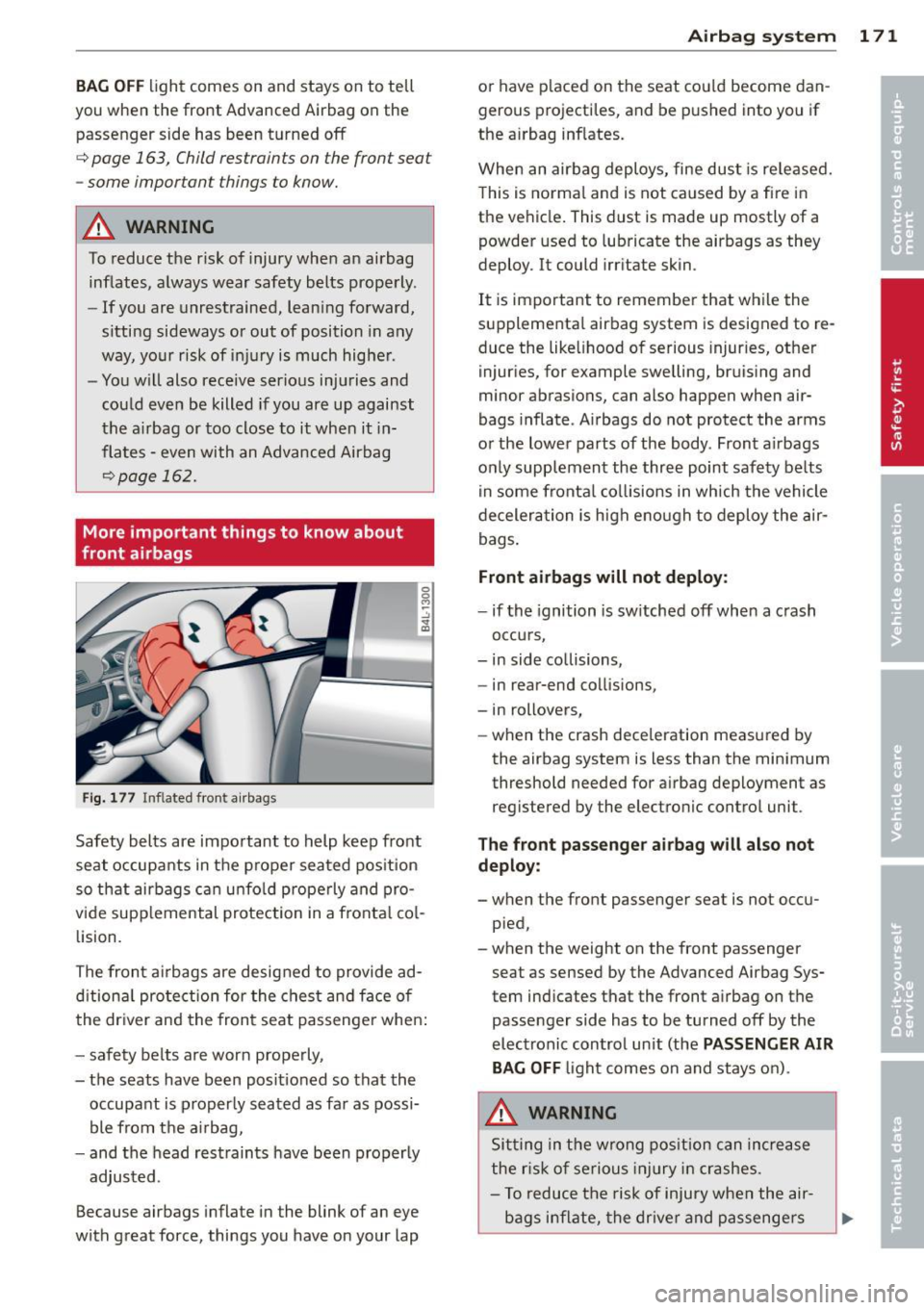
Fi g. 177 Inflated front a irbags
Safety belts are important to help keep front
seat occupants in the proper sea ted pos ition
so that airbags c an u nfo ld properly and pro
vide supp lemental protection in a fronta l co l
lision.
The front a irbags are designed to provide ad
d itiona l protection for the chest and face of
the dr iver and the front seat passenge r when:
- safety belts are worn properly,
- the seats have been posit io ned so that the
occupant is p roperly seated as far as possi
ble from the a irbag,
- and the head restraints have been properly
adjusted.
Because airbags inflate in the blink of an eye
with great force, things you have on your lap
A irba g sy stem 1 71
or have p laced on the seat co uld become dan
gerous projectiles, and be p ushed into you if
the a irbag inf lates.
When an airbag deploys, fine dust is re leased.
T his is norma l and is not caused by a fi re in
the ve hicle . This dust is made up mostly of a
powder used to lubricate the airbags as they
deploy. It could irr itate skin .
It is important to remembe r that wh ile the
supplementa l airbag system is designed to re
duce the like lihood of serious injur ies, other
injuries, for example swelling, bruis ing and
minor abrasions, can also happen when air
bags inflate . A irbags do not protect the arms
o r the lower parts of the body. Front a irbags
on ly supp lement the three point safety belts
in some fronta l co llisions in which the vehicle
decelera tion is high e no ugh to deploy the air
bags .
Front airbags will not deploy :
-if the ignition is sw itched off when a crash
occu rs,
- in side collisions,
- in rear-end collisions,
- in rollovers,
- when the crash deceleration measured by
the airbag system is less than the minimum
threshold needed for a irbag deployment as
reg istered by the electronic control unit .
The front pa sse n ger ai rbag will also not
deplo y:
- when the front passenger seat is not occu
pied,
- when the weight on the front passenger seat as sensed by the Advanced Airbag Sys·
tern ind icates that the front airbag on the
passe nger side has to be turned off by the
electronic control unit (the
PAS SENGER A IR
BAG OFF
light comes on and stays on) .
A WARNING
Sitting in the wrong position can increase
the r is k of se rious inj ury in crashes.
- To reduce the risk of injury when the air
bags inflate, the drive r and passenge rs
Page 174 of 316
172 Airbag system
must always sit in an upright position,
must not lean against or place any part
of their body too close to the area where
the airbags are located .
- Occupants who are unbelted, out of posi
tion or too close to the airbag can be se riously injured by an airbag as it unfolds
with great force in the blink of an eye
~page 163.
A WARNING
A child in a rearward-facing child safety
seat installed on the front passenger seat
will be seriously injured and can be killed if
the front airbag inflates -even with an Ad
vanced Airbag System.
- The inflating airbag will hit the child
safety seat or infant carrier with great
force and will smash the child safety seat
and child against the backrest, center
armrest, door or roof.
- Always install rear-facing child safety
seats on the rear seat.
- If you must install a rearward facing
child safety seat on the front passenger
seat because of exceptional circumstan
ces and the
PASSENGER AIR BAG OFF
light does not come on and stay on, im
mediately install the rear-facing child
safety seat in a rear seating position and
have the airbag system inspected by your
authorized Audi dealer.
A WARNING
Objects between you and the airbag will
increase the risk of injury in a crash by in
terfering with the way the airbag unfolds
or by being pushed into you as the airbag
inflates.
- Never hold things in your hands or on
your lap when the vehicle is in use.
- Never transport items on or in the area of the front passenger seat. Objects
could move into the area of the front air
bags during braking or other sudden ma
neuver and become dangerous projec- tiles that can cause serious personal in
jury if the airbags inflate.
- Never place or attach accessories or oth
er objects (such as cupholders, tele phone brackets, large, heavy or bulky ob
jects) on the doors, over or near the area marked "AIRBAG" on the steering wheel,
instrument panel, seat backrests or be
tween those areas and yourself. These
objects could cause injury in a crash, es
pecially when the airbags inflate.
- Never recline the front passenger's seat
to transport objects. Items can also
move into the area of the side airbag or
the front airbag during braking or in a
sudden maneuver. Objects near the air
bags can become projectiles and cause
injury, particularly when the seat is re
clined.
A WARNING
'-
The fine dust created when airbags deploy
can cause breathing problems for people
with a history of asthma or other breath
ing conditions.
- To reduce the risk of breathing problems, those with asthma or other respiratory
conditions should get fresh air right
away by getting out of the vehicle or
opening windows or doors.
- If you are in a collision in which airbags
deploy, wash your hands and face with
mild soap and water before eating.
- Be careful not to get the dust into your
eyes, or into any cuts or scratches.
- If the residue should get into your eyes,
flush them with water.
Page 176 of 316
174 Airbag sys te m
Vehicle Safety Standard 208 with which the
Advanced Airbag System in your vehicle was certified.
I f the front passenger seat is not occupied,
the front airbag will not deploy, and the
PAS
SENGER AIRBAG OFF
light will stay on . Never
install a rearward-facing chi ld restraint on the
front passenger seat, the safest p lace for a
child in any kind of child restraint is at one of
the seating posit ions on the rear seat
c::> page 163, Child restraints on the front seat
- some important things to know
and
c::> page 186, Child Safety .
If the PASSENG ER A IRBAG OFF light com es
on
when one of the conditions l isted above is
met, be sure to check the light regularly to
make certa in that the
PASSENGER AIRBAG
OFF
l igh t stays on cont inuo usly whenever the
ignition is on.
If the PAS SENGER AIRBAG OFF
light does not appear and not stay on all the
time, stop as soon as it is safe to do so and
- react iva te the system by turning the ignition
off and then turning it on again;
- remove and re insta ll the chi ld restraint.
Make su re that the child res traint is properly
insta lled and that the safety be lt for the
front passenger seat has been correct ly
ro uted around the child restraint as descri
bed in the chi ld restraint manufacturer's in
structions;
- make sure that the convertible locking fea
ture on the safety be lt for the front passen
ger seat has been activated and that the
safety belt has been pulled tight. The belt must not be loose or have loops of slack so
t h at the sensor below the safety be lt latch
on the sea t can do its job
c::> page 195.
- make sure that th ings that may increase the
we ight of t he chi ld and child safety seat are
not be ing tra nspo rted on the front passen
ger seat;
- make su re that the safety be lt tension sen
so r is not b locked. Shake t he safety be lt
l atch on the front passenger seat back and
forth;
- If a st rap or te ther is being used to tie the
child safety seat to the front passenger seat, make sure that
it is not so tight that it
causes the weight-sensing mat to measure
more weight than is act ually on the seat.
If the PASSENGER AIRBAG OFF light still
does not come on
and does not stay on con
tin uous ly (when the ignition is switched on),
- t ake the child res train t off the front passen-
ge r seat and ins tall it properly at one of the
rear seat positions. Have the airbag system
inspected by your authorized Audi dea ler
immed iate ly .
- move the child to a rear seat position and
make sure t hat the c hild is properly restra in
ed in a ch ild restra int that is appropriate for
its size and age.
The
PASSENGER AIRBAG OFF light should
NOT come on when the ignit ion is on and an
adult is s itting in a proper seating position on
the front passenger seat. If the
PASSENGER
AIRBAG OFF
lig ht comes on a nd stays on or
flashes fo r about 5 seconds wh ile driving, un
der these c ircumstances, make sure that:
- the adult on the front passenger seat is
properly seated on the center of the seat
cushion with his or her back up aga inst the
backrest and the backrest is not recl ined
c::> page 145, Proper occupant seating posi
tions,
- the adult is not tak ing weight off the seat by
holding on to the passenger assist handle
above the fron t passenger door or s upport
ing their weight on the armres t,
- t he safety belt is be ing properly wo rn and
t hat the re is not a lot o f slack in the safety
be lt webb ing,
- accessory seat covers or cushions or othe r
t hings tha t may cause an incorrec t reading
or impression on the weight-sensing mat
under the upho lstery of the seat have been
removed from the front passenger seat,
- a safety belt extender has not been left in
the safety belt latch for the front passenger
seat.
In add ition to the
PASSENGER AIRBAG OFF
light in the center of the instrument panel,
the message
PASSENGER AIRBAG OFF or
Page 178 of 316
176 Airbag system
There are some important things you have to
know to make sure that the effectiveness of
the system will not be impaired and that dis
carded components do not cause injury or pol
lute the environment.
A WARNING
Improper care, servicing and repair proce
dures can increase the risk of personal in
jury and death by preventing an airbag
from deploying when needed or deploying an airbag unexpectedly:
- Never cover, obstruct, or change the
steering wheel horn pad or airbag cover
or the instrument panel or modify them
in any way.
- Never attach any objects such as cu
pholders or telephone mountings to the
surfaces covering the airbag units.
- For cleaning the horn pad or instrument
panel, use only a soft, dry cloth or one
moistened with plain water. Solvents or
cleaners could damage the airbag cover
or change the stiffness or strength of the
material so that the airbag cannot de
ploy and protect properly.
- Never repair, adjust, or change any parts
of the airbag system .
- All work on the steering wheel, instru
ment panel, front seats or electrical sys
tem (including the installation of audio
equipment, cellular telephones and CB
radios, etc .) must be performed by a
qualified technician who has the training
and special equipment necessary.
- For any work on the airbag system, we
strongly recommend that you see your
authorized Audi dealer or qualified work shop.
- Never modify the front bumper or parts
of the vehicle body.
- Always make sure that the side airbag
can inflate without interference:
- Never install seat covers or replace
ment upholstery over the front seat
backs that have not been specifically
approved by Audi . -
Never use additional seat cushions that
cover the areas where the side airbags
inflate.
- Damage to the original seat covers or
to the seam in the area of the side air
bag module must always be repaired
immediately by an authorized Audi
dealer .
- The airbag system can be activated only
once. After an airbag has inflated, it
must be replaced by an authorized Audi
dealer or qualified technician who has
the technical information, training and
special equipment necessary.
- The airbag system can be deployed only
once . After an airbag has been deployed,
it must be replaced with new replace
ment parts designed and approved espe
cially for your Audi model version. Re
placement of complete airbag systems
or airbag components must be per
formed by qualified workshops only.
Make sure that any airbag service action
is entered in your Audi Warranty
& Main
tenance booklet under
AIRBAG REPLACE
MENT RECORD .
-In accidents when an airbag is deployed,
the vehicle battery separates the alterna
tor and the starter from the vehicle elec
trical system for safety reasons with a pyrotechnic circuit interrupter.
- Work on the pyrotechnic circuit inter
rupter must only be performed by a
qualified dealer -risk of an accident!
- If the vehicle or the circuit interrupter
is scrapped, all applicable safety pre
cautions must be followed.
@ For the sake of the environment
Undeployed airbag modules and preten
sioners might be classified as Perchlorate Material -special handling may apply, see
www.dtsc.ca.gov/hazardouswaste/per
chlorate. When the vehicle or parts of the restraint system including airbag modules
safety belts with pretensioners are scrap
ped, all applicable laws and regulations
must be observed. Your authorized Audi
1J1-
Page 179 of 316
dealer is familiar with these requirements
and we recommend that you have your
dealer perform this service for you.
Other things that can affect Advanced
Airbag performance
Changing the vehicle's suspension system can
change the way that the Advanced Airbag Sys
tem performs in a crash. For example, using
tire-r im combinations not approved by Audi,
lowering the vehicle, changing the stiffness of
the suspension, including the springs, suspen
sion struts, shock absorbers etc. can change
the forces that are measured by the airbag sensors and sent to the electronic control
unit. Some suspension changes can, for exam
ple, increase the force levels measured by the
sensors and make the airbag system deploy in
crashes in which it would not deploy if the
changes had not been made . Other kinds of
changes may reduce the force levels meas
ured by the sensors and prevent the airbag
from deploying when it should .
The sensors in the safety belt buckle for the
d river and front passenger seat tell the elec
tronic control module if the safety belt is
latched or not. If the safety belt is being used,
the front airbag will deploy at a slightly high
er rate of vehicle deceleration than if the safe
ty belt is not being used. Therefore, in a par
ticular collision, it is possible that an airbag
will not deploy at a seating position where the safety belt is being used but will inflate at the
position where the safety belt is not being
used. It is important that nothing interfere
with the safety belt buckles so that the sen
sors can send the correct information about
safety belt use to the electronic control unit.
.&_ WARNING
Changing the vehicle 's suspension includ
ing use of unapproved tire-rim combina
tions can change Advanced Airbag per
formance and increase the risk of serious personal injury in a crash.
- Never install suspension components
that do not have the same performance
Airbag system 177
characteristics as the components origi
nally installed on your vehicle .
- Never use tire-rim combinations that
have not been approved by Audi.
.&_ WARNING
= -
Items stored between the safety belt buckle and the center console can cause
the sensors in the buckle to send the
wrong information to the electronic con
trol module and prevent the Advanced Air bag System from working properly.
-Always make sure that nothing can inter-
fere with the safety belt buckles and that
they are not obstructed.
Knee airbags
Description of knee airbags
Applies to vehicles: wit h knee airbags
The knee airbag system can provide supple
mental protection to properly restrained
front seat occupants.
Fig. 179 Driver 's knee airbag
The driver knee airbag is in the instrument
panel underneath the steering wheel
Q fig . 179, the knee airbag for the passenger
is at about the same height in the instrument
panel underneath the glove compartment .
The knee airbag offers additional protection
to the driver's and passenger's knees and up
per and lower thigh areas and supplements
the protection provided by the safety belts.
If the front airbags deploy, the knee airbags
also deploy in frontal collisions when the de ployment threshold stored in the control unit
I),-
Page 180 of 316
178 Airbag system
is met ¢ page 171, More important things to
know about front airbags.
I n addition to their normal safety function,
safety belts he lp keep the driver or front pas
senger in position in a frontal collision so that
the airbags can provide supplemental protec
tion.
The airbag system is not a s ubst itute for yo ur
safety belt . Rather, it is part of the overall oc
cupant restraint system in your vehicle. Al
ways remember that the airbag system can
only help to protect you if you are wearing
your safety belt and wear ing it properly. This
is why you shou ld always wear your safety
belt, not just because the law requires you to
do so
¢page 154, General notes .
The safety belt buckle for the driver and front
seat passenger have switches that tell the air
bag control module if the safety belt is being
used or not . If the safety belt is being used,
the knee airbag will deploy at a slightly higher rate of decelera tion than if the belt is not be
ing used . Therefore, in a par ticu lar collision, it
is possible that an airbag will not deploy at a
seating position where the safety belt is being
used but will inflate at the pos ition where the
safety belt is not be ing used.
Remember too, airbags will deploy only once
and on ly in certain kinds of accidents -your
safety belts are a lways there to offer protec
tion in those accidents in which airbags are
not supposed to deploy or when they have al
ready deployed, fo r example whe n your veh i
cle strikes or is struck by another after the
fi rst coll is ion.
This is just one of the reasons why an airbag is
not a substitute for the safety belt . The airbag
system works most effective ly when used with
the safety belts. Therefore, always wear your
safety be lts correctly.
It is importan t to remember that while the
supplemental knee a irbag system is designed
to reduce the like lihood of serious injur ies,
o ther inj uries, for example, swel ling, bruising,
and minor abras ions and frict io n burns can a l
so occur when an airbag inflates.
The knee airbag system basically consists
of:
- The e lectronic control module
- Two inflatable ai rbags (a irbag and gas gen -
erator), one for the driver and one for the
front passenger
- The a irbag indicator light in the instr ument
panel
The knee airbag system will not deploy:
- when the ig nit ion is t urned off
- in frontal collisions when the deceleration
meas ured by the control unit is too low
- in side collisions
- in rear-end collisions
- in rollovers
- in the event of a system malfunction (warn-
ing/indicator light is on)
¢page 15.
A WARNING
--
-Safety belts and the airbag system can
only provide protection when occupants
are in the proper seating position
¢page 171.
-If the airbag ind icator light comes when
the vehicle is be ing used , have the sys
tem inspected immediate ly by you r au
thori zed A udi dealer. The airbag may not
w ork p roperly when the vehicle accelera
tion in a side collision is high enough to
de ploy the airbag . See also¢
page 15 .
How knee airbags work
Applies to veh icles : w ith knee airbags
The risk of injury to the leg area can be re
du ced by f ully deployed knee airbags.
Fig . 1 80 In flated airbags protecting in a frontal colli-
s ion
II--
Page 181 of 316
The knee airbag system has been designed so
that the airbags for the driver and front pas
senger deploy in certain but not all frontal
collis ions .
I f the front airbags deploy , the knee airbags
also deploy in fronta l collis ions when the de
p loyment threshold stored in the control unit
ist met.
When the system dep loys, the airbags fill
with a prope llant gas, and inflate between the
l ower part of the instrument panel and the
driver and the lower part of the instrument panel and the fron t passenger <=>
page 171,
fig . 17 7.
Although they are not a soft pillow, they can
cushion the impact and in this way they can
he lp to reduce the r isk of injury to the lower
extremities .
All of this takes place in the blink of an eye, so
fast that many people don't even reali ze that
t he airbags have deployed . The airbags also
inflate w it h a great deal of force and it is im
portant for occ upant safety that not hing
should be in the ir way when they dep loy .
Fully infla ted airbags in comb ination with
properly worn safety belts slow down and lim
it the occupant's forward movement and help
to reduce the r isk of injury .
Important safety instructions on the
knee airbag system
Applies to vehicles: with knee a irbags
Airbags are only supplemental restraints. Al
ways wear safety belts correctly and ride in a
proper seating position .
There is a lot that you and your passenge rs
must know and do to help the safety be lts a nd
ai rbags to provide supp lemen tal protection .
_.6 WARNING
An inflating knee airbag can cause ser ious
injury. Wear ing safety belts incorrectly and
improper seating positions increase the
r isk of serious personal injury and death
whenever a veh icle is being used.
A irbag system 179
-The knee a irbag system cannot p rotect
you proper ly if you a re seated too close
to any of the airbag locat ions. When ad
justing their seat pos itions, it is impor
tant that both the driver and the front passenger keep the ir upper bod ies and
knees at the following m inimum safe
distances :
- at least 10 inches (25 cm) between the
chest and the steering wheel/instru
ment panel.
- at least 4 inches (10 cm) between the knees and the lower part of the instru
ment panel.
- The risk of personal in jury increases if
you lean forward or to the s ide, or if the
seat is improperly positioned and you are
not wearing yo ur safety belt . The risk i n
creases even more should the ai rbag de
ploy .
- Always ma ke sure that the knee a irbag
can inflate without inte rfe rence. Objects
between yo u and the airbag can inc rease
the risk of in jury in an accident by inte r
fering w ith the way the a irbag deploys or
by being p ushed into you as the airbag
deploys.
- Never let anybody, especia lly children
or anima ls ride in the footwell in front
of the passenge r seat. If the airbag de
ploys, th is can result in serious or fa tal
i njur ies.
- Never carry obje cts of any kind in the
footwe ll area in front of the dr iver' s or
passenger 's sea t. Bulky objects (shop
ping bags , fo r example) can interfere
with o r prevent proper deployment of
the airbag. Small objects can be
thrown through the ve hicle if the air
bag deploys and injure you or your pas
sengers .
- Make sure there are no cracks, deep
scratches or other damage in the area of
the instrument panel where the knee air
bags are located.
- If ch ildren are incorrectly seated, their
risk of injury increases in a collision
<=> page 186, Child Safety .
•
•
Page 182 of 316
180 Airbag system
Side airbags
Description of side airbags
The airbag system can provide supplemental
protection to properly restrained occupants .
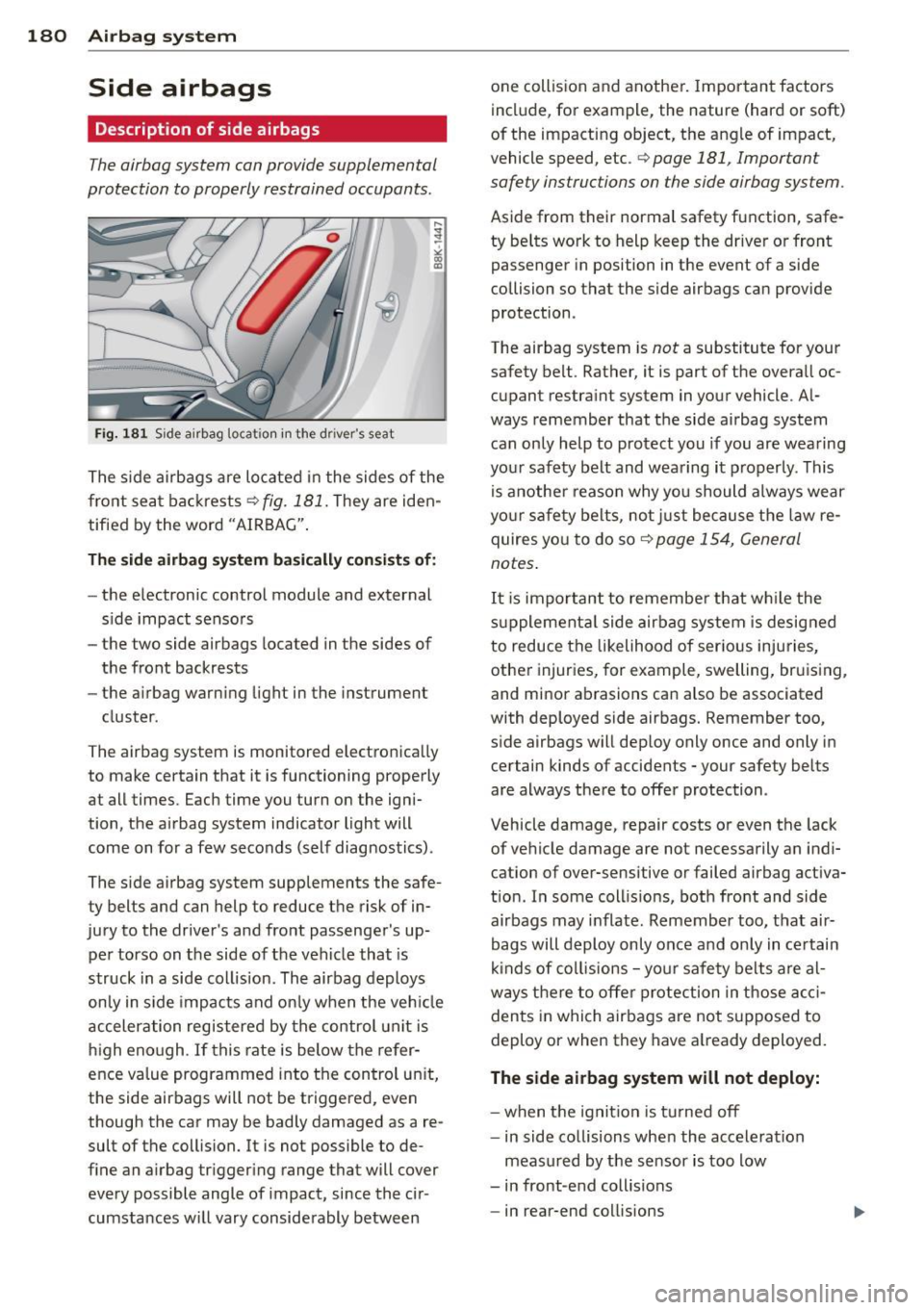
Fig. 18 1 Side a irbag locat io n in the d river 's seat
The s ide airbags are located in the sides of the
front sea t bac krests
~ fig. 181. They are iden
tified by the word "AIRBAG" .
The sid e airbag system basicall y consis ts of :
-the electronic control module and external
side impact sensors
- the two side airbags located in the sides of
t h e front backrests
- the a irbag warn ing light in the instrument
cluster.
The airbag system is monitored electronica lly
to make certain that it is functioning properly at all times. Each time you turn on the igni
tion, the airbag system indicator light will
come on for a few seconds (self diagnostics) .
The s ide airbag system supplements the safe
ty belts and can help to reduce the risk of in
jury to the drive r's and front passenger's up
pe r torso on the side of the vehicle that is
struck in a side col lision . The airbag deploys
on ly in side impacts and on ly when the veh icle
acceleration registered by the control unit is h igh eno ugh . If this rate is below the refer
ence va lue programmed into the control un it,
the side airbags will not be triggered,
even
though the car may be badly damaged as a re
sult of the collision. It is not possible to de
f ine an a irbag tr igger ing range that will
cover
every
possible angle of impact, since the cir
cumstances w ill
vary considerably between one collision and another.
Important factors
incl ude, for example, the nature (hard or soft)
of the impacting object, the angle of impact,
vehicle speed, etc .
c:> page 181, Important
safety instructions on the side airbag system .
Aside from their normal safety function, safe
ty belts work to help keep the driver or front
passenger in position in the event of a side
collision so that the side airbags can provide
protection .
The airbag system is
not a substitute for your
safety belt . Rather, it is part of the overa ll oc
cupant restra int system in your vehicle . Al
ways remember that the side airbag system
can only help to protect you if you are wea ring
you r safety belt and wea ring it p roperly . This
is anothe r reason why yo u should always wear
yo ur s afe ty be lts, no t ju st because the law re
quires yo u to do so~
page 154, General
notes .
It is impo rtant to remembe r th at w hile the
s u pplementa l side airbag system is designed
to reduce the likelihood of ser io us inju ries,
othe r injuries, for example, swelling, br uising ,
and minor abrasions ca n also be associated
with deployed side airbags. Remember too,
s ide airbags will deploy only once and only in
certain kinds of accidents -your safety belts
are always there to offer protection .
Vehicle damage, repair costs or even the lack
of ve hicle damage are not necessarily an ind i
cation of over-sensitive or failed airbag activa
t io n. In some coll is ions, both front and side
airbags may inflate . Remembe r too, t hat air
bags will deploy only once and on ly in ce rtain
ki nds of col lisions -yo ur safety belts a re a l
ways there to offer pro tection in those a cc i
den ts in which airbags are no t su pposed to
deploy or when they have a lready deployed.
The side airbag system will not deploy:
- when t he ig nit ion is tu rned off
- in side co llisions when the acceleration
measured by the sensor is too low
- in front -end collisions
- in rear-end collisions
Page 183 of 316
- in rollovers.
I n some types of acc idents the front airbags,
side curt ain a irbags and side airbag s may be
t r iggered together .
& WARNING
- Safety belts and the airbag system will
only prov ide protection when occ upants
are in the proper seating position
r:::;, page 181.
- If the airbag indicator light comes on
when the vehicle is being used, have the
system inspected immediately by your
authorized Audi dealer. The a irbag may
not wo rk properly when the vehicle ac
celeration in a side co llision is h igh
enough to activate the airbag .
How supplemental side airbags work
-
Side airbags deploy instantly and can help re
duce the risk of upper torso injuries for occu
pants who are properly restrained .
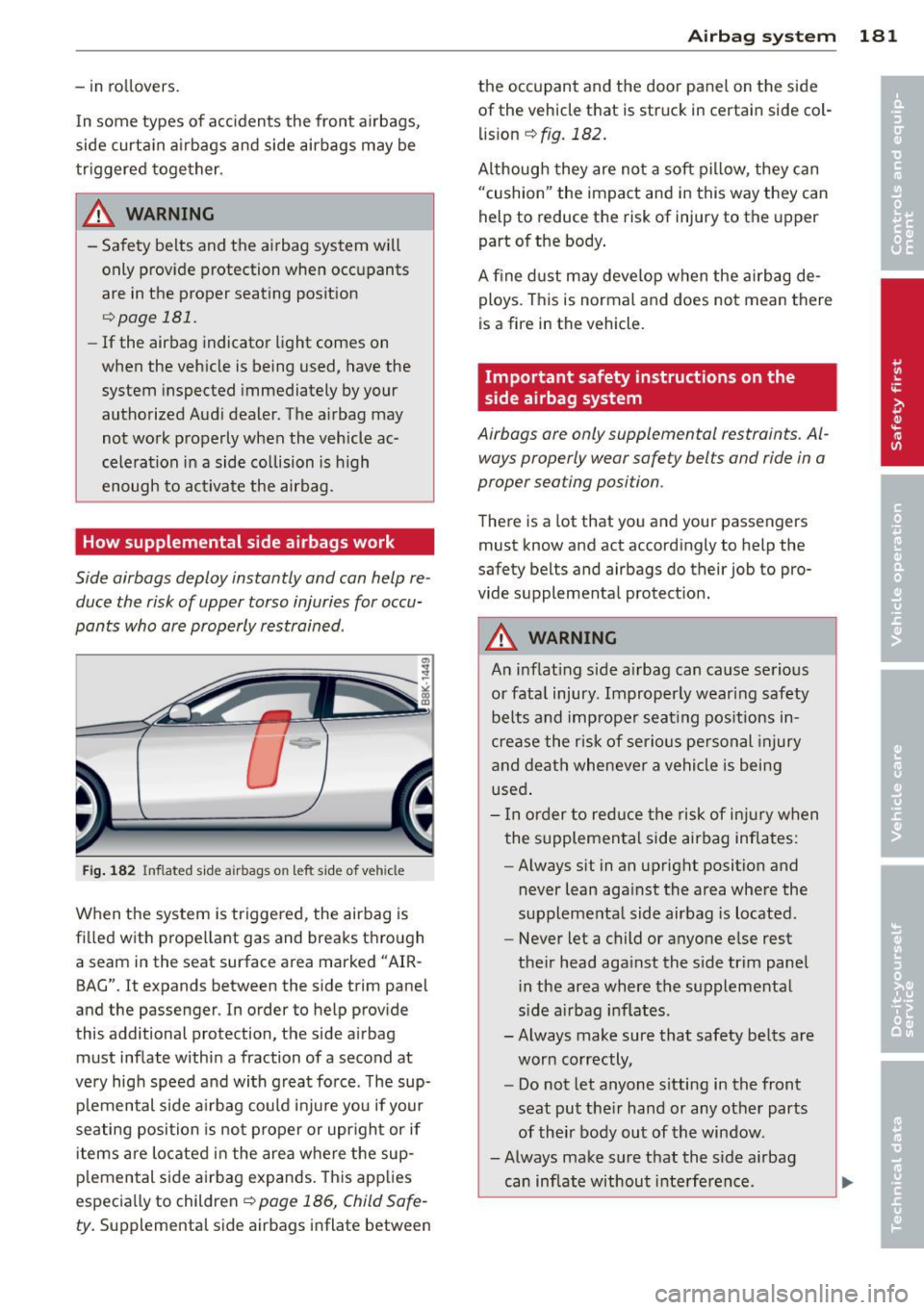
Fig. 1 82 Inflated sid e airbags o n left sid e of ve hicle
When t he system is triggered, the airbag is
f ill ed with propellant gas and breaks thro ugh
a seam in the seat surface area marked "AIR
BAG".
It exp ands between the side trim pane l
and the passenger . In order to help prov ide
this additional protection, the side a irbag
must inflate withi n a fraction of a second at
ve ry high speed and with great force . T he sup
p lemental side a irbag could injure you if your
seating position is not p roper or upr ight or if
items are Located in the area where the sup
p lemental s ide a irbag e xpands. This app lies
especia lly to children r:::;, page 186, Child Safe
ty . Supplementa l side airbags inflate between
A irba g sy stem 181
the occ upant and the door panel on the side
of the vehicle t hat is struck in certain side col
li sion ¢fig. 182.
Although they are not a soft pillow , they can
"cushion" the impact and in this way they can
help to reduce the risk of injury to the upper
part of the body .
A fine d ust may deve lop when the a irbag de
ploys . This is normal and does not mean there
is a fire in the veh icle.
Important safety instructions on the
side airbag system
Airbags are only supplemental restraints . Al
ways properly wear safety belts and ride in a
proper seating position.
T here is a lot that you and your passengers
must know and act accordingly to help the
s afety belts and airbags do their job to pro
vide supplementa l protect ion.
& WARNING ...
A n inflat ing side a irbag can cause serious
or fata l injury. Improperly wear ing safety
belts and imp roper seat ing pos itions in
crease the r isk of serio us pe rsonal injury
and death whenever a vehicle is being
used .
- I n order to reduce the risk of i njury when
the supplemental side airbag inflates:
- Always sit in an upright position and
never lean aga inst the area where the
suppleme nta l side airbag is Located.
- Never Let a child or a nyone e lse rest
their head aga inst the s ide trim pane l
i n the area where the supplemental
s ide a irbag inflates .
-Always make sure that safety be lts are
worn co rrectly,
- Do not Let anyone s itting in the front
seat put the ir hand or any other parts
of their body out of the window .
-Always make sure that the s ide a irbag
can inflate without interfe rence.