oil AUDI A5 COUPE 2012 Owner's Guide
[x] Cancel search | Manufacturer: AUDI, Model Year: 2012, Model line: A5 COUPE, Model: AUDI A5 COUPE 2012Pages: 316, PDF Size: 78.59 MB
Page 247 of 316

When the engine is warm, the level may be
slightly above the
"MAX" marking.
The location of the coolant expansion tank
can be seen in the engine compartment illus
tration ¢ page 239.
To obtain an accurate reading, the engine must be switched
off.
The expansion tank in your vehicle is equipped
with an electric coolant level sensor.
When the coolant level is too low, the warning
light in the Auto-Check System ¢page
31 will
blink until you add coolant and the level has
been restored to normal. Even though there is
an electric coolant level sensor, we still rec
ommend you check the coolant level from
time to time.
Coolant loss
Coolant loss may indicate a leak in the cooling
system. In the event of coolant loss, the cool
ing system should be inspected immediately
by your authorized Audi dealer.
It is not
enough merely to add coolant.
In a
sealed system, losses can occur only if
the boiling point of the coolant is exceeded as
a result of overheating.
& WARNING
The cooling system is under pressure and
can get very hot. Reduce the risk of scald
ing from hot coolant by following these
steps.
- Turn
off the engine and allow it to cool
down.
- Protect your face, hands and arms from
escaping fluid and steam by covering the
cap with a large, thick rag.
- Turn the cap slowly and very carefully in
a counter-clockwise direction while ap
plying light, downward pressure on the
top of the cap.
- To avoid being burned, do not spill anti freeze or coolant on the exhaust system or hot engine parts. Under certain condi
tions, the ethylene glycol in engine cool
ant can catch fire.
Checking and filling 245
@ Note
Do not add any type of radiator leak seal
ant to your vehicle's engine coolant. Add
ing radiator repair fluid may adversely af
fect the function and performance of your
cooling system and could result in damage not covered by your New Vehicle limited
Warranty.
Adding coolant
Be very careful when adding engine coolant.
Before you check anything in the engine com
partment,
always read and heed all WARN
INGS ¢ & in Working in the engine compart
ment on page 23
7.
.,. Turn off the engine .
.,. let the engine cool down.
.,. Place a thick rag over the coolant expansion
tank ¢ page
244, fig . 206 and carefully turn
the cap counter-clockwise ¢
&_.
.,. Add coolant.
.. Twist the cap on again tightly.
Replacement engine coolant must conform to
exact specifications ¢ page
244, Coolant.
Even in an emergency, if coolant addi-
tive G12++, G12+ or G12 is
not available, do
not use a different additive. Use plain water
instead until you can get the correct additive
and can restore the correct ratio. This should
be done as soon as possible.
If you have lost a considerable amount of
coolant , then you should add cold antifreeze
and cold water only when the engine is cold.
Always use new engine coolant when refilling.
Do not fill coolant above the "MAX" mark. Ex
cess coolant will be forced out through the pressure relief valve in the cap when the en
gine becomes hot.
A WARNING
- The cooling system is under pressure and
can get very hot. Reduce the risk of ...,
•
•
Page 262 of 316
260 Tire s and wheel s
reduced speed to the nearest service sta
t ion to c heck t he tire pressure a nd add
air as required.
Driving without va lve stem caps can cause
damage to the tire va lves. To prevent this,
always make sure that factory installed
valve stem caps on all wheels are secure ly
mounted on the valve .
@I For the sake of the environment
Underinflated tires will also increase the
fue l consumption .
Tires and vehicle load limits
There are limits to the amount of load or
weight that any vehicle and any t ire can carry.
A vehicle that is ove rloaded w ill not ha ndle
well and is more difficult to stop. Over load ing
can no t on ly lead to loss of vehi cle contro l,
but can also damage important pa rts of the
ve hicle and can lead to sudden tire failure, in
cluding a blowout and sudd en deflation that
can cause the veh icle to crash.
Your safety and that of yo ur passenge rs a lso
depends on making s ure that load limits are
not exceeded . Vehicle load includes everybody
and everyth ing in and on the vehicle . These
load limits are techn ically referred to as the
ve hicle's
Gross Veh icle W eight Rat ing
(" GVWR ").
T he "GVWR" incl udes the we ight of the basic
vehicle, all f actory installed accessories, a full
tank of fuel, oil, coolant and other fluids plus maximum load . T he maximum load includes
the number of passengers that the vehicle is in tended to carry ("seating capacity") with a n
assumed weig ht of 150 lbs . (68 kg) for e ach
passenger at a des igna ted seat ing pos ition
and the tota l we ight of any l uggage in the ve
h icle. If you tow a trailer, the weight of the
tra iler hitch and the tong ue weight of the
loaded trailer must be included as part of the
ve hicle load . T
he
Gro ss Axle We ight Rating ("GAWR") is
the maximum load that can be applied at each
of the veh icle's two axles .
T he Gross Vehicle Weigh t Rat ing and the
G ross Ax le Weight Rating are listed on the
safety comp liance sticker label located either
on the dr iver's s ide B-pillar or on the ins ide of
the fuel fi ller flap . Audi has
4 seating pos i
t ions, 2 in the front and 2 in the rear for to tal
seat ing capac ity of 4 . Each seating position
has a seat belt ¢
page 154, Safety belts.
The fact that there is an upper limit to yo ur
vehicle 's Gross Vehicle Weight Rating means
that the total weight of whatever is being car ried in the vehicle ( includ ing t he weight of a
t railer hitch and the tongue weight of the
l oaded tra ile r) is lim ited. The more passen
gers in the vehicle or passengers w ho are
heavier tha n t he standard we ights assumed
mean that less weight can be carried as lug
gage.
T he tire pressure label o n your Aud i also lis ts
the max imum combi ned weight of a ll of the
occupants and luggage or other cargo that
t h e vehicle can carry. Fo r the location of the
label ¢
page 256 , fig. 210.
A WARNING
-Overloading a vehicle can cause loss of ve-
h icle contro l, a crash or other accident, se
rious pe rsonal injury, and even death .
- Carrying more we ight than your veh icle
was des igned to carry will prevent the
veh icle from handling properly and in
crease the risk of the loss of vehicle con
trol.
- The b rakes on a vehicle that has been
overloaded may not be abl e to stop the
veh icle w it hi n a safe distance .
- Tires on a vehicle that has been overload
ed can fail s udden ly, incl uding a blowo ut
a nd sud den defla tion, causing loss of
con trol an d a crash.
- Always make sure that the total load be
i n g tr anspor ted - incl ud ing t he weight o f
a trailer hitch and the tongue we igh t of a
~
Page 265 of 316
A WARNING
Sudden tire failure can lead to loss of con
trol, a crash and serious personal injury!
- Never drive a vehicle when the tread on
any tire is worn down to the wear indica
tors.
- Worn tires are a safety hazard, they do
not grip well on wet roads and increase
your risk of "hydroplaning" and loss of
control.
- Always keep chemicals that can cause
tire damage, such as grease, oil, gasoline
and brake fluid away from t ires.
- Tires age even if they are not be ing used
and can fail suddenly, especially at high
speeds . Tir es that are more than 6 years
old can only be used in an emergency
and then with special care and at lower
speeds.
- Never mount used tires on your vehicle if
you are not sure of their" previous histo
ry ." Old used tires may have been dam
aged even though the damage cannot be
seen that can lead to sudden tire failure
and loss of vehicle control.
Tires and wheels 263
New tires and replacing tires and wheels
New tires and wheels have to be broken in .
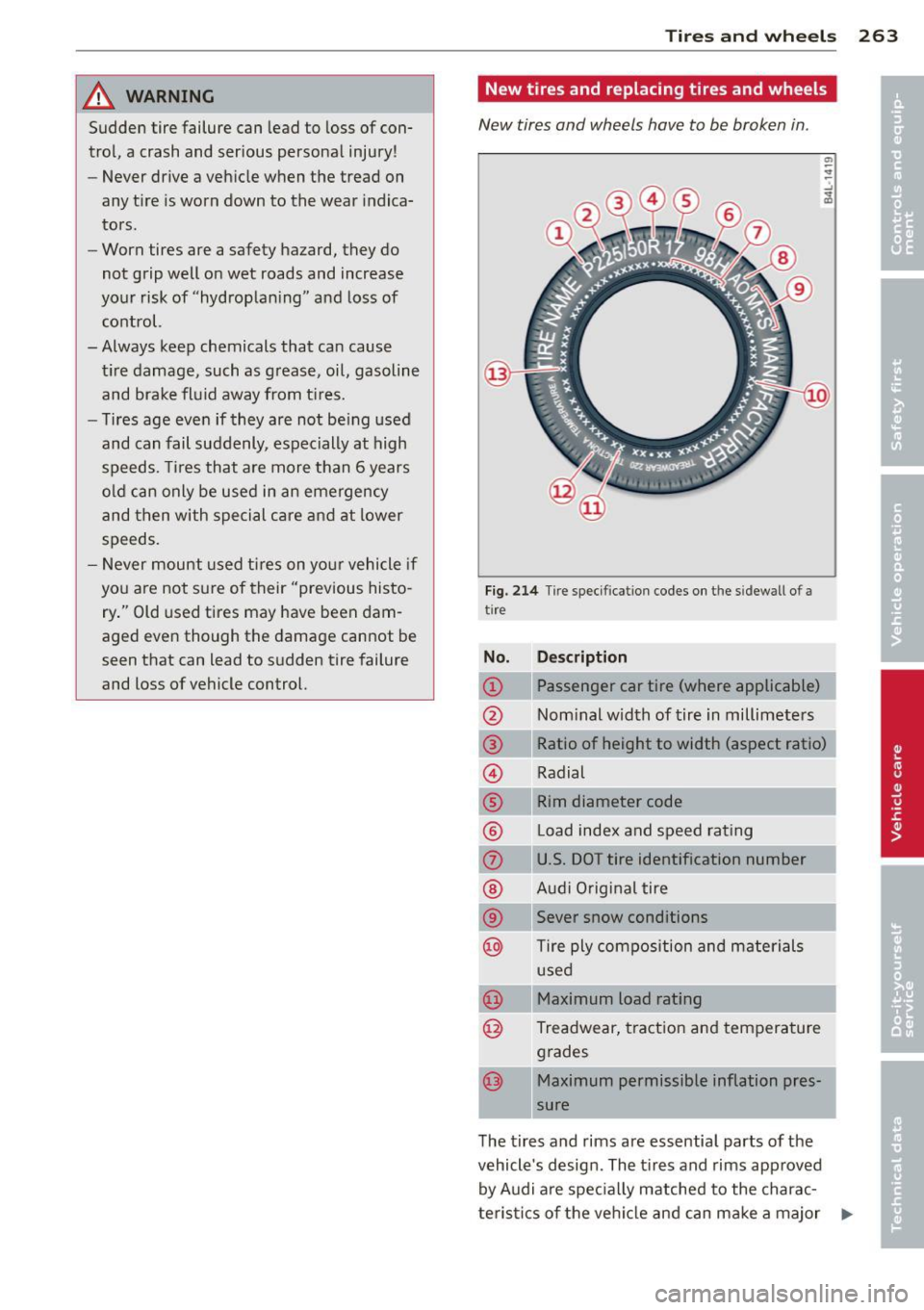
Fig. 214 Tir e specificat ion codes on t he s idewall o f a
tire
No. Description
CD Passenger car tire (where applicable)
@ Nominal width of tire in millimeters
® Ratio of height to width (aspect ratio)
© Radial
® Rim diameter code
® Load index and speed rat ing
(f) U.S. DOT tire identification number
® Audi Original tire
® Sever snow conditions
@ Tire ply composition and materials
used
@ Maximum load rating
@ Treadwear, traction and temperature
grades
@ Maximum permissible inflation pres-
sure
The tires and rims are essential parts of the
vehicle's design . The tires and rims approved
by Audi are specially matched to the charac
teristics of the vehicle and can make a major .,.
•
Page 271 of 316
Wheel bolts
Wheel bolts must always be tightened to the
correct torque .
The design of wheel bolts is matched to the
factory installed r ims. If differen t rims are fit
ted, the correct wheel bolts with the right l ength and correctly shaped bolt heads must
be used. This ensures that wheels are fitted
securely and that the brake system functions
correctly .
In certain circumstances, you may not use
wheel bo lts from a different vehicle -eve n if it
i s the same model
¢ page 295.
_&. WARNING
Improperly tig htened or maintained whee l
bolts can become loose ca using loss of
contro l, a co llision and serious persona l in
jury.
- Always keep the wheel bolts and the threads in the wheel hubs clean so the
whee l bolts can turn easily and be prop
erly t ightened.
- Never grease or oil the wheel bo lts and
the threads in the wheel hubs. They can become loose wh ile driving if greased or
o iled, even if tightened to the specif ied
torque .
- Only use wheel bolts that belong to the
rim being installed.
- Never use different whee ls bolts on your
vehicle .
-Always maintain the correct tighten ing
torque for the wheel bo lts to reduce the
risk of a wheel loss . If the tightening tor
que of the wheel bolts is too low, they
can loosen and come out when the vehi
cl e is moving.
If the tightening torque is
too high, the whee l bolts and threads
can be damaged and the wheel can be
come loose.
Q;) Note
The spec ified torque fo r the wheel bo lts is
90 ft lbs. (120 Nm) with a tolerance of
± 7,4 ft lbs.(± 10 Nm). Torque wheel bo lts
Tire s an d wheel s 269
diagonally. After changing a wheel, the
torque m ust be checked as soon as possi
ble with a torque wrench -preferably by an
a uthori zed Audi dea ler or qualified work
shop.
Low aspect ratio tires
Your Aud i is factory -equ ipped w ith low aspect
ratio tires . These tires have been tho roughly
tested and been se lected specifically fo r your
model for their superb perfo rmance, road fee l
and hand ling under a var iety o f driving cond i
tions. Ask your authorized Audi dealer for
more details .
T he low aspect ratio of these t ires is ind icated
by a numeral of
55 or l ess in the tire's s ize
designation. The numera l rep resents the ra tio
of the tire's sidewa ll height in relation to its
tread width expressed in percentage . Conven
tiona l tires have a he ight/w idth ratio of 60 or
more.
T he performance of low-a spe ct- ra tio tire s is
p ar tic ul ar ly se nsi tiv e to i mprop er i nfl ation
pre ssure. It is the refo re important that low
a spect ratio t ires are inflated to the specified
pr ess ure and that th e inflation pr essur e is
r e gula rly ch ecked and maintain ed. Tir e pre s
s ure s should b e check ed at l east once a
m onth and alwa ys befo re a long trip
¢ page 258, Checking tire pressure.
What you c an do to avo id tire and rim
damage
Low aspect ratio tires can be damaged mo re
easily by impact w ith potholes, curbs, g ull ies
o r ridges on the road, pa rticularly if the tire is
u nderinflated.
In orde r to minimize the occurrence of impact
damage to the tires of your vehicle, we recom
mend that you observe the following p reca u
tions:
- Always ma inta in recommended inflation
pressu res. Check your tire pressure eve ry
2,000 miles (3,000 km) and add air if neces-
sary . .., •
•
Page 291 of 316
fall f rom a lift if the re is a change in ve
h icle we ight d istr ibut ion and balance.
This might happen, for examp le, when
heavy components such as the engi ne
b lock or transmiss io n are removed .
- Whe n removing heavy components like
these, ancho r vehicle to ho ist o r add cor
r e spond ing w eig hts to ma intai n the cen
te r of g ravity . Othe rwise, the vehicl e
mi ght til t or slip off th e hoi st, causi ng
s er ious perso nal inju ry.
(D Note
- Be awa re of th e f ollowing po in ts b efore
li fting t he vehi cle:
- The vehicle should never be lifted or
jacked up from underneath the engine oil pan, the transmission housing, the
front or rear axle or the body side
members. This could lead to serious
damage .
- To avoid damage to the underbody or
chassis frame, a rubber pad must be
inserted between the floor jack and
the lift points.
- Before driving over a workshop hoist,
check that the vehicle weight does not
exceed the permissible lifting capacity
of the hoist.
- Before driving over a workshop hoist,
ensure that there is sufficient clear ance between the hoist and low parts
of the vehicle .
Emergency situations 289
•
•
Page 293 of 316
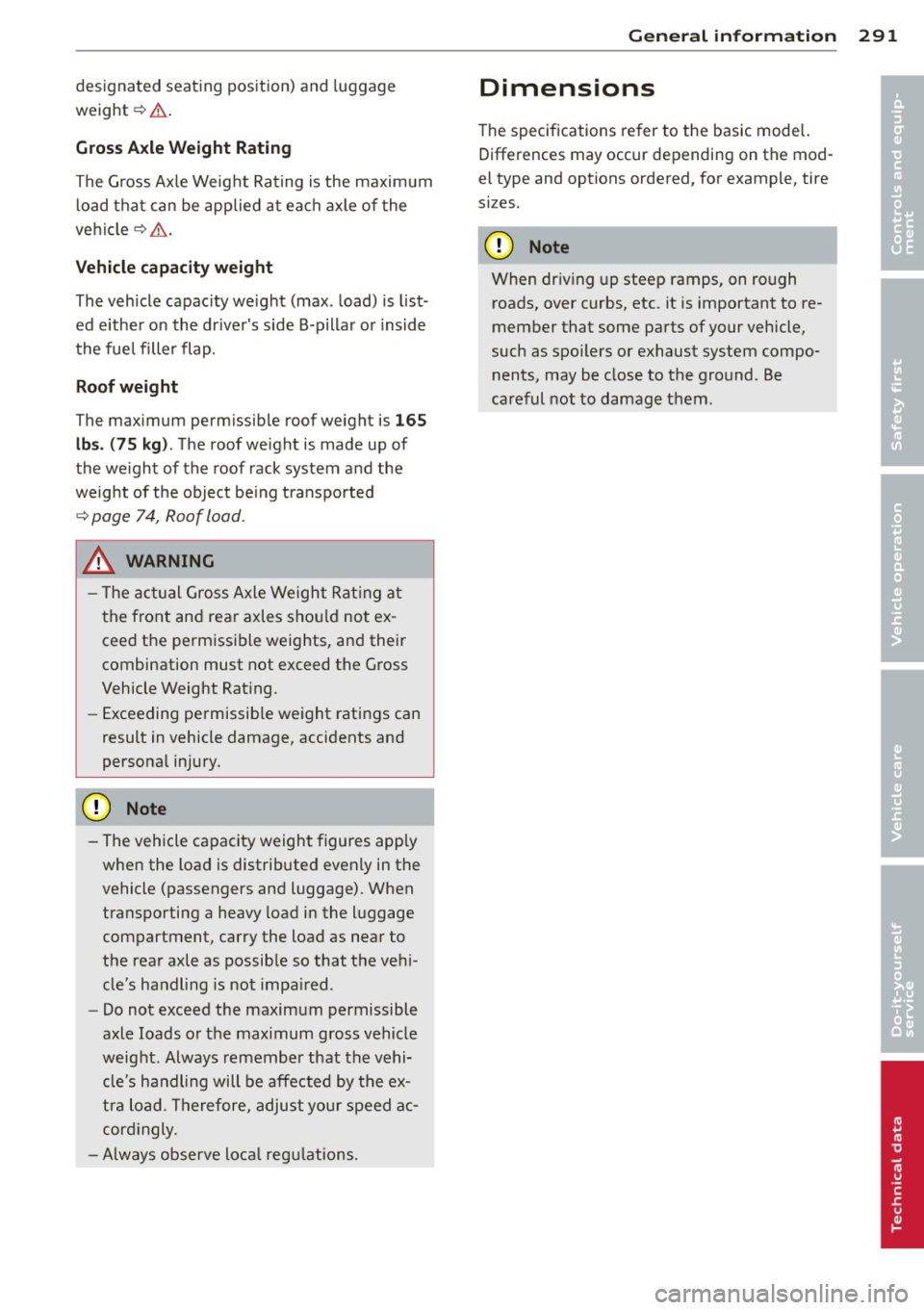
designated seating position) and luggage
weight~&. .
Gros s Axle W eight Rating
The G ross Axle Weight Rating is the maximum
l oad that can be applied at each axle of the
vehicle
q .&. .
Vehicle capacit y weight
The vehicle capac ity we ight (max. load) is list
ed either on the dr iver's side B-pillar or inside
the fuel filler flap.
Roof weight
The maximum perm issible roof weight is 165
lbs. (7 5 kg). The roof we ight is made up of
the we ight of the roof rack system and the
weight of the object be ing transported
qpage 74, Roof load .
.&, WARNING
- The actual Gross Axle Weight Rat ing at
the front and rear axles shou ld not ex
ceed the permiss ible weights, and their
combination must not exceed the Gross
Vehicle Weight Rat ing .
- Exceeding permissib le weight ratings can
result in vehicle damage, accidents and
personal injury.
CD Note
- The vehicle capacity weight figures apply
when the load is distributed evenly in the
vehicle (passengers and luggage). When
transporting a heavy load in the luggage
compartment, carry the load as near to
the rear axle as possib le so that the vehi
cle's handling is not impa ired.
- Do not exceed the maximum permissible
axle loads or the maximum gross vehicle
weight. Always remember that the vehi
cle's handling will be affected by the ex
tra load. Therefore, adjust you r speed ac
cord ingly.
- Always observe loca l regu lations.
-
G ene ral in formation 29 1
Dimensions
The specifications refer to the basic model.
Differences may occur depending on the mod
el type and options ordered, for example, tire
sizes.
CD Note
When driving up steep ramps, on rough roads, over curbs, etc. it is important to re
member that some parts of your vehicle,
such as spoilers or exhaust system compo nents, may be close to the ground . Be
careful not to damage them .
•
•
Page 294 of 316
292 Data
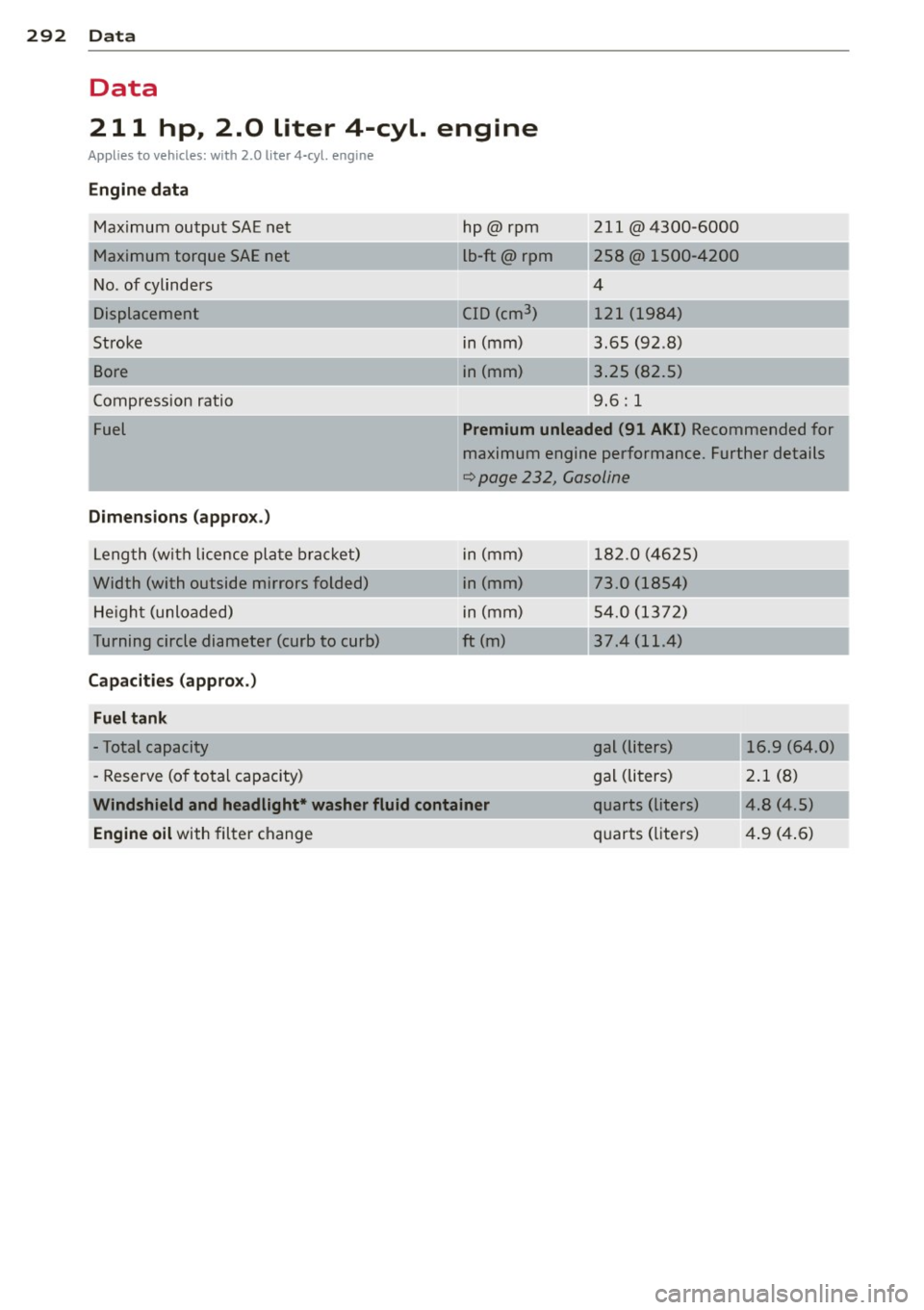
Data
211 hp, 2.0 liter 4-cyl. engine
Applies to vehicles: with 2.0 liter 4-cyl. engine
Engine data
Ma ximum output SAE ne t
M aximum torque SAE net
No . of cylinders
Displacement
Stroke
Bore
C ompress ion ratio
Fuel
Dimensions (approx .)
Leng th (wit h licence pl ate brack et)
Width (with outside mirrors folded) He igh t (unloaded)
T urning circle diameter (curb to curb)
Capacities (appro x.)
Fuel tank
- Total capacity
- Reserve (o f to tal capacity) h
p@rpm
L b-ft@ rpm
C ID (cm
3
)
in (mm)
i n (mm)
-~,
211 @4300-6000
258@ 1500-420 0
4 121 (1984)
3.65 (92 .8 )
3 .25 (82 .5)
9 .6: 1
Premium unleaded (91 AKI) Recommended for
m aximum engine performance . Further details
q page 232, Gasoline
i n (mm) 1 82.0 (4 625)
i n (mm) 73.0 (1854)
i n (mm) 5 4.0 (1 37 2)
ft (m) 37.4 (11.4)
gal (liters) 16.9 (64 .0)
gal (li ters) 2.1
(8 )
Windshield and headlight* washer fluid container quarts (liters) 4.8 (4 .5)
Engine
oil with filter c hange qu
arts (lite rs) 4 .9 (4 .6)
Page 295 of 316
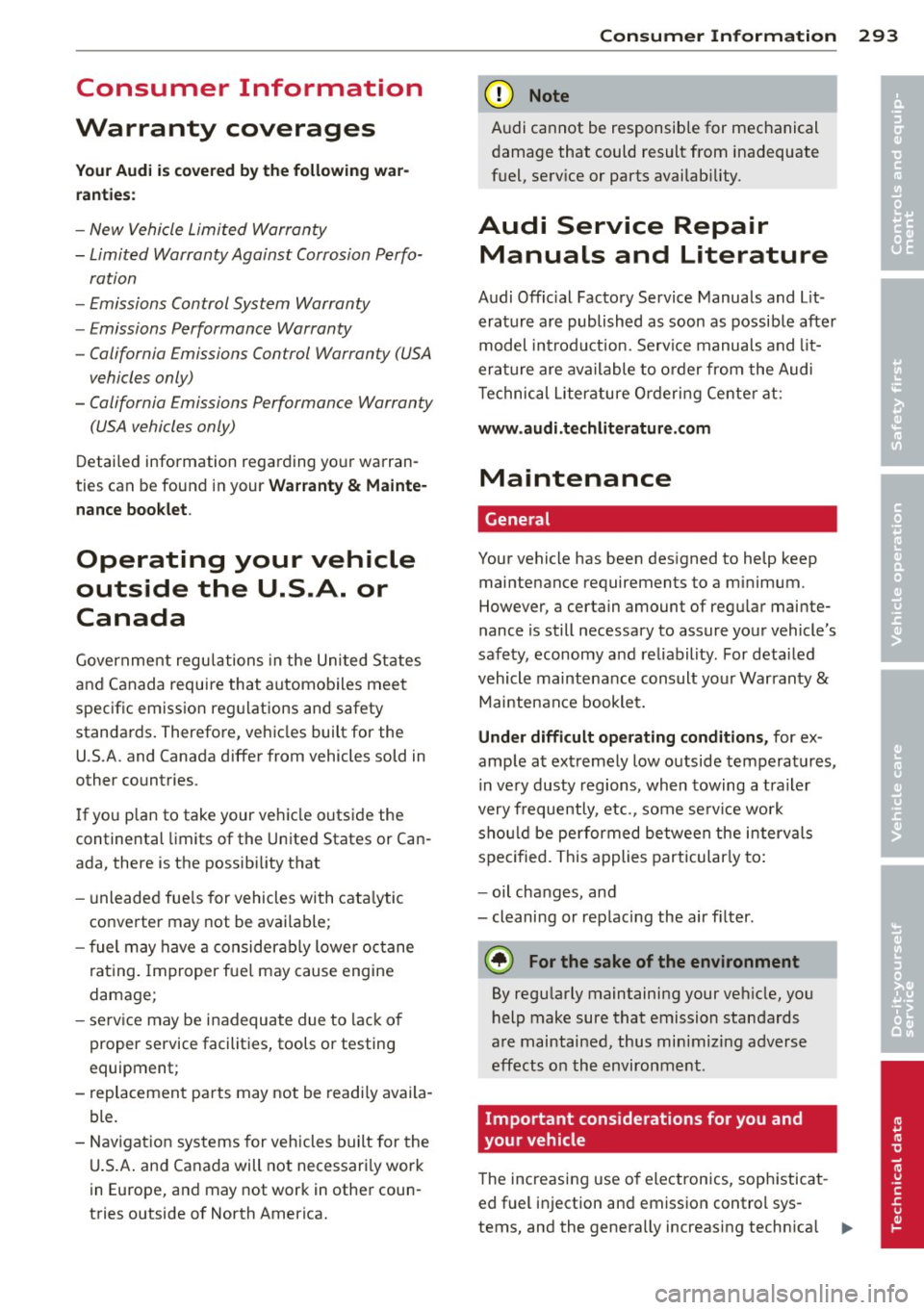
Consumer Information
Warranty coverages
Your Audi is covered by the following war
ranties :
- New Vehicle Limited Warranty
- Limited Warranty Against Corrosion Perfo-
ration
- Emissions Control System Warranty
- Emissions Performance Warranty
- California Emissions Con trol Warranty (USA
vehicles only)
- California Emissions Performance Warranty
(USA vehicles only)
Detailed information regarding your warran
ties can be found in your
Warranty & Mainte
nance booklet .
Operating your vehicle
outside the U.S.A. or
Canada
Government regulations in the United States
and Canada require that automobiles meet
specific emission regulations and safety
standards. Therefore, veh icles built for the
U.S.A. and Canada differ from vehicles sold in
other countries .
If you p lan to take your vehicle outside the
continental limits of the United States or Can
ada, there is the possibility that
- unleaded fuels for vehicles with cata lytic
converter may not be available;
- fuel may have a considerably lower octane
rating . Improper fuel may cause engine
damage ;
- service may be inadequate due to lack of
proper service facilities, tools or testing
equipment ;
- replacement parts may not be readily availa
ble.
- Navigation systems for vehicles built for the
U.S.A. and Canada will not necessari ly work
in Europe, and may not work in other coun
tries outside of North America.
Consumer Information 293
@ Note
Audi cannot be responsible for mechanical
damage that could result from inadequate
fuel, service or parts availab ility.
Audi Service Repair
Manuals and Literature
Audi Offic ial Factory Service Manuals and Lit
erature are published as soon as possible after
model introduction. Service manuals and lit
erat ure are available to order from the Audi
T echnical Literature Ordering Center at:
www.audi.techliterature.com
Maintenance
' General
Your vehicle has been designed to help keep
maintenance requirements to a minimum.
However, a certain amount of regular mainte
nance is still necessary to assure your vehicle's
safety, economy and reliability . For detailed
vehicle maintenance consult your Warranty
&
Maintenance booklet.
Under difficult operating conditions , for ex
ample at extremely low outside temperatures ,
in very dusty regions, when towing a tra iler
very frequently, etc., some serv ice work
shou ld be pe rformed between the intervals
specified. This applies particularly to:
- oil changes, and
- cleaning or replacing the air filter .
® For the sake of the environment
By regularly maintaining your vehicle, you
help make sure that emission standards
are maintained, thus min imizi ng adverse
effects on the environment .
Important considerations for you and
your vehicle
The increasing use of electronics , sophisticat
ed fuel injection and emission contro l sys-
tems, and the genera lly increasing technica l ..,_
•
•
Page 297 of 316
-Always make sure the transm ission se
lector lever (automatic transmiss ion) is
in "P" (Park position) or Neutral (manual
transmission) and the park brake is firm
ly appl ied .
® For the sake of the environment
-Changing the eng ine settings w ill ad
versely affect em ission levels. This is det
rimental to the environment and increas
es fuel consumption .
- Always observe env ironmental regula
tions when d ispos ing of old engine oil,
used brake fluid, dirty engine coolant,
spent batter ies or worn out t ires.
- Undeployed airbag modules and p reten
s ioners might be classified as Perchlo
rate Material -special handling may ap
ply, see www.dtsc.ca .gov/hazardous
waste/perch lorate . When the veh icle or
parts of the restraint system including
airbag modules safety belts with preten
s ioners are scrapped, all applicable laws
and regulations must be observed. Your
authorized Audi dealer is familiar w ith
these requirements and we recommend
that you have your dealer perform this
serv ice for you .
Additional accessories,
modifications and
parts replacement
Additional accessories and parts
replacement
Always consult on authorized Audi dealer be
fore purchasing accessories.
Your veh icle incorporates the latest safety de
sign featu res ensu ring a high standard of ac
tive and passive safety.
This safety could be compromised by non-ap
proved changes to the veh icle. For this reason ,
if parts have to be replaced, p lease observe
the following points when installing addition
al accessories:
Con sumer In formation 295
Approved Audi accessories and genuine Audi
parts are available from authorized Audi deal
ers.
T hese dea lers a lso have the necessary facili
ties, tools and trained specialists to install the
parts and accessories proper ly.
A WARNING
Using the wrong spare parts or using non
approved accessories can cause damage to
the vehicle and serious persona l injury.
- Use on ly accessories express ly approved
by Audi and genuine Audi spare parts
- These parts and accessories have been
specially designed to be used on your ve
hicle.
- Never install accessories such as tele
phone cradles or beverage holders on air
bag covers or within the airbag deploy
ment zones . Do ing so will increase the
risk of injury if a irbags are triggered in an
accident!
- Before you check anything in the engine
compartment, always read and heed all
WARNINGS ~
page 230.
(D Note
-If items other than genuine Audi spare
parts, add-on equipment and accessory
items are used or if repair work is not
performed accord ing to specified meth
ods, this can result in severe damage to
your vehicle's engine and body (such as
corrosion) and adversely affect your vehi
cle's warranty .
- If emergency repairs must be performed
elsewhere, have the vehicle examined by
an authorized Audi dealer as soon as
possible.
- The manufacturer cannot be held liable
for damage wh ich occurs due to failure
to comply with these stipulations.
•
•
Page 300 of 316
298 ~l :..:.: nd ~e ~x :._ ______________________________ _
A
A/C mode 83,88
Accessories .. ....... ...... ... ... .. . 295
Adaptive cruise control . . . . . . . . . . . . . . . 102
Changing speed . . . . . . . . . . . . . . . . . . . 105
Driver information . . . . . . . . . . . . . . . . . 107
Driver intervention prompt . .. .. .. .. . 111
Driving in traffic . . . . . . . . . . . . . . . . . . . 103
Driving program . ........... .. .. .. . 111
Error messages .......... .... .... . 109
Open road .. ............. .. .. .. .. . 103
Override ... ................ ..... . 103
Request for driver to assume contro l . . 103
Save speed ............... ... .... . 104
Setting distance . . . . . . . . . . . . . . . . . . . 106
Settings . . . . . . . . . . . . . . . . . . . . . . . . . 111
Setting time interval .......... .... . 106
Special driving situations ...... .. .. . 112
Status messages ... ...... .. .. .. .. . 109
Switching on and off .... .. .. .. .. ... 104
System limits . ........... .... .... . 112
Temporarily turning off .. .. .. .. .. .. . 105
Warning/indicator lights ............ 108
Adaptive dampers . .......... ... .. .. . 124
Adaptive light ............. .. .. ......
52
defective ................ .... .... .. 36
Adding
Engine coolant ............ ... .... .
245
Engine oi l .. ................ ..... . 242
Windshield washer fluid ... .. .. .... . 251
Addit ional accessories
Addit ives 295
Eng ine oil .. ................ ... .. . 242
Adjusting
Steering column manually . .. .. .... ..
92
Adj usting front seats ....... .. .. .. .. . . 61
Airbag system . . . . . . . . . . . . . . . . . 162, 181
Advanced Airbag System ....... .. ... 166
Advanced Airbag System components . 169
Care ... .. ............... .. .. .... . 175
Children . .... ........... .. .. .. .. . 187
Child restraints .............. ..... . 188
Components (front airbags) . ... .... . 169
Danger of fitting a child safety seat on
the front passenger seat . . . . . . . . . . . .
163
Disposal . ................. .. .... . 175
Front airbags . . . . . . . . . . . . . . . . 166, 167
How do the front airbags work? ... ... 171
How many airbags does my vehicle
have? ... ... .. .. .. .............. .
169
How the Advanced Airbag System com-
ponents work together ......... ....
170
Important safety instructions on the
knee airbag system ...... ...... .. ..
179
Important things to know .......... . 162
Indicator light . ... ............ .. .. 173
Knee airbags ..... ... .......... .... 177
Monitoring . ..... ................ . 173
PASSENGER AIR BAG OF F light . . . . . . . 173
Repairs .......................... 175
Safety instructions ............. .... 175
Side airbags ... .. ............. .... 180
Side curtain airbags ............ .... 182
Weight-sensing mat ............... 187
When must the system be inspected? 173
All-wheel drive
Winter tires ... .. ... .......... ....
267
Alloy wheels .. .. . .. ............ .. .. 225
All wheel drive 210
Alternator
Malfunction ... ... ................ .
30
Anti-freeze
refer to Engine coolant system ....... 244
Anti-lock brake system
How the ABS system works ..........
208
Warning/indicator lights ............ . 16
Anti-Slip Regulation System (ASR)
How the system works ............. .
206
Anti-theft systems
Electronic immobilizer ...............
39
Ashtray .. .. .. .. .. .... ......... .... . 75
ASR
How the Anti -Slip Regulation System
works
Asterisk
206
What does it mean when something is marked with an asterisk? . . . . . . . . . . . . . . 6
Audi braking guard ................. .
113
Error messages .................. . 115
Settings .. .... .. ............. .... 115
Status messages ... ........... .. .. 115
Switching on and off ........... .... 115