oil AUDI A5 COUPE 2012 User Guide
[x] Cancel search | Manufacturer: AUDI, Model Year: 2012, Model line: A5 COUPE, Model: AUDI A5 COUPE 2012Pages: 316, PDF Size: 78.59 MB
Page 78 of 316
76 Seats and storage
Reinst alling ashtray insert
> Press the ashtray insert into its holder .
A WARNING
Never put waste paper in the ashtray. Hot
ashes or other hot objects in the ashtray
co uld set waste paper on fire.
Cigarette lighter/outlet
Cigarette lighter
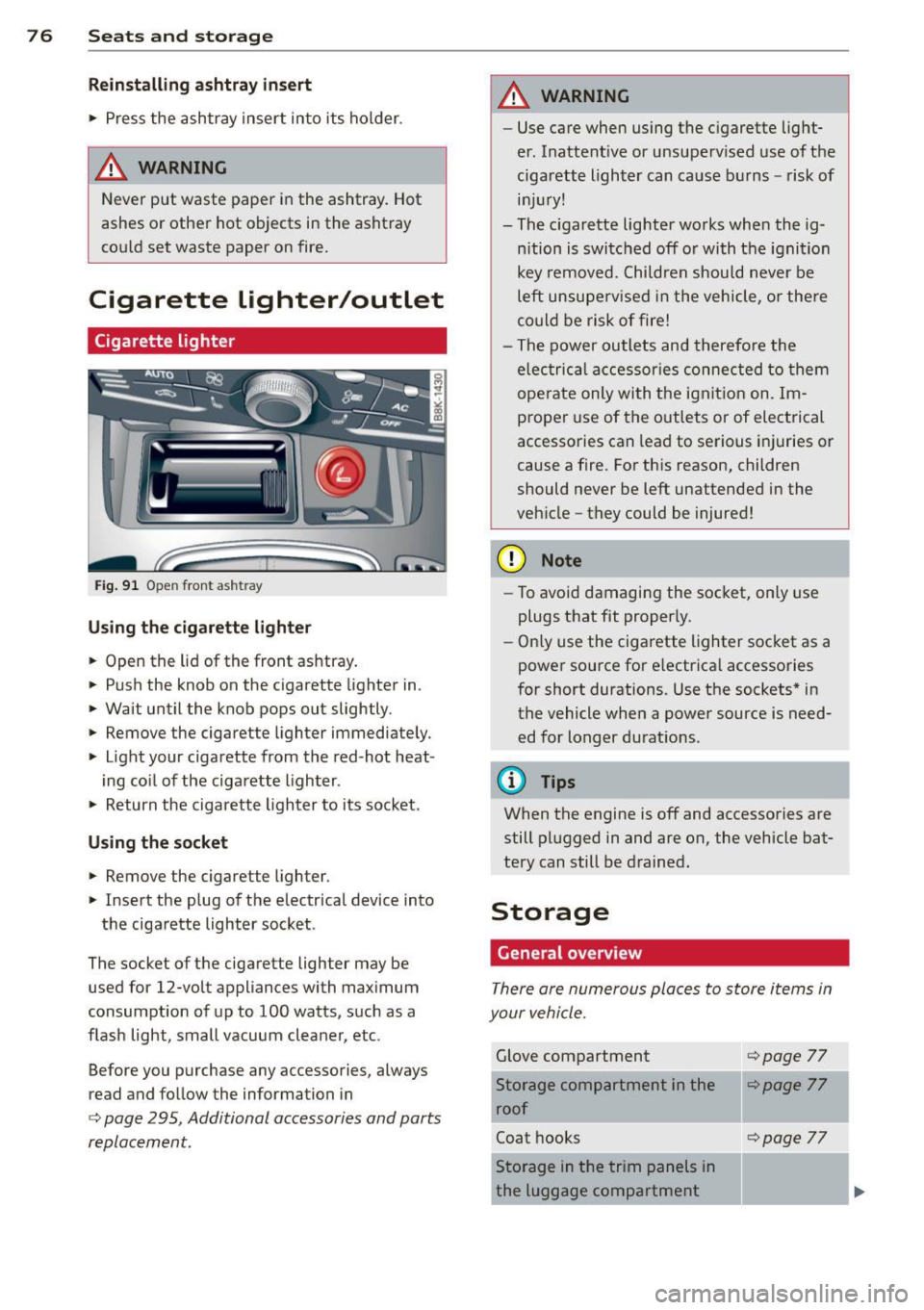
Fig . 9 1 Open front asht ray
Using th e cig arett e light er
> Open the lid of the front ashtray .
> Push the knob on the cigarette lighter in.
> Wait until the knob pops out slightly .
> Remove the cigarette lighter immediately.
> Light your cigarette from the red-hot heat -
ing coil of the cigarette lighter .
> Return the cigarette ligh ter to its socket.
Using the socket
> Remove the cigarette lighter.
> Insert the plug of the electrical device into
t h e ciga rette lighter socket .
The socket of the cigarette lighter may be
used for 12-volt appliances with max imum
consumption of up to 100 watts, such as a
flash light, small vacuum cleane r, etc.
Before you purchase any accessories, always
read and follow the information in
¢ page 295, Additional accessories and parts
replacement.
A WARNING
-
- Use care when using the c igarette light-
er . Inattent ive or unsuperv ised use of the
cigarette lighter can ca use burns -risk of
in jur y!
- The cigarette lighter works when the ig nition is switched off o r with the ignition
key removed. Child ren shou ld never be
left unsuperv ised in the vehicle, or the re
co uld be risk of fire!
- T he power outlets and therefore the
elec tric al accessor ies connec ted to them
operate only with t he ignit ion on. Im
p roper use of the outlets or of elect rical
accessories can lead to serious i nju ries or
cause a fire . For th is reason, children
should never be left unattended in the
veh icle -they could be injured!
(D Note
- To avoid damagi ng the socket, only use
plugs that fit proper ly.
- Only use the cigarette lighter socket as a
power source for e lectr ica l accessories
for short durations. Use the sockets * in
the vehicle when a power source is need
ed for longer du rat io ns.
(!) Tips
When the engine is off and accessories are
still plugged in and are on, the vehicle bat
tery can still be d rained.
Storage
General overview
T here are numerous places to store items in
your vehicle.
Glove compartment
Storage compartment in the roof
Coat hooks
-Storage in the trim panels in
the luggage compartment
i:>page 77
i:>page 7 7
i:>page 77
Page 97 of 316

If the engine does not start immediately, stop
trying after 10 seconds and then try to restart
the eng ine about 30 seconds later .
After a cold engine is star ted, there may be a
brief period of increased noise because oil
pressure must first bui ld up in the hydraulic
va lve adjusters. This is normal and not a cause
for concern.
Driv er m essa ge in th e in strument clu ster
disp lay
No ke y ident ified
This message appears when the
I S TAR T ENGINE STOP ! button is pressed if
there is no master key inside the vehicle or if
the system does no t recogni ze it. For exam
ple, the master key cannot be recognized if it
is covered by an object (e .g . aluminum brief
case) which
screens the radio signal. Electron
i c devices such as ce ll phones can also inter
fere wi th the radio signal.
Press brake ped al to start engine
This message appears if you press the
I STAR T ENGIN E ST OP ! button to start the en
g ine and do not depress the b rake pedal. The
engine can on ly be sta rted if the brake pedal
is depressed.
Press clutch ped al to start engin e
This message appears with a manual trans
miss ion when you press the
I S TAR T ENGIN E ST OP ! button to start the en
g ine and do not depress the clu tch pedal. The
engine can on ly be started when the clutch
pedal is dep ressed .
Engage Nor P to st art engine
This message appears when attempting to
start the engine if the selector lever fo r the
automatic t ransmission is not in the
P or N
position . Th e engine can on ly be started w ith
the selector in these posit ions.
!II Key not in vehicle
This message appears along with the II! sym
bo l if t he maste r key is removed from the ve
h icle w ith the engine r unning. It is intended
On th e ro ad 95
to remind you (e .g. when changing dr ive rs)
not to continue the journey without the mas
ter key.
If t he mas ter key is no longer in the ve hicle,
you cannot switch on the ignition after stop
ping the engine and you also cannot start the
engine aga in. Moreover, you cannot lock the
vehicle from the outside with the key.
Shift to P, oth erwise vehicle can roll away.
D oors do not lock if le ver i s not in P .
This message app ears for safety reasons
a long with a warn ing signal. It appears if the
selector leve r for the automa tic transmission
is not in the
P position when sw itching off the
ignition with the
I STAR T ENGIN E ST OP ! but
ton . Move the se lector lever to the
P position,
othe rwise the veh icle is not se cured against
ro lling away. You also cannot lock the veh icle
u sing the lock ing b utton on the door hand le
or using the remote key.
Convenience key defective ! Use ignition
lock
T his message appears if the vehicle has to be
started not w ith the
I S T AR T ENGINE ST OPI
button but with the ig nition key.
A WARNING
- Never a llow the engine to run in confined
spaces - danger of asphyx iation.
- Never turn off t he engine until the vehi
cle has come to a complete stop.
- The brake booster and servotron ic only
work when the engine is runn ing . With
the ignition turned off, you have to apply
more force when steering or brak ing.
Since you can not steer and stop normal
ly, th is can lead to acc idents and serious
in ju ries .
(D Note
-Avo id h igh engine rpm, full thrott le and
heavy engine loads until the eng ine has
reached operating temperature - other-
w ise you risk engine damag e.
- T he engine cannot be started by pushing
o r towing the vehicle.
Ill-
Page 119 of 316

-The radar sensor's vision can be reduced
or entirely blocked by rain, snow, and
heavy spray. This can result in side assist
not adequately detecting vehicles or, in
some cases, not detecting them at all.
Always keep an eye on the d irection you
are traveling and the relevant area
around the vehicle.
- Please note that side assist indicates
there are approaching vehicles, o r vehi
cles in your blind spot, only after your ve
hicle has reached a driving speed of at
least 19 mph (30 km/h).
- Side ass ist signal does not work around
tight corners (turning radius less than
328 feet or 100 m).
- Side assist is no replacement for the driv
er's full attention . The driver alone is re
sponsible for lane changes and similar
driving maneuvers. A lways keep an eye
on the direction you are traveling and the
relevant area around the vehicle.
(D Note
-To ensure that you do not adversely af
fect side assist, do not block the area on
the rear bumper where the radar sensors
are located with foreign objects (such as
stickers or bicycle racks).
- Make sure that the signal light on the
outside m irror is not blocked by st ickers
or other items.
@ Tips
- Side assist automatically deactivates if it
detects that the radar sensors are
blocked
9 page 122. The indicator light
on the button goes out .
- The area on the bumper where the radar
sensors are located must consistently re
main free of snow, ice, and heavy soiling
so that side assist can function properly.
Follow the additional notes on
.:!>page 122 .
-Additional tinting on the front side w in
dows can make it harder to see and cor
rectly understand the signal light on the
outside mirror.
Aud i side assist 11 7
-For Declaration of Compliance to United
States FCC and Industry Canada regula
t ions ¢
page 296.
Sensor detection area
Applies to vehicles: wit h side assist
t
Fig. 133 Schemat ic illustrat ion : Sensor detect ion area
The detection¢ fig. 133 of the radar sensor
detection area is made up of:
- the approach area (light red area)
(D, about
230 feet (70 m) behind the vehicle, and
- the "blind spot" (dark red area)@.
The radar sensors cover the adjacent left and
right lanes. Other lanes are
not covered by the
radar sensors.
(D Tips
Side assist does not measure actual lane
width. The system assumes a fixed lane
width . Detection in the left and right lanes
i s based on this assumed lane width .
When driving on narrow roads o r when
driving to the left or right of the center of
a travel lane, it is possib le that vehicles
will be detected that are
not in the lane
next to the lane you are using
¢page 121.
Operation
App lies to vehicles: wit h side assist
Side assist compares the distance and differ
ence in speed of detected vehicles with the
speed of your vehicle . Whenever the differ
ence in speed and distance is registered as no·
table if you were to change lanes, a signal
light appears on the respective m irror.
Ill-
Page 210 of 316
208 Intellig ent technol ogy
,8. WARNING
- You should perform braking maneuvers
for the purpose of cleaning the brake
system only if road condit ions permit .
Other road users must not be put at r isk -
you may cause an acc iden t!
- Before descending a steep grade, reduce
speed and shift transmiss ion into a lower
gear or lower driving range. Do not ride
the brakes or hold the pedal down too long or too often . This cou ld cause the
brakes to get hot and diminish braking
efficiency.
- Do not "ride the brakes" by resting your
foot on the pedal when you do not intend
to brake . This may cause the brakes to
overheat, premature wear and increased
stopp ing distance.
- Under certain climatic and operating
condit ions such as passing through wa
ter, driving in heavy ra in or after wash ing
the vehicle, the effect iveness of the
brakes can be reduced. In winter, ice can
accumula te on the brake pads, linings,
discs and drums. Carefully apply brakes
for a test. Brakes will dry and ice coat
ings will be cleaned off after a few care
ful brake applications.
- Driv ing fo r an extended period of time on
salt -covered roads w ithout using your
brakes can also affect braking efficiency.
Clean off accumulated salt coating from
brake discs and pads w ith a few careful
brake applicat ions.
- If you damage the front spoiler, or if you
install a different spoiler, be sure the air
flow to the front brakes is not obstruct ed . Otherwise the brake system could
overheat reducing the effectiveness of
the ent ire brake system.
- Failure of one brake c ircuit will impair
the braking capability resulting in an in creased stopp ing distance. Avoid driv ing
the vehicle and have it towed to the near est authorized Audi dealer or qualified
workshop.
Brake booster
The brake booster adds extra braking power .
The brake booster works with vacuum pres
sure which is created only when the engine is
runn ing
c> .&. .
,8. WARNING
-Never let the vehicle roll to a stop with
the engine shut off .
- If the brake booster is not working, for
example when towing your vehicle, or
because the brake booster has somehow
been damaged, the bra ke pedal mus t be
pressed considerably harder to make up
for the lack of booster assistance.
Functioning of Anti-Lock Brake System
(ABS)
ABS prevents the wheels from locking up un der braking .
-
The ABS contributes effect ively to vehicle con
trol since it prevents the whee ls from
locking
when the brakes are applied. This means that
the ve hicle remains steerable and is less likely
to skid .
With AB S you do n ot need to pump the
brake . Ju st hold th e bra ke p edal down.
However, do not expect the ABS to s horten
braking distance under
all c ircumstances.
When driving on gravel or on new ly fallen
snow on top of icy surfaces, braking dis tance
may be even longer, therefore, under these
circumstances, it is especia lly important that
you drive s low ly and with great care.
How the ABS syst em work s
An automat ic check is made when a speed o f
about 12 mph (20 km/h) is reached. When
this happens, a pumping noise can be heard.
If an ind iv idual whee l begi ns to rota te too
s lowly in re lation to vehicle speed and tends
to lock, the ABS automatically reduces brake pressure to prevent that whee l from locking . .,..
Page 216 of 316
214 Driving and en vironm ent
Avoid damaging the
vehicle
When you are driving on poor roads, or over
curbs, steep ramps, etc ., make certain that
low-lying parts such as spoilers and exhaust
system parts do not bottom out and get dam
aged.
This is especially true for vehicles with low
slung chassis (sports chassis) * and fully load
ed veh icles .
Driving through water
on roads
Note the following to avoid vehicle damage
when driving through water, for example on
flooded roads:
- T he water must not be any higher tha n the
bottom o f the vehicle body.
- Do not d rive faster than wa lking speed.
_& WARNING
After d riving through water, m ud, slush,
et c., the brakes may be slow to take effect
because o f wet brake ro tors and pads . Dry
the brakes fi rst by braking carefully to re
store the full braking effect.
(]) Note
Vehicle components such as the engine,
transmiss ion, suspension or electrical sys
tem can be severely damaged by driving
through water.
- Check the depth o f the water before driv
ing through it.
- Do not stop the veh icle, dr ive in reverse
or switch the engine
off when driving
through water.
- Keep in mind that oncoming vehicles may create waves that raise the water
level and make it too deep for your vehi
cle to drive through safely.
- Avoid driving thro ugh salt water because
it can ca use corrosion.
-
Catalytic converter
It is very important that your emission con
trol system (catalytic converter) is function
ing properly to ensure that your vehicle is run
ning in an environmentally sound manner.
.,. Always use lead-free gasoline¢ page 232,
Fuel supply .
.,. Never run the tank down all the way to
empty .
.,. Never put too much motor o il in your en-
gine ¢
page 242, ~ Adding engine oil .
.,. Never try to push- or tow-sta rt you r vehicle.
The catalytic converter is an efficient "clean
u p" dev ice built into the exhaust system of
the vehi cle. The cata lytic conve rter bu rns
many of the pollu tan ts in the exha ust gas be
f o re they are re leased into the atmosphere.
T he exclusive use of unleaded fuel is critically
important for the life of the catalyt ic convert
er and prope r fu nct ion ing of the engine.
A WARNING
- Do not park or operate the vehicle in
areas where the hot ex haust system may
come in contact with dry grass, brush,
fue l spill or other material wh ich can
cause a fire.
- Do not app ly additiona l undercoating or
r u stproofing on or near the exhaust
manifold, exhaust pipes, catalytic con
verter or heat sh ields. Dur ing driv ing, the
substance used fo r undercoating could
overheat and cause a fire.
(D Note
- Be aware that just one tank filling with
leaded fuel will already ser iously de-
grade the performance of the catalytic
converte r.
- Do not exceed the correct engine oil level
¢page 242.
-Do not drive until the fuel tank becomes
completely empty . The engine co uld mis-
fire. Unburned fuel could also get into ..,.
Page 218 of 316

216 Driving and environment
Reducing unnecessary idling
Even when your car is just idling it burns up
fuel.
.,. Shut the engine off when you are not driv
ing the vehicle.
.,. Do not warm up the vehicle by letting the
engine run at idle .
It makes sense to shut off the engine in traffic
jams, when waiting for trains to pass at rail
road crossings, or at traff ic lights that have
l ong wa its on red. Turning the engine off for
just 30-40 seconds saves more fue l than is
burned starting the eng ine again .
It takes a long time for the engine to warm up
fully when it is running at idle. However , wear
and noxious emissions are especially high
when the engine is warming up. So you should
drive away as soon as you start the engine and
avoid running at high rpms while the engine is
still warming up .
(D Note
Do not leave engine idling unattended af
ter starting . If warning lights should come
on to indicate improper operation, they
wou ld go unheeded. Extended idling also
produces heat, which cou ld result in over
heating or other damage to the vehicle or
other property .
Regular maintenance
A badly tuned engine unnecessarily wastes a
lot of fuel .
... Have your vehicle serviced at regular inter-
vals.
By having your vehicle regularly serviced by an
authorized Audi dealer helps to ensure that it runs properly and economically . The condition
of your vehicle not only affects its safety and
ability to hold its value, it also affects
fuel
consumption .
Check your oil each time you fill your tank.
The amount of oi l used is re lated to engine
load and speed.
It is normal for the oil consumption of a new
engine to reach its lowest value after a certa in
mileage has been driven.
You must drive your veh icle about 3,000 m iles
(5,000 kilometers) before you can properly
assess oil consumpt ion.
This also app lies to fue l consumption and en
gine output.
(D Note
- Have your veh icle ma inta ined properly
and in accordance with the service rec
ommendations in your Warranty
& Main
tenance booklet . Lack of proper mainte
nance as well as improper use of the ve
hicle will impair the function of the
emission contro l system and cou ld lead
to damage.
- Do not alter or remove any component of
the Emission Control System unless ap
proved by the manufacturer.
- Do not alter or remove any device, such
as heat shields, switches, ignition wires,
valves, which are designed to protect
your vehicle's Emission Control System and other important vehicle compo
nents.
Fewer short trips
Fuel consumption will always be relatively
high on short trips .
.,. Try to avoid driv ing short distances with a
cold engine .
The engine and cata lytic converter have to
reach their optimal
operating temperature to
reduce fuel consumpt ion and noxious emis
s ions effectively .
Just after starting, a co ld engine in a mid-size
car only achieves a fuel economy of 6-8 mi les
per gallon (30-40 l/100 km). After about a
half a mile, fuel economy cl imbs to 12 mpg
(20 l/100 km) . After about
2 .5 miles (4 km), ll>
Page 224 of 316
222 Cleaning and protection
Automatic car wash
The vehicle can be washed in almost any
modern automatic car wash.
The vehicle paint is so durable that the vehicle
can normally be washed without problems in
an automatic car wash. However, the effect on
the paint depends to a large extent on the de
sign of the facility, the filtering of the wash
water, the type of wash and care material, etc. If the paint has a dull appearance after going
through the car wash or is scratched, bring
this to the attention of the operator immedi
ately. If necessary, use a different car wash.
Before going through a car wash, be sure to
take the usual precautions such as closing the
windows and the roof. Factory installed an
tennas must not be removed.
If you have installed additional accessories on
the vehicle - such as spoilers, roof rack, etc. -
it is best to ask the car wash operator if these
should be removed.
A WARNING
Always read and heed all WARNINGS and
other information
c;, page 221.
Washing the vehicle by hand
A lot of water is needed when washing a vehicle by hand.
., Before you start washing, make sure you
have read and understood the WARNINGS
r:::;, A in General information on page 221.
., First soak all dried dirt until it is soft, then
rinse it off.
., As you clean your vehicle, start with the
roof and work your way down to the bottom,
using a sponge, a sponge glove or a clean
brush.
., Rinse the sponge or the sponge glove often,
flushing it clean each time.
., Use special car shampoo only for very per
sistent dirt.
., Rinse the car thoroughly with water .
., Use a chamois leather to gently wipe the ex
terior dry. Use
a separate sponge for cleaning the
wheels, door sills and other regions exposed
to road dirt. In this way, you will not scratch
the paint with coarse particles imbedded in
the sponge the next time you wash the car.
A WARNING
---Do not clean the underside of the chas
sis, fenders, wheel covers, or other hard
to reach parts without protecting your
hands and arms. You may cut yourself on
sharp-edged metal parts.
- Always read and heed all WARNINGS and
other information
c;, page 221.
0 Note
- Never try to remove dirt, mud or dust if
the surface of the vehicle is dry. Never
use a dry cloth or sponge, since this
could scratch your vehicle's paint or win
dows.
- Never wash your car in bright sunlight.
Drops of water act as magnifying lenses
and may damage your paint.
-When you wash your car in the winter: if
you rinse your vehicle with a hose, be
careful not to aim the stream of water
directly at locks, or at door or hatch
openings - they can freeze shut.
- Never use sponges designed to remove
insects, or any kitchen scouring sponges
or similar products. They can damage
your paint finish .
- You should remove debris (such as in
sects) from the headlight lenses on a
regular basis, for example when refuel
ing your vehicle. Never use a dry cloth or
sponge to clean the headlights. Only use
wet cloths or sponges to prevent
scratches. It is best to use soapy water.
@ For the sake of the environment
In the interest of the environment, the ve
hicle should only be washed in special
wash bays .
Page 226 of 316
224 Cleaning and protection
Trim strips
Metal trim needs special care.
For environmenta l reasons, Audi fabricates
the bright tr im strips and trim pieces from
pure chromium-free aluminum.
Dirt and marks on the trim strips should be
removed with a
pH -b ala nced cleaning agent
(do not use a chrome cleaner). Authori zed Au
d i dealers carry clean ing products wh ich have
been tested for use on your veh icle and are
not harmful to the env ironment .
To avoid corros ion on the exterior trim strips,
only a pH-balanced solution should be used
for the w indshield washer .
A WARNING
Always read and heed a ll WARNINGS and
other information
c:> page 221.
Plastic and vinyl
Plastic needs special care .
Use a clean, damp cloth or sponge to remove
dust and light surface dirt. For other soil, use
a lukewarm all-purpose clean ing solution or a
mild saddle soap for vinyl trim. Remove water
spots and traces of soap w ith a clean, damp
clot h or sponge. Use a clean, soft clot h to rub
d ry.
Grease, tar or oil stains can be removed with a
clean cloth or sponge soaked w ith all-purpose
cleane r or with a solvent designed especially
to clean viny l.
Occasionally apply a colorless vi nyl or leather
preservat ive to reta in the material 's luste r
and p liability.
A WARNING
Alw ays read and heed all WARNINGS and
other information
c:> page 2 21.
Aluminum trim
Use only neutral-pH products to remove spots
and deposits from aluminum s urfaces. Chrome care products and a
lkaline cleaners
will attack a luminum surfaces and can dam
age them over t ime.
A WARNING "--
A lways read and heed all WARNINGS and
other information
c:> page 221.
Touch-up paint
Minor paint damages should be touched up
immediately.
... Use either a touch-up paint stick or spray
paint to cover m inor scratches and nicks .
Your a uthorized Audi dea ler has touch- up
paint for minor scratches and stone chips.
Scratches sho uld be to uched up soon after
they occ ur to prevent corrosion.
If a spot starts to rus t, however, a s imple
touch -up job will not be eno ugh. The affected
s u rface m ust be sanded smooth and coated
with an anti-rust prime r before the painted
finish can be restored.
T he number for the original veh icle paint can
be fo und on the vehicle identification label
c=> poge 290 .
I
'
A WARNING
Always read and heed all WARNINGS and
other information
c:> page 221.
Windows
Clear vision to oil sides.
C lean all w indows regularly to remove road
film and car wash wax buildup.
.,. Remove snow from w indows us ing a b rush .
... Use a plastic ice s craper to remove i ce from
w indows and m irrors.
... Remove ot her residue on the windows with
a spray-on g lass cleaner .
... Wipe the windows dry with a clean piece of
cloth or kitchen paper towel.
Page 227 of 316
The best way to remove snow from windows
and mirrors is to use a brush. Use a non-abra
sive
plastic ice scraper -better still, a spray
deicer -to remove
ice from windows and mir
rors.
The windows must not be cleaned with insect
remover or wax sin ce these can interfere with
the function of the windshield wiper blades
(chatter).
Oil, grease, or silicone residue can be removed
with
glass cleaner or silicone remover. How
ever, wax residue require s the use of a special
ly formulated solvent. Please contact your au
thor ized Audi dealer for advice on safe prod
ucts for wax removal.
Windows should also be cleaned on the inside
at regular intervals.
Never dry windows with the same chamois
that you use to dry painted surfaces. Wax resi
due on the chamois can impair vision through
the windows.
A WARNING
-Always read and heed all WARNINGS and
other information
r::.> page 221.
- The windshield must not be treated with
water-repellent materials. They can in
crease glare under poor visibility condi
tions such as wetness, darkness, or when
the sun is low on the horizon. In addi
tion, they can cause the windshield wip
ers to chatter.
- Never use warm or hot water to remove
snow and ice from windows and mirrors.
This could cause the glass to crack.
- To prevent damage to the wires of the
rear defogger, do not place any adhesive
stickers on the inside of the rear window
over the wires.
- To help prevent dirt from scratching the
window, always scrape in a forward di
rection -pushing the scraper away from
you -never back and forth.
Cleaning and protection 225
-Water leaking from the inside of the rear
windows may damage sensitive electrical components located either under the
rear parcel shelf or in the rear trunk area.
Always ensure that water never leaks
through the body section of the vehicle.
You can do this by using waterproof pro tection over the vehicle's electrical com
ponents (e.g. when installing window
tinting) .
- Damage or malfunction of electrical
components due to water damage or any
other outside influence is not covered by
the Audi New Vehicle Limited Warranty.
See your Warranty
& Maintenance book
let for additional details about your war
ranty.
Cast (light) alloy wheels
Cast (light) alloy wheels require special care.
.,. Wash the wheels with a sponge or hose
brush every other
week .
.,. For deep cleaning afterwards, use only a
dedicated
acid-free cast alloy wheel cleaner.
.,. Rub a coat of
liquid wax onto the rims every
three month. Be sure to reach and treat all
parts of the rim.
To preserve the decorative appearance of the
cast alloy wheels, some special care is neces
sary. In addition to road dirt and salt, brake
dust is also corrosive . If left on for too long,
brake dust can cause pitting.
Use only special
acid-free cleaners formulated
for alloy rims. Safe products are available at
your authorized Audi dealer. Never leave the
cleaner on the rims longer than specified on
the label. If not rinsed
off promptly, the acid
contained in some cleaners can attack the
threads on the wheel bolts.
Never use abrasive or metal polishing clean
ing agents. If the protective coating has been
chipped, e.g. by kicked up road dirt, touch it up as soon as possible . .,..
•
•
Page 229 of 316
~ Then wipe the MMI contro l conso le with a
clean, soft, slightly damp cloth.
The MM I control console shou ld be cleaned
with a brush first so that no dirt is trapped be
tween the buttons and the housing . We rec
ommend giving the MMI contro l console a fi
na l wipe with a cloth moistened with water
and d ish washing detergent.
(D Note
To prevent damage, make sure that no flu
id ever gets into the MMI control console .
Aluminum trim
Use only neutral-pH products to remove spots
and depos its from alum inum surfaces.
Ch rome care products and alkaline cleaners
will attack alum inum su rfaces and can dam
age them ove r time.
A WARNING
Always read and heed a ll WARNINGS and
other information
¢ page 2 2 1.
Fabrics and fabric coverings
Fabrics and fabric coverings (e .g. seats, door
trim panels, etc.) should be cleaned at reg ular
interva ls with a vacuum cleaner. Th is removes
surface dirt particles which could become em
bedded in the fabr ic through use. Steam
cleane rs should not be used, because the
steam tends to push the dirt deeper into the
fabric and lock it there.
Norm al cleaning
Generally, we recommend using a soft sponge
or a lint-free microfiber cloth to the clean fab
ric. Brushes should o nly be used for carpets
and floor mats, s ince other fab ric su rfaces
could be harmed by b rushes .
Normal surface sta ins can be cleaned using a
commercially available foam cleaner . Spread
the foam on the surface of the fab ric with a
soft sponge and work it in gently. Do not satu
r ate the fabric. Then pat the foam d ry using
Cleaning and protec tion 22 7
absorbent, dry cloths (e .g . m icrofiber cloth)
and vac uum it after it has dried completely .
Cleaning stains
Stains caused by beverages (e.g. coffee, fr uit
j u ic e, etc.) ca n be treated w ith a mild de ter
gen t solu tion. Apply the detergent sol ution
with a sponge. In the case o f stubborn stains,
a detergent paste can be applied directly to
the stain and worked into the fabric . After
wards, use copious amounts of clean water to remove the rema ining detergent. Apply the
water wit h a damp cloth or sponge and pat
the fabr ic dry with an absorbent, dry clot h.
Stains from choco late or makeup should have
detergent paste rubbed into them . After
wards, remove the soap with water (damp
sponge) .
Alcohol can be used to treat stains from grease, o il, lipstick or a ballpoint pen. Melted
grease or dye must be patted off using ab
sorbent mater ial. It may be necessary to re
treat the areas with detergent paste and wa
te r.
In the case of general soiling of the up hols
te ry and cover material, we recommend hir ing
a spec ia list t hat has the equipment to clean
the seat cove rs and othe r fabr ic surfa ces by
shampooing a nd spray extraction.
A WARNING ~ -
Always read and heed all WARN INGS and
the information
~ page 221 .
(D Tips
Open Ve lcro fas teners on yo ur clothing can
d am age the sea t cover. Please m ake su re
that Ve lcro fasteners are closed .
Plastic parts and instrument panel
Always use a clean cloth moistened in clear
water to clean these areas. For persistent d irt
use an Aud i approved
sol vent -free p lastic
cleaner/protectant. ..,. •
•