emergency brake AUDI A5 COUPE 2013 User Guide
[x] Cancel search | Manufacturer: AUDI, Model Year: 2013, Model line: A5 COUPE, Model: AUDI A5 COUPE 2013Pages: 294, PDF Size: 73.84 MB
Page 98 of 294
96 Audi adaptive cruise control and braking guard
confirmed by the video camera, an acute
collision warning.
- For safety reasons, do not use adaptive
cruise control when driving on roads with
many curves, when the road surface is in
poor condition and/or in bad weather
(such as ice, fog, gravel, heavy rain and
hydroplaning). Using the system under
these conditions could result in a colli
sion.
- Switch adaptive cruise control off tempo
rarily when driving in turning lanes, on
expressway exits or in construction
zones. This prevents the vehicle from ac
celerating to the set speed when in these
situations.
- The adaptive cruise control system will
not brake by itself if you put your foot on
the accelerator pedal. Doing so can over
ride the speed and distance regulation.
- When approaching stationary objects
such as stopped traffic, adaptive cruise
control will not respond and braking
guard will have limited function.
- The adaptive cruise control system and
braking guard do not react to people, an
imals, objects crossing the road or on
coming objects .
- The function of the radar sensor can be
affected by reflective objects such as
guard rails, the entrance to a tunnel,
heavy rain or ice.
- Never follow a vehicle so closely that you cannot stop your vehicle safely. The
adaptive cruise control cannot slow or
brake the vehicle safely when you follow
another vehicle too closely . Always re
member that the automatic braking
function cannot bring the vehicle to a sudden or emergency stop under these
conditions.
- To prevent unintended operation, always
switch ACC
off when it is not being used.
{[) Note
The sensor can be displaced by impacts or
damage to the bumper, wheel housing and
underbody. That could affect the adaptive cruise control system and braking guard.
Have your authorized Audi dealer or au
thorized Audi Service Facility check their
function.
, In curves
App lies to vehicles: wi th Audi ada ptive c ruise contro l
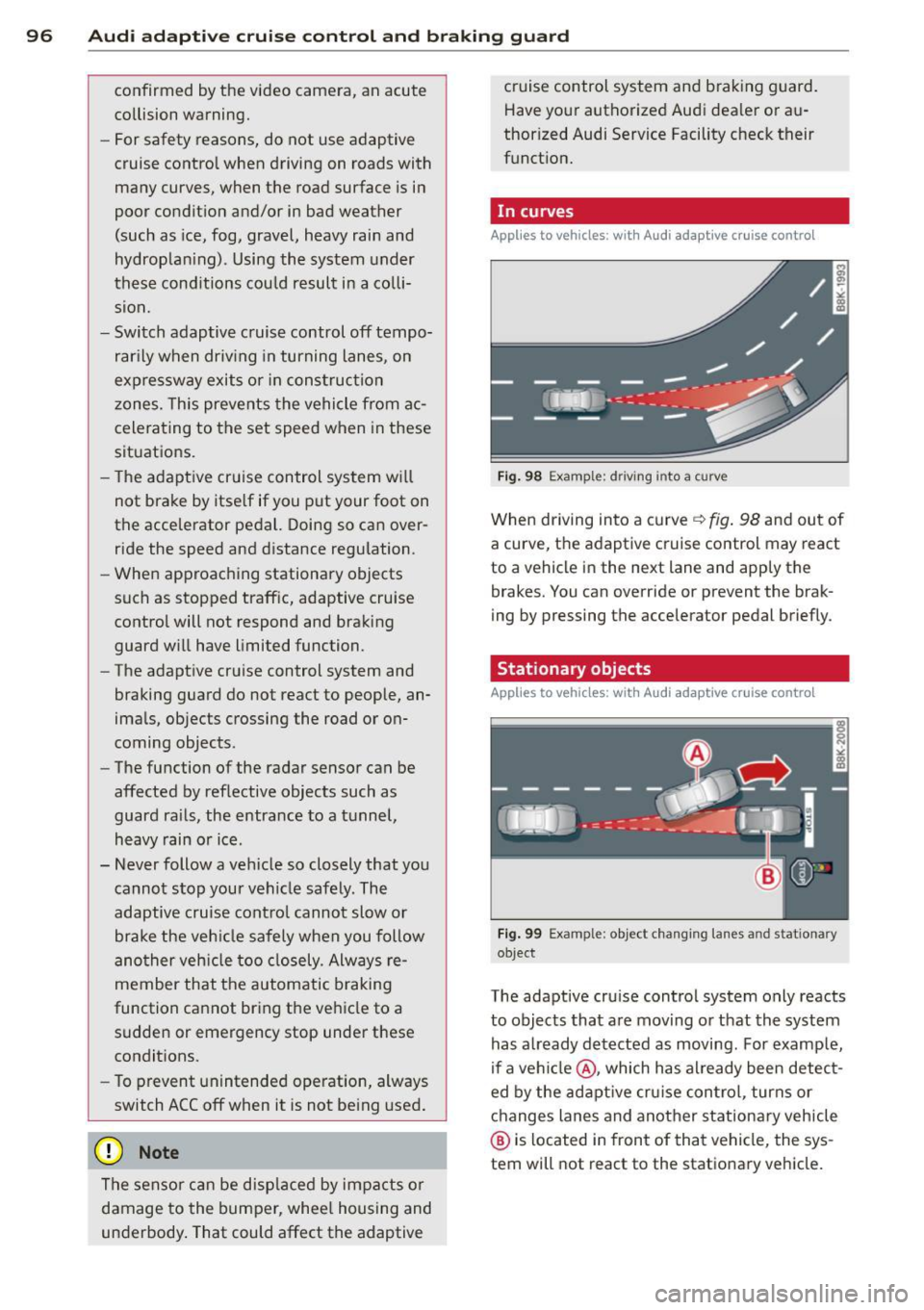
Fig. 98 Example: d riving i nto a curve
When driving into a curve ~ fig. 98 and out of
a curve, the adaptive cruise control may react
to a vehicle in the next lane and apply the
brakes. You can override or prevent the brak
ing by pressing the accelerator pedal briefly.
Stationary objects
Applies to vehicles : wi th Audi adapt ive crui se contro l
Fig. 99 Example: object changing lanes a nd stat ionary
object
The adaptive cruise control system only reacts
to objects that are moving or that the system
has already detected as moving. For example,
if a vehicle @, which has already been detect
ed by the adaptive cruise control, turns or
changes lanes and another stationary vehicle
@ is located in front of that vehicle, the sys
tem will not react to the stationary vehicle.
Page 227 of 294
scalding from hot coo lant by following
these steps.
- Turn
off the engi ne and a llow it to cool
down.
- Protect your face, hands and arms from
escapi ng fl uid and steam by cover ing
the cap with a large, thick rag .
- Turn the cap slowly and very ca refully
i n a cou nte r-clockw ise dir ect ion while
a pply ing lig ht, downwa rd p ress ure on
the top of the cap.
- T o avo id being burned, do no t sp ill an
tifree ze o r coolan t on t he exh aust sys
tem or ho t engine parts . Un der certain
conditions, the ethylene glyco l in en
gine coolant can catch fire .
- Antifree ze is poisono us. Always store an
tifreeze in its or iginal co ntainer and we ll
o ut o f the reac h of children.
- If you drain the coolant , it must be
caught and safely stored in a p roper con
tainer clear ly marked "poison".
(D Note
- Coolant po llutes the env ironment and
could ca use a n engine fire . Excess coo l
ant wi ll be forced out through the pres
sure re lief va lve in the cap when the en
gine becomes hot.
- If, in an emergency, only water can be
added , the correct ratio between water
and antifreeze¢
page 223 must be re
stored as soon as possib le .
@ For the sake of the environment
Drained coolant should not be re used . Al
ways dispose of used c oolant while observ
ing all envir onmental regulations .
Radiator fan
The radiator fan switches on automa tically by
itself
T he radiator fan is driven by the engine via the
V-be lt. The viscous clutch regulates the speed
of the fan according to the temperature of the
coolant .
Checkin g and fillin g 225
An auxiliary electric radiato r fan* sw itches on
and
off depending on coolant temperature
and othe r vehicle ope rat ing con ditions.
After yo u switc h the engi ne off, the aux iliary
f an can con tinue r unning for up to 10 minutes
- even with the ignition off. It can even switch
on again later by itself¢ & , if
- t he temperatu re of the engine coo lant rises
due to the heat b uild -up from the en gine in
the engi ne compartment, or
- the engine compartment heats up be cause
the vehicle is parked in intense sunlight.
A WARNING
- To reduce the risk of personal in jury nev
er touch the radiator fan.
- The a uxiliary electric fan is temperat ure
contro lled and can switch on sud denly
even when the engine is not running.
- The a uxiliary radiator fa n switches on a u
tomatically when the engine coo lant
reaches a certain temperature and will
continue to run until the coo lant temper
ature drops .
Brake fluid
Checking brake fluid level
The brake fluid level can be checked with a
qui ck glance.
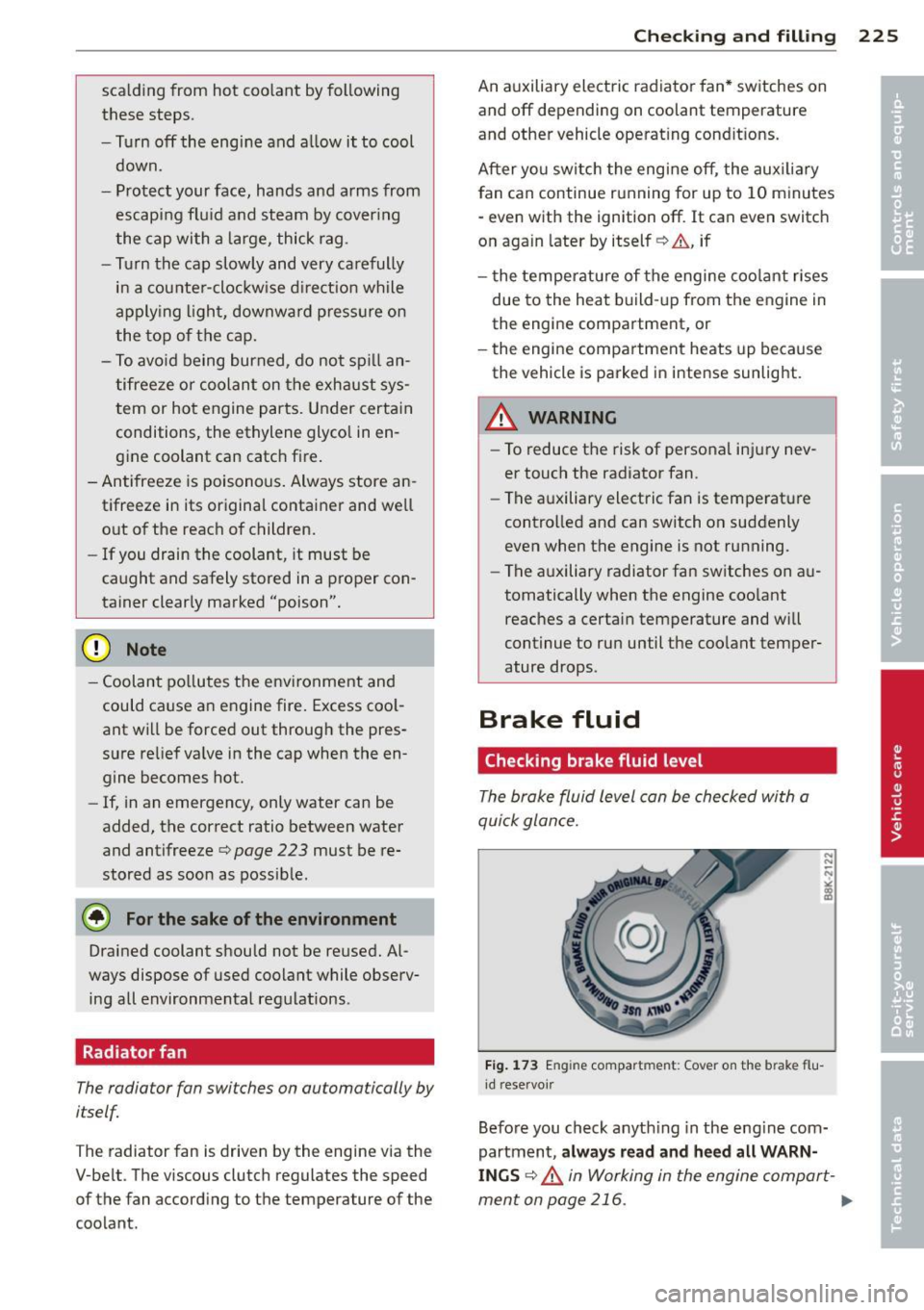
Fig. 17 3 En gin e compar tment: Cover o n the brak e flu
i d reservoi r
Before you check anyth ing in the eng ine com
partment ,
always re ad and heed all WARN
INGS c::> ,& in Working in the engine compar t-
ment on page 216 . .,..
Page 233 of 294
Tires and wheels
Tires
General notes
Tires may be the least appreciated and most
abused parts of a motor vehicle .
Tires may be the least appreciated and most
abused parts of a motor vehicle . Tires are,
however, one of the most important parts of a
vehicle, particularly considering the compara
tively small patch of rubber on each tire that
assures that a ll- important contact between
you, your vehicle and the road.
Maintaining the correct tire pressure, mak ing
sure that your vehicle and its tires do not have
to carry more weight than they can safely han
d le, avoiding damage from road hazards and
r eg ularly inspect ing t ires for damage i nclud
ing cuts, slashes irregu la r wear and ove rall
condition are the most important things that
you can do to he lp avoid sudden tire failure in
cluding tread separat ion and blowouts.
A vo idin g damage
If you have to drive over a curb or similar ob
stacle, drive very slow ly and as close as possi
b le at a right angle to the curb.
A lways keep chemicals includ ing grease, o il ,
gasoline and brake fluid off the t ires .
I nspect the t ires regularly for damage (cuts,
cracks or b listers, etc.). Remove any fo reign
bod ies embedded in the treads.
Storing tires Mark tires when you remove them to indicate
the direction of rotation . Th is ensures you to
be ab le to mount them correctly when you re
i nstall them .
When removed, the wheels or t ires should be
sto red in a cool, dry and preferably dark place .
Store tires in a vertical pos ition if they are not
mounted on rims, in a horizontal pos it ion if
they are mounted on rims .
Tires an d wheel s 231
New tires
New ti res have to be broken in¢& .
The tread depth of new t ires may vary, accord
ing to the type a nd make of t ire and the tread
patte rn.
H idden damage
Damage to tires and r ims is often not readily
visible . If you notice unusual v ib rat ion or the
vehicle pulls to one s ide, th is may ind icate
that one of the t ires has been damaged . T he
ti res m ust be chec ked immed iate ly by an au
thorized Audi dea le r or q ua lified wor kshop .
Unidirectional tires
A un idirectional tire can be identified by ar
rows on the sidewa ll, that po int in the direc
tion the t ire is designed to rotate. You must
f ol low the specified di rection of rotation . T his
is necessary so that these tires can develop
their optimum characteristics regarding grip, road noise, wear and hydrop laning resistance.
For more information ¢
page 258.
A WARNING
New tires or t ires that are o ld, worn or
damaged cannot provide maximum con
trol and braking ability .
-
-New tires tend to be slippery and must
also be broken-in. To reduce the risk of losing control, a collision and serious
personal injuries, drive w ith special care
for the first 350 miles (560 km).
- Driving with worn or damaged tires can
lead to loss of control, sudden tire fail
ure, including a blowout and sudden de
fl ation, cras hes and se riou s personal in
juries . Have worn or damaged t ires re
placed immediate ly.
- Tires age even if they are not being used
and can fai l sudden ly, especially at hig h
speeds. Tires that are more than 6 years
old can only be used in an emergency
and then w ith special care and at low
speed.
•
•
Page 244 of 294
242 Tires and wheels
& WARNING
Sudden tire failure can lead to loss of con
trol, a crash and serious persona l injury!
- Never drive a vehicle when the tread on
any tire is worn down to the wear indica
tors.
- Worn tires are a safety hazard, they do
not grip well on wet roads and increase
your risk of "hydroplaning" and loss of control.
- Always keep chemicals that can cause tire damage, such as grease, oil, gasoline
and brake fluid away from tires.
- Tires age even if they are not be ing used
and can fail suddenly, especially at high
speeds. Tires that are more than 6 years
old can only be used in an emergency
and then with special care and at lower
speeds.
- Never mount used tires on your vehicle if
you are not sure of their "previous histo
ry." Old used tires may have been dam
aged even though the damage cannot be
seen that can lead to sudden tire failure
and loss of vehicle control.
New tires and replacing tires and wheels
New tires and wheels have to be broken in .
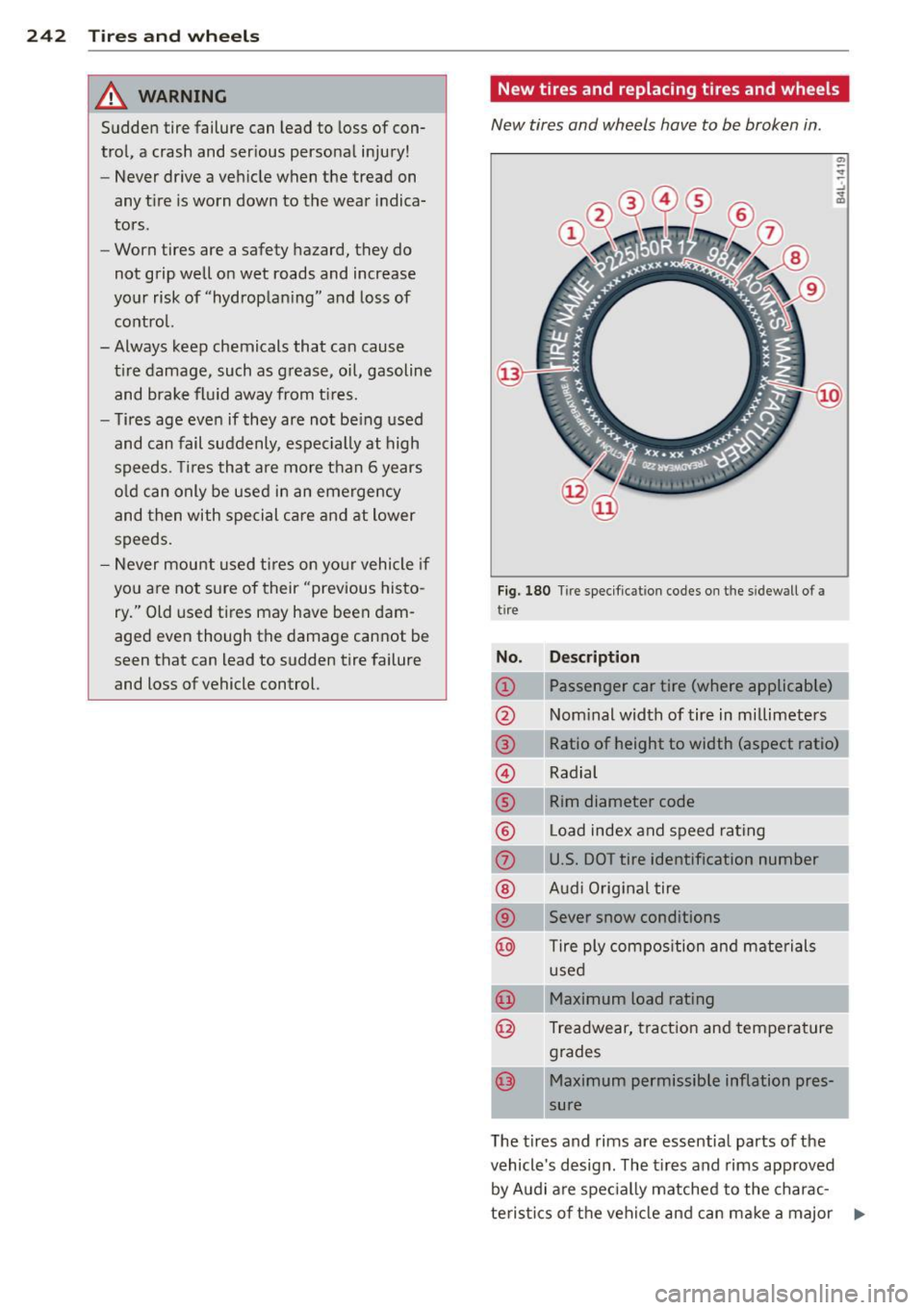
Fig. 180 Tir e specificat ion codes on the s idewall of a
t ire
No. Description
(!) Passenger car tire (where applicable)
@ Nominal width of tire in millimeters
@ Ratio of height to width (aspect ratio)
© Radial
® Rim diameter code
@ Load index and speed rating
(J) U.S. DOT tire identification number
@ Audi Orig inal tire
@ Sever snow conditions
@ Tire ply composition and materials
used
Maximum load rating
Treadwear, traction and temperature
grades
Maximum permissible inflation pres
sure
T he tires and rims are essential parts of the
vehicle 's design . The tires and rims approved
by Audi are spec ially matched to the charac
teristics of the vehicle and can make a major .,..
Page 255 of 294
has been designed specifically for your type of
vehicle.
It must not be swapped with a com
pact spare t ire from another type of veh icle .
Snow cha ins
F or techn ica l reasons, the use of snow chains
on the compact spare tire is
not p ermitt ed .
If you do have to dr ive with snow cha ins and a
front tire fails, mou nt the spare whee l w it h
tire ins tead of a rea r tir e. Install the snow
chains on the rear t ire and use it to replace
the defective front tire .
A WARNING
-Never use the spare tire if it is damaged
or if it is worn down to the tread wear in
dicators.
- If the spare tire is mo re than 6 years o ld,
use it only in an emergency and w ith ex
treme caution and careful driving.
- The spare tire is intended only for tem
porary and short-term use. It should be
replaced as soon as possib le w ith the
normal wheel and t ire .
- After mounting the compact spare tire,
the tire pressure must be checked as
soon as poss ible. The tire pressure of the
compact spa re tire must be 4.2 bar ; oth
erwise, you risk hav ing an accident.
- Do not drive faster than SO mph (80 km/
h). You risk having an acc ident .
-Avo id full-throttle acce lerat ion, heavy
braking, and fast corner ing . You risk hav
ing an acc ident.
- Never drive us ing more t han one spare
wheel and tire . You risk hav ing an acci
de nt.
- No rma l summer or winte r tires must not
be mounted on the compact spare whee l
rim.
- For technical reasons, the use of ti re
ch ains on the spare tire is no t permitted.
If it is necess ary to dr ive wi th tire ch ain s,
the spare whee l must be moun ted on the
front axle in the event o f a flat in a rear
t ire. The newly ava ilable front w heel
must then be installed in place of the
What do I do now? 253
'
rea r whee l w ith the flat tire. Installing
the t ire cha in be fore mounting the whee l
and tire is recommended.
- Loose items in the passenger compart
ment can cause serious personal injury
during hard brak ing or in a n accident.
Never store the inflatable spa re tire or
jack and tools in the passenge r compart
ment.
Changing a wheel
Before changing a wheel
Observe the following precautions for your
own and your passenger 's safety when chang
ing a wheel .
.,. After you expe rie nce a tir e fail ure, p ull the
car we ll away from mov ing traffic and try to
reac h
level ground before you stop ¢ .&, .
.,. All passengers should
leave the car and
move to a safe location ( for instance, behind
the guardra il) ¢ .&, .
.,. Engage the
park ing brake to prevent your
veh icle from rolling unintentionally¢.&, .
.,. Shift into
1st gear on veh icles with man ual
transm iss ion, or move th e
selector lever to
the P po sition
on vehi cles w ith automa tic
t ra nsm iss io n.
.,. If you are towing a tra iler : u nhi tch the trail
er from your vehicle .
.,. Take the
ja ck r=:> page 252 and the spare tire
r=:> page 252 out of the luggage compart
ment.
A WARNING
You o r you r passengers could be i njured
while changing a w heel if you do not fo l-
low these saf ety p recaut ions :
- If you have a fla t tire, move a safe d is
tance off th e road . T urn off the engine,
tur n the eme rgency flashers on and use
o ther warni ng devi ce s to a le rt other mo
t oris ts.
- Ma ke sure tha t passenge rs wait in a safe
p la ce aw ay from the vehicle and well
-
away from the road and tra ffic. .,. •
•
Page 266 of 294
264 Emergency situations
@ Tips
The discharged battery must be properly
connected to the vehicle's electrical sys
tem. When jump starting or charging the
battery, never connect the negative
ground cable to the battery negative post
because the batte ry manager system must
be able to detect the battery 's state of
charge. Always connect the negative
ground cab le to the negative ground post
of the battery manager control unit.
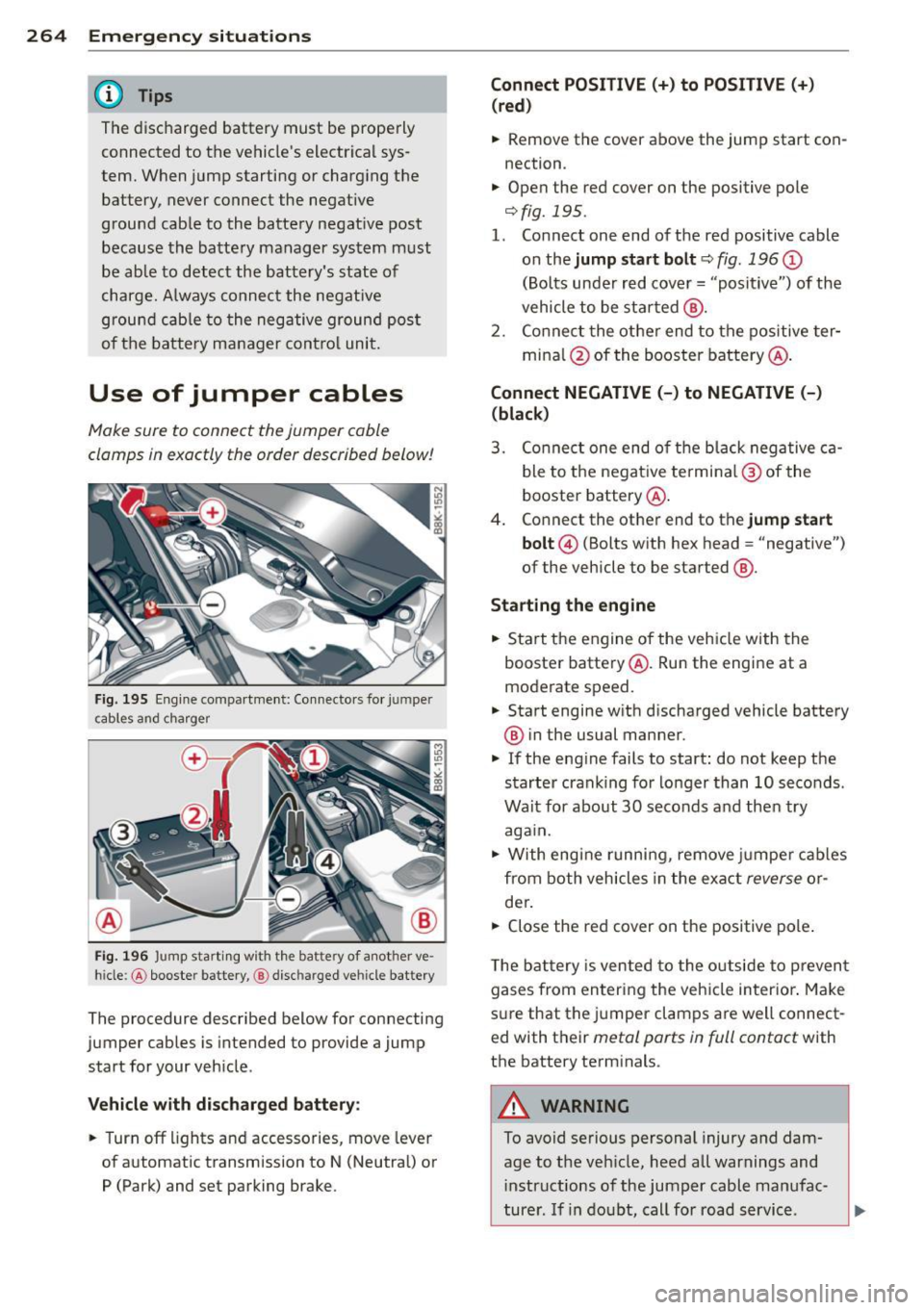
Use of jumper cables
Make sure to connect the jumper cable
clamps in exactly the order described below!
Fig. 195 Engine compartment: Connecto rs fo r jum per
cables and charger
Fig. 196 Jump sta rting wi th the battery of anot her ve ·
h ide :@ booster battery, @ disc harged vehicle battery
The procedure described below for connecting
jumper cables is intended to provide a jump
start for your vehicle .
Vehicle with discharged battery:
.. Turn off lights and accessories, move lever
of automatic transmission to N (Neutral) or
P (Park) and set parking brake .
Connect POSITIVE(+) to POSITIVE(+)
(red)
.. Remove the cover above the jump start con
nection .
.. Open the red
cover on the positive pole
¢fig. 195.
1. Connect one end of the red positive cable
on the
jump start bolt c::> fig. 196 @
(Bolts under red cover= "positive") of the
vehicle to be started @.
2. Connect the other end to the positive ter-
mina l@ of the booster battery@.
Connect NEGATIVE (-) to NEGATIVE (-)
(black)
3. Connect one end of the b lack negative ca
ble to the negative terminal @of the
booster battery @.
4. Connect the other end to the
jump start
bolt @
(Bolts with hex head= "negative")
of the vehicle to be started ®·
Starting the engine
.. Sta rt the engine of the vehicle with the
booster battery@. Run the engine at a
moderate speed.
.. Start engine with discharged vehicle battery
® in the usual manner .
.. If the eng ine fails to start: do not keep the
starter cranking for longer than 10 seconds .
Wait for about 30 seconds and then try
again .
.. With engine running, remove jumper cables
from both vehicles in the exact
reverse or
der .
.. Close the red
cover on the positive pole .
T he battery is vented to the outside to prevent
gases from entering the vehicle interior . Make
sure that the jumper clamps are well connect
ed with their
metal parts in full contact with
the battery terminals.
A WARNING
--
To avoid serious personal injury and dam
age to the veh icle, heed all warnings and
i nstructions of the jumper cable manufac-
turer . If in doubt, call for road service . ..,.
Page 277 of 294
-Always make sure the transm ission se
lector lever (automatic transmiss ion) is
in "P" (Park position) or Neutral (manual
transmission) and the park brake is firm
ly appl ied .
® For the sake of the environment
-Changing the eng ine settings w ill ad
versely affect em ission levels. This is det
rimental to the environment and increas
es fuel consumption .
- Always observe env ironmental regula
tions when d ispos ing of old engine oil,
used brake fluid, dirty engine coolant,
spent batter ies or worn out t ires.
- Undeployed airbag modules and p reten
s ioners might be classified as Perchlo
rate Material -special handling may ap
ply, see www.dtsc.ca .gov/hazardous
waste/perch lorate . When the veh icle or
parts of the restraint system including
airbag modules safety belts with preten
s ioners are scrapped, all applicable laws
and regulations must be observed. Your
authorized Audi dealer is familiar w ith
these requirements and we recommend
that you have your dealer perform this
serv ice for you .
Additional accessories,
modifications and
parts replacement
Additional accessories and parts
replacement
Always consult on authorized Audi dealer be
fore purchasing accessories.
Your veh icle incorporates the latest safety de
sign featu res ensu ring a high standard of ac
tive and passive safety.
This safety could be compromised by non-ap
proved changes to the veh icle. For this reason ,
if parts have to be replaced, p lease observe
the following points when installing addition
al accessories:
Con sumer In formation 275
Approved Audi accessories and genuine Audi
parts are available from authorized Audi deal
ers.
T hese dea lers a lso have the necessary facili
ties, tools and trained specialists to install the
parts and accessories proper ly.
A WARNING
Using the wrong spare parts or using non
approved accessories can cause damage to
the vehicle and serious persona l injury.
- Use on ly accessories express ly approved
by Audi and genuine Audi spare parts
- These parts and accessories have been
specially designed to be used on your ve
hicle.
- Never install accessories such as tele
phone cradles or beverage holders on air
bag covers or within the airbag deploy
ment zones . Do ing so will increase the
risk of injury if a irbags are triggered in an
accident!
- Before you check anything in the engine
compartment, always read and heed all
WARNINGS ~
page 209.
(D Note
-If items other than genuine Audi spare
parts, add-on equipment and accessory
items are used or if repair work is not
performed accord ing to specified meth
ods, this can result in severe damage to
your vehicle's engine and body (such as
corrosion) and adversely affect your vehi
cle's warranty .
- If emergency repairs must be performed
elsewhere, have the vehicle examined by
an authorized Audi dealer as soon as
possible.
- The manufacturer cannot be held liable
for damage wh ich occurs due to failure
to comply with these stipulations.
•
•
Page 281 of 294
Automatic climate control Air vents ... ................ ... .... 69
Operation . . . . . . . . . . . . . . . . . . . . . . . . . 68
Setup ... .. ................. .. .... 70
Automatic Shift Lock (ASL) . . . . . . . . . . . . 85
Automatic transmission . . . . . . . . . . . 82, 88
Automatic Shift Lock (ASL) . . . . . . . . . . . 85
Driving .. .. ............. .... .. .. .. 82
Dynamic shift program . . . . . . . . . . . . . . 86
Emergency mode . . . . . . . . . . . . . . . . . . . 87
Emergency release . . . . . . . . . . . . . . 88, 94
Kick -down . . . . . . . . . . . . . . . . . . . . . . . . . 85
Manual shift program . . . . . . . . . . . . . . . 86
Removal lock (ignition key) . .. .. .. .. .. 71
Selector lever . . . . . . . . . . . . . . . . . . . . . .
84
S tronic .. ..... ........... ... ... ... 88
also refer to S tronic transmission ..... 88
Automatic wipers ................ .. .. 49
Auto Safety Hotline ........ .. .. .. .. . 132
Average speed . . . . . . . . . . . . . . . . . . . . . . . 25
Avoid damaging the vehicle ... ... .. .. . 193
B
Battery . . . . . . . . . . . . . . . . . . . . . . . 17,226
Battery location inside the luggage com-
partment .. ................ ... ... 227
Charging ... ................ ... ... 229
Important warnings when working on
the battery . ............. .... .. ... 227
Jump starting ............ .... .. ... 263
Low ..... ... ...... ............. .. 191
Replacing the battery ..... .. .. .. .. . 230
State of charge ........... .... .. .. . 191
W inter operation ......... .. .. .. .. . 226
Working on the battery .... .. .. .. .. . 227
Before driving . . . . . . . . . . . . . . . . . . . . . . 124
Bio-ethanol (Fuel) ................ .. . 212
Blended gasoline .......... .. .. .. .. . 211
Blower (automatic climate control) . . . . . . 69
Body cavity sealing ............ ... .. . 205
Booster seats .............. ... ... .. 174
Brake fluid Changing the brake fluid ... .. .. .. .. . 226
Checking the brake fluid level ... .. .. . 225
Reservoir .. ... .. .. ...... .. .. .. .. . 225
Index 279
What is the correct brake fluid level? . . 225
What should I do if the brake fluid warn- ing light comes on? ............... . 225
B rake system .. .. .. .... ........... .. 225
Anti- lock b raking system ........ .. .. . 19
Brake assist system ............... . 185
Brake fluid . ..... ................. 225
Brake fluid specifications for refill and re-
placement .. .. .. .... ........... .. 226
Brake light defective ............... . 21
Brake power assist unit ............. 188
Brakes .. .. .. .. .. .. . .. .... ........ 188
Ceramic brakes ... .. ............... 188
Electromechanical parking brake ..... . 76
Warning/ind icator lights ........ .. .. . 15
Worn brake pads symbol . . . . . . . . . . . . . 20
Braking Emergency braking function .......... 78
braking guard . .. .. .... ............. . 95
Messages . .. .. .. .. ............... 103
Settings .. .. .. .. .... ... .... .... .. 102
Break-in period . ..... ............... 193
Tires ........... .. ............... 193
Bu lbs .......... .... ............... 262
C
California Proposition 65 Warning ... .. 217
Battery specific ...... ......... .. .. 228
Capacities .. .. .. .. .... ........... .. 271
Car care ..... ... .... ............... 200
Interior ..... .... .. ............... 206
Plastic and vinyl .... .............. . 203
Care of exterior .. .. .... ........... .. 200
Cargo area
refer to Luggage compartment. . . 63, 130
Catalytic converter . . . . . . . . . . . . . . . . . . 194
Center armrest . . . . . . . . . . . . . . . . . . . . . . 56
Central locking .. .. ............... .. . 32
Central locking switch .......... .... . 36
Convenience key . . . . . . . . . . . . . . . . . . . . 36
Remote control key .... ....... .... .. 35
Ceramic brake rotors New brake pads .. ................. 188
Certification .. .. .. ... ............ .. 276
Changing a flat tire ................. . 253
Changing a wheel .... .............. . 253
•
•
Page 283 of 294
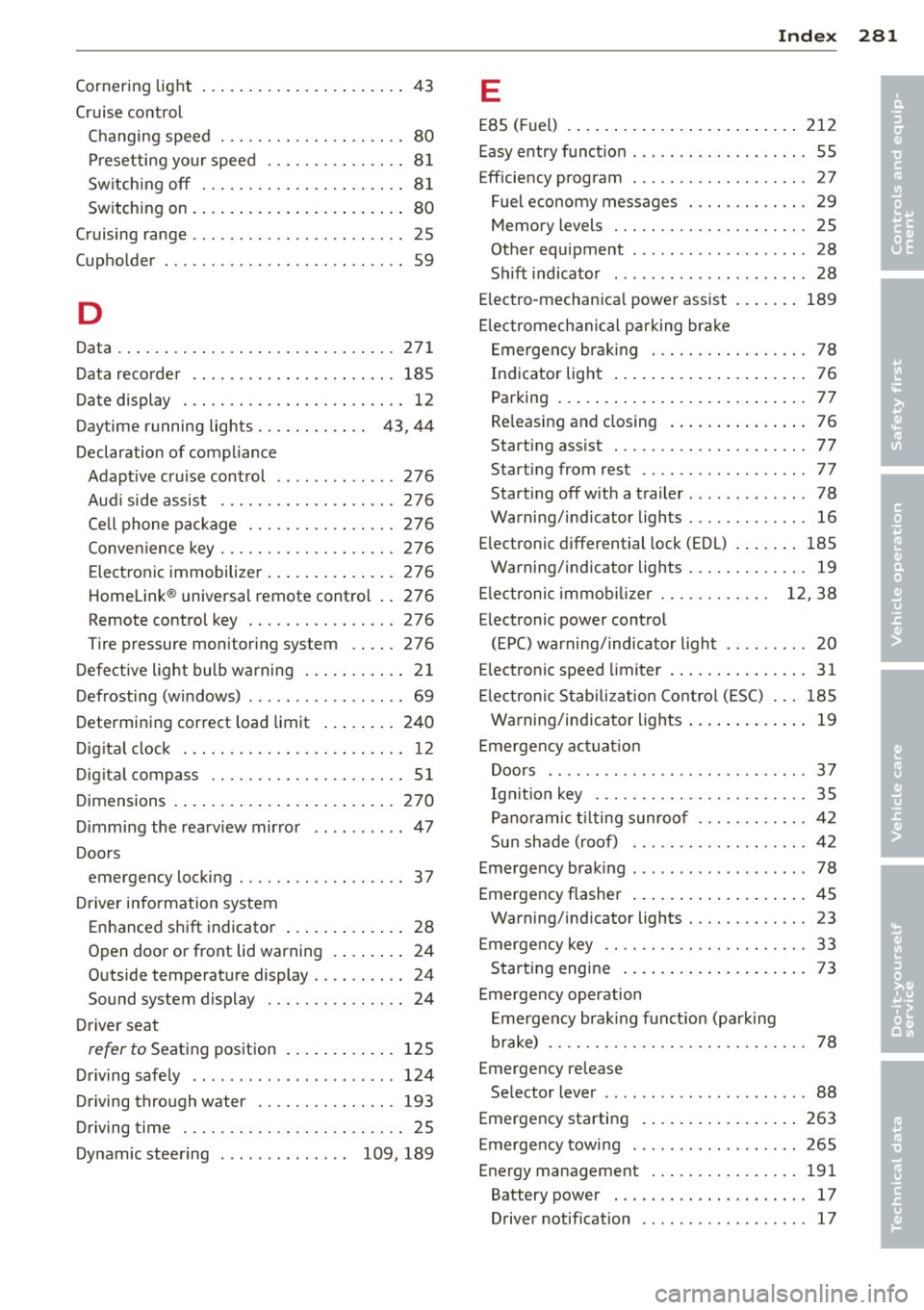
_______________________________ I~ n~ d:::: e~x 281
Cornering light ..... .... ... .. .. .. .... 43
Cruise control Changing speed . . . . . . . . . . . . . . . . . . . . 80
Pr esetting your speed ..... .. .. .. .. .. 8 1
Sw itching off . ........... .. .. .. .... 8 1
Sw itching on . ... .. .... ... .. .. .. .... 80
Cruising range . . . . . . . . . . . . . . . . . . . . . . . 25
(upho lder . . . . . . . . . . . . . . . . . . . . . . . . . . 59
D
D ata .. .. .. .. .. ... .. ..... ... .. .. ...
Data recorder 271
185
Date display . ............. .... .. .... 12
D ay time r unning lights. . . . . . . . . . . . 4 3, 44
Declaration of comp liance
Adapt ive cruise control ........ . ... . 276
A d' 'd . u I s1 e assist .......... .. .. .. .. . 276
Cell phone package ....... .. .. .. .. . 276
Conve nience key .......... .. .. .. .. . 276
Elect ronic immobilize r .. ... .. .. .. .. . 27 6
Homelink ® universal remote contro l .. 276
Remote control key ....... .. .. .. .. . 276
Tire pressure monitoring system .. .. . 276
D efect ive light bulb warning . . . . . . . . . . . 2 1
Defrosting (w indows) .......... .. .... . 69
Determining cor rect load limit ... .. .. . 240
Di gita l cl ock . .... ......... .. .. .. .. .. 12
Dig ita l compass ........... .. .. .. .. .. 51
D imensions .. .. .. .. .... ... .. .. .. ... 270
Dimming the rearview mir ro r .. .. ... ... 4 7
Doors emergency locking ........ .. .. .. .. .. 37
D river information system
En hanced s hift indicator ... .. .. .. .. .. 28
Open doo r or front lid warning . . . . . . . . 24
Outside temperature display .. .. .. .. .. 24
Sound system display . . . . . . . . . . . . . . . 24
D river seat
refer to Seat ing position ... .. .. .. .. . 125
Dr iving safely .. ........ ...... .... .. 124
Driving through water ...... .. .. .. .. . 193
D riving time . . . . . . . . . . . . . . . . . . . . . . . . 25
Dynamic steering . . . . . . . . . . . . . . 109, 189
E
E85 (Fuel) . ....... ... .. .. ..... ... .. 2 12
Easy entry funct io n . . . . . . . . . . . . . . . . . . . 55
Eff ' .
1c1ency program . .. ........... .... . 27
Fuel economy messages . . . . . . . . . . . . . 29
Memory levels . . . . . . . . . . . . . . . . . . . . . 25
Other equipment ................. .. 28
S hi ft indicato r ... .. . .. .... .... .. .. . 28
E lectro-mechan ica l power ass ist ... .. .. 189
El ec tromechani ca l pa rking brake
E mergency bra king ................ . 78
Ind icator light ... .. . ... ...... ... .. . 76
Parking ... .. .... .. . .. .. ..... ... .. . 77
Re leas ing and closing ... .... ... .. .. . 76
Starting ass ist . . . . . . . . . . . . . . . . . . . . . 77
Starting from rest . . . . . . . . . . . . . . . . . . 77
Starting off w ith a trailer .. .. ... ... .. . 78
Warning/ind icator lights ........... .. 16
E lectronic differential lock (EDL) ... .. .. 185
Warning/ind icator lights ............ . 19
E lectronic immob ilizer . . . . . . . . . . . . 12, 38
E lectronic power control
(EPC) warning/ indicator light ... ... .. . 20
E lectronic speed limiter .............. . 31
El ec tronic Stab iliz at ion Con tro l (E SC) . .. 185
Warning/ind icator lights ..... ... .. .. . 19
Emergency ac tuat ion
Doors ...... .. .... .......... ...... 37
Ig nition key . .. .. ................. . 35
Pano ram ic t ilting sunro of ....... .. .. . 42
Sun shade (roo f) . ............. .. .. . 42
Emergency brak ing ................. .. 78
Emergency flasher .... .. ..... ... .. .. . 45
Warning/ind icator lights ........ .... . 23
E mergency key . . . . . . . . . . . . . . . . . . . . . . 33
Star ting engine .... . .. .. ..... ... .. . 73
Emergency operation Em ergency bra king funct ion (park ing
brake) .... .. .. .. .. .. ........... .. . 78
Emergency release Se lector lever . . . . . . . . . . . . . . . . . . . . . . 88
Emergency starti ng . .. .. ..... ... .. .. 263
E merge ncy towing . .. ........... .... 265
Energy management ............ .. .. 191
Battery power . . . . . . . . . . . . . . . . . . . . . 17
Driver notif ication . . . . . . . . . . . . . . . . . . 17
•
•
Page 287 of 294
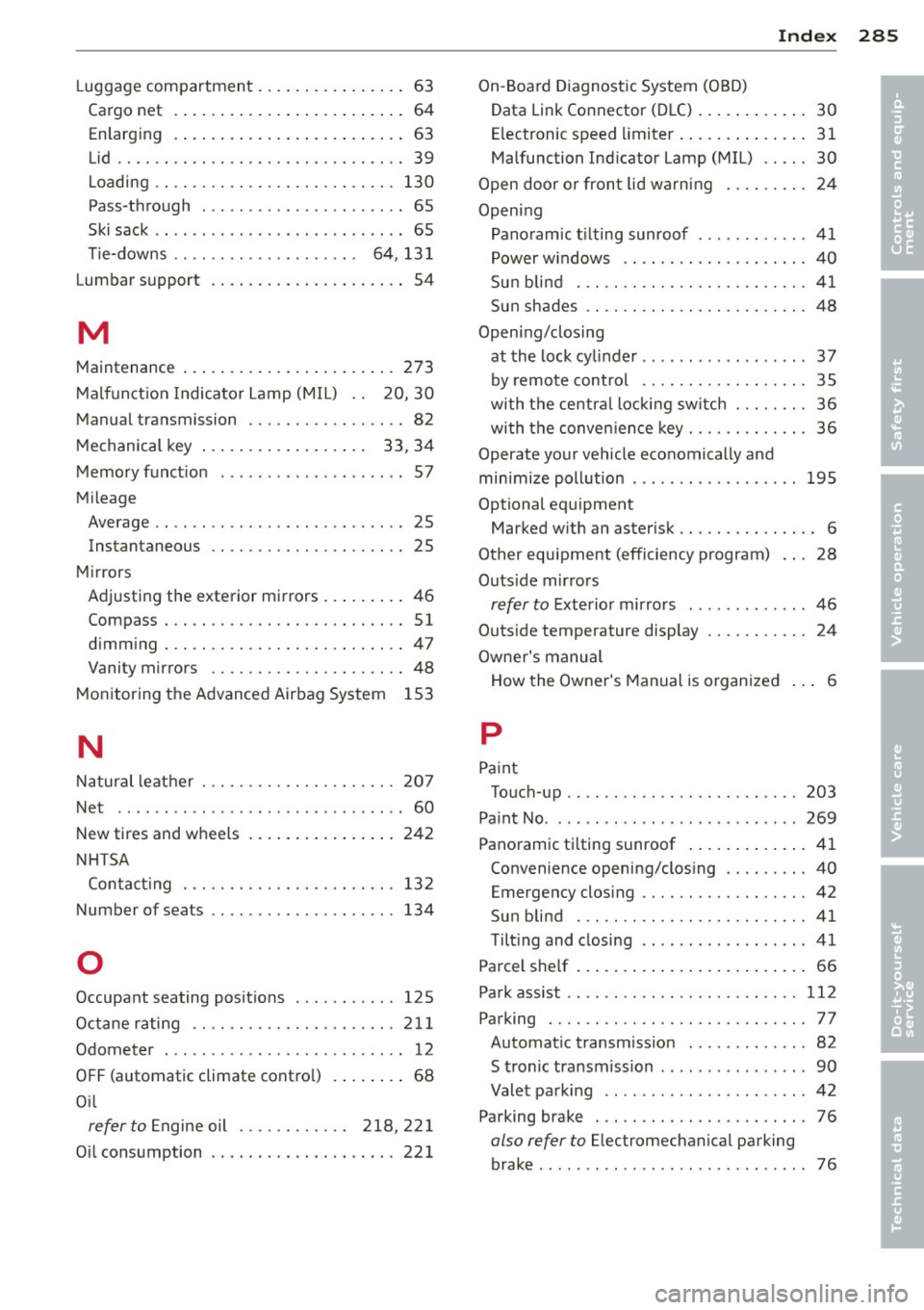
Luggage compartment ... ... .. .. .. .. .. 63
Cargo net .. .... .. .... ... .. .. .. .... 64
Enlarg ing . ..... ...... ... .. .. .. .. .. 63
Lid .. .... .. ................. .. .... 39
Loading .. .. ............. .... .. ... 130
Pass -t h rough . . . . . . . . . . . . . . . . . . . . . . 65
Ski sack . ... ... .. .. ...... .. .. .. .. .. 65
T ie-downs ............ ...... .. 64, 13 1
Lumbar support ........... .... .. .... 54
M
Maintenance ... .... .... ... .. .. .. ... 273
M alf unct io n I ndicator Lamp (MIL) . . 20, 30
Manual transmission ....... .. .. .. .. .. 82
M echanical key . . . . . . . . . . . . . . . . . . 33, 34
M emory funct ion .... ...... .. .. .. .. .. 57
M ileage
Average .. .. ............. .... .. .... 25
Instantaneous ........... .. .. .. .. .. 25
M ir rors
Ad justing the exte rior mirrors ... .. .... 46
Compass . .. .. .. ......... .. .. .. .... 51
d imm ing . .. ............. .... .. .. .. 47
Vanity mirrors ........... .. .. .. .. .. 48
M on itoring the Advanced Airbag System 1 53
N
Na tur al leat her ............ .... .. .. . 20 7
Net .. .. .. .. .. ........ ... .. ... ... .. 60
New tires and w heels .... ... .. .. .. .. . 242
NHTSA Contac ting . ............. .. .. .. .. . 13 2
Number of seats ........... .. .. .. ... 134
0
Occupant seating posit ions
125
Octane r ating ............. .... .. .. . 211
Odometer ... .. ........ ... .. ... ... .. 12
O FF (automatic climate contro l) . . . . . . . . 68
O il
refer to Engine oil . . . . . . . . . . . . 218, 22 1
O il consumption .. ...... ... .... .. ... 221
Inde x 285
On-Boa rd Di agnost ic System (O BD)
Data Link Connector (D LC) .... ... .. .. . 30
E lectronic speed limiter . . . . . . . . . . . . . . 31
Malfunction Ind icator Lamp (MIL) .. .. . 30
Open door or fron t lid warn ing .... .. .. . 24
Open ing
Pano ram ic t ilting sunroof ............ 41
Power w indows .. .... ........... .. . 40
Su n blin d ... .. ...... ............. . 41
Su n sh ad es .. .. .. .. . ............... 48
Opening/closing at the lock cylinder .................. 37
by remote control ............. .. .. . 35
with t he ce ntra l locki ng sw itch ... .. .. . 36
wi th t he conve nien ce key ............ . 36
Operate your vehicle economically and
minimize pollution . .. .. .. ...... ..... 195
Optional equipment Marked w ith an asterisk . . . . . . . . . . . . . . . 6
Other equ ipment (efficiency program)
Outs ide mir ro rs 28
refer to Exte
rio r mirro rs ........... .. 46
Outs ide temperature disp lay . . . . . . . . . . . 24
Own er's ma nual
How the Owner's Manual is organ ized ... 6
p
Paint
T o uch-up .. .. .. .. ... ............ .. 20 3
Pa int No . ...... ... .. ............... 269
Pano ramic ti lting sunroof ..... ... .. .. . 41
Convenience opening/clos ing .... .... . 40
Emergency clos ing .... ......... .. .. . 42
Su n bli nd . .... .. .. . ............... 41
Tilt ing and closing .. ..... ......... .. 41
Pa rcel she lf ... .... .. . .. .. ..... ... .. . 66
Pa rkass ist .. .. .. .. .. .. ........... .. 112
Parking ...... .. ...... ............. . 77
Automat ic transm iss ion .. .. ... ... .. . 82
S t ronic tra nsmission . . . . . . . . . . . . . . . . 90
Valet pa rking .. .. .. .. .. ...... .... .. 42
Parking brake . .. .. ............. .... . 76
also refer to Electromechanical parking
brake . .. .. .. .. .... .. ........ ...... 76
•
•