trailer AUDI A5 COUPE 2013 User Guide
[x] Cancel search | Manufacturer: AUDI, Model Year: 2013, Model line: A5 COUPE, Model: AUDI A5 COUPE 2013Pages: 294, PDF Size: 73.84 MB
Page 119 of 294
Parallel Parking
Applies to vehicles: with parking system (rear, with rear
view ca mera)
Use parking mode 2 to help you pork on the
edge of o street.
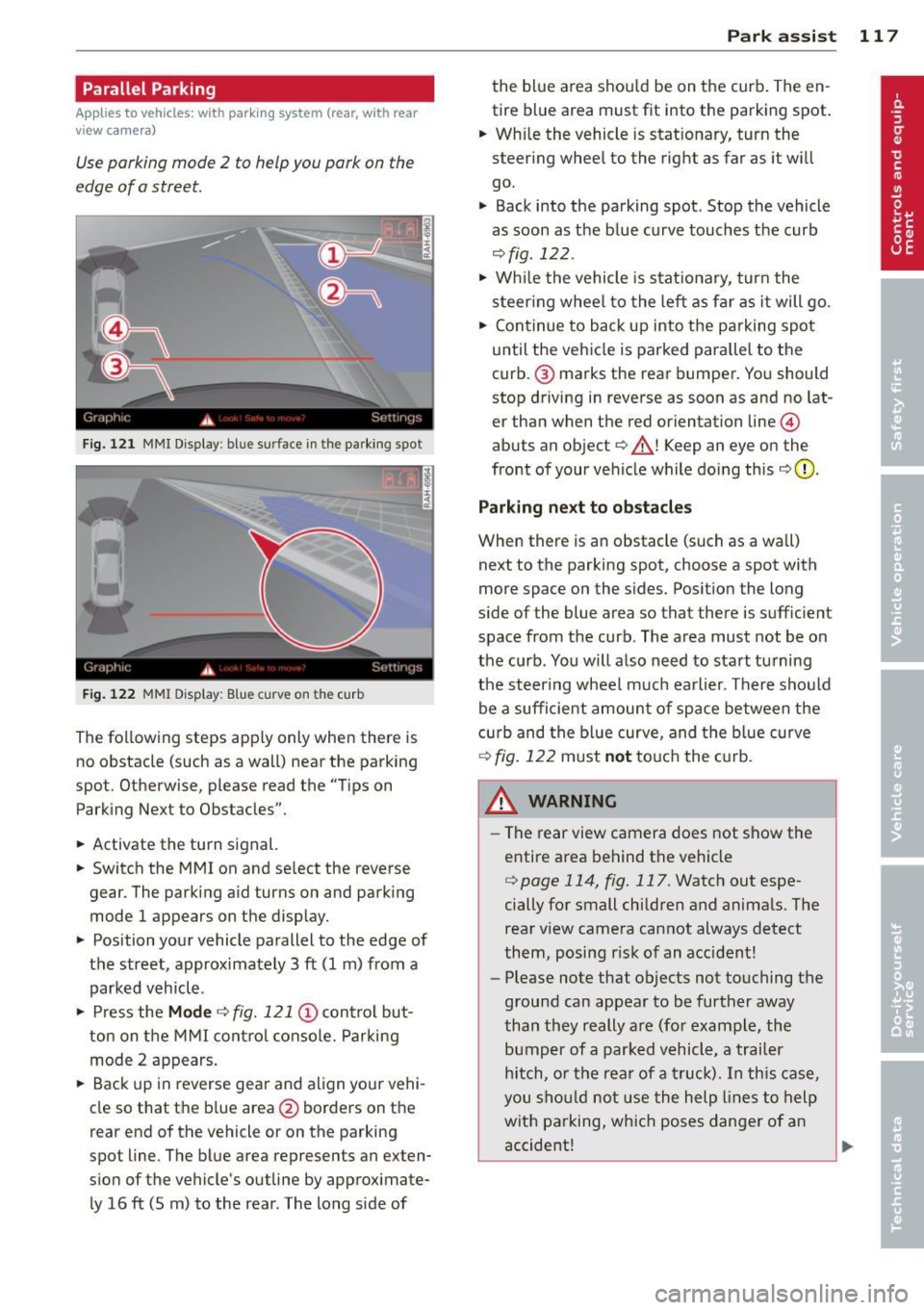
F ig. 121 MMI Display : blue surface in the park ing spot
Fig. 122 MMI Disp lay: Blue curve on t he c urb
The following steps app ly only when there is
no obstacle (such as a wall) near the parking
spot. Otherwise, please read the "Tips on
Parking Next to Obstacles".
• Activate the turn signal.
• Switch the MMI on and se lect the reverse
gear. The parking aid turns on and park ing
mode 1 appears on the display.
• Position your vehicle parallel to the edge of
the street, approximately 3 ft (1 m) from a parked vehicle .
• Press the
Mode ¢ fig. 121 © control but
ton on the MMI control console. Parking
mode 2 appears.
• Back up in reverse gear and align your vehi
cle so that the b lue area
@ borders on the
rear end of the vehicle or on the parking
spot line . The blue area represents an exten
s ion of the vehicle's outline by approximate
ly 16 ft (5 m) to the rear . The long s ide of
Park assist 11 7
the blue a rea shou ld be on the curb. The en
tire blue area must fit into the parking spot.
• Wh ile the vehicle is stat ionary, turn the
steer ing whee l to the right as far as it wi ll
go.
• Back into the parking spot . Stop the vehicle
as soon as the blue curve touches the curb
¢ fig . 122 .
• Wh ile the vehicle is stationary, turn the
s t eering whee l to the left as far as it will go.
• Continue to back up into the parking spot
until the vehicle is parked parallel to the
curb .@ marks the rear bumper. You should
stop driving in reverse as soon as and no lat
er than when the red orientat ion line @
abuts an object¢_& ! Keep an eye on the
front of your vehicle while doing this
¢ 0 .
Parking next to obstacles
When there is an obstacle (such as a wall)
next to the parking spot, choose a spot with
more space on the sides. Posit ion the long
s ide of the blue area so that there is suff ic ient
space from the curb. The area must not be on
the curb . You will also need to start tu rning
the steer ing wheel much earlier. There should
be a sufficient amount of space between the
c urb and the blue curve, and the blue curve
¢ fig. 122 must not touch the curb.
&_ WARNING
- The rear view camera does not show the
entire area behind the vehicle
¢ page 114 , fig. 117. Watch out espe
cially for small children and animals. The
rear view camera cannot always detect
them, posing r isk of an accident!
- Please note that objects not touching the
ground can appear to be further away
than they really are (for example, the
bumper of a parked vehicle, a trailer
hitch, or the rear of a truck). In this case,
you should not use the help lines to help
with parking, which poses danger of an
accident!
.__ _____________ _J ...
Page 187 of 294
Intelligent technology Notice about data
recorded by vehicle
control modules
Your vehicle is not equipped with an Event Da
ta Recorder (EDR), installed by some manu
facturers for the express purpose of capturing
data for retrieval after an accident or crash
event. EDR's are sometimes called "crash re
corders".
Some state laws restrict the retr ieval or down
loading of data stored by EDR's that were in
stalled in a vehicle for the express purpose of
retrieving data after an accident or crash
event without the owner's consent.
Although your vehicle is not equipped with an
EDR, it is equipped with a number of electron
ic control modules for various vehicle systems
such as, for examp le, engine function, emis
sion control, as well as for the airbags and
safety belts.
These electronic control modules also record
vehicle-related data during norma l vehicle op
eration for diagnostic and repair purposes.
The recording capacity of the electronic con
trol modules is limited to data (no sound is re
corded) and only a small amount of data is ac
tually recorded over a very limited period of
time and stored when a system fault or other
condition is sensed by a control unit. Some of
the data then stored may relate to vehicle
speed, direction, braking as we ll as restraint
system use and performance in the event of a
crash or other condition. Stored data can only be read and downloaded with special equip
ment.
Electronic Stabilization
Control (ESC)
Description
ESC helps to improve road holding and vehicle
dynamics to help reduce the probability of
skidding and loss of veh icle control. It works
only when the engine is running. ESC detects
Intelligent technology 185
certain difficult driving situations, including
when the vehicle is beginning to spin (yaw)
out of control and helps you to get the veh icle
back under control by se lectively braking the
wheels, and/or reducing engine power and
providing steering ass istance to help hold the
vehicle on the driver's intended course. The in
dicator light
JjJ in the instrument cluster
blinks when ESC is taking action to help you
control the vehicle.
ESC has limitations .
It is important to remem
ber that ESC cannot overcome the laws of
physics.
It will not always be able to help out
under all conditions you may come up against.
For example, ESC may not always be able to
help you master situations where there is a
sudden change in the coefficient of friction of
the road surface. When there is a section of dry road that is suddenly covered with water,
slush or snow, ESC cannot perform the same
way it would on the dry surface. If the vehicle
hydroplanes (rides on a cushion of water in
stead of the road surface), ESC will not be
able to help you steer the vehicle because con
tact with the pavement has been interrupted
and the vehicle cannot be braked or steered .
During fast cornering, particularly on winding
roads, ESC cannot always deal as effectively
with difficult driving situations than at lower
speeds. When towing a trailer, ESC is not able
to help you regain control as it would if you
were not tow ing a trailer.
A lways adjust your speed and driving style to
road, traffic; and weather conditions. ESC can
not override the vehicle's physical limits, in
crease the available traction, or keep a vehicle
on the road if road departure is a result of
driver inattention. Instead, ESC improves the
poss ibility of keeping the vehicle under con
trol and on the road dur ing extreme maneu
vers by using the driver's steering inputs to
help keep the vehicle going in the intended di
rection. If you are traveling at a speed that
causes you to run off the road before ESC can
provide any assistance, you may not experi
ence the benefits of ESC.
•
•
Page 199 of 294
Trailer towing Driving with a trailer
General information
Your Audi was designed primarily for passen
ger transportation .
If you plan to tow a tra iler, p lease remember
that the addit ional load will affect durab ility,
economy and performance .
T railer towing not on ly places more stress on
the vehicle, it also calls for more concentra
tion from the driver.
F or this reason, a lways fo llow the operating
and driving instructions provided and use
common sense.
Technical requirements
Traile r hitch
Use a weight-carrying hitch conforming to the
gross trailer we ight. The hitch must be suita
b le for your veh icle and trailer and must be
mounted secure ly on t he veh icle's chassis at a
technically sound location . Use only a t railer
h itch w ith a removab le ball moun t. A lways
check with the tr ailer hitch man ufac tur er to
make sure that you are using the correct
hitch.
Do not use a bumper hitch.
T he hitc h must be installed in such a way that
it does not inte rfe re with the impac t-absorb
i ng b umper syst em. No modifica tions should
be made to the vehicle exhaus t and b rake sys
tems . From t ime to time, check that a ll hitch
mo unt ing bolt s remain securely fas tened.
W hen you are not tow ing a trailer, remove the
trai le r hi tch ball moun t. T h is prevents the
hi tch from causing damage sho uld your ve hi
cle be str uck from be hind
¢ &. .
Trailer brakes
If yo ur tra iler is equ ipped w it h a braking sys
tem, check to be su re that it conforms to a ll
r eg ulat io ns.
Trailer towin g 197
The trailer hyd ra ulic bra ke system must not be
direct ly connected to the vehicle's hydraulic
brake system
¢ &. .
Safety chains
Alw ays use s afety chains between your ve hicle
and t he tra ile r.
Trailer lights
Tra ile r lights m ust meet all reg ulations . Be
su re to check w ith your authorized Audi dealer
fo r c orrec t w iri ng, sw itches, and relays.
Mirrors
If you a re unable to see the traffic behind you
u sing the regula r outside m irrors, then you
must insta ll ext ended mir ro rs. It is important
t h at you
always have clea r vis io n to the rear .
.8, WARNING
- If a trai ler has elec trica l br ake s plea se
no te th at t hese bra kes are not activat ed
by the fa ctory -fit ted control unit -risk of
accident!
- After removing the t railer hi tch, do no t
s to re it in yo ur vehicle . In case of sudden
brak ing, the hitch could fly fo rward and
in ju re you or yo ur passenge rs .
Operating instructions
Maximum traile r we ight
-
A trai ler fo r you r vehicle is limited to a typical
class 1 or class 2 tra iler.
Trailer load distribution
B e sure the lo ad in the tra iler is h eld secure ly
i n p lace to p reven t it from shifting fo rward,
backward or sideways.
Never allow a passenger to ride in a trailer
¢ &. in Driving instru ctions on page 198.
Engine cooling system
T owing a t railer ma kes t he engine wor k hard
er . It is impo rta nt that the cooling system's
perfo rman ce is up to the additional load.
Make sure tha t the coo ling sys tem h as enough
f lu id . .,..
•
•
Page 200 of 294
198 Trailer towing
Tire pre ss ure
When towing a trai le r, inflate the t ires of your
vehicle to the co ld tire pressure listed under
"Full load" on the label located on the driver 's
side B-pillar (visible when the door is open).
Inflate trailer tires to trailer and tire manufac
turers' specifications.
Light s
The headlight settings should be checked with
the trailer attached before dr iving off. Check
to make sure both vehicle and tra iler lights
are working properly.
Saf ety chains
Be sure tra iler sa fe ty cha ins a re p roperly con
nected from the trailer to the hitch on the ve
hicle. Leave eno ugh slack in the chains to per
mit turning corners. When you install safety
cha ins, make sure they w ill not drag on the
road when you are driving.
The chains shou ld cross under the trai ler
tongue to prevent it from dropping in case of
separation from the hitch.
Driving instructions
Driving with a trailer always requires extra
care and consideration.
To obtain the best possible handling o f vehicle
and trai ler, p lease note the following:
.,. Do not tow a loaded tra iler whe n your car it
self is no t loaded .
.,. Be especia lly careful when passing other
vehicles .
.,. Observe speed limits .
.,. Do not drive at the maximum permissible
speed.
.,. Always apply brakes early .
.,. Monitor the temperature gauge.
Weigh t di stribution
Towing a loaded trai ler with an empty car re
sults in a highly unstable distribution of
weight . If this cannot be avo ided, drive at very
low speeds only to avoid the risk of losing
steer ing control. A "ba
lanced' ' rig is easier to operate and con
trol. This means that the tow vehicle should be loaded to the extent possible and permissi
ble, while keep ing the trai ler as light as possi
ble under the c ircumstances. Whenever poss i
ble, transfer some cargo to the luggage com
partment of the tow veh icle while obse rving
tongue load requ irements and vehicle load ing
considerations.
Speed
The higher the speed, the more d iff icu lt it be
comes for the driver to control the rig. Do not
drive at t he maximum permissible speed. Re
duce your speed even more if load, weather or
wind conditions are unfavorable -pa rtic ularly
whe n going downhill.
Reduce veh icle speed
immediately if the trail
er shows the slightest s ign of sway ing.
Do n ot
try to sto p th e swaying by acc elerating .
Observe speed limits. In some areas, speeds
fo r vehicles tow ing tra ile rs a re lower than for
regular veh icles .
Always apply brakes early. When driving downh ill, shift into a lower gear to use the en
gine braking effect to slow the vehicle . U se of
the brakes alone can cause them to overheat
and fail.
Coolant tempe rature
The coo lant temperature gauge c> page 10
must be observed carefu lly. If the needle
moves close to the upper end of the scale, re
duce speed immediately and/or turn off the
air conditioner.
If the coolant temperature warning light •
i n t he i nstrument cluster starts flashing, pull
off the road, stop and let the engine
idle for
abo ut two min utes to prevent he at build-up .
_& WARNING
Anyone not proper ly restra ined in a mov
i ng vehicle is a t a much greater risk in an
accident . Never let anyone ride in yo ur car
who is not p roperly wea ring the rest raints
prov ided by Audi.
-
Page 201 of 294
Trailer towing tips
Important to know
Your vehicle hand les different ly when tow ing
a trailer because o f the addit ional weight and
d iffe ren t weight distribution . Safety, perform
ance and economy w ill greatly depend on how
caref ully you load your trailer and operate
your rig.
B efore you actua lly tow your trailer, pr actice
turning, stopp ing and bac king up in an area
away from traffic. Keep practicing until you have become comp lete ly fam iliar with the way
your veh icle-trailer comb ination behaves and
responds.
Backing up is d ifficu lt a nd requires practice .
Backing up with a tra iler genera lly requires
steer ing action opposite to that when backing
up your vehicle without a trailer.
M aintain a g reater distance betwee n your ve
h icle and the one in front o f you . You will need
mo re room to stop. To compensate for the
trailer, you will need a larger than normal
turning radius .
W hen pass ing, remember that yo u cannot ac
celerate as fast as yo u normally wo uld be
cause of the added load. Ma ke s ure you have
e nough room to pass . After passing , allow
p lenty o f room fo r your tra iler before chang
in g la nes aga in .
Avoid jerky starts, sharp turns or rap id lane
changes.
(D Tips
- Do not tow a tra iler during the break-in
period of you r vehicle.
- If you tow a trailer, your A udi may re
quire more frequent maintenance due to
the extra load
o page 2 73.
Trailer towin g 199
Parking on a slope
Do not park on a slope with a trailer . If it can
not be avoided, do so only after doing the fol lowing:
When parking:
.. App ly the foot brake.
.. Have someone p lace chocks under both the
veh icle and the tra iler wheels .
.,. With chocks in place, slowly release t he
bra kes unt il t he whee l chocks absorb the
load .
.. Tur n the whee ls towa rds t he curb .
.,. App ly the parking brake.
.. Place an a utomat ic t ransm ission* in P, re
spectively a manual transmission in first or
reverse gear.
When restarting after parking:
.. App ly the foot br ake .
.. Sta rt t he engine.
.. Move the se lector lever to D/S, respectively
a man ual transmiss ion in first gear .
.. Release the parking brake and s low ly pull
out and away from the wheel chocks .
.. Stop and have someone retr ieve the wheel
chocks.
@ Tips
If you move the selector leve r of the auto
matic transmissio n* to P before applying
the pa rking brake and before bloc king the
whee ls, you may hav e to use mor e forc e
la ter to m ove the lever out of the P p osi
tion.
•
•
Page 239 of 294
-The brakes o n a vehicle t hat has been
overloaded may not be a ble to stop the
vehicle within a safe distance.
- Tires on a vehicle that has been overload
ed can fail suddenly causing loss of con
trol and a crash.
- Always make sure that the tota l load be
ing transported -including the we ight of
a tra ile r hitch and the tongue weight of a
loaded trailer - does not make the veh i
cle heav ier than the veh icle's Gross Vehi
cl e Weight Rating.
A WARNING
- Incorrect tire pressures and/or underin
fla tion can lead to a serious o r fatal acci
dent.
- Incorrect tire pressures and/or underin
fla tion cause increased tire wea r and can
affect the handling of the vehicle .
- Incorrect tire pressures and/or underin
flation can also lea d to sud den tire fa il
ure, incl uding a blowo ut and sudden de
flation, causing loss of vehicle control.
Checking tire pressure
.
The correct tire pressure for the tires original
ly installed on your vehicle is listed on the tire
pressure Lobel located on driver's side 8-pil lor.
The re commended t ire press ures a re o n the
tire pressure label and in the tab le
c=> page 235, Cold tire inflation pressure. This
means that the pressure must be checked and
adj usted when the tire has not been driven for
more than a couple of m iles (kilometers) at
low speeds during the previous three hours .
A ir i n the tires expands when the tire heats up
as a result of inte rnal fr iction as it flexes in
use. The t ire p ress ure is higher w hen the tire
h as wa rmed up th an when it is "cold."
It is the inflat io n pressu re in a "cold" tire that
counts. Therefore, you shou ld never let air out
of a warm t ire to ma tch "Cold tire in flation
p ressu re" recommend ations
c::> page 235. T he
Tire s an d wheel s 237
tires wo uld then be unde rinflated and co uld
fail suddenly.
T he tire pressure label on your Aud i lis ts the
re commended co ld tire inflation pressures at
maximum capacity for the new, orig inal
equipment tires that were on your ve hicle at
the time it was manufactured. For the loca
tion of the labe l
c::> page 235, fig. 176.
Most tires lose air naturally over t ime. They
can a lso lose some air if yo u drive over a pot
ho le or hit a curb while par king. It is usually
not possible to see whether the rad ia l tires
u sed today are underinflated just by looking
at them .
There fore, be sure to check t ire p ress ures at
l east once a month and always before going
on a long tr ip. Make sure to take the n umber
of peop le and the amount of luggage into ac
count when adjust ing tire pressure for a tr ip -
even one that you wou ld not conside r to be
"long." See
c::> page 239, Tires and vehicle
food limits
f or mo re import ant inform ation .
Always use an accurate ti re pressu re gauge
when checking and ad justing inflation pres
s ur es. Check a ll of t he tires and be s ure not to
forge t the spare tire.
If the pressure in any t ire
is too high when the ti re is "cold", let air out
of the ti re s low ly with the edge of the tire
gauge and keep checking the pressure until
you reach the pressure that is correct for the
load (passengers and luggage) and k ind of
driv ing you plan to do.
If the pressure in any ti re is too low, note the
difference between the pressure in the co ld
tire and the pressure you need and add the air
that you need to reach the correct pressure for
the ve hicle load (passengers and luggage) for
the tires on you r veh icle as listed on the on
you r vehicle and in this ma nual and the kind
of d rivi ng you plan to do .
Never exceed th e maximum inflation pr es
sure listed on the tire sidewall for any rea
s on.
•
•
Page 241 of 294
(D Note
Driving without valve stem caps can cause
damage to the t ire va lves. To prevent this,
always make sure that factory installed
valve stem caps on all wheels are securely
mounted on the valve .
@) For the sake of the environment
Underinflated tires will also increase the
fue l consumption .
Tires and vehicle load limits
There are limits to the amount of load or
weight that any vehicle and any t ire can carry .
A vehicle that is overloaded w ill not handle
well and is more difficult to stop. Overload ing
can not on ly lead to loss of vehicle contro l,
but can a lso damage important pa rts of the
ve hicle and can lead to sudden tire failure, in
cluding a blowout and sudd en d eflation that
c a n cause the veh icle to crash.
Your safety and that of yo ur passenge rs a lso
depends on making sure that load limits are
not exce eded . Vehicl e load includes ev erybody
and everyth ing in and on the vehicle. These
load limi ts are techn ically referred to as the
vehicle's
Gross Vehicl e W eight Rat ing
("GVWR ").
The "GVWR" includes the we ight of the basic
vehicle, all fac tory installed accessories, a full
tank of fuel, oil, coolant and other fluids plus
maximum load . The maximum load includes
the number of passengers that the vehicle is
i ntended to ca rry ("seating capacity") with an
assumed weight of 150 lbs . (68 kg) for each
passenger a t a des igna ted seat ing pos ition
and the tota l weight of any l uggage in the ve
h icle. If you tow a trailer, the weig ht of the
trailer hitch and the tongue we ight of the
loaded traile r must be included as part of the
vehicle load .
The
Gro ss Axle Weight Rating ("GAWR") is
the maximum load that can be applied at each
of the vehicle's two axles.
Tire s an d wheel s 239
The Gross Vehicle Weight Rat ing and the
Gross Axle Weight Rating are listed on th e
safety comp liance sticker label located on the
driver's side B-pillar. Audi has 4 seat ing pos i
tions, 2 in the front and 2 in the rear for total
seat ing capac ity of 4. Each seating position
has a seat belt ¢
page 134, Safety belts .
The fact that there is an upper limit to your
vehicle's Gross Vehicle Weight Rating means
that the total weight of whatever is being car ried in the vehicle ( includ ing the weight of a
trailer hitch and the tongue we ight of the
loaded tra ile r) is lim ited. The more passen
gers in the vehicle or passe ngers w ho are
heavier than the standard we ights assumed
mean that less weight can be carried as lug
gage.
T he tire pressure label on your Aud i also lis ts
t h e maximum combined weight of a ll of the
occupants and l uggage or other cargo that
the ve hicle can carry. For the location of the
l abel ¢
page 235, fig. 176.
A WARNING
Overloading a vehicle can cause loss of ve
h icle contro l, a crash or other accident , se
rious personal injury, and even death .
- Carrying more we ight than your veh icle
was des igned to carry will prevent the
ve hicle from handling properly and in
crease the risk of the loss of vehicle con
trol.
- The brakes on a vehicle that has been
overloaded may not be able to stop the
ve hicl e with in a safe distance .
- Tires o n a vehicle that has been overload
ed can fail suddenly, incl uding a blowout
a nd sudden defla tion, causing loss of
control and a crash .
- Always ma ke sure t hat the to tal load be
i n g transpo rted - incl udi ng t he weight of
a trailer hitch and the tongue we igh t of a
loaded trailer -does not make the vehi
cle heavier than the vehicle's Gross Vehi
cle Weight Rating.
•
•
Page 242 of 294
240 Tires and whee ls
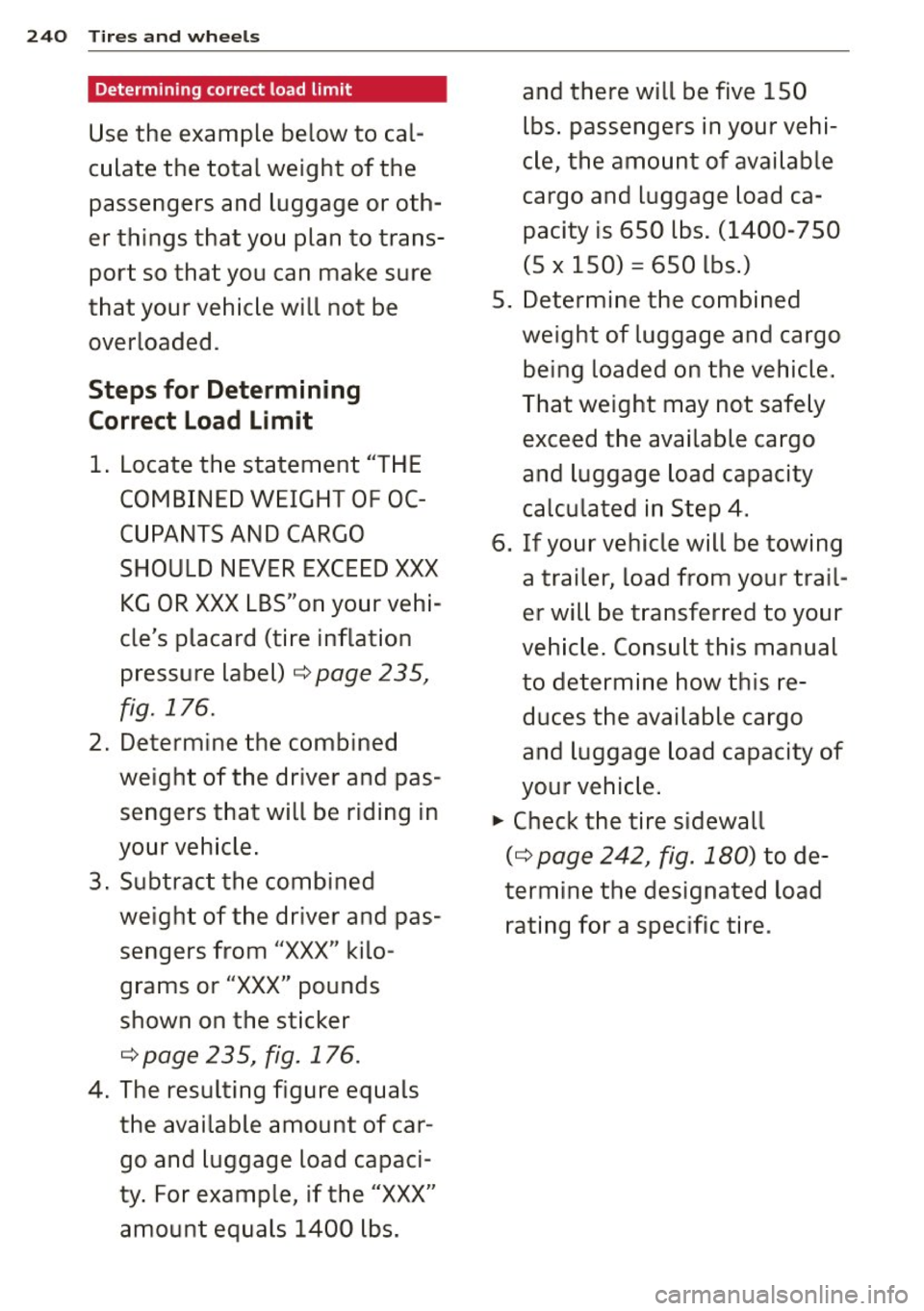
Determining correct load limit
Use the example below to cal
culate the total weight of the
passengers and luggage or oth
er things that you plan to trans
port so that you can make sure
that your vehicle will not be overloaded.
Steps for Determining
Correct Load Lim it
1 . Locate the statement "THE
COMB INED W EIGHT OF OC
CUPANTS AND CARGO
SHOULD NEVER EXCEED XXX KG OR XXX LBS"on your vehi
cle's placard (tire inflation
pressure label)
c::> page 235,
fig. 176.
2.
Determ ine the comb ined
weight of the driver and pas
sengers that will be riding in
your vehicle .
3. Subtract the combined weigh t of the dr iver and pas
sengers from
"XXX " kilo
grams or
"XXX" pounds
shown on the sticker
c::> page 235, fig . 176 .
4. The resulting figure equals
the available amount of cargo and luggage load capaci
ty . F or examp le, if the "XXX"
amount equals 1400 lbs. and there will be five 150
lbs . passengers in your vehi
cle, the amount of available
cargo and luggage load ca pacity is 650 lbs . (1400 -750
(5
X 150) = 650 lbs .)
5 . D etermine the combined
weight of luggage and cargo be ing loaded on the vehicle.
That we ight may not safely
exceed the available cargo
and luggage load capacity
calculated in Step
4 .
6. If your vehicle will be towing
a trailer, load from your trail
er will be transferred to your
vehicle . Consu lt this manual
to determine how this re
duces the available cargo
and luggage load capacity of
your vehic le .
.,. Check the tire sidewall
(c::> page 242, fig. 180) to de
termine the designated load rating for a specific tire .
Page 262 of 294
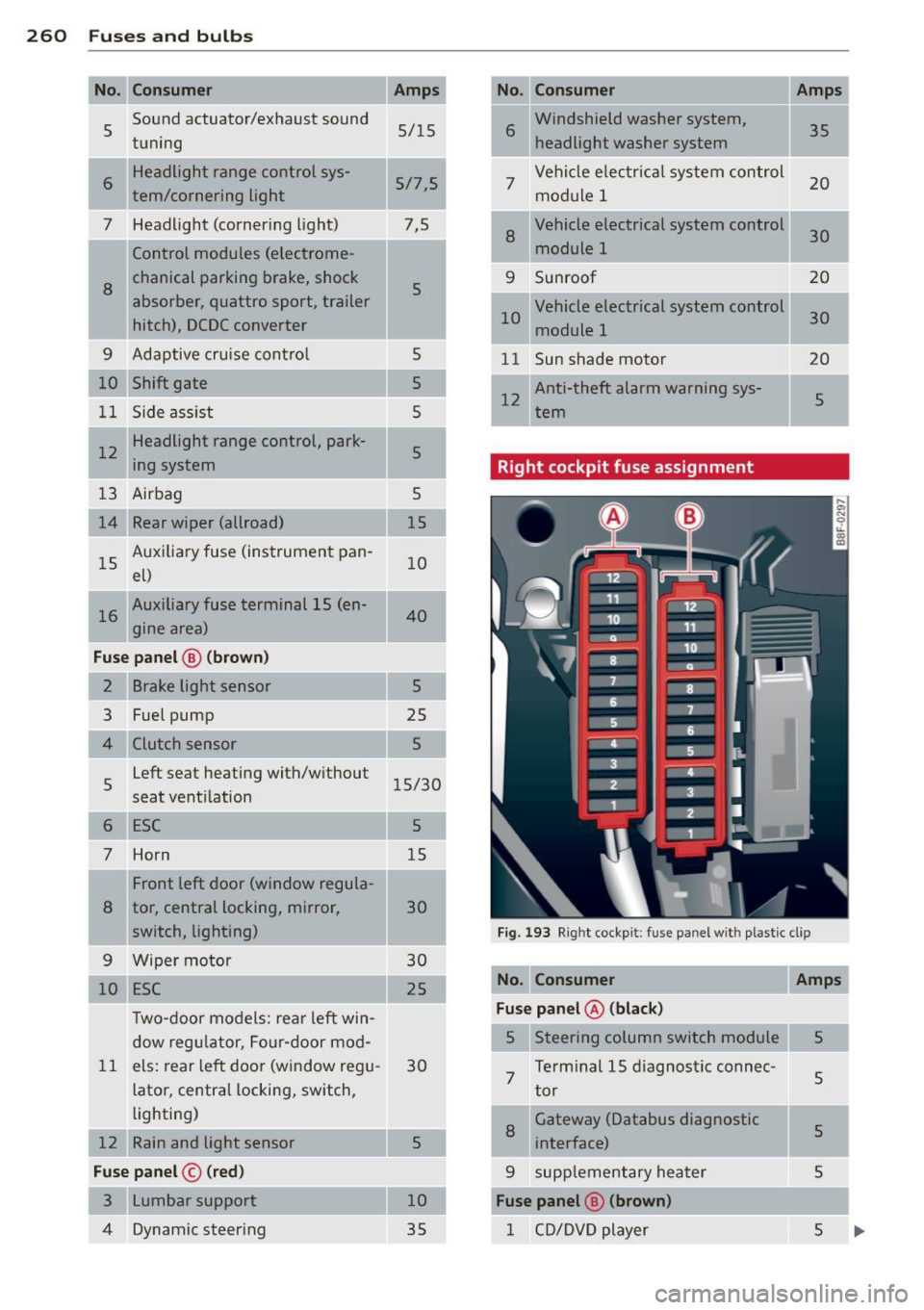
260 Fuses and bulb s
No.
5 Sound actuator/exhaust sound
tuning
6 Headlight range control sys
tem/cornering light
7
8
Headlight (corner ing light)
Control modules (electrome
chanical parking brake, shock
absorber, quattro sport, trailer
hitch), DCDC converter
9 Adaptive cruise contro l
10 Shift gate
1 1 Side ass ist
Headlight range control, park
ing system
13 Airbag
14 Rear wiper (allroad)
15 Auxiliary fuse (instrument pan
el)
1
16
Auxiliary fuse terminal 15 (en
gine area)
Fu se pane l @ (b row n)
2 Brake light sensor
5
6
7
Left seat heating with/w ithout
seat venti lation
ESC Horn
Front left door (window regula-
8 tor, central locking, mirror, switch, lighting)
9 Wiper motor
10 ESC Two-door models: rear left win
dow regulator, Fo ur-door mod-
11 els: rear left door (window regu lator, central locking, switch,
lighting)
12 Rain and light sensor
F u se p anel© (red )
3
4 Dynamic steer ing
Amps
5/15
5/7,5 7,5
5
5
5
5
5
5
15
10
40
5
25
15/30
5
15
30
30
25
30
-No . Consumer Amps
6
Windshield washer system,
35
headlight washer system
7
Vehicle e lectrical system control
20
module 1
8
Vehicle electrical system control
30
module 1
9 Sunroof 20
10 Vehicle electrical system control
30
module
1
11 Sun shade motor 20
-
12 Anti-theft alarm warning sys-
tern 5
Right cockpit fuse assignment
Fig.
193 Right cockpit : fuse panel wit h plastic cl ip
No. Consume r
Fuse pane l@ (black )
..
5 Steering column switch module
7
8
Terminal 15 diagnostic connec
tor
Gateway (Databus diagnostic interface)
9 supp lementary heater
Fuse pan el@ (bro wn)
1 CD/DVD player
Amp s
5
5
5
5
5
•
I
Page 263 of 294
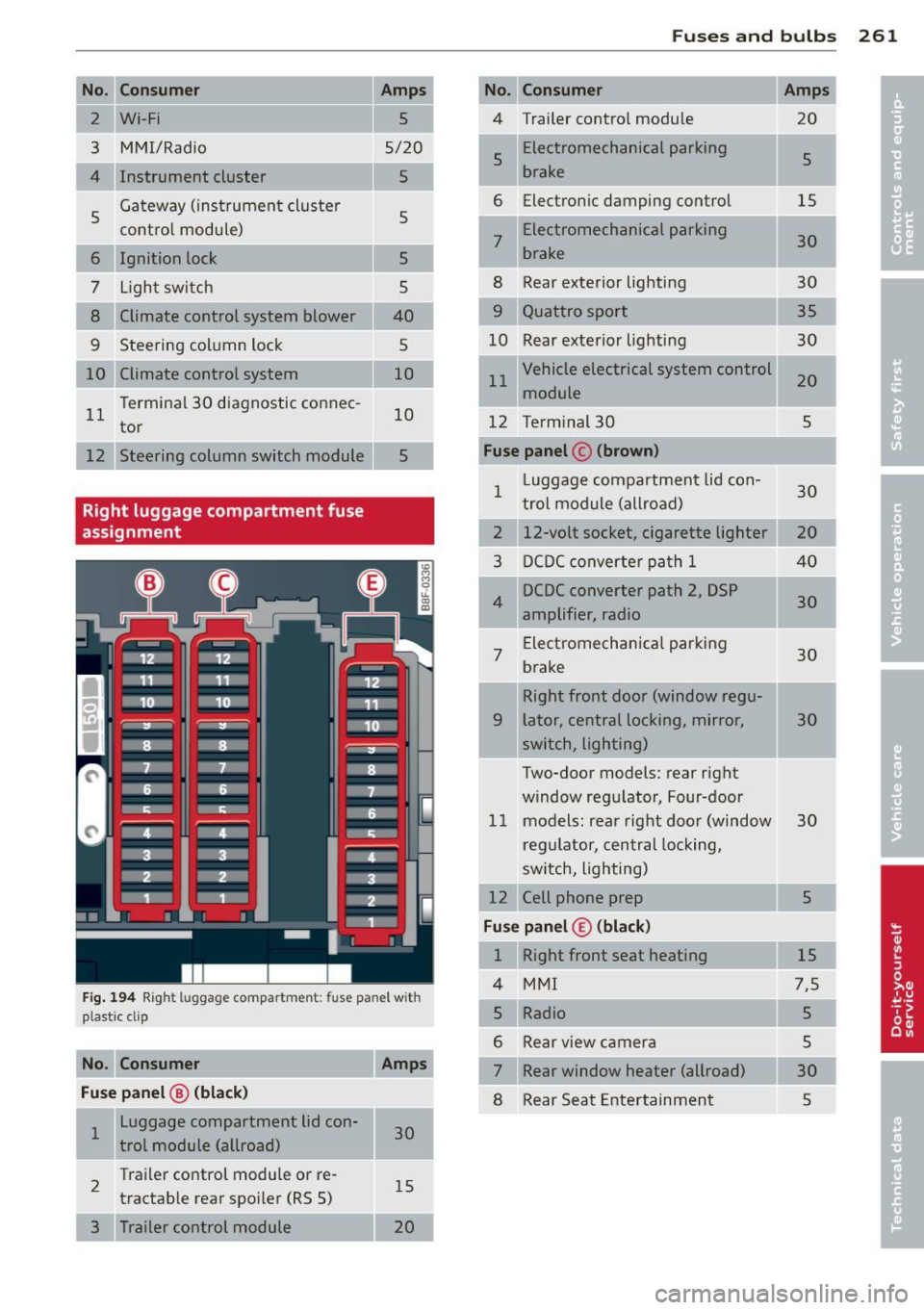
-No. Consumer
2 Wi-Fi
3 MMI/Radio
4 Instrument cluster
Gateway (inst
rument cluster
5 control module)
6 Ignition lock
7 L ight switch
8 Climate control system blower
9 Steering col umn lock
10 Climate control system
11 T
ermina l 30 diagnostic connec-
tor
Steering column switch module
Right luggage compartment fuse
assignment Amps
5
5/20
5
5
5
5
40
5
10
10
5
Fig . 194 Right l uggage compart ment : fuse panel with
plastic d ip
No . Con sumer Amps
Fuse panel @ (black )
1 Luggage compar
tment lid con-
30
trol module (allroad)
2
Trailer control module or re-
15
tractable rear spoiler (RS 5)
3 Tra iler control module 20
Fu se s and bulb s 261
No. Consumer
4 Trailer control module
Electromechanical parking
5 5
brake
6 Electronic damping control
15
Electromechanical parking
7 30
brake
8 Rear exterior lighting 30
9 Quattro sport 35
10 Rear exterior lighting 30
11 Vehicle electrical system control
20
module
12 Te rm inal 30
s
Fuse panel © (brown)
1 L
uggage compartmen t lid con-
30
trol module (all ro ad)
2 12-volt socket, cigarette lighter
20
3 DCDC converte r pa th 1 40
4 DCDC converter path 2, DSP
30
amplifier, radio
7 E
lect romechanical parking
30
b rake
Right front door (window regu-
9 lator, cent ral locking, mir ro r, 30
switch, lighting)
Two-door models: rear right
window regu lator, Four-door
1 1 models : rea r right door (window
30
regulator, central locking,
sw itch, lighting)
Cell phone prep
5
Fu se panel © (black )
1 Right front seat heating
15
4 MMI 7,5
5 Radio
5
6 Rear view c amer a 5
7 Rear window heater (allroad)
30
8 Rear Seat Enter tainmen t 5