door lock AUDI A5 COUPE 2013 Owner's Manual
[x] Cancel search | Manufacturer: AUDI, Model Year: 2013, Model line: A5 COUPE, Model: AUDI A5 COUPE 2013Pages: 294, PDF Size: 73.84 MB
Page 79 of 294
Emergency brake fun ction
An emergency brake ensures that the vehicle
can be slowed down even if the
normal b rakes
fail
c::> page 78, Emergency broking.
Ind icat or light s
-If the par king b rake is closed w ith the igni
t ion
s wit ched on the . (USA models)/
• (Canada models) indicato r lights come
on in the instrument cluster and the switch .
-If the par king brake is closed w ith the igni
tion
s witc hed off the . (USA models)/
• (Canada mode ls) indicator lights come
on in the instrument cluster and the switc h
for about 20 seconds.
A WARNING
If a gear or a drive range (automat ic trans
m ission) is engaged with the vehicle sta
tionary and the engine runn ing, you must
in no instance accelerate or release the
clutch carelessly. Othe rwise the vehicle
w ill sta rt to move immediately- r isk of an
accident.
(D Note
If the . symbol in the display or the
.. (USA models) . (Canada models)
ind icator light in the instr ument cluster
flashes, there is a ma lfunction in the b rake
system. By press ing the
!SETI button, you
can bring up a driver message which ex
plains the malfunction in more detail. If
the driver message
Pa rking brake! ap
pears, there is an operating malfunction in
the parking brake which you should have
repaired immediately by an authorized
Aud i dealer or other q ual ified workshop
c::> poge 15.
(j) Tips
- You can apply the parking brake at any
time -even w ith the ignition switched
off . T he ignit io n must be tu rned on in o r
der to release the parking b rake.
On th e ro ad 77
-Occasional noises when the parking
brake is app lied and released are normal
and are not a cause for concern.
- When the vehicle is pa rked, the park ing
brake goes through a self -test cycle at
regu lar interva ls. Any associated noises
are normal.
Parking
Parking
.,. Press the brake pedal to stop the veh icle .
.,. Pull the button
@ c::> page 76, fig. 78 to set
the parking brake .
.,. Automatic transmission: Move the selector
lever to P.
.,. Tur n the engine off
c::> &_ .
.,. Manual transmiss ion: Shift into 1s t gear.
In addition on inclines and grades
.,. Turn the steering wheel so that your vehicle
w ill roll aga inst the curb in case it shou ld
start to move.
_&. WARNING
- When you leave you r vehicle -even i f on
ly briefly -always remove the ignition
key. This app lies particularly when chil
dren remain in the vehicle. Otherwise the
children could start the eng ine, release
the parking brake or operate electrical
equ ipment (e .g . power windows) . There
is the risk of an acc ident .
- When the veh icle is locked, no one -par
ticularly not childre n should rema in in
the vehicle . Locked doors make it mo re
difficult for emergency wo rke rs to get in
to the vehicle -put ting lives at risk .
Starting from rest
The starting assist function ensures that the
parking broke is released automatically upon starting.
Stopping and applying p arking brake
.,. Pull the switch @ c::> page 76, fig. 78 to ap-
ply the parking brake .
Ill>-
Page 85 of 294
Rocking back and forth to become
un stuck
~ Shi ft on ly between D/S and R when the ve
hicle is at a full stop and the engine is
runn ing at idle speed.
Stopp ing
~ Press and ho ld the brake pedal unti l the ve
hicle has come to a complete stop .
~ Keep the brake pedal depressed so that the
vehicle cannot roll forward or backward
while it is idling¢ .&_.
~ Once stopped, do not depress the accelera-
tor pedal to rev up the engine ¢.&_ .
Pa rking
If the selector lever is not in the P position
when you open the dr iver's door, the vehicle
could ro ll. The message
T ra nsmi ssion: C ar
may roll! Shift to park!
appears.
~ Press and ho ld the brake pedal unti l the ve
hicle has come to a complete stop.
~ Set the parking brake firmly¢ page 77,
Parking.
~ Press and ho ld the release button in these
l ector lever handle, move the selector lever
into P and then let go of the release button
¢ .&_ .
The engine can only be
s tart ed when these
l ecto r lever is in the P o r N posit ions .
On slopes , activate the parking brake first and
the n move the selector lever to the P pos it ion .
This prevents too much stress from being
p laced on the lock ing mecha nism .
_& WARNING
-Unin tended veh icle movement ca n cause
serious injury .
- When the selector lever is in a dr iving
position, the veh icle may creep, even at
id le speed. Therefore do not release
the park ing brake or foo t brake until
you are ready to move, because powe r
is t ransmitted to the whee ls as soon as
a dr iving posit ion is engaged.
Tran sm iss ion 83
-Do not accelerate wh ile selecting a
driv ing position. At this time the en
gine must be at idle speed so that un due stress is not placed on the clutches
i n the transmiss ion.
- Remember: Even when stopped br iefly
with the automatic t ransmission in D/S
o r R, eng ine power is being transmit
ted to the wheels. Your veh icle cou ld
"creep" forward or backwa rd. Whe n
stopped, keep the brake pe dal fu lly de
pressed and use the pa rking brake if
necessary to keep the vehicle from ro ll
ing.
- If the selec to r l ever is unintentionally
moved into N while you are driving, take
your foot off the accelerator peda l and
wait for the eng ine to ret urn to idle
speed before se lecting a dr iv ing pos ition.
- Never sh ift into R or P when the vehicle is
in motion.
- Never get out of the d river's seat when
the eng ine is running.
- If you m ust get out of the vehicle, move
the selector lever secure ly into the P po
sition and apply the parking brake firmly.
- If the engine must remain r unning, neve r
have any driving position engaged when
checking under the hood . Make sure the
selector lever has securely engaged and
is locked in P w it h the par king brake
fi rm ly set¢
page 209, Engine compart
ment.
Othe rwise, any in cr ease in engine
speed may set t he vehi cle in motion,
even with the park ing brake applied .
(D Tips
For safety reasons, the pa rking brake is re
l eased a utomatically o nly when the d riv
er's safety belt is engaged in the buckle.
Page 92 of 294
90 Transmi ssion
When st a tiona ry apply brake ped al while se
lecti ng gear
The se lector lever lo ck only funct ions when
the vehicle is stationary and at speeds up to
3 mph (5 km/h). At higher speeds, the lock is
automatically deactivated i n the N position .
The se lector lever is not loc ked when s hifting
q ui ckly thro ugh N, for examp le from R to D/5.
This makes it possible to free the veh icle when
it is stuck by " rocking" it . The selector lever
l ock engages if the lever stays in N longer
than 1 second when the brake pedal is not pressed.
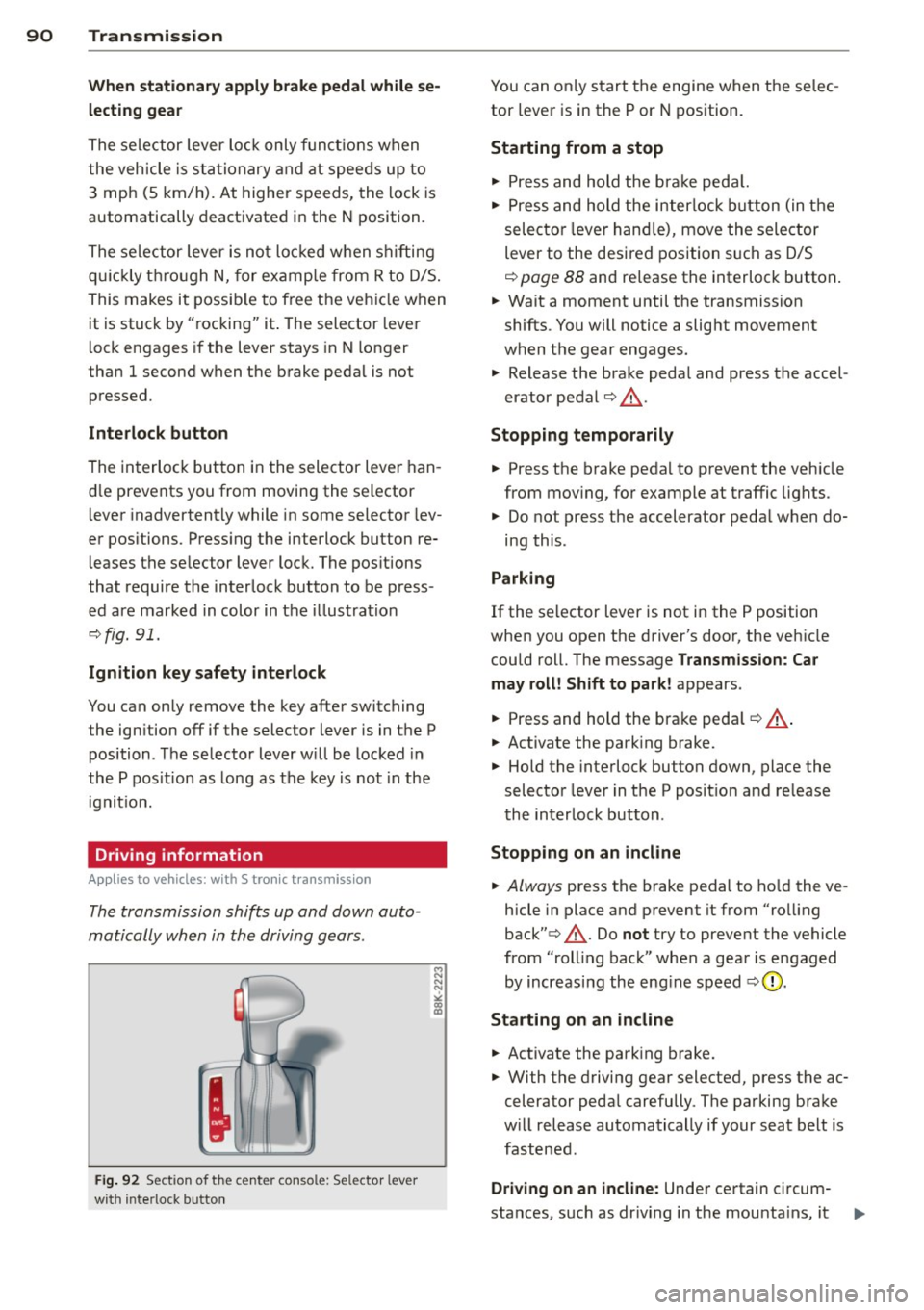
Inte rlock button
The interlock button in the selector lever han
d le prevents you from moving the selector
l ever inadvertently while in some selector lev
er positions. Press ing the interlock button re
leases the se lector lever lock. The pos itions
that require the interlock button to be press
ed are marked in color in the i llustration
~ fig.91.
Ignition key safety inte rlock
You can only remove the key after switching
the ign it ion off if the selec tor lever is in the P
position . T he selector lever w ill be locked in
the P pos ition as long as the key is not in the
ignit io n.
Driving information
App lies to vehicles: with S tronic transmission
The transmission shifts up and down auto
matically when in the driving gears .
Fig. 92 Sect io n of the ce n ter conso le: Sele ctor lev er
w it h inte rlock b utton
M N N N
" CD CD
You can on ly start the engine when the se lec
tor lever is in the P or N position.
Sta rting from a stop
" Press and hold the b ra ke peda l.
.. Press and hold the interlock button (in the
selecto r lever hand le), move the selector
lever to the desired position s uch as D/5
~ page 88 and re lease the interlock button .
.. Wait a moment until the transmission
shifts. You will notice a slight movement
when the gear engages.
.. Release the brake peda l and press the accel
erator pedal¢& .
Stopping t emporarily
.. Press the brake peda l to prevent the veh icle
from mov ing, for example at traffic lights .
.. Do not press the accelerator peda l when do-
ing this .
Parking
If the selector lever is not in the P position
when you open the driver's door, the veh icle
could roll. The message
Transmission : Car
may roll! Shift to park!
appears .
.. Press and hold the brake pedal¢ ,&. .
.. Activate the park ing brake.
.. Hold the interlock button down, place the
selector lever in the P posit ion and re lease
the interlock button .
Stopping on an incline
.. Always press the brake pedal to ho ld the ve
hicle in place and preven t it from "ro lling
back" ¢,&. . Do
not try to prevent the vehicle
from "roll ing back" when a gear is engaged
by increasing the eng ine speed
~ CD .
St arting on an incline
.. Activate the park ing brake .
.. With the driving gear selected, press the ac
celera tor peda l carefully . The parking brake
w ill release automatically if your seat be lt is
fastened .
Driving o n an incline: Under certain c ircum-
sta nces, such as dr iv ing in the mounta ins, it ..,_
Page 133 of 294
-Never transport objects larger than
those fitting completely into the luggage
area because the rear lid cannot be fully
closed.
- If you absolutely must drive with the rear
lid open, observe the following notes to
reduce the risk of poisoning:
- Close all windows,
- Close the sunroof,
- Open all air outlets in the instrument
panel,
- Switch off the air recirculation,
- Set the fresh air fan to the highest
speed .
A WARNING
Always make sure that the doors, all win
dows, the sunroof and the rear lid are se
curely closed and locked to reduce the risk
of injury when the vehicle is not being
used.
- After closing the rear lid, always make
sure that it is properly closed and locked.
- Never leave your vehicle unattended es
pecially with the rear lid left open. A
child could crawl into the vehicle through
the luggage compartment and close the
rear lid becoming trapped and unable to
get out. Being trapped in a vehicle can
lead to serious personal injury.
- Never let children play in or around the
vehicle.
- Never let passengers ride in the luggage
compartment . Vehicle occupants must
always be properly restrained in one of
the vehicle's seating positions.
@ Tips
- Air circulation helps to reduce window fogging. Stale air escapes to the outside
through vents in the trim panel. Be sure
to keep these slots free and open.
- The tire pressure must correspond to the
load. The tire pressure is shown on the
tire pressure label. The tire pressure la bel is located on the driver's side B-pillar.
The tire pressure label lists the recom-
-
Driving Safely 131
mended cold tire inflation pressures for
the vehicle at its maximum capacity
weight and the tires that were on your
vehicle at the time it was manufactured.
For recommended tire pressures for nor
mal load conditions, please see chapter
r::> page235 .
Tie-downs
The luggage compartmen t is equipped with
four tie -downs to secure luggage and other
items .
Use the tie-downs to secure your cargo prop
erly
r::> page 130, Loading the luggage com
partment .
In a collision, the laws of physics mean that
even smaller items that are loose in the vehi
cle will become heavy missiles that can cause
serious injury. Items in the vehicle possess en
ergy which vary with vehicle speed and the
weight of the item. Vehicle speed is the most
significant factor.
For example, in a frontal collision at a speed
of 30 mph (48 km/h), the forces acting on a
10-lb (4.5 kg) object are about 20 times the
normal weight of the item . This means that
the weight of the item would suddenly be about 200 lbs . (90 kg). You can imagine the
injuries that a 200 lbs. (90 kg) item flying
freely through the passenger compartment
could cause in a collision like this.
A WARNING
Weak, damaged or improper straps used
to secure items to tie-downs can fail dur
ing hard braking or in a collision and cause
serious personal injury.
-Always use suitable mounting straps and
properly secure items to the tie-downs in
the luggage compartment to help pre
vent items from shifting or flying for
ward as dangerous missiles.
- When the rear seat backrest is folded
down , always use suitable mounting
straps and properly secure items to the
tie-downs in the luggage compartment
•
•
Page 156 of 294
154 Airbag sys te m
If the front passenger seat is not occupied,
the front airbag will not deploy, and the
PAS
SENGER AIR BAG OF F
light wi ll stay on. Nev
er install a rearward-fac ing ch ild restra int on
the front passenger seat, the safest place fo r
a child in any kind of child restraint is at one
of the seat ing positions on the rear seat
¢ page 143, Child restraints on the front seat
- some important things to know
and
¢ page 166, Child Safety.
If th e PASSEN GER AI R BAG OFF light c ome s
on
when one of the conditions listed above is
met, be sure to check the light regular ly to
make certa in that the
PAS SENGER AIR BA G
O FF
light stays on cont inuous ly whenever the
ignition is on. If the
PASSENGER AIR BAG
OFF
li ght does not appear and not stay on all
the time, stop as soon as it is safe to do so
and
- reactivate the system by turning the ignition off and then turning it on again;
- remove and re install the child restraint.
Make sure that the child restraint is properly
installed and that the safety belt for the
front passenger seat has been correctly routed around the child restraint as descr i
bed in the child restraint manufacturer's i n
structions;
- make sure that the convertible locking fea
ture on the safety belt for the front passen
ger seat has been activated and that the
safety belt has been pulled tight. The belt
must not be loose o r have loops of slack so
that the senso r below the safety be lt latch
on the seat can do its job
¢ page 176 .
-make su re that th ings that may increase the
weight of the ch ild and child safety seat are
not being transpo rted on the front passen
ger seat;
- make su re that the safety belt tension sen
sor is not b locked. Shake the safety be lt
l atch on the front passenger seat back and
forth;
- If a strap or tether is being used to tie the
child safety seat to the front passenger
seat, make sure that it is not so tight that it causes the weight
-sensing mat to measure
more weight than is act ually on the seat.
If th e PASSENGER AIR BAG OFF lig ht still
does not come on
and does not s tay on con
t in uous ly (when the ignition is switched on) ,
- take the child restraint off the front passen-
ge r seat and install it properly at one of the
rea r seat posi tions. H ave the airbag system
inspected by yo ur authorized Audi dealer
immediate ly .
- move the child to a rear seat position and
make sure t hat the c hild is properly restrain
ed in a c hild restraint that is appropriate for
its size and age.
T he
PAS SENGER AIR BAG OFF light should
NOT come on when t he ignition is on and an
adult is sitting in a proper seating position on
the front passenger seat. If the
PA SSENGER
AIR BAG OFF
light comes on and stays on or
flashes for about 5 seconds wh ile driving, un
der these c ircumstances, make sure that:
- the adult on the front passenger seat is properly seated on the center of the seat
cushion with his or her back up aga inst the
backrest and the backrest is not recl ined
¢ page 125, Proper occupant seating posi
tions,
- the adult is not tak ing weight off the seat by
holding on to the passenger assist handle
above the front passenger door or support
ing their weight on the armrest,
- the safety belt is being properly wo rn and
t ha t the re is no t a lot of s lack in the safety
be lt webb ing ,
- accesso ry seat covers or cushions or other
t hings tha t may cause an incorrect reading
or impression on the weight-sensing mat
under the upho lstery of the seat have been
removed from the front passenger seat,
- a safety belt extender has not been left in
the safety belt latch for the front passenger
seat.
In add ition to the
PASSENGER AIR BAG OFF
light in the center o f the instrument panel,
t h e message
PASSENGER AIR BAG OFF or
PASSENGER AIR BAG ON wi ll briefly appear ..,.
Page 174 of 294
17 2 Child Safety
Child safety seats
Infant seats
Babies and infants up to about one year old
and 20 lbs. or 9 kg need special rearward-fac
ing child restraints that support the back,
neck and head in a crash.
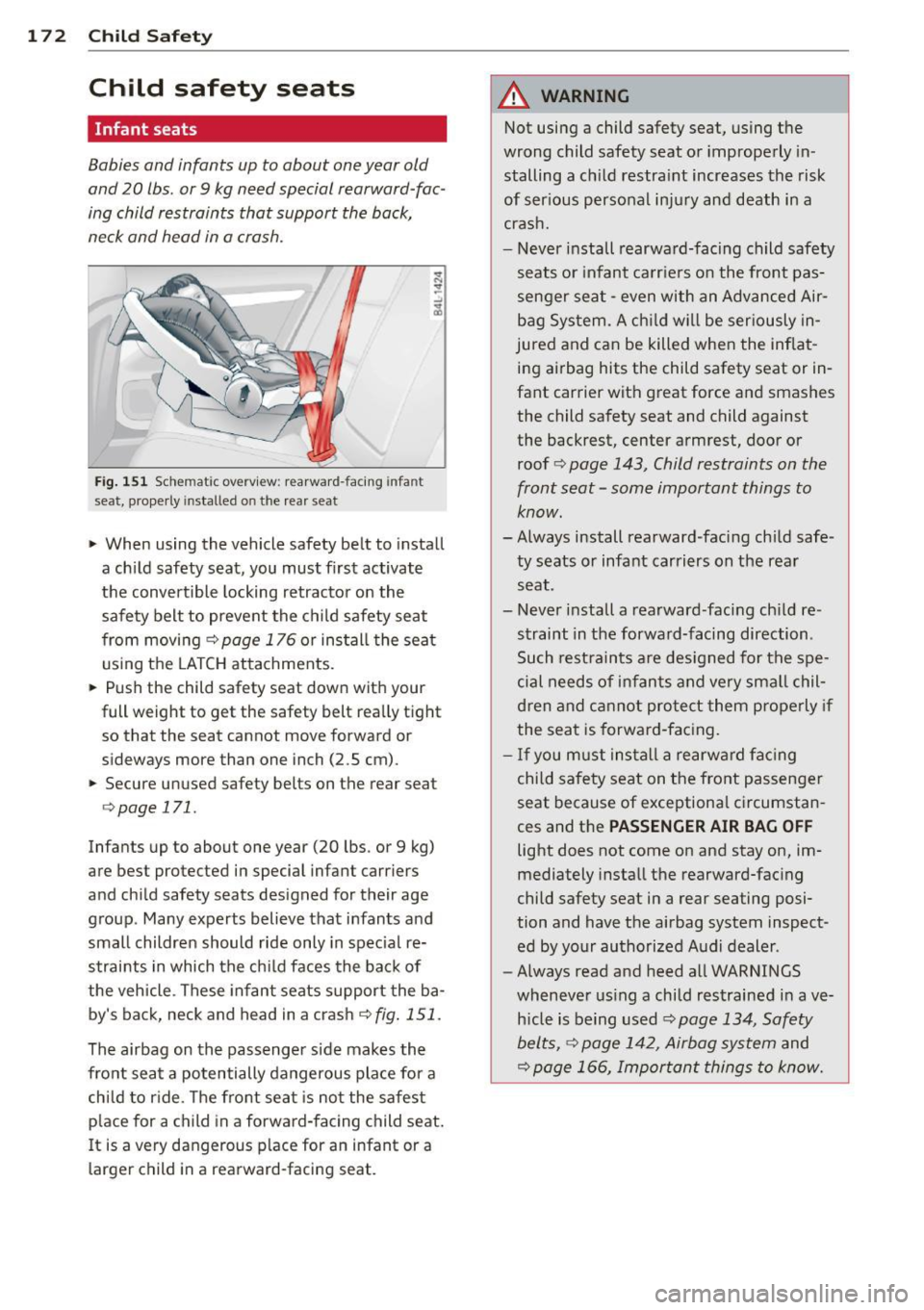
-- /
Fig . 151 Schematic overv iew: rearwa rd -fac ing infant
seat, properly installed on the rear seat
> When using the vehicle safety belt to install
a ch ild safety seat, you must first activate
the convertible locking retractor on the
safety belt to prevent the child safety seat
from moving ¢
page 176 or install the seat
using the LATCH attachments .
> Push the child safety seat down with your
full weight to get the safety belt really tight
so that the seat cannot move forward or
s idew ays more than one inch (2.5 cm).
> Secure unused safety belts on the rear seat
¢page 171.
Infants up to about one year (20 lbs. or 9 kg)
are best protected in special infant carriers
and child safety seats designed for their age
group . Many experts believe that infants and
small children should ride only in spec ial re
straints in which the chi ld faces the back of
the vehicle . These infant seats support the ba
by's back, neck and head in a crash¢
fig. 151 .
The airbag on the passenger side makes the
front seat a potentially dangerous place for a
child to ride . The front seat is not the safest
p lace for a child in a forwa rd-facing child seat.
I t is a very dangerous p lace for an infant or a
larger child in a rearward-facing seat.
A WARNING
-Not using a child safety seat, using the
wrong child safety seat or improperly in
stalling a ch ild restra int increases the risk
of ser ious personal injury and death in a
crash.
- Never install rearward-facing child safety
seats or infant ca rr ie rs on the front pas
senger seat -even with an Advanced Air
bag System. A child will be ser iously in
jured and can be killed whe n the inflat
ing airbag hits the child safety seat or in
fant carrier with great force and smashes the child safety seat and child against
the backrest, center armrest, door or roof¢
page 143, Child restraints on the
front seat -some important things to
know.
- Always install rearward-facing ch ild safe
ty seats or infant carriers on the rear seat.
- Never install a rearward-facing ch ild re
straint in the forward-facing direction .
Such rest ra ints are designed for the spe
cial needs of infants and very smal l chil
dren and cannot protect them properly if
the seat is forward-facing.
-If you must install a rearward facing
chi ld safety seat on the front passenger
seat because of exceptiona l circumstan
ces and the
PASSENGER AIR BAG OFF
light does not come on and stay on, im
mediately install the rearward-fac ing
child safety seat in a rear seating posi
tion and have the airbag system inspect
ed by your authorized Aud i dealer .
- Always read and heed all WARNINGS
whenever using a child restrained in ave
h icle is being used
¢page 134, Safety
belts,
¢ page 142, Airbag system and
¢ page 166, Important things to know.
Page 175 of 294
Convertible child safety seats
Properly used convertible child safety seats
can help protect toddlers and children over
age one who weigh between 20 and 40 lbs. (9
and 18 kg) in a crash.
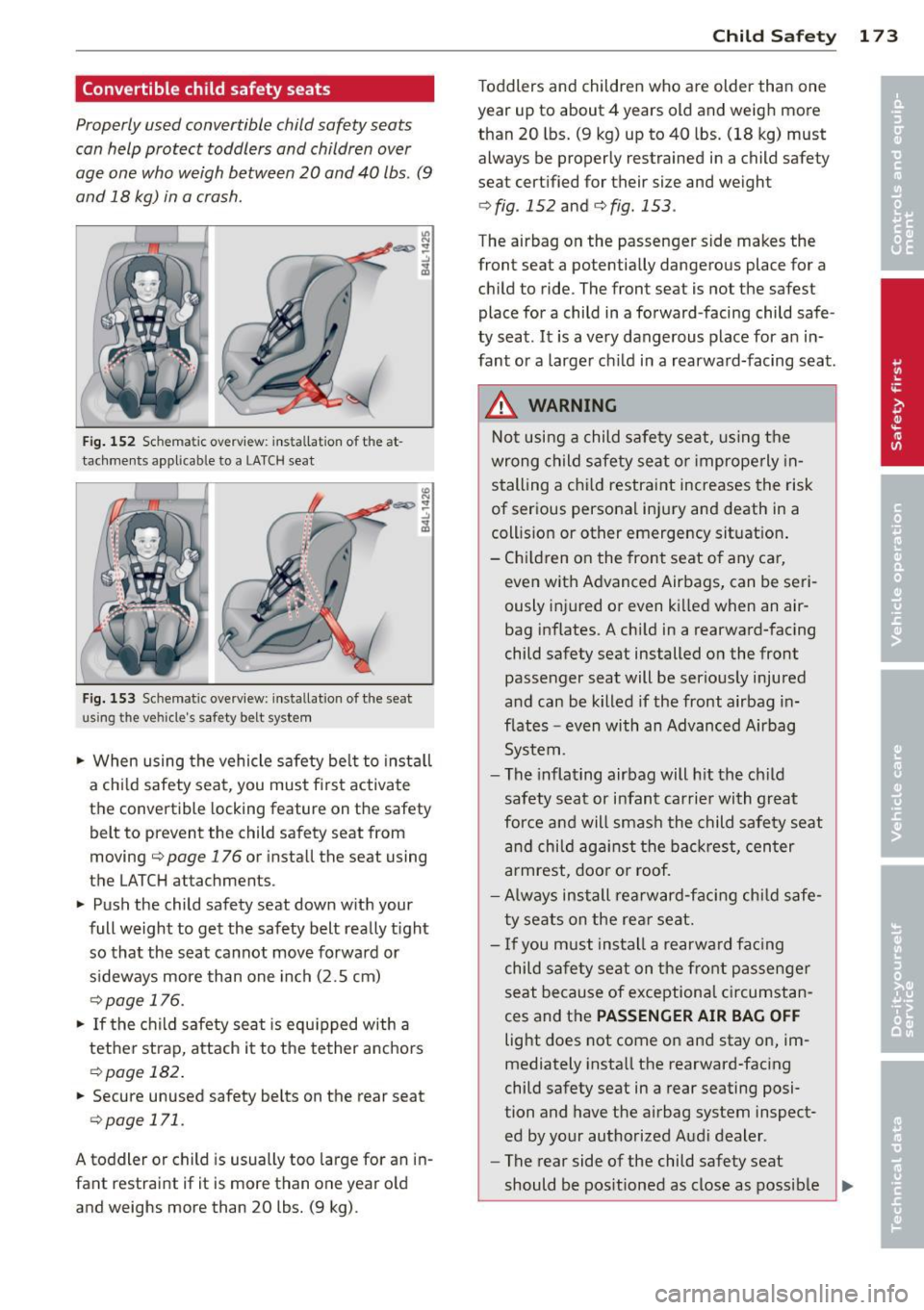
Fig. 152 Schematic overview: installat ion of the at
tachments applicable to a LATCH seat
F ig. 153 Schematic overview: installation of the seat
using the vehicle's safety belt system
.. When using the vehicle safety be lt to insta ll
a chi ld safety seat, you must f irst activate
the convertible locking feature on the safety
belt to prevent the child safety seat from
moving
c::>page 176 or install the seat using
the LATCH attachments.
.,. Push the child safety seat down w ith your
full weight to get the safety belt really t ight
so that the seat cannot move forward or
s ideways more than one inch (2.5 cm)
c:;, page 176.
.,. If the child safety seat is equ ipped with a
tether strap, attach it to the tether anchors
c:;, page 182 .
.. Secure unused safety belts on the rear seat
c:;, page 171.
A toddler or child is usually too large for an in
fant restraint if it is more than one year o ld
and weighs more than 20 lbs. (9 kg). Child Safety 173
Toddlers and children who are older than one
year up to about 4 years old and weigh more
than 20 lbs. (9 kg) up to 40 lbs. (18 kg) must
always be properly restrained in a child safety
seat cert ified for their size and weight
c::>fig . 152 and c::>fig. 153.
The airbag on the passenger side makes the
front seat a potentially dangerous place for a
child to ride. The front seat is not the safest place for a child in a forward-facing child safe
ty seat.
It is a very dangerous place for a n in
fant or a large r ch ild in a rearward-facing seat .
.&_ WARNING
Not using a child safety seat, using the
wrong child safety seat or imprope rly in
stalling a chi ld restraint increases the risk
of serious personal injury and death in a
collision or other emergency situation .
- Ch ildren on the front seat of any car,
even with Advanced Airbags, can be seri
ously injured or even killed when an air bag inflates. A child in a rearward-facing
child safety seat installed on the front passenger seat will be serious ly injured
and can be killed if the front airbag in
flates -even with an Advanced Airbag
System .
- The inflating airbag will hit the child
safety seat or infant carrier with great
force and will smash the child safety seat
and child against the backrest, center
armrest, door or roof.
- Always install rearward-f acing child safe
ty seats on the rear seat.
- If you must install a rearward facing
child safety seat on the front passenger
seat because of exceptional circumstan
ces and t he
PASSENGER AIR BAG OFF
light does not come on and stay on, im
mediately install the rearward-fac ing
child safety seat in a rear seating posi
tion and have the airbag system inspect
ed by your authorized Audi dealer.
- The rear side of the child safety seat
should be positioned as close as possible
~
Page 203 of 294
Automatic car wash
The vehicle can be washed in almost any
modern automatic car wash .
The vehicle paint is so durable that the vehicle
can normally be washed without problems in
an automatic car wash. However, the effect on
the paint depends to a large extent on the de
sig n of the fac ility, the filte ring of the wash
water, the type of wash and care mater ial , etc.
If the paint has a dull appearance afte r go ing
through the car wash or is scratched, bring
this to the attention of the operator immedi
ately. If necessary, use a different car wash.
Before going through a ca r wash, be s ure to
take the usual precautions such as closing the
windows and the roof . Factory installed an
tennas must not be removed.
If you have installed additional accessories on
the vehicle -such as spoilers, roof rack, etc. -
it is best to ask the car was h operator if these
should be removed .
A WARNING
Always read and heed a ll WARNINGS and
other information
¢ page 200.
(D Note
Before washing the vehicle in an automatic
car wash, p lease make sure to retract the
exterior m irrors to prevent them from be
ing damaged.
Washing the vehicle by hand
A lot of water is needed when washing a vehi
cle by hand.
~ Before you start washing, make sure yo u
have read and understood the WARNINGS
¢ A in General information on page 200 .
~ First soak all dried dirt until it is soft, then
rinse it off .
~ As you clean your veh icle, start with the
roof and work your way down to the bottom,
us ing a sponge , a sponge glove o r a clean
brush.
Cleaning and protec tion 20 1
~ Rinse the sponge or the sponge g love often,
flushing it clean eac h time .
~ Use spec ia l car shampoo only for very per
sistent d irt .
~ Rinse the car thoroughly with water.
~ Use a chamois leather to gently w ipe the ex-
ter ior d ry .
U se a separate sponge for cleaning the
whee ls, door sills and other regions exposed
to road dirt . In this way, you w ill not scratch
the pa int wit h coarse particles imbedded in
the sponge the next time you wash the car.
&_ WARNING
- Do not clean the underside of the chas
sis, fenders, wheel covers, or o ther ha rd
to reach pa rts without protect ing you r
hands and arms. You may cut yourself on
sharp-edged metal parts .
-Always read and heed a ll WARNINGS and
other information
¢ page 200.
(D Note
- N ever try to remove dirt, mud or dust if
the s urface o f the veh icle is dry . Never
use a dry cloth or sponge, since this
co uld scratch your vehicle's paint or win
dows.
- Never wash your car in bright s unlight .
Drops of wate r act as magnifying lenses
and may damage yo ur paint .
- When you wash yo ur car in the winter: if
you rinse yo ur vehicle with a hose, be
careful not to aim the stream of water
directly at locks, or at door or hatch
openings -they can freeze shut .
- Never use sponges designed to
remove
insects, or any k itche n scou ring sponges
or s imilar products. They can damage
your paint finish .
- You should remove debris (such as in
sects) from the headlight lenses on a
regu lar bas is, for exampl e w hen refuel
ing your veh icle . Never use a dry cloth o r
sponge to clean t he headlights. On ly use
wet cloths o r sponges to prevent
scratches. It is best to use soapy water.
-
•
•
Page 216 of 294
214 Fuel supply and filling your fuel tank
Refuelling procedure
.. Inse rt the fue l nozzle from the gasol ine
pump into the fue l filler neck as far as it will
go.
.. Select a m edium refu elling rate so that the
no zzle switches
off automatica lly when the
tank is full.
Putting the fuel cap back on
.. After filling your tank, twist the fuel cap
clockwise as far as it will go.
.. Close the fuel filler flap.
To avoid fuel spi lling or evaporating from the
fuel tank always close fuel cap properly and
comp letely.
A WARNING
Improper refueling or handling of fue l can
cause fire, explosion and severe burns.
- Fuel is highly f lammable and can cause
severe burns and other injuries.
- Failure to shut the engine
off while refu
eling and/or to insert the pump nozzle
fully into the fuel filler neck could cause
fuel to spray out of filler neck or to over
flow. Fuel spray and overflow ing fuel can
cause a fire .
- Never use a cellular telephone while re
fueling . The electromagnetic radiation
can cause sparks that can ignite fue l va
pors and cause a fire.
- Never get back into your vehicle while re
fueling. If in exceptiona l circumstances
you must get back in your vehicle wh ile
refue ling, make certa in that you close
the door and touch metal to discharge
static electricity before touching the fill
er nozzle again . Static electricity can
cause sparks that can ignite fuel vapors
released during refueling.
- Never smoke or have an open flame any
where in or near your vehicle when refu
eling or filling a portable fuel container.
- For your safety, we strongly recommend that you do not travel w ith a portable
fuel container in your vehicle. The con- tainer, fu
ll or empty may leak and could
cause a fire, especially in a crash .
- If, under exceptional circumstances, you
must transport a portab le fuel container,
please observe the following:
- Never fill a portable fuel container
wh ile it is anywhere in or on the vehicle
(for example, in the luggage compart
ment, or on the trunk) . Static electrici
ty can build up while filling and can ig
nite fue l vapors causing a fire .
-Always place a portab le fue l container
on the ground before filling .
- Always keep the filler nozzle complete
ly inside the portable container before
and during filling.
- If filling a portab le container made of
metal, the filler nozzle must always be
in contact with the container. This will
help prevent static electricity from dis
charging and cause a fire.
- Never spill fuel inside the vehicle or luggage compartment . Fuel vapors are
highly flammable .
- Always observe local and state/provin
c ial laws regarding the use, storage
and transportation of fuel containers .
- Make certain the fuel container meets
industry standards (ANSI/ ASTM
F852-86) .
(D Note
If any fuel has spi lled onto the car, it
should be removed immediately to prevent
damage to the paint.
@) For the sake of the environment
As soon as the correct ly operated nozzle
switches
off automat ically for the first
time, the tank is full. Do not try to add
more fuel because fuel may spill out . In
addition, the expansion space in the fuel
tank wi ll be filled -causing the fuel to
overflow when it becomes warm and pol
lute the environment.
Page 217 of 294
@ Tips
-Running yo ur engine while refuelling
may cause vapors to escape or even
cause fue l to spill out of the tank. This
would then shut off the fuel nozzle be
fore the tank is full.
- Do not refuel your veh icle w ith the igni
tion turned on . The fuel gauge may oth
erwise not ind icate the correct fue l level
after refuelling .
- The fuel filler flap of your vehicle is not
l ocked when you lock the vehicle from
the i nside.
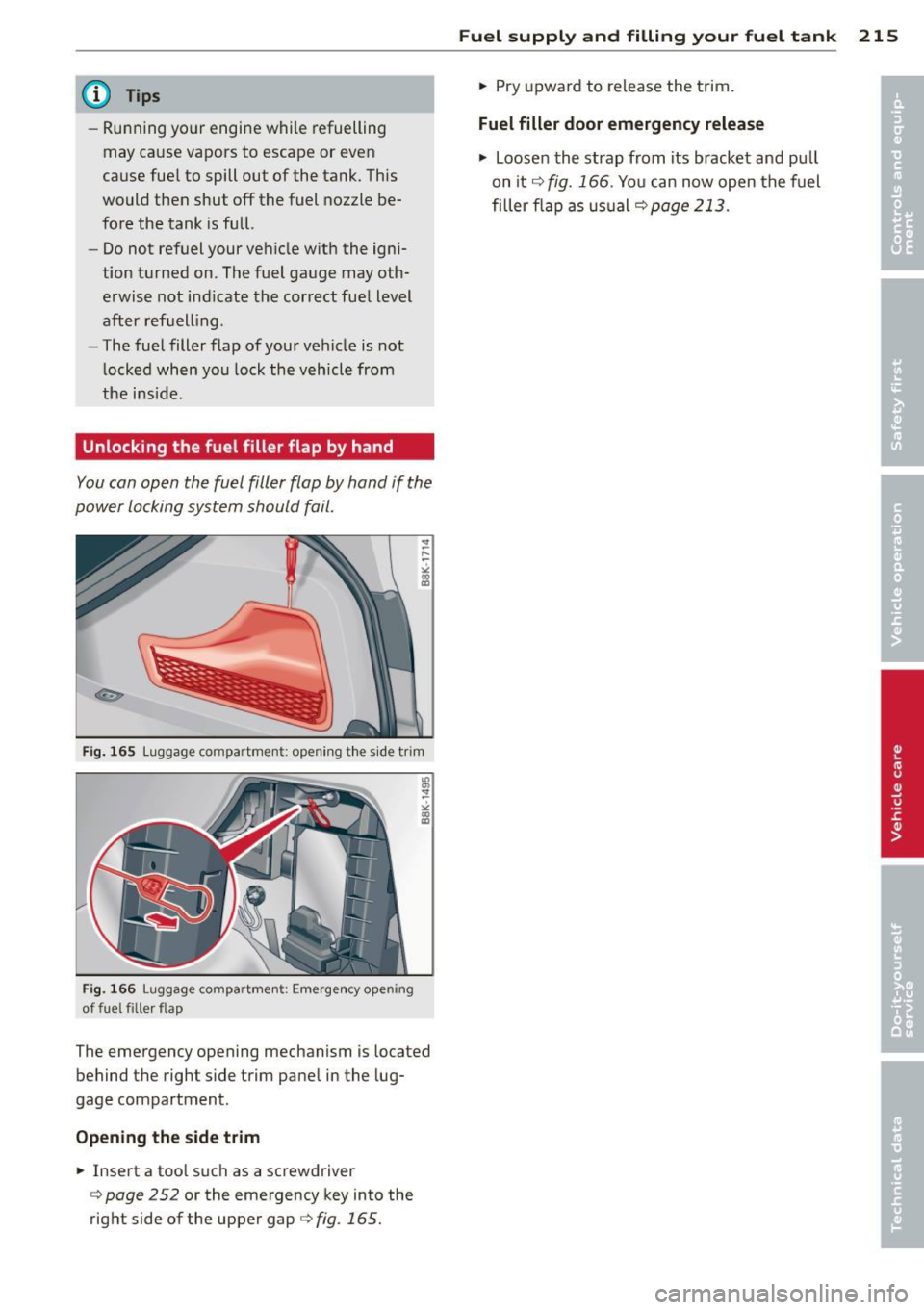
Unlocking the fuel filler flap by hand
You can open the fuel filler flap by hand if the
power locking system should fail.
F ig. 1 65 Luggage co mpartme nt: open ing t he side trim
Fi g. 166 Luggage co mpa rt m ent : E m erge ncy ope ning
of fuel fill er flap
The emergency opening mechanism is located
behind the right side trim pane l in the lug
gage compartment .
Opening the side trim
.. Insert a too l such as a screwdriver
¢
page 252 or the emergency key into the
rig ht side of the upper gap ¢
fig. 165.
Fuel suppl y and filli ng your fuel t ank 215
.. Pry upward to release the trim .
Fuel filler door emergency release
.. Loosen the strap from its bracket and pu ll
on it ¢
fig. 166. You can now open the fuel
filler f lap as usual ¢
page 213.