flat tire AUDI A5 COUPE 2013 Owners Manual
[x] Cancel search | Manufacturer: AUDI, Model Year: 2013, Model line: A5 COUPE, Model: AUDI A5 COUPE 2013Pages: 294, PDF Size: 73.84 MB
Page 133 of 294
-Never transport objects larger than
those fitting completely into the luggage
area because the rear lid cannot be fully
closed.
- If you absolutely must drive with the rear
lid open, observe the following notes to
reduce the risk of poisoning:
- Close all windows,
- Close the sunroof,
- Open all air outlets in the instrument
panel,
- Switch off the air recirculation,
- Set the fresh air fan to the highest
speed .
A WARNING
Always make sure that the doors, all win
dows, the sunroof and the rear lid are se
curely closed and locked to reduce the risk
of injury when the vehicle is not being
used.
- After closing the rear lid, always make
sure that it is properly closed and locked.
- Never leave your vehicle unattended es
pecially with the rear lid left open. A
child could crawl into the vehicle through
the luggage compartment and close the
rear lid becoming trapped and unable to
get out. Being trapped in a vehicle can
lead to serious personal injury.
- Never let children play in or around the
vehicle.
- Never let passengers ride in the luggage
compartment . Vehicle occupants must
always be properly restrained in one of
the vehicle's seating positions.
@ Tips
- Air circulation helps to reduce window fogging. Stale air escapes to the outside
through vents in the trim panel. Be sure
to keep these slots free and open.
- The tire pressure must correspond to the
load. The tire pressure is shown on the
tire pressure label. The tire pressure la bel is located on the driver's side B-pillar.
The tire pressure label lists the recom-
-
Driving Safely 131
mended cold tire inflation pressures for
the vehicle at its maximum capacity
weight and the tires that were on your
vehicle at the time it was manufactured.
For recommended tire pressures for nor
mal load conditions, please see chapter
r::> page235 .
Tie-downs
The luggage compartmen t is equipped with
four tie -downs to secure luggage and other
items .
Use the tie-downs to secure your cargo prop
erly
r::> page 130, Loading the luggage com
partment .
In a collision, the laws of physics mean that
even smaller items that are loose in the vehi
cle will become heavy missiles that can cause
serious injury. Items in the vehicle possess en
ergy which vary with vehicle speed and the
weight of the item. Vehicle speed is the most
significant factor.
For example, in a frontal collision at a speed
of 30 mph (48 km/h), the forces acting on a
10-lb (4.5 kg) object are about 20 times the
normal weight of the item . This means that
the weight of the item would suddenly be about 200 lbs . (90 kg). You can imagine the
injuries that a 200 lbs. (90 kg) item flying
freely through the passenger compartment
could cause in a collision like this.
A WARNING
Weak, damaged or improper straps used
to secure items to tie-downs can fail dur
ing hard braking or in a collision and cause
serious personal injury.
-Always use suitable mounting straps and
properly secure items to the tie-downs in
the luggage compartment to help pre
vent items from shifting or flying for
ward as dangerous missiles.
- When the rear seat backrest is folded
down , always use suitable mounting
straps and properly secure items to the
tie-downs in the luggage compartment
•
•
Page 159 of 294
dealer is familiar with these requirements
and we recommend that you have your
dealer perform this service for you.
Other things that can affect Advanced
Airbag performance
Changing the vehicle's suspension system can
change the way that the Advanced Airbag Sys
tem performs in a crash. For example, using
tire-r im combinations not approved by Audi,
lowering the vehicle, changing the stiffness of
the suspension, including the springs, suspen
sion struts, shock absorbers etc. can change
the forces that are measured by the airbag sensors and sent to the electronic control
unit. Some suspension changes can, for exam
ple, increase the force levels measured by the
sensors and make the airbag system deploy in
crashes in which it would not deploy if the
changes had not been made . Other kinds of
changes may reduce the force levels meas
ured by the sensors and prevent the airbag
from deploying when it should .
The sensors in the safety belt buckle for the
d river and front passenger seat tell the elec
tronic control module if the safety belt is
latched or not. If the safety belt is being used,
the front airbag will deploy at a slightly high
er rate of vehicle deceleration than if the safe
ty belt is not being used. Therefore, in a par
ticular collision, it is possible that an airbag
will not deploy at a seating position where the safety belt is being used but will inflate at the
position where the safety belt is not being
used. It is important that nothing interfere
with the safety belt buckles so that the sen
sors can send the correct information about
safety belt use to the electronic control unit.
.&_ WARNING
Changing the vehicle 's suspension includ
ing use of unapproved tire-rim combina
tions can change Advanced Airbag per
formance and increase the risk of serious personal injury in a crash.
- Never install suspension components
that do not have the same performance
Airbag system 157
characteristics as the components origi
nally installed on your vehicle .
- Never use tire-rim combinations that
have not been approved by Audi.
.&_ WARNING
= -
Items stored between the safety belt buckle and the center console can cause
the sensors in the buckle to send the
wrong information to the electronic con
trol module and prevent the Advanced Air bag System from working properly.
-Always make sure that nothing can inter-
fere with the safety belt buckles and that
they are not obstructed.
Knee airbags
Description of knee airbags
Applies to vehicles: wit h knee airbags
The knee airbag system can provide supple
mental protection to properly restrained
front seat occupants.
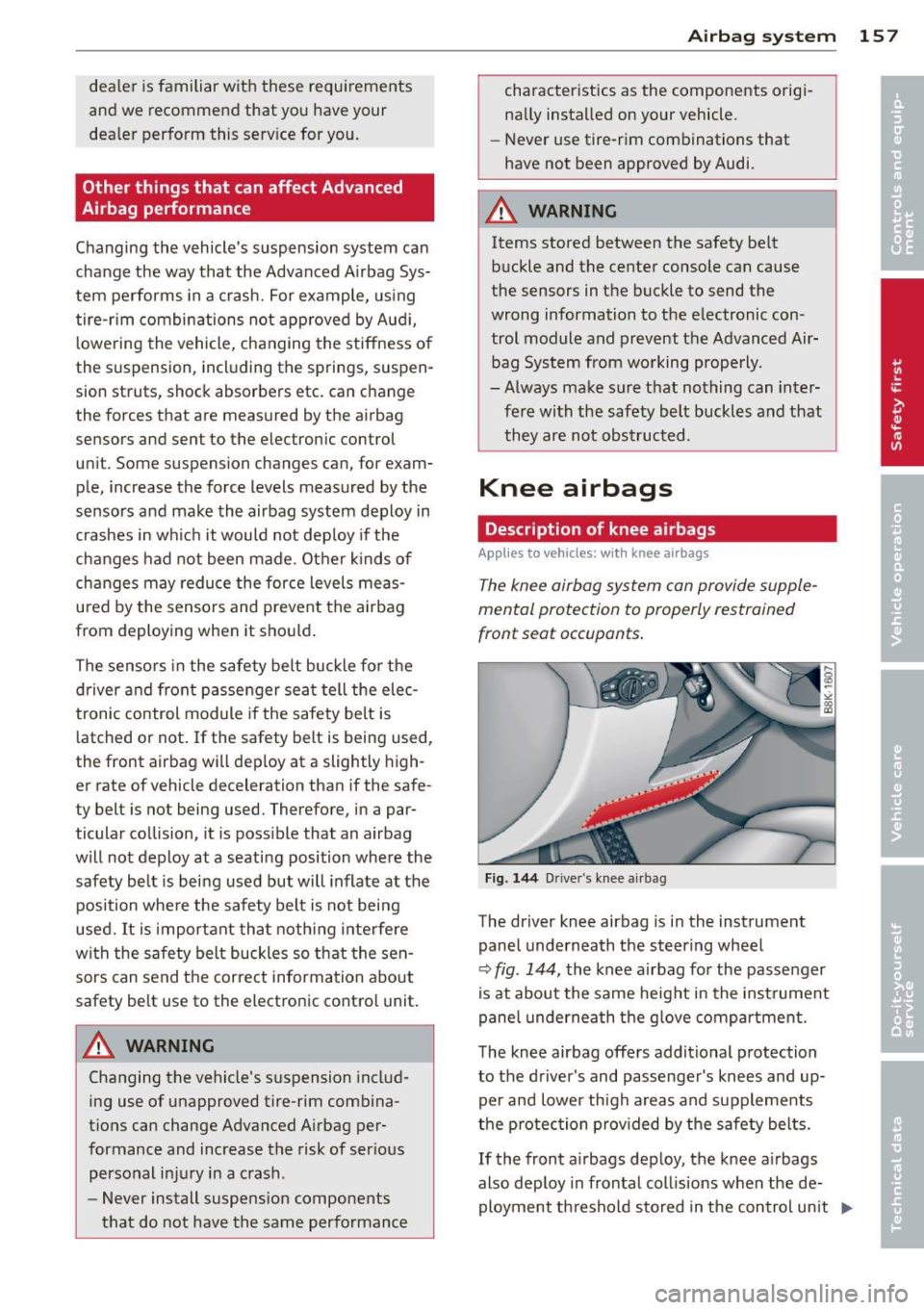
Fig. 144 Driver 's knee airbag
The driver knee airbag is in the instrument
panel underneath the steering wheel
Q fig . 144, the knee airbag for the passenger
is at about the same height in the instrument
panel underneath the glove compartment .
The knee airbag offers additional protection
to the driver's and passenger's knees and up
per and lower thigh areas and supplements
the protection provided by the safety belts.
If the front airbags deploy, the knee airbags
also deploy in frontal collisions when the de ployment threshold stored in the control unit
I),-
Page 200 of 294
198 Trailer towing
Tire pre ss ure
When towing a trai le r, inflate the t ires of your
vehicle to the co ld tire pressure listed under
"Full load" on the label located on the driver 's
side B-pillar (visible when the door is open).
Inflate trailer tires to trailer and tire manufac
turers' specifications.
Light s
The headlight settings should be checked with
the trailer attached before dr iving off. Check
to make sure both vehicle and tra iler lights
are working properly.
Saf ety chains
Be sure tra iler sa fe ty cha ins a re p roperly con
nected from the trailer to the hitch on the ve
hicle. Leave eno ugh slack in the chains to per
mit turning corners. When you install safety
cha ins, make sure they w ill not drag on the
road when you are driving.
The chains shou ld cross under the trai ler
tongue to prevent it from dropping in case of
separation from the hitch.
Driving instructions
Driving with a trailer always requires extra
care and consideration.
To obtain the best possible handling o f vehicle
and trai ler, p lease note the following:
.,. Do not tow a loaded tra iler whe n your car it
self is no t loaded .
.,. Be especia lly careful when passing other
vehicles .
.,. Observe speed limits .
.,. Do not drive at the maximum permissible
speed.
.,. Always apply brakes early .
.,. Monitor the temperature gauge.
Weigh t di stribution
Towing a loaded trai ler with an empty car re
sults in a highly unstable distribution of
weight . If this cannot be avo ided, drive at very
low speeds only to avoid the risk of losing
steer ing control. A "ba
lanced' ' rig is easier to operate and con
trol. This means that the tow vehicle should be loaded to the extent possible and permissi
ble, while keep ing the trai ler as light as possi
ble under the c ircumstances. Whenever poss i
ble, transfer some cargo to the luggage com
partment of the tow veh icle while obse rving
tongue load requ irements and vehicle load ing
considerations.
Speed
The higher the speed, the more d iff icu lt it be
comes for the driver to control the rig. Do not
drive at t he maximum permissible speed. Re
duce your speed even more if load, weather or
wind conditions are unfavorable -pa rtic ularly
whe n going downhill.
Reduce veh icle speed
immediately if the trail
er shows the slightest s ign of sway ing.
Do n ot
try to sto p th e swaying by acc elerating .
Observe speed limits. In some areas, speeds
fo r vehicles tow ing tra ile rs a re lower than for
regular veh icles .
Always apply brakes early. When driving downh ill, shift into a lower gear to use the en
gine braking effect to slow the vehicle . U se of
the brakes alone can cause them to overheat
and fail.
Coolant tempe rature
The coo lant temperature gauge c> page 10
must be observed carefu lly. If the needle
moves close to the upper end of the scale, re
duce speed immediately and/or turn off the
air conditioner.
If the coolant temperature warning light •
i n t he i nstrument cluster starts flashing, pull
off the road, stop and let the engine
idle for
abo ut two min utes to prevent he at build-up .
_& WARNING
Anyone not proper ly restra ined in a mov
i ng vehicle is a t a much greater risk in an
accident . Never let anyone ride in yo ur car
who is not p roperly wea ring the rest raints
prov ided by Audi.
-
Page 234 of 294
232 Tire s and wheel s
-Never mount used tires on yo ur vehicle if
you are not sure of their "previous histo
ry." Old used tires may have been dam
aged even though the damage cannot be
seen that can lead to sudden tire failure
and loss of vehicle control.
Glossary of tire and loading terminology
Accessory weight
means the comb ined we ight (in excess of
those standard items which may be rep laced)
of automa tic tra nsmission, power steer ing,
power br akes, power windows, power seats,
radio, and heater, to the extent that these
items are availab le as factory -installed equip
ment (whether installed or not) .
Aspect ratio
means the ratio of the height to the w idt h of
the tire in percent. Numbers of 55 or lower in
dicate a low sidewall fo r improved steer ing re
sponse and better overall handling on dry
pavement.
Bead
means t he pa rt of the tire that is made of
steel wires, wrapped o r reinforced by ply cords
and that is shaped to fit the r im.
Bead s eparation
means a b reakdown of the bond between
components in the bead.
Cord
means the strands forming the plies in the
tire.
Cold tire inflatio n pre ssure
means the tire pressure recommended by the
ve hicle manufacturer for a tire of a designated
size that has not been dr iven for more than a
couple of miles (kilometers) at low speeds in
the three hour period before the tire pressure i s measu red or adjusted. -
If you notice unusual vibration or if the
veh icle pulls to one side when driv ing, a l
ways stop as soon as it is safe to do so and check the wheels and tires for dam
age.
Curb weight
means the weight of a motor ve hicle w ith
standard equipment including t he maximum
capa city of fuel, o il, and coola nt, a ir cond i
tion ing and additional weig ht o f option al
equipment .
Extra load tire
means a tire design to operate at h igher loads
and at h igher inflation pressures than the cor
respondi ng standa rd tire. Extra load tires may
be identified as "X L", "xl", "EXTRA LOA D", o r
"R F" on the sidewall .
Gross Axle Weight Rating ( "GAWR ")
means the load-carrying capacity of a s ingle
axle system, measured at the tire-ground in
te rfaces .
Gross Vehicle Weight Rating ( "GVWR ")
means the maximum total loaded we ight of
t h e ve hicle.
Groove
means the space between two adjacent tread
ribs .
Load rat ing (code )
means the maximum load that a tire is rated
to carry for a given inflation press ure. Yo u
may not find this information on all tires be
ca use it is not required by law.
Maximum load rating
me ans the lo ad r ating for a tire a t the m axi
mum pe rm issib le inflation pressure for that
t ir e.
Page 235 of 294
Maximum loaded vehicle weight
means the sum of:
(a) Curb weight
(b) Accessory weight
(c) Vehicle capacity weight, and
(d) Production options weight
Maximum (permissible) inflation pressure
means the maximum cold inflation pressure
to which a tire may be inflated. Also called
"maximum inflation pressu re."
Normal occupant weight
means 150 lbs . (68 k ilograms) times the
number of occupants seated in the vehicle up
to the total seating capacity of your vehicle .
Occupant distribution
means distribution of occupants in a vehicle .
Outer diameter means the overall diameter of an inflated new
tire.
Overall width
means the linear distance between the exteri
ors of the sidewalls of an inflated tire, includ
ing e levations due to labeling, decorations, or
protective bands or ribs.
Ply
means a layer of rubber-coated para llel cords.
Production options weight
means the comb ined weight of those installed
regular production options weighing over 5
lbs . (2 .3 kg) in excess of those standard items
which they replace, not previously considered
in curb weight or accessory weight, including
heavy duty brakes, r ide leve lers, roof rack,
heavy duty battery, and specia l trim .
Radial ply tire
means a pneumatic t ire in which the p ly cords
that extend to the beads are laid at substan
tially 90 degrees to the centerline of the
tread.
Tires and wheels 233
Recommended inflation pressure
see~
page 232, Cold tire inflation pressure.
Reinforced tire
means a t ire design to operate at higher loads
and at higher inflation pressures than the cor
responding standard tire. Reinforced tires
may be identified as "XL" , "x l", " EXTRA LOAD",
o r "R F" on the sidewall.
Rim
means a metal support for a tire or a t ire and
tube assembly upon which the tire beads are
seated.
Rim diameter
means nom inal d iameter of the bead seat. If
you change your wheel s ize, you w ill have to
purchase new tires to match the new r im di
ameter.
Rim size designation
means r im diameter and width.
Rim width
means nom inal distance between rim fla nges.
Sidewall
means that portion of a tire between the
tread and bead.
Speed rating (letter code)
means the speed at which a tire is designed to
be driven for extended periods of time. The
ratings range from 93 mph (150 km/h) to
186 mph (298 km/h)
~ page 243 . You may
not find this information on all tires because
it is not requ ired by law.
The speed rating letter code, where applica
ble, is molded on the tire sidewall and indi
cates the max imum pe rm issib le road speeds
~ .&. in Winter tires on page 247 .
Tire pressure monitoring system*
means a system that detects when one or
more of a veh icle's tires are underinflated and
illuminates a low tire pressure warning tell
tale.
•
•
Page 237 of 294
Tires and wheels 235
Cold tire inflation pressure
Tire pressure affects the overall handling, performance and safety of a vehicle .
Fig . 17 6 Tir e pr essur e labe l: located on drive r's s ide B ·
p ill ar
Tire pressu re genera lly refers to the amount
of air in a t ire tha t it needs it to do its job and
safely carry the combined load of the entire
vehicle and its contents . Tire pressure is
measured in kilopasca ls (kPa), the i nterna
tional measuring unit and in pounds pe r
square inc h (PSI). Tire pressure is based in
p ar t o n the vehicle's desig n an d load limit
the greatest amount of weight that the vehi
cle can carry safe ly and the ti re size . The prop
er tire pressure is freq uent ly referred to as the
"recommended cold tire inf lation pressure ."
Air in the tires expands when the tire heats up
because of interna l frict io n when it flexes in
use . The ti re p ressu re is higher when the tire
has warmed up than when it is "cold ." It is the
i nflat io n pressure i n a "cold" tire that counts.
Therefo re, you s ho ul d never let air ou t of a
warm tire to matc h "cold tire infla tion p res
sure" recommendations . The tires wo uld then
be underinf lated a nd could fail suddenly.
M ain taining proper t ire press ure is one of the
most impor tan t thi ngs you c an do to he lp
avoid sudden tire failure. Underinfla ted tires
are a major cause of s udden tire failure . Keep
ing tires at the r ight pressure is also impor
tant for safe and responsive vehicle handling,
traction, b rak ing and load carrying .
Tire pres
sures are part icularly important wh en th e
vehicle is being driven at higher speeds , and
then especially when h eavily loaded even
within the permi ssible load -carrying capaci
tie s approved for your vehi cle.
~
"' ~
,.------------------- ~
•(=~: I := I ~ I )§ :ll
,.,,. ........................ ...., .... ~----.... _ ... t.._.. .... _..,.. .... ......,... .. ~--......... ·- ..
- KPA. . PSI
- KPA. . PSI
- KPA. . PSI
Fig. 17 7 Tir e pressu re labe l
The recommended tire pressures for your Audi
depe nd on the kind of tires on your ve hicle
and t he number of passe ngers and/or amount
of luggage you w ill be t ransporting .
The tire pressure label is located on the driv
er's side 8-pillar . The tire pressure labe l lists
the recommended cold t ire inflat io n pressures
for the veh icle at its maximum capac ity
weight and tires that we re o n your veh icle at
t h e time it was manufactu red.
If you wish to improve comfort when op erat
ing the ve hicle at normal load (up to 2 occu
pant s), you can adju st tire pres sures to those
spe cified for normal vehi cle load . Before op
erating the vehicle at maximum load, you
must increase the tire pressure s to those
speci fied for maximum vehicle load
¢ .&.
Bear in mind that the tire pressure mon itor ing
system* can on ly mon itor the tire p ress ures
yo u have sto red. The sys tem does not recog
nize the load condi tion of your veh icle.
T he effectiveness of the t ire p ress ure monitor
ing system * w ill be impa ired i f you s to re no r
m al load pressures but t hen opera te the veh i
cle a t its maximum load
¢ .& .
See the ill ustration 9 fig. 176 fo r the lo cat ion
of the label o n driver's s ide B-pillar (color of
the actu al label a nd exact lo cat ion on the ve
hicle will vary s light ly).
Note t hat the follow ing table is accu rate at
the time of going to press and is s ubject to
Page 238 of 294
236 Tires and wheels
change. In the event of discrepancies, the tire
pressure labe l is located on the driver's side B
p ill ar a lways takes precedence.
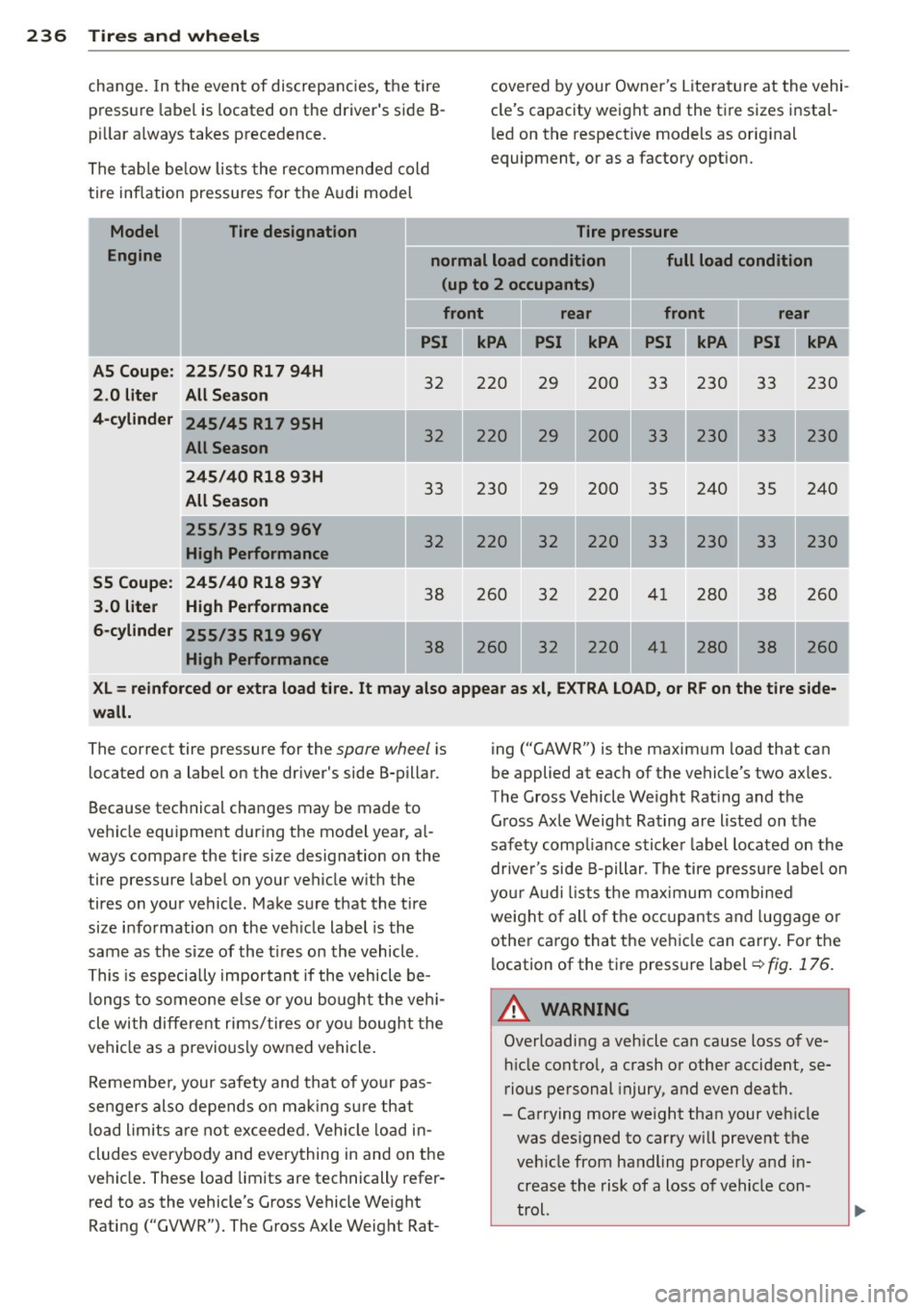
The table below lis ts the recommended cold
tire inflation pressures for the Audi model
I Model II
Tire designation
covered by your Owner's Literature at the vehi
cle's capacity weight and the tire sizes instal
l ed on the respective models as orig inal
equipment, or as a factory option.
Tire pressure
Engine normal load condition full load condition
(up to 2 occupants)
front rear front rear
I
PSI Jl kPA PSI Jl kPA PSI Jl kPA PSI Jl kPA
AS Coupe: 225/50 R17 94H
2.0 liter All Season
4-cylinder 245/45 Rl 7 95H
I Au Season
245/40 R18 93H
All Season
2SS /35 R19 96V
High Performance
55 Coupe: 245/40 R18 93V
3 .0 liter High Performance
6-cylinder
-255/35 R19 96V
High Performance
32 220
32 220
33 230
32 220
38 260
38
260
29 200 33 230 33 230
.
29 200 33 230 33 230
I
29 200 35 240 35 240
'
32 220 33
230 33 230
I
32 220 41 280 38 260
32 220 41 280 38 260
I
XL= reinforced or extra load tire. It may also appear as xl, EXTRA LOAD, or RF on the tire side
wall.
The correct tire pressure for the spare wheel is
located on a label on the driver's side B-pillar.
Because technical changes may be made to
vehicle equipment during the model year, a l
ways compare the tire size designation on the
tire pressure label on your vehicle with the
tires on your vehicle . Make sure that the tire
size information on the veh icle label is the
same as the size of the t ires on the vehicle .
This is especially important if the vehicle be
lo ngs to someone else or you bought the veh i
cle with different rims/tires o r you bought the
vehicle as a previously owned vehicle .
Remember, your safety and that of your pas
sengers also depends on mak ing sure that
l oad limits are not exceeded. Vehicle load in
cludes everybody and everything in and on the
vehicle . These load limits are technically refer
red to as the vehicle's Gross Vehicle Weight
Rating ("GVWR"). The Gross Axle Weight Rat- ing
("GAWR") is the maximum load that can
be applied at each of the vehicle's two axles.
The Gross Vehicle Weight Rating and the
G ross Axle Weight Rating are listed on the
safety comp liance sticker label located on the
drive r's side B-pillar . The tire pressure label on
your Audi lists the maximum combined
weight of all of the occupa nts and luggage or
other cargo that the vehicle can carry. For the
location of the tire pressure label¢
fig. 176.
A WARNING ._
Overloading a vehicle can cause loss of ve
hicle contro l, a crash or other accident, se
rious personal injury, and even death.
- Carrying more weight than your vehicle
was designed to carry will prevent the
veh icle from handling properly and in
crease the risk of a loss of vehicle con
trol.
Page 239 of 294
-The brakes o n a vehicle t hat has been
overloaded may not be a ble to stop the
vehicle within a safe distance.
- Tires on a vehicle that has been overload
ed can fail suddenly causing loss of con
trol and a crash.
- Always make sure that the tota l load be
ing transported -including the we ight of
a tra ile r hitch and the tongue weight of a
loaded trailer - does not make the veh i
cle heav ier than the veh icle's Gross Vehi
cl e Weight Rating.
A WARNING
- Incorrect tire pressures and/or underin
fla tion can lead to a serious o r fatal acci
dent.
- Incorrect tire pressures and/or underin
fla tion cause increased tire wea r and can
affect the handling of the vehicle .
- Incorrect tire pressures and/or underin
flation can also lea d to sud den tire fa il
ure, incl uding a blowo ut and sudden de
flation, causing loss of vehicle control.
Checking tire pressure
.
The correct tire pressure for the tires original
ly installed on your vehicle is listed on the tire
pressure Lobel located on driver's side 8-pil lor.
The re commended t ire press ures a re o n the
tire pressure label and in the tab le
c=> page 235, Cold tire inflation pressure. This
means that the pressure must be checked and
adj usted when the tire has not been driven for
more than a couple of m iles (kilometers) at
low speeds during the previous three hours .
A ir i n the tires expands when the tire heats up
as a result of inte rnal fr iction as it flexes in
use. The t ire p ress ure is higher w hen the tire
h as wa rmed up th an when it is "cold."
It is the inflat io n pressu re in a "cold" tire that
counts. Therefore, you shou ld never let air out
of a warm t ire to ma tch "Cold tire in flation
p ressu re" recommend ations
c::> page 235. T he
Tire s an d wheel s 237
tires wo uld then be unde rinflated and co uld
fail suddenly.
T he tire pressure label on your Aud i lis ts the
re commended co ld tire inflation pressures at
maximum capacity for the new, orig inal
equipment tires that were on your ve hicle at
the time it was manufactured. For the loca
tion of the labe l
c::> page 235, fig. 176.
Most tires lose air naturally over t ime. They
can a lso lose some air if yo u drive over a pot
ho le or hit a curb while par king. It is usually
not possible to see whether the rad ia l tires
u sed today are underinflated just by looking
at them .
There fore, be sure to check t ire p ress ures at
l east once a month and always before going
on a long tr ip. Make sure to take the n umber
of peop le and the amount of luggage into ac
count when adjust ing tire pressure for a tr ip -
even one that you wou ld not conside r to be
"long." See
c::> page 239, Tires and vehicle
food limits
f or mo re import ant inform ation .
Always use an accurate ti re pressu re gauge
when checking and ad justing inflation pres
s ur es. Check a ll of t he tires and be s ure not to
forge t the spare tire.
If the pressure in any t ire
is too high when the ti re is "cold", let air out
of the ti re s low ly with the edge of the tire
gauge and keep checking the pressure until
you reach the pressure that is correct for the
load (passengers and luggage) and k ind of
driv ing you plan to do.
If the pressure in any ti re is too low, note the
difference between the pressure in the co ld
tire and the pressure you need and add the air
that you need to reach the correct pressure for
the ve hicle load (passengers and luggage) for
the tires on you r veh icle as listed on the on
you r vehicle and in this ma nual and the kind
of d rivi ng you plan to do .
Never exceed th e maximum inflation pr es
sure listed on the tire sidewall for any rea
s on.
•
•
Page 240 of 294
238 Tire s and whee ls
Remember that the vehicle manufacturer, not
the tire manufacturer, determines the correct
tire pressure for the t ires on your vehicle.
I t is important to check the tire pressu re when
the tires are cold.
- Read the requ ired t ire pressure from the tire
pressure label. The tire pressure labe l is lo
cated on the drive r's side 8-p illar. The tire
pressure label lists the recommended cold
tire inflation pressures for the vehicle at its maximum capacity we ight and the tires that
were on your vehicle at the time it was man ufactured . For recommended tire pressures
for normal load condit ions, please see chap
ter ¢
page 235 .
-Turn the valve stem cap coun ter-clockwise
to remove it from the tire valve .
- Place the air pressure gauge on the valve .
- The tire pressures should on ly be checked
and adjusted when the tires are cold . The
s lightly raised pressures of warm tires must
not be reduced .
- Adjust the tire pressure to the load you are
carrying.
- Re install the valve stem cap on the valve .
When should I check th e tire p ressur e?
The correct tire pressure is especially impor
tant at high speeds . The pressure should
therefore be checked at least once a month
and a lways before starting a journey . Do not
forget to check the tire pressure for the spare
wheel.
When should I adju st the tire pre ssure s?
Adjust the tire pressure to the load you are
carrying. After changing a wheel
or replacing
wheels you have to adjust the tire pressures
on all wheels. In addition, you must then init i
alize the new tire pressures in the tire pres
sure mon itor ing system*
¢ page 249 .
A WARNING
Incorrect tire pressures and/or underinf la
tion can lead sudden tire failure, loss of contro l, collision, ser ious persona l inju ry
or even death. -
When the
[ti warning symbol appears in
the instrument cluster, stop and inspect
the t ires.
- Incorrect tire pressure and/or underinfla
tion can cause increased tire wear and can affect the handling of the vehicle and
stopping ability .
- Incorrect tire pressures and/or underin
flation can a lso lead to sudden t ire fail
ure, including a blowout and sudden de
flation, caus ing loss of veh icle control.
- The driver is responsible for the correct
tire pressures for all tires on the veh icle.
The applicable pressure values a re locat
ed on a sticker on the dr iver's s ide 8-pil
lar.
- Only when all tires on the vehicle are fil
led to the correct pressu re, the t ire pres
sure mon itor ing system* can work cor
rectly.
- The use of incorrect tire p ressure va lues
can lead to acc idents or other damage .
Therefore it is essential that the driver
observe the spe<;ified tire pressure val ues
for the tires and the correct pressures for
the function of the tire pressure monitoring system*.
-Always inf late tires to the recommended
and correct t ire pressure before dr iving
off.
- Driving with underinflated tires bend
more, letting them get too hot resulting
in tread separation, sudden tire failure
and loss of control.
- Excessive speed and/overloading can
cause heat build-up, sudden tire failure
and loss of control.
- If the tire pressure is too low or too high,
the t ires will wear prematurely and the
veh icle w ill not handle well.
- If the tire is not flat and you do not have to change a wheel immediately, drive at
reduced speed to the nearest service sta
tion to check the t ire press ure and add
ai r as requ ired .
Page 241 of 294
(D Note
Driving without valve stem caps can cause
damage to the t ire va lves. To prevent this,
always make sure that factory installed
valve stem caps on all wheels are securely
mounted on the valve .
@) For the sake of the environment
Underinflated tires will also increase the
fue l consumption .
Tires and vehicle load limits
There are limits to the amount of load or
weight that any vehicle and any t ire can carry .
A vehicle that is overloaded w ill not handle
well and is more difficult to stop. Overload ing
can not on ly lead to loss of vehicle contro l,
but can a lso damage important pa rts of the
ve hicle and can lead to sudden tire failure, in
cluding a blowout and sudd en d eflation that
c a n cause the veh icle to crash.
Your safety and that of yo ur passenge rs a lso
depends on making sure that load limits are
not exce eded . Vehicl e load includes ev erybody
and everyth ing in and on the vehicle. These
load limi ts are techn ically referred to as the
vehicle's
Gross Vehicl e W eight Rat ing
("GVWR ").
The "GVWR" includes the we ight of the basic
vehicle, all fac tory installed accessories, a full
tank of fuel, oil, coolant and other fluids plus
maximum load . The maximum load includes
the number of passengers that the vehicle is
i ntended to ca rry ("seating capacity") with an
assumed weight of 150 lbs . (68 kg) for each
passenger a t a des igna ted seat ing pos ition
and the tota l weight of any l uggage in the ve
h icle. If you tow a trailer, the weig ht of the
trailer hitch and the tongue we ight of the
loaded traile r must be included as part of the
vehicle load .
The
Gro ss Axle Weight Rating ("GAWR") is
the maximum load that can be applied at each
of the vehicle's two axles.
Tire s an d wheel s 239
The Gross Vehicle Weight Rat ing and the
Gross Axle Weight Rating are listed on th e
safety comp liance sticker label located on the
driver's side B-pillar. Audi has 4 seat ing pos i
tions, 2 in the front and 2 in the rear for total
seat ing capac ity of 4. Each seating position
has a seat belt ¢
page 134, Safety belts .
The fact that there is an upper limit to your
vehicle's Gross Vehicle Weight Rating means
that the total weight of whatever is being car ried in the vehicle ( includ ing the weight of a
trailer hitch and the tongue we ight of the
loaded tra ile r) is lim ited. The more passen
gers in the vehicle or passe ngers w ho are
heavier than the standard we ights assumed
mean that less weight can be carried as lug
gage.
T he tire pressure label on your Aud i also lis ts
t h e maximum combined weight of a ll of the
occupants and l uggage or other cargo that
the ve hicle can carry. For the location of the
l abel ¢
page 235, fig. 176.
A WARNING
Overloading a vehicle can cause loss of ve
h icle contro l, a crash or other accident , se
rious personal injury, and even death .
- Carrying more we ight than your veh icle
was des igned to carry will prevent the
ve hicle from handling properly and in
crease the risk of the loss of vehicle con
trol.
- The brakes on a vehicle that has been
overloaded may not be able to stop the
ve hicl e with in a safe distance .
- Tires o n a vehicle that has been overload
ed can fail suddenly, incl uding a blowout
a nd sudden defla tion, causing loss of
control and a crash .
- Always ma ke sure t hat the to tal load be
i n g transpo rted - incl udi ng t he weight of
a trailer hitch and the tongue we igh t of a
loaded trailer -does not make the vehi
cle heavier than the vehicle's Gross Vehi
cle Weight Rating.
•
•