key AUDI A5 COUPE 2013 Owner's Manual
[x] Cancel search | Manufacturer: AUDI, Model Year: 2013, Model line: A5 COUPE, Model: AUDI A5 COUPE 2013Pages: 294, PDF Size: 73.84 MB
Page 56 of 294
54 Seats and storage
close to this position as possible
¢page 56.
A WARNING
Never place any objects in the driver's foot
well. An object could get into the pedal area and interfere with pedal function. In
case of sudden braking or an accident, you
would not be able to brake or accelerate .
Front passenger's seat
Always move the front passenger seat into
the rearmost position .
To avoid contact with the airbag while it is de
ploying, do not sit any closer to the instru
ment panel than necessary and always wear
the three-point safety belt provided adjusted correctly . We recommend that you adjust the
passenger's seat in the following manner:
• Bring the backrest up to an (almost) upright
position. Do not ride with the seat reclined .
• Applies to vehicles with adjustable head re
straints: Adjust the head restraint so the up
per edge is as even as possible with the top
of your head . If that is not possible, try to
adjust the head restraint so that it is as
close to this position as possible
¢ page 56.
• Place your feet on the floor in front of the
passenger's seat.
Front seats
Power seat adjustment
Applies to vehicles: with power adjustab le seats
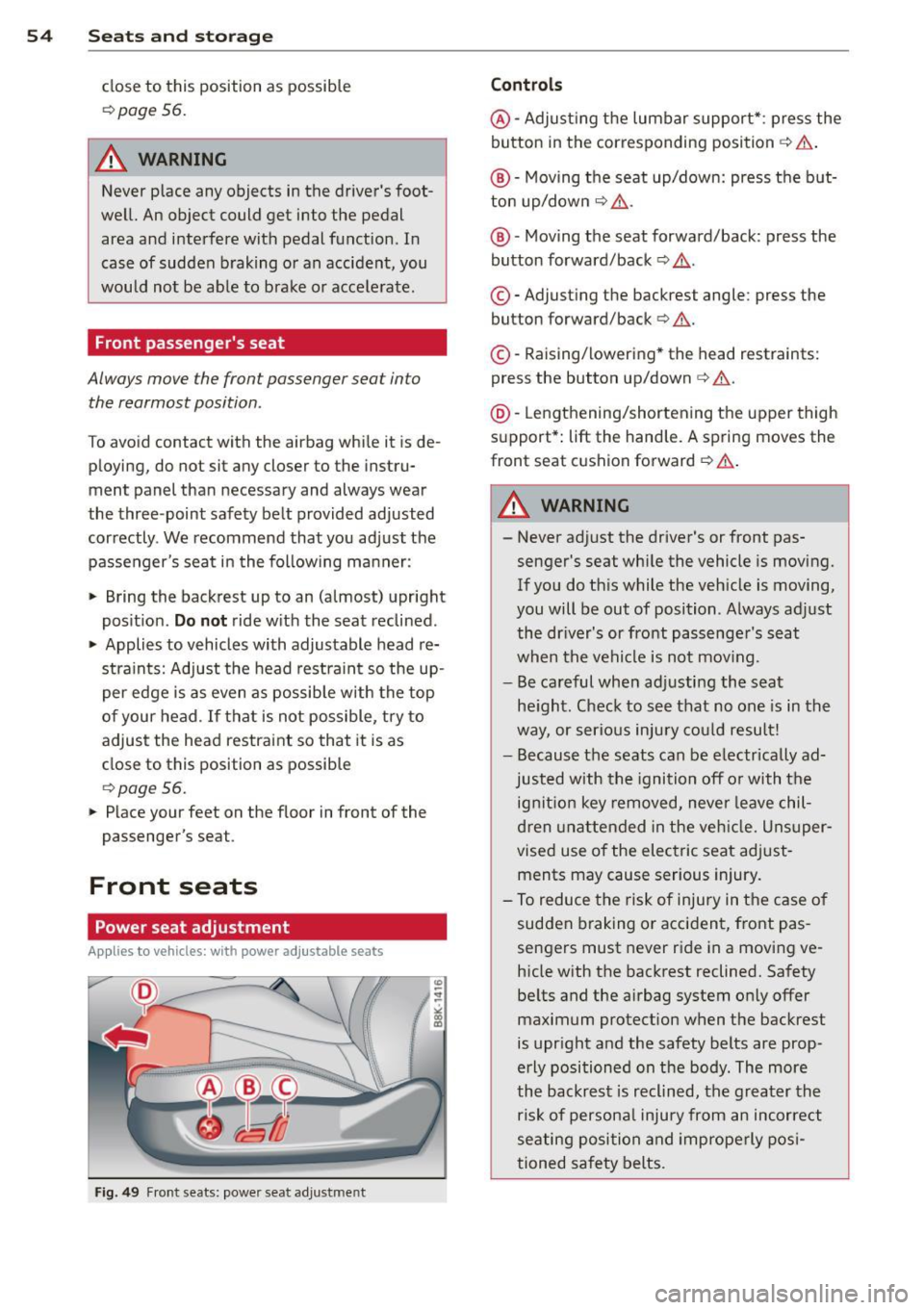
Fig. 49 Front seats: powe r seat adjustme nt
Controls
@ -Adjusting the lumbar support* : press the
button in the corresponding position ¢ .&, .
@ -Moving the seat up/down: press the but
ton up/down ¢ .&, .
@ -Moving the seat forward/back : press the
button forward/back ¢.&, .
©-Adjusting the backrest angle: press the
button forward/back ¢.&, .
©-Raising/lowering * the head restraints:
press the button up/down¢.&, .
@ -Lengthening/shortening the upper thigh
support* : lift the handle. A spring moves the
front seat cushion forward ¢ .&, .
A WARNING
---Never adjust the driver's or front pas
senger's seat while the vehicle is moving.
If you do this while the vehicle is moving,
you will be out of position . Always adjust
the driver's or front passenger's seat
when the vehicle is not mov ing.
- Be careful when adjusting the seat
height . Check to see that no one is in the
way, or serious injury could result!
- Because the seats can be electrically ad
justed with the ignition off or with the
ignition key removed, never leave chil
dren unattended in the vehicle. Unsuper
vised use of the electric seat adjust
ments may cause serious injury.
- To reduce the risk of injury in the case of
sudden braking or accident, front pas
sengers must never ride in a moving ve hicle with the backrest reclined. Safety
belts and the airbag system only offer maximum protection when the backrest
is upright and the safety belts are prop
erly positioned on the body. The more
the backrest is reclined, the greater the
risk of personal injury from an incorrect
seating position and improperly posi
tioned safety belts.
Page 59 of 294
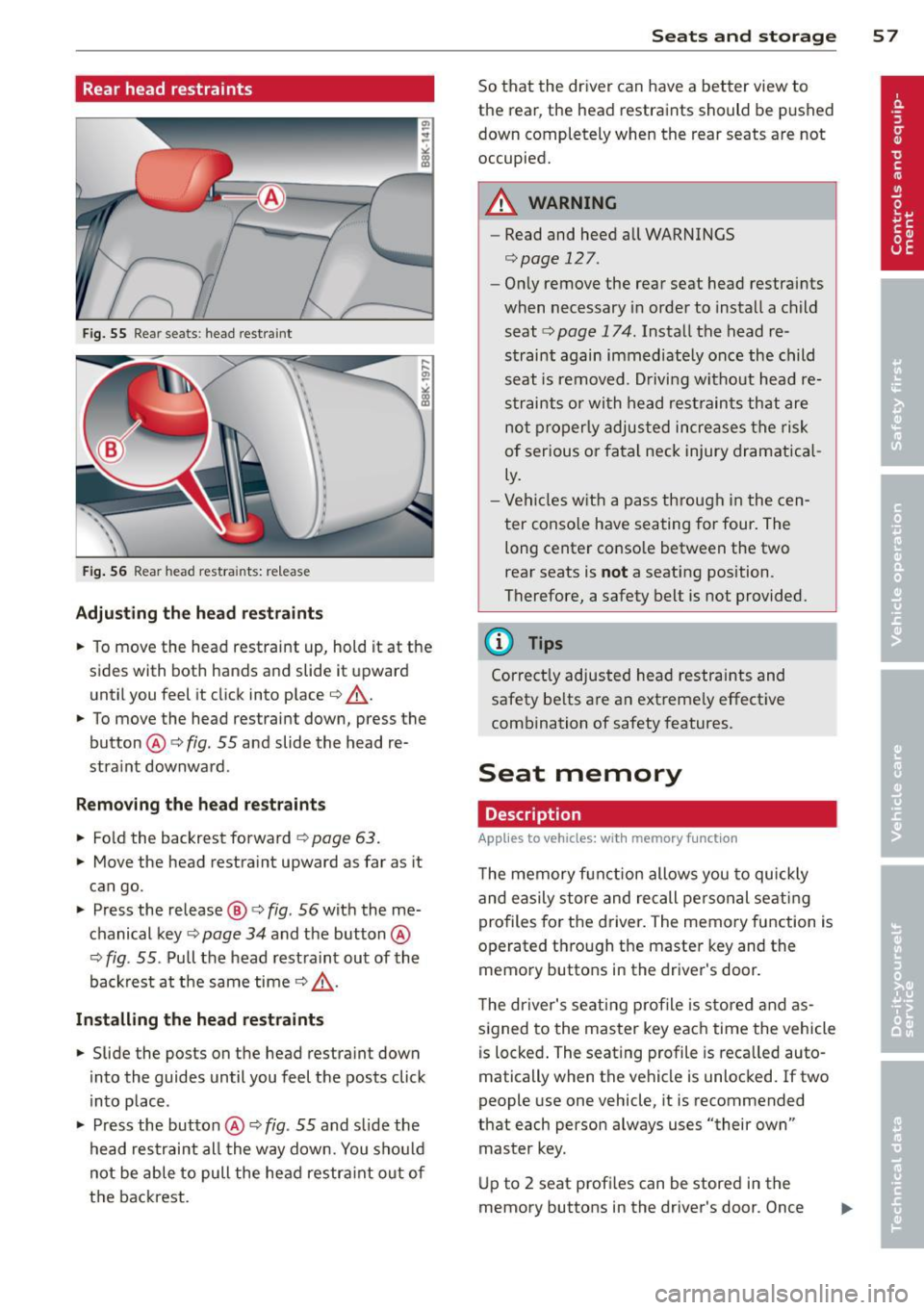
Rear head restraints
Fig. 55 Rear seats : head restraint
Fig. 56 Rear head restra ints: re lease
Adjusting the head restraints
• To move the head restraint up, hold it at the
s ides with both hands and slide it upward
until you feel it click into place¢.,&.
• To move the head restraint down , press the
button @¢
fig. 55 and slide the head re
stra int downward .
Removing the head restraints
• Fo ld the backrest forward ¢ page 63.
• Move the head restraint upward as far as it
can go.
• Press the release@¢
fig. 56 with the me
chanical key¢
page 34 and the button @
¢
fig . 55 . Pull the head restraint out of the
backrest at the same time¢.,& .
Installing the head restraints
• Slide the posts on the head restra int down
into the guides until you feel the posts click
into place .
• Press the button @ ¢
fig. 55 and slide the
head restraint al l the way down. You shou ld
not be able to pull the head restra int o ut of
the backrest.
Seats and storage 57
So that the driver can have a better view to
the rear, the head restraints should be pushed
down completely when the rear seats are not
occupied.
A WARNING
- Read and heed all WARNINGS
¢page 127.
-On ly remove the rear seat head restraints
when necessary in order to install a child
seat ¢
page 174. Install the head re
straint again immediately once the child
seat is removed. Driving without head re
straints or with head restraints that are
not properly adjusted increases the risk
of serious or fatal neck injury dramatical
ly.
- Vehicles with a pass through in the cen
ter conso le have seating for four. The
long center conso le between the two
rear seats is
not a seating position .
Therefore, a safety belt is not provided.
@ Tips
Correctly adjusted head restraints and
safety be lts are an extreme ly effective
combination of safety features.
Seat memory
Description
Applies to vehicles : with memory fun ctio n
The memory function allows you to quickly
and easily store and recall personal seati ng
profiles for the driver. The memory function is
operated through the master key and the
memory buttons in the driver's door.
The driver's seating profile is stored and as
signed to the master key each time the vehicle
is locked. The seating profile is recalled auto
matically when the vehicle is unlocked.
If two
people use one vehicle, it is recommended
that each person always uses "their own" master key.
Up to 2 seat profi les can be stored in the
memory buttons in the driver's door. Once
Page 60 of 294
58 Seats and storage
they are stored, these seat profiles can be
se lected at any time .
I n addition to the driver's seat settings, you
can also stor e and access the exterior mir ror
adj ustment settings* using the remote con
trol key or memory button .
Remote control key
Applies to vehicles: with seat memo ry
To assign the driver 's seat settings to the re
mote control key when locking the vehicle, the
function must be activated in the radio or
MMI*
.. Se lect :
ICARI function button > Seat adjust
ment > Driver's seat > Remote control key
>
on.Or
> Select: ICARI function button> Car systems
control button > Vehicle settings > Seats>
Driver's seat> Remote control key> On .
@ Tips
If you do not want another d river's set
tings to be assigned to the remote key,
switch off the memory function using the
radio or MMI* or the
ION/OFF I button
qpage58.
Memory buttons
Applies to vehicles: with seat memo ry
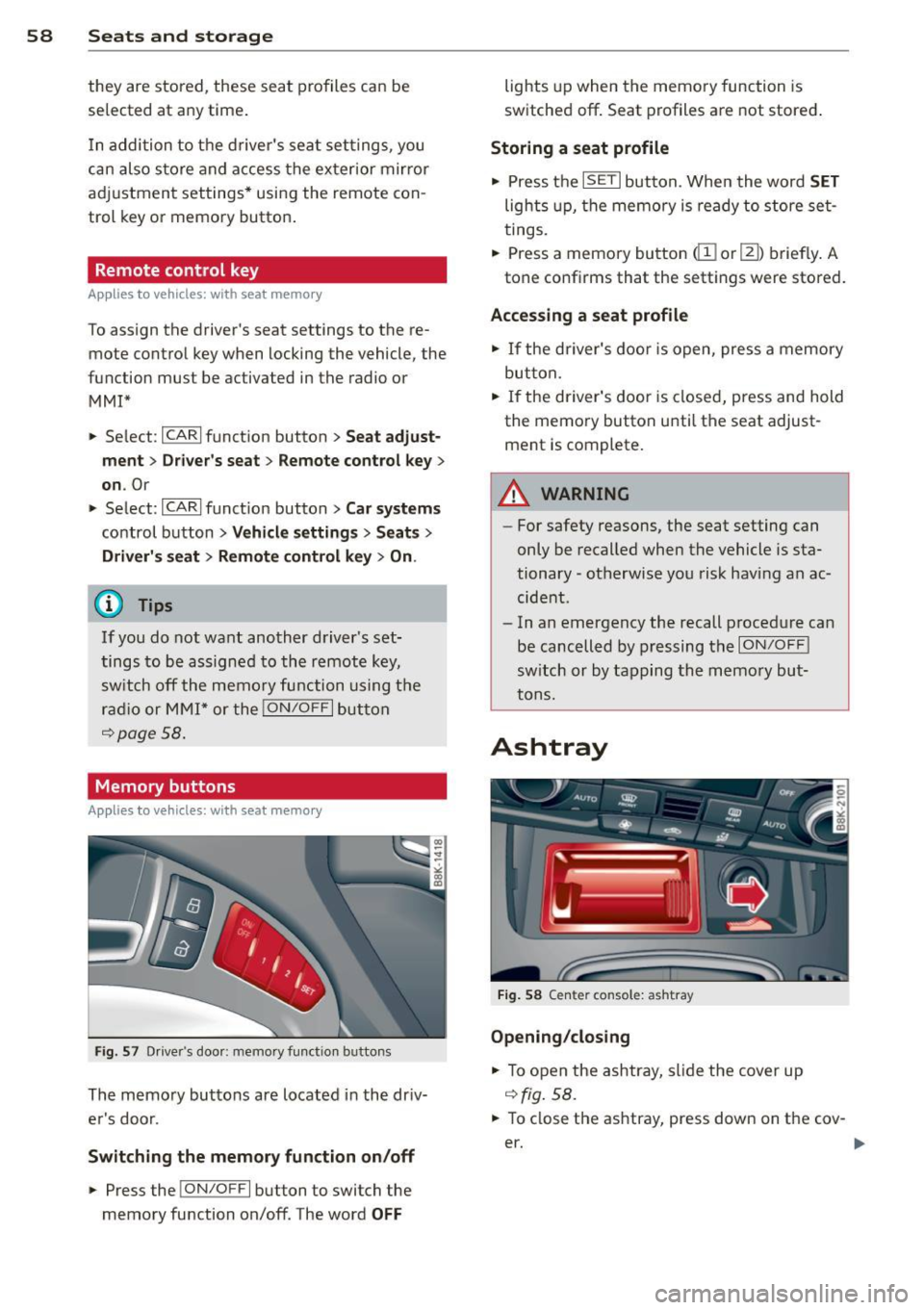
F ig. 57 Driver's doo r: memory function buttons
The memory buttons are located in the driv
e r's door.
Switching the memory function on/off
.. Press the !ON/O FF I button to switch the
memory function on/off. The word
OFF
lights up when the memo ry function is
switched off . Seat profiles are not stored .
Storing a seat profile
.. Press the ISETI button. When the word SET
lights up, the memory is ready to store set
tings .
.. Press a memory button
dil or~) briefly. A
tone conf irms that the sett ings were stored.
Accessing a seat profile
.. If the driver's door is open, press a memory
but ton.
.. If the driver's door is closed, press and hold
the memory button until the seat adjust ment is complete.
A WARNING
- For safety reasons, the seat setting can
only be recalled when the vehicle is sta
tionary -otherwise you risk having an ac
cident.
- In an emergency the recall procedure ca n
be cancelled by pressing the
ION/OF F!
sw itch or by tapping the memory but
tons.
Ashtray
Fig. 58 Center co nsole: ashtray
Opening/closing
.. To open the ashtray, slide the cover up
qfig. 58.
.. To close the ashtray, press down on the cov-
er. ..,.
Page 62 of 294
60 Seats and st o rage
• To adjust the arm @, swing it in the direc
tion of the arrow .
• Place the beverage in the holder and release
the arm. The arm swings back by itself and
automatically secures the beverage.
Clo sing cuphold ers
• To close the cupholder, press on the center
section between the two arms and push the
cupholder in the s lot as far as it will go.
A WARNING
Spilled hot liquid can cause an accident
and personal i njury .
-
-Never carry any beverage containers with
hot liquids, such as hot coffee or hot tea,
in the vehicle while it is moving. In case
of an accident, sudden braking or other
vehicle movement, hot liqu id could spill,
causing sca ld ing bur ns. Sp illed hot liq uid
can also ca use an accident and persona l
injury.
- Use only soft cups in the cuphol der. H ard
c u ps and g lasses can ca use in jury in an
accident.
- Never use the cupho lder or adapter as an
ashtray- risk of fire.
@ Note
On ly dr ink containe rs with lids should be
car ried in the cupho lde r. Liqu id could sp ill
out and damage your veh icle's e lectronic
equipment or stain the upholstery, etc.
Glove compartment
The glove compar tment is illuminated and
can be locked.
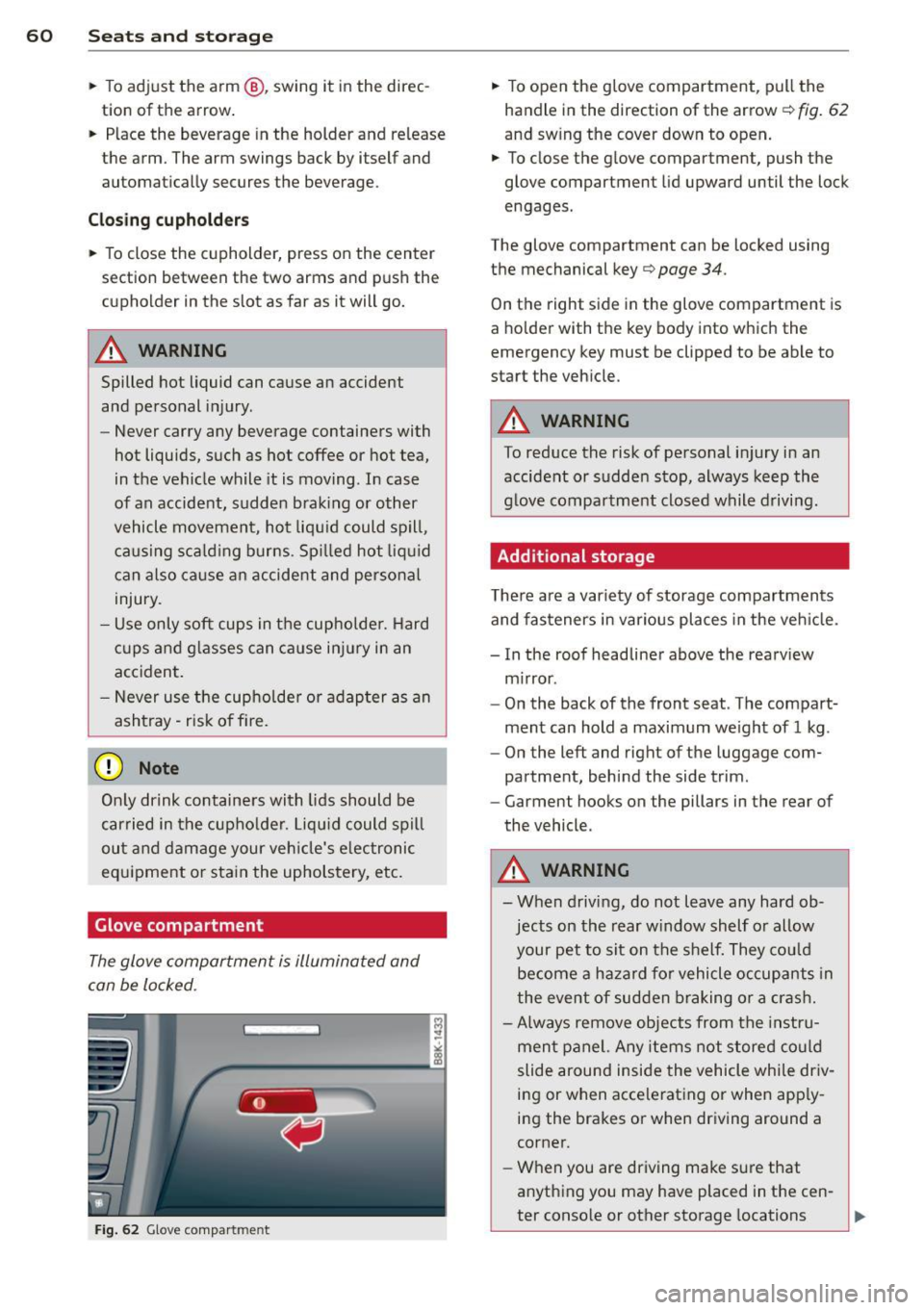
F ig . 62 G love compart men t
• To open the g love compartment, pull the
handle in the direction of the arrow ¢
fig. 62
and sw ing the cover down to open.
• To close the glove compartment, push the
glove compartment lid upward until the lock
engages.
The glove compartment can be locked using
the mechanical key¢
page 34.
On the right side in the glove compartment is
a holder with the key body into which the
emergency key must be clipped to be able to
start the vehicle.
A WARNING
--To reduce the risk of pe rsonal injury in an
accident or sudden stop, always keep the
glove compartment closed while d riving .
Additional storage
The re are a var iety of storage compartments
and fasteners in various places in the veh icle.
- In the roof headliner above the rearv iew
m irror.
- On the back of the front seat . The compart
ment can hold a maximum we ight of 1 kg .
- On the left and right of the luggage com
partment, behind the side trim.
- Garment hooks on the pillars in the rear of
the vehicle.
A WARNING
-- When driving, do not leave any hard ob -
jects on the rear w indow shelf o r allow
your pet to sit on the shelf. They co uld
become a hazard fo r vehicle occupants in
the event of sudden braking or a cr ash.
- Always remove objects from the instru
men t panel. A ny item s not stored could
slide around inside the vehicle wh ile dr iv
ing or when acce le rat ing or when app ly
ing the brakes or when driving around a
corner.
- When you are driving make sure that
anything you may have placed in the cen
ter conso le or other storage locations
Page 65 of 294
-The use of a roof rack can negative ly af
fect the way a vehicle handles. Cargo
that is large, heavy, bulky, long or flat
will have a greater negative influence on
the vehicle's aerodynamics, center of
gravity and overall handling . Always
dr ive slowly, avo id sudden braking and
maneuvers when transporting cargo on
the roof of your vehicle.
- Never exceed the max imum permissible
load carry ing capacity of the roof of your
vehicle, the perm issib le axle weights and
the permissible total weight of your vehi
cle
c::> page 269, Weights.
@) For the sake of the environment
As a result of the increased w ind resist
ance created by a roof rack, your vehicle is
using fue l unnecessarily . So remove the
roof rack after using it .
Luggage compartment
General information
A WARNING
Read and follow the important safety pre
cautions on c:>
page 130, Stowing lug
gage.
Enlarging the luggage compartment
App lies to vehicles: with fold ing rear seatback
The backrests can be folded forward sepa
rately or together using the two release lev
ers .
0
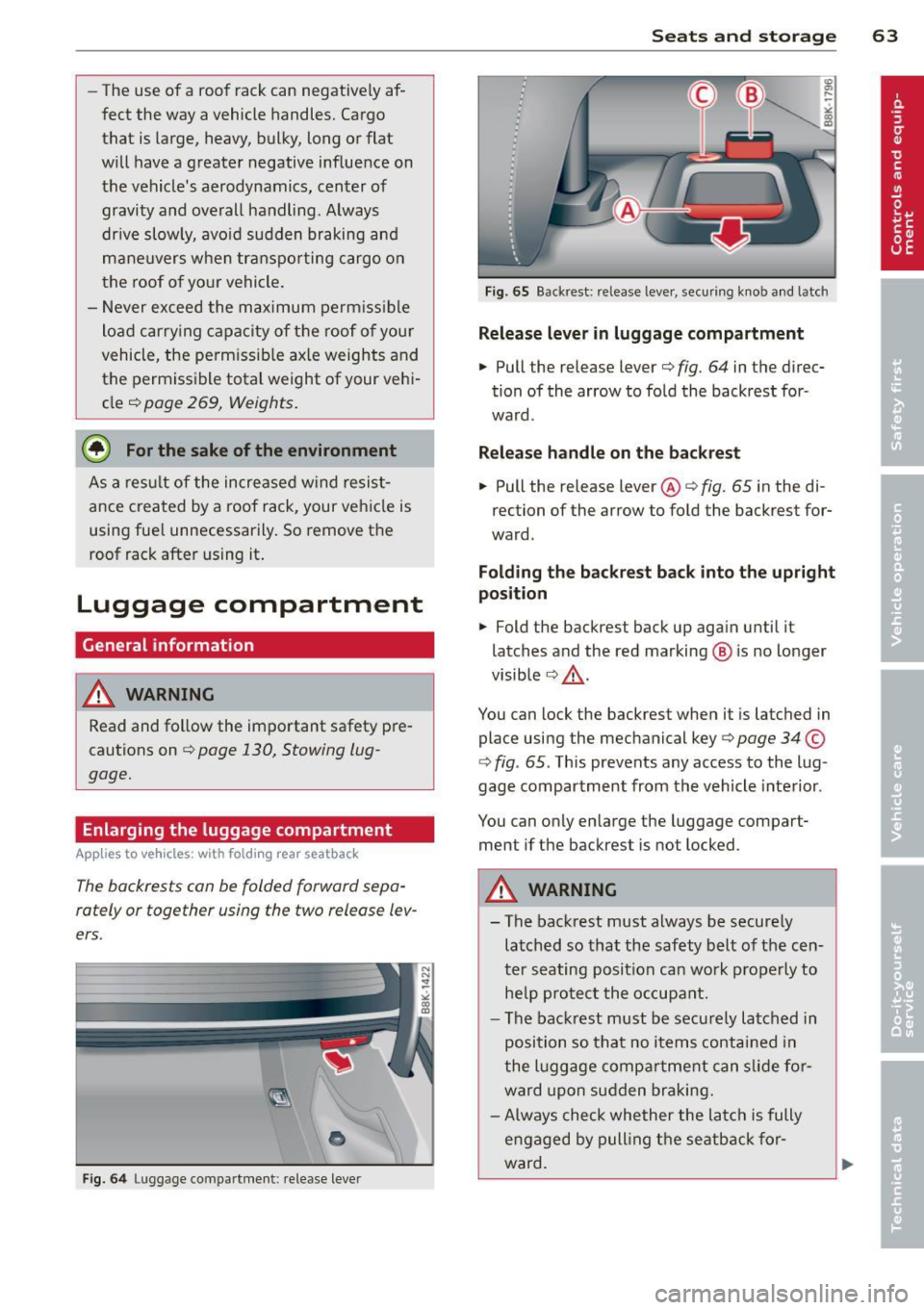
Fig. 64 Luggage compartment: re lease leve r
Seats and storage 63
Fig. 65 Backrest: release lever, securing knob and latc h
Release lever in luggage compartment
... Pull the release lever c:> fig. 64 in the direc
tion of the arrow to fo ld the backrest for
ward .
Release handle on the backrest
... Pull the release lever@c:> fig. 65 in the di
rection of the arrow to fold the backrest for
ward .
Folding the backrest b ack into the upright
position
... Fold the backrest back up again until it
latches and the red marking @ is no longer
visible
c:> .&_ .
You can lock the backrest when it is latched in
place using the mechanical key
c:> page 34 ©
c:> fig . 65 . This prevents any access to the lug
gage compartment from the vehicle interior.
You can only enlarge the luggage compart ment if the backrest is not locked.
A WARNING
-
- The backrest must always be securely
latched so that the safety belt of the cen
ter seating position can work properly to
he lp protect the occupant.
- The backrest must be securely latched in
position so that no items contained in
the lu ggage compa rtment can slide for
ward upon sudden braking.
- Always check whether the latch is fully
e ngag ed by pull ing the seatback for
ward .
Page 67 of 294
_& WARNING
Weak, damaged or improper straps used
to secure items to tie-downs can fa il dur
ing hard brak ing or in a collision and cause
ser ious personal injury .
- Always use suitable retaining straps and properly secure items to the tie-downs in
the luggage compartment to help pre
vent items from shifting or flying for
wa rd.
- Never attach a child seat tether strap to
a tie-down .
- For strength-related reasons, the mount
ing hooks can only be used to secure ob
jects we ighing up to 10 lb. (5 kg). Heavi
er objects will not be adequately secured
- there is a risk of injury .
Ski sack
Applies to vehicles: with ski sack
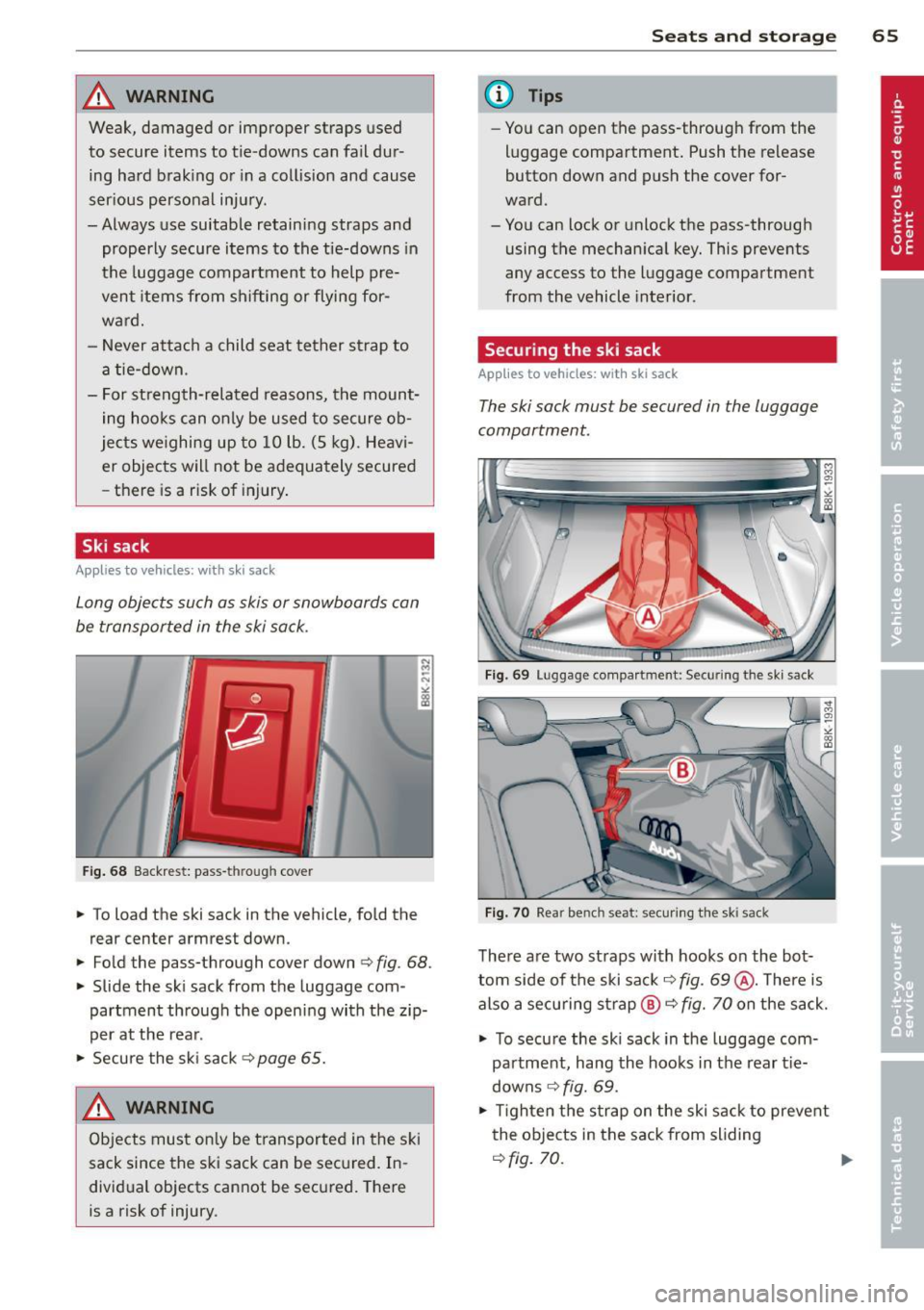
Long objects such as skis or snowboards can
be transported in the ski sack .
Fig . 68 B ackr est: pass-thr ough cover
.. To load the sk i sa ck in the veh icle, fold the
rea r cente r arm res t down.
.. Fo ld the pass- through cover down
Q fig . 68.
.. Slide the sk i sa ck from the luggage com
partment through the opening with the zip
per at the rear .
.. Secure the sk i sack
Q page 65.
_& WARNING ,..__
Objects must on ly be transported in the ski
sack since the ski sack can be sec ured . In
dividual objects cannot be secured. There
is a risk of injury .
Sea ts a nd s to rage 65
@ Tips
-You can open the pass-through from the
luggage compartment. Push the release
button down and push the cover for
ward.
- You can lock or unlock the pass-through
using the mechanical key. This preven ts
any access to the luggage compar tment
from the vehicle interior .
Securing the ski sack
Applies to vehicles: w ith ski sack
The ski sa ck mu st be secured in the luggage
compartment.
F ig. 69 Luggage compar tment: Se curing the s ki s ack
F ig. 70 Rea r ben ch s eat: secur ing the sk i sack
There are two straps with hooks on the bot
tom side of the ski sac k
q fig. 69@. There is
also a secu ring strap ®
q fig. 70 on the sack.
.. To secu re the ski sack in the luggage com-
pa rtment, hang the hooks in the rear t ie
downs
q fig. 69 .
.. Tighten the strap on the ski sack to prevent
the objects in the sack from sliding
q fig. 70. ...
Page 68 of 294
66 Seat s a nd s tor ag e
8_ WARNING
-
- The ski sack is intended only for the
transportation of skis and other light ob
jects . To reduce the risk of serious per
sonal injury, never transport heavy or
pointed objects in the ski sack.
- When brak ing rapidly or during an acci
dent, the load could be displaced and
ca use injury to occupants.
- Sharp edges on the load must be covered
for protect ion. Always fasten the belt
t ightly around the sack and its contents
¢ fig. 70.
-For safety reasons, do not transport
more than two pairs of skis in the ski
sack .
- You must sec ure the ski sac k with the
st rap after loading.
- Make su re a ll objects that you are t rans
porting in the pass-through are secured.
Otherwise they cou ld slide around during
sudden braking maneuvers and cause in
jury.
(D Tips
- Never stow the sk i sack away when it is
still wet or damp (for examp le, snow
melting from skis). Allow it to dry com
plete ly before stowing it away.
- When transporting skis or snowboards, tighten the securing strap between the bindings.
- Position skis in the ski sack wit h the
pointed ends facing the front and ski
po les with the pointed ends facing the
rear.
- You can lock or un lock the pass-through
u sing the mechanical key. This prevents
any access to the luggage compartment
from the vehicle interior .
Parcel shelf
The parcel shelf behind the rear seatback can
be used to car ry light items of cloth ing .
8_ WARNING
No heavy or hard objects should be p laced
on the parcel shelf. They are a hazard to
the veh icle occupants during s udden brak
i ng . The is a risk of injury .
(D Note
Please make sure that the heating w ires
for the rear window defogger are not dam
age by abrasive objects .
(D Tips
To ensure problem-free ven tilation , the
vent ilation slots between the rear window
and the pa rcel she lf must not be covered .
Page 69 of 294
Warm and cold Climate controls
Description
Th e climate control sy stem warms, cools and
adds humidity to the a ir in the veh icle inter io r.
It is the most effect ive when the windows and
sunroof are closed . If the re is a build-up of
h eat inside the vehicle, ventilation can help to
speed up the cooling process .
I n all he ating mode functions except
defrost,
the blower on ly switches to a higher speed
once the engine coolant has reached a certain
temperature.
Condensat ion from the cooling sys tem can
d rip and form a puddle of water under the ve
h icle. This is normal and does not mean there
is a leak .
Pollutant filter
The po llutant filte r removes po llutants such
as dus t and pollen from the air.
The air pollutants filte r must be changed at
the intervals spec ified in you r Wa rra nty
&
M aintenance book let, so tha t the air condi
tioner can prope rly work .
If you drive your vehicle in an area w ith h igh
a ir po llution, the fi lter may need to be
changed more frequent ly than specified in
your Aud i Warranty
& Ma intenance bookle t. If
in doubt, ask your authorized A udi Service Ad
v isor for advice .
Key coded settings
The clima te control sett ings are automat ically
stored and assigned to the remote co ntro l key
that is in use.
WARNING
Reduced vis ibili ty is dangero us and can
cause accidents.
Warm and c old 67
-For safe driving it is very important that
all windows be free of ice, snow and con
densat ion.
- Comp letely fam iliarize yourse lf with the
proper use and funct ion of the heat ing
and ve nti lation system and especially
how to defog and defrost the w indows.
- Never use the windshield wiper/washer
system in freez ing weather unt il you
have warmed the w indshield first, using
the heating and ventilation system. The
washer sol ution may free ze o n the wind
shie ld an d red uce visib ility.
(D Note
- If you suspect that the air conditioner has been damaged, switch the system
off to avoid furt her damage and have it
i n spected by a q ua lified dea lership.
- Repairs to the Audi air condition er re
quire specia l techni cal know ledge and
speci al tools. Contact an autho rized Aud i
dealer fo r ass istance.
@ For the sake of the environment
B y reduci ng the amou nt of f uel you use,
you also re duce the amount of pollu tan ts
emitted in to the a ir.
(D Tips
- Keep the air intake s lo ts ( in fro nt of the
w indshield) free from ice, snow and de
br is in order to maintai n the proper f unc
tion of the climate control system.
- T he energy m anagement system may
switch the seat heating* or rear window
defroster off temporar ily . These systems
are available again as soon as the energy
balance has been restored.
- Air escapes through vents under the rear
window. When placing items of clothing
on the luggage compartment cover, en
sure that the openings are not covered.
Page 73 of 294
On the road
Steering
Manually adjustable steering wheel
The steering wheel position is fully adjustable
up and down and forward and back.
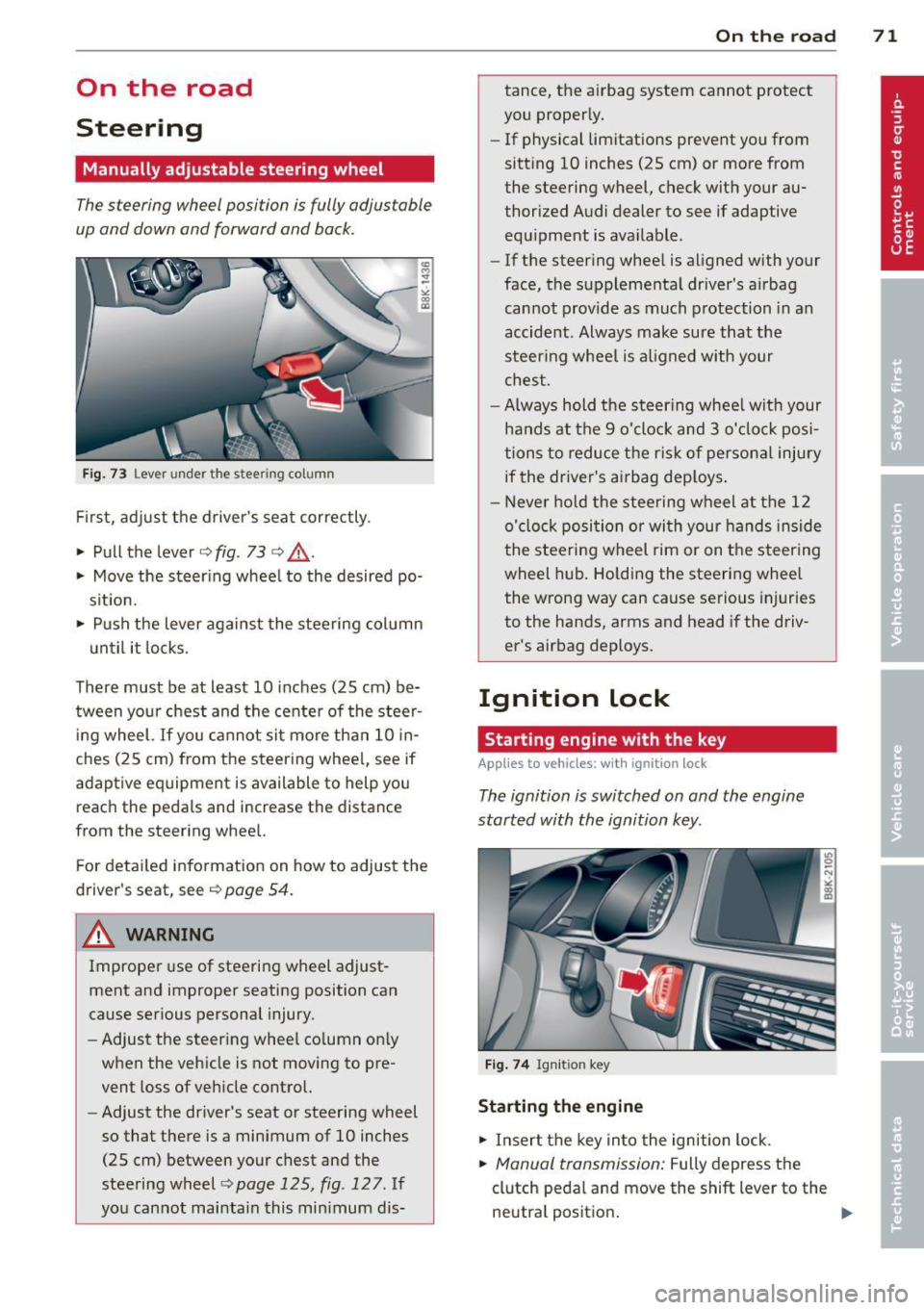
F ig . 73 Lever under the steer ing column
Fir st, adj ust t he d river's sea t correctly.
• Pull the lever
i:> fig . 73 ¢ Lo, .
• Move the steer ing wheel to th e desired po
s it ion.
• Push the lever against the steering col umn
u ntil it locks.
There must be at least 10 inches (25 cm) be
tween your chest and the cente r of the stee~
i ng wheel. If you cannot si t more than 10 in
ches ( 25 cm) from the steering whee l, see if
adaptive equipment is available to help yo u
reach the peda ls and increase the distance
from the steering whee l.
F or detai le d informatio n on how to adjust the
d river's seat, see
i:> page 54.
& WARNING
Imprope r use of stee ring wheel adjust
ment and improper seating position can
cause serious personal injury.
- Adjust the steer ing whee l co lumn on ly
when the veh icle is not moving to pre
vent loss of veh icle control.
- Adjust the driver's seat or steering wheel
so that there is a minimum of 10 inches
(25 cm) between your chest and the
steering wheel¢
page 125, fig . 127. If
yo u cannot mai ntain this mi nimum dis -
On the road 71
tance, the a irbag system cannot protect
you proper ly.
- If physical limitations prevent you from
sitt ing 10 inches (25 cm) or more from
the steering wheel, check with your au
thorized Audi dealer to see if adaptive
equ ipment is ava ilable.
- If the steer ing wheel is aligned with your
face , the suppleme nta l dr iver's a irbag
cannot provide as much protection in an
accident . Always make sure that the
steer ing whee l is a ligned with your
ches t.
- Always h old the ste ering whee l w ith your
hands at t he 9 o'clock and 3 o'clock posi
tions to redu ce the risk of persona l injury
if the driver's airbag dep loys .
- N ever hold the stee ring wheel at the 12
o' clock posi tion or wi th your hands in si de
the stee rin g wheel rim or on t he steering
wheel h ub. Holding the steering whee l
the wrong way can cause se rious injuries
to the hands, arms and head if the driv
er 's airbag deploys.
Ignition lock
Starting engine with the key
App lies to vehicl es: wi th igni tion lo ck
The ignition is switched on and the engine
started with the ignition key .
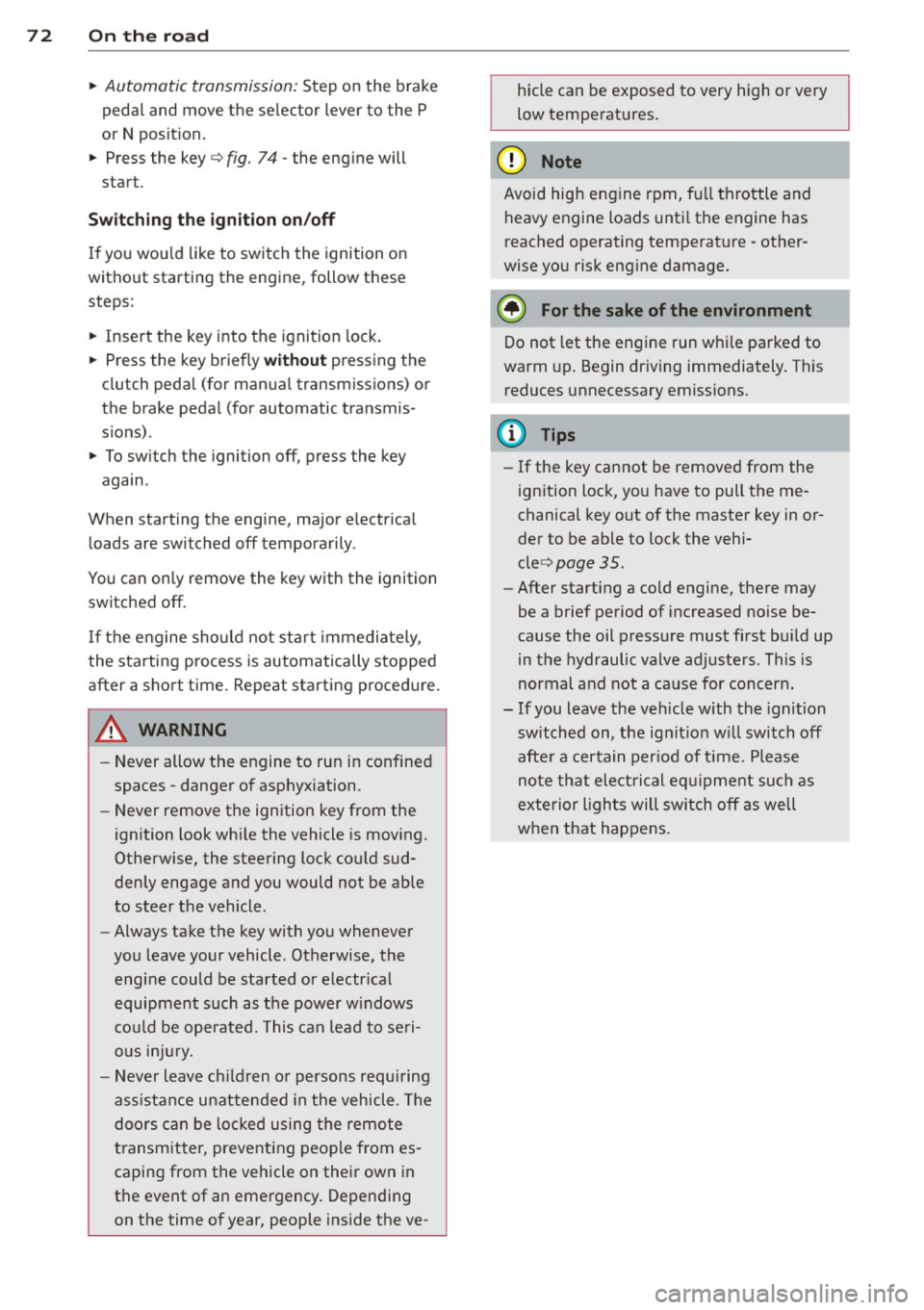
Fig . 7 4 Ig nition key
Starting the engine
• Insert the key in to the ignition lock.
• Manual transmi ssion: Fully depress the
clutch peda l and move the shift lever to the
neutra l positio n.
Page 74 of 294
72 On the road
• Automatic transmission: Step on the brake
pedal and move th e se lector lever to the P
or
N position.
• Press the key c::>
fig. 74 -the eng ine will
start.
Sw itching the i gni tion on /off
If you wou ld like to switch the ignition on
without starting the engine, follow these
steps :
• Inse rt the key into the ignition lock .
• Press the key briefly
wi thout pressing the
c lutch pedal (for man ual transmissions) or
the brake peda l (for automatic transmis
s ions) .
• To sw itch the igni tion off, press the key
again.
When starting the engine, major e lectr ical
loads are swi tched off temporarily .
You can on ly remove the key with the ignition
switched off.
I f the engine should not sta rt immediately,
the starting process is automatically stopped
after a short time. Repeat starting procedure .
A WARNING
-Never allow the engine to run in confined
spaces -danger of asphyxiation .
- Never remove the ign ition key from the
ignition look whi le the vehicle is moving.
Otherw ise, the steering lock cou ld sud
denly engage and you would not be able
to steer the vehicle.
- Always take the key with you whenever
you leave your vehicle . Otherwise, the
engine could be started or electr ica l
equipment such as the power w indows
c ou ld be operated. This can lead to seri
o us inj ury.
- Never leave children or persons requiring
assistance u nattended in the vehicle . The
doors c an be locked using the remo te
transmitter, preventing people from es
caping from the vehicle on their own in
the event of an eme rgency. Depending
on the time of year, people inside the ve- h
icle can be exposed to very high or very
low temperatu res.
@ Note
Avoid high eng ine rpm, f ull throttle and
heavy engine loads unti l the engine has
r eached operating tempe rat ure -other
wise you risk eng ine damage.
@ For the sake of the environment
Do not let the engine run w hile parked to
warm up. Begin driving immediately. This
reduces unnecessary emissions.
(D Tips
- If the key cannot be removed from the
ignition lock, you have to pull the me
chanical key out of the master key in or
der to be able to lock the vehi-
cle c::>
page 35 .
-After starting a cold engine, there may
be a brief period of increased noise be
cause the oil pressure must first bu ild up
in the hydraulic valve ad justers. This is
normal and not a cause for concern.
- If you leave the veh icle with the ignition
switched on, the ignit ion w ill switch off
afte r a certain per iod of t ime . P lease
no te that electrical eq uipment such as
exterior ligh ts will sw itch off as well
when that happens .