tire pressure AUDI A5 COUPE 2013 Owner's Manual
[x] Cancel search | Manufacturer: AUDI, Model Year: 2013, Model line: A5 COUPE, Model: AUDI A5 COUPE 2013Pages: 294, PDF Size: 73.84 MB
Page 247 of 294
-All four wheels must be fitted with radial
tires of the same type, size (rolling cir
cumference) and the same tread pattern .
Driving with different tires reduces vehi
cle handling and can lead to a loss of
control.
- If the spare tire is not the same as the
tires that are mounted on the vehicle -
for example with winter tires -only use
the spare tire for a short period of time and drive with extra care. Refit the nor
mal road wheel as soon as safely possi
ble.
- Never drive faster than the maximum
speed for which the tires on your vehicle
are rated because tires that are driven
faster than their rated speed can fail
suddenly.
- Overloading tires cause heat build-up,
sudden tire failure, including a blowout
and sudden deflation and loss of control.
- Temperature grades apply to tires that
are properly inflated and not over or un
derinflated .
- For technical reasons it is not always
possible to use wheels from other
vehicles -in some cases not even wheels
from the same vehicle model.
- If you install wheel trim discs on the ve
hicle wheels, make sure that the air flow
to the brakes is not blocked. Reduced air
flow to the brakes can them to overheat,
increasing stopping distances and caus
ing a collision.
- Run flat tires may only be used on
vehicles that were equipped with them at the factory. The vehicle must have a
chassis designed for run flat tires and a
factory-installed tire pressure monitor ing system* that indicates a loss of tire
pressure. Incorrect use of run flat tires
can lead to vehicle damage or accidents.
Check with an authorized Audi dealer or
tire specialist to see if your vehicle can be
equipped with run flat tires .
If run flat
tires are used, they must be installed on
all four wheels. Mixing tire types is not
permitted.
Tires and wheels 245
@ Note
- For technical reasons, it is not generally
possible to use the wheel rims from oth
er vehicles. This can hold true for wheels
of the same vehicle type.
- If the spare tire is different from the
tires that you have mounted on your ve
hicle (for example winter tires or wide
profile tires), then use the spare tire for a
short period of time only and drive with
extra care. Replace the flat tire with the
tire matching the others on your vehicle
as soon as possible.
- Never drive without the valve stem cap .
The valves could get damaged.
(® For the sake of the environment
Dispose of old tires in accordance with the
local requirements.
Uniform tire quality grading
- Tread wear
- Traction AA A B C
- Temperature ABC
Quality grades can be found where applicable
on the tire side wall between tread shoulder
and maximum section width
c:> page 242,
fig. 180 .
For example: Tread wear 200, Traction AA,
Temperature A.
All passenger car tires must conform to Feder
al Safety Requirements in addition to these
grades.
Tread wear
The tread wear grade is a comparative rating
based on the wear rate of the tire when tested
under controlled conditions on a specified
government test course.
For example, a tire graded 1S0 would wear
one and one half (1 1/2) times as well on the
government course as a tire graded 100.
1JJ>
•
•
Page 250 of 294
248 Tires and wheels
driving a few yards and correct if neces
sary. Follow the instructions from the
snow cha in manufacturer when doing so.
(D Tips
Where snow chains are mandatory oncer
tain roads, this normally also applies to
vehicles with all wheel drive.
Wheel bolts
Wheel bolts must always be tightened to the
correct torque.
The design of whee l bolts is matched to the
factory installed rims. If different rims are fit
ted, the correct wheel bolts with the right length and correctly shaped bolt heads must
be used. This ensures that wheels are fitted
securely and that the brake system functions
correctly .
In certain circumstances, you may not use
wheel bolts from a different vehicle -even if it
is the same model
¢ page 275.
.&_ WARNING
Improperly tightened or maintained wheel
bolts can become loose causing loss of
control, a collision and serious persona l in
Jury.
- Always keep the wheel bolts and the
threads in the wheel hubs clean so the
wheel bolts can turn easily and be prop
erly tightened.
- Never grease or oil the wheel bolts and
the threads in the wheel hubs. They can
become loose while driving if greased or
oiled, even if tightened to the specified
torque.
- Only use wheel bolts that belong to the
rim being installed.
- Never use different wheels bolts on your
vehicle.
- Always maintain the correct tightening
torque for the wheel bolts to reduce the
risk of a wheel loss . If the tightening tor
que of the wheel bolts is too low, they
can loosen and come out when the veh i- cle
is moving.
If the tightening torque is
too high, the wheel bolts and threads
can be damaged and the wheel can be
come loose.
(D Note
The specified torque for the whee l bolts is
90 ft lbs . (120 Nm) with a tolerance of
± 7,4 ft lbs. (± 10 Nm). Torque wheel bolts
diagonally . After changing a wheel, the
torque must be checked as soon as possi
ble with a torque wrench -preferably by an
authorized Audi dealer or qualified work
shop.
Low aspect ratio tires
Your Audi is factory -equipped with low aspect
ratio tires. These tires have been thoroughly
tested and been se lected specifically for your
model for their superb performance, road feel
and handling under a variety of driving condi
t ions . Ask your authorized Audi dealer for
more details .
The low aspect ratio of these tires is indicated
by a numeral of
55 or less in the tire's s ize
designation . The numeral represents the ratio
of the tire's sidewall height in relation to its
tread width expressed in percentage. Conven
tional tires have a height/w idth rat io of 60 or
more.
The performance of low-aspect-ratio tires is
particularly sensitive to improper inflation
pressure. It is therefore important that low
aspect ratio tires are inflated to the specified
pressure and that the inflation pressure is
regularly checked and maintained. Tire pres
sures should be checked at least once a
month and always before a long trip
¢ page 237, Checking tire pressure.
What you can do to avoid tire and rim
damage
Low aspect ratio tires can be damaged more
easily by impact with potholes, curbs, gul lies
or ridges on the road, particularly if the tire is
underinflated . ..,.
Page 251 of 294
In o rder to minimize the occurrence o f impact
damage to the tires of your vehicle, we recom mend that you observe the following precau
tions :
- Always maintain recommended inflation
pressures. Check your tire pressure every
2,000 miles (3,000 km) and add a ir if neces
sary.
- Drive carefu lly on roads with potholes, deep
gullies or ridges. The impact from driving
through or over such obstacles can damage
your tires. Impact with a curb may also cause damage to your tires .
- After any impact, immediately inspect your
tires or have them inspected by the nearest
authorized Aud i dealer . Replace a damaged
t ire as soon as poss ible .
- In spect your t ires every 2,000 miles (3,000
km) for damage and wear . Damage is not al
ways easy to see. Damage can lead to loss of
air and unde rinflation, wh ic h could eventu
ally cause ti re fail ure.
If yo u be lieve that a
ti re may have been damaged , replace the
tire as soon as possible.
- These tires may wear more quick ly than oth
ers.
- Please a lso remembe r that, whi le these t ires
deliver respons ive handling, they may ride
less comfortably and make more noise than
other c hoices.
Reduced p erformance in winter /cold
s ea son condit ion s
All ti res are designed for certain purposes .
The low aspect ratio, ultra hig h performance
tires originally installed on your veh icle are in
tended for max imum dry and wet road per
formance and handling . They are not suitable
for cold, snowy or icy weather cond it ions . If
you dr ive under those circumstances, you
should equip your vehicle with all-season or
winter tires, whi ch offe r better traction under
those cond it ions . We suggest you use the rec
ommended snow or all -season tires specified
for your ve hicle, or their equiva lent .
Refe r to ~
page 246 for mo re deta iled info r
mat io n regarding w in ter t ires.
Tire s an d wheel s 249
Tire pressure
monitoring system
ill General notes
App lies to vehicles : wi th tire p ress ure mo nito rin g system
Each tire, incl uding the spare (if provided),
shou ld be checked monthly when co ld and in
flated to the inflation pressure recommended
by the veh icle manufacturer on the veh icle
placard or tire inflation pressure label. (If your
vehicle has tires of a d ifferent size than the
s iz e indicated on the vehicle placard or tire in
flat io n pressu re labe l, you shou ld dete rmine
the p roper t ire inflation p ress ure fo r those
t i r es).
As an added safety feature, your veh icle has
been equipped with a tire pressure monitoring
system ( TPMS) that illum inates a low ti re
pressure te lltale whe n one or more o f your
ti res is significant ly under -inflated . According
ly, when the low tire pressure te lltale i llumi
nates, you shou ld stop and check your tires as
soon as possib le, and inflate them to the
proper pressure. Driving on a sign ificantly un
der- inflated t ire causes the tire to overheat
and can lead to tire fa ilure . Under-inflation al
so reduces fuel effic iency and tire tread life,
and may affect the vehicle 's hand ling and
stopp ing abil ity.
Please note that the TPMS is not a subst itute
fo r proper tire ma intenanc e, and it is the d riv
er's respo nsibility to maintain co rrect tire
pressure, even if under-inflation has not
reached the leve l to tr igger illum inat ion of the
T PMS low ti re p ressu re tellta le .
You r vehicle has also been equipped with a
T PMS ma lf u nction indicator to ind icate w hen
the sys tem is not operating prope rly . T he
T PMS ma lfunction indicator is combined w ith
the low tire pressure te lltale. When the sys
tem detects a malfunction, the telltale wi ll
flash for approximate ly one min ute and then
rema in con tinuously i llum inated . T hi s se
quence will continue upon subsequent vehicle
start-ups as long as the malfunct ion exists . ..,.
•
•
Page 252 of 294
250 Tire s and wheel s
When the malfunction indicator is illuminat
ed, the system may not be able to detect or
signal low t ire pressure as intended. TPMS
malfunctions may occur for a variety of rea
sons, including the installation of replace
ment or a lternate tires or wheels on the vehi
cle that prevent the TPMS from funct ioning
properly . Always check the TPMS malfunct ion
tellta le afte r replacing one or more t ires or
wheels on your veh icle to ensure that the re
p lacement or a lternate tires and wheels allow
the TPMS to continue to function properly.
Tire pressure indicator appears
Applies to vehicles: with tire pressure monitoring system
The tire pressure indicator in the instrument
cluster informs you if the tire pressure is too
low or if there is a system malfunction.
N
I
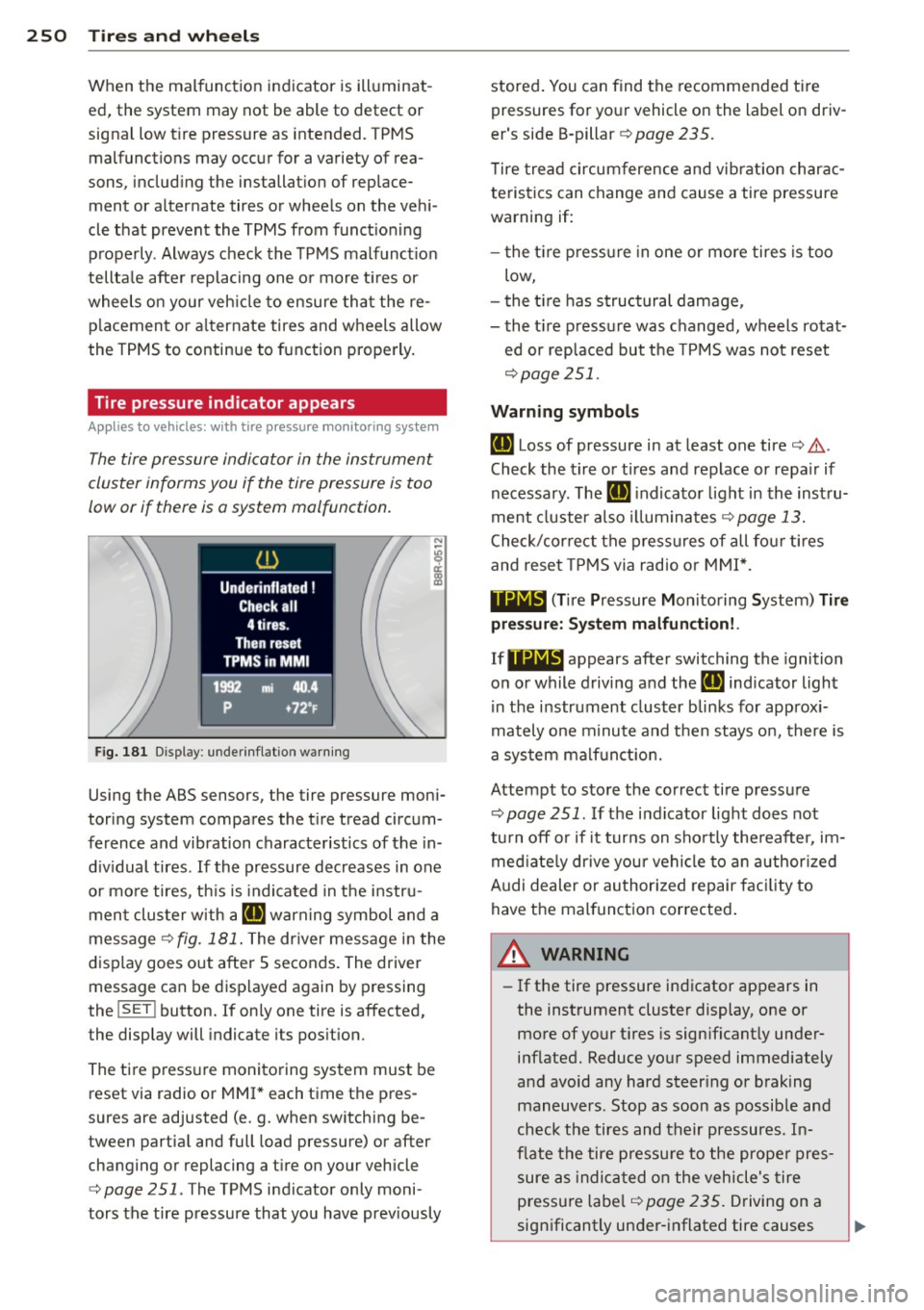
F ig. 181 Display : underinflatio n warning
Using the ABS sensors, the tire pressure moni
toring system compares the t ire tread circum
ference and vibration characteristics of the in
d iv idual tires . If the pressure decreases in one
or more tires, th is is indicated in the instru
ment cluster w ith a
IE warning symbol and a
message¢
fig. 181 . The driver message in the
display goes out after 5 seconds. The driver
message can be displayed again by pressing
the
! SE T! button. If on ly one tire is affected,
the display will indicate its pos it ion.
The tire pressure monitoring system must be reset via radio or MMI * each time the pres
sures are adjusted (e. g . when switching be
tween partia l and full load pressure) or after
changing or replacing a t ire on your vehicle
¢
page 251 . The TPMS indicator only moni
tors the tire pressure that you have prev iously stored
. You can find the recommended tire
pressures for yo ur vehicle on the label on driv
er's side B-pillar ¢
page 235.
Tire tread circumference and vibration charac
teristics can change and cause a tire pressure
warning if:
- the t ire p ress ure in one or more tires is too
low,
- the t ire has structural damage ,
- the t ire pressure was changed, wheels rotat-
ed or rep laced but the TPMS was not reset
¢ page 251.
Warning symbols
IE Loss of pressure in at least one tire¢.&. .
Check the tire or tires and replace or repa ir if
necessary. The
IE i ndicato r light in the inst ru
ment cluster a lso illuminates
¢ page 13.
Check/cor rect the press ures of all fo ur tires
and reset TPMS via radio or MMI*.
11@1~1 (Tir e Pressure Mon itoring System) Tir e
pr ess ure : Sy ste m malfun cti on!.
If11Nlf:1 appears after switching the ignition
on or while driving and the
IE indicator light
in the instrument cluster blinks for approx i
mately one minute and then stays on, there is
a system malf unct ion.
Attempt to store the correct tire pressure
¢ page 251. If the indicator light does not
tu rn
off or if it turns on sho rtly the reafter, im
med iate ly dr ive you r vehicle to a n author ized
A udi dealer or authorized repair fac ility to
have the malfunction corrected .
A WARNING
=
-If the tire pressure indicator appears in
the instrument cluster display, one or
more of your t ires is sign ificant ly under
inflated. Reduce your speed immediately
and avoid any hard steer ing or braking
maneuvers. Stop as soon as possib le and
check the tires and their pressures. In
flate the tire pressu re to the prope r pres
sure as indicated on the vehicle's tire
pressu re labe l¢
page 235. D riving on a
significantly under-inflated tire causes
Page 253 of 294
the tire to overheat and can lead to tire
failure. Under-inflation also is likely to impair the vehicle's handling and stop
ping ability .
- The driver is responsible for ma inta ining
the correct tire pressures. You must
check the t ire pressures regularly.
- Under certain cond itions (such as a spor
ty driving style, w inter condit ions or un
paved roads), the pressure monitor ind i
cator may be de layed .
-Ask your author ized Audi dealer if run
flat tires may be used on your veh icle .
You r vehicle registrat ion becomes invalid
if you use these tires when not permit
ted. Dam age to your veh icle or a cc iden ts
cou ld also resu lt.
@ Tips
- The t ire pressure monitoring system
stops working when there is an ESC/ABS
malfunction.
- Using snow chains may result in a system
malfunction.
- The t ire pressure monitoring system on
you r Audi was developed using t ires with
the "AO" or "RO" identification on the
tire sidewall¢
page 242. We recom
mend using these t ires .
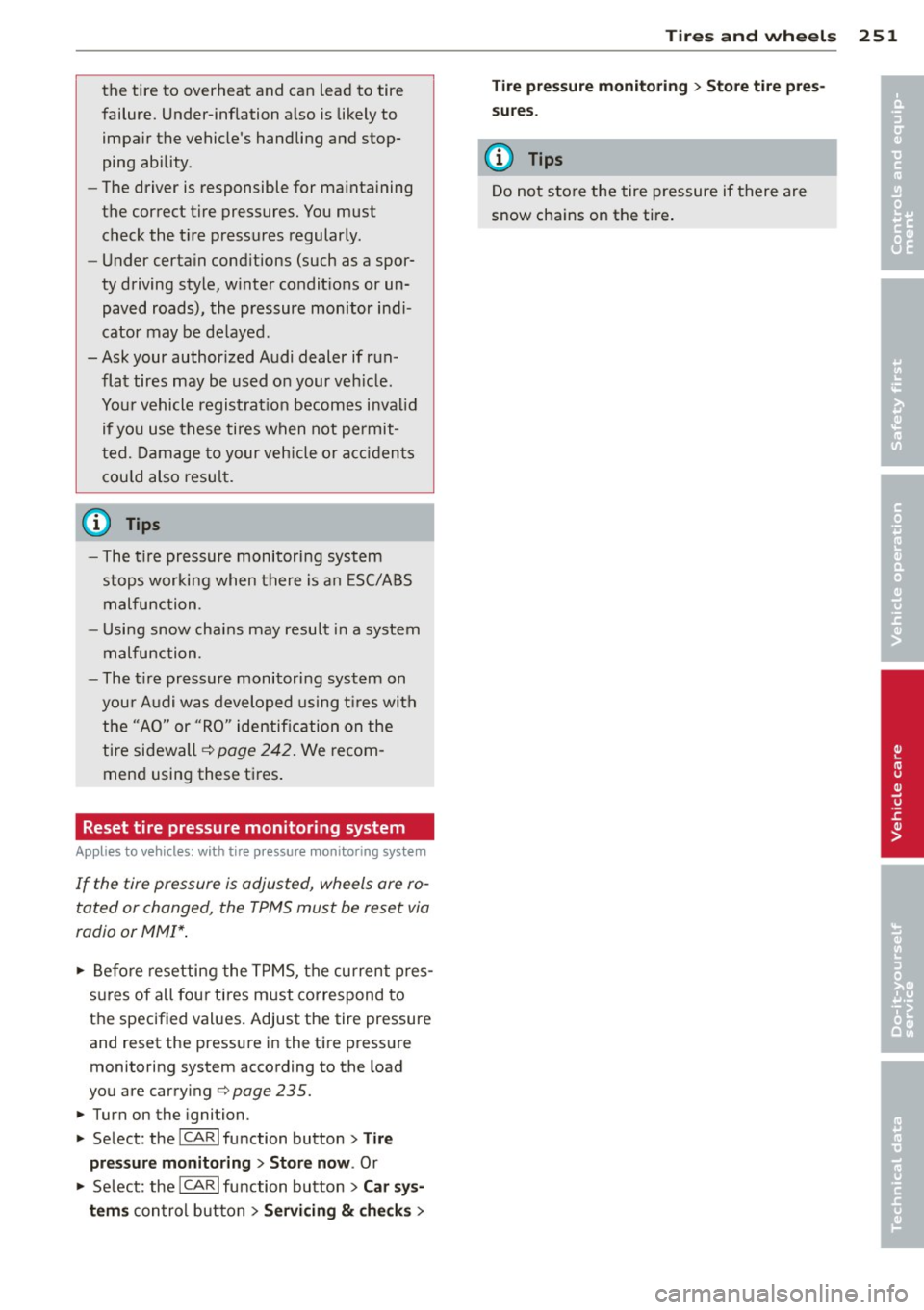
Reset tire pressure monitoring system
Applies to vehicles: with tire pressure monitoring system
If the tire pressure is adjusted, wheels are ro
tated or changed, the TPMS must be reset via
radio or MMI* .
.,. Before resetting the TPMS, the current p res
s u res of all four tires must correspond to
the specified val ues . Adjust the tire pressure
and reset the pressure in the tire press ure
monitoring system according to the load
you are carry ing
¢ page 235 .
.. Turn on the ignition .
.,. Select : the
ICARI function button> T ire
pr ess ure monitoring
> Stor e now . Or
.,. Se lect : the ICARI function button > Car sys
t e m s
control button > Serv icing & ch ecks>
Tire s an d wheel s 251
Tire pres su re mon itor ing > St ore tire pre s
s u re s.
(D Tips
Do not s to re the tire pressure if there are
snow chains on the tire .
•
•
Page 255 of 294
has been designed specifically for your type of
vehicle.
It must not be swapped with a com
pact spare t ire from another type of veh icle .
Snow cha ins
F or techn ica l reasons, the use of snow chains
on the compact spare tire is
not p ermitt ed .
If you do have to dr ive with snow cha ins and a
front tire fails, mou nt the spare whee l w it h
tire ins tead of a rea r tir e. Install the snow
chains on the rear t ire and use it to replace
the defective front tire .
A WARNING
-Never use the spare tire if it is damaged
or if it is worn down to the tread wear in
dicators.
- If the spare tire is mo re than 6 years o ld,
use it only in an emergency and w ith ex
treme caution and careful driving.
- The spare tire is intended only for tem
porary and short-term use. It should be
replaced as soon as possib le w ith the
normal wheel and t ire .
- After mounting the compact spare tire,
the tire pressure must be checked as
soon as poss ible. The tire pressure of the
compact spa re tire must be 4.2 bar ; oth
erwise, you risk hav ing an accident.
- Do not drive faster than SO mph (80 km/
h). You risk having an acc ident .
-Avo id full-throttle acce lerat ion, heavy
braking, and fast corner ing . You risk hav
ing an acc ident.
- Never drive us ing more t han one spare
wheel and tire . You risk hav ing an acci
de nt.
- No rma l summer or winte r tires must not
be mounted on the compact spare whee l
rim.
- For technical reasons, the use of ti re
ch ains on the spare tire is no t permitted.
If it is necess ary to dr ive wi th tire ch ain s,
the spare whee l must be moun ted on the
front axle in the event o f a flat in a rear
t ire. The newly ava ilable front w heel
must then be installed in place of the
What do I do now? 253
'
rea r whee l w ith the flat tire. Installing
the t ire cha in be fore mounting the whee l
and tire is recommended.
- Loose items in the passenger compart
ment can cause serious personal injury
during hard brak ing or in a n accident.
Never store the inflatable spa re tire or
jack and tools in the passenge r compart
ment.
Changing a wheel
Before changing a wheel
Observe the following precautions for your
own and your passenger 's safety when chang
ing a wheel .
.,. After you expe rie nce a tir e fail ure, p ull the
car we ll away from mov ing traffic and try to
reac h
level ground before you stop ¢ .&, .
.,. All passengers should
leave the car and
move to a safe location ( for instance, behind
the guardra il) ¢ .&, .
.,. Engage the
park ing brake to prevent your
veh icle from rolling unintentionally¢.&, .
.,. Shift into
1st gear on veh icles with man ual
transm iss ion, or move th e
selector lever to
the P po sition
on vehi cles w ith automa tic
t ra nsm iss io n.
.,. If you are towing a tra iler : u nhi tch the trail
er from your vehicle .
.,. Take the
ja ck r=:> page 252 and the spare tire
r=:> page 252 out of the luggage compart
ment.
A WARNING
You o r you r passengers could be i njured
while changing a w heel if you do not fo l-
low these saf ety p recaut ions :
- If you have a fla t tire, move a safe d is
tance off th e road . T urn off the engine,
tur n the eme rgency flashers on and use
o ther warni ng devi ce s to a le rt other mo
t oris ts.
- Ma ke sure tha t passenge rs wait in a safe
p la ce aw ay from the vehicle and well
-
away from the road and tra ffic. .,. •
•
Page 256 of 294
254 What do I do now?
-To help prevent the vehicle from moving
sudden ly and possibly slipping off the
jack, always fully set the parking brake
and block the wheel diagonally opposite
the wheel being changed with the fold ing chocks or other objects. When one
front whee l is lifted off the gro und, plac
ing the A utomat ic Transm iss io n in "P"
(Park) will
not prevent the vehi cle from
moving .
- Be fore yo u change a wheel, be sure the
ground is leve l and fi rm . If necessa ry,
use a sturdy board under the jack.
- After installing the spare tire, make sure
that you replace the f lat ti re/wheel in its
storage area properly and tighten the
knurled retain ing screw secu rely .
@ Note
If you are chang ing the wheel on a steep
incline, use a rock or similar object to
block the opposite wheel to prevent the
veh icle from mov ing.
(D} Tips
Obey a ll laws .
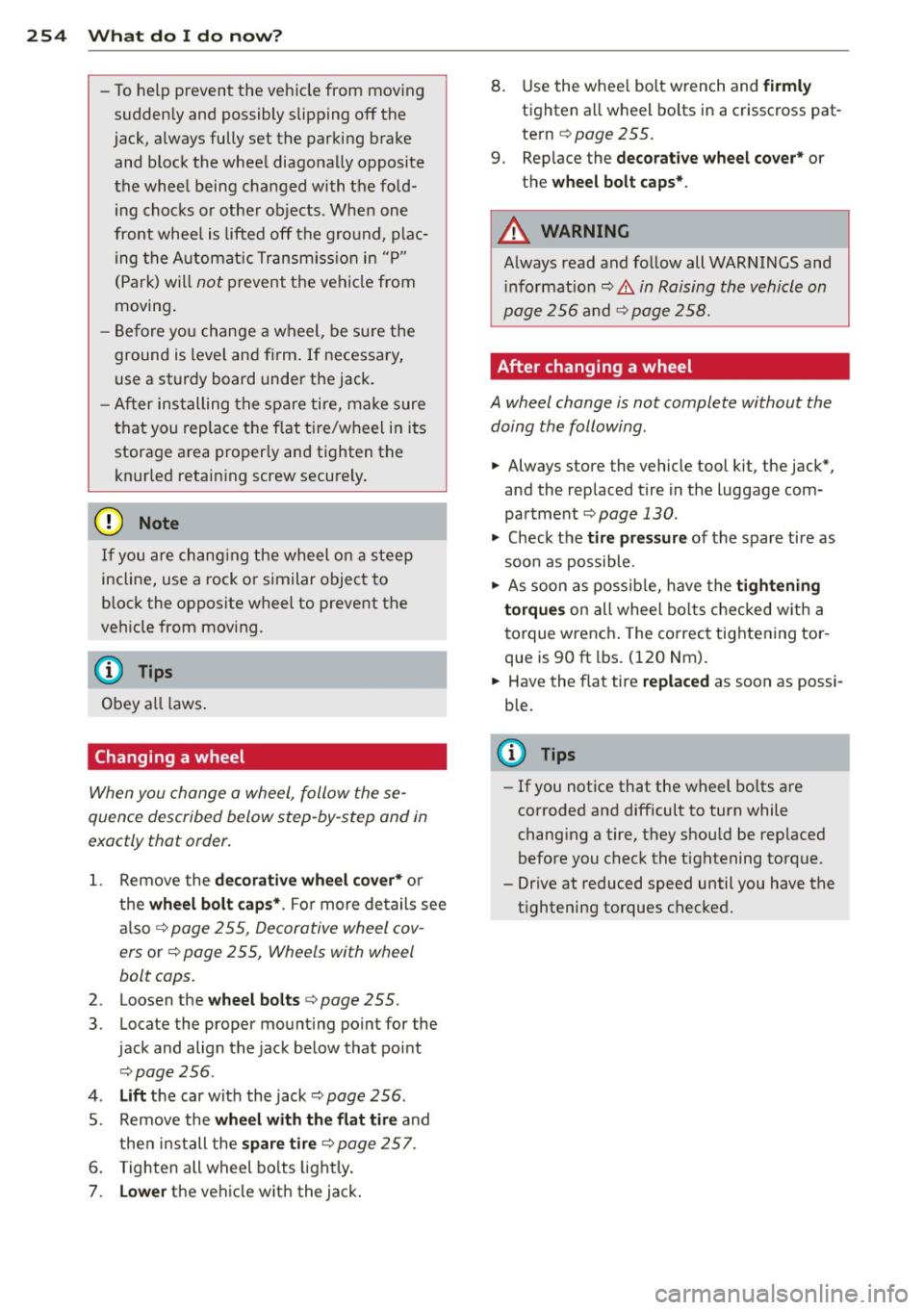
Changing a wheel
When you change a wheel, follow the se
quence described below step -by -step and in
exactly that order.
1. Remove the decorative wheel c ove r* or
the wheel bolt cap s*. For more de tails see
a lso
¢ page 255, Decorative wheel cov
ers
or ¢ page 255, Wheels with wheel
bolt caps.
2 . Loosen the wheel bolts ¢ page 255.
3. Locate the proper mount ing point for the
jack and align the jack below that point
¢ page 256.
4. Lift the car with the jack¢ page 256 .
S. Remove the wheel with th e flat tire and
then install the spare tire
¢page 257.
6. Tighten all wheel bo lts ligh tly.
7 . lowe r the ve hicle w ith the jack . 8
. Use the wheel bolt w rench and firmly
tighten all wheel bolts in a crisscross pat
te rn
¢ page 255.
9. Replace the decorati ve wheel cover * or
the wheel bolt caps *.
A WARNING
Always read and fo llow all WARNINGS and
in fo rmat ion¢ .&.
in Raising the vehicle on
page 256
and ¢ page 258.
After changing a wheel
A wheel change is not complete without the
doing the following .
.,. Always store the vehicle tool kit, the jack*,
and the replaced tire in the luggage com
partme nt
¢ page 130.
.,. Check the tire pressure of the spare tire as
soon as possible.
.,. As soon as poss ib le, have the tightening
torque s on all whee l bolts chec ked w ith a
to rque wrenc h. The co rrect tighte ning tor
que is
90 ft lbs. (120 Nm) .
.,. Have the flat tire replaced as soon as possi
ble.
@ Tips
- If you notice that the wheel bo lts a re
co rroded and difficult to turn while
chang ing a tire, they shou ld be rep laced
before you check the tightening torque.
- Dr ive at reduced speed until you have the
tightening torques checked.
Page 260 of 294
258 What do I do now?
-The w heel bolt s should be clea n and easy
to tu rn. Check for dirt and corrosion on
t h e mat ing s urfaces o f both the whee l
and the h ub. Remove a ll dirt from these
su rfaces befor e remo unt ing the wheel.
- Do no t use the hexagona l socket in the
screwdriver handle to l oosen o r ti gh ten
t h e wheel bo lts .
Tires with unidirectional tread design
Tires with unidirectional tread design must be
mounted with their tread pattern pointed in the right direction .
Using a spare tire with a tread pattern
intended for use in a specific direction
When using a spare tire w it h a t read patte rn
in te nded for use in a specific direction, p lease
n ote t he follow ing:
- The direction of rotation is marked by an
ar
row on the side of the tire .
-If the spare t ire has to be installed in the in
correct d irection, use the spare tire only
temporarily si nce the t ire will not be able to
achieve its optimum perfo rma nce character
ist ics w ith r ega rd to aquaplani ng, noise and
wea r.
- We recommend tha t you pay particular at
tent io n to this fact du ring wet weathe r and
t h at you a djust your spee d to matc h roa d
condition s.
- Re place the fla t tire w ith a n ew on e and
h av e it installed o n your ve hicle as soon as
p ossib le to res tore the ha nd ling ad vantages
o f a un idirect ional t ire.
Notes on wheel changing
Please rea d the information c::> page 242, New
tires and replacing tires and wheels
if you are
go ing t o use a spare t ire which is different
from the tires on your ve hicle.
Afte r you change a tire :
-Check the tire pressure on the spare imme
diately after installation. -
Have the wheel bolt tightening torque
checked with a torque wrench as soon as
possible by your authorized Audi dealer or
a qualified workshop.
- With steel and alloy wheel rims, the wheel
bolts are correctly tightened at a torque of
90 ft lbs. (120 Nm).
- If you notice that the wheel bolts are cor ·
roded and difficult to turn while chang ing
a tire , they should be replaced before you
check the tightening torque .
- Replace the flat tire w ith a new one and
have it installed on your vehicle as soon as
possible. Remount the wheel cover.
Until then, drive with extra care and at re·
duced speeds.
A WARNING ..__ -
- If you are going to equ ip your ve hicle
wit h tir es o r rims which differ from th ose
which w ere fac tory i nstalled, then be
s ure to read the information
c::> pag e 242 ,
N ew t ires and repl acin g tires and
wheels.
- Always make sure the dam age d wheel o r
eve n a flat tire and t he jack and to ol kit
a re p roperly secu red in the lugg age com
p art ment and are no t loose in the pas
sen ger compartment.
- In an a cci dent or sudde n maneuver they
co uld fly forwa rd, in juring a nyone in the
veh icle.
- Always s to re damage d whee l, jack an d
too ls sec urely in the l ugga ge com pa rt
ment. Othe rwise, in a n accide nt or s ud
den maneuver they co uld f ly forwa rd,
causing inj ury to passe ngers in the ve hi
cle .
(I) Note
Do not use comme rcially ava ilab le tire
sea lants. Ot herwise , th e e lectr ica l comp o
nents of the tire pressu re monitoring sys
tem* w ill no longe r work pr oper ly and th e
se nso r fo r th e tire pressure moni tor ing
syst em* will have to be repla ced by a
qu alifie d w ork s hop .
Page 278 of 294
2 76 Consumer Information
Technical Modifications
Our guidelines must be complied with when
technical modifications are made .
Always consult an authorized Audi dealer be
fore starting work on any modifications.
This will help ensure that vehicle function,
performance and safety are not impaired
¢ &. .
Attempting to work on electronic components
and the software used with them can cause
malfunctions. Because of the way electronic
components are interconnected with each
other, such malfunctions can also have an ad
verse affect on other systems that are not di
rectly involved. This means that you risk both
a substantial reduction in the operational
safety of your vehicle and an increased wear of
ve hicle parts ¢
A:,..
Author ized Audi dealers will perform th is
wo rk in a professiona l and competent manner
or, in special cases, refer you to a professional
company that specializes in such modifica
tions .
A WARNING
-
Improper repairs and modifications can
change the way vehicle systems work and
cause serious personal injury.
(D Note
If emergency repairs must be performed
elsewhere, have the vehicle examined by
an authorized A udi dealer as soon as possi
ble.
Declaration of
Compliance, Telecom
munications and
Electronic Systems
Radio Frequency Devices and Radiocommuni
cation Equipment User Manual Notice.
The manufacturer is not responsib le for any
radio or TV interference caused by unauthor
ized modifications to this equipment.
Devices
T he following devices each comply with FCC
Part 15.19, FCC Part 15.21 and RSS-Gen Iss ue
1:
- Adapt ive cru ise control*
- Conven ience key*
- Aud i side assist*
- Cell phone package*
- Electron ic immobilizer
- Homelink ® universal remote control*
- Remote control key
- Tire pressure monitoring system*
FCC Part 15.19
This device complies with part 15 of the FCC
Rules . Operation is subject to the follow ing
two conditions:
(1) This device may not cause harmful inter
ference, and
(2) this device must accept any interference
received, including interference that may
cause undesired operation.
FCC Part 15.21
CAU TION:
Changes or mod ifications not expressly ap
proved by the party responsible for compli
ance could void the user 's authority to operate
the equipment .
RSS-Gen Issue 1
Operation is subject to the following two con
ditions:
Page 282 of 294
28 0 Index
Changing engine o il
Chass is 222
Unde rcoat ing . ........... .... .... . 205
Checking
Eng ine coolant leve l .... ... .. .. .. .. .
223
Checking tire pressure . ... .. .. .. .. .. . 237
Ch ild restra ints
Da nger of us ing ch ild restra ints in the
front seat . . . . . . . . . . . . . . . . . . . . . . . .
143
Where can I get additional information
about child restraints and their use? ..
184
Ch ild restra int system anchors . .. .. .. . 180
Ch ild safety .. .. . .......... .. .. .... . 166
Convertible locking retractor . . . . . . . . . 176
Important safety instructions for us ing
ch ild safety seats .. ..... .. .. .. .. .. .
169
Important th ings to know when dr iving
with ch ildren . ............. .. .... .
166
Ins tall ing a chi ld restraint using the
L A T C H system .. ... .... ... .. .. .... .
181
Lower anchorages ..... ... .. .. .... . 181
Mounti ng and releasing the ancho rage
hook .. .. .. ............. .. .. .. ...
181
Tether anchors . . . . . . . . . . . . . . . . . . . . 182
Tether straps . . . . . . . . . . . . . . . . . . . . . 182
Chil d safety seats .. ..... ... .. .. .... . 172
Booste r seats .. .. ..... ... .. .. .... . 174
Convertible child seats .... .. .. .... . 173
Convertible locking retractor .. .. ..... 176
Danger of us ing ch ild restra ints in the
front seat . . . . . . . . . . . . . . . . . . . . . . . .
143
H ow do I properly install a child safety
seat in my vehicle? ............ .. ...
169
Infant seats ............. .. .. .. .. . 172
Ins tall ing .. ... .......... .. .. .. .. . 176
LA T CH system .. .. ..... ... .. .. .... . 181
Safety instructions ..... ... .. .. .... . 169
Unused safety belts on the rear seat . . 17 1
Cigare tte lig hte r . . . . . . . . . . . . . . . . . . . . . 59
C leaning
A lcantara ® (synthetic suede) .. .. .. .. .
209
Eng ine compartment .......... .. ... 209
Exhaust tail p ipes ...... .... ... .. .. . 205
Fab rics and fabr ic coverings .. .. ..... 206
Instrument panel ....... .. .. .. .. .. . 207
In ter ior .. ... ............ .. .. .. .. . 206
Leather ..... .. .. ..... ... .. .. .... . 208
MMI disp lay/controls . ... .. .. .... .. . 206
Plastic and vinyl . .... .. ..... .... . .. 203
Plastic parts ..... .. ... ..... ... .. .. 207
Safety be lts ... .. ... .. ..... ... .. .. 209
Tr im strips .... .. ............. .... 203
Cleaning and p rotection .......... .... 2 00
Cl imate controls ... ..... ........... .. 67
Climate control system
Automatic recircu lation ......... .... .
70
synchroni zing .. .. ............. .. .. . 70
Clock . . . . . . . . . . . . . . . . . . . . . . . . . . . . . . 12
Closing
Panoramic t ilting sunroof ........ ... .
41
Power w indows ... ............ .. .. . 40
Su n blind ..... .. .. ........... .... . 41
Closing/opening
at the lock cylinder . . . . . . . . . . . . . . . . . . 3 7
by remote control ..................
35
with the centra l locki ng switch ... .... . 36
with the conven ien ce key ........ .. .. . 36
Co ld tire inflation pressure . ........... 235
Coming home ..... ... .. ..... ... .. .. . 44
Compact spare tire . .. .. ...... ... .. .. 252
also refer to Spare ti re .......... .... 252
Compartments . . . . . . . . . . . . . . . . . . . . . . 60
Compass in the mirror . .. ..... ... .. .. .
51
Compliance . ...... .. .............. . 276
Consumer Information . . . . . . . . . . 132, 273
Contacting NHTSA . ... .......... .. .. 132
Convenience key
Indicator lights .. ... .. .. ... ..... .. .
75
Start ing engine (S TART E NGIN E STOP
button) ... .... ................... .
74
Stopping the eng ine (START ENG IN E
STOP b utton) .... .. .... .... ... .. .. .
75
Switching on ignition . .. ..... .... . .. . 74
unlocking/locking . .... ..... ... .. .. . 36
Co nvenience openi ng/clos ing ... .. .... . 40
Convertib le child safety seats ..... .... 173
Convertib le locking retractor
Activating ..... .. .. ... ..... ... .. ..
178
Deact ivat ing ... .. .. .... .... ... .. .. 178
Using to secure a child safety seat l.76, 178
Coolant system .. .. ... .......... .. .. 223
Cooling mode (automat ic cl imate co ntrol) 68
Cooling System
Expansion tank . .. ............. .. ..
223