flat tire AUDI A5 COUPE 2013 User Guide
[x] Cancel search | Manufacturer: AUDI, Model Year: 2013, Model line: A5 COUPE, Model: AUDI A5 COUPE 2013Pages: 294, PDF Size: 73.84 MB
Page 242 of 294
240 Tires and whee ls
Determining correct load limit
Use the example below to cal
culate the total weight of the
passengers and luggage or oth
er things that you plan to trans
port so that you can make sure
that your vehicle will not be overloaded.
Steps for Determining
Correct Load Lim it
1 . Locate the statement "THE
COMB INED W EIGHT OF OC
CUPANTS AND CARGO
SHOULD NEVER EXCEED XXX KG OR XXX LBS"on your vehi
cle's placard (tire inflation
pressure label)
c::> page 235,
fig. 176.
2.
Determ ine the comb ined
weight of the driver and pas
sengers that will be riding in
your vehicle .
3. Subtract the combined weigh t of the dr iver and pas
sengers from
"XXX " kilo
grams or
"XXX" pounds
shown on the sticker
c::> page 235, fig . 176 .
4. The resulting figure equals
the available amount of cargo and luggage load capaci
ty . F or examp le, if the "XXX"
amount equals 1400 lbs. and there will be five 150
lbs . passengers in your vehi
cle, the amount of available
cargo and luggage load ca pacity is 650 lbs . (1400 -750
(5
X 150) = 650 lbs .)
5 . D etermine the combined
weight of luggage and cargo be ing loaded on the vehicle.
That we ight may not safely
exceed the available cargo
and luggage load capacity
calculated in Step
4 .
6. If your vehicle will be towing
a trailer, load from your trail
er will be transferred to your
vehicle . Consu lt this manual
to determine how this re
duces the available cargo
and luggage load capacity of
your vehic le .
.,. Check the tire sidewall
(c::> page 242, fig. 180) to de
termine the designated load rating for a specific tire .
Page 244 of 294
242 Tires and wheels
& WARNING
Sudden tire failure can lead to loss of con
trol, a crash and serious persona l injury!
- Never drive a vehicle when the tread on
any tire is worn down to the wear indica
tors.
- Worn tires are a safety hazard, they do
not grip well on wet roads and increase
your risk of "hydroplaning" and loss of control.
- Always keep chemicals that can cause tire damage, such as grease, oil, gasoline
and brake fluid away from tires.
- Tires age even if they are not be ing used
and can fail suddenly, especially at high
speeds. Tires that are more than 6 years
old can only be used in an emergency
and then with special care and at lower
speeds.
- Never mount used tires on your vehicle if
you are not sure of their "previous histo
ry." Old used tires may have been dam
aged even though the damage cannot be
seen that can lead to sudden tire failure
and loss of vehicle control.
New tires and replacing tires and wheels
New tires and wheels have to be broken in .
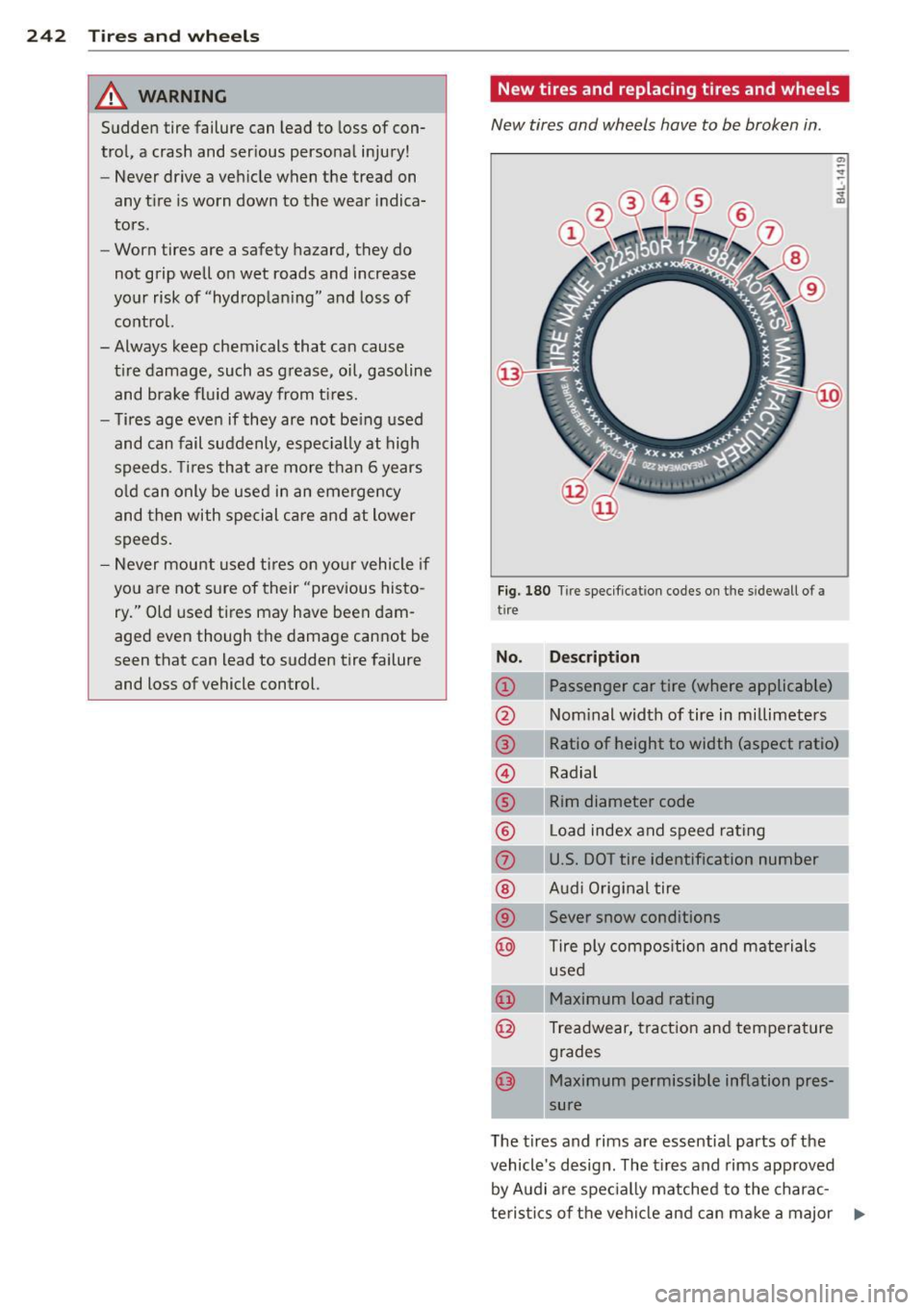
Fig. 180 Tir e specificat ion codes on the s idewall of a
t ire
No. Description
(!) Passenger car tire (where applicable)
@ Nominal width of tire in millimeters
@ Ratio of height to width (aspect ratio)
© Radial
® Rim diameter code
@ Load index and speed rating
(J) U.S. DOT tire identification number
@ Audi Orig inal tire
@ Sever snow conditions
@ Tire ply composition and materials
used
Maximum load rating
Treadwear, traction and temperature
grades
Maximum permissible inflation pres
sure
T he tires and rims are essential parts of the
vehicle 's design . The tires and rims approved
by Audi are spec ially matched to the charac
teristics of the vehicle and can make a major .,..
Page 245 of 294
contribution to good road holding and safe
handling when in good condition and properly
inflated
¢ .&. .
We recommend that all work on t ires and
wheels be performed by an authorized A udi
dealer. They are familiar with recommended
procedures and have the necessary spec ial
too ls and spare parts as we ll as the proper fa
cilities for dispos ing of the old tires .
Authorized Audi dealers have the necessary information about techn ica l requ irements for
installing or changing tires and r ims.
R eplacing t ires and wheel s
Tires shou ld be rep laced at least in pairs and
not individua lly (for example both front tires
or both rear tires together).
Be s ure to read and heed the information to
the tire pressure monitoring system*
¢ page 249.
Always buy rep lacement radial tires that have
the same specifications as the t ires approved
for your ve hicle by Audi. Replacement tires
must always have the same load rating speci
fication as the original equipment or approved
optional tires listed in the table
¢ page 235.
Audi-approved specification tires are specially
matched to your vehicle and its load limits ,
and can contribute to the important road hold
ing, driving character istics, and safety of the
veh icle. The table
( ¢ page 235) lists spec ifica
tions o f the t ires approved for the Audi mod
e ls covered by your Owner 's Literature .
T he tire pressure labe l located on dr iver 's side
B-pillar (¢
page 235, fig. 177) lists the speci
fications o f the orig inal equipment tires in
stalled on your veh icle at the time it was man
ufactured .
Federal law requires t ire manufacturers to
p lace s tanda rd iz ed information on the s ide
wall of all tires¢
fig. 180 . This information
i dent ifies and desc ribes the fundamental
characterist ics , the quality grade of the tire
and a lso provides a tire ide ntificat io n number
Tire s an d wheel s 243
for sa fety standard certification and in case of
a reca ll.
Tire specifications
Knowledge of tire specifications makes it eas
ier to choose the co rrec t tires . Radial ti res
have the tire specifications marked on the
sidewa ll, for examp le:
P255 / 35 Rl 9 96Y XL
This co nta ins the following information :
P Indicates the tire is for passenger cars
(where app licab le)
255 Nom inal tire width i n mm of the tire
from sidewall edge to sidewall edge. In
general, the larger the number, the wider
the tire
35 Height/w idth ratio in percent (aspect ra -
t io)
R Tire construct ion: Radial
1 9 Rim diameter code (i n inches)
96 Load rating code
Y Speed ra ting letter code
XL (or "xl", " EXTRA LOAD", or "RF" Indicates
t h at the t ire is a"Re info rced" or an " Extra
Load " tir e
M+S (or "M/S") Indicates that the ti re has
some mud and snow capab ility
The tires could also have the informat ion of
direction of rotation ¢
page 231 .
Tire manufacturing d ate
The manufact uring date is also indicated on
the tire sidewall (possibly only on the
inner
s ide of the wheel):
"DOT ... 2212 .. . "means, for examp le, that
the tire was produced in the 22nd week of 2012.
Speed rating (letter cod e)
The speed rating letter code on the whee ls in
dicates the maximum permissible road speeds
¢ .&. in Winter tires on page 247.
P up to 93 mp h (150 km/h)
Q up to 99 mp h (1 58 km/h)
R up to 106 mph ( 170 km/h)
•
•
Page 246 of 294
24 4 T ire s and wheel s
S up to 110 mph (180 km/h)
T up to 118 mph (190 km/h)
U up to 124 mph (200 km/h)
H up to 130 mph (210 km/h)
V up to 149 mph (240 km/h)1l
Z over 149 mph (240 km/h)ll
W up to 168 mph (270 km/h)ll
Y up to 186 mph (298 km/h)
1 l
Your veh icle is no rma lly factory equipped with
tires, which possess excellent driving cha rac
terist ics and give yo ur Audi opt imum d riving
comfort . An e lectronic speed limiter
c::> page 31 will normally prevent your vehicle
from going faster than the tire speed rating
¢ &. .
U.S. DOT Ti re Identification Numb er (TIN)
and ti re manuf actur e date
This is the tire's "serial number" . It begins
with the letters "DOT" and indicates that the
tire meets all federal standards. The next two
numbers or letters indicate the plant where it
was manufactured, and the last four numbers
represent the week and year of manufacture.
For example, the numbers 2212 mean that
the tire was produced in the 22nd wee k of
2012. The other n umbers are mar keting co
des that may or may not be used by the tire
manufacturer . This information is used to con
tact consumers if a tire defect requires a re
call.
Audi Original tir e
Tires with the identification "AO" or "RO" have
been specia lly matched with your Audi . We
recommend using only these tires because
they meet the highest standards regard ing
safety and driving character istics when used
correctly. Your authorized Audi dealer will
glad ly provide you with more information.
Tire ply compo sit ion and materi als used
The number of plies indicates the number of
l ayers of rubber-coated fabric in the tire. In
ll For tir es w it h a m ax im um spee d ca pabil ity ove r
1 4 9 mp h (2 40 k m/h) , t ire man ufact urers somet imes
u se the letters "ZR. "
genera l, the greater the number of plies, the
more weight a tire can support. Tire manufac
turers also must indicate the mate rials in the
t ire, which include steel, nylon, po lyester, and
others.
Ma ximum Load Rating
This number ind icates the maximum load in
ki lograms and pounds that can be carried by
the tire.
Tire quality grading for treadwear ,
traction , and t emp eratu re resi stance
T read wear, t raction and temperat ure grades
c::> page
245.
Ma ximum Permi ssible Inflat ion Pressure
T h is number is the greatest amount of a ir
pressure that should ever be put in the tire
u nder norma l driving cond itions.
.&, WARNING ~ -
- Using incorrect or unmatched tires and/
or wheels or improper tire and wheel
comb inat ions can lead to loss of control ,
coll is ion and serious personal injury.
-Always use t ires, rims and whee l bolts
that meet the specifications of original
factory- installed tires or other combina
tions that have been specifically ap
p roved by the vehicle manufacture r.
- Tires age even if they are not being used
and can fail suddenly, especially at high
speeds. Tires that are more than 6 yea rs
old can only be used in an emergen cy
a nd then w it h specia l care and at lower
speeds.
- Never mo unt used tires on your veh icle if
you are no t sure of the ir "previo us histo
ry." O ld used tires may have been dam
aged even though the damage cannot be
seen that can lead to sudden tire fa ilure
and loss of vehicle control.
Page 247 of 294
-All four wheels must be fitted with radial
tires of the same type, size (rolling cir
cumference) and the same tread pattern .
Driving with different tires reduces vehi
cle handling and can lead to a loss of
control.
- If the spare tire is not the same as the
tires that are mounted on the vehicle -
for example with winter tires -only use
the spare tire for a short period of time and drive with extra care. Refit the nor
mal road wheel as soon as safely possi
ble.
- Never drive faster than the maximum
speed for which the tires on your vehicle
are rated because tires that are driven
faster than their rated speed can fail
suddenly.
- Overloading tires cause heat build-up,
sudden tire failure, including a blowout
and sudden deflation and loss of control.
- Temperature grades apply to tires that
are properly inflated and not over or un
derinflated .
- For technical reasons it is not always
possible to use wheels from other
vehicles -in some cases not even wheels
from the same vehicle model.
- If you install wheel trim discs on the ve
hicle wheels, make sure that the air flow
to the brakes is not blocked. Reduced air
flow to the brakes can them to overheat,
increasing stopping distances and caus
ing a collision.
- Run flat tires may only be used on
vehicles that were equipped with them at the factory. The vehicle must have a
chassis designed for run flat tires and a
factory-installed tire pressure monitor ing system* that indicates a loss of tire
pressure. Incorrect use of run flat tires
can lead to vehicle damage or accidents.
Check with an authorized Audi dealer or
tire specialist to see if your vehicle can be
equipped with run flat tires .
If run flat
tires are used, they must be installed on
all four wheels. Mixing tire types is not
permitted.
Tires and wheels 245
@ Note
- For technical reasons, it is not generally
possible to use the wheel rims from oth
er vehicles. This can hold true for wheels
of the same vehicle type.
- If the spare tire is different from the
tires that you have mounted on your ve
hicle (for example winter tires or wide
profile tires), then use the spare tire for a
short period of time only and drive with
extra care. Replace the flat tire with the
tire matching the others on your vehicle
as soon as possible.
- Never drive without the valve stem cap .
The valves could get damaged.
(® For the sake of the environment
Dispose of old tires in accordance with the
local requirements.
Uniform tire quality grading
- Tread wear
- Traction AA A B C
- Temperature ABC
Quality grades can be found where applicable
on the tire side wall between tread shoulder
and maximum section width
c:> page 242,
fig. 180 .
For example: Tread wear 200, Traction AA,
Temperature A.
All passenger car tires must conform to Feder
al Safety Requirements in addition to these
grades.
Tread wear
The tread wear grade is a comparative rating
based on the wear rate of the tire when tested
under controlled conditions on a specified
government test course.
For example, a tire graded 1S0 would wear
one and one half (1 1/2) times as well on the
government course as a tire graded 100.
1JJ>
•
•
Page 248 of 294
246 Tires and wheels
The relative performance of tires depends
upon the actual conditions of their use, how
ever, and may depart significantly from the norm due to variations in driving habits, serv
ice practices and differences in road character
istics and climate.
Traction
The traction grades , from highest to lowest,
are AA, A, Band
C. Those grades represent the
tire's ability to stop on wet pavement as measured under controlled conditions on
specified government test surfaces of asphalt
and concrete . A tire marked C may have poor
traction performance ¢.&, .
Temperature
The tempera ture grades are A (the highest),
B, and
C, representing the tire's resistance to
the generation of heat and its ability to dissi
pate heat when tested under controlled condi
tions on a specified indoor laboratory test
wheel.
Sustained high temperature can cause the
material of the tire to degenerate and reduce
tire life, and excessive temperature can lead
to sudden tire failure~.&, .
The grade
C corresponds to a level of perform
ance which all passenger car tires must meet under the Federal Motor Vehicle Safety Stand
ard No.
109. Grades Band A represent higher
levels of performance on the laboratory test
wheel than the minimum required by law.
A WARNING
The traction grade assigned to this tire is
based on straight-ahead braking traction
tests, and does not include acceleration,
cornering, hydroplaning or peak traction
characteristics.
A WARNING
The temperature grade for this tire is es
tablished for a tire that is properly inflated
and not overloaded . Excessive speed, un
derinflation, or excessive loading, either
-
separately or in combination, can cause heat buildup and possible tire failure.
Winter tires
Winter tires can improve vehicle handling on
snow and ice. At temperatures below 45 °F (7 °C) we recommend changing to winter
tires.
In some heavy snow areas, local governments
may require true winter or "snow" tires, those
with very deeply cut tread . These tires should
only be used in pairs and be installed on all
four wheels . Make sure you purchase snow
tires that are the same size and construction
type as the other tires on your vehicle .
Your vehicle is equipped with all wheel drive,
this will improve traction during winter driv
ing, even with the standard tires. However, we
strongly recommend that you always equip all
four wheels on your vehicle with correctly fit
ted winter tires or all-season tires, when win
ter road conditions are expected. This also im
proves the vehicle's braking performance and
reduces stopping distances.
Summer tires provide less grip on ice and
snow.
Winter tires (snow tires) must always be fitted
on all four wheels.
Ask your authorized Audi dealer or qualified
workshop for permitted
winter tire sizes . Use
only radial winter tires.
Winter tires lose their effectiveness when the
tread is worn down to a depth of
O .15 7 inch
(4 mm).
Only drive with winter tires under winter con
ditions. Summer tires handle better when
there is no snow or ice on the roads and the
temperature is above 45 °F (7 °().
If you have a flat ti re, see notes on spare
wheel
¢page 242.
Please always remember that winter tires may
have a lower speed rating than the tires origi-
nally installed on your vehicle at the time it .,.
Page 249 of 294
was manufacture d. Please see ¢ page 243,
Speed rating (letter code) for a listing of the
speed rat ing letter codes and t he maxim um
speed at whic h the tires can be driven .
The s peed rating letter code(¢
page 233) is
on the side wall of the tire
c::> page 242 .
A WARNING
Winter tires have maximum speed limits
that may be lower than your vehicle's max
imum speed. Always know the maximum
speed before driving off . Never drive faster
than the speed permitted for your specific
w inte r tir es . This will cause damag e to the
ti res leading to an ac cident and serious
pe rsonal in jury to you and yo ur passen
gers .
A WARNING
Driv ing faster than the maximum speed
for which the winter tires on your vehicle
were designed can ca use tire fai lure in
cl uding a blowout and sudden deflat ion,
loss of control, crashes and serious per
sonal injuries . Have worn or damaged tires
rep laced immed iate ly.
- Winter tires have maximum speed rat ing
that may be lower tha n your veh icle's
maximum speed .
- Never drive faster than the speed for
w hich the winter or other tires installed
on your veh icle are rated .
A WARNING
Always adjust your d rivi ng to the road and
traffic conditions. Neve r let the good ac
c eleration of the w inte r ti res and all whee l
drive temp t you in to taking extra r is k s . A l
ways remember:
- When bra king, an a ll whee l dr ive vehicle
hand les in the s ame way as a front drive
vehicle.
- Drive carefu lly and reduce your speed on
icy and slippery roads, even winter tires
cannot he lp un der blac k ice conditions.
Tire s an d wheel s 24 7
'
@) For the sake of the environment
Use summer tires when weather condi
tions permit. They are qu ieter, do not wear
as quickly and reduce fuel consumpt ion.
Snow chains
Snow cha ins may be fitted only to the front
whee ls, and o nly to certain tire sizes . Ask your
autho rized Aud i deale r on which tire sizes
snow c ha ins can be used.
The snow chains must have low-prof ile links
and must not be t hicker than 0.53 inch
(13.5 mm) , includ ing the lock .
Remove wheel center covers and trim discs
before putt ing snow cha ins on your vehicle
c::> Q) . For safety reasons cover caps must then
be fitted over the wheel bolts. These are ava il
able from autho riz ed Aud i dealers.
A WARNING
Using the wrong snow chai ns for your vehi
cle o r insta lling them in co rr ect ly can in
crease the risk of loss of cont ro l leading to
serious pe rsonal injury.
- Snow chains are available in different
sizes. A lways make sure to follow t he i n
structions p rov ided by the snow chain
manufacturer.
- When driving with snow chains never
drive faster than the speed permitted for
your specif ic snow chains.
- Always observe local regulations .
(D Note
-Remove s now c hain s be fo re dr iv ing o n
roads not covered with snow to avoid
damaging tires and wea ring the snow
chains down unnecessa rily.
- Snow chains, which come into direc t con
tact with the whee l rim , can scratch or
damage it . Therefo re, make sure that the
snow chains are s uitably covered. Check
the pos ition of the snow chains after
•
•
Page 250 of 294
248 Tires and wheels
driving a few yards and correct if neces
sary. Follow the instructions from the
snow cha in manufacturer when doing so.
(D Tips
Where snow chains are mandatory oncer
tain roads, this normally also applies to
vehicles with all wheel drive.
Wheel bolts
Wheel bolts must always be tightened to the
correct torque.
The design of whee l bolts is matched to the
factory installed rims. If different rims are fit
ted, the correct wheel bolts with the right length and correctly shaped bolt heads must
be used. This ensures that wheels are fitted
securely and that the brake system functions
correctly .
In certain circumstances, you may not use
wheel bolts from a different vehicle -even if it
is the same model
¢ page 275.
.&_ WARNING
Improperly tightened or maintained wheel
bolts can become loose causing loss of
control, a collision and serious persona l in
Jury.
- Always keep the wheel bolts and the
threads in the wheel hubs clean so the
wheel bolts can turn easily and be prop
erly tightened.
- Never grease or oil the wheel bolts and
the threads in the wheel hubs. They can
become loose while driving if greased or
oiled, even if tightened to the specified
torque.
- Only use wheel bolts that belong to the
rim being installed.
- Never use different wheels bolts on your
vehicle.
- Always maintain the correct tightening
torque for the wheel bolts to reduce the
risk of a wheel loss . If the tightening tor
que of the wheel bolts is too low, they
can loosen and come out when the veh i- cle
is moving.
If the tightening torque is
too high, the wheel bolts and threads
can be damaged and the wheel can be
come loose.
(D Note
The specified torque for the whee l bolts is
90 ft lbs . (120 Nm) with a tolerance of
± 7,4 ft lbs. (± 10 Nm). Torque wheel bolts
diagonally . After changing a wheel, the
torque must be checked as soon as possi
ble with a torque wrench -preferably by an
authorized Audi dealer or qualified work
shop.
Low aspect ratio tires
Your Audi is factory -equipped with low aspect
ratio tires. These tires have been thoroughly
tested and been se lected specifically for your
model for their superb performance, road feel
and handling under a variety of driving condi
t ions . Ask your authorized Audi dealer for
more details .
The low aspect ratio of these tires is indicated
by a numeral of
55 or less in the tire's s ize
designation . The numeral represents the ratio
of the tire's sidewall height in relation to its
tread width expressed in percentage. Conven
tional tires have a height/w idth rat io of 60 or
more.
The performance of low-aspect-ratio tires is
particularly sensitive to improper inflation
pressure. It is therefore important that low
aspect ratio tires are inflated to the specified
pressure and that the inflation pressure is
regularly checked and maintained. Tire pres
sures should be checked at least once a
month and always before a long trip
¢ page 237, Checking tire pressure.
What you can do to avoid tire and rim
damage
Low aspect ratio tires can be damaged more
easily by impact with potholes, curbs, gul lies
or ridges on the road, particularly if the tire is
underinflated . ..,.
Page 251 of 294
In o rder to minimize the occurrence o f impact
damage to the tires of your vehicle, we recom mend that you observe the following precau
tions :
- Always maintain recommended inflation
pressures. Check your tire pressure every
2,000 miles (3,000 km) and add a ir if neces
sary.
- Drive carefu lly on roads with potholes, deep
gullies or ridges. The impact from driving
through or over such obstacles can damage
your tires. Impact with a curb may also cause damage to your tires .
- After any impact, immediately inspect your
tires or have them inspected by the nearest
authorized Aud i dealer . Replace a damaged
t ire as soon as poss ible .
- In spect your t ires every 2,000 miles (3,000
km) for damage and wear . Damage is not al
ways easy to see. Damage can lead to loss of
air and unde rinflation, wh ic h could eventu
ally cause ti re fail ure.
If yo u be lieve that a
ti re may have been damaged , replace the
tire as soon as possible.
- These tires may wear more quick ly than oth
ers.
- Please a lso remembe r that, whi le these t ires
deliver respons ive handling, they may ride
less comfortably and make more noise than
other c hoices.
Reduced p erformance in winter /cold
s ea son condit ion s
All ti res are designed for certain purposes .
The low aspect ratio, ultra hig h performance
tires originally installed on your veh icle are in
tended for max imum dry and wet road per
formance and handling . They are not suitable
for cold, snowy or icy weather cond it ions . If
you dr ive under those circumstances, you
should equip your vehicle with all-season or
winter tires, whi ch offe r better traction under
those cond it ions . We suggest you use the rec
ommended snow or all -season tires specified
for your ve hicle, or their equiva lent .
Refe r to ~
page 246 for mo re deta iled info r
mat io n regarding w in ter t ires.
Tire s an d wheel s 249
Tire pressure
monitoring system
ill General notes
App lies to vehicles : wi th tire p ress ure mo nito rin g system
Each tire, incl uding the spare (if provided),
shou ld be checked monthly when co ld and in
flated to the inflation pressure recommended
by the veh icle manufacturer on the veh icle
placard or tire inflation pressure label. (If your
vehicle has tires of a d ifferent size than the
s iz e indicated on the vehicle placard or tire in
flat io n pressu re labe l, you shou ld dete rmine
the p roper t ire inflation p ress ure fo r those
t i r es).
As an added safety feature, your veh icle has
been equipped with a tire pressure monitoring
system ( TPMS) that illum inates a low ti re
pressure te lltale whe n one or more o f your
ti res is significant ly under -inflated . According
ly, when the low tire pressure te lltale i llumi
nates, you shou ld stop and check your tires as
soon as possib le, and inflate them to the
proper pressure. Driving on a sign ificantly un
der- inflated t ire causes the tire to overheat
and can lead to tire fa ilure . Under-inflation al
so reduces fuel effic iency and tire tread life,
and may affect the vehicle 's hand ling and
stopp ing abil ity.
Please note that the TPMS is not a subst itute
fo r proper tire ma intenanc e, and it is the d riv
er's respo nsibility to maintain co rrect tire
pressure, even if under-inflation has not
reached the leve l to tr igger illum inat ion of the
T PMS low ti re p ressu re tellta le .
You r vehicle has also been equipped with a
T PMS ma lf u nction indicator to ind icate w hen
the sys tem is not operating prope rly . T he
T PMS ma lfunction indicator is combined w ith
the low tire pressure te lltale. When the sys
tem detects a malfunction, the telltale wi ll
flash for approximate ly one min ute and then
rema in con tinuously i llum inated . T hi s se
quence will continue upon subsequent vehicle
start-ups as long as the malfunct ion exists . ..,.
•
•
Page 252 of 294
250 Tire s and wheel s
When the malfunction indicator is illuminat
ed, the system may not be able to detect or
signal low t ire pressure as intended. TPMS
malfunctions may occur for a variety of rea
sons, including the installation of replace
ment or a lternate tires or wheels on the vehi
cle that prevent the TPMS from funct ioning
properly . Always check the TPMS malfunct ion
tellta le afte r replacing one or more t ires or
wheels on your veh icle to ensure that the re
p lacement or a lternate tires and wheels allow
the TPMS to continue to function properly.
Tire pressure indicator appears
Applies to vehicles: with tire pressure monitoring system
The tire pressure indicator in the instrument
cluster informs you if the tire pressure is too
low or if there is a system malfunction.
N
I
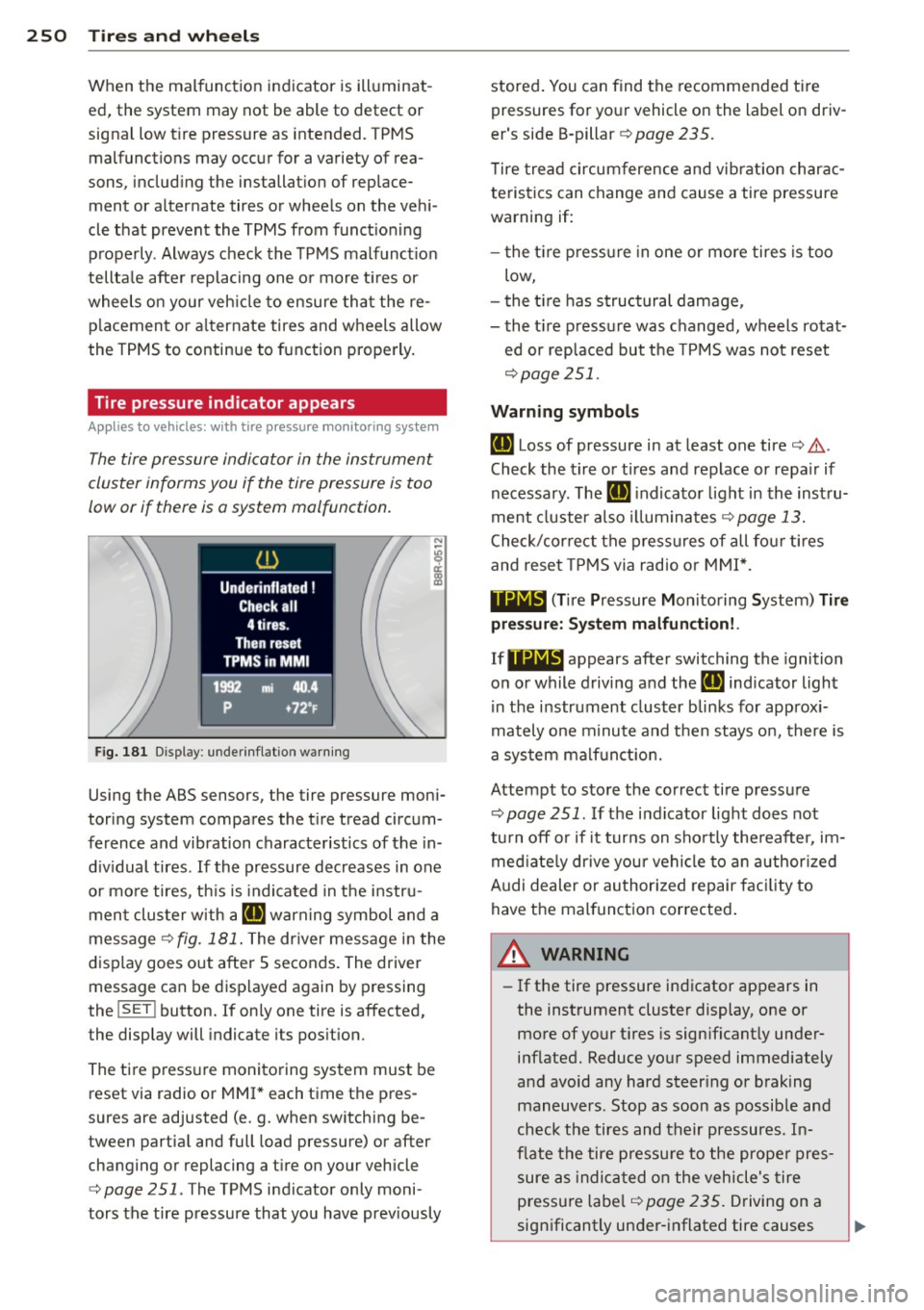
F ig. 181 Display : underinflatio n warning
Using the ABS sensors, the tire pressure moni
toring system compares the t ire tread circum
ference and vibration characteristics of the in
d iv idual tires . If the pressure decreases in one
or more tires, th is is indicated in the instru
ment cluster w ith a
IE warning symbol and a
message¢
fig. 181 . The driver message in the
display goes out after 5 seconds. The driver
message can be displayed again by pressing
the
! SE T! button. If on ly one tire is affected,
the display will indicate its pos it ion.
The tire pressure monitoring system must be reset via radio or MMI * each time the pres
sures are adjusted (e. g . when switching be
tween partia l and full load pressure) or after
changing or replacing a t ire on your vehicle
¢
page 251 . The TPMS indicator only moni
tors the tire pressure that you have prev iously stored
. You can find the recommended tire
pressures for yo ur vehicle on the label on driv
er's side B-pillar ¢
page 235.
Tire tread circumference and vibration charac
teristics can change and cause a tire pressure
warning if:
- the t ire p ress ure in one or more tires is too
low,
- the t ire has structural damage ,
- the t ire pressure was changed, wheels rotat-
ed or rep laced but the TPMS was not reset
¢ page 251.
Warning symbols
IE Loss of pressure in at least one tire¢.&. .
Check the tire or tires and replace or repa ir if
necessary. The
IE i ndicato r light in the inst ru
ment cluster a lso illuminates
¢ page 13.
Check/cor rect the press ures of all fo ur tires
and reset TPMS via radio or MMI*.
11@1~1 (Tir e Pressure Mon itoring System) Tir e
pr ess ure : Sy ste m malfun cti on!.
If11Nlf:1 appears after switching the ignition
on or while driving and the
IE indicator light
in the instrument cluster blinks for approx i
mately one minute and then stays on, there is
a system malf unct ion.
Attempt to store the correct tire pressure
¢ page 251. If the indicator light does not
tu rn
off or if it turns on sho rtly the reafter, im
med iate ly dr ive you r vehicle to a n author ized
A udi dealer or authorized repair fac ility to
have the malfunction corrected .
A WARNING
=
-If the tire pressure indicator appears in
the instrument cluster display, one or
more of your t ires is sign ificant ly under
inflated. Reduce your speed immediately
and avoid any hard steer ing or braking
maneuvers. Stop as soon as possib le and
check the tires and their pressures. In
flate the tire pressu re to the prope r pres
sure as indicated on the vehicle's tire
pressu re labe l¢
page 235. D riving on a
significantly under-inflated tire causes