light AUDI A5 COUPE 2014 Owners Manual
[x] Cancel search | Manufacturer: AUDI, Model Year: 2014, Model line: A5 COUPE, Model: AUDI A5 COUPE 2014Pages: 286, PDF Size: 70.99 MB
Page 247 of 286
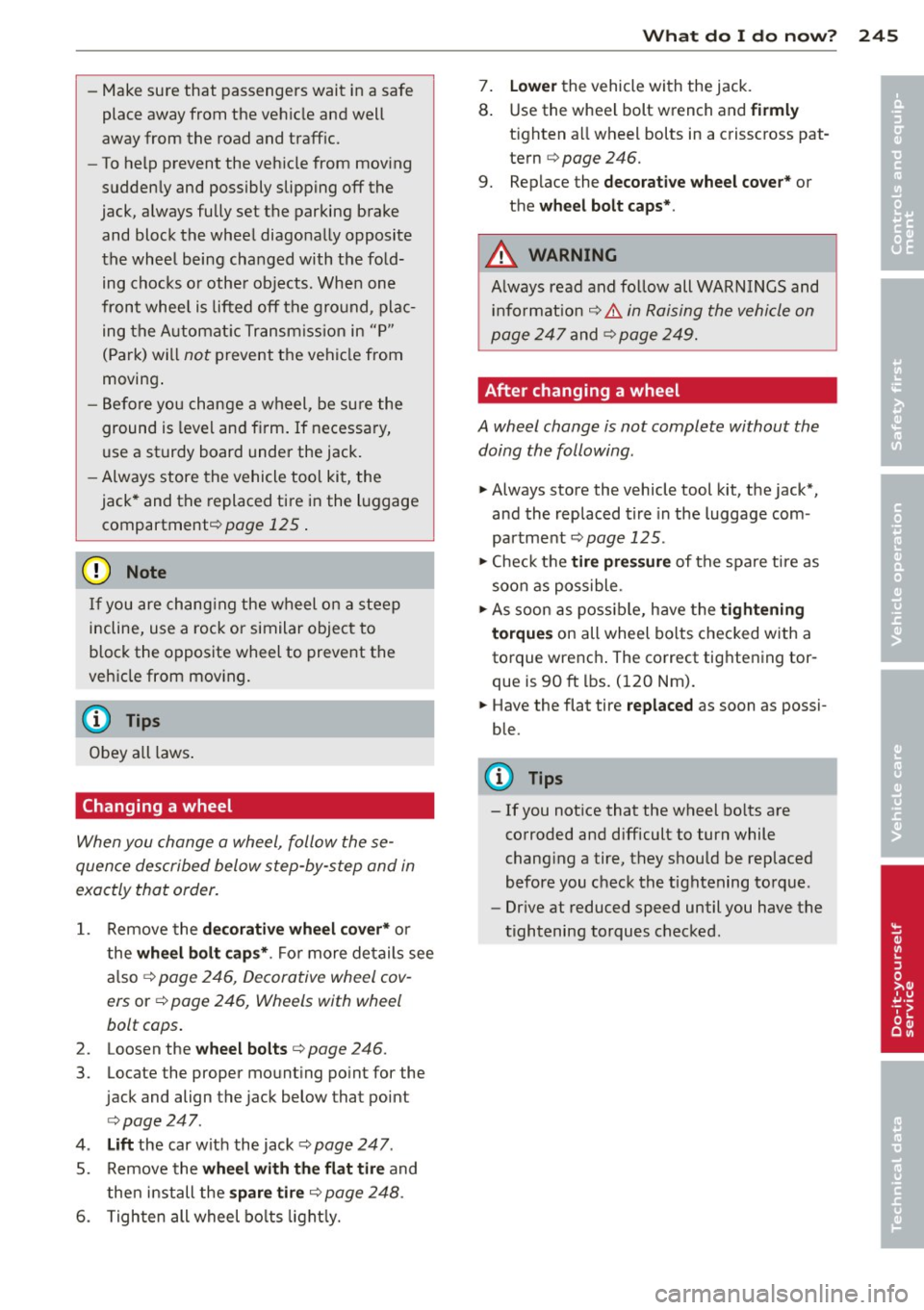
-Make sure that passengers wait in a safe
place away from the vehicle and well
away from the road and traffic.
- To help prevent the vehicle from moving
suddenly and possibly slipping off the
jack, always fully set the parking brake and block the wheel diagonally opposite
the wheel being changed with the fold
ing chocks or other objects. When one
front wheel is lifted off the ground, plac
ing the Automatic Transmission in
"P"
(Park) will not prevent the vehicle from
moving.
- Before you change a wheel, be sure the
ground is level and firm. If necessary,
use a sturdy board under the jack.
- Always store the vehicle tool kit, the
jack* and the replaced tire in the luggage
compartmentc:>poge
125.
(D Note
If you are changing the wheel on a steep
incline, use a rock or similar object to
block the opposite wheel to prevent the
vehicle from moving.
(D Tips
Obey all laws.
Changing a wheel
When you change a wheel, follow these
quence described below step-by-step and in
exactly that order.
1. Remove the decorative wheel cover* or
the
wheel bolt caps* . For more details see
also
c:> page 246, Decorative wheel cov
ers
or c:> page 246, Wheels with wheel
bolt cops.
2 . Loosen the wheel bolts c:> page 246.
3. Locate the proper mounting point for the
jack and align the jack below that point c:>
page 247.
4 . Lift the car with the jack c:> page 247 .
5. Remove the wheel with the flat tire and
then install the
spare tire c:> page 248 .
6. Tighten all wheel bolts lightly.
What do I do now? 245
7. Lower the vehicle with the jack.
8. Use the wheel bolt wrench and firmly
tighten all wheel bolts in a crisscross pat
tern
c:> page 246.
9. Replace the decorative wheel cover* or
the
wheel bolt caps* .
A WARNING
Always read and follow all WARNINGS and
information c:>
.&. in Raising the vehicle on
page 247
and c:> page 249.
After changing a wheel
A wheel change is not complete without the
doing the following.
.. Always store the vehicle tool kit, the jack*,
and the replaced tire in the luggage com
partment
c:> poge 125 .
.,. Check the tire pressure of the spare tire as
soon as possible .
.. As soon as possible, have the
tightening
torques
on all wheel bolts checked with a
torque wrench. The correct t ightening tor
que is
90 ft lbs. (120 Nm) .
.. Have the flat tire
replaced as soon as possi
ble .
(D Tips
-If you notice that the wheel bolts a re
corroded and difficult to turn while
changing a tire, they should be replaced
before you check the tightening torque .
- Drive at reduced speed until you have the
tightening torques checked.
•
•
Page 249 of 286
@ Tips
-Never use the hexagonal socket in the
handle of the screwdriver to loosen or
tighten the wheel bolts.
- If a whee l bolt is very tight, you may find
it easier to loosen by carefully pushing
down on the end of the wheel bolt
wrench w ith
one foot only. As you do so,
hold on to the car to keep your ba lance
and take ca re not to slip.
Raising the vehicle
The vehicle must be li~ed with the jack first
before the wheel can be removed .
*- '*
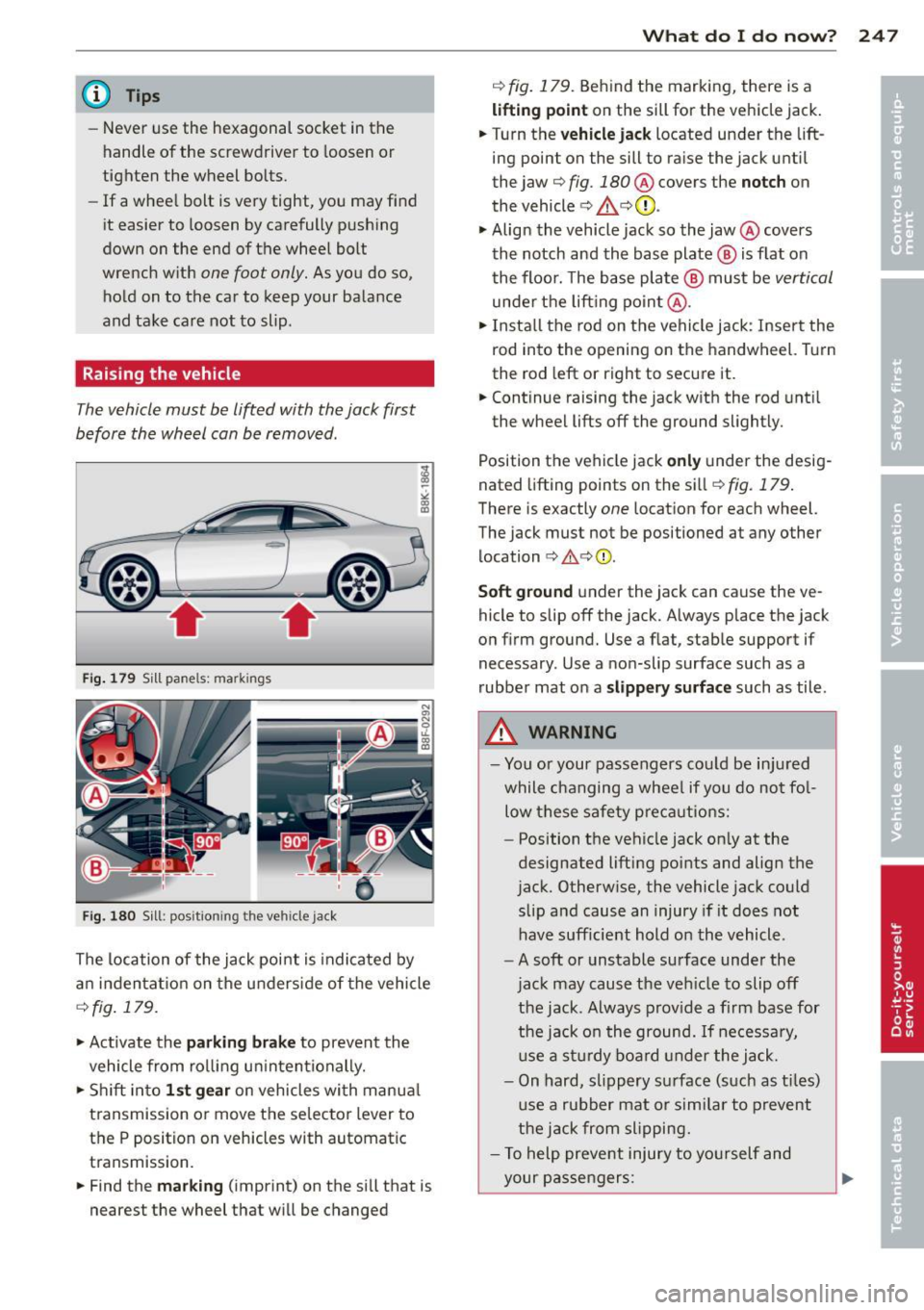
Fig. 1 79 Sill pane ls: ma rk ings
Fi g. 180 Sill: posit ion ing the ve hicle
jack
The location of the jack point is indica ted by
a n in den ta ti on on the underside of the vehicle
¢ fig . 179.
"'Activate the parking b rake to prevent the
vehicle from ro lling u ninten tionally.
"' Shift in to
1st gear on vehicles with manua l
transmission or move the se lector lever to
the P position on vehicles with automatic
transmission.
"' Find the
marking (imprint) on the sill that is
nearest the wheel that w ill be changed
What do I d o now ? 24 7
¢ fig. 179. Behind the marking, there is a
lifting point on the sill for the vehicle jack.
"' Turn the
vehicle ja ck located under the lift
ing point on the sill to ra ise the jack until
the jaw ¢
fig. 180 @ covers the notch on
the vehicle
¢ & ¢ (D .
"'Align the vehicle jack so the jaw@ covers
th e notch and the base plate @ is flat on
the floor. The base plate @ must be
vertical
unde r th e lift ing po in t @ .
"'I nsta ll the rod on the vehicle jack : Inser t the
rod into the opening on the handwheel. T urn
the rod left or right to secure it.
"' Continue raising the jack w ith the rod unt il
the wheel lifts off the ground slightly.
Position the veh icle jack
only under the desig
nated lifting points on the sill ¢
fig. 179 .
There is exactly one locat ion for each wheel.
The jack must not be positioned at any other location c> &, c>(D.
Soft ground under the jack can cause the ve
hicle to slip off the jack. Always place the jack
on f irm ground. Use a f lat, stab le support if
necessary . Use a non-slip surface such as a
rubber mat on a
s lipp ery surface such as tile .
A WARNING
-You or your passengers co uld be in ju red
while changing a wheel if you do no t fo l
low these safety p re ca utions:
- Position t he veh icle jack on ly at the
designated lifting poi nts and align the
jack. Otherw ise, the vehicle jack could
slip a nd cause an injury if it does not
have sufficie nt hold o n the vehicle.
- A soft or unstable surface under the
jac k may cause the ve hicle to slip off
the jack . A lways prov ide a fi rm base for
the jack o n the ground. If necessa ry,
u se a st ur dy boa rd under the jack .
- On hard, sl ippery su rface (such as t iles)
u se a rubber mat or simi lar to prevent
the j ack from slipping.
- T o help preve nt injury to yo urself and
your pas sengers:
Page 250 of 286
248 What do I do now?
-Do not raise the vehicle unti l you are
sure the jack is securely engaged.
- Passengers must not remain in the ve
hicle when it is jacked up.
- Make sure that passengers wait in a
safe p lace away from the vehicle and
well away from the road and traffic.
- Make sure jack position is correct, ad
just as necessary and then continue to ra ise the jack.
CD Note
Do not lift the vehicle by the sill. Position
the vehicle jack only at the designated lift
ing points on the sill. Otherwise, your vehi
cle will be damaged.
Taking the wheel off/installing the spare
tire
Follow these instructions step-by-step for
changing the wheel .
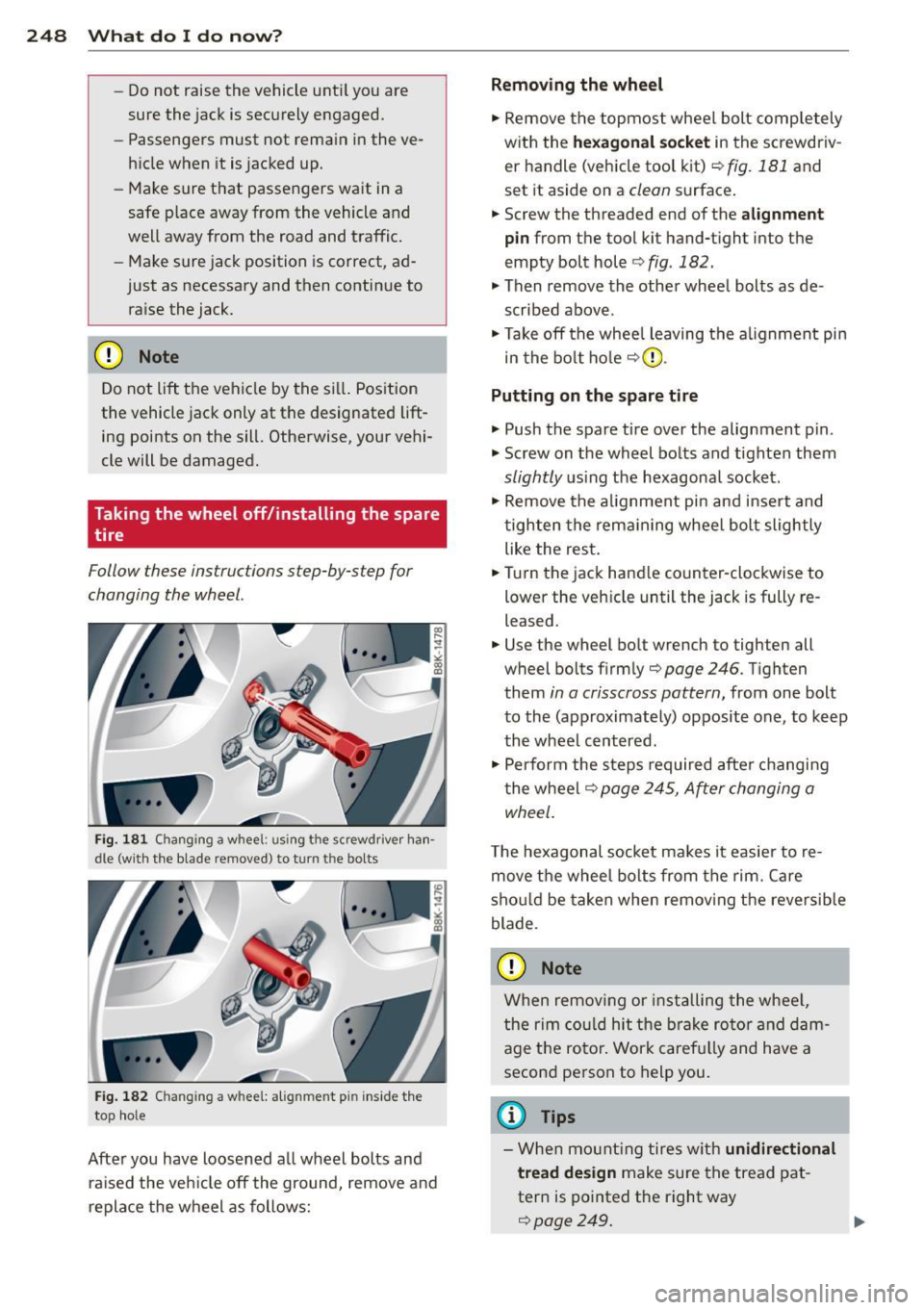
Fig. 181 Changing a w hee l: usi ng the screwdriver han ·
dle (with the blade r~mo ved) to turn th e bo lts
Fig. 182 C hangin g a w hee l: alig nmen t pin inside the
to p hole
After you have loosened a ll wheel bolts and
ra ised the veh icle off the ground, remove and
replace the wheel as follows:
Removing the wheel
"' Remove the topmost wheel bolt comp letely
with the
hexagonal socket in the screwdriv
er handle (vehicle tool kit)¢
fig. 181 and
set it aside on a
clean surface.
"' Screw the threaded end of the
alignment
pin
from the tool kit hand-tight into the
empty bolt hole¢
fig. 182.
"' Then remove the other wheel bolts as de
scribed above.
"' Take off the whee l leaving the alignment pin
in the bolt hole ¢(D .
Putting on the spare tire
"' Push the spare tire over the alignment p in.
"' Screw on the wheel bolts and tighten them
slightly using the hexagonal socket .
"' Remove the alignment pin and insert and
tighten the remain ing wheel bolt slightly
like the rest.
"' Turn the jack handle counter-clockwise to
lower the veh icle until the jack is fully re
leased.
"' Use the wheel bo lt wrench to tighten all
wheel bolts firmly¢
page 246 . Tighten
them
in a crisscross pattern, from one bolt
to the (approximately) opposite one, to keep
the wheel centered.
"' Perform the steps required after changing
the wheel
c::> page 245, After changing a
wheel.
T he hexagonal socket ma kes it easier to re
move the wheel bolts from the rim. Care
sho uld be taken when removing the reversible
blade .
CD Note
When removing or installing the wheel,
the rim could hit the brake rotor and dam
age the rotor. Work carefu lly and have a
second person to help you.
(D Tips
-When mount ing tires with unidirectional
tread design
make sure the tread pat
tern is po inted the right way
c::> page 249. Iii>
Page 253 of 286
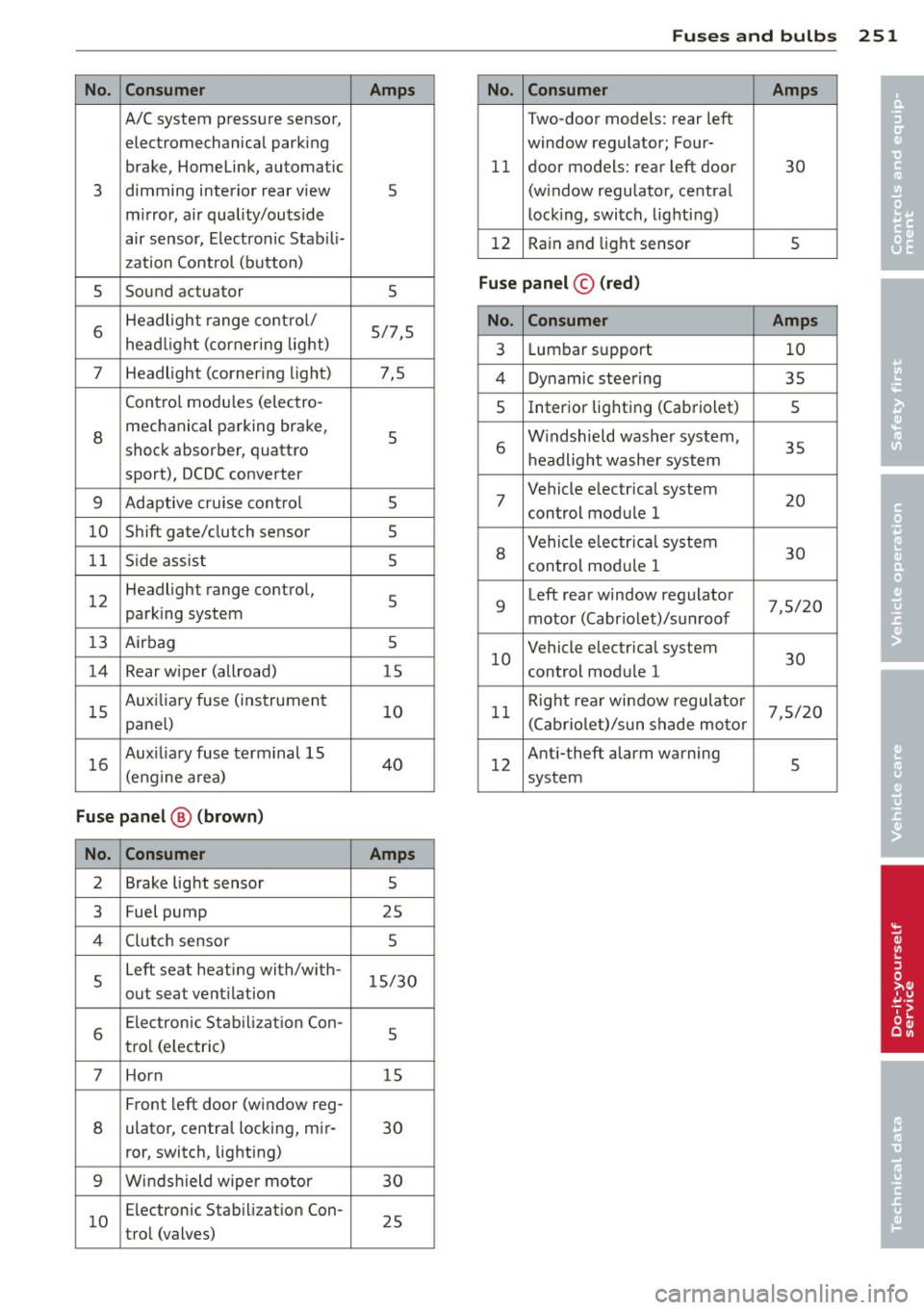
Fuses and bulb s 251
No. Con sumer Amps No. Consumer Amps
•
A/C system pressure sensor, Two-door models: rear left
• electromechanical parking window regulator; Four-
brake, Homelink, automatic 11 door models:
rear left door
30
3 dimming interior rear view
5 (window regulator, central
m irror, air quality/outside locking, switch, lighting)
air sensor, Electronic Stab ili-
12 Rain and light sensor
5
zation Control (button)
5 Sound
actuator
5
Fuse panel© (r e d )
6 Headlight
range cont rol/
5/7,5
head light (cornering light)
No. Consumer Amps
3 Lumbar support 10
7 Headlight (corner
ing light) 7,5
4 Dynamic steering 35
Contro l modu les (e lectro-
s Inter ior lighting (Cabriolet)
5
8 mechanical parking brake,
5
shock absorber, quattro
sport), DCDC converter
9 Adaptive cru ise contro l 5 6
W
indshield washer system,
35
h eadlight washe r system
7 Vehicle electrical
system
20
control module 1
10 Shift gate/clutch
sensor
5
1 1 Side ass ist 5
8
Vehicle electr ica l system
30
control module 1
1 2 Headlight range
control,
5
park ing system 9 Left rear window regulator
7,5/20
motor (Cabriolet)/sunroof
13 Airbag 5
14 Rear wiper (allroad) 15 10 Vehicle e
lectrical system
30
control module 1
1 5 Auxi
liary fuse (instrument
10
pane l) 11 R
ight rea r window regulato r
7,5/20
(Cabriolet)/sun shade motor
16 Aux
iliary fuse terminal 15
40
(engine area) 12 Anti-theft
alarm warning
5
system
Fuse p anel @ (brown )
No. Con sumer Amps
2 Brake light sensor 5
3 Fuel
pump
25
4 Clutc h sensor 5
5 Left
seat heating with/w ith-
15/30
out seat vent ilation
6 Electronic Stab
il iz at ion Con-
5
tro l (e lectric)
7 Horn 15
Front left door (window reg-
8 ulator, centra
l locking, mir-
30
ror, switch, lighting)
9 Winds hield wipe r motor 30
1 0 Electronic
Stabilizat ion Con-
25
trol (valves)
Page 254 of 286
252 Fuses and bulbs
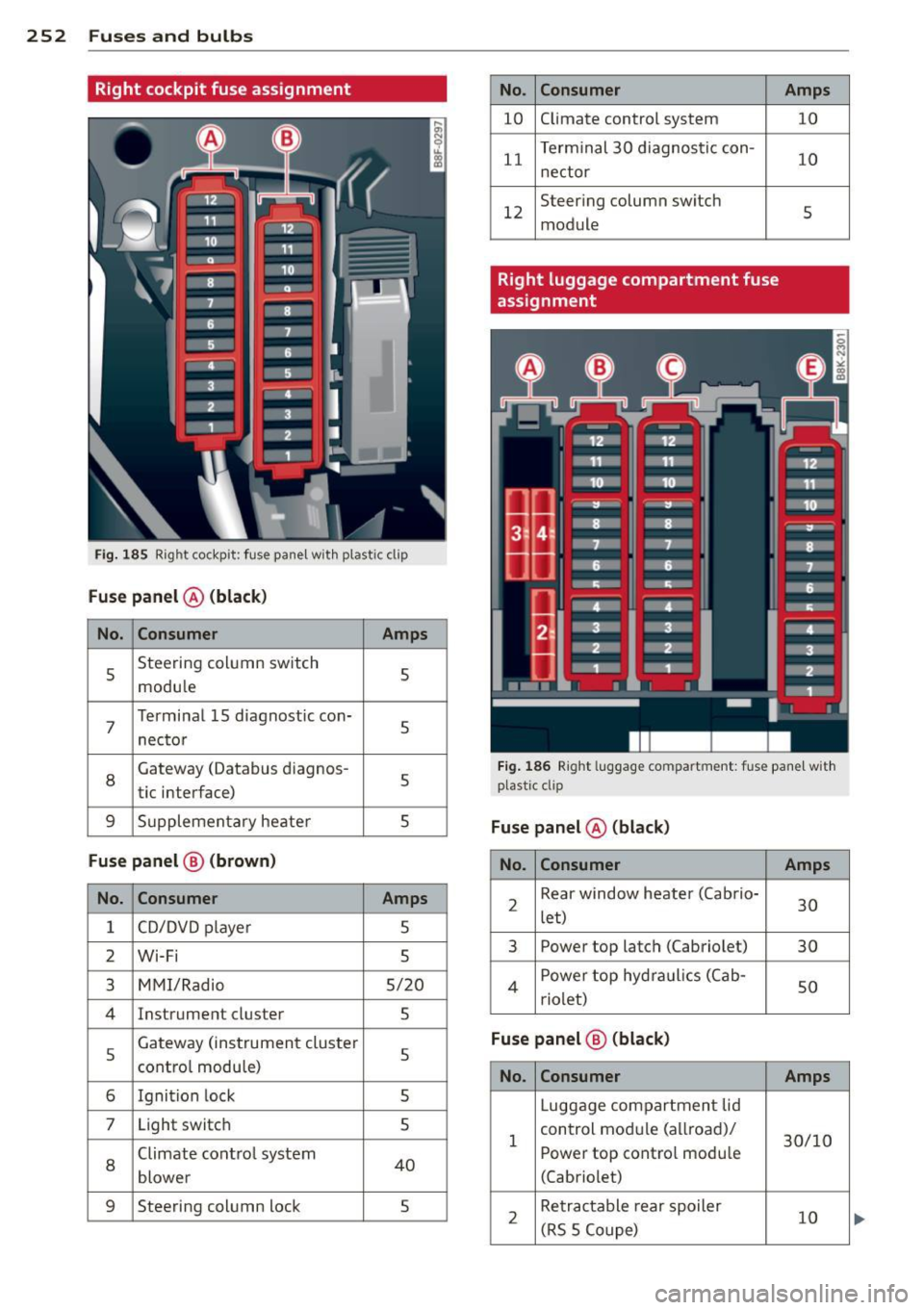
Right cockpit fuse assignment
Fi g. 185 Right cockpit: f use pane l w it h plastic clip
Fuse panel @ (black )
No. Consumer Amps
5 Steering col
umn sw itch
5
modu le
7
Terminal 15 d iagnostic con-
nec tor 5
8
Gateway (Databus d
iagnos -
5
tic interface)
9 S u pplemen tary heate r 5
Fuse panel @ (brown )
No. Consumer
Amps
1 CD/DVD p laye r 5
2 Wi·Fi 5
3
M MI/Radio 5/20
4 Instrume nt cluster
5
5
Gateway (ins trumen t cluster
5 contro l modu le)
6 Igni tion lock
5
7 Light switch
5
8
Climate contro l system 40
blowe r
9 Steering column lock 5
No . Consumer
10 C
limate control system
11 T
erm inal 30 diagnosti c con-
n ectar
12 Steer
ing column switch
module
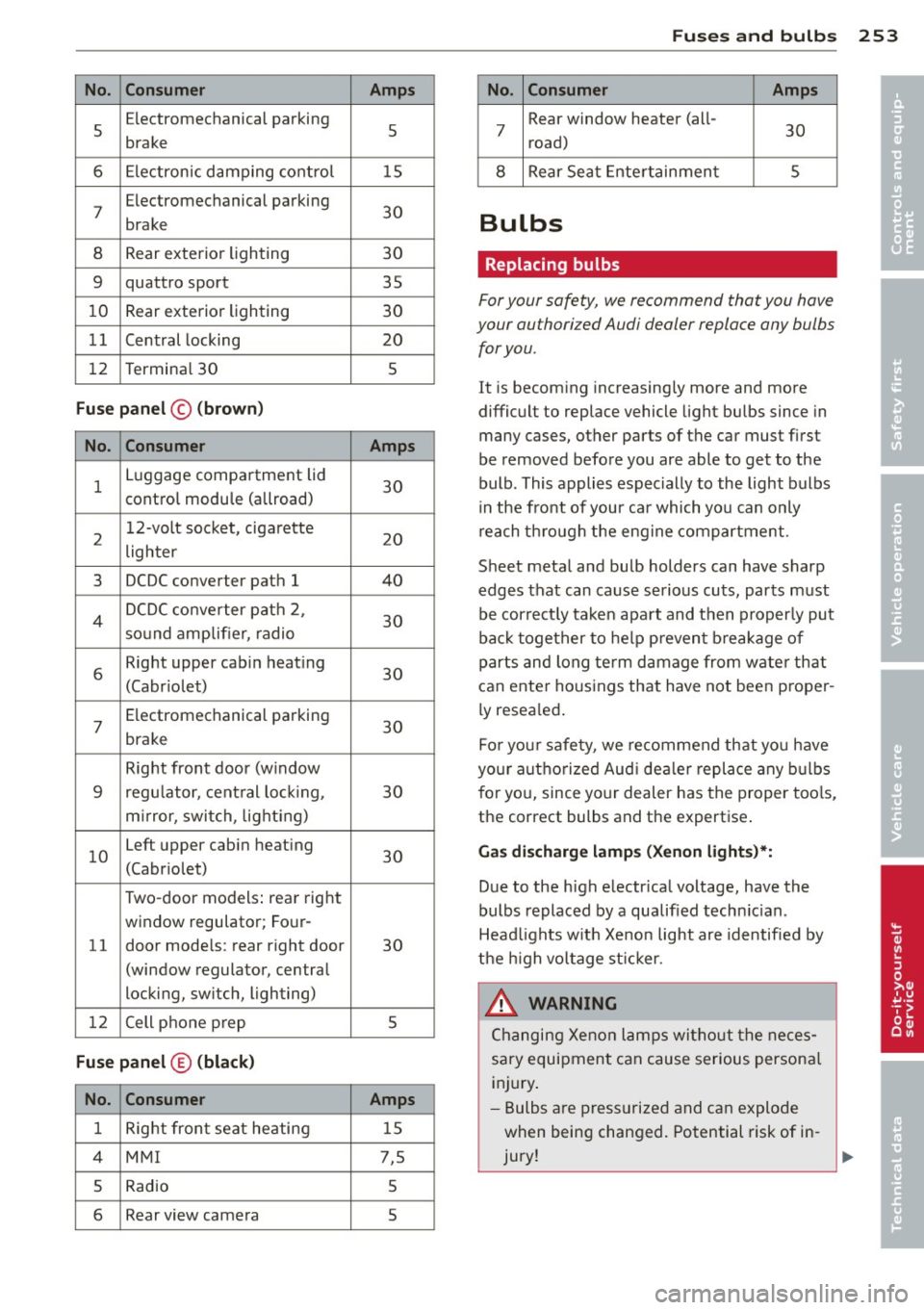
Right luggage compartment fuse
assignment Amps
10
10
5
F ig . 18 6 Right lu ggage compartment: fu se pane l w it h
plast ic clip
Fuse panel @ (black)
No . Consumer Amps
2 Rear window heater (Ca b
rio-
30
let)
3 Power
top latch (Cabriolet)
30
4 Power top hyd ra ulics ( Cab-
so rio let)
Fuse panel @ (black)
No. Consumer Amps
Luggage compartmen t lid
1 control mod
ule (a llroad)/
30/10
Power top contro l modu le
(Cabriolet)
2 Re
tra ctable rear spoiler
10
( R S 5 Coupe)
Page 255 of 286
No. Consumer
5 Electromechanical
parking
brake
6 Electronic damping control
7
Electromechanical parking
brake
8 Rear exterior lighting
9 quattro sport
10 Rear
exterior lighting
1 1 Central locking
12 Termina
l 30
Fu se pa nel © (brown )
No. Con sumer
1 Luggage compartment lid
control module (allroad)
2 1
2-volt socket, cigarette
lighter
3 DCDC
converter path 1
4 DCDC converter path 2,
so und amplifier, radio
6
Right upper cabin heat ing
(Cabr iolet)
7
Electromechanical parking
brake
Right front door (w indow
9 regu lator, central lock ing,
m irror, swit ch, lig hting)
10 Left upper
cabin heating
(Cabriolet)
Two -door models: rear right
window regulator; Four-
11 door mode
ls: rear right door
(window regulator, central
locking, sw itch, lighting)
12 Cell phone prep
Fu se panel © (black )
No. Consumer
1 Right front seat heating
4
MMI
5 Radio
6 Rear view camera
Amp s
5
15
30
30
35
30
20 5
Amp s
30
20
40
30
30
30
30
30
30
5
Amps
15
7,5
5
5
Fu ses and bulb s 253
No. Consumer Amps
7
Rear window heater (all-
30
road)
8 Rear Seat Entertainment 5
Bulbs
Replacing bulbs
For your safety, we recommend that you hove
your authorized Audi dealer replace any bulbs
for you .
It is becoming increasingly more and more
difficult to replace vehicle light bulbs since in
many cases, other parts of the car must first
be removed before you are able to get to the
bulb. This applies especially to the light bulbs
in the front of your car which you can only
reach through the engine compartment.
Sheet metal and bulb holders can have sharp
edges that can cause serious cuts, parts must
be correct ly take n apa rt and then p roperly put
bac k together to he lp p revent breakage of
parts and long te rm damage from water that
can enter housings that have not been p roper
ly re sea led .
Fo r you r safety, we re commend that you have
your autho rized Audi de aler replace any b ulbs
f or you, since your dealer has the proper too ls,
the correct bulbs and the expertise.
Gas disc har ge la mp s (Xenon l ig hts)*:
Due to the high electr ical voltage, have the
bulbs replaced by a qualified techn ic ian .
Head lights w ith Xenon light are identified by
the h igh vol tage sticker.
_&. WARNING
Changing Xenon lamps without the neces
sary equipment can cause serious persona l
injury .
- Bulbs are pressurized and can explode
when being changed. Potential risk of in
jury!
-
•
•
Page 256 of 286
254 Fuse s a nd bul bs
-On vehicles equipped with gas discharge
bulbs (Xenon light)* life-threatening in
juries can result from improper handling of the high-voltage portions of such
lamps!
- Only your authorized Audi dealer or
qualified workshop should change the
bulbs in gas d ischarge lamps. There are
parts with sharp edges on the openings
and on the bulb holders tha t can cause
serious cuts. If you are uncertain about
what to do, have the work performed by an authorized Audi dealer or qualified
workshop. Serious personal injury may result from improperly performed work.
(D Tips
- If you still p refer to replace the light
bulbs yourself, be aware that the engine
compartment is a hazardous area to
work inc:>
page 206 c:> A.
-It is best to ask your authorized Audi
dealer whenever you want to change a
bulb.
Page 257 of 286
Emergency situations
General
This chapter is intended for trained emer
gency crews and working personnel who have the necessary tools and equipment to
perform these operations.
Starting by pushing or
towing
(D Note
Vehicles with an automatic transmission
cannot be started by pushing or towing.
Starting with jumper
cables
If necessary, the engine can be started by
connecting it to the battery of another vehi
cle.
If the engine should fail to start because of a
discharged or weak battery, the battery can be
connected to the battery of
another vehicle,
using a
pair of jumper cables to start the en
gine.
Jumper cables
Use only jumper cables of sufficiently
largecross section to carry the starter current
safely. Refer to the manufacturer's specifica
tions.
Use only jumper cables with
insulated termi
nal clamps which are distinctly marked:
plus(+) cable in most cases colored red
minus(-) cable
in most cases colored black .
A WARNING
Batteries contain electricity, acid, and gas.
Any of these can cause very serious or fatal
injury. Follow the instructions below for
safe handling of your vehicle's battery.
- Always shield your eyes and avoid lean
ing over the battery whenever possible.
Emergency situations 255
-A discharged battery can freeze at tem
peratures just below 32 °F (0 °C). Before
connecting a jumper cable, you must
thaw the frozen battery completely, oth
erwise it could explode.
- Do not allow battery acid to contact eyes
or skin . Flush any contacted area with
water immediately .
- Improper use of a booster battery to
start a vehicle may cause an explosion.
- Vehicle batteries generate explosive gas
es. Keep sparks, flame and lighted ciga
rettes away from batteries.
- Do not try to jump start any vehicle with
a low acid level in the battery.
- The voltage of the booster battery must
also have a 12-Volt rating. The capacity
(Ah) of the booster battery should not be
lower than that of the discharged bat
tery. Use of batteries of different voltage
or substantially different "Ah" rating
may cause an explosion and personal in
jury.
- Never charge a frozen battery. Gas trap
ped in the ice may cause an explosion.
- Never charge or use a battery that has
been frozen. The battery case may have
be weakened.
- Use of batteries of different voltage or
substantially different capacity (Ah) rat
ing may cause an explosion and injury.
The ca pa city (Ah) of the booster battery
should not be lower than that of the dis
charged battery.
- Before you check anything in the engine
compartment, always read and heed all
WARNINGS¢
page 206.
(D Note
- Applying a higher voltage booster bat
tery will cause expensive damage to sen
sitive electronic components, such as
control units, relays, radio, etc.
- There must be no electrical contact be tween the vehicles as otherwise current
could already start to flow as soon as the
positive(+) terminals are connected. ..,. •
•
Page 258 of 286
256 Emergency situations
@ Tips
The discharged battery must be properly
connected to the vehicle's electrical sys
tem. When jump starting or charging the
battery, never connect the negative
ground cable to the battery negative post
because the batte ry manager system must
be able to detect the battery 's state of
charge. Always connect the negative
ground cab le to the negative ground post
of the battery manager control unit.
Use of jumper cables
Make sure to connect the jumper cable
clamps in exactly the order described below!
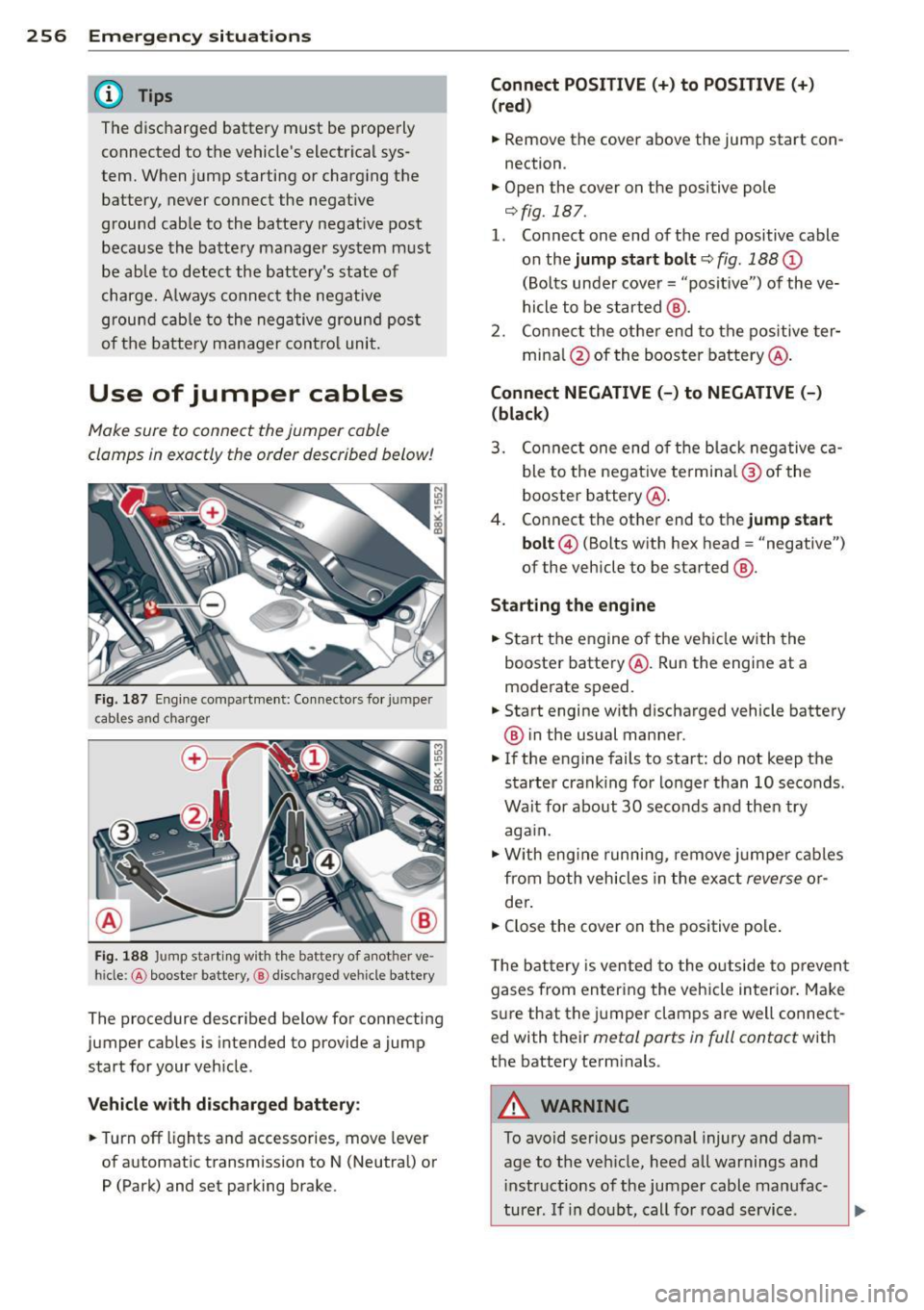
Fig. 187 Engine compartment: Connectors fo r jum per
cables and charger
Fig. 188 Jump sta rting wi th the battery of anot her ve ·
h ide :@ booster battery, @ disc harged vehicle battery
The procedure described below for connecting
jumper cables is intended to provide a jump
start for your vehicle .
Vehicle with discharged battery:
.. Turn off lights and accessories, move lever
of automatic transmission to N (Neutral) or
P (Park) and set parking brake .
Connect POSITIVE(+) to POSITIVE(+)
(red)
.. Remove the cover above the jump start con
nection .
.. Open the cover on the positive pole
c::;, fig. 187 .
1. Connect one end of the red positive cable
on the
jump start bolt c::> fig. 188 @
(Bolts under cover= "positive") of the ve
hicle to be started @.
2. Connect the other end to the positive ter-
minal @of the booster battery@.
Connect NEGATIVE (-) to NEGATIVE (-)
(black)
3. Connect one end of the b lack negative ca
ble to the negative terminal @of the
booster battery @.
4. Connect the other end to the
jump start
bolt @
(Bolts with hex head= "negative")
of the vehicle to be started @.
Starting the engine
.. Start the engine of the vehicle with the
booster battery@. Run the engine at a
moderate speed.
.. Start engine with discharged vehicle battery
@ in the usual manner .
.. If the engine fails to start: do not keep the
starter cranking for longer than 10 seconds .
Wait for about 30 seconds and then try
again .
.. With eng ine running, remove jumper cables
from both vehicles in the exact
reverse or
der .
.. Close the cover on the positive pole .
T he battery is vented to the outside to prevent
gases from entering the vehicle interior . Make
sure that the jumper clamps are well connect
ed with their
metal parts in full contact with
the battery terminals.
A WARNING
--
To avoid serious personal injury and dam
age to the veh icle, heed all warnings and
instructions of the jumper cable manufac-
turer . If in doubt, call for road service . ..,.
Page 264 of 286
26 2 Techni cal Dat a
Gross Ax le Weight R atin g
The Gross Axle Weight Rating is the maximum
l oad that can be applied at each axle of the
vehicle
c::> &. .
Vehicle capacity weight
The vehicle capac ity we ight (max. load) is list
ed on the driver 's side 8-p illar.
_& WARNING
-
- T he actual Gross Axle Weight Rat ing at
the front and rear axles shou ld not ex
ceed the permissible weights, and their
combination must not exceed the Gross
Vehicle Weight Rat ing.
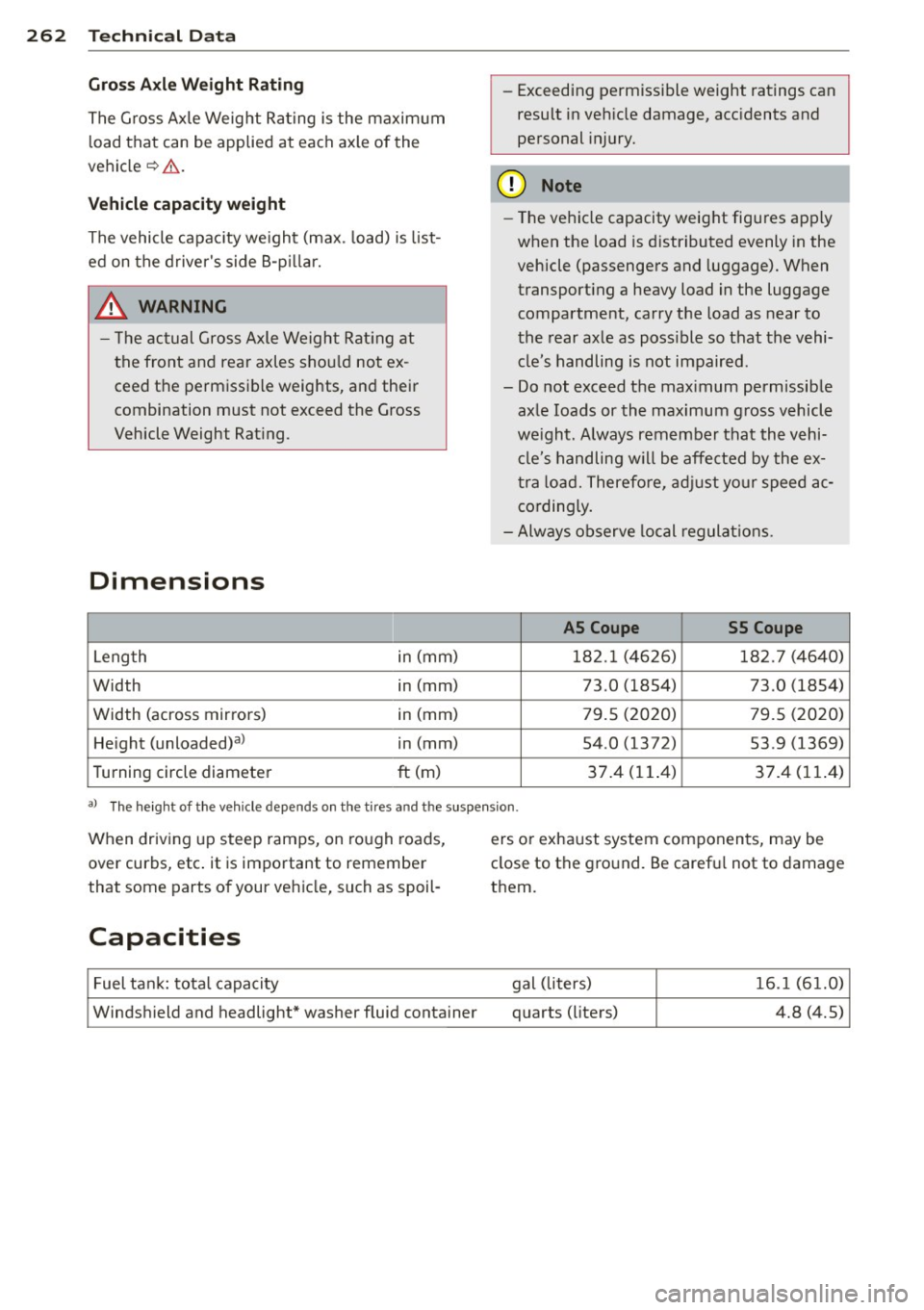
Dimensions
Length in (mm)
Width in (mm)
Width (across mir rors) in (mm)
He ight (unloaded)a) in (mm)
T urning circle diameter
ft (m) -
Exceeding permissible weight ratings can
result in veh icle damage, acc idents and
personal injury.
(D Note
- The vehicle capacity weight figures apply
when the load is distributed evenly in the
vehicle (passengers and luggage). When
transport ing a heavy load in the luggage
compartment, carry the load as near to
the rear axle as poss ible so that the vehi
cle's handling is not impaired.
- Do not exceed the maximum permissible axle loads or the maximum gross vehicle
we ight. Always remember that the vehi
cle's handling w il l be affected by the ex
tra load. Therefo re, adj ust your speed ac
cordingly.
- Always observe local regulat ions.
AS Coupe S5 Coupe
182.1 (4626) 182.7 (4640)
73.0 (1854) 73 .0 (1854)
79.5 (2020) 79.5 (2020)
54 .0 (1372) 53 .9 (1369)
37.4 (1 1.4) 37.4 ( 11.4)
a) The he ight of the vehicle depends on the tires and the suspension.
When driving up steep ramps, on rough roads,
over curbs, etc . it is important to remember
that some parts of your ve hicle, such as spoil-
Capacities
Fuel tank: total capacity
Windsh ield and headlight* washer fluid container ers
or exhaust system components, may be
close to the ground. Be carefu l not to damage
them.
gal ( liters) 16.1 (61.0)
quarts (liters) 4.8 (4.5)