warning AUDI A5 COUPE 2014 Owners Manual
[x] Cancel search | Manufacturer: AUDI, Model Year: 2014, Model line: A5 COUPE, Model: AUDI A5 COUPE 2014Pages: 286, PDF Size: 70.99 MB
Page 189 of 286
to prevent excessive discha rge of the battery
and thus maintain starting capability .
Dynam ic energy man agement
W hile the vehicle is being driven , dynamic en
e rgy management distributes the energy gen
erated according to the needs of the individu
a l components . It regu lates consumption, so
that more electrical energy is not being used
than is being generated and ensures an opti mal state of charge for the battery.
(D Tips
- But even energy management cannot
negate the limits of physics. Consider
that the power and life of a battery are
limited.
- If starting ab ility is threatened, the indi
cator light (•) appears
¢ page 17.
What you should know
The highest priority is given to maintaining
starting capabili ty.
The battery is severely taxed in short-distance
driving, in city traffic and d uring the co ld time
of year. Abundant electrical energy is re
qu ired, but only a little is generated. It is also
cr itical if the engine is not run ning and electri
cal components are turned on . In th is in
stance energy is being consumed but none is
be ing generated.
It is in precisely these situations that you w ill
notice energy management actively regulat
i ng the distribution of energy.
Vehicle stands for an extended period
If you do not drive your vehicle over a period
of several days or weeks, electrical compo
nents are gradually cut back o r switched off .
This reduces energy consumption and main
tains starting capab ility over a longer per iod .
Some of the conven ience fun ctions may not
ope rate, such as the in ter ior lig hts o r th e
power seat adj ustment. The conven ience
functions will be available again when you
switch on the ignitio n and start the engine .
Intellig ent technolog y 187
With the eng ine turned off
If you listen to the radio, for examp le, w ith
the engine turned off or use other MMI func
tions, the battery is being discharged .
If starting capab il ity is jeopardized d ue to en
ergy consump tion, the following warning ap
pears in the MM I display:
Pl ea se start the en gin e s oon or the sy ste m
will be turn ed off .
The warning indicates that the system w ill be
turned off automatically after 3 minutes . If
you w ish to continue using the funct io ns, yo u
have to sta rt the eng ine .
With the engine running
Although electrical energy is generated when
the vehicle is being driven, the battery can be
come d ischa rged . This happe ns mostly when
li ttle energy is being gene rated and a g reat
deal consumed and t he battery's state of
charge is not opt imal.
To b ring the energy ba lance back into equili
brium , consume rs which requ ire espec ially
la rge amounts of ene rgy are temporar ily cu t
ba ck or sw itched o ff. Hea ting systems in p ar
ticu lar require a great deal of energy . If yo u
notice, for examp le, that the heated seats * or
the heated rear window are not heating, they
have been temporarily cut back or switched
off . These systems w ill be available again as
soon as the ene rgy balance has been restored .
You wi ll also notice that engine id le speed has
been increased slightly . T hi s is normal and not
a cause for concern. By increasing engine id le
speed the additional energy required is gene r
ated and the battery is charged .
•
•
Page 190 of 286
188 Driving and environment
Driving and
environment
The first 1,000 miles
(1,500 km) and
afterwards
New engine
The engine needs to be run-in during the first
1,000 miles (1,500 km).
For the fir st 600 miles (1,000
kilometers ):
.,. Do not use full throttle.
... Do not d rive at engine speeds that are more
than 2/3 of the max imum permitted RPM.
From 600 to 1,000 miles (1 ,000 to
1,500 kilometers):
.,. Speeds can gradually be increased to the
max imum pe rm iss ible road or eng ine speed .
During and after break-in period
... Do not rev the eng ine up to high speeds
when it is cold. Th is app lies whether the
transmission is in N (Neutra l) or in gear.
After the break- in period
... Do not exceed max imum engine speed un
der any circumstances .
... Upshift into the next higher gear before
reaching the red area at the end of the tach
ometer scale¢ page 10.
During the first few hours of driving, the en
g ine's inter na l friction is higher than later
when all the moving parts have been broken
i n. How well this break- in process is done de
pends to a conside rable extent on the way the
ve hicl e is driven du ring the first 1,000 miles
(1, 500 kilome ters).
(D Note
E xtremely high engi ne speeds are auto
mat ica lly r educ ed. However, t hese rpm
lim its are programme d for a n engine well
r u n- in, not a new eng ine.
{® For the sake of the environment
Do not d rive with unnecessarily high en
g ine speeds - upshifting ear ly saves fuel,
reduces no ise and protects the environ
ment.
, New tires
If your vehicle is runni ng on new tires, drive
very carefully for the first 350 miles (500 ki lo
meters) after fitting.
_& WARNING
N ew tires tend to be slip pery a nd mus t al
so be "b roken -in" . Be s ure to remembe r
this dur ing the fi rst 350 mi les ( 500 kilo
meters) . Brake gently . Avoid fo llow ing
closely behind other vehicles or other sit
uations that m ight require sudden, hard
braking.
Avoid damaging the
vehicle
When you a re d rivi ng on poo r roads, or over
cu rbs, ste ep ramps, etc., ma ke certai n that
low- ly ing parts s uch as spoile rs and ex ha ust
s ystem parts do not bot tom o ut and get dam
aged.
T his is espec ially true for veh icles with low
s lu ng chassis (s por ts chassis)* and fully load
ed vehicles.
Driving through water
on roads
Note th e following to avoi d ve hicle damage
whe n driving through water, for examp le on
flooded roads:
- The wa ter must not be any hig he r th an the
bottom of the vehicle bo dy.
- Do not dr ive faste r than wal king speed.
Page 191 of 286
A WARNING 1= ~
After driving through water, mud, slush, etc., the brakes may be slow to take effect
because of wet brake rotors and pads. Dry
the brakes first by braking carefully to re
store the full brak ing effect.
([) Note
Vehicle components such as the engine,
transmiss ion, suspension or electrical sys
tem can be severely damaged by driving
through wate r.
@ Tips
- Check the depth of the water before dr iv
i ng through it.
- Do not stop the veh icle, dr ive in reverse
or switch the engine off when driving
th rough water.
- Keep in mind that oncoming vehicles
may create waves that raise the water
level and make it too deep for you r vehi
cle to drive th rough safely.
- Avoid dr iving through sa lt water because
i t can ca use corrosion.
Catalytic converter
It is very important that your emission con
trol system (catalytic converter) is function
ing properly to ensure that your vehicle is run
ning in an environmentally sound manner.
11-Always use lead -free gaso line¢ page 201,
Fuel supply .
"'"Never run the tank down all the way to emp
ty.
11-Never put too much motor oil in your engine
¢ page 211, ~ Adding engine oil .
11-Never try to push -or tow -start your veh icle .
The catalytic converter is an efficient "clean up" device built into the exhaust system of
the vehicle . The catalytic converter burns
many of the pollutants in the exhaust gas be
fore they are released into the atmosphere .
Drivin g and en vironm ent 18 9
The exclusive use of unleaded fuel is critically
important for the life of the catalytic convert
er and proper f unct ion ing of the engine.
A WARNING
- The temperature of the exhaust system
is high, both when driving and after stop
ping the eng ine.
- Never touch the exhaust tail pipes once
they have become hot. This could result in burns.
- Do not park or operate the vehicle in
areas where the hot exhaust system may
come in co ntact with dry grass, br ush,
fue l spill or other material wh ich can
cause a fire .
- Do not apply additional undercoating or
ru stp roof ing on or nea r the exhaust
manifold, exhaust pipes, cataly tic con
ve rter or heat shield s. Dur ing driving, the
substance used for undercoating could
overheat and cause a fire.
(D Note
- Be aware that just o ne tank filling with
leaded fuel w ill already ser iously de
grade the performance of the catalytic
converter .
- Do not exceed the cor rect engine oil level
¢ page 211.
-Do not drive until the f ue l t ank becomes
comple tely empty . The engine co uld m is
fire . Unburned fuel could also get into
the exhaust system and this co uld cause
the catalytic converter to overheat.
- Do not turn off the ignition while the ve
hicle is mov ing.
- Do not continue to operate your vehicle
under these conditions, as othe rwise fuel
can reach the catalyt ic converter. Th is
cou ld result in overheating of the con
verter, requir ing its replacement.
- To assure efficient operation of the Emis -
sion Control System: ..,. •
•
Page 193 of 286
Reducing unnecessary idling
Even when your car is just idling it burns up
fuel.
11-Shut the engine off when you are not driving
the vehicle.
11-Do not warm up the vehicle by letting the
engine run at idle .
It makes sense to shut
off the engine in traffic
jams, when waiting for trains to pass at rail road cross ings, or at traffic lights that have
long wa its on red. Turning the engine
off for
just 30-40 seconds saves more fue l than is
burned s tarting the eng ine again.
It takes a long time for the engine to warm up
fully when it is running at idle . However, wear
and nox ious em issions are especially high
when the engine is warming up. So you should
drive away as soon as you start the engine and
avoid running at high rpms while the engine is
still warming up .
(D Note
Do not leave engine idling unattended af
ter starting . If warning lights should come
on to indicate improper operation, they
wou ld go unheeded. Extended idling also
produces heat, which cou ld result in over
heating or other damage to the vehicle or
other property .
Regular maintenance
A badly tuned engine unnecessarily wastes a lot of fuel .
11-Have your vehicle serviced at regular inter-
vals.
By having your vehicle regular ly serviced by an
authorized Audi dealer he lps to ensure that it
runs properly and economically. The condition
of your vehicle not only affects its safety and
ab ility to hold its value, it also affects fuel
co nsumpt ion .
Ch eck you r oil each time you fill you r ta nk .
Dri vin g and en vironm ent 191
The amount of oi l used is re lated to engine
load and speed.
It i s normal for the oil consumption of a new
engine to reach its lowest value after a certa in
mileage has been driven.
You must drive your veh icle about 3,000 m iles
(S,000 kilometers) before yo u can properly
assess oil consumpt ion.
Th is also app lies to fue l consumption and en
gine output.
(D Note
- Have your veh icle ma inta ined properly
and in accordance with the service rec
ommendations in your Wa rranty
& Ma in
t enance book let. Lack of p roper mainte
nance as well as improper use of the ve
hicle will impair the function of the
emission cont ro l system and could lead
to damage.
- Do not alter or remove any component of
the Emission Control System unless ap
proved by the manufacturer.
- Do not alter or remove any device, such
as heat shie lds, switches, ignition wires,
valves, which are designed to protect
your vehicle's Emission Control System and other important vehicle compo
nents.
Fewer short trips
Fuel consumption will always be relatively
high on short trips .
11-Try to avoid driving short distances w ith a
cold engine.
T he engine and cata lytic converter have to
reach their optimal opera ting temp era ture to
reduce fuel consumpt ion and noxious em is
s ions effectively .
Just after starting, a co ld engine in a mid-size
car on ly achieves a fuel economy of 6-8 mi les
per gallon (30-40 l/100 km). After about a
half a mile, fuel economy climbs to 12 mpg
(20 l/100 km). After about
2 .5 miles (4 km), liJI,
•
•
Page 195 of 286
Trailer towing Driving with a trailer
General information
Your Audi was designed primarily for passen
ger transportation .
If you plan to tow a tra iler, p lease remember
that the addit ional load will affect durab ility,
economy and performance .
T railer towing not on ly places more stress on
the vehicle, it also calls for more concentra
tion from the driver.
F or this reason, a lways fo llow the operating
and driving instructions provided and use
common sense.
Technical requirements
Traile r hitch
Use a weight-carrying hitch conforming to the
gross trailer we ight. The hitch must be suita
b le for your veh icle and trailer and must be
mounted secure ly on t he veh icle's chassis at a
technically sound location . Use only a t railer
h itch w ith a removab le ball moun t. A lways
check with the tr ailer hitch man ufac tur er to
make sure that you are using the correct
hitch.
Do not use a bumper hitch.
T he hitc h must be installed in such a way that
it does not inte rfe re with the impac t-absorb
i ng b umper syst em. No modifica tions should
be made to the vehicle exhaus t and b rake sys
tems . From t ime to time, check that a ll hitch
mo unt ing bolt s remain securely fas tened.
W hen you are not tow ing a trailer, remove the
trai le r hi tch ball moun t. T h is prevents the
hi tch from causing damage sho uld your ve hi
cle be str uck from be hind
¢ &. .
Trailer brakes
If yo ur tra iler is equ ipped w it h a braking sys
tem, check to be su re that it conforms to a ll
r eg ulat io ns.
Trailer towin g 193
The trailer hyd ra ulic bra ke system must not be
direct ly connected to the vehicle's hydraulic
brake system
¢ &. .
Safety chains
Alw ays use s afety chains between your ve hicle
and t he tra ile r.
Trailer lights
Tra ile r lights m ust meet all reg ulations . Be
su re to check w ith your authorized Audi dealer
fo r c orrec t w iri ng, sw itches, and relays.
Mirrors
If you a re unable to see the traffic behind you
u sing the regula r outside m irrors, then you
must insta ll ext ended mir ro rs. It is important
t h at you
always have clea r vis io n to the rear .
.8, WARNING
- If a trailer has elec trica l br ake s plea se
no te th at t hese bra kes are not activat ed
by the fa ctory -fit ted control unit -risk of
accident!
- After removing the t railer hi tch, do no t
s to re it in yo ur vehicle . In case of sudden
brak ing, the hitch could fly fo rward and
in ju re you or yo ur passenge rs .
Operating instructions
Maximum traile r we ight
-
A trai ler for your vehicle is limited to a typical
class 1 or class 2 tra iler.
Trailer load distribution
Be sure the lo ad in the traile r is h eld secure ly
i n p lace to p reven t it from shifting fo rward,
backward or sideways.
Never allow a passenger to ride in a trailer
¢ &. in Driving instru ctions on page 19 4.
Engine cooling system
Towing a t railer ma kes t he engine wor k hard
er . It is impo rta nt that the cooling system's
perfo rman ce is up to the additional load.
Make sure tha t the coo ling sys tem h as enough
f lu id . .,..
•
•
Page 196 of 286
194 Trailer towing
Tire pre ss ure
When towing a trai le r, inflate the t ires of your
vehicle to the co ld tire pressure listed under
"Full load" on the label located on the driver 's
side B-pillar (visible when the door is open).
Inflate trailer tires to trailer and tire manufac
turers' specifications.
Light s
The headlight settings should be checked with
the trailer attached before dr iving off. Check
to make sure both vehicle and tra iler lights
are working properly.
Saf ety chains
Be sure tra iler sa fe ty cha ins a re p roperly con
nected from the trailer to the hitch on the ve
hicle. Leave eno ugh slack in the chains to per
mit turning corners. When you install safety
cha ins, make sure they w ill not drag on the
road when you are driving.
The chains shou ld cross under the trai ler
tongue to prevent it from dropping in case of
separation from the hitch.
Driving instructions
Driving with a trailer always requires extra
care and consideration.
To obtain the best possible handling o f vehicle
and trai ler, p lease note the following:
.,. Do no t tow a lo aded tra ile r when your car it
self is no t loaded .
.,. Be especia lly carefu l when passing other
vehicles .
.,. Observe speed lim its .
.,. Do not drive at the maximum permissible
speed.
.,. Always apply brakes early.
.,. Monitor the temperature gauge.
Weight di stribution
Towing a loaded trai ler with an empty car re
sults in a highly unstable distribution of
weight . If this cannot be avo ided, drive at very
low speeds only to avoid the risk of losing
steering control. A "ba
lanced" rig is easier to operate and con
tro l. This means that the tow vehicle should
be loaded to the extent possible and permissi
ble, while keep ing the trai ler as light as possi
ble under the c ircumstances. Whenever poss i
ble, transfer some ca rgo to the luggage com
partment of the tow veh icle while obse rv ing
tongue load requ irements and vehicle load ing
co nsiderations.
Speed
The higher the speed, the more d iff icu lt it be
comes for the driver to control the rig. Do not
drive at the maximum permissible speed. Re
duce your speed even more if load, weather or
wind conditions are unfavorable -pa rtic ularly
whe n goi ng downhill.
Reduce veh icle speed
imm ediately if the trail
er shows the slightest s ign of sway ing.
Do not
try t o sto p th e swaying by a ccelerating .
Observe speed limits . In some areas, speeds
fo r vehicles tow ing tra ile rs a re lower than for
regular veh icles .
Always apply brakes early. When driving downh ill, shift into a lower gear to use the en
gine braking effect to slow the vehicle . U se of
the b rakes alone can cause them to overheat
and fail.
Coolant tempe rature
The coo lant temperature gauge c> page 10
must be observed carefu lly. If the need le
moves close to the upper end of the scale, re
duce speed immediately and/or turn off the
air condi tioner.
If the coolant temperature warning light •
i n t he i nstrument cluster starts flashing, pull
off the road, stop and let the engine
idle for
abo ut two min utes to prevent heat build-up .
_& WARNING
Anyone not proper ly restra ined in a mov
i ng vehicle is a t a much greater risk in an
accident . Never let anyone ride in yo ur car
who is not p roper ly wea ring the rest raints
prov ided by A udi.
-
Page 198 of 286
196 Vehicle care and cleaning
Vehicle care and
cleaning
General information
Regular, proper care helps to maintain your
ve hicle 's value. It can also be a requirement
when subm itting warranty claims for corro
sion damage and paint defects on the body .
The required cleaning and care prod ucts can
be obtained from your authorized Audi dea ler
or qualified workshop . Read and follow t he in
structions fo r use on the pac kaging .
A WARNING
-Us ing cleaning and care products incor
rect ly can be dange rous to your he alth.
- Always store cleaning and care products
o ut of rea ch of children to redu ce the r is k
of po ison ing.
@) For the sake of the environment
- Preferably use environmentally-friendly
products when buying cleaning agents .
- Do not d ispose of leftover cleaning and
ca re p rod ucts with household trash .
Car washes
-
The longer that depos its suc h as insects, bird
d roppings , tree sap o r road salt rema in on the
ve hicl e, the more the su rface can be dam
aged. High tempe ra tur es such as those
c a used by s unligh t increase the cor rosive ef
fect.
B efore was hing, wet heavy deposits w ith p le n
ty of water.
A lso , wash the underside of your vehicle once
r oad salt stops be ing used fo r th e season .
Pressure wa shers
When washing your veh icles w ith a pressure
washer, always follow the operating instruc
tions provided w ith the pressure washe r. Th is
i s especially important in rega rd to t he pres
sure and spray ing distance . Do not aim the
spray d irectly at seals o n side w indows, doors, the
hood, the rear lid o r the sunroo f* or at
t ir es , rub ber hoses, insu lating mate rial, sen
sors * or camera lenses *. Keep a d istance o f at
l east 16 inches (40 cm).
Do not remove snow and ice wi th a p ressu re
washe r.
Never use rota ry no zzle s or high pressure noz
z les.
T he wate r temperature must not be above
140
° F (60 °() .
Automatic car washes
Spray off the ve hicle before washing.
Make sure that the w indows and roof * are
closed and the winds hield wipers are off . Fo l
l ow instructions from the car wash operator,
especially if there are accessories attached to
your vehicle.
If possible, use car washes that do not have
brushes .
Washing by hand
Clean the ve hicl e starting from the top and
working down using a soft sponge or cleaning
brush . Use solvent-f ree cleaning products.
Washing vehicles with matte finish paint
by hand
To avoid damaging the paint when washing,
first remove dust and la rge particles from
yo ur vehicle. Insects, grease spots and finger
pri nts are best removed with a special cleaner
for matte finish paint .
Apply the p rod uct us ing a microfiber cloth . To
avo id damag ing the pa int surface, do not use
too much pressure.
Rinse the ve hicl e thoro ughly with water . Then
clean usi ng a neutral shampoo and a soft mi
crof iber cloth.
Rinse t he vehi cle thoroughly again and le t it
air dry . Remove any wa ter residue using a
shammy.
Stubborn dep osit s su ch as b ird drop pin gs o r
t ree sap are best remove d with p le nty o f wa -
te r and a microfiber cloth . ..,.
Page 199 of 286
Vehicl e ca re a nd cl eanin g 197
A WARNING
-Only wash the vehicle when the ignition
is off and follow the instructions from
the car wash operator to reduce the risk of accidents .
- To reduce the r isk of cuts, protect your
self from sharp metal components when
wash ing the underbody or the inside of
t he wheel housings.
- After washing the vehicle, the braking ef
fec t may be delayed due to mo isture on
the brake rotors or ice in the winter. The
brakes must be dried first with a few
careful brake applications.
Q) Note
- If you wash t he vehicle in an automatic
car wash, yo u must fold the exterior m ir
rors in to reduce the r is k of damage to
the mirrors. Power folding exterior mir
rors* must only be folded in and out us
ing the power folding function.
- To prevent paint damage, do not wash
the vehicle in direct sunlight . -
To reduce the risk of damage to the sur
face, do not use insect removing spong
es, kitchen sponges or similar items.
- Matte finish painted vehicle compo
nents:
- To reduce the risk of damage to the surface, do not use polishing agents or hard wax.
- Never use car wash cycles that apply protective wax.
It can destroy the
matte fi nish effect.
- Do not place any stickers or magnet ic
signs on vehicle parts painted w ith
matte fi nish paint. The paint cou ld be
damaged when the stickers o r magnets
are removed.
@ For the sake of the environment
Only wash the vehi cle in facilities spec ial ly
designed for that purpose . This will red uce
the risk of dirty water contam inated with
oil from entering the sewer system.
Cleaning and care information
When cleaning and caring for individual vehi
cle components, refer to the fo llow ing tables .
The information contained there is s imply rec
ommendations. For quest ions or for compo- nents
that are not listed, refer to an author
ized Audi dea ler or qualified workshop. A lso
fo llow the information found inc>,& .
Cle anin g exter ior
Component Situation Solution
Wiper b lades
Dirty i=> page 5 0, Cleaning windshield wiper blades
Headligh ts / Dirty Soft
sponge with a m ild soap solutional
tail light s
S ensor s/
Dirty Sensors: soft cloth with a solvent-free cleaning product
camera l enses Camera lenses: soft cloth with an alcohol-free cleaning
solution
Snow/ice Hand brush/solvent-free de-icing spray
Wheels Road sa lt Water
Brake dust Acid-free special cleaning solution
Exhau st t ail Road sa lt Water, cleaning solut ion suitable for sta inless steel, if
pi pes necessary
•
•
Page 201 of 286
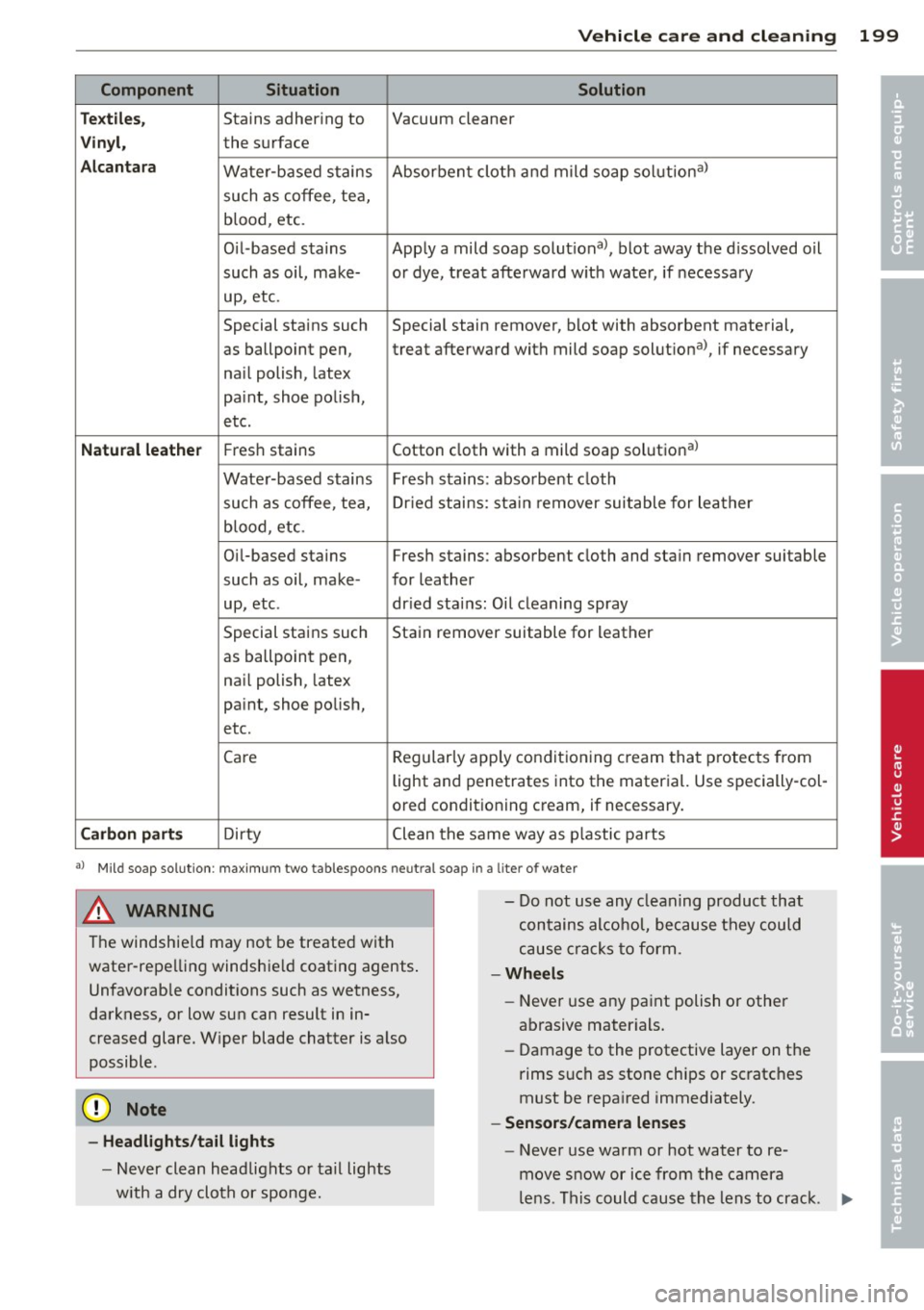
Vehicle care and cleaning 199
Component Situation Solution
Te xtile s,
Stains adhering to Vacuum cleaner
Vinyl, the surface
Alcantara Water-based stains Absorbent cloth and mild soap solutiona>
such as coffee, tea, blood, etc.
Oil-based stains Apply a mild soap solutiona>, blot away the d issolved oil
such as oil, make- or dye, treat afterward w ith water, if necessary
up, etc.
Special stains such Special stain remover, blot with absorbent material,
as ballpoint pen, treat afterward with mild soap solutiona>, if necessary
na il polish, latex
pa int, shoe polish,
etc.
Natural leather Fr es h stains Cotton cloth with a mild soap solutiona)
Water-based stains Fresh sta ins: absorbent cloth
such as coffee, tea, Dr ied stains: sta in remover suitable for leather
blood, etc.
Oil-based stains Fresh sta ins: absorbent cloth and stain remover suitable
such as oil, make- for leather
up, etc . dried sta ins: Oil cleaning spray
Special stains such Stain remover suitable for leather
as ballpo int pen,
na il polish, latex
pa int, shoe polish,
etc .
Care Regularly
apply conditioning cream that protects from
light and penetrates into the material. Use specially-col-
ored conditioning cream, if necessary.
Carbon parts Dirty Clean the same way as plastic parts
al Mild soap solution: maximum two tablespoons neut ral soap in a liter of water
& WARNING
The windshie ld may not be treated with
water-repelling windshie ld coating agents .
Unfavorab le conditions such as wetness,
darkness, or low sun can result in in
creased glare. W iper blade chatter is also
possible.
- Headlights/tail lights
- Never clean headlights or tail lights
w ith a dry cloth or sponge. -
Do not use any cleaning product that
contains alcohol, because they could
cause cracks to form .
-Wheels
-Never use any paint polish or other
abrasive mater ials.
- Damage to the protective layer on the
rims such as stone chips or scratches
must be repaired immediately.
- Sensors/camera lenses
- Never use warm or hot water to re-
move snow or ice from the camera
len s. This could cause the lens to crack .
IJII>
•
•
Page 205 of 286
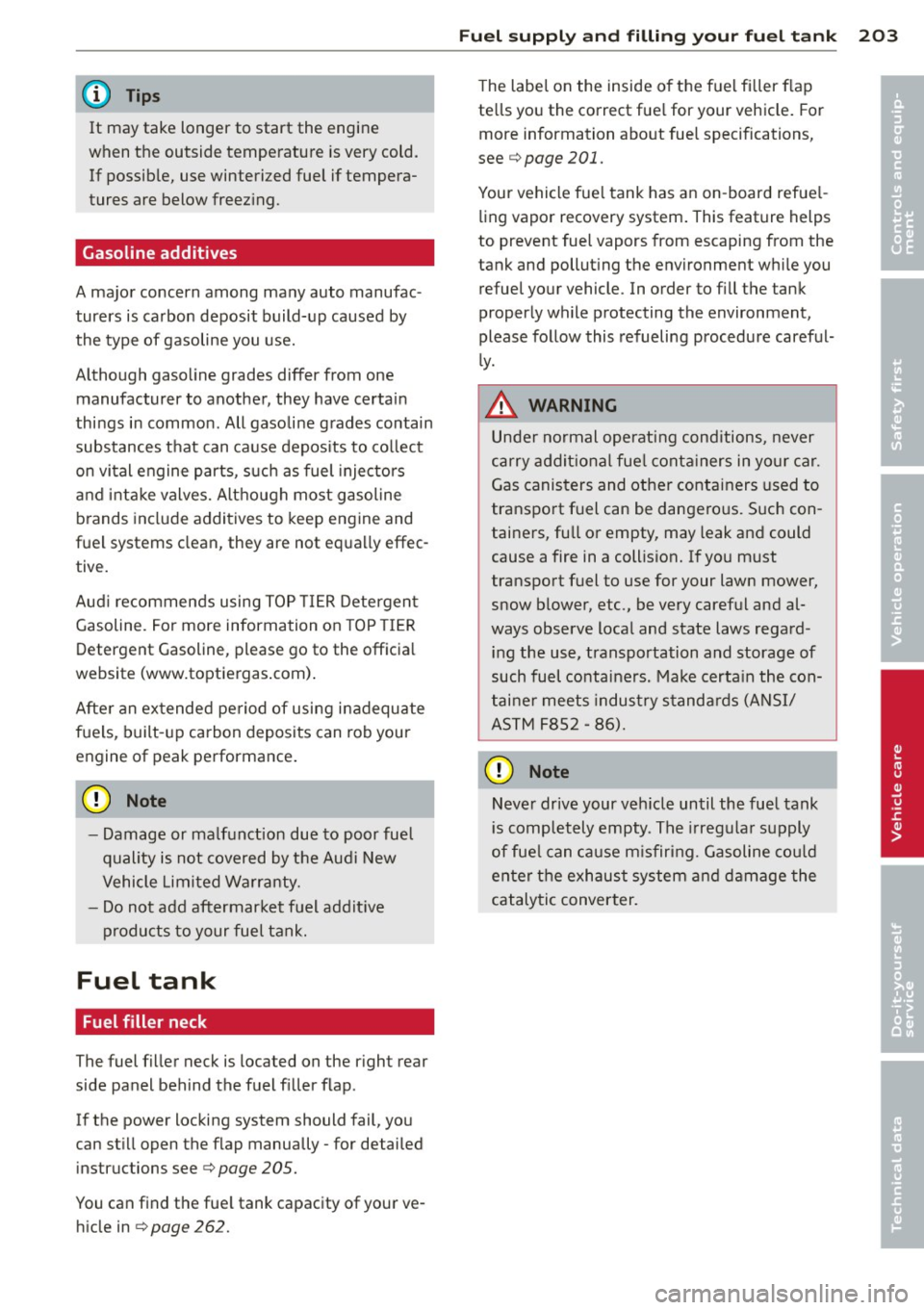
@ Tips
It may take longer to start the engine
when the outside temperature is very cold.
If possible, use winterized fuel if tempera
tures are below freezing.
Gasoline additives
A major concern among many auto manufac
turers is carbon deposit build-up caused by
the type of gasoline you use.
Although gasoline grades differ from one manufacturer to another, they have certain
things in common. All gasoline grades contain
substances that can cause deposits to collect
on vital engine parts, such as fuel injectors
and intake valves. Although most gasoline
brands include additives to keep engine and
fuel systems clean, they are not equally effec
tive.
Aud i recommends using TOP TIER Detergent
Gasoline. For more information on TOP TIE R
Detergent Gasoline, please go to the officia l
website (www.toptiergas .com) .
Afte r an extended pe riod of using inadequate
fuels, built-up carbon deposits can rob your
engine of peak performance.
CD Note
- Damage or malfunction due to poor fuel
quality is not covered by the Audi New
Vehicle Limited Warranty.
- Do not add aftermarket fuel additive
products to your fuel tank.
Fuel tank
Fuel filler neck
The fuel filler neck is located on the r ight rear
side panel behind the fuel filler flap.
If the power locking system should fail, you
can sti ll open the flap manually - for detailed
instructions see
c:> page 205.
You can find the fue l tank capacity of your ve
hicle in
c:> page262.
Fuel supply and filling your fuel tank 203
The label on the inside of the fuel fi lier f lap
te lls you the correct fue l for your vehicle. For
more information about fuel specifications,
see
c:> page 201.
Your vehicle fue l tank has an on -board refue l
ling vapor recovery system. This feature helps
to prevent fuel vapors from escaping from the
tank and polluting the environment while you
refuel your vehicle. In order to fill the tank
proper ly while protecting the environment,
please follow this refueling procedure careful
ly.
_&. WARNING
Under normal operating conditions, never
carry additional fuel containers in your car.
Gas canisters and other containers used to
transport fuel can be dangerous. Such con
tainers, fu ll or empty, may leak and could
cause a fire in a collision. If you must
transport fuel to use for your lawn mower,
snow blower, etc., be very careful and al
ways observe local and state laws regard
ing the use, transportation and storage of
such fuel containers. Make certain the con
tainer meets industry standards (ANSI/
ASTM F852 - 86).
CD Note
Never drive your veh icle until the fuel tank
i s completely empty. The irregu la r supply
of fue l can cause misfiring. Gasoline cou ld
enter the exhaust system and damage the
catalytic converter.
•
•