warning AUDI A5 COUPE 2014 Owners Manual
[x] Cancel search | Manufacturer: AUDI, Model Year: 2014, Model line: A5 COUPE, Model: AUDI A5 COUPE 2014Pages: 286, PDF Size: 70.99 MB
Page 237 of 286
S up to 110 mph (180 km/h)
T up to 118 mph (190 km/ h)
U up to 124 mph (200 km/ h)
H up to 130 mph (210 km/h)
V up to 149 mph (240 km/h)
1
)
Z over 149 mph (240 km/h)1
)
W up to 168 mph (270 km/h)1
)
Y up to 186 mph (298 km/h)1>
Your vehicle is no rma lly facto ry equipped with
tires, which possess excellent driving cha rac
ter istics and give yo ur Audi opt imum driving
comfort . An e lectronic speed limiter
¢ page 31 wi ll normally prevent your vehicle
from going faster than the tire speed rating
¢ A .
U.S. DOT Tir e Identification Numbe r (TIN )
a nd tir e m anufactur e date
This is the t ire's "serial number". It begins
with the letters "DOT" and indicates that the
tire meets all federal standards. The next two
numbers or letters indicate the plant where it
was manufactured, and the last four numbers
represent the week and year of manufacture .
F or example, the numbers 2213 mean that
the t ire was produced in the 22nd wee k of
20 13. The othe r numbe rs a re mar ke ting co
des that may or may not be used by the tire
manufacturer . This information is used to con
tact consumers if a tire defect requires a re
call.
Audi Original tir e
Tires with the identi fication "AO" or "RO" have
been specia lly matched with your Audi . We
recommend using only t hese tires because
they meet the highest standards regard ing
safety and driving character istics when used
correctly . You r authorized Audi dealer will
g lad ly provide you with more information .
Tire ply composition and materi als used
The number of plies indicates the n umber of
layers of rubber-coated fabric in the tire. In
ll For tires w it h a max imum spee d capa bility over
1 4 9 mp h (2 40 k m/h ), t ire man ufact urers somet imes
u se the lette rs "ZR ."
Tire s an d wheel s 235
genera l, the greater the number of plies, the
more weight a tire can support . Tire manufac
turers also must indicate the materials in the
tire, which include steel, nylon, po lyester, and
others.
Maximum Load Rating
This number indicates the maximum load in
ki lograms and pounds that can be carr ied by
the tire.
Tir e quality grading for treadwear ,
tract ion, and temp eratu re resis tance
T read wear, t raction and temperat ure grades
¢ page 236.
Maximum Permissible Inflation Pressure
This number is the g reatest amount of a ir
pressure that should ever be put in the tire
u nder normal driving conditions.
A WARNING ~
- Using incorrect or unmatched tires and/
or wheels or improper tire and wheel
comb inat ions can lead to loss of control,
col lis ion and serious personal injury.
-Always use t ires, rims and whee l bolts
that meet the specif ications of original
factory- installed tires or other combina
tions that have been specifically ap
proved by the vehicle manufacture r.
- T ires age even if they are not being used
and can fai l sudden ly, especially at high
speeds. Tir es that are more than 6 yea rs
old can only be used in an emergency
a nd then w ith speci al care and at lower
speeds.
- Never mo unt used tires on your veh icle if
you are not sure of the ir "previous histo
ry." O ld used tires may have been dam
aged even thoug h the damage cannot be
seen that can lead to sudden tire fai lure
and loss of vehicle control.
•
•
Page 239 of 286
The relative perform a nee of ti res depends
upon the actua l conditions of their use, how
ever, and may depart sign ificantly from the
norm due to var iat ions in dr iving habits, serv
ice practices and differences in road character
istics and climate .
Trac tion
The traction grades, from highest to lowest,
are AA, A, Band
C. Those grades represent the
tire's ability to stop on wet pavement as measured under controlled cond itions on
specified government test surfaces of asphalt
and concrete . A tire marked C may have poor
traction performance ¢,&. .
Temp erature
The temperature grades are A (the h ighest),
B, and
C, representing the t ire's resistance to
the generat ion of heat and its ability to dissi
pate heat when tested under controlled condi
tions on a specified i ndoor laboratory test
wheel.
Sustained high temperature can cause the
materia l of the tire to degenerate and reduce
tire life, and excessive temperature can lead
to sudden ti re fa ilu re ¢ ,&. .
The grade
C corresponds to a level of perform
ance which all passenger car tires must meet
u nder the Federa l Moto r Veh icle Safety Stand
a rd No.
1 09. G rades Band A represent h igher
l eve ls of perfo rmance on the laboratory tes t
wheel than the m inimum required by law .
A WARNING
The traction grade assigned to this ti re is
based on stra ight-ahead b raking t raction
tests, and does not include acceleration,
cornering, hydrop lan ing or peak traction
character istics.
A WARNING
The temperature grade for this t ire is es
tablished for a t ire that is p roperly inflated
and not overloaded. Excessive speed, un
derinflation, or excessive loading, either
-
Tire s an d wheel s 237
separately or in combinat ion, can ca use
heat bui ldup and possible tire failure.
Winter tires
Winter tires can improve vehicle handling on
snow and ice. At temperatures below 45 °F (7 °C) we recommend changing to winter
tires.
In some heavy snow areas, local governments
may require true winter o r "snow" tires, those
with very deeply cut tread. These tires should
o nly be used in pairs and be installed o n all
four wheels . Make sure you purchase snow
t ires that are the same size and construction
type as the other tires on you r vehicle.
Your vehicle is equipped with all wheel drive,
th is w ill improve traction during winter driv
i ng, even with the standa rd tires . However, we
strong ly recommend that you always equip all
fo ur wheels on you r vehicle wit h corre ct ly fit
ted winter tires or all-season t ires, when win
te r road cond itions are expected . This also im
proves the veh icle's braking per formance and
reduces stopping dista nces.
Summe r tires provide less grip on i ce and
snow.
Winter tires (snow tires) must always be fitted
o n all fo ur wheels .
Ask your authorized Audi dealer or qualified
workshop for permitted
winter tire size s. Use
o nly rad ial w inter t ires.
Winter tires lose their effectiveness when the
tread is worn down to a depth of
0 .157 inch
(4 mm) .
Only drive w ith w inter t ires under w inter con
dit ions. Summer t ires handle better when
there is no snow or ice on the roads and the
temperature is above 45 °F (7 °() .
If you have a flat tire, see notes on spare
whee l
¢page 233.
Please a lways remember that winter tires may
have a lowe r speed rating than the tires o rigi -
nally installed on your vehicle at the time it .,.
•
•
Page 240 of 286
238 Tire s and whee ls
was manufactured . Please see q page 234,
Speed roting (letter code) for
a listing of the
speed rat ing letter codes and the maximum
speed at which the tires can be driven .
The speed rating letter code( ¢
page 225) is
on the side wall of the tire
c::> page 233.
A WARNING
Winter tires have maximum speed limits
that may be lower than your vehicle's max
imum speed . Always know the maximum
speed before driving off . Never drive faster
than the speed permitted for your specific
w inter t ires. This will cause damage to the
tires leading to an accident and serious
personal inj ury to you and your passen
gers.
A WARNING
=
Driving faster than the maximum speed
for which the winter tires on your vehicle
were designed can cause tire failure in cluding a blowout and sudden deflation,
loss of control, crashes and serious per
sonal injuries. Have worn or damaged tires
replaced immed iately .
- Winter tires have maximum speed rat ing
that may be lower than your veh icle's
maximum speed .
- Never drive faster than the speed for
which the winter or other tires installed on your vehicle are rated.
A WARNING
Always adjust your driving to the road and
traffic conditions. Never let the good ac
celeration of the winter tires and all whee l
drive tempt you into taking extra r is ks . A l
ways remember :
- When brak ing , an a ll whee l drive vehicle
hand les in the same way as
a front drive
vehicle.
- Drive caref ully and reduce your speed on
icy and slippery roads, even winter tires
cannot he lp under black ice conditions.
{® Fo r the s ake of the en vironment
Use summer tires when weather condi
tions permit. They are quieter, do not wear
as quickly and reduce fuel consumption.
Snow chains
Snow cha ins may be f itted only to the front
wheels, and only to certain tire sizes . Ask your
authorized Aud i dealer on which tire sizes
snow chains can be used.
The snow chains must have low-prof ile links
and must not be th icker than 0.53 inch
(13 .5 mm), includ ing the lock .
Remove wheel center covers and trim discs
before putt ing snow chains on your vehicle
c::> @ . For safety reasons cover caps must then
be fitted over the wheel bolts . These are avail
able from autho rized Aud i dealers.
A WARNING
Using the wrong snow chai ns for your veh i
cle or instal ling them incorrect ly can in
crease the risk of loss of cont ro l leading to
serious personal injury.
- Snow chains are available in different
sizes . Always make sure to follow the in
structions provided by the snow chain manufacturer.
- When driving with snow chains never
drive faster than the speed permitted for
your specif ic snow chains.
- Always observe local regulations .
(D Note
-Remove snow chains before dr iv ing on
roads not covered with snow to avoid
damaging tires and wearing the snow
chains down unnecessarily.
- Snow chains, which come into direct con
tact with the whee l rim, can scratch or
damage it . Therefore, make sure that the
snow chains are s uitably covered. Check
the pos ition of the snow chains after
Page 241 of 286
driving a few yards and correct if neces
sary . Follow the instructions from the
snow cha in manufacturer when doing so.
(D Tips
Where snow chains are mandatory oncer
tain roads, this norma lly also applies to
veh icles with all wheel drive .
Wheel bolts
Wheel bolts must always be tightened to the
correct torque.
The design o f whee l bolts is matched to the
factory insta lled r ims . If different rims are fit
ted, the correct wheel bo lts wit h the right
l ength and correctly shaped bolt heads must
be used. This ensures that wheels are f itted
securely and that the brake system functions
correctly .
In certain circumstances, you may not use
wheel bo lts from a different vehicle -even if it
is the same model<=>
page 266.
A WARNING
Improperly tightened or maintained wheel
bolts can become loose caus ing loss of
cont ro l, a co llision and serious persona l in
Jury .
- Always keep the w heel bolts and the
threads in the wheel hubs clea n so the
w hee l bolts can t urn easily and be p rop
erly t igh tened.
- Never grease or oil the wheel bolts and
the threads in the wheel h ubs. They can
become loose wh ile d riving if greased or
oiled, even if tightened to the specified
torq ue.
- Only use whee l bo lts that belong to the
rim being installed .
- Never use different whee ls bolts on your
vehicle.
- Alw ays m ain ta in the co rrec t tig hten ing
torq ue fo r the wheel bo lts to reduce the
risk of a wheel loss . If the tightening tor
que of the wheel bo lts is too low, they
can loosen and come out when the vehi-
Tire s an d wheel s 239
cle is mov ing. If the tightening torq ue is
too high, the wheel bolts and threads
can be damaged and the whee l can be
come loose.
@ Note
The specified torque for the whee l bolts is
90 ft lbs . (120 Nm) w ith a tolerance of
± 7,4 ft lbs. (± 10 Nm). Torque whee l bolts
diagonally . After changi ng a wheel, the
torque m ust be checked as soon as poss i
ble with a to rque wrench -preferably by an
a uthorized Aud i dea le r or qualified wor k
shop .
Low aspect ratio tires
Your A udi is fac tory -eq uipped w ith low aspect
ratio tires . These tires have been tho ro ughly
tested and been se lected specifically for your
model for their superb performance, road fee l
and handling under a variety of driving condi
tions . Ask your authorized Aud i dealer for
more details .
The low aspect ratio of these t ires is ind icated
by a numeral of
55 or less in the tire's size
designation. The numera l represents the ratio
of the tire's sidewa ll height in relation to its
tread width exp ressed in percentage. Conven
tiona l tires have a he ight/w idth ratio of 60 or
more.
The performance of low-a spect-r atio tire s is
particularly sensit ive to improper inflation
pre ssure. It is therefor e important that low
a spect ratio tire s are inflated to the specified
pres sure and that th e inflation pr essure i s
regularly checked and maintained. Tire pre s
sure s should be chec ked at lea st once a
month and always before a long trip
<=> page 228 , Checking tire pressure.
What you can do to avo id tire and rim
damage
Low aspect ratio tires can be damaged mo re
easily by impact w ith potholes, curbs, gull ies
or ridges on the road, particularly if the tire is
under inflated . ..,.
•
•
Page 243 of 286
When the malfunction indicator is illuminat
ed, the system may not be able to detect or
signal low tire pressure as intended. TPMS
malfunctions may occur for a variety of rea
sons, including the installation of replace
ment or alternate tires or whee ls on the veh i
cle that prevent the TPMS from funct io ni ng
p roperly . Always check the T PMS malfunct ion
tellta le afte r replacing one o r more t ires or
wheels on your veh icle to ensure that the re
p lacemen t or a lternate tires and wheels allow
the TPMS to continue to function properly .
Tire pressure indicator appears
Applies to vehicles: with tire pressure monitoring system
The tire pressure indicator in the instrument
cluster informs you if the tire pressure is too
low or if there is a system malfunction.
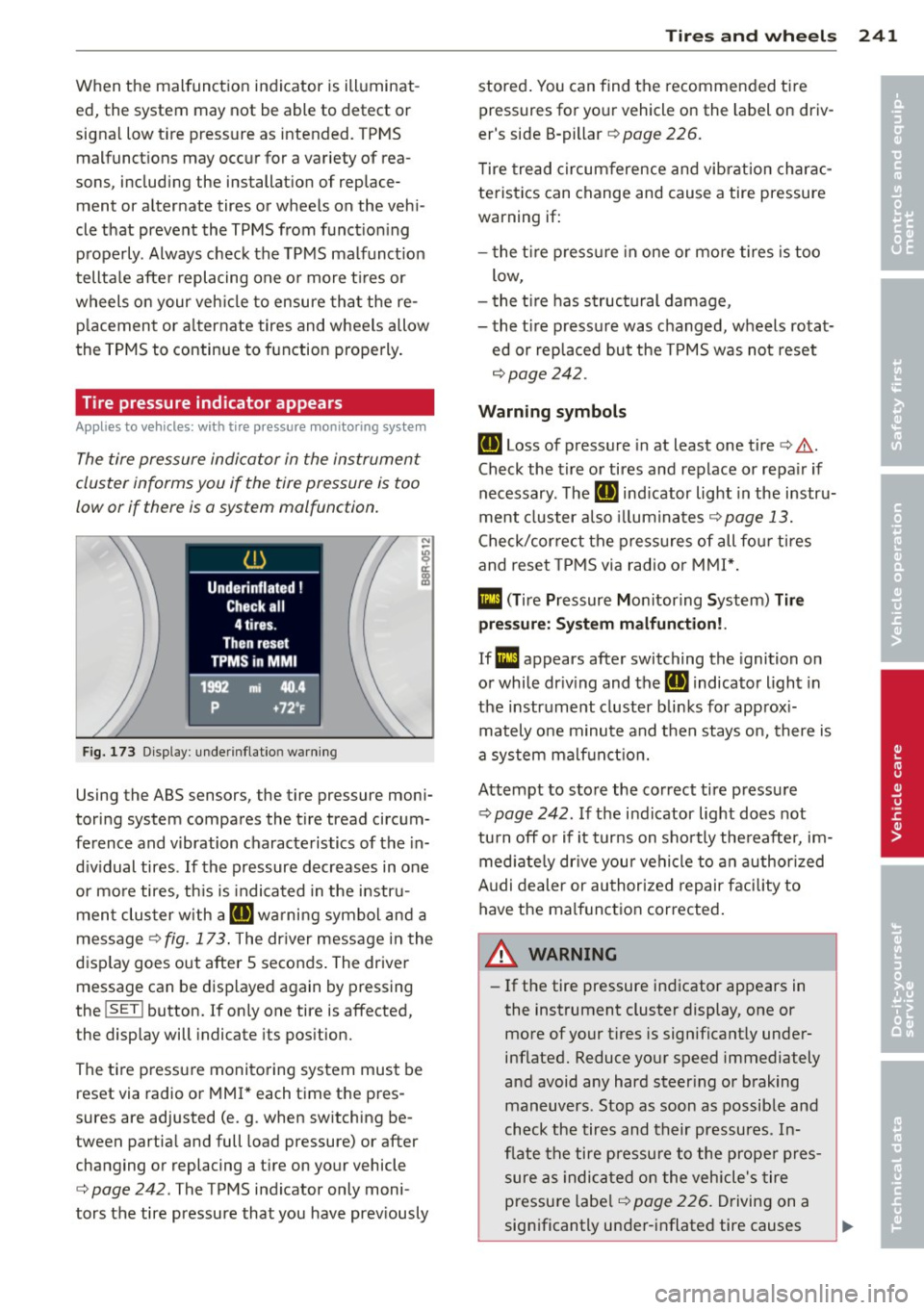
Fig. 173 Display : underinflatio n warning
Using the ABS sensors, the tire pressure moni
toring system compares the t ire tread circum
ference and vibration characteristics of the in
d iv idual tires . If the pressure decreases in one
or mo re tires, th is is indica ted in the instru
ment clus ter with a
RE wa rning symbol and a
message¢
fig. 173 . The driver message in the
disp lay goes out after 5 seconds . The driver
message can be displayed again by pressing
the
! SET ! button. If only one tire is affected,
the display will indicate its pos ition.
The ti re pressu re monitoring system must be
reset via radio or MMI* each time the pres
sures are adjusted (e.g . when switching be
tween partia l and full load pressure) or after
changing or replacing a t ire on your vehicle
¢
page 242 . The TPMS indicator only moni
tors the tire pressure that you have prev iously
Tire s an d wheel s 241
stored . You can find the recommended t ire
pressures for yo ur vehicle on the label on driv
er's side 8-pillar ¢
page 226.
T ire tread circum ference and vibration charac
teristics can change and cause a tire pressure
warning if:
- t he t ire p ress ure in one or more tires is too
low,
- t he t ire has s tructural damage,
- the t ire pressure was changed, wheels rotat-
ed or replaced but the TPMS was not reset
¢ page 242.
Warning symbo ls
RE Loss of pressure in at least one tire c> & .
Check the tire or tires and replace or repa ir if
necessary. The
RE ind icator light in the instru
ment cluster a lso illuminates
c::!;> page 13.
Check/correct the press ures of all fou r tires
and reset TPMS via radio or MMI*.
Ill (T ir e Pressure Monitor ing System) Tire
press ure: Syst em malfun ction!.
If II! appears after switching the ignition on
o r while dr iv ing and the
RE i ndicator light in
the instr ume nt cluster blinks for app rox i
mately o ne minute and t hen stays o n, there is
a system malf unct ion.
Attempt to store the co rrect tire pressure
¢ page 242 . If the ind icator light does not
tu rn off o r if it turns on sho rtly the reafter, im
med iate ly dr ive your vehicle to a n author ized
Audi dealer or au thorized repair faci lity to
have the malfunc tion corrected .
A WARNING
-=
-If the tire pressure indicator appears in
the instrument cluster display, one or
more of your t ires is significant ly under
inflated. Reduce your speed immediately
and avoid any hard steer ing or b raking
maneuvers. Stop as soon as possib le and
check the tires and their pressures. In
flate the tire pressure to the prope r pres
sure as indicated on the vehicle's tire
pressu re labe l
¢page 226. Driving on a
significantly under-inflated tire causes
•
•
Page 245 of 286
What do I do now?
Vehicle tool kit
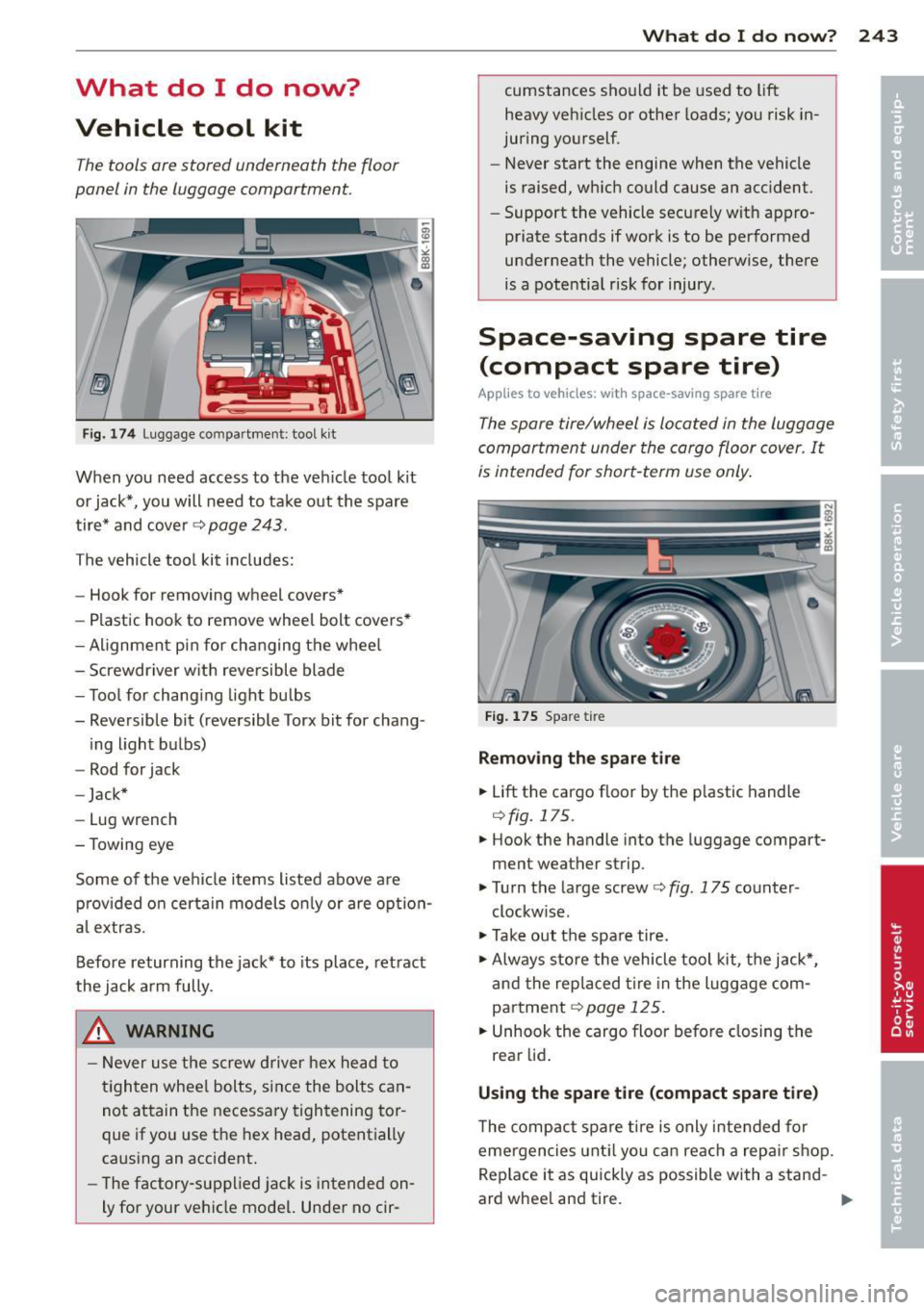
The tools ore stored underneath the floor
panel in the luggage comportment.
Fig. 174 Luggage compartment: tool kit
When you need access to the veh icle tool kit
or jack*, you will need to take o ut the spare
tire* and cover¢
page 243.
The vehicle tool kit includes:
- Hook for removing wheel covers*
- Plastic hook to remove wheel bolt covers*
- Alignmen t pin for ch anging the whee l
- Screwdriver w ith reversible blade
- Too l for chang ing light bulbs
- Reversible bit (reversible Torx bit for chang -
ing light bulbs)
- Rod for jack
- Jack*
- Lug wrench
- Towing eye
Some of the vehi cle items listed above are
p rov ided o n certain models o nly or are opt io n
al extras .
Before returning the jack* to its place, retract
the jack arm fully.
.&, WARNING
-
-Never use the screw d river hex head to
tighten whee l bolts, since the bolts can
not attain the necessary tightening tor
que if yo u use the hex head, potentially
caus ing an accident.
- The factory-supplied jac k is intended on
ly for your vehicle model. Unde r no cir-
What do I d o now ? 243
cumstances should it be used to lift
heavy veh icles or other loads; you risk in
juring yourself.
- Never start the engine when the vehicle
is raised, wh ich could cause an acc ident.
- Support the vehicle securely w it h appro
priate stands if work is to be performed
underneath the vehicle; otherwise , there
is a pote ntia l risk for injury .
Space-saving spare tire
(compact spare tire)
App lies to vehicles: wit h space -saving spare t ire
The spore tire/wheel is located in the luggage
comportment under the cargo floor cover. It
is intended for short-term use only .
Fig. 175 Spa re tir e
Remo ving th e spare tire
.. Lift the cargo floor by the p lastic handle
¢ fig. 175 .
.. Hook the handle into the luggage compart
ment wea ther strip .
.,. Turn the large screw <=>
fig. 175 counter
clockw ise.
.,. Take out the spa re tire .
.,. Always s tore the vehicle tool kit, the jack*,
and the rep laced tire in the luggage com
partment
¢ page 125 .
.. Unhook the cargo floor before closing the
rear lid .
Using th e spare tire (compact spar e tire )
The compact spare t ire is only intended fo r
eme rgencies unt il you can reach a repa ir sh op.
Rep lace it as qu ickly as possible with a stand -
ard whee l and tire.
Ill-
Page 246 of 286
24 4 What do I do no w?
There are some restrictions on the use of the
compact spare tire. The compact spare tire
has been des igned specifically for your type of
vehicle.
It must not be swapped with a com
pact spare tire from another type of vehicle.
Sno w cha in s
For technical reasons, the use of snow chains
on the compact spare tire is
n ot permitted .
If you do have to dr ive with snow cha ins and a
front tire fails, mount the spare wheel w ith
tire instead of a rear tire. Install the snow
chains on the rear tire and use it to rep lace
the defective front tire.
A WARNING
- Never use the spare tire if it is damaged
or if it is worn down to the tread wear in
dicators.
- If the spare tire is more than 6 years o ld,
use it only in an emergency and w ith ex
t reme caution and careful driving.
- The spare tire is intended only for tem
porary and short-term use. It should be
replaced as soon as possib le w ith the
normal wheel and t ire.
- After mounting the compact spare tire, the tire pressu re must be checked as
soon as poss ible. The tire pressure of the
c ompac t spare tire must be 4.2 bar; oth
erwise, you risk hav ing an accident.
- Do not drive faster than 50 mph (80 km/
h). You r isk having an acc ident.
- Avoid full-throttle acce le rat ion, heavy
braking, and fast corner ing . Yo u risk hav
ing an acc iden t.
- Never dr ive us ing more than one spare
wheel and tire. You risk having an acci
dent.
- No rma l summer o r winte r ti res m ust not
be mounted on the compact spare whee l
rim.
- F or te chnical reasons, the use o f ti re
chains on the spare tire is not permi tted .
If it is necessary to drive with tire chains,
the spare whee l must be mounted o n the
front axle in the event of a f lat in a rear tire. The new
ly available front wheel
must then be installed in place of the
rear whee l with the flat tire. Installing
the t ire cha in before mounting the whee l
and tire is recommended .
- Loose items in the passenger compart
ment can cause serious personal injury
during hard brak ing or in an accident.
Never store the spa re tire or jack and
too ls in the passenger compa rtment.
Changing a wheel
Before changing a wheel
Observe the following precautions for your
own and your passenger's safety when chang
ing a wheel .
"'After you expe rience a tire failure, pull the
car we ll away from moving traffic and try to
reach
le vel ground before you stop ¢ ,&.
"'All passengers should leave the car and
move to a safe location (for instance, behind
the guardrail)¢ &,.
"' Engage the
parking brak e to prevent your
veh icle from rolling unintentionally¢&, .
"' Shift into
1st gea r on ve hicles w ith manual
transmiss io n, or move the
select or lever to
the P p osition
on ve hicles w it h automatic
transmission .
"'I f you are towing a trailer : unhitch the trai l
er from your vehicle .
"' Take the
jack¢ page 243 and the spare tire
¢ page 243 out of the luggage compart
ment.
A WARNING
--
You o r you r passengers could be injured
while changing a wheel if you do not fo l
l ow these safety precaut io ns:
- I f you have a flat tire, move a safe d is
tance off the road. Tu rn off the engine,
tur n the eme rgency flashers on and use
o ther warning devices to a lert other mo-
torists .
IIJ>
Page 247 of 286
-Make sure that passengers wait in a safe
place away from the vehicle and well
away from the road and traffic.
- To help prevent the vehicle from moving
suddenly and possibly slipping off the
jack, always fully set the parking brake and block the wheel diagonally opposite
the wheel being changed with the fold
ing chocks or other objects. When one
front wheel is lifted off the ground, plac
ing the Automatic Transmission in
"P"
(Park) will not prevent the vehicle from
moving.
- Before you change a wheel, be sure the
ground is level and firm. If necessary,
use a sturdy board under the jack.
- Always store the vehicle tool kit, the
jack* and the replaced tire in the luggage
compartmentc:>poge
125.
(D Note
If you are changing the wheel on a steep
incline, use a rock or similar object to
block the opposite wheel to prevent the
vehicle from moving.
(D Tips
Obey all laws.
Changing a wheel
When you change a wheel, follow these
quence described below step-by-step and in
exactly that order.
1. Remove the decorative wheel cover* or
the
wheel bolt caps* . For more details see
also
c:> page 246, Decorative wheel cov
ers
or c:> page 246, Wheels with wheel
bolt cops.
2 . Loosen the wheel bolts c:> page 246.
3. Locate the proper mounting point for the
jack and align the jack below that point c:>
page 247.
4 . Lift the car with the jack c:> page 247 .
5. Remove the wheel with the flat tire and
then install the
spare tire c:> page 248 .
6. Tighten all wheel bolts lightly.
What do I do now? 245
7. Lower the vehicle with the jack.
8. Use the wheel bolt wrench and firmly
tighten all wheel bolts in a crisscross pat
tern
c:> page 246.
9. Replace the decorative wheel cover* or
the
wheel bolt caps* .
A WARNING
Always read and follow all WARNINGS and
information c:>
.&. in Raising the vehicle on
page 247
and c:> page 249.
After changing a wheel
A wheel change is not complete without the
doing the following.
.. Always store the vehicle tool kit, the jack*,
and the replaced tire in the luggage com
partment
c:> poge 125 .
.,. Check the tire pressure of the spare tire as
soon as possible .
.. As soon as possible, have the
tightening
torques
on all wheel bolts checked with a
torque wrench. The correct t ightening tor
que is
90 ft lbs. (120 Nm) .
.. Have the flat tire
replaced as soon as possi
ble .
(D Tips
-If you notice that the wheel bolts a re
corroded and difficult to turn while
changing a tire, they should be replaced
before you check the tightening torque .
- Drive at reduced speed until you have the
tightening torques checked.
•
•
Page 248 of 286
246 What do I do now?
Decorative wheel covers
Applies to vehicles: with decorative wheel covers
The decorative wheel covers must be removed
first to access the wheel bolts .
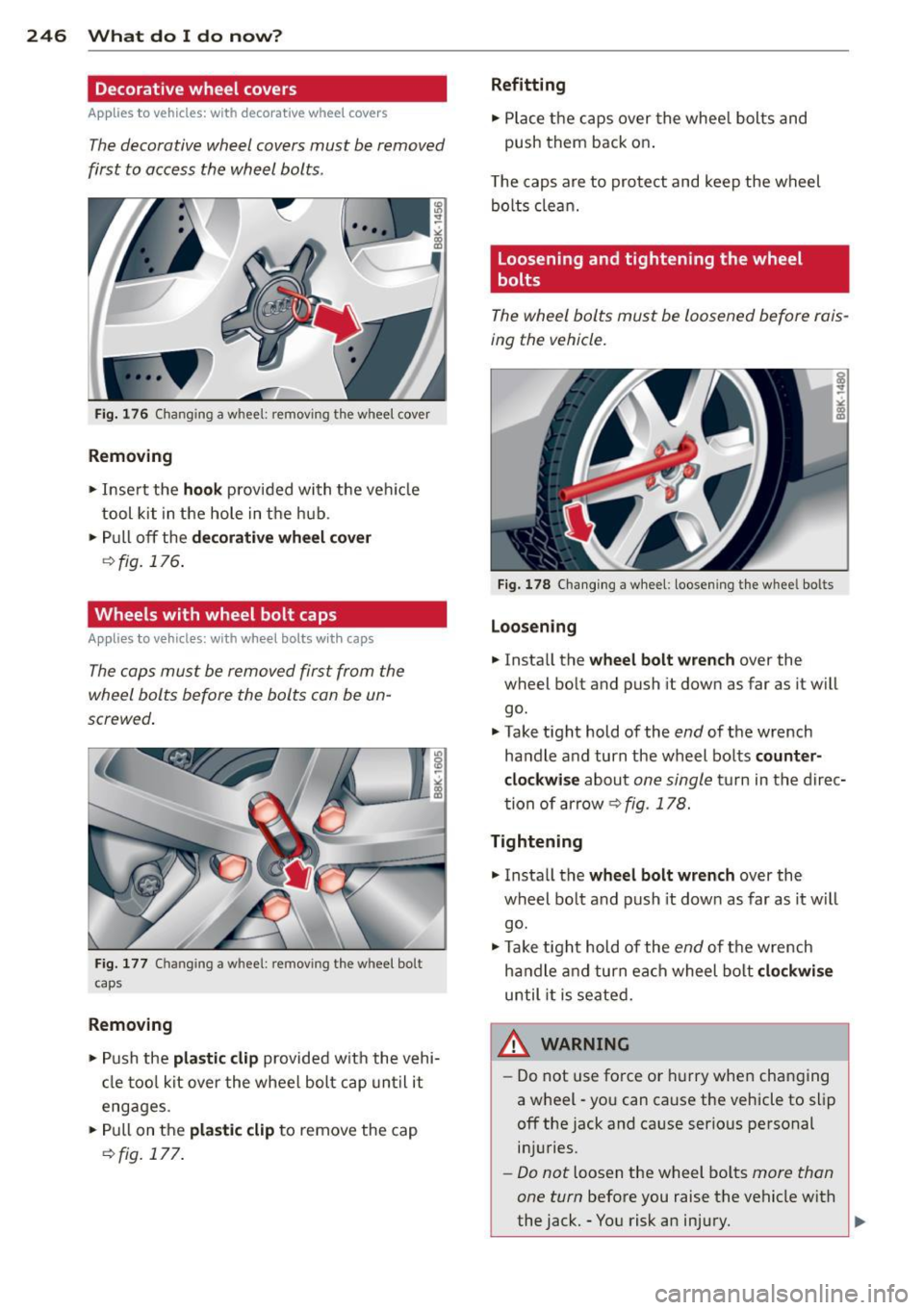
Fig. 176 Changing a w hee l: remov ing the w heel cover
Removing
.. Insert the hook provided with the vehi cle
tool kit in the hole in the hub .
.. Pull off the
decorative wheel cover
~fig. 176 .
Wheels with wheel bolt caps
Applies to vehicles: with wheel bolts w ith caps
The caps must be removed first from the
wheel bolts before the bolts con be un
screwed .
Fig. 177 Chan gin g a w hee l: rem ov ing the w heel bo lt
c ap s
Removing
.. Push the plastic clip provided w ith the vehi
cl e too l kit over the wheel bolt cap until it
engages.
.. Pull on the
plastic clip to remove the cap
9fig . 177 .
Refitting
.. Place the caps over the whee l bolts and
push them back on .
T he caps are to protect and keep the wheel
bolts clean.
Loosening and tightening the wheel
bolts
The wheel bolts must be loosened before rais
ing the vehicle.
Fig. 178 Changing a wheel: loosening the whee l bo lts
Loosening
.. Insta ll the wheel bolt wrench over the
wheel bolt and push it down as far as it w ill
go.
.. Take tight hold of the
end of the wrench
handle and turn the wheel bolts
counter
clockwise
about one single turn in the direc
tion of arrow
c;, fig. 178.
Tightening
.. Insta ll the wheel bolt wrench over the
wheel bolt and push it dow n as far as it will
go .
.. Take tight hold of the
end of the wrench
handle and turn ea ch wheel bo lt
clockwise
until it is seated.
,&_ WARNING
-= -
- Do not use force or hurry when changing
a wheel -you can cause the vehicle to slip
off the jack and cause serious personal injuries.
- Do not loosen the wheel bolts more than
one turn
before you raise the vehicle with
the jack. -You risk an injury. ..,.
Page 249 of 286
@ Tips
-Never use the hexagonal socket in the
handle of the screwdriver to loosen or
tighten the wheel bolts.
- If a whee l bolt is very tight, you may find
it easier to loosen by carefully pushing
down on the end of the wheel bolt
wrench w ith
one foot only. As you do so,
hold on to the car to keep your ba lance
and take ca re not to slip.
Raising the vehicle
The vehicle must be li~ed with the jack first
before the wheel can be removed .
*- '*
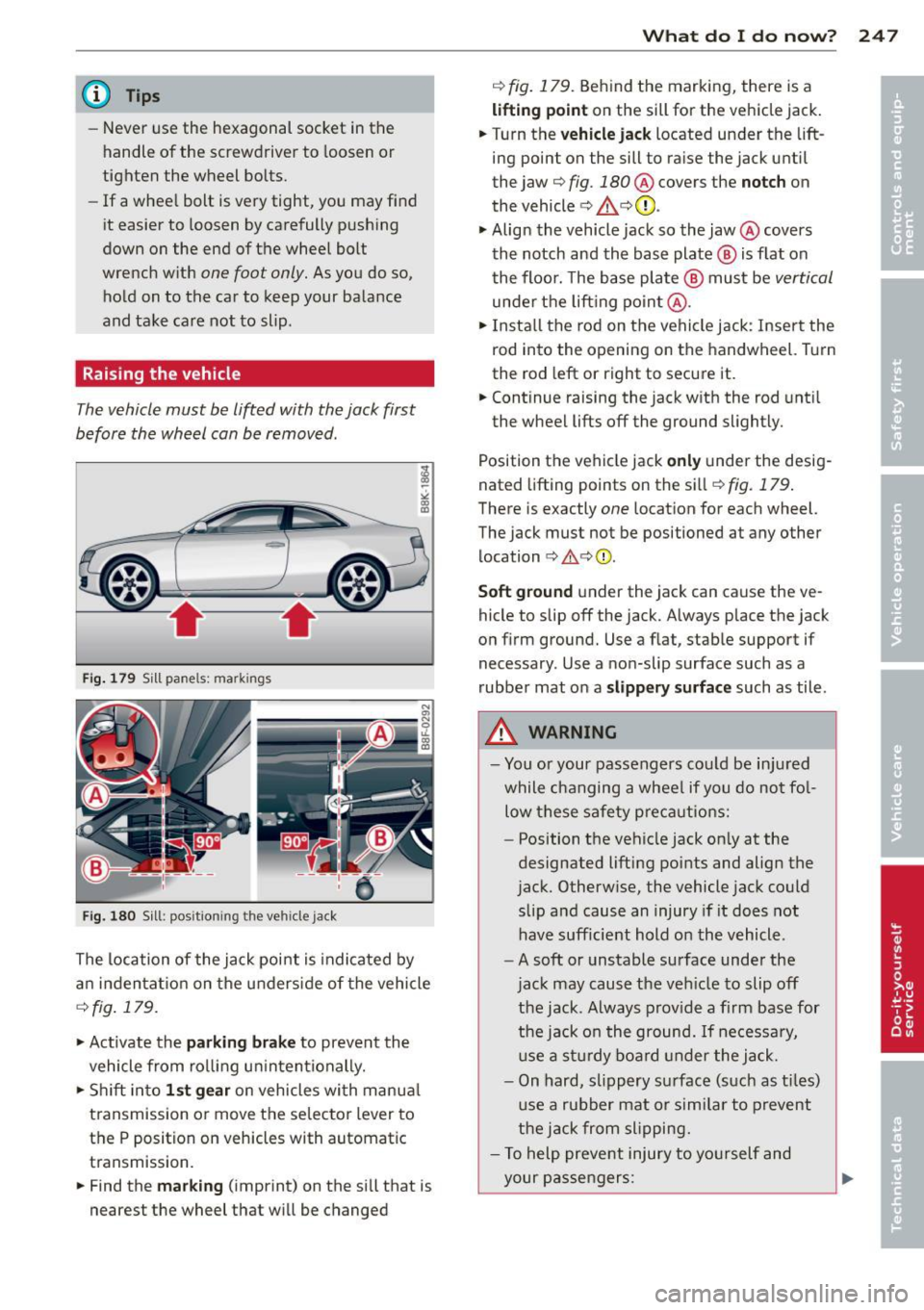
Fig. 1 79 Sill pane ls: ma rk ings
Fi g. 180 Sill: posit ion ing the ve hicle
jack
The location of the jack point is indica ted by
a n in den ta ti on on the underside of the vehicle
¢ fig . 179.
"'Activate the parking b rake to prevent the
vehicle from ro lling u ninten tionally.
"' Shift in to
1st gear on vehicles with manua l
transmission or move the se lector lever to
the P position on vehicles with automatic
transmission.
"' Find the
marking (imprint) on the sill that is
nearest the wheel that w ill be changed
What do I d o now ? 24 7
¢ fig. 179. Behind the marking, there is a
lifting point on the sill for the vehicle jack.
"' Turn the
vehicle ja ck located under the lift
ing point on the sill to ra ise the jack until
the jaw ¢
fig. 180 @ covers the notch on
the vehicle
¢ & ¢ (D .
"'Align the vehicle jack so the jaw@ covers
th e notch and the base plate @ is flat on
the floor. The base plate @ must be
vertical
unde r th e lift ing po in t @ .
"'I nsta ll the rod on the vehicle jack : Inser t the
rod into the opening on the handwheel. T urn
the rod left or right to secure it.
"' Continue raising the jack w ith the rod unt il
the wheel lifts off the ground slightly.
Position the veh icle jack
only under the desig
nated lifting points on the sill ¢
fig. 179 .
There is exactly one locat ion for each wheel.
The jack must not be positioned at any other location c> &, c>(D.
Soft ground under the jack can cause the ve
hicle to slip off the jack. Always place the jack
on f irm ground. Use a f lat, stab le support if
necessary . Use a non-slip surface such as a
rubber mat on a
s lipp ery surface such as tile .
A WARNING
-You or your passengers co uld be in ju red
while changing a wheel if you do no t fo l
low these safety p re ca utions:
- Position t he veh icle jack on ly at the
designated lifting poi nts and align the
jack. Otherw ise, the vehicle jack could
slip a nd cause an injury if it does not
have sufficie nt hold o n the vehicle.
- A soft or unstable surface under the
jac k may cause the ve hicle to slip off
the jack . A lways prov ide a fi rm base for
the jack o n the ground. If necessa ry,
u se a st ur dy boa rd under the jack .
- On hard, sl ippery su rface (such as t iles)
u se a rubber mat or simi lar to prevent
the j ack from slipping.
- T o help preve nt injury to yo urself and
your pas sengers: