battery AUDI A5 COUPE 2014 User Guide
[x] Cancel search | Manufacturer: AUDI, Model Year: 2014, Model line: A5 COUPE, Model: AUDI A5 COUPE 2014Pages: 286, PDF Size: 70.99 MB
Page 105 of 286
@ Tips
-Side assist is not active whi le you are
making the adjustment.
- Your settings are automatica lly stored
and assigned to the remote control key
being used.
Driver messages
Applies to vehicles: with Audi side assist
If s ide ass ist switches off by itself, the LED in
the button turns off and a message will ap
pear in the instrument cluster display:
Audi side assist unavailable: Sensors blocked
The radar sensors' vision is affected. Do not
cover the area in front of the sensors with bike
wheels, stickers, dirt or other objects. Clean
the area in front of the sensors, if necessary
c;.page 101, fig. 104.
Audi side assist: Currently unavailable
Side assist cannot be switched on temporarily
because there is a malfunc tion (for example,
the battery charge leve l may be too low) .
Audi side assist: System fault!
The system cannot guara ntee that it will de
tect veh icles correctly and it is switched off .
The sensors have been displaced or are faulty.
H ave the system checked by an authorized
Aud i dealer or authorized Aud i Service Facility
soon.
Audi side assist: Unavailable when towing
Side assist sw itches off automatically when a
factory- insta lled trailer h itch is connected to
the electrical connector on the trailer. There is
no guarantee the system will switch off when
usi ng a retrofitted trailer hitch. Do not use
side assist when towing a trailer .
Audi side assist 103
Page 153 of 286
-Never attach any objects such as cu
pholders or telephone mountings to the
surfaces covering the airbag units.
- For cleaning the horn pad or instrument
panel, use only a soft, dry cloth or one
moistened with plain water. Solvents or
cleaners could damage the airbag cover
or change the stiffness or strength of the
material so that the airbag cannot de
ploy and protect properly.
- Never repair, adjust, or change any parts
of the airbag system.
-All work on the steering wheel, instru
ment panel, front seats or electrical sys
tem (including the installation of audio
equipment, cellular telephones and CB
radios, etc.) must be performed by a
qualified technician who has the training
and special equipment necessary.
- For any work on the airbag system, we
strongly recommend that you see your
authorized Audi dealer or qualified work
shop.
- Never modify the front bumper or parts
of the vehicle body.
- Always make sure that the side airbag
can inflate without interference:
- Never install seat covers or replace
ment upholstery over the front seat backs that have not been specifically
approved by Audi.
- Never use additional seat cushions that
cover the areas where the side airbags
inflate.
- Damage to the original seat covers or
to the seam in the area of the side air
bag module must always be repaired
immediately by an authorized Audi
dealer.
- The airbag system can be activated only
once. After an airbag has inflated, it must be replaced by an authorized Audi
dealer or qualified technician who has
the technical information, training and
special equipment necessary.
- The airbag system can be deployed only
once. After an airbag has been deployed,
it must be replaced with new replace-
Airbag system 151
ment parts designed and approved espe
cially for your Audi model version. Re placement of complete airbag systems
or airbag components must be per
formed by qualified workshops only. Make sure that any airbag service action
is entered in your Audi Warranty
& Main
tenance booklet under
AIRBAG REPLACE
MENT RECORD.
- In accidents when an airbag is deployed,
the vehicle battery separates the alterna
tor and the starter from the vehicle elec
trical system for safety reasons with a pyrotechnic circuit interrupter.
- Work on the pyrotechnic circuit inter
rupter must only be performed by a
qualified dealer -risk of an accident!
- If the vehicle or the circuit interrupter
is scrapped, all applicable safety pre
cautions must be followed.
@ For the sake of the environment
Undeployed airbag modules and preten
sioners might be classified as Perchlorate
Material -special handling may apply, see
www.dtsc.ca.gov/hazardouswaste/per-
ch lorate. When the vehicle or parts of the
restraint system including airbag modules
safety belts with pretensioners are scrap
ped , all applicable laws and regulations
must be observed. Your authorized Audi
dealer is familiar with these requirements
and we recommend that you have your
dealer perform this service for you.
Other things that can affect Advanced
Airbag performance
Changing the vehicle's suspension system can
change the way that the Advanced Airbag Sys
tem performs in a crash. For example, using
tire-rim combinations not approved by Audi, lowering the vehicle, changing the stiffness of
the suspension, including the springs, suspen
sion struts, shock absorbers etc. can change
the forces that are measured by the airbag
sensors and sent to the electronic control
unit. Some suspension changes can, for
•
•
Page 188 of 286
186 Intelligent technology
The all-wheel drive concept is designed fo r
high engine power. Yo ur vehicle is exception
ally powerful and has exce llent dr iving charac
te ristics both under normal driving conditions
and on snow and ice . Always read and follow
safety precautions
c:> ,&. .
Winter t ires
When driving in the winte r, your ve hic le with
a ll-whee l drive has an advantage, even with
regular t ires. In winter road conditions it may
be adv isable to mount winter tires (or all-sea
son t ires) for improved dr iveability a nd brak
ing: these t ires must be mounted on
all four
wheels . See also i=>page 237, Winter tires.
Tire chain s
Where tire cha ins are mandatory on certain
roads, th is normally a lso applies to vehicles
with a ll-wheel drive
c:> page 238, Snow
chains.
Replacing wheels /ti res
Vehicles w ith all -wheel drive must a lways
have tires o f the same size. Also avoid t ires
with d iffe rent tread depths . For details see
page
c:;> page 2 33, New tires and replacing
tires and wheels .
Off-Road driving?
Your Audi does not have enough ground clear
ance to be used as an off-road veh icle.
It is
therefore best to avoid rough t racks and un
even terrain as much as possible . Also refe r to
<=;> page 188.
A WARNING
Always adjus t you r d rivi ng to roa d and tr af
fic co ndition s. Do no t let the e xt ra s afety
a ff orde d by all -whee l dr ive tem pt you in to
taking extra risks .
- Alt hough the all-whee l dr ive is very e f
f ec tive, a lways remember tha t br aking
ca pacity is limited by t ire traction . Yo u
sho uld the refore not dr ive at excessive
speeds on icy or s lippery road surfaces.
- On wet road s urfaces, be careful not to
dr ive too fast because the front wheels co
uld begin to slide o n top of the water
(aquaplaning). If t his should occur, you
will have no warn ing fr om a s udden in
crease in eng ine speed as w ith a front
wh eel drive veh icle . Always dr ive at
speeds wh ich are su ited to the road co n
di tions -risk of crash.
Energy management
Starting ability is optimized
Energy management controls the distribution
of electrical energy and thus optimizes the
availability of electrical energy for starting the engine.
If a vehicle wi th a conventiona l ener gy sys tem
is not driven for a long per io d of time, the bat
te ry is discharged by idling current consumers
(e .g. immobilize r). In certain circumstances it
can res ult in there being insufficient energy
available to start the eng ine .
Intelligent energy management in your vehi
cle hand les the dist ribution o f electr ica l ener
gy. Start ing ability is markedly improved and
t h e life of the battery is extended .
Bas ica lly, energy management consists of
battery diagnosis , idling current manage
ment
and dynamic energy management .
Battery diagnosis
Battery diagnosis contin uously de termines
t h e state of the battery . Sensors determine
batte ry voltage, battery current and battery
temperature. This determines the current
state of charge and t he power of t he battery .
Idling current management
Idling current management reduces energy
consumption while t he vehi cle is standing.
With the ign ition sw itched off, it controls the
energy supply to the various electrica l compo
nen ts. Data from battery diagnos is is cons id
ered .
Depend ing on the battery's state of charge,
individ ual consumers are gradually turned off ..,.
Page 189 of 286
to prevent excessive discha rge of the battery
and thus maintain starting capability .
Dynam ic energy man agement
W hile the vehicle is being driven , dynamic en
e rgy management distributes the energy gen
erated according to the needs of the individu
a l components . It regu lates consumption, so
that more electrical energy is not being used
than is being generated and ensures an opti mal state of charge for the battery.
(D Tips
- But even energy management cannot
negate the limits of physics. Consider
that the power and life of a battery are
limited.
- If starting ab ility is threatened, the indi
cator light (•) appears
¢ page 17.
What you should know
The highest priority is given to maintaining
starting capabili ty.
The battery is severely taxed in short-distance
driving, in city traffic and d uring the co ld time
of year. Abundant electrical energy is re
qu ired, but only a little is generated. It is also
cr itical if the engine is not run ning and electri
cal components are turned on . In th is in
stance energy is being consumed but none is
be ing generated.
It is in precisely these situations that you w ill
notice energy management actively regulat
i ng the distribution of energy.
Vehicle stands for an extended period
If you do not drive your vehicle over a period
of several days or weeks, electrical compo
nents are gradually cut back o r switched off .
This reduces energy consumption and main
tains starting capab ility over a longer per iod .
Some of the conven ience fun ctions may not
ope rate, such as the in ter ior lig hts o r th e
power seat adj ustment. The conven ience
functions will be available again when you
switch on the ignitio n and start the engine .
Intellig ent technolog y 187
With the eng ine turned off
If you listen to the radio, for examp le, w ith
the engine turned off or use other MMI func
tions, the battery is being discharged .
If starting capab il ity is jeopardized d ue to en
ergy consump tion, the following warning ap
pears in the MM I display:
Pl ea se start the en gin e s oon or the sy ste m
will be turn ed off .
The warning indicates that the system w ill be
turned off automatically after 3 minutes . If
you w ish to continue using the funct io ns, yo u
have to sta rt the eng ine .
With the engine running
Although electrical energy is generated when
the vehicle is being driven, the battery can be
come d ischa rged . This happe ns mostly when
li ttle energy is being gene rated and a g reat
deal consumed and t he battery's state of
charge is not opt imal.
To b ring the energy ba lance back into equili
brium , consume rs which requ ire espec ially
la rge amounts of ene rgy are temporar ily cu t
ba ck or sw itched o ff. Hea ting systems in p ar
ticu lar require a great deal of energy . If yo u
notice, for examp le, that the heated seats * or
the heated rear window are not heating, they
have been temporarily cut back or switched
off . These systems w ill be available again as
soon as the ene rgy balance has been restored .
You wi ll also notice that engine id le speed has
been increased slightly . T hi s is normal and not
a cause for concern. By increasing engine id le
speed the additional energy required is gene r
ated and the battery is charged .
•
•
Page 192 of 286
190 Driving and en vironm ent
- Have your vehicle main tained properly
and in accordance with the service rec
ommendations in your Warranty
&
Ma intenance booklet.
- Lack of proper maintenance as well as
improper use of the vehicle will impair
the function of the emission control
system and cou ld lead to damage.
@ For the sake of the environment
Even when the Emission Contro l System is
operating properly, the exhaust gas can have a sulfur-like exhaust gas smell under
some operating states. This depends on
the sulfur content of the fuel being used.
Using a different brand of fuel may help,
or filling the tank w it h lead-free super
grade gasoline.
Shutting down vehicle
If you wou ld like your veh icle to remain inop
e rat ive for a longer period of time, con tact an
Aud i or other specialized dealer. They can ad
vise you on necessary precautions e .g. corro
sion prevention, maintenance and storage. Pay attention to add itiona l information con
cerning the battery. Refer to
c:> page 217.
Operate your vehicle
economically and minimize pollution
General
Your personal style of driving will determine
the economy of your vehicle, as well as ex
haust and noise levels .
Fuel economy, environmental impact, and
wear on your engine, brakes and t ires largely
depend on three factors:
- yo ur persona l dr iving style
- operating conditions
- tec hnic al lim itations
If you anticipate what you need to do next and
d rive economically, you can eas ily cut your
f u el cons umption by 10 -15 pe rcen t. T his sec- t
ion w ill give you some tips on how you can
help the environment and your pocketbook .
(D Tips
The cons umption estima tes as published
by ENVIRONME NTAL PROTEC TION AGENCY
(EPA) and Transport Canada may not corre
spond to your actual consumption on the road, which will va ry depending upon vehi
cle load and speed, road and weather con
dit ions, trip length, etc.
Drive smoothly and keep a lookout
ahead
Vehicles use the most fuel when they are ac
celerating .
.. Avo id u nnecessary accelerating and brak ing.
Vehicles use the most fue l when they are ac
ce lerat ing. If you ant icipate what is going to
happen next, you wi ll need to brake less and,
t h us, acce lerate less . Let the veh icle coast
whenever possible -for example when you see
that the next t raff ic light is red.
Avoid full throttle
Driving at moderate speeds saves fuel and
improves your mileage.
.. Try and keep well below your car's maximum
speed.
Acce lerat ing gently red uces fue l cons ump
t ion, eng ine wear, and does not disturb the
environment .
Fuel consumption, exhaust emissions and en
gine noise increase disproportionate ly at h igh
speeds. If you drive at approximately three quarters of top speed, fuel consumption w ill
be reduced by one half. Never drive faster
than the posted speed limit and weathe r con
ditions pe rm it.
Page 209 of 286
-To reduce the r isk of being burned, never
open the hood if you see or hear steam
or coolant escaping from the engine
compartment . Wait until no steam or
coolant can be seen or heard before ca re
fully opening the hood .
- Keep children away from the engine com
partment.
- Never spill flu ids on hot engine compo
nents. They can cause a fire .
- Never touch the radiator fan. The aux ili
ary e lectr ic fan is temperature controlled
and can switch on suddenly .
- Never open the coolant reservoir cap
when the eng ine is still warm . The cool
ant system is pressur ized and hot coo l
ant could spray out.
- Protect your face, hands and arm from
steam or hot eng ine coolant by placing a
thic k rag over the cap when you open the
coolant reservoir.
- Do not remove the engine cover under
any c ircumstances. Th is increases the
risk of bu rns.
- If wo rk on the fuel system or the electri
cal sys tem is ne cessary:
- Always disconnect the battery.
- Never smoke or work near heaters or
open flames . Fluids in the engine com
partment co uld start a fire.
- Keep an approved fire extinguisher im
mediately ava ilable.
- To avoid electrical s hock and persona l in
jury while the engine is running or being
started, never touch:
- Ignition cables
- Other components of the high voltage
electronic ignition system.
- If you must perform a check or repa ir
with the engine running:
- Fir st, fully apply the parking brake,
move se lector lever of a utomatic trans-
Checkin g and fillin g 207
mission to "P" (Park); put manual
transmission in Neutral.
- Always use extreme caution to prevent
clothing, jewe lry, or long hair from get
ting caught in the radiator fan, V-be lts
or other moving parts, or from contact i ng hot parts . Tie back hair before
starting, and do not wear clothing that
will hang o r droop into the engine .
- Minimize exposure to emission and
chemical hazards~&. .
A WARNING
California Proposition 65 Warning:
- Engine exhaust, some of its const ituents,
a nd certain vehicle components contain
or emit chemicals known to the State of
Ca lifornia to cause cance r and birth de
fects and reproductive harm. In addition, certain fl uids contained in veh icles and
certain products of component wear con
tain or emit chemica ls known to the
State of California to cause cancer and
birth defects or other reproductive harm.
- Battery posts, terminals and related ac
cessories conta in lead and lead com
pounds, chemicals known to the State of
California to cause cancer and reproduc
tive harms. Wash hands afte r handling.
Q) Note
When adding f lu ids, always make sure that
they are poured into the proper conta iner
or f iller opening, otherwise serious dam
age to vehicle systems w ill occur .
@ For the sake of the environment
To detect leaks in time, inspect the vehicle
floor pan from underneath regular ly . If
you see spots from oil or other veh icle flu
i ds, have your vehicle inspected by an au
thorized Audi dealer. •
•
Page 219 of 286
@ For the sake of the environment
Because of the pr oblem of proper d isposa l
of brake flu id as we ll as the special tools
requ ired and the necessary expert ise, we
recommend that you have the brake fluid
changed by your author ized Audi dealer .
Battery
General information
Under normal operating conditions, the bat
tery in your Audi does not need any mainte
nance. With
high outside temperatures or
long daily dr ives we recommend that you have
the electro lyte level checked by an authorized
Aud i dealer or qualified workshop . The elec
trolyte leve l should also be checked each time
the battery is charged ¢
page 219.
Have the battery checked when you take your
ve hicle in for service . Yo u are well adv ised to
replace a battery that is older than 5 yea rs .
W ith certa in types of a irbag deployment, t he
b attery is d isconnected from the vehicle elec
tr ica l system for safety reasons¢.&.
in Re
pair, care and disposal of the airbags on
page 150.
Disconnecting the battery terminals
Some vehicle functions (power w indow regu
lators , for example) are lost if the battery ter
m inals a re d isconnected. These func tions have
to be re lea rned after the batte ry term inals a re
connected agai n. T o prevent this , the bat tery
should only be d isconnec ted from the vehicle
e lec tric al system when absolu tely necessa ry
for repairs .
Vehicles not driven for long periods
If you do not drive you r vehicle over a period
of severa l days or weeks, elec trical compo
nen ts are gr adually cut b ack o r swi tched off .
This redu ces energy cons umption and main
tains starting capab ility over a longer per io d
¢ page 186.
Some o f the conven ience f unctions m ay not
ope rate, su ch as the in ter ior lig hts or t he
Checkin g and fillin g 217
power seat adjus tment. The convenience
funct io ns w ill be available again when yo u
turn o n the ign ition and start the engine.
Winter operation
D ur ing the w inte r mon ths, bat tery capa city
tends to dec rease as tempera tures drop . This
is beca use more power is a lso consumed wh ile
starting, and the headlights, rear window de
fogge r, etc., are used more often.
Avoid unnecessary powe r consumpt ion, pa r
ticular ly in city traffic or when traveling only
sho rt distances. Let yo ur authorized A udi
dealer check the capacity of the vehicle bat
tery before w inter sets in
¢ page 219. A well
charged battery will no t on ly prevent star tin g
problems w hen the weather is cold, but w ill
also last longer .
@ Tips
If your vehicle is left standing for seve ral
weeks at extremely low temperatures, the
vehicle battery s hou ld be removed and
stored where it will not freeze . This will
p revent it from be ing damaged and having
to be repla ced .
Working on the battery
Be especially careful when working on or near
the bat tery.
The battery is located in the luggage compar t
ment under the floor . B efo re you che ck any
thi ng in the luggage compartment,
read and
heed all WARNINGS
¢ ,&. .
Always heed the safety warnings , when work
i ng on the veh icle batte ry or t he vehicle e lec
t rical sys tem to p reven t inju ry.
The following WARNINGS are very
important when working on the battery:
Always heed the following WARNING SYM· BO LS and safety precautions when working
on the battery .
®
Always wear eye protection.
•
•
Page 220 of 286
218 Check ing and filling
&
Batter y acid contain s sulfuric acid . Al ·
wa ys wear glo ves and eye prote ction .
@
No
- spar ks
- flames
- smoking .
~
When a b attery i s ch arged , it p roduce s
h y d rogen ga s whi ch i s ex plosi ve and
c ould cau se per sonal inju ry.
®
Alwa ys keep the battery well out of
r ea ch of children .
A WARNING
Whenever working on the battery or on
the electrical system, there is the risk of
injury , acc ident and even fire. Read and
heed the following WARNINGS:
-Always wear eye protection. Do not let battery acid or any lead part icles get on
your sk in or cloth ing . Sh ield your eyes .
Explosive gases can cause blindness or
other injury .
- Battery acid contains sulfur ic acid . Sulfu
ric acid can cause blindness and severe
burns.
- Always wear gloves and eye protection.
Do not tilt the battery because ac id
could leak out of the vent ilation open
ings.
- If you get battery acid in yo ur eyes or
on your sk in, immediately rinse with
cold water for severa l minutes and get
medical attention .
- If you should ingest any battery acid,
seek medical attention immediately.
- Do not expose the battery to an open
flame, electric sparks or an open light.
- Do not smoke.
- Do not interchange the positive and neg -
ative cab les.
- When working on the battery, be sure
not to short-circuit the terminals with
tools or other metal objects. This would
cause the battery to heat up very quickly,
wh ich could lead to damage or explosion
and personal in jury.
-
- When a battery is charged, it produces
hydrogen gas which is explosive and
could cause personal injury.
- Always keep the battery well out of the
reach of children.
- Before work is done on the electrical sys
tem, disconnect the negat ive ground ca
ble.
- Before performing any work on the e lec
trica l system, switch off the engine and
ignit ion as well as any electrical equip
ment. The negative cable on the battery
m ust be disconnected .
If you are just go
ing to replace a light bulb, then it is
e nough to swi tc h off the lights.
- Before disconnecting the battery, switch
off the anti-theft alarm system! Other
wise you wi ll set off the alarm.
- When disconnecting the battery, f irst
d isconnect the negat ive cab le and then
the posit ive c ab le.
- Before reconnecting the batte ry, ma ke
sure all e lectr ica l consumers are sw itch
ed off . Re conne ct the pos it ive cab le first
and then the negative cable. Never inter
change the cables - this could start a fire!
- Never cha rge a frozen or a thawed-out
battery. It could exp lode! If a battery has
frozen, then it must be replaced . A dis
charged battery can freeze over at 32°F
(QOC).
- Make sure the vent hose is always attach
ed to the opening on the s ide of the bat
tery.
- Never use batteries which are damaged.
There is the danger of an explosion! Al
ways rep lace a damaged battery.
A WARNING
Ca lifornia Proposition 65 Warning:
- Battery posts, terminals and related ac
cessories conta in lead and lead com
pounds, chem icals known to the State of
California to cause cancer and reproduc
tive problems . Wash hands after han-
dling.
~
Page 221 of 286
(D Note
-Do not disconnect the ve hicle battery
when the ignition is sw itched on or when
the engine is running, otherwise, yo u will
damage e lectronic components in the
electrica l system .
- If your vehicle is going to stand for a
l ong period of time without being driven,
protect the battery from "freezing", oth
erwise it w ill be damaged and w ill then
have to be replaced .
Battery charging
Starting the engine requires a well charged
batt ery.
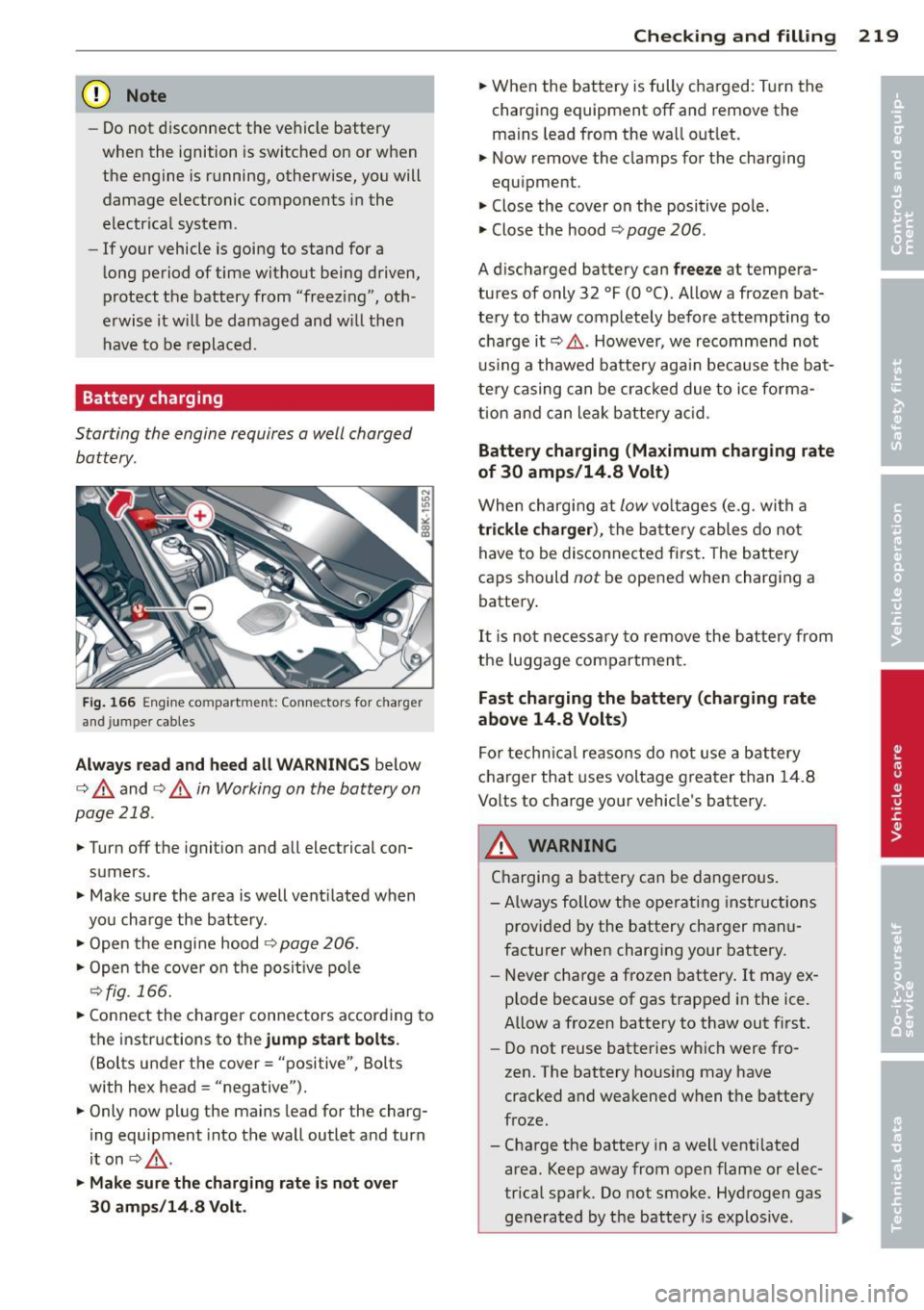
F ig. 166 Engin e comp artm ent: Conn ecto rs for char ger
an d jumper cables
Always read and heed all WARNINGS below
c::, &. and c::, &. in Working on the battery on
page 218 .
.,. Turn off t he ignit io n and all electrical con
s umer s .
.,. Make sure the area is well vent ilated when
you charge the bat tery .
.,. Open the engi ne hood
c::, page 2 06.
.,. Open the cove r on the pos it ive pole
¢ fig . 166 .
.,. Co nnect the charger connectors according to
the instructions to the
jump start bolts.
(Bolts under t he cover= "positive", Bolts
with hex head = "negative").
.,. Only now plug the mains lead for the charg
i ng equipment into the wall outlet a nd turn
i t on
c::, &_ .
.,. Make sure the charging rate i s not over
30 amp s/14 .8 Volt .
Checkin g and fillin g 219
.,. When the bat tery is fully cha rged : Tu rn the
charging equ ipment off and
remove the
mains lead from the wa ll out let .
.,. Now remove the clamps for the charging
equ ipment.
.,. Close the cover on the positive pole .
.,. Close the hood
c::, pag e 206 .
A discha rged bat tery can freeze at tempera
tures of only 32 °F (0 °C) . Allow a frozen bat
tery to thaw comp letely before attempting to
cha rge it
c::, .&. . However, we r ecommend not
u sing a thawed batte ry aga in beca use the b at
te ry casing can be cr acked due to i ce fo rma
tion an d ca n leak b attery a cid.
Battery charging (Maximum charging rate
of 30 amps/14.8 Volt )
When charging at low vo ltages (e.g. wi th a
trickle charger) , the ba tte ry cables do no t
have to be disco nne cte d fir st. T he bat tery
caps should
not be opened when charg ing a
batte ry .
It is no t necessa ry to remove the b attery from
the luggage compartmen t.
Fast charging the battery (charging rate
above 14 .8 Volts)
Fo r tec hni cal re asons do not use a bat tery
c h arger th at uses voltage g reater than
1 4 .8
Volts to c harge yo ur veh icle's battery.
A WARNING
C harging a battery can be dangero us.
-A lways follow t he operati ng instr uctions
provided by the battery charger manu
facturer when charging your battery .
- Never cha rge a fro zen battery. It may ex
p lode because of gas trapped in the ice .
A llow a frozen battery to thaw out f irst.
- Do not reuse batteries wh ic h were fro
zen. The battery housing may have
cracked and weakened w hen the battery
froze.
- Charge the battery in a well venti lated
area . Keep away from open flame or elec
trical spark. Do not smoke . Hydrogen gas
generated by t he battery is explos ive . ..,
Page 222 of 286
220 Check ing and filling
- To r educe the danger of explosion, never
co nnect or disconn ect cha rger cables
wh ile the c harger is operating.
- Fast char ging a battery is dangerous and
shou ld on ly be attempted by a compe
tent technician w ith the proper equip
ment .
- Battery acid that may spill d uring charg
ing should be washed
off with a solution
of warm water and baking soda to neu
tralize the acid.
(Q) Note
Never use a fast charger as a booster to
start the engine . This will seriously dam
age sensitive electronic components, such
as control units, relays, rad io, etc., as we ll
as the battery charger.
Battery replacement
The new battery must have the same specif/·
cations and dimensions as the original equip
ment battery.
In tell igent energy management in your veh i
cle is respons ible for d istributing the e lectr i
cal energy throughout you r vehicle
~ page 186. The intell igen t energy m anage
men t system w ill keep the engine ba tte ry
charged better then vehicles w ithout this sys
tem . To make sure the additional e lectrica l en
ergy is available once again after you have
changed the battery, we recommend that you install batteries o f the same type and ma nu
facture only (the same as those installed at
the time your vehicle was delivered). Specifi
cations are listed on the battery hous ing. You r
author ized Audi dealer must code the battery
in the ene rgy managemen t system to enable
you to use the ene rgy management functions
correctly after replac ing the battery.
I f it is not poss ible to use a battery of this
type, the new bat tery m ust h ave the s ame ca
pac ity, voltage ( 12-volts), amperage, con
struction and plug sea ling. When installing the battery, make su
re the ig
nition and a ll electrical consumers are turned
off.
(D Note
Make sure the ventilat ion hose on the side
of the battery is connected, otherwise
fumes or battery acid can leak out .
@ For the sake of the environment
Because o f the p rob lem of p roper disposal
of a battery, we recommend your author
i zed Audi dealer change the battery fo r
you. Batteries contain sulfur ic acid and
l ead and must always be disposed of prop
erly in comp liance with all environmental
regula tions. Dispos ing of veh icle batter ies
i mprope rly is very dange rous to the envi
r o nment .
Windshield/headlight*
washer container
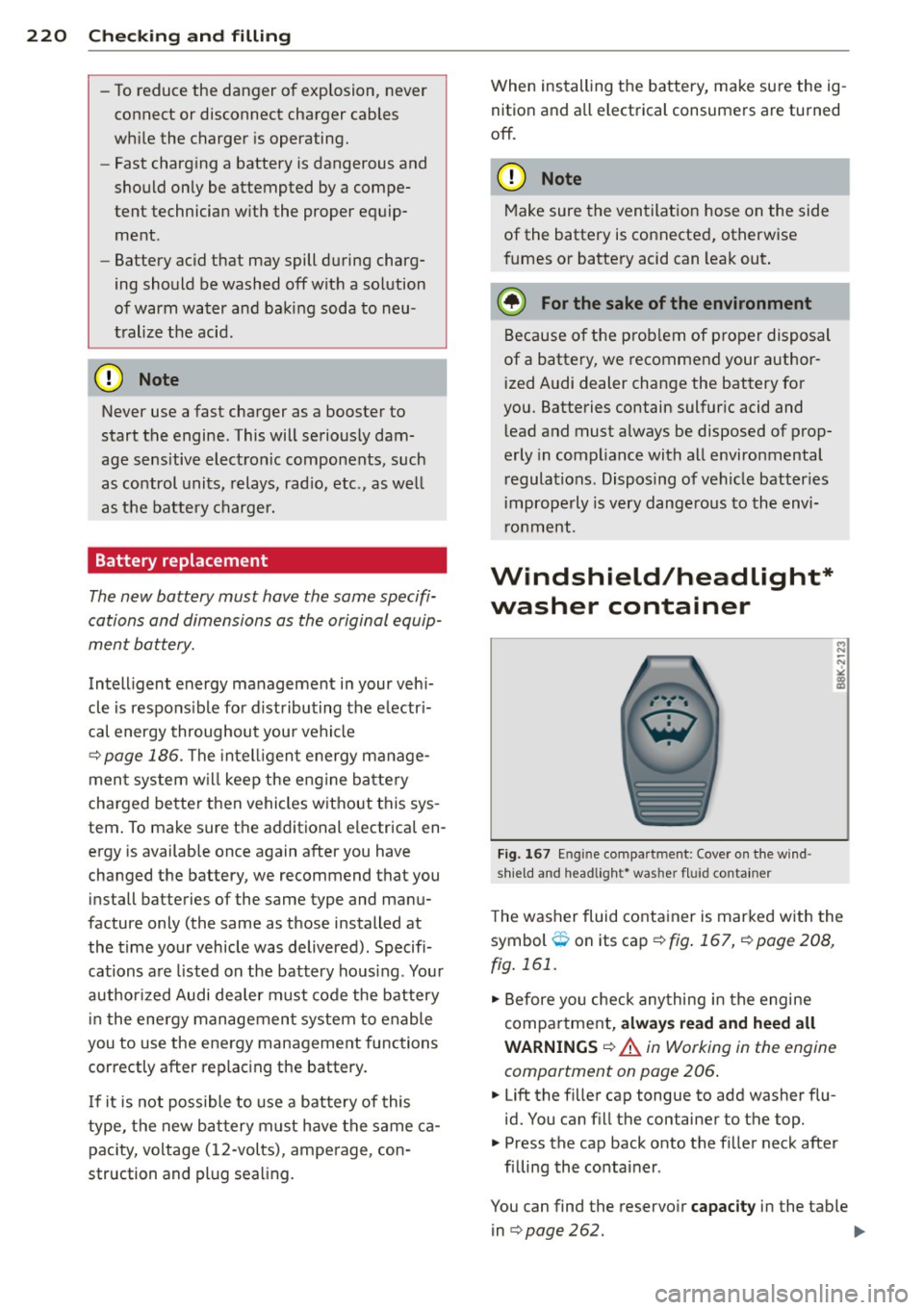
Fig. 167 En gin e compa rt m en t: Cove r on the w ind·
s h iel d a nd h eadligh t• was he r fl uid conta in er
.., N
-~ (X) a,
The washer fluid conta iner is marked w ith the
symbol
O on its cap~ fig. 167, ~ page 208,
fig .161.
.. Before yo u check any thing in the engine
compa rtment,
always read and heed all
WARNINGS q A in Working in the engine
compartment on page 206 .
.. Lift the fi ller cap tongue to add washer flu
id. You can f ill the container to the top.
.. Press the cap back onto the filler neck after
fi lling the conta iner .
You can find the reservo ir
capacity in the table
in
q page 262. .,.