battery AUDI A5 COUPE 2014 Owner's Manual
[x] Cancel search | Manufacturer: AUDI, Model Year: 2014, Model line: A5 COUPE, Model: AUDI A5 COUPE 2014Pages: 286, PDF Size: 70.99 MB
Page 226 of 286
224 Tires and wheels
Gross Vehicle Weight Rating ("GVWR" )
means the maximum total loaded weight o f
the vehicle.
Groove
means the space between two adjacent tread
ribs.
Load rating (code)
means the maximum load that a tire is rated
to carry for a given inflat ion pressure. You
may not find this informat ion on all tires be
cause it is not requ ired by law .
Ma ximum load rating
means the load rating for a t ire at the maxi
mum permissible inflation pressure for that
tire .
Maximum loaded vehicle weight
means the sum of:
(a) Curb weight
(b) Accessory weight
(c) Vehicle capacity we ight, and
(d) Production opt ions weight
Maximum (permissible) inflation pressure
means the maximum cold inflation pressure
to which a tire may be inflated . Also called
"maximum inflation pressure."
Normal occupant weight
means 150 lbs. (68 kilog rams) times the
number of occupants seated in the vehicle up
to the tota l seating capacity of your vehicle.
Occupant distribution
means dist ribution of occupants in a veh icle.
Outer diameter
means the overall diameter of an inflated new
tire.
Overall width
means the linear distance between the exteri
ors of the sidewalls of an inflated tire, includ
ing elevations due to labeling, decorations, or
protective bands or ribs .
Ply
means a layer of rubbe r-coated parallel cords.
Production options weight
means the combined weight of those installed
regular production opt ions we ighing over 5
lbs. ( 2.3 kg) in excess of those standa rd items
wh ich they replace, not previously cons idered
in curb weight or accessory weight, including
heavy duty brakes, ride levelers, roof rack,
heavy duty battery, and special tr im.
Radial ply tire
means a pneumat ic tire in which the ply cords
that extend to the beads are laid at substan
tially 90 deg rees to the center line of the
tread.
Recommended inflation pressure
see c:::> page 223, Cold tire inflation pressure .
Reinforced tire
means a tire design to operate at higher loads
and at higher inflation pressures than the cor
responding standard tire. Reinforced tires
may be identified as "XL", "xl", "EXTRA LOAD",
or "RF" on the sidewall.
Rim
means a metal support for a tire or a t ire and
tube assembly upon which the tire beads are
seated .
Rim diameter
means nominal diameter of the bead seat. If
you change your wheel s ize, you w ill have to
purchase new tires to match the new rim di
ameter .
Rim size designation
means rim diameter and width.
Rim width
means nom inal distance between rim flanges.
Sidewall
means that portion of a tire between the
tread and bead .
Page 257 of 286
Emergency situations
General
This chapter is intended for trained emer
gency crews and working personnel who have the necessary tools and equipment to
perform these operations.
Starting by pushing or
towing
(D Note
Vehicles with an automatic transmission
cannot be started by pushing or towing.
Starting with jumper
cables
If necessary, the engine can be started by
connecting it to the battery of another vehi
cle.
If the engine should fail to start because of a
discharged or weak battery, the battery can be
connected to the battery of
another vehicle,
using a
pair of jumper cables to start the en
gine.
Jumper cables
Use only jumper cables of sufficiently
largecross section to carry the starter current
safely. Refer to the manufacturer's specifica
tions.
Use only jumper cables with
insulated termi
nal clamps which are distinctly marked:
plus(+) cable in most cases colored red
minus(-) cable
in most cases colored black .
A WARNING
Batteries contain electricity, acid, and gas.
Any of these can cause very serious or fatal
injury. Follow the instructions below for
safe handling of your vehicle's battery.
- Always shield your eyes and avoid lean
ing over the battery whenever possible.
Emergency situations 255
-A discharged battery can freeze at tem
peratures just below 32 °F (0 °C). Before
connecting a jumper cable, you must
thaw the frozen battery completely, oth
erwise it could explode.
- Do not allow battery acid to contact eyes
or skin . Flush any contacted area with
water immediately .
- Improper use of a booster battery to
start a vehicle may cause an explosion.
- Vehicle batteries generate explosive gas
es. Keep sparks, flame and lighted ciga
rettes away from batteries.
- Do not try to jump start any vehicle with
a low acid level in the battery.
- The voltage of the booster battery must
also have a 12-Volt rating. The capacity
(Ah) of the booster battery should not be
lower than that of the discharged bat
tery. Use of batteries of different voltage
or substantially different "Ah" rating
may cause an explosion and personal in
jury.
- Never charge a frozen battery. Gas trap
ped in the ice may cause an explosion.
- Never charge or use a battery that has
been frozen. The battery case may have
be weakened.
- Use of batteries of different voltage or
substantially different capacity (Ah) rat
ing may cause an explosion and injury.
The ca pa city (Ah) of the booster battery
should not be lower than that of the dis
charged battery.
- Before you check anything in the engine
compartment, always read and heed all
WARNINGS¢
page 206.
(D Note
- Applying a higher voltage booster bat
tery will cause expensive damage to sen
sitive electronic components, such as
control units, relays, radio, etc.
- There must be no electrical contact be tween the vehicles as otherwise current
could already start to flow as soon as the
positive(+) terminals are connected. ..,. •
•
Page 258 of 286
256 Emergency situations
@ Tips
The discharged battery must be properly
connected to the vehicle's electrical sys
tem. When jump starting or charging the
battery, never connect the negative
ground cable to the battery negative post
because the batte ry manager system must
be able to detect the battery 's state of
charge. Always connect the negative
ground cab le to the negative ground post
of the battery manager control unit.
Use of jumper cables
Make sure to connect the jumper cable
clamps in exactly the order described below!
Fig. 187 Engine compartment: Connectors fo r jum per
cables and charger
Fig. 188 Jump sta rting wi th the battery of anot her ve ·
h ide :@ booster battery, @ disc harged vehicle battery
The procedure described below for connecting
jumper cables is intended to provide a jump
start for your vehicle .
Vehicle with discharged battery:
.. Turn off lights and accessories, move lever
of automatic transmission to N (Neutral) or
P (Park) and set parking brake .
Connect POSITIVE(+) to POSITIVE(+)
(red)
.. Remove the cover above the jump start con
nection .
.. Open the cover on the positive pole
c::;, fig. 187 .
1. Connect one end of the red positive cable
on the
jump start bolt c::> fig. 188 @
(Bolts under cover= "positive") of the ve
hicle to be started @.
2. Connect the other end to the positive ter-
minal @of the booster battery@.
Connect NEGATIVE (-) to NEGATIVE (-)
(black)
3. Connect one end of the b lack negative ca
ble to the negative terminal @of the
booster battery @.
4. Connect the other end to the
jump start
bolt @
(Bolts with hex head= "negative")
of the vehicle to be started @.
Starting the engine
.. Start the engine of the vehicle with the
booster battery@. Run the engine at a
moderate speed.
.. Start engine with discharged vehicle battery
@ in the usual manner .
.. If the engine fails to start: do not keep the
starter cranking for longer than 10 seconds .
Wait for about 30 seconds and then try
again .
.. With eng ine running, remove jumper cables
from both vehicles in the exact
reverse or
der .
.. Close the cover on the positive pole .
T he battery is vented to the outside to prevent
gases from entering the vehicle interior . Make
sure that the jumper clamps are well connect
ed with their
metal parts in full contact with
the battery terminals.
A WARNING
--
To avoid serious personal injury and dam
age to the veh icle, heed all warnings and
instructions of the jumper cable manufac-
turer . If in doubt, call for road service . ..,.
Page 259 of 286
-Jumper cables must be long enough so
that the vehicles do not t ouch.
- W hen connecting jumper ca bles, make
sure that they cannot get caught in any
moving parts in the eng ine compart
ment.
- Do not bend over the batteries - danger
of chemical burns!
- The battery ce ll locking screws must be
t ightened securely .
- Before you check anything in the engine
compartment, always read and heed all
WARNINGS ¢
page 206.
Improper hook-up of jumper cables can ru
in the generator.
- Always connect POSITIVE( +) to POSI
TIVE(+), and NEGATIVE( -) to NEGATIVE
( - ) ground post of the battery manager
control unit.
- Check that all screw plugs on the battery
ce lls are screwed in firmly . If not, tighten
plugs p rior to connecting clamp on nega
tive battery terminal.
- Please note that the procedure for con
necting a jumper cable as described
above applies spec ifically to the case of
your vehicle be ing jump started. When
you are givi ng a jump start to another ve
hicle, do
not connect the negat ive( -) ca
ble to the negat ive( -) term inal on the
discharged battery @¢
fig. 188. In
stead, securely connect the negative(- )
cable to e ither a solid metal component
that is firmly bolted to the engine block
or to the engine block itse lf. If the bat
tery that is being charged does not vent
to the outside, escaping battery gas
could ignite and explode!
Em erg en cy si tuation s 257
Emergency towing
with commercial tow
truck
General hints
Your Audi requires special handling for tow
ing.
T he following information is to be used by
commercial tow t ruck operators who know
how to operate their equipment safely.
- Never tow your Audi , towing will cause
damage to the engine a nd transmi ssion.
- Never wrap th e safet y chain s or winch c a
ble s around th e brak e lin es.
- To prevent unne ce ss ary dam age, your Aud i
mu st be t ransp orted with a flat bed truck .
- To load th e vehi cle on to the fl at bed , use
the t owing loop found in the vehicle t ool s
and atta ch to the front or rear anch o rage
r=:> page 258 and ¢page 258 .
A WARNING
A vehicle being towed is not safe for pas
sengers. Never allow anyone to ride in a
vehicle being towed, for any reason.
-
•
•
Page 263 of 286
Technical Data
Vehicle identification
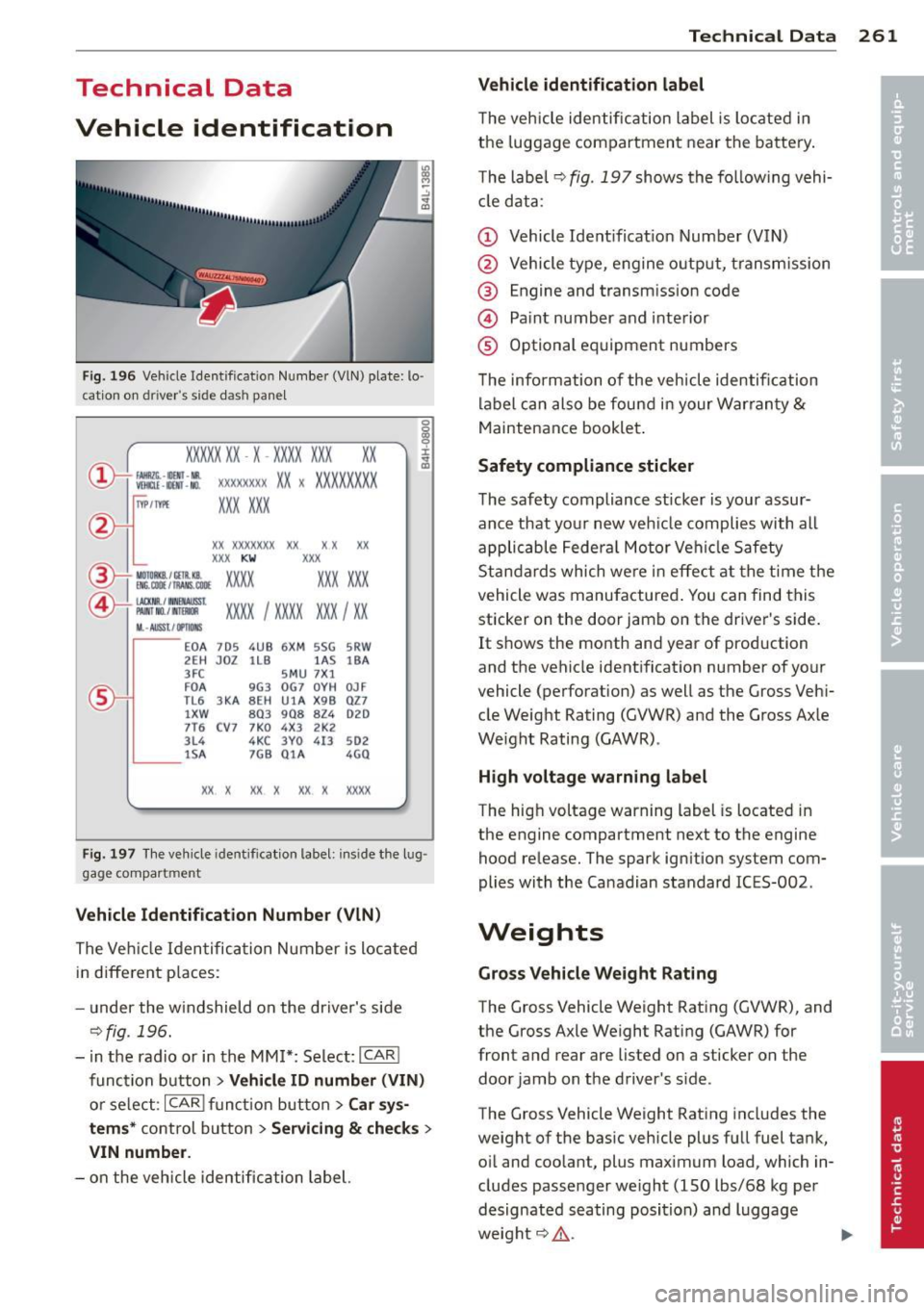
F ig. 196 Veh ide Identificat ion Number (VlN) plate: lo ·
c ation on d river 's s ide das h panel
XXXXX XX · X -XXXX XXX
~ fAllftlli. -llllll · NR. ~ W!ru -IIOO -NO.
xx
XXXX XXXX XX X XXXXXXXX
XXX XXX
IYP /TYPE
XX XXXXXXX XX X X XX
XXX KW XXX
®i ~W.::·f :l~~ XXXX XXX XXX
©+ ::rw= xxxx I xxxx XXX I xx
M. · AUSSt I IJ'IIDIIS
~--
EOA 7D 5 4UB 6XM SSG SRW
2E H JDZ 1LB lA S 18A
3FC SMU 7X l
FD A 9G3 OG7 OYH OJF
TL6 3 KA 8EH UlA X98 027
lXW 803 908 824 D2D
7T6 CV7 7KO 4X3 2K2
3L4 4KC 3YO 413 502
1S A 7GB 01A 4GO
XX. X XX X XX X XXXX
Fig. 197 Th e vehicle identification label: ins ide the lu g·
ga ge compar tmen t
Vehicle Identification Number (VlN)
The Veh icle Identification Number is located
in different p laces :
- under the windshield on the driver's side
9fig. 196.
- in the radio or in the MM!*: Select: ICARI
function button > Vehicle ID number (VIN)
or select : I CAR I function button> Car sys
tems*
control button > Servicing & checks >
VIN number .
-on the vehicle identification label. Technical Data 261
Vehicle identification label
T
he vehicle identification label is located in
the luggage compartment near the battery.
T he label 9
fig. 197 shows the follow ing vehi
cl e data :
(D Vehicle Identificat ion Number (VIN)
@ Vehicle type, engine output, transm ission
@ Engine and transmission code
© Paint number and interior
® Optional equipment numbers
T he information of the vehicle identification
label can also be found in your Warranty
&
Maintenance booklet.
Safety compliance sticker
The safety compliance sticker is your assur
ance that yo ur new veh icle complies with all
applicable Federal Motor Vehicle Safety
Standards which were in effect at the time the
vehicle was manufactured. You can find this
sticker on the door jamb on the driver's side.
It shows the month and year of production
and the vehicle identification number of your
vehicle (perforation) as well as the Gross Veh i
cle Weight Rating (GVWR) and the Gross Ax le
Weight Rating (GAWR) .
High voltage warning label
The high voltage warning label is located in
the engine compartment next to the engine hood release. The spark ign ition system com
plies with the Canadian standard ICES-002 .
Weights
Gross Vehicle Weight Rating
The Gross Vehicle Weight Rating (GVWR), and
the Gross Axle Weight Rating (GAWR) for
front and rear are listed on a sticker on the
door jamb on the driver's s ide .
The Gross Vehicle Weight Rating includes the
weight of the bas ic vehicle plus full fuel tank,
o il and coo lan t, plus maximum load, which in
cludes passenger we ight (150 lbs/68 kg per
designated seating position) and luggage
weight9 ,:'.Q,..
Page 272 of 286
270 Index
Automatic climate control Ai r vents ... ... . ...... ... .. .. .... .. 69
Operation . . . . . . . . . . . . . . . . . . . . . . . . . 68
Setup . .. ............... .. .. .... .. 70
Autom atic S hift Lock (ASL) . . . . . . . . . . . . 8 4
Automatic transmission . . . . . . . . . . . . . . . 82
Automatic Sh ift Lock (ASL) . . . . . . . . . . . 84
D riving .. ... ............ .. .. .. .. .. 84
E mergency mode . . . . . . . . . . . . . . . . . . . 8 8
E mergency release . . . . . . . . . . . . . . . . . . 89
K ick -dow n . . . . . . . . . . . . . . . . . . . . . . . . . 87
M anual s hift program ... .. .. .... .. . . 86
Remova l lock (ignition key) ... .. .... . . 71
Selector lever . . . . . . . . . . . . . . . . . . . . . . 83
Autom atic wi pers .......... .... .... .. 49
Auto Safety Hotline ............ .. ... 127
Average speed . . . . . . . . . . . . . . . . . . . . . . . 2S
Avoid damaging the vehicle .. .... .... . 188
B
Battery ... .. ...... ............ 17,217
B attery locat io n in side the luggage com-
pa rtment ................. .. .... . 217
C ha rging . ............... .. .. .... . 219
I mpor tan t war nings when wo rking on
the battery . . . . . . . . . . . . . . . . . . . . . . . 217
Jump starting .. .. ..... ... .. .. .... . 255
Low . .. .. .. ............. .. .. .. ... 186
Replacing the battery ..... .. .. .. .. . 220
State of charge . . . . . . . . . . . . . . . . . . . . 186
W inter operation . . . . . . . . . . . . . . . . . . 217
Wo rking on the battery . . . . . . . . . . . . . 217
Before driving .. ........... .. .. .... . 119
B io-e thanol ( Fue l) .......... .. .. .. .. . 202
Blended gasoline ... ... .. .. .. .. .. .. . 201
Blower (automatic climate control) . . . . . . 69
B ooste r seats ............. .. .. .. .. . 169
Brake fl uid
C hanging the brake fl uid ..... .. .... . 216
Check ing the brake fluid level ..... .. . 216
Reservoir .. .......... ...... ... .. . 216
What is the cor rect brake fl uid leve l? .. 2 16
What should I do if the bra ke flui d warn-
i ng light comes on? ....... .. .. .. .. . 216
Brake system .... ... .... ... .. .. .. .. . 216
Anti-lock braking system ....... .. .... 19
B rake ass ist system ..... .. .. .. .. .. . 180 B
rake fluid .... .. ... .. ..... ... .. .. 216
B rake fluid specifications for refill and re-
placement . ... .. ... .. ..... ... .. .. 216
Brake light defective ........... .... . 21
B rake power ass ist unit ......... .... 183
Brakes ....... ... .. .............. . 183
Ceram ic brakes ... ... .. .. ... ..... .. 183
El ectromechanical pa rking brak e ..... . 76
Wa rning/ind icator lights ...... .. .. .. . 15
Worn b rake pads symbo l ........ .. .. . 20
B rak ing
E mergency brak ing funct ion ... .. .. .. . 78
braking guard ..... ... .. ..... .... . .. . 90
Messages . .. .. .. .. ........... .... . 98
Settings .. .... .. ............. .... . 97
Break-in per iod .... .. ... ..... ... .. .. 188
T ires ... .. .... .. .. ... ..... ... .. .. 188
Bul bs .. .. .. .. .. .. .. .. ...... ... .. .. 253
C
Californ ia Proposition 65 Warn ing .... . 207
Battery specific .. ..... ........... . 218
Capacities .. .... .. ............. .... 262
Carbon p arts
Cleaning . . . . . . . . . . . . . . . . . . . . 198, 199
Care ........ ... .. .. ... ........... . 196
Cargo area
refer to Luggage compartment. . . 63, 125
Ca talyt ic co nve rter . . . . . . . . . . . . . . . . . . 189
Center armrest .. .. ................ .. 56
Central locking .... ... .. ..... .... . .. . 32
Central lock ing switch .......... .. .. . 36
Convenience key . . . . . . . . . . . . . . . . . . . . 36
Remote contro l key .............. .. . 35
Ceramic brake rotors New brake pads . ... .... .... ... .. .. 183
Ce rtifi cation .. .. .. ... .......... .. .. 267
Chang ing a f lat t ire . ............. .... 244
Chang ing a wheel . ... .... .... ... .. .. 244
Chang ing engine oil ..... .. ... ..... .. 212
Checking Engine coolant level . ........... .. .. 213
Checking t ire press ure . ... .... ... .. .. 228
Page 274 of 286
272 Index
Declaration of compliance
Adaptive cruise control ... ... ... ... . 267
Audi side assist ................... 267
Cell phone package ....... .. .. .... . 267
Convenience key .......... .... .... . 267
Electronic immobilizer ......... .. ... 267
H omelink universal remote control .. . 267
Remote control key ........ ... .. .. . 267
Decorative parts/trim Cleaning . .. ............... ...... . 198
Defective light bulb warning . . . . . . . . . . . 21
Defrosting (w indows) ........ ... .. .. .. 69
Determining correct load limit ... .. ... 231
Digital clock .............. .. .. .... .. 12
Digital compass ............ ... .. .. .. 51
Dimensions .. ................ ..... . 262
Dimming the rearview mirror .. .. .. .. . . 47
Displays Cleaning . ... ............ .. .. .. .. . 198
Doors emergency locking .................. 37
Driver information system
Enhanced shift indicator . .. .. .. .. .. .. 28
Open door or front lid warning . . . . . . . . 24
Outside temperature display ...... .. .. 24
Sound system display . . . . . . . . . . . . . . . 24
Driver seat
refer to Seating pos ition ... .. .. .. .. . 120
Driving safely .. ... .... .... .. .. .... . 119
Driving through water ....... ..... .. . 188
Driving time . . . . . . . . . . . . . . . . . . . . . . . . 25
Dust filter
refer to Pollutant filter (automatic AC
system) .. .. ................ ... .. .. 67
Dynamic steering . . . . . . . . . . . . . . 104, 185
E
E8S ( Fue l) ... ................ ..... . 202
Easy entry function .. ........ ... .. .... 55
Efficiency program .......... ... .... .. 27
Fuel economy messages . . . . . . . . . . . . . 29
Memory levels . . . . . . . . . . . . . . . . . . . . . 25
Other equipment . . . . . . . . . . . . . . . . . . . 28
Shift indicator . . . . . . . . . . . . . . . . . . . . . 28
Electro-mechanical power assist . . . . . . . 185 Electromechanical
parking brake
Emergency braking ................. 78
Indicator light ... ................ .. 76
Parking ... .... .. ............. .... . 77
Releasing and closing .......... .... . 76
Starting assist . . . . . . . . . . . . . . . . . . . . . 77
Start ing from rest ....... ...... .. .. . 77
Starting off w ith a trailer ........... .. 78
Warning/ind icator lights ........ .. .. . 16
Electronic differential lock
Warning/indicator lights ........... .. 18
E lectronic differential lock (EDL) ....... 180
Warning/indicator lights ............. 19
Electronic immob ilizer . . . . . . . . . . . . 12, 38
Electronic power control (EPC) warning/indicator light . . . . . . . . . 20
E lectronic speed
Li miter . . . . . . . . . . . . . . . 31
Electronic stabilization control
Sport mode . .. .. ............. .. .. 182
Electronic Stabilization Control (ESC) . .. 180
Warning/indicator lights . ............ 18
Emergency actuation Doors .... .... .. ............. .... . 37
Ignition
key . .. .. ............. .. .. . 35
Panoramic t ilting sunroof . ...... .... . 42
Sun shade (roof) . ................ .. 42
Emergency braking ................. .. 78
Emergency flasher ................ .. . 45
Warning/ind icator lights ........ .. .. . 23
Emergency key . . . . . . . . . . . . . . . . . . . . . . 33
Starting engine . . . . . . . . . . . . . . . . . . . . 73
Emergency operation Emergency braking function (parking
brake) .... .... .. ............. .... . 78
Emergency starting ................ . 255
Emergency towing ................. . 257
Energy management . . . . . . . . . . . . . . . . 186
Battery power . . . . . . . . . . . . . . . . . . . . . 17
Driver notification . . . . . . . . . . . . . . . . . . 17
Engine Compartment .... ............. .... 208
Coolant . .. .. .. .. ............. .. .. 213
Data ..... .... .. .. ........... .... 263
Hood . .... .... ................... 206
Starting . . . . . . . . . . . . . . . . . . . . . . 71, 74
Starting with jumper cables ... .. .. .. 255
Stopping . . . . . . . . . . . . . . . . . . . . . . 73, 75
Page 275 of 286
Engine compartment
Safety instructions ................ . 206
Working the engine compartment 206
Engine coolant
Indicator light . . . . . . . . . . . . . . . . . . . . . 17
Engine coolant system .......... ... .. 213
Adding coolant .............. ... ... 214
Checking coolant level ..... .. .. .. .. . 213
Checking the engine coolant level . . . . . 213
Radiator fan ............. .. .. .. .. . 215
Engine coolant temperature Temperature gauge .......... .... ... 10
Engine hood Closing .. .. .. ........... .. .. .. ... 206
How to release the hood ... .. .. .. .. . 206
Engine oil ... ................ ... ... 208
Adding .... ................ ... ... 211
Additives . .. .. ........... .. .. .. ... 211
Changing .. ............. .... .. ... 212
Check oil level ........... .... .. ... 211
Consumption ............... ... ... 211
Indicator light . . . . . . . . . . . . . . . . . 17, 21
Oil consumption . ...... ... .. .. .. .. . 210
Oil grades ..................... ... 208
Pressure malfunction ...... .. .. .. .. .. 17
Sensor defective . . . . . . . . . . . . . . . . . . . . 21
Specification and viscosity ... ... .. .. . 208
Engine speed limitation .......... .... . 21
Environment Break-in period ........... .. .. .. ... 188
Catalytic converter ............ ... .. 189
Disposing of your vehicle battery ..... 220
Driving at high speeds .......... .... 190
Driving to minim ize pollution and noise 190
Fu el . .. .. .. .. .. ........... .. .. ... 204
Fu el economy ..................... 190
Leaks under your vehicle ............ 206
Letting the vehicle stand and warm up. 191
Proper disposal of drained brake fluid . 216
Proper disposal of drained engine cool-
ant . .... .. .. ............. .. .. ... 214
Proper disposal of drained engine
oil ...... ... ............. ... 211,212
Recycling used engine oil . .. .. .. .. .. . 211
Roof rack . . . . . . . . . . . . . . . . . . . . . . . . . 62
Unleaded fuel . ........... .. .. .. ... 201
What should I do with an old battery? . 220
Index 273
EPC
refer to Electronic power control . . . . . . 20
Ethyl alcohol (Fuel) . ................. 202
Event Data Recorder (EDR) ........ .... 180
Exhaust tail pipes Cleaning ... ..... .. ............... 197
Expansion tank .. .... ... ....... ..... 213
Exterior lighting . .. ................. . 43
Exterior m irrors
Adjusting ..... .... ................ 46
Dimming ... ..... .. ................ 47
Heating ........................... 46
F
Fan
Radiator
Fastening 215
Booster seats .. ...... ......... .... 169
Convertible child safety seats .... .... 168
Infant seats
Flat tire 167
Changi ng ... .. .. .. .. ........... .. 244
flexible fuel ... .. .... ............... 202
Floor mats ... ..... .. ............... 124
Fog lights/rear fog lig ht(s) . . . . . . . . . . . . . 43
Folding the rear seats ... ............. . 63
Foot pedals . .. .. .. .. ............... 124
For the sake of the environment Gasoline fumes and the environment .. 204
Letting the engine warm up . . . . . . 71, 74
Refueling . .. .. .. ................. 204
Saving fuel by early upsh ifting ... .. .. . 11
Front airbags Description . . . . . . . . . . . . . . . . . . . . . . . 141
How they work ... .. . .. .... ........ 146
Frontal collisions and the laws of physics 130
Front passenger's door emergency locking 37
Front seats Adjusting ....... .. ..... .......... 121
Child restraints in the front seat ...... 138
Fuel Additives .... .. ...... ............. 201
Blended gasoline ... . .. .... ........ 201
Consumption .. ... ............... .. 25
Filler neck . .. .. .... .......... ..... 203
Fuel gauge . . . . . . . . . . . . . . . . . . . . . . . . 12
•
•
Page 277 of 286
Insta lling chi ld safety seats
Safety belts . . . . . . . . . . . . . . . . . . . . . .
171
Instal ling the upper tet he r st rap on the
anchorage . .. ............. .. .. .. ...
178
Instruments
Adjusting the lighting ......... ... ...
46
Instruments and contro ls ... .. .. .. .. .. 10
General illustration ....... .. .. .. .. .. . 8
I n ter ior lights
Fr ont . ..... .. .... .. .... ... .. .. ....
4 6
Rear . ..... .. ... .. ..... ... .. .. .... 46
Intermittent (windshield wipe rs) . ...... 49
J
Jump -starting 255
J u mpe r cables . ..... .... ... .. .. .. .. . 256
K
Key ... .. .. .. .. ... .. ..... ... .. .. .... 33
Battery rep lacement . . . . . . . . . . . . . . . . 34
C heck light . . . . . . . . . . . . . . . . . . . . . . . . 34
Emergency key . . . . . . . . . . . . . . . . . 33, 73
Ignit ion/engine on/off . . . . . . . . . . . . . . . 71
Key replacement ......... .. .. .. .. ..
33
Mechanical key . . . . . . . . . . . . . . . . . 33, 34
removing . . . . . . . . . . . . . . . . . . . . . . . . . 73
un locking/ locking .. ...... .. . 35, 36, 37
Kick-down
tiptronic . . . . . . . . . . . . . . . . . . . . . . . . . .
87
Knee airbags ... .. .. .. .... ... .. .. ... 15 2
Descr ipt ion ... ... .. ..... ... .. .. ... 152
How they work . . . . . . . . . . . . . . . . . . . . 153
Important safety instr uctions . .. .. .. . 154
L
Lane Change Ass istant
refer to side assist ........ .. .. .. .. . 100
L A T CH .. .. .. .. ............. .. .. ...
175
D escr iption ..... .. .... ... .. .. .. ... 176
Installing a chi ld restraint . ... .. .. .. . 17 6
Location . . . . . . . . . . . . . . . . . . . . . . . . . 17 5
Mounting and releasing the anchorage
hook .... .. ................. .. ...
176
Launch Contro l Program . . . . . . . . . . . . . . 8 7
Leather cleaning/protection ........ .. 199
Inde x 275
Leav ing home ....... . .. .. ..... ... .. . 44
Left hand drive .. ... ................. 45
Lifting jack . .. .. .. ............... .. 247
Lifting vehicle . .. .. ................. 259
Light
adaptive light .. .. .. ... ....... ......
43
Coming/Leav ing home ......... .... .. 44
Dayt ime run ning ligh ts . . . . . . . . . . 43, 4 4
Exterior lighti ng . . . . . . . . . . . . . . . . 43 , 44
F og lights/rea r fog lig ht(s) . . . . . . . . . . . 43
Interior/reading .... . .. .. ..... ... .. . 46
Low beam ....... .. . .. .. ..... ... .. . 43
Rear fog lights . .. ................. . 43
Side marker lig hts ................. . 43
Travel mode . . . . . . . . . . . . . . . . . . . . . . . 45
Light/rain senso r
Head lights . ... .. .. . ... ...... ... .. .
43
Intermittent (w indshie ld w ipers) . .. .. . 49
Sensor defective . . . . . . . . . . . . . . . . . . . . 22
Lights
Emergency flashe rs . . . . . . . . . . . . . . . . .
45
High beam . ........ .. .. ..... ... .. . 44
Turn signals . .. .. .. ............... . 44
Locking
Rea r lid ... .. .. .. .. . ...............
39
Locking/unlock ing
at the lock cy linder ................ ..
37
by remote control ............. .. .. . 35
with t he centra l locki ng sw itch ... .. .. . 36
wi th t he conven ien ce key ............ . 36
Low beams ........ ................. 43
Lower anchorage locator button ... .. .. 176
Lower universal a nc horage bars (Canada) 175
Lower universal anchorages (Canada) 175
Luggage
Stow ing . ... .... .. . .. .. ..... ... ..
125
Luggage compartment . . . . . . . . . . . . . . . . 63
Cargo net . .. .. .. .... ............. . 64
Enl arging . .. .. .. ............... .. . 63
Lid .. ... .. .. .... .. . .. .. ..... ... .. . 39
Loading ... .. .... .. . .. .. ..... ... .. 125
Pass-through . . . . . . . . . . . . . . . . . . . . . . 65
Ski sack ... .. .. .. .. . ............... 65
Tie-downs . . . . . . . . . . . . . . . . . . . . 64, 126
Valet parking .. .. .. . .. .... .... .. .. . 42
Lumbar support . . . . . . . . . . . . . . . . . . . . . 54
•
•
Page 283 of 286
Wheels ..... .. .... .. .... ... .. .. ... 222
Checking tire pressure .. ... .. .. .. .. . 228
C leaning ... .... ...... ... .. .. .. .. . 197
Cold tire inflat ion pressure . .. .. .. .. . 226
General notes ............ .... .. ... 222
Glossary of t ire and load ing termino lo -
gy .. .. .. .. .. ........ ... .. ... ... . 223
New tires and wheels ......... .... .. 233
T ires and vehicle load lim its .. .. .. .. . 230
When must a safety belt be rep laced? . . 132
When must the airbag system be inspect -
ed? ... .... .. ... .. .. ..... ... .. .. ... 147
W hen shou ld I ad just the tire p ressu res? 229
When shou ld I check the tire pressures? . 229
Where can I find the tire pressu res for my
car? . ..... .. .. .... .. .... ... .. .. ... 228
W hy safety belts? . . . . . . . . . . . . . . 129, 130
W indows
C lean ing/remov ing ice ..... .. .. .. .. . 198
defrosting ............ .... ... ... ... 69
W indshield
C leaning ... .... .. .... ... .. .. .. .... 4 9
defrosting .. ............. .... .. .... 69
W indshield washe r fl uid
L ow level . . . . . . . . . . . . . . . . . . . . . . . . . . 21
W indshield washe r system .. .. .. .. .. .. 49
W indshield wipers
C lea ning . .. ............. .... .. .... SO
Folding up . . . . . . . . . . . . . . . . . . . . . . . . SO
Indicator light . . . . . . . . . . . . . . . . . . . . . 21
Replacing w indshield w iper blades ... .. 50
Sw itch ing on/off ............ .. .... . 49
Washer rese rvoi r 220
W inter operation
Battery . . . . . . . . . . . . . . . . . . . . . . . . . . 217
Car washes ........... .... ... ... .. 196
Coolant system ............... .... 213
D efrosting windows . . . . . . . . . . . . . . . . . 69
Removing ice from w indows .. .. .. .. . 198
Seat heating . . . . . . . . . . . . . . . . . . . . . . . 69
Tires . ..... .. .. ... . .... ... .. .. ... 185
W inte r ti res ............ ...... .... .. 237
A ll whee l dr ive ........... .... .. .. . 23 7
X
Xeno n headlights . . . . . . . . . . . . 43, 45, 253
Inde x 281
•
•