oil level AUDI A5 COUPE 2014 User Guide
[x] Cancel search | Manufacturer: AUDI, Model Year: 2014, Model line: A5 COUPE, Model: AUDI A5 COUPE 2014Pages: 286, PDF Size: 70.99 MB
Page 215 of 286
Engine cooling system
Coolant
The engine coolant performs two functions: it
keeps the engine from overheating and it pro tects the engine from freezing in the winter .
The cooling system is sealed and generally re
quires little attention.
The cooling system has been filled at the fac
tory with a permanent coolant which does not
need to be changed. The coolant consists of a
mixture of specially conditioned water and the
manufacturer's glycol-based coolant addi-
tive G13 antifreeze with anticorrosion addi tives (50% for USA models; 60% for Canadian models). This mixture both assures the neces
sary frost protection and protects metal com
ponents in the engine's cooling system from
corrosion and scaling.
It also raises the boil
ing point of the coolant.
Do not reduce the concentration of the cool
ant in the summer by adding plain water.
The
proportion of coolant additive must be at
least 50% but not more than 60%
to main
tain antifreeze protection and cooling efficien
cy. If the coolant frost protection is too low,
the coolant could freeze and damage the vehi cle heating and engine cooling system.
For year-round driving, antifreeze is added at
the factory for temperatures down to:
- -31°F(-35°C)USA
- -40 °F ( - 40 °C) Canada.
If you must add coolant, use a mixture of wa
ter and coolant additive. Mixing the coolant
additive with distilled water is recommended.
& WARNING
Before you check anything in the engine
compartment, always read and heed all
WARNINGS¢ .&.
in Working in the engine
compartment on page 206.
(D Note
- Before winter sets in, have the coolant
checked to see if the coolant additive in
Checking and filling 213
your vehicle is sufficient to meet the cli
mate conditions. This is especially impor
tant if you live in a region where the win
ter is extremely cold. If necessary, in
crease the proportion of coolant additive
to 60%.
- When adding coolant additive to your
cooling system, remember:
- We recommend using only coolant ad
ditive G12++ or G13 for your vehicle.
This coolant additive is available at au
thorized Audi dealers. Other types of
antifreeze can significantly reduce cor
rosion protection. The resulting corro
sion can cause a loss of coolant and se rious engine damage.
- Do not add any type of radiator leak seal
ant to your vehicle's engine coolant.
Adding radiator repair fluid may adverse
ly affect the function and performance of
your cooling system and could result in
damage not covered by your New Vehicle
Limited Warranty.
Checking the engine coolant level
The engine coolant level can be checked with
a quick glance.
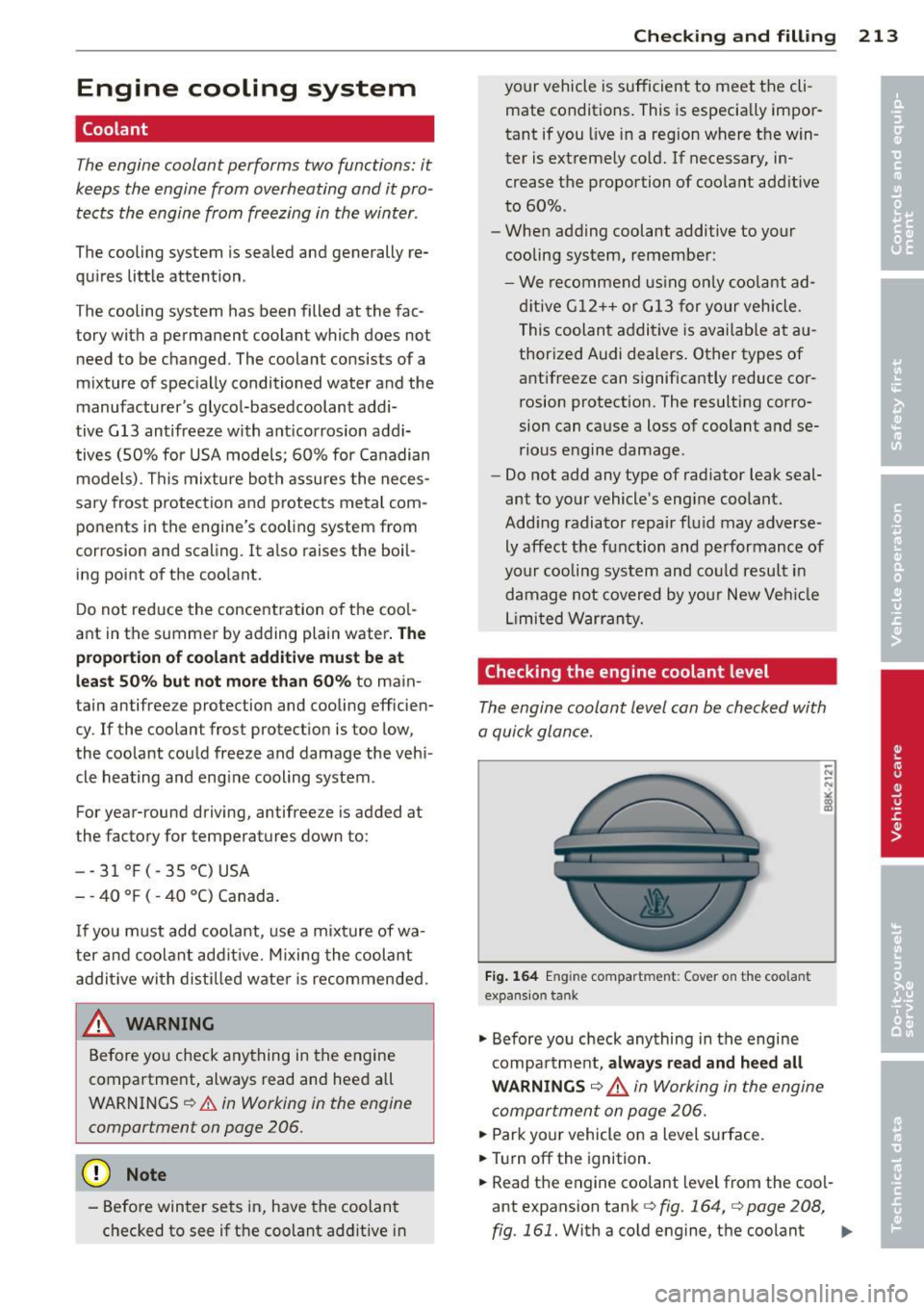
Fig. 164 Eng ine compartment: Cover on the coolant
expansion tank
"' Before you check anything in the engine
compartment,
always read and heed all
WARNINGS ¢ .&, in Working in the engine
compartment on page 206.
"'Park your vehicle on a level surface .
.,. Turn off the ignition.
.,. Read the engine coolant level from the cool
ant expansion tank ¢
fig. 164, ¢ page 208,
fig. 161.
With a cold engine, the coolant Iii>
Page 216 of 286
214 Check ing and filling
level should be between the "MIN" and
"MAX" markings. When the engine is warm,
the leve l may be slightly above the "MAX"
marking .
The location of the coolant expansion tank
can be seen in the engine compartment illus
tration
c:> page 208.
To obtain an accurate reading, the engine must be switched
off.
The expansion tank in you r vehicle is equipped
with an e lectric coolant level sensor.
When the coolant level is too low, the warning light in the Auto-Check System
c:> page 17will
b link until you add coo lant and the level has
been restored to no rma l. Even though there is
an electric coolant level sensor, we still rec
ommend you check the coolant leve l from
time to time.
Coolant loss
Coolant loss may indicate a leak in t he cool ing
system. In the event of coolant loss, the cool
ing system should be inspected immediately
by your authorized A udi dealer.
It is not
enough merely to add coolant.
I n a
sea led system, losses can occur only if
the boiling point of the coolant is exceeded as
a result of overheat ing.
A WARNING
The cooling system is unde r pressure and
can get very hot. Reduce the risk of scald
ing from hot coolant by following these
steps .
- Turn
off the engine and allow it to cool
dow n.
- Protect yo ur face, hands and arms from
escaping fluid and steam by covering the
cap with a large, thick rag .
- Turn the cap slowly and very carefully in
a counter-clockwise direction wh ile ap
plying light, downward pressure on the
top of the cap .
- To avoid be ing burned, do not spill ant i
freeze or coolant on the exhaust system
'
or hot engine parts. Under certa in cond i
tions, the ethylene glycol in engine coo l
ant can catch fire.
(D Note
Do not a dd any type of radiator leak sea l
ant to your veh icle's engine coolant. Add
i ng radiator repa ir fl uid may adverse ly af
fect the funct ion and performance of your
cooling system and could result in damage
not covered by your New Veh icle L imited
War ranty .
Adding coolant
Be very careful when adding engine coolant.
Before you check anyth ing in the eng ine com
partment,
always read and heed all WARN
INGS c:> A in Working in the engine compart
ment on page 206 .
Requirement: There m ust be a res idual
amount of coo lant in the expans ion tank
c:> (]) .
.,.. Turn off the eng ine .
.,.. Let the engin e cool down.
.,.. Place a thick rag over the coo lant expansion
tank
c:> page 213 , fig. 164 and carefully turn
the cap counter-clockwise
c:> .&_ .
.,.. Add coo lant m ixed in the correct rat io
c:> page 213, Coolant up to the MAX ma rk
ing.
.,.. Mak e s ure t hat the fl uid leve l remains sta-
b le. Add more coo lant if necessary.
.,.. Twist the cap on again
tightly .
Replacement engine coo lant must confo rm to
ex act spec ific at ions
c:> page 213, Coolant.
We recommend using only coolant add it ive
G12 ++, G13 or i n an emergency G 12+. Do
not
use a different add it ive. In an emergen cy use
plain wa ter until yo u can ge t the correct addi
tive and can restore t he correct ratio. This
sho uld be done as soon as possib le .
If you have los t a cons iderab le amount o f
coolant, the n you sho uld add cold ant ifree ze
and co ld wate r on ly when the engine is cold.
Always use
n ew engine coo la nt w hen refilling . .,.
Page 218 of 286
216 Checking and filling
Brake fluid
Checking brake fluid level
The brake fluid level can be checked with a
quick glance .
N N ~ N
" (X) (0
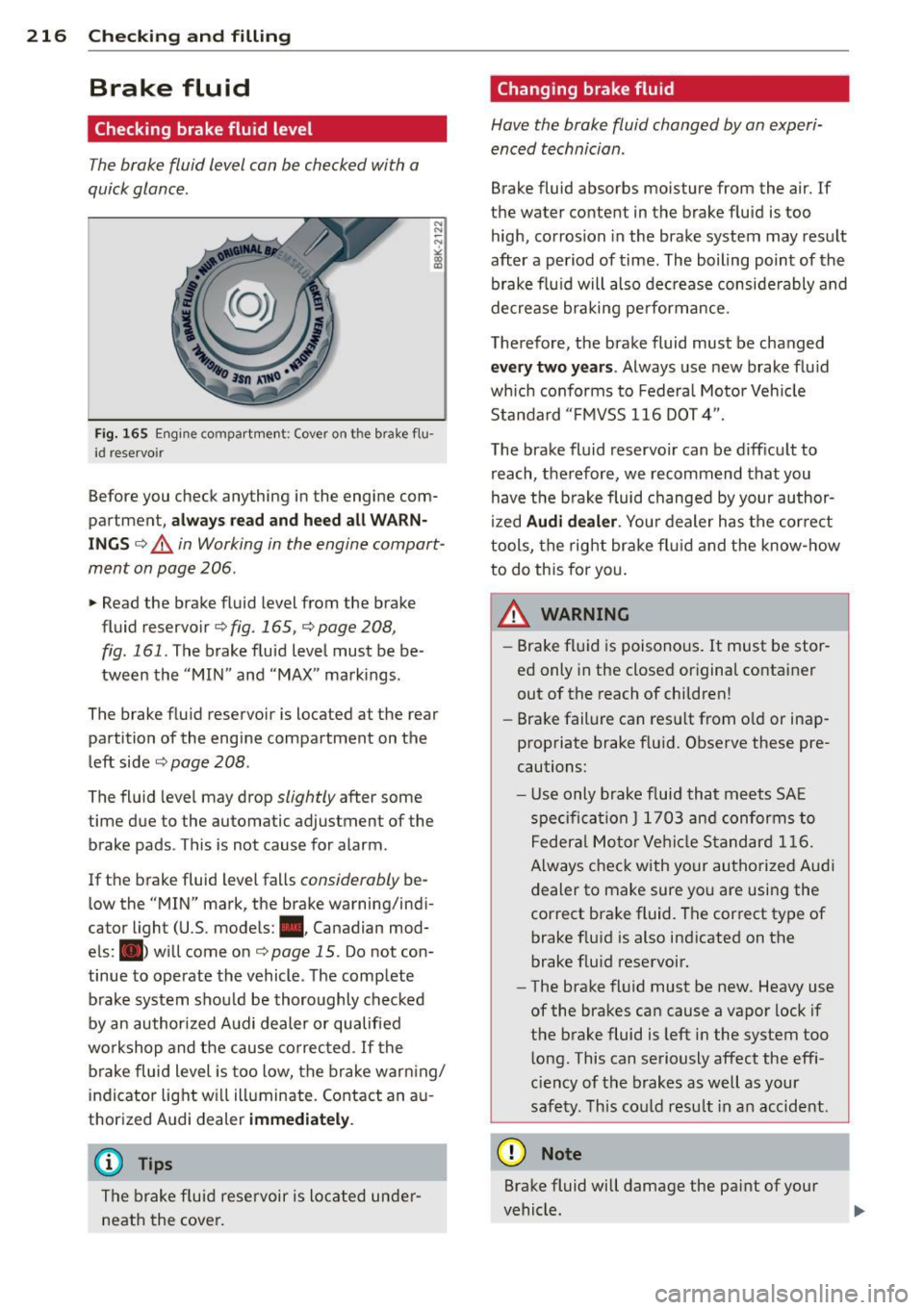
Fig. 165 Engine compartme nt: Cover on the brake flu ·
id reservo ir
Before you check anything in the engine com
partment,
always read and heed all WARN·
INGS ¢ .&._ in Working in the engine compart
ment on page 206 .
.. Read the brake fluid level from the brake
fluid reservoir ¢
fig. 165, ¢ page 208,
fig. 161.
The brake fluid level must be be ·
tween the "MIN" and
"MAX" markings.
The brake fluid reservoir is located at the rear
partition of the engine compartment on the
left side ¢
page 208 .
The fluid level may drop slightly after some
time due to the automatic adjustment of the
brake pads . This is not cause for alarm.
If the brake fluid level falls
considerably be
low the "MIN" mark, the brake warning/indi
cator light (U.S. models: ., Canadian mod
els: .) will come on¢
page 15. Do not con
tinue to operate the vehicle . The complete
brake system should be thoroughly checked
by an authorized Audi dealer or qualified
workshop and the cause corrected.
If the
brake fluid level is too low, the brake warning/
indicator light will illuminate. Contact an au
thorized Audi dealer
immediately .
@ Tips
The brake fluid reservoir is located under
neath the cover.
Changing brake fluid
Have the brake fluid changed by an experi
enced technician .
Brake fluid absorbs moisture from the air. If
t he water content in the brake fluid is too
high, corrosion in the brake system may result
after a period of time . The boiling point of the
brake fluid will also decrease considerably and
decrease braking performance.
Therefore, the brake fluid must be changed
every two years . Always use new brake fluid
which conforms to Federal Motor Vehicle
Standard "FMVSS 116 DOT 4".
The brake fluid reservoir can be difficult to reach, therefore, we recommend that you
have the brake fluid changed by your author
ized
Audi dealer. Your dealer has the correct
tools, the right brake fluid and the know-how
to do this for you .
A WARNING
- Brake fluid is poisonous. It must be stor
ed only in the closed original container
out of the reach of children!
- Brake failure can result from old or inap
propriate brake fluid. Observe these pre
cautions:
- Use only brake fluid that meets SAE
specification
J 1703 and conforms to
Federal Motor Vehicle Standard 116.
Always check with your authorized Audi
dealer to make sure you are using the
correct brake fluid. The correct type of
brake fluid is also indicated on the
brake fluid reservoir.
- The brake fluid must be new. Heavy use
of the brakes can cause a vapor lock if
the brake fluid is left in the system too
long . This can seriously affect the effi
ciency of the brakes as well as your
safety. This could result in an accident.
(D Note
Brake fluid will damage the paint of your
vehicle.
Page 268 of 286
26 6 Con sum er Inf ormation
-Always make sure the transmission se
lector lever (automatic transmiss ion) is
in "P" (Park position) or Neutral (manual
transmission) and the park brake is firm
ly applied.
@) For the s ake of the environment
-Changing the engine settings will ad
versely affect emission levels. This is det
rimental to the environment and increas
es fuel consumption .
- Always observe environmental regula
tions when disposing of old engine oil,
used brake fluid, dirty engine coolant,
spent batteries or worn out tires.
- Undeployed airbag modules and preten
s ioners might be classified as Perchlo
rate Material -spec ial handling may ap
ply, see www.dtsc.ca .gov/hazardous
waste/perch lorate. When the veh icle or
parts of the restraint system including
airbag modules safety belts with preten
sioners are scrapped, all app licable laws
and regulations must be observed . Your
authorized Audi dealer is familiar with
these requirements and we recommend
that you have your dealer perform this
serv ice for you .
Additional accessories,
modifications and
parts replacement
Additional accessories and parts
replacement
Always consult on authorized Audi dealer be
fore purchasing accessories.
Your veh icle inco rporates the latest safety de
sign featu res ensuring a high standard of ac
tive and passive safety.
This safety could be compromised by non-ap
proved changes to the veh icle. For this reason ,
if pa rts have to be replaced , please observe
the following points when installing addition
a l accessories: Approved Audi accessories and genuine Audi
parts are available from authorized Audi deal
er.
T hese dea lers a lso have the necessary facili
ties, tools and trained specialists to install the parts and acc essories proper ly.
A WARNING
-Using the wrong spare parts or using non-
approved accessories can cause damage to
the veh icle and ser ious personal injury.
- Use on ly accessories expressly approved
by Audi and genuine Audi spare parts
- These parts and accessories have been
specially designed to be used on your ve
h icle .
- Never install accessories such as tele
phone crad les or beverage ho lders on a ir
bag covers or within the airbag deploy
ment zones . Do ing so will increase the
risk of injury if a irbags are triggered in an
accident!
- Before you check anything in the engine
compa rtment, always read and heed a ll
WARNINGS
9 page 206 .
(D Note
-If items other than genu ine Audi spare
parts, add-on equipment and accessory
items are used or if repair work is not
performed accord ing to specified meth
ods, this can resu lt in seve re damage to
your vehicle's eng ine and body (such as
corrosion) and adversely affect yo ur vehi
cle's warranty .
- If emergency repairs must be performed
elsewhere, have the vehicle examined by
an authorized Audi dealer as soon as
possible .
- The manufacturer cannot be held liable
for damage wh ich occ urs due to failure
to comply with these stipu lations.
Page 272 of 286
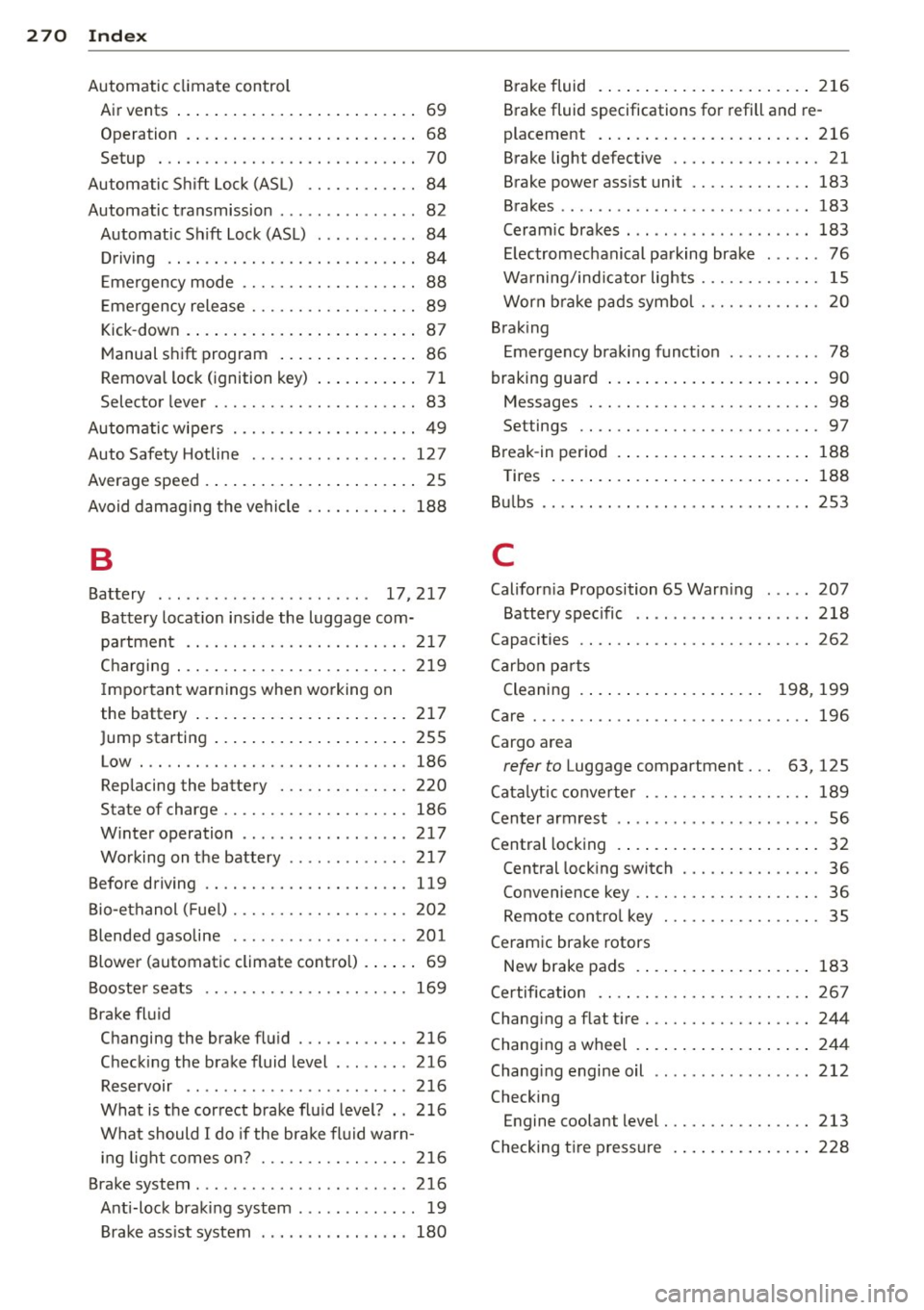
270 Index
Automatic climate control Ai r vents ... ... . ...... ... .. .. .... .. 69
Operation . . . . . . . . . . . . . . . . . . . . . . . . . 68
Setup . .. ............... .. .. .... .. 70
Autom atic S hift Lock (ASL) . . . . . . . . . . . . 8 4
Automatic transmission . . . . . . . . . . . . . . . 82
Automatic Sh ift Lock (ASL) . . . . . . . . . . . 84
D riving .. ... ............ .. .. .. .. .. 84
E mergency mode . . . . . . . . . . . . . . . . . . . 8 8
E mergency release . . . . . . . . . . . . . . . . . . 89
K ick -dow n . . . . . . . . . . . . . . . . . . . . . . . . . 87
M anual s hift program ... .. .. .... .. . . 86
Remova l lock (ignition key) ... .. .... . . 71
Selector lever . . . . . . . . . . . . . . . . . . . . . . 83
Autom atic wi pers .......... .... .... .. 49
Auto Safety Hotline ............ .. ... 127
Average speed . . . . . . . . . . . . . . . . . . . . . . . 2S
Avoid damaging the vehicle .. .... .... . 188
B
Battery ... .. ...... ............ 17,217
B attery locat io n in side the luggage com-
pa rtment ................. .. .... . 217
C ha rging . ............... .. .. .... . 219
I mpor tan t war nings when wo rking on
the battery . . . . . . . . . . . . . . . . . . . . . . . 217
Jump starting .. .. ..... ... .. .. .... . 255
Low . .. .. .. ............. .. .. .. ... 186
Replacing the battery ..... .. .. .. .. . 220
State of charge . . . . . . . . . . . . . . . . . . . . 186
W inter operation . . . . . . . . . . . . . . . . . . 217
Wo rking on the battery . . . . . . . . . . . . . 217
Before driving .. ........... .. .. .... . 119
B io-e thanol ( Fue l) .......... .. .. .. .. . 202
Blended gasoline ... ... .. .. .. .. .. .. . 201
Blower (automatic climate control) . . . . . . 69
B ooste r seats ............. .. .. .. .. . 169
Brake fl uid
C hanging the brake fl uid ..... .. .... . 216
Check ing the brake fluid level ..... .. . 216
Reservoir .. .......... ...... ... .. . 216
What is the cor rect brake fl uid leve l? .. 2 16
What should I do if the bra ke flui d warn-
i ng light comes on? ....... .. .. .. .. . 216
Brake system .... ... .... ... .. .. .. .. . 216
Anti-lock braking system ....... .. .... 19
B rake ass ist system ..... .. .. .. .. .. . 180 B
rake fluid .... .. ... .. ..... ... .. .. 216
B rake fluid specifications for refill and re-
placement . ... .. ... .. ..... ... .. .. 216
Brake light defective ........... .... . 21
B rake power ass ist unit ......... .... 183
Brakes ....... ... .. .............. . 183
Ceram ic brakes ... ... .. .. ... ..... .. 183
El ectromechanical pa rking brak e ..... . 76
Wa rning/ind icator lights ...... .. .. .. . 15
Worn b rake pads symbo l ........ .. .. . 20
B rak ing
E mergency brak ing funct ion ... .. .. .. . 78
braking guard ..... ... .. ..... .... . .. . 90
Messages . .. .. .. .. ........... .... . 98
Settings .. .... .. ............. .... . 97
Break-in per iod .... .. ... ..... ... .. .. 188
T ires ... .. .... .. .. ... ..... ... .. .. 188
Bul bs .. .. .. .. .. .. .. .. ...... ... .. .. 253
C
Californ ia Proposition 65 Warn ing .... . 207
Battery specific .. ..... ........... . 218
Capacities .. .... .. ............. .... 262
Carbon p arts
Cleaning . . . . . . . . . . . . . . . . . . . . 198, 199
Care ........ ... .. .. ... ........... . 196
Cargo area
refer to Luggage compartment. . . 63, 125
Ca talyt ic co nve rter . . . . . . . . . . . . . . . . . . 189
Center armrest .. .. ................ .. 56
Central locking .... ... .. ..... .... . .. . 32
Central lock ing switch .......... .. .. . 36
Convenience key . . . . . . . . . . . . . . . . . . . . 36
Remote contro l key .............. .. . 35
Ceramic brake rotors New brake pads . ... .... .... ... .. .. 183
Ce rtifi cation .. .. .. ... .......... .. .. 267
Chang ing a f lat t ire . ............. .... 244
Chang ing a wheel . ... .... .... ... .. .. 244
Chang ing engine oil ..... .. ... ..... .. 212
Checking Engine coolant level . ........... .. .. 213
Checking t ire press ure . ... .... ... .. .. 228
Page 275 of 286
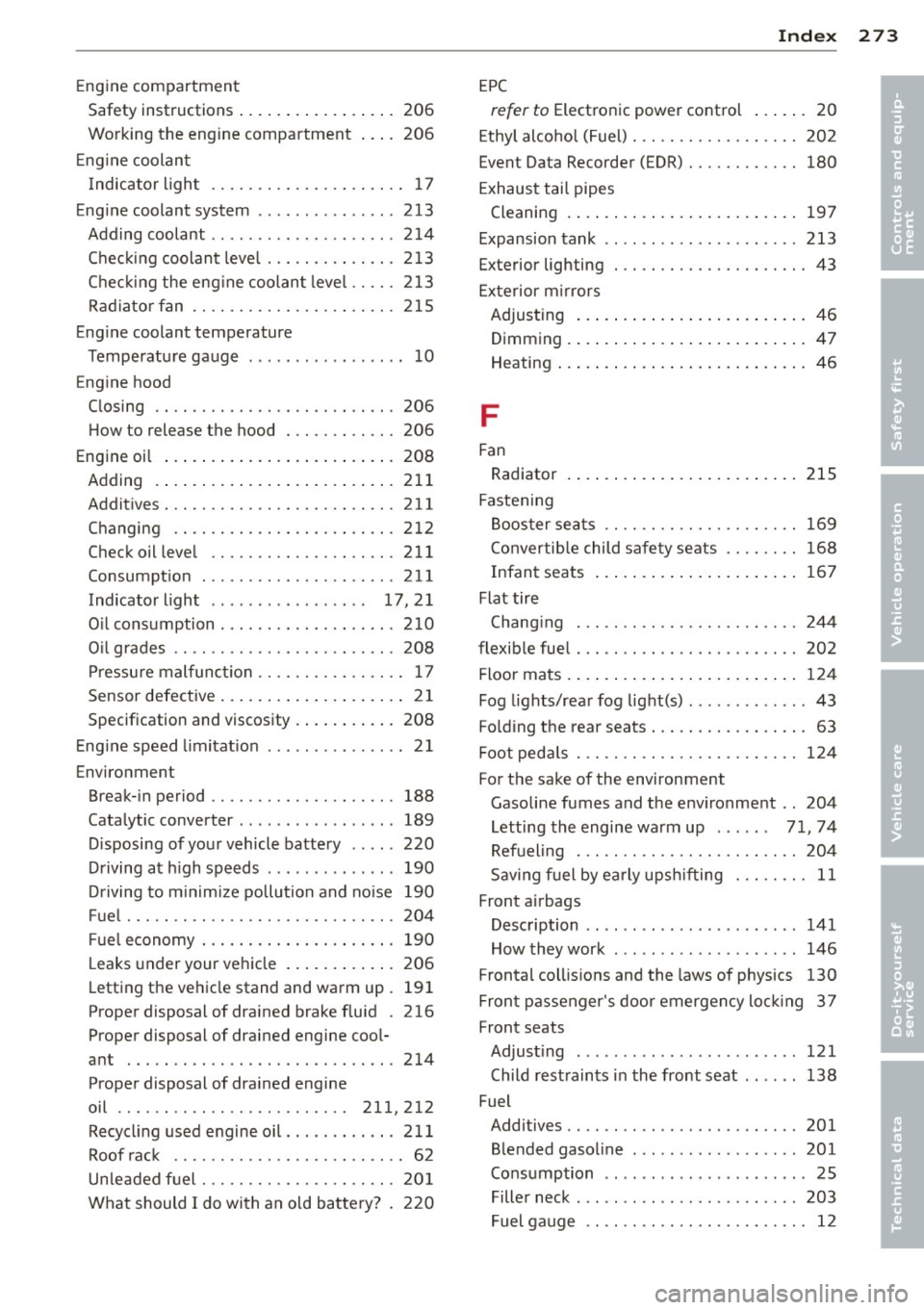
Engine compartment
Safety instructions ................ . 206
Working the engine compartment 206
Engine coolant
Indicator light . . . . . . . . . . . . . . . . . . . . . 17
Engine coolant system .......... ... .. 213
Adding coolant .............. ... ... 214
Checking coolant level ..... .. .. .. .. . 213
Checking the engine coolant level . . . . . 213
Radiator fan ............. .. .. .. .. . 215
Engine coolant temperature Temperature gauge .......... .... ... 10
Engine hood Closing .. .. .. ........... .. .. .. ... 206
How to release the hood ... .. .. .. .. . 206
Engine oil ... ................ ... ... 208
Adding .... ................ ... ... 211
Additives . .. .. ........... .. .. .. ... 211
Changing .. ............. .... .. ... 212
Check oil level ........... .... .. ... 211
Consumption ............... ... ... 211
Indicator light . . . . . . . . . . . . . . . . . 17, 21
Oil consumption . ...... ... .. .. .. .. . 210
Oil grades ..................... ... 208
Pressure malfunction ...... .. .. .. .. .. 17
Sensor defective . . . . . . . . . . . . . . . . . . . . 21
Specification and viscosity ... ... .. .. . 208
Engine speed limitation .......... .... . 21
Environment Break-in period ........... .. .. .. ... 188
Catalytic converter ............ ... .. 189
Disposing of your vehicle battery ..... 220
Driving at high speeds .......... .... 190
Driving to minim ize pollution and noise 190
Fu el . .. .. .. .. .. ........... .. .. ... 204
Fu el economy ..................... 190
Leaks under your vehicle ............ 206
Letting the vehicle stand and warm up. 191
Proper disposal of drained brake fluid . 216
Proper disposal of drained engine cool-
ant . .... .. .. ............. .. .. ... 214
Proper disposal of drained engine
oil ...... ... ............. ... 211,212
Recycling used engine oil . .. .. .. .. .. . 211
Roof rack . . . . . . . . . . . . . . . . . . . . . . . . . 62
Unleaded fuel . ........... .. .. .. ... 201
What should I do with an old battery? . 220
Index 273
EPC
refer to Electronic power control . . . . . . 20
Ethyl alcohol (Fuel) . ................. 202
Event Data Recorder (EDR) ........ .... 180
Exhaust tail pipes Cleaning ... ..... .. ............... 197
Expansion tank .. .... ... ....... ..... 213
Exterior lighting . .. ................. . 43
Exterior m irrors
Adjusting ..... .... ................ 46
Dimming ... ..... .. ................ 47
Heating ........................... 46
F
Fan
Radiator
Fastening 215
Booster seats .. ...... ......... .... 169
Convertible child safety seats .... .... 168
Infant seats
Flat tire 167
Changi ng ... .. .. .. .. ........... .. 244
flexible fuel ... .. .... ............... 202
Floor mats ... ..... .. ............... 124
Fog lights/rear fog lig ht(s) . . . . . . . . . . . . . 43
Folding the rear seats ... ............. . 63
Foot pedals . .. .. .. .. ............... 124
For the sake of the environment Gasoline fumes and the environment .. 204
Letting the engine warm up . . . . . . 71, 74
Refueling . .. .. .. ................. 204
Saving fuel by early upsh ifting ... .. .. . 11
Front airbags Description . . . . . . . . . . . . . . . . . . . . . . . 141
How they work ... .. . .. .... ........ 146
Frontal collisions and the laws of physics 130
Front passenger's door emergency locking 37
Front seats Adjusting ....... .. ..... .......... 121
Child restraints in the front seat ...... 138
Fuel Additives .... .. ...... ............. 201
Blended gasoline ... . .. .... ........ 201
Consumption .. ... ............... .. 25
Filler neck . .. .. .... .......... ..... 203
Fuel gauge . . . . . . . . . . . . . . . . . . . . . . . . 12
•
•