belt AUDI A5 COUPE 2014 Service Manual
[x] Cancel search | Manufacturer: AUDI, Model Year: 2014, Model line: A5 COUPE, Model: AUDI A5 COUPE 2014Pages: 286, PDF Size: 70.99 MB
Page 156 of 286
154 Airbag sys te m
Although they are not a soft pillow, they can
cushion the impact and in this way they can he lp to reduce the r isk of injury to the lower
extremities.
A ll of this takes place in the blink of an eye, so
fast that many people don't even realize that
the airbags have deployed. The a irbags also
inflate with a great deal of force and it is im
portant for occupant safety that noth ing
should be in their way when they deploy.
Fu lly inflated airbags in combination with
properly worn safety belts slow down and lim
it the occupant's forward movement and help
to reduce the r isk of injury .
Important safety instructions on the
knee airbag system
Applies to vehicles: with knee airb ags
Airbags are only supplemental restraints . Al
ways wear safety belts correctly and ride in a
proper seating position.
There is a lot that you and your passengers
must know and do to help the safety be lts and
a ir bags to provide supp lemental p rotection .
A WARNING
An inflating knee airbag can cause ser ious
inju ry. Wear ing sa fety belts inco rrec tly and
improper seating posi tions increase the
risk of serious personal injury and death
whenever a veh icle is being used.
- The knee airbag system cannot protect
yo u properly if you are seated too close
to any o f the airbag locations. When ad
just ing their seat positions, it is impor
tant that both the driver and the front
passenger keep their upper bodies and
knees at the following min imum safe
dis tances:
- at least 10 inches (25 cm) between the
chest and the steering wheel/instr u
ment panel.
- at least 4 inches (10 cm) between the
knees and the lower part of the instru
ment panel. -
The risk of personal inj ury increases if
you lean fo rward or to the s ide, or if the
seat is improperly positioned and you are not wearing you r safety belt . The risk in
creases even more should the a irbag de
ploy .
- Always make sure that the knee airbag
can inflate without inte rfe rence. Objects
between you and the airbag can inc rease
the risk of injury in an ac cident by inte r
fering w ith the way the a irbag deploys or
by being p ushed into you as the airbag
deploys.
- Never let anybody, espec ia lly children
or anima ls ride in the footwell in front
of the passenge r seat. If the airbag de
ploys, th is can result in serious or fatal
injur ies.
- Never carry objects of any kind in the
footwell area in front of the dr iver's or
passenger 's seat. Bulky objects (shop
ping bags, for example) can interfere
with or prevent proper deployment of
the a irbag . Small ob jects can be
thrown thro ugh the veh icle if the air
bag deploys and injure you or your pas
sengers.
- Make sure there are no cracks, deep
scratches or other damage in the area of
the instrument panel where the knee air bags are located.
- If ch ildren are incorrectly seated, their
risk of injury increases in a collision
c:::> page 161, Child Safety .
Page 157 of 286
Side airbags
Description of side airbags
The airbag system can provide supplemental
protection to properly restrained occupants.
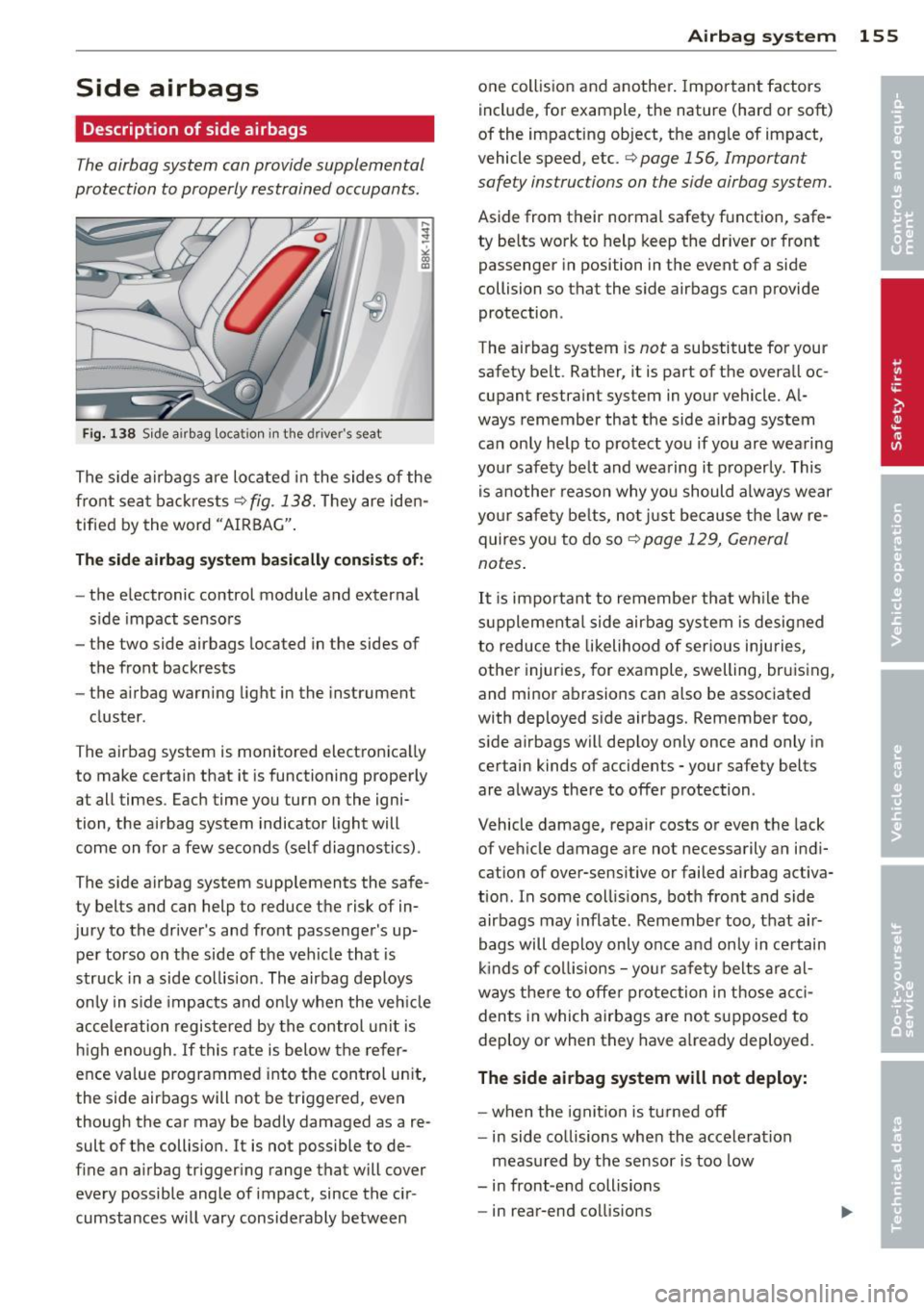
Fi g. 1 38 S ide a irbag location i n the driver 's seat
The s ide a irbags are located in the sides of the
front sea t backrests ¢
fig . 138. They are iden
tified by the word "AIRBAG" .
The side airbag system ba sicall y consis ts of :
-the electronic control module and external
side impact senso rs
- the two side airbags located in the sides of
the front backrests
- the a irbag warning light in the instrument
cluster .
The airbag system is monitored electronica lly
to make certain that it is functioning properly at all times . Each time you turn on the igni
tion, the airbag system indicator light will
come on for a few seconds (self diagnostics) .
The s ide a irbag system supplements the safe
ty belts and can help to reduce the risk of in
jury to the dr iver's and front passenge r's up
pe r torso on the side of the veh icle that is
struck in a side co llision . The airbag deploys
on ly in side impacts and on ly when the vehicle
acceleration registered by the control u nit is
hi gh eno ugh . If this rate is below the refer
ence va lue programmed i nto the con trol un it,
the side airbags will not be triggered, even
though the car may be badly damaged as a re
sult of the collision. It is not possible to de
fine an airbag trigger ing range that will cover
eve ry possible angle of impact, since the ci r
cumstances wi ll vary conside rably between
A irba g sy stem 155
one collis ion and anothe r. Important factors
incl ude, for example, the nature (hard or soft)
of the impacting object, the ang le of impact,
vehicle speed, etc. ¢
page 156, Important
safety instructions on the side airbag system .
Aside from their normal safety function, safe
ty belts work to help keep the driver or front
passenger in position in the event of a side
collision so that the side airbags can provide protection .
The airbag system is
not a substitute for your
safety belt. Rather, it is part of the overall oc
cupant restra int system in your vehicle. Al
ways remember that the side airbag system can only help to protect you if you are wearing
you r safety be lt and wea ring it p roperly. This
is anothe r reason why you should a lways wear
yo ur safe ty be lts, no t ju st because the law re
quires you to do so¢
page 129, General
notes .
It is important to remembe r that wh ile the
s u pplementa l side airbag system is designed
to reduce the likelihood of ser ious inju ries,
other injur ies, for example, swelling, br uising,
and minor abrasions can also be associated
with deployed side airbags. Remember too,
s ide airbags will deploy only once and only in
certain kinds of accidents -your safety belts
are always the re to offer protection .
Vehicle damage, repair costs or
even the lack
of ve hicle damage are not necessarily a n indi
cation of over-sensitive or failed airbag activa
tion. In some coll is io ns, both front and side
airbags may inflate. Remember too, that air
bags will deploy only once and only in certain
k inds of co lli sions -you r safe ty be lts are al
w ays the re to offe r protection in those ac ci
dents in whi ch airbags are not s upposed to
deploy or when they have a lready deployed .
The side airbag system will not deploy:
-when t he ignit io n is tu rned off
- in side collisions whe n the acceleration
meas ured by the sensor is too low
- in front-e nd collisions
- in rear-end collis ions
Page 158 of 286
156 Airbag system
-in rol lovers.
I n s ome types of acc idents the front a irbags,
side curtain a irbags and side ai rbags may be
tr iggered together.
A WARNING
- Sa fety belts and the airbag system will
only prov ide protection when occupants
are in the proper seating position
¢ page 156 .
-If the airbag indicator light ¢ page 20
comes when the vehicle is be ing used,
have the system inspected immediate ly
by your autho rized Aud i dea ler . It is pos
sible that the airbag will inflate when it
is not s upposed to, or w ill not i nflate
when it should.
How supplemental s ide airbags work
-
Side airbags deploy instantly and can help re
duce the risk of upper torso injuries for occu
pants who are properly restrained .
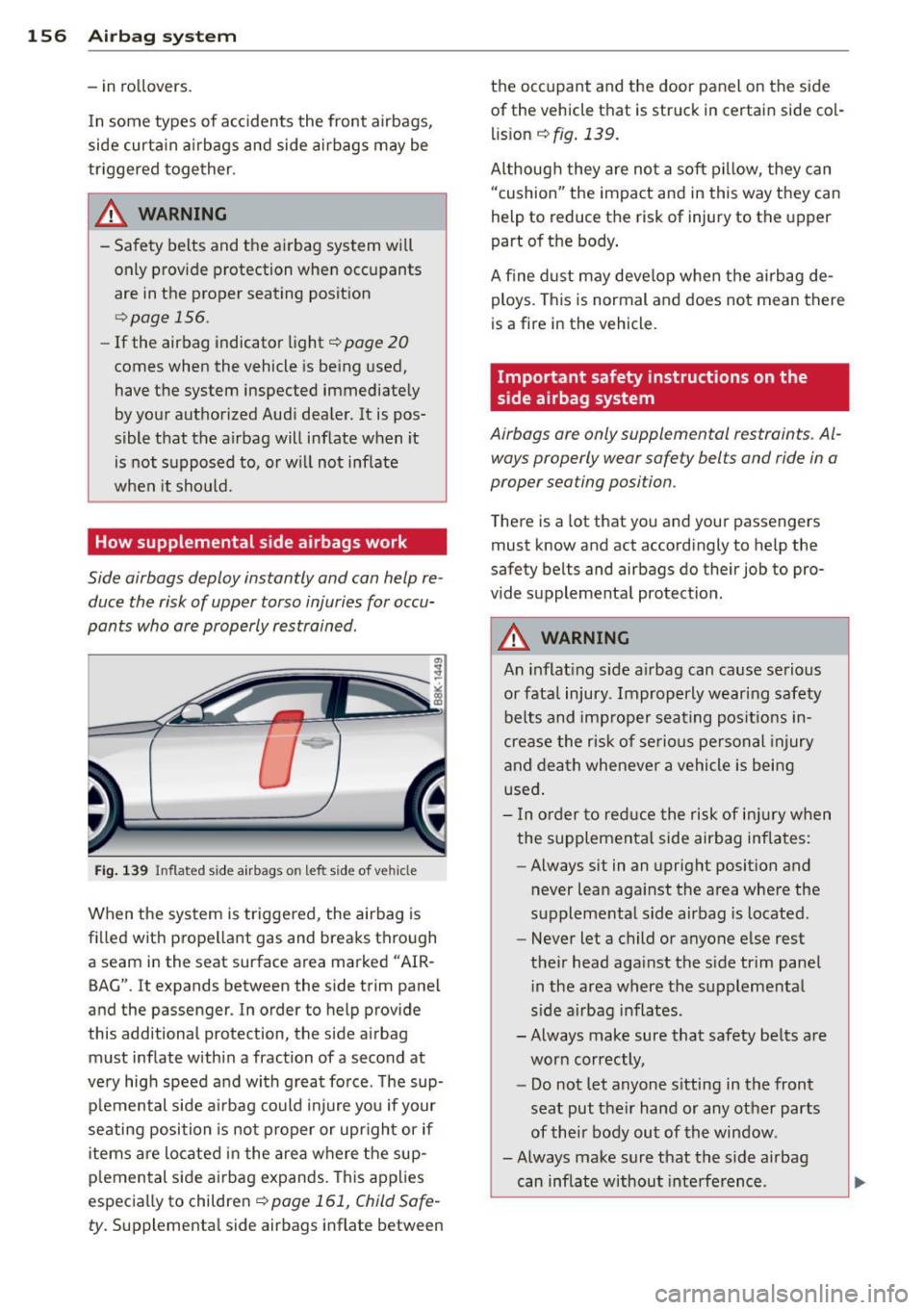
Fig. 139 Infla ted side a irbags o n left side of ve hicle
When the system is triggered, the airbag is
fi lled wit h propellant gas and breaks through
a seam in the seat surface area marked "AIR
BAG". It exp ands between the side trim panel
and the passenger . In order to help prov ide
this additional protection, the side a irbag
must inflate within a fraction of a second at
ve ry hig h speed and with great fo rce . The sup
p lemental side a irbag could injure you if your
se ating position is no t proper or upr ight or if
item s are located in the area where the sup
p lemental side a irbag expands. This app lies
especia lly to childre n
¢ page 161, Child Safe
ty.
Supplementa l side airbags inflate betw een the occ
upant and the door panel on the side
of the vehicle that is struck in certain side col
lis ion ¢
fig. 139.
Although they are not a soft pi llow , they can
"cushion" the im pact and in this way they can
help to reduce the risk of injury to the upper
part o f the body .
A fine d ust may deve lop when the ai rbag de
ploys. This is normal and does not mean there
is a fire in the veh icle.
Important safety instructions on the
side airbag system
Airbags are only supplemental restraints . Al
ways properly wear safety bel ts and ride in a
proper seating posi tion .
There is a lot that you and your passengers
must know and act accordingly to help the
safety belts and airbags do their job to pro
vide supplementa l protect ion.
A WARNING
An i nflat ing s ide a irbag can cause serious
or fata l injury . Improperly wearing safety
be lts and imp roper seating pos itions in
crease the risk of serious pe rsonal injury
and dea th whenever a vehicle is being
use d.
- In order to red uce the risk of i njury when
the supplemental side airbag infla tes:
- Always sit in an upright posit ion and
never lean aga inst the a rea whe re the
suppleme nta l side airbag is located .
- Never let a child or anyone e lse rest
their head aga inst the s ide trim pane l
i n the area where the supplementa l
s ide airbag inflates .
- Always make sure that safety be lts a re
worn correctly,
- Do not let anyone s itting in the front
seat put their hand or any other parts
of their body out of the window .
- Always make sure that the s ide airbag
can inf late without inte rfe rence .
Page 160 of 286
158 Airbag sys te m
The side curtain airbags are located on both
sides of the interior above the front and rear
side windows ~
fig. 140. They are ident ified
by the word "AIRBAG" on the windshie ld
frame and the center roof pillar.
The side curtain airbag system supp lements
the safety belts and can help to reduce the
risk of injury for occupants ' heads and upper
torso on the side of the vehicle that is struck in a side co llision . The side curtain airbag in
flates in s ide impacts and only when the veh i
cle acce lerat ion reg istered by the contro l unit
is high enoug h. If th is rate is below the refe r
ence va lue programmed into the control un it,
the side airbags will not be t riggered, even
though the ca r may be badly damaged as a re
sult of the collision . It is not possible to de
fine an a irbag tr igger ing range that will cover
every possible angle of impact, since the cir
cumstances will vary considerably between
one co llision and another . Important factors
i nclude, for example, the natu re (hard or soft)
of the impacting object, the ang le of impact ,
ve hicl e speed, etc.~
page 159, How side cur
tain airbags work.
As ide from the ir no rmal safety function, safe
ty belts work to he lp keep the driver or front
passenger in position in the event of a co lli
sion so tha t the side curta in airbags can pro
vide protection.
The airbag system is not a subst itute for you r
safety belt. Rathe r, it is pa rt of the overall oc
cupa nt res traint system in your ve hicle. Al
ways remember that the airbag system can
only help to protect you if you are wearing
your safety be lt and wearing it properly. This
is another reason why you sho uld a lways wear
your safety belts, not just beca use the law re
qu ires you to do so
Q page 129, General
notes.
It is important to remember that while the
side curta in a irbag system is designed to help
reduce the likelihood of serious injuries, other
injuries, fo r example , swell ing, bruisi ng, and
minor abras io ns can also be associated w it h
these airbags. Remembe r too, these a irbags
will dep loy only once and only in cer tain kinds of accidents
-your safety belts are always
there to offer protection.
The side curtain airbag system basically
con sists of:
- The e lectronic control module and external
side impact sensors
- The side curtain airbags above the fron t and
rear side windows
- The a irb ag ind icator light in the inst rument
panel
T he airbag syste m is mon itored e lectronically
to make ce rtain it is functioning prope rly at all
t imes. Each t ime yo u turn on t he igni tion, the
airbag system indicator light wi ll come on for
a few seconds (self diagnostics) .
The side curtain airbag is not activated:
-if the ignition is tur ned off,
- in side collisions when the accele ration
measured by the sensor is too low,
- in rear-end col lisions,
- in rollovers.
A WARNING '"--
-Safety belts and the airbag system will
only provide protection when occupa nts
are in th e prop er seating position
Q page 53, Seats and storage.
- If the ai rbag ind icator light Q page 20
comes when the veh icle is being used,
h ave the system inspected immedia tely
by your au thori zed A udi dealer.
It is pos
sible tha t the airbag will inflate when i t
is not supposed to, or will not inflate
when it should.
Page 161 of 286
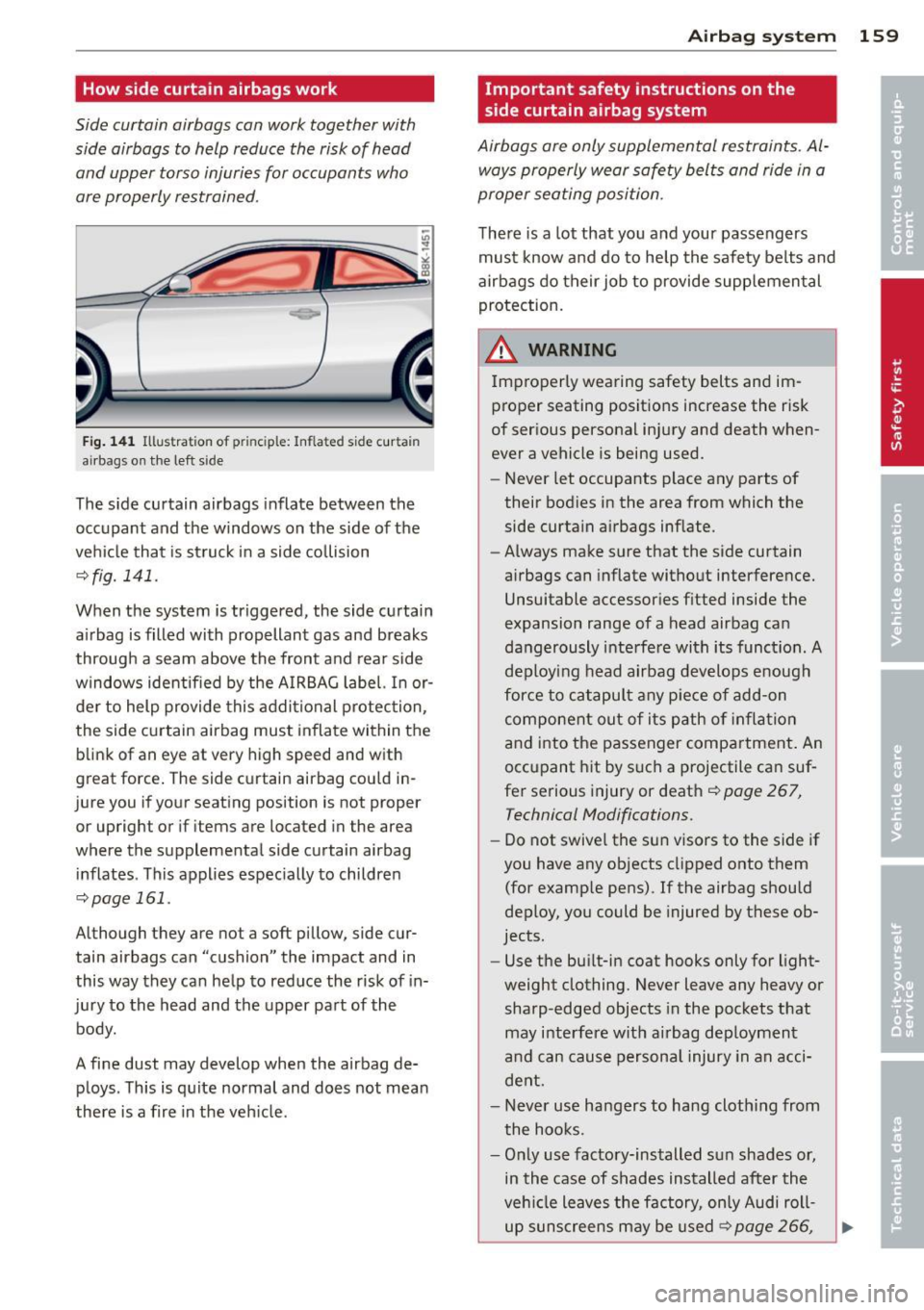
How side curtain airbags work
Side curtain airbags can work together with
side airbags to help reduce the risk of head
and upper torso injuries for occupants who
are properly restrained.
€
Fig. 141 Illustration of prin ciple: In flated side cur ta in
airbags on the left side
The side curtain airbags inflate between the
occupant and the windows on the side of the
vehicle that is struck in a side collision
c::>fig. 141 .
When the system is triggered, the side curtain
airbag is filled with propellant gas and breaks
through a seam above the front and rear side windows identified by the AIRBAG label. In or
der to help provide this additional protection,
the side curtain airbag must inflate within the blink of an eye at very high speed and with
great force. The side curtain airbag could in
jure you if your seating position is not proper
or upright or if items are located in the area
where the supplemental side curtain airbag
inflates . This applies especially to children
c::> page 161.
Although they are not a soft pillow, side cur
tain airbags can ''cushion" the impact and in
this way they can help to reduce the risk of in
jury to the head and the upper part of the
body.
A fine dust may develop when the airbag de ploys . This is quite normal and does not mean
there is a fire in the vehicle .
Airbag system 159
Important safety instructions on the
side curtain airbag system
Airbags are only supplemental restraints . Al
ways properly wear safety belts and ride in a
proper seating position.
There is a lot that you and your passengers
must know and do to help the safety belts and
airbags do their job to provide supplemental
protection.
A WARNING
Improperly wearing safety belts and im
proper seating positions increase the risk
of serious personal injury and death when
ever a vehicle is being used.
- Never let occupants place any parts of
their bodies in the area from which the side curtain airbags inflate.
- Always make sure that the side curtain
airbags can inflate without interference.
Unsuitable accessories fitted inside the
expansion range of a head airbag can
dangerously interfere with its function . A
deploying head airbag develops enough
force to catapult any piece of add-on
component out of its path of inflation
and into the passenger compartment. An
occupant hit by such a projectile can suf
fer serious injury or death
c::> page 267,
Technical Modifications.
- Do not swivel the sun visors to the side if
you have any objects clipped onto them
(for example pens) . If the airbag should
deploy, you could be injured by these ob
jects.
- Use the built-in coat hooks only for light
weight clothing. Never leave any heavy or sharp-edged objects in the pockets that
may interfere with airbag deployment
and can cause personal injury in an acci
dent.
- Never use hangers to hang clothing from
the hooks .
- Only use factory-installed sun shades or,
in the case of shades installed after the
vehicle leaves the factory, only Audi roll-
-
up sunscreens may be used c::, page 266, .,_
Page 162 of 286
160 Airbag sys te m
Additional accessories and parts re
placement.
- Always sit in proper seating position and
wear safety belts while traveling so that
the side curtain airbags can help provide
protection.
- The airbag system can only be triggered once. If the a irbag has been triggered,
the system must be replaced by an au
thorized Aud i deale r o r qualified work
shop.
- Always have work involving the side cur tain airbag system, removal and installa
tion of the a irbag components, o r other
repa irs perfo rmed by an authori zed A udi
de aler or qualified wor kshop. Otherwise
the a irbag sys tem may no t work correct
ly .
- Never a ttempt to modify any compo
nents of the airbag system in any way .
Page 163 of 286
Child Safety
Important things to know
Introduction
The rear seat is generally the safest place in a
collision .
The physical principles of what happens when
your veh icle is in a crash app ly also to chi ldren
q page 130, What happens to occupants not
wearing safety belts? .
But unlike adu lts thei r
muscles and bones are not fully developed. In
many respects children are at greater risk of
serio us inju ry in crashes than adults .
Because children's bod ies are not fu lly deve l
oped, they require restraint systems especial
l y des igned for their size, weight, and body
structure. Many co untries and all states of th e
United States and p rovinces of Canada have
laws requ iring the u se of approved ch ild re
straint systems for infants and small children .
In a frontal crash at a speed o f 20 -35 mph
(30-56 km/h) the forces acting on a 13-po und
(6 kg) infant w ill be more than 20 t imes the
weight of the child . Th is means the weight of
the child would suddenly be more than 260 pounds ( 120 kg). Under these conditions,
on ly an appropriate chi ld restrai nt properly
used can reduce the risk of ser ious injury.
Ch ild restr aints must be used p roperly to be
effective. Used improperly, they can inc rease
the risk of serious in jury i n an accident.
Consult the chil d safety seat manufacture r's
i nstr uctions to be s ure the seat is r igh t for
your chi ld's size
q page 164, Important safe
ty instructions for using child safety seats .
Please be sure to read and heed a ll of the im
portant informat ion and WARNINGS abo ut
child safety, Advanced Airbags, and the ins tal
lation of child restraints in this chapter.
T here is a lot you need to know about the Ad
vanced A irbags in your vehicle and how they
work when infants and children in child re
straints are on the front passenger seat . Be
cause of the large amount of important i nfor-
Child Sa fet y 161
mation, we cannot repeat it a ll here . We urge
you to read the detai led information in this
owner 's man ua l about airbags and the Ad
vanced Airbag System in your vehicle and the
very important information about transpor t
ing ch ildren on the front passenger seat.
Please be sure to heed the WARNINGS -they
ar e extremely importa nt for your safety and
the safety of you r passenge rs, especially in
f an ts and small chi ld ren.
A WARNING
- Accident statistics have shown that c hil
dren are generally safer in the rear seat
area than in the front seating position.
Always restrain any child age 12 and un
der in the rear.
- All vehicle occupants and especially chil
dren must be restrained p roperly when
ever riding i n a vehicle. An unrestrained
or improper ly restrained chi ld could be
in ju red by str iking the interior o r by be
ing ejected from the vehicle during a
sudden maneuve r or impact. A n un re
s tra ine d or improperly restrained ch ild is
a lso at greate r risk of injury o r dea th
through contact with an inflating airbag .
- A suitable ch ild restrai nt properly inst al
led and used a t one o f the rear seat ing
positions prov ides the highest degree of
protection for infants and small children
in most accident situations.
A WARNING
Children on the front seat of any car even
with Advanced Airbags can be ser iously in
ju red or even killed when an a irbag i n
flates. A child in a rearward -fac ing ch ild
safety seat installed on t he front passen
ger seat w ill be ser iously injured and can
be killed if the front airbag infla tes.
- The infla ting airbag will h it the ch ild
s afe ty seat or i nfant carrie r wi th grea t
force and will sm ash the child safety se at
and child against the bac krest, cen ter
armrest o r door .
- Always install re arward-fac ing ch ild safe-
ty seats on the rea r seat .
~
•
•
Page 164 of 286
162 Child Safety
-If you must install a rearward facing
child safety seat on the front passenger
seat in exceptional circumstances and
the
PASSENGER AIR BAG OFF light does
not come on and stay on, immediately
install the rearward-facing child safety
seat in a rear seating position and have
the airbag system inspected immediately
by your authorized Audi dealer.
.&, WARNING
If, in exceptional circumstances, you must
install a forward-facing child restraint on
the front passenger's seat:
- Always make sure the forward-facing
seat has been designed and certified by
its manufacturer for use on a front seat
with a passenger front and side airbag.
- Always follow the manufacturer's in
structions provided with the child safety
seat or carrier.
- Always move the passenger seat into its
rearmost position in the seat's fore and
aft adjustment range, as far away from
the airbag as possible before installing
the child restraint. The backrest must be adjusted to an upright position .
- Always make sure that the
PASSENGER
AIR BAG OFF
light comes on and stays
on all the time whenever the ignition is
switched on.
(D Tips
Always replace child restraints that were
installed in a vehicle during a crash. Dam
age to a child restraint that is not visible
could cause it to fail in another collision
situation.
Advanced front airbag system and children
Your vehicle is equipped with a front "Ad
vanced Airbag System" in compliance with
United States Federal Motor Vehicle Safety
Standard (FMVSS) 208 as applicable at the
time your vehicle was manufactured . The
Advanced Airbag system in your vehicle
has been certified to meet the "low-risk" re
quirements for 3- and 6-year old children on
the passenger side and small adults on the driver side. The low risk deployment criteria
are intended to reduce the risk of injury
through interaction with the airbag that can
occur, for example, by being too close to the
steering wheel and instrument panel when
the airbag inflates . In addition, the system
has been certified to comply with the "sup
pression" requirements of the Safety Stand
ard, to turn off the front airbag for infants up
to 12 months who are restrained on the front
passenger seat in child restraints that are list
ed in the Standard.
Even though your vehicle is equipped with an
Advanced Airbag system, all children, espe
cially those 12 years and younger, should al
ways ride in the back seat properly restrained
for their age and size. The airbag on the pas
senger side makes the front seat a potentially
dangerous place for a child to ride . The front
seat is not the safest place for a child in a for
ward-facing child safety seat.
It can be a very
dangerous place for an infant or a larger child
in a rearward-facing seat.
Advanced Airbags and the weight
sensing mat in the front seat
The Advanced Airbag System in your vehicle detects the presence of an infant or child in a
child restraint on the front passenger seat us
ing the weight-sensing mat in the seat cush
ion and the sensor below the safety belt latch
on the front passenger seat that measures the
tension on the safety belt.
The weight-sensing mat measures total
weight of the child and the child safety seat
and a child blanket on the front passenger
seat. The weight on the front passenger seat
is related to the design of the child restraint
and its "footprint", the size and shape of the
bottom of the child restraint as it sits on the
seat. The weight of a child restraint and its "footprint" vary for different kinds of child re -
straints and for the different models of the .,.
Page 165 of 286
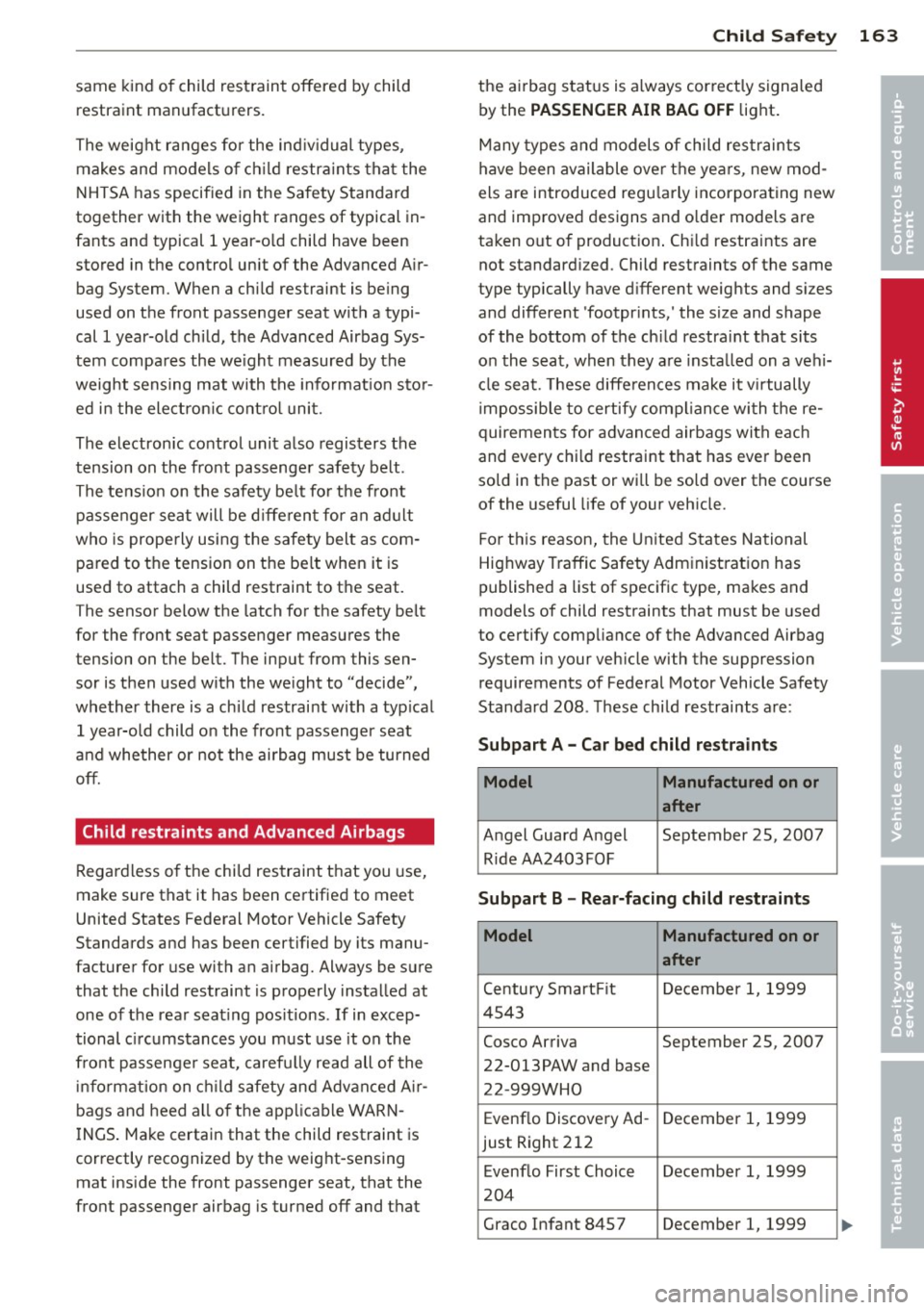
same kind of child restrain t offered by child
restraint manufacturers.
T he weight ranges for the ind iv idual types,
makes and models o f ch ild restra ints tha t the
NHTSA has specified in the Safety Standard
together with the weight ranges of typical in
fants and typical 1 year-o ld child have been
stored in the control unit of the Advanced A ir
bag System. When a child res traint is being
used on the front passenger seat with a typi
cal 1 year-old ch ild, the Advanced Airbag Sys
tem compares the we ight measured by the
weight sens ing mat with the info rmat ion s to r
ed i n the electron ic cont rol unit.
The electron ic control unit a lso registers the
tension on the front passenger safety be lt .
The te nsio n on the safety be lt fo r the front
p assenger seat will be d iffe ren t fo r an ad ult
who is properly using the safety belt as com
pared to the tension on the be lt when it is
used to attach a child restraint to the seat.
T he sensor below the latch for the safety be lt
for the front seat passenger measures the
t ension on the be lt. The input from this sen
sor is then used with the we ight to "decide",
whether there is a ch ild restrai nt with a typ ical
1 year-o ld child on the front passenge r seat
and whether or no t the airbag must be turned
off.
Child restraints and Advanced Airbags
Regard less o f the child res traint that you use,
make sure that it has been certified to meet
United States Federal Motor Vehicle Safety
Standards and has been certified by its manu
facturer for use with an airbag. Always be sure
that the child restraint is properly insta lled at
one of the rear seat ing pos itions .
If in excep
tional c ircumstances you must use it on the
fr ont passenge r seat, caref ully read all of the
information on c hild safety and Adv ance d Air
bags an d heed a ll of the app licable WAR N
I NGS . Make certai n that the child restraint is
correctly recognized by the weig ht-sensing
mat inside the front passenger seat, that the
front passenger airbag is turned off and that
Child Sa fet y 163
the a irbag s tat us is a lways cor rect ly signaled
by the
PASSENGER AIR BAG OFF light .
Many types and models of child res traints
have been available over t he years, new mod
els are introduced regu larly incorporating new
and improved designs and o lde r models are
ta ken o ut of product ion . Ch ild restraints are
not standa rd iz ed. Child restraints of the same
type typically have d ifferent weights and si zes
and different 'footpr ints, ' the size and shape
of the bottom of the ch ild restra int that sits
on the seat, when they a re insta lled on a vehi
cl e sea t. T hese d iffe rences make i t vir tually
i mpossible to certify compl ian ce wi th t he re
quiremen ts for advanced airbags with each
and every ch ild restraint that has eve r been
so ld in the past or wi ll be sold over the course
of the useful life of your veh icle.
For t his reason, the United S tates Na tional
Hig hway T raffic Safety Administration has
published a list of specific type, makes and
models of child restraints that must be used
to certify comp liance of the Advanced Airbag
Sys tem in your veh icle with the suppression
requirements of Federal Motor Vehicle Safety
Standard 208. These child res traints are :
Subpart A - Car bed child restraints
Model Manufactured on or
after
A ngel Guard A ngel September 25, 2007
Ride AA2403FOF
Subpart B -Rear-facing child restraints
Model Manufactured on or
after
Ce ntury Smart Fit Decembe r 1, 1999
4 543
Cosco Arriva September 25, 2007 22-013PAW and base
22 -999WHO
Evenflo Discovery Ad -December 1, 1999
just Right 212
Evenflo First Choice December 1, 1999
204
Graco Infant 8457 December 1, 1999
•
•
Page 166 of 286
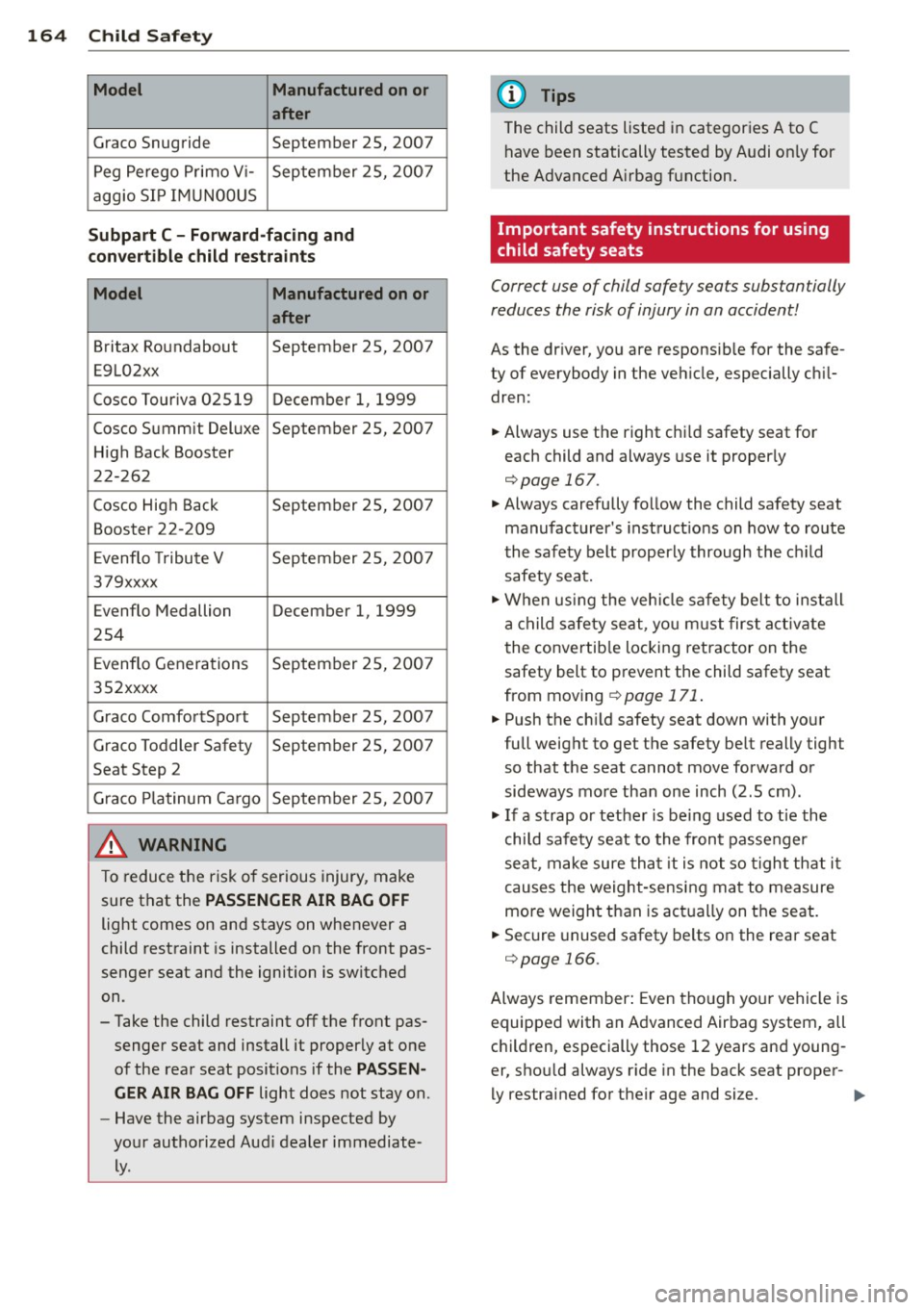
164 Child Saf ety
Model Manufactured on or
a fter
Graco Snugride September 2S, 2007
Peg Perego Primo V i- September 25, 2007
aggio SIP IMUN00US
Subpart C -Forward -facing and
con vertibl e child r estra in ts
Model Manufactured on or
after
Britax Roundabout September 25, 2007
E9L02xx
Cosco Tour iva 02519 December 1, 1999
Cosco Summit Deluxe September 2S, 2007
High Back Booster
22-262
Cosco Hig h Back September 25, 2007
Booster 22-209
Evenflo Tribute V September 25, 2007
379xxxx
Evenflo Medallion December 1, 1999
254
Evenflo Generations September 25, 200
7
352xxxx
Graco ComfortSport September 25, 2007
Graco Toddler Safety September 25, 2007
Seat Step 2
Graco P latinum Ca rgo September 25, 2007
_&. WARNING
T o reduce the risk of serious injury, make
sure that the
PASSENGER AIR BAG OFF
light comes on and stays on whenever a
child restraint is installed on the front pas
senger seat and the ignition is switched
on.
- Take the child restraint off the front pas senger seat and install it properly at one
of the rear seat positions if the
PASSEN
G ER AIR BAG OFF
light does not stay on.
- Have the airbag system inspected by
your authorized Aud i dealer immediate
ly.
(!) Tips
The child seats listed in categories A to C have been statically tested by Audi on ly for
the Advanced A irbag function.
Important safety instructions for using
child safety seats
Correct use of child safety seats substantially
reduces the risk of injury in an accident!
As the driver, you are responsib le for the safe
ty of everybody in the veh icle, especially ch il
dren:
... Always use the right ch ild safety seat for
each child and always use it properly
c::;,page 167 .
... Always carefully follow the child safety seat
manufacturer's instruct ions on how to route
the safety belt properly through the child
safety seat.
... When usi ng the veh icle safety belt to install
a child safety seat, you m ust first activate
the convertib le locking retractor on the
safety belt to prevent the child safety seat
from moving
¢ page 171.
... Push the ch ild safety seat down with your
full weight to get the safety belt really tight
so that the seat cannot move forwa rd or
sideways mo re than one inch (2.5 cm) .
... If a strap or tether is be ing used to t ie the
child safety seat to the front passenger
seat, make sure tha t it i s n ot so tight th at i t
causes the weight -sensing mat to measure
more weight than is act ually on the seat.
... Sec ure unused safety belts o n the rear seat
c::;, page 166 .
Always remember : Even tho ugh yo ur vehicle is
equipped with an Advanced Airbag system, all
chi ldren, especially those 12 years and young
er, shou ld always r ide in the back seat proper-
ly restrained for their age and size. .,.