belt AUDI A5 COUPE 2014 Repair Manual
[x] Cancel search | Manufacturer: AUDI, Model Year: 2014, Model line: A5 COUPE, Model: AUDI A5 COUPE 2014Pages: 286, PDF Size: 70.99 MB
Page 179 of 286
.. Pull on the connector attachments to make
sure they are properly attached to the LATCH
lower anchorage .
.. Pull straps tight following the child restraint
manufacturer 's instructions.
Re lea sin g
.. Loosen the tension on the straps following
the chi ld restraint manufacturer's instruc
tions .
.,. Depress the spring catches to release the
anchorage hooks from the lower anchorag
es .
Remember: Use tether straps to help keep the
child restraint firmly in place.
A WARNING
Improper use of the LATC H system can in
crease the risk of ser ious personal injury
and death in an acc ident.
- These anchors were developed only for child safety seats us ing the "LATCH" sys
tem.
- Never attach other child safety seats,
belts or other objects to these anchors .
- Always make sure that you hear a click when latching the seat in place . If you do
not hea r a click the seat is not secure and
c ou ld fly forward and h it the inte rior of
the vehicle, or be ejected from the vehi
cle .
A WARNING
Improper installation of chi ld restraints
w ill increase the risk of in jury in an acci
dent.
- Always fo llow the child rest raint system
manufacturer's instr uctions for proper
installation o f the child restraint system
and proper use of tether straps as we ll as
the lower anchorages or safety belts in
your vehicle .
- Always read and heed the important in
format io n and WARNINGS about child
safety and the installation of child re
st raint systems~
page 161, Child Safe
ty.
-
Child S afety 177
Tether anchors and tether straps
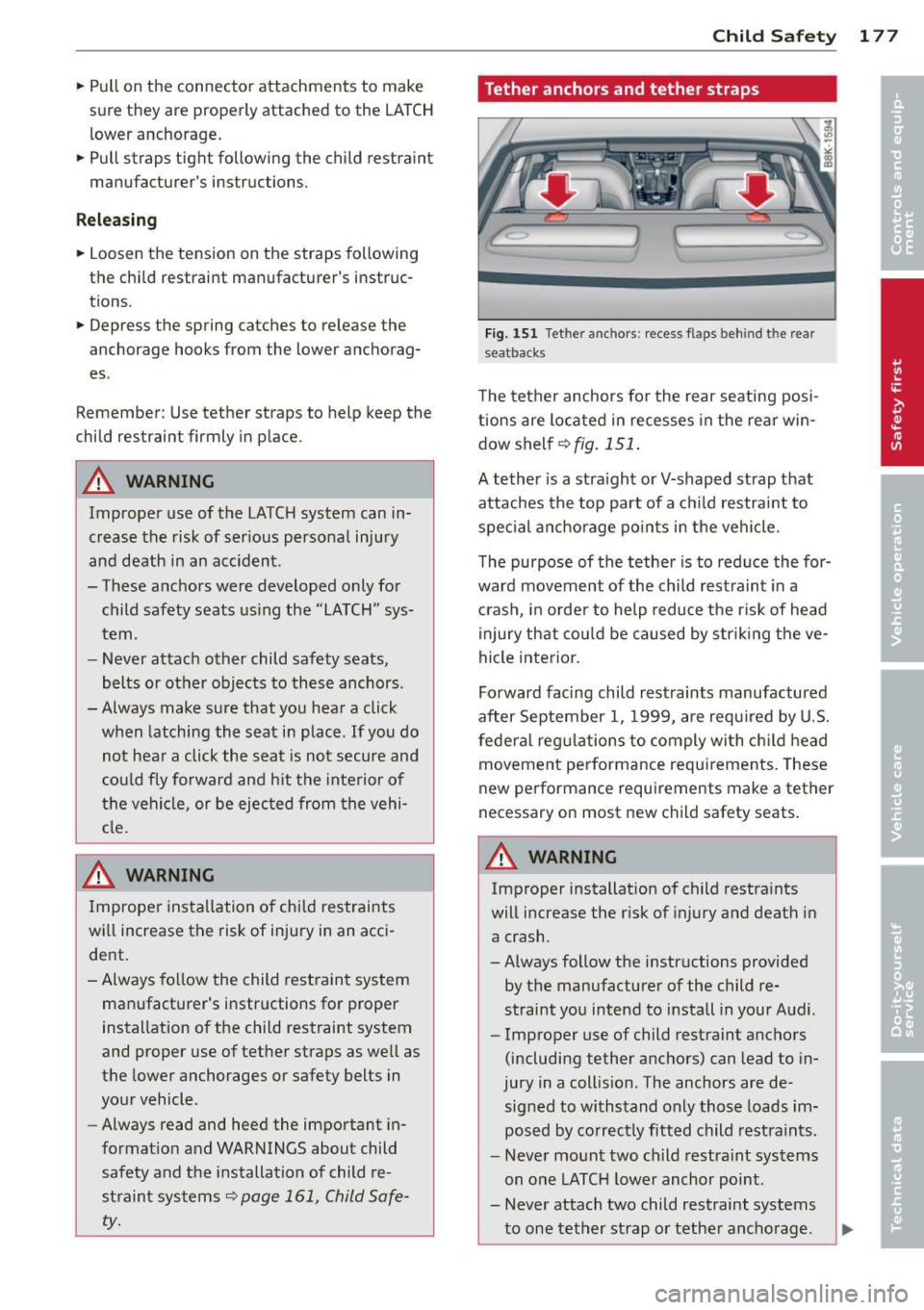
Fig. 151 Tet her anchors: recess flaps behind the rear
seatbacks
T he te ther anchors for the rear seating posi
tions are located in recesses in the rear win
dow shel f¢
fig. 151 .
A tether is a stra ight or V-shaped st rap that
attaches the top par t of a ch ild restrai nt to
special a nchorage po ints in the vehicle.
T he purpose of the tether is to reduce the for
ward movement of the child rest raint in a
c rash, i n orde r to help reduce the risk of head
injury that cou ld be caused by strik ing the ve
hicle inte rior.
Fo rward facing child restraints manufactured
after September 1, 1999, are requ ired by U.S.
federa l reg ulations to comply wi th ch ild head
movement pe rformance requi rements. These
new performance requirements make a tether
necessary on most new child safety seats .
A WARNING
Improper installation of child restra ints
will increase the r isk of injury and death in
a crash.
-Always follow the instr uctions provided
by the manufacturer of the child re
straint you intend to install in your Audi.
- Improper use of child restraint anchors
(including tether anchors) can lead to in
jury in a coll ision. The anchors are de
signed to withstand only those loads im posed by co rrectly fitt ed child restraints.
- Neve r mo unt two child rest ra int systems
on one LATC H lower anchor point.
- Never attach two child restraint systems to one tether strap o r tethe r ancho rage .
-
Page 180 of 286
1 78 Child Safety
-Never attach a tether strap to a tie-down
hook in the luggage compartment .
- Never use child restraint tether ancho
rages to secure safety belts or other
kinds of occupant restraints.
- Never secure or attach any luggage or
other items to the LATCH lower ancho
rages or to the tether anchors.
- If a tether or other strap is used to at
tach a child restraint to the front passen
ger seat, make sure that it is not so
tight, that it causes the weight-sensing
mat to measure more weight than is ac
tually on the seat.
- The heavier weight registered can make
the Advanced Airbag System work as
though an adult were on the seat and de
ploy the Advanced Airbag when it must
be suppressed causing serious or even
fatal injury to the child.
-If you must install a rearward facing
child safety seat on the front passenger
seat because of exceptional circumstan
ces and the
PASSENGER AIR BAG OFF
light does not come on and stay on, im
mediately install the rear-facing child
safety seat in a rear seating position and
have the airbag system inspected by your
authorized Audi dealer.
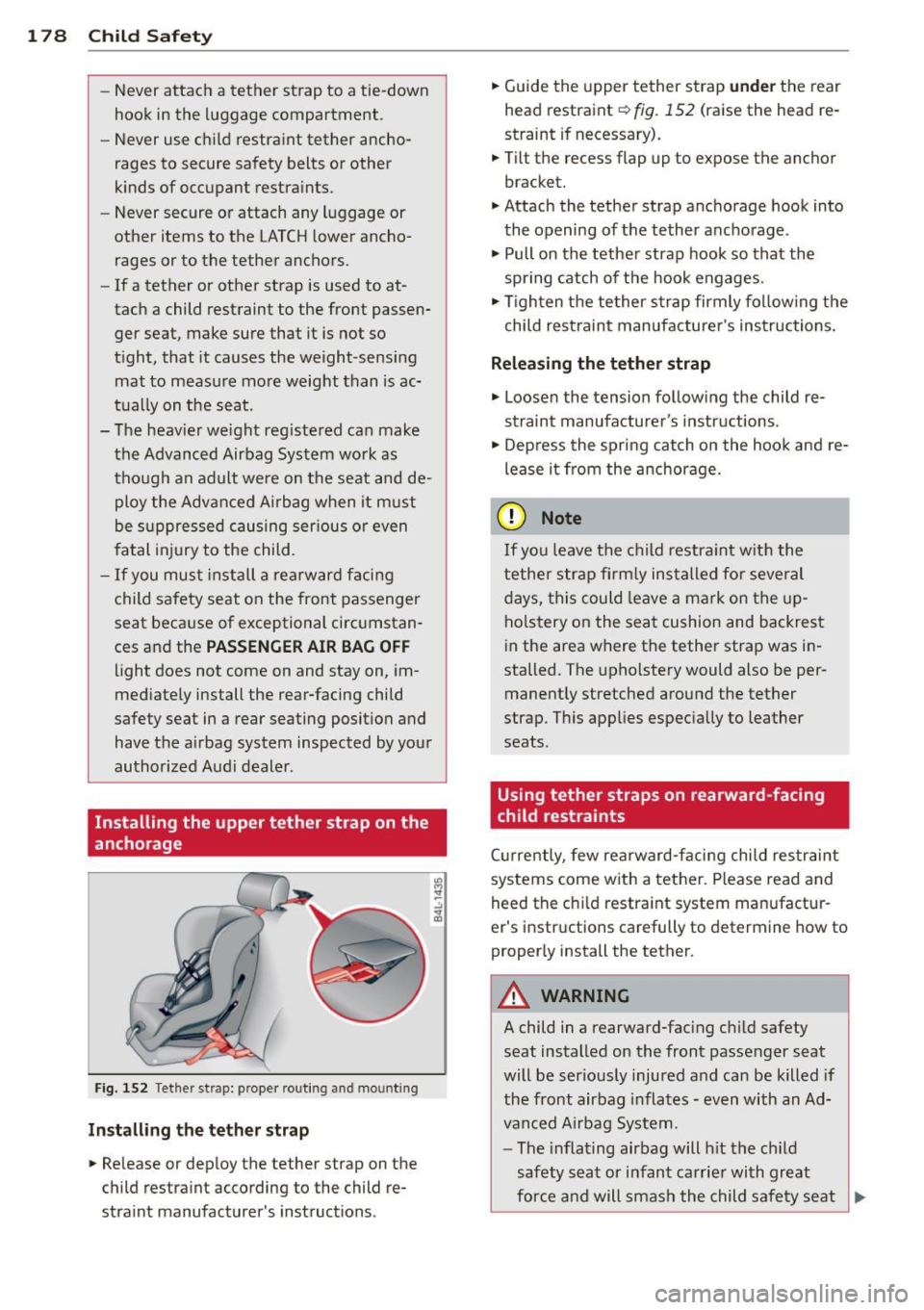
Installing the upper tether strap on the
anchorage
Fig. 1S2 Tethe r strap: prope r routing and mounting
Installing the tether strap
.,. Release or deploy the tether strap on the
child restraint according to the child re
straint manufacturer's instructions. .,.
Guide the upper tether strap
under the rear
head restraint co
fig. 152 (raise the head re
straint if necessary).
.,. Tilt the recess flap up to expose the anchor
bracket.
.,. Attach the tether strap anchorage hook into
the opening of the tether anchorage.
.,. Pull on the tether strap hook so that the
spring catch of the hook engages .
.,. Tighten the tether strap firmly following the
child restraint manufacturer's instructions.
Releasing the tether strap
.,. Loosen the tension following the child re
straint manufacturer's instructions.
.,. Depress the spring catch on the hook and re
lease it from the anchorage.
(D Note
If you leave the child restraint with the
tether strap firmly installed for several
days, this could leave a mark on the up
holstery on the seat cushion and backrest
in the area where the tether strap was in
stalled. The upholstery would also be per
manently stretched around the tether
strap. This applies especially to leather
seats .
Using tether straps on rearward-facing
child restraints
Currently, few rearward-facing child restraint
systems come with a tether. Please read and
heed the child restraint system manufactur
er's instructions carefully to determine how to
properly install the tether .
A WARNING ~ -
A child in a rearward-facing child safety
seat installed on the front passenger seat
will be seriously injured and can be killed if
the front airbag inflates -even with an Ad
vanced Airbag System.
- The inflating airbag will hit the child
safety seat or infant carrier with great
force and will smash the child safety seat ..,.
Page 181 of 286
and child against the backrest, center
armrest, or door .
- A tight tether or other strap on a rear
ward-fac ing c hild restra int attached to
the front passenger seat can put too much pressure on the weight-mat in the
seat and register a heavier weight in the
Advanced Airbag System . T he heav ie r
we ight registe red ca n make th e system
wor k as thoug h an adu lt were on t he seat
and dep loy the A dvanced Airbag when i t
must be suppressed ca using serious or
even fatal injury to the child.
- If you mus t inst all a rearw ard facing
child safety seat on the front passenger
seat because of exceptional circ umstan
ces and the
PASSENGER AIR BAG OFF
light does not come on and stay on, im
med iate ly install the rearward-facing
child safety seat in a rear seat ing pos i
t io n and have the airbag system inspect
ed by you r a uthorized Audi dea le r.
Additional Information
Sources of information about child
restraints and their use
There are a number of sources of additional
information about ch ild restrai nt select ion, in
stallat ion and use:
NHTSA advises that t he best child safety seat
is the one that fits y our child and fits i n your
ve hicle, and that you w ill use correctly and
consis tently.
Try before you buy !
U.S National Highway T raffic Safety Admin
istration
T e l. : 1-888-327-4236 (T TY : 1-800-424-9153)
www.nhtsa.gov
National SAFE KIDS Campaign
Te l.: (202) 662 -0600
www.safekids.o rg
Child Sa fet y 1 79
Safety BeltSafe U.S.A
Tel.: (800) 7 45 -SAFE (English)
T el.: (800) 747-SANO (Span ish)
www.carseat.org
Transport Canada Information Centre
Tel.: 1 -800-333-0371 or ca ll
1 -6 13-998-86 16 if yo u are in the Ottawa a rea
http://www .tc.gc.ca/eng/roadsafety/
menu.htm
Audi Customer Relation s
Tel.: (800) 822-2834
•
•
Page 182 of 286
180 Intellige nt tec hno logy
Intelligent technology
Notice about data
recorded by veh ic le
control modules
Your vehicle is not equipped with an Event Da
ta Recorder (EDR), installed by some manu
facturers fo r the express purpose of capturing
data for retrieval after an accident or crash
event . EDR's are sometimes called "crash re
corders".
Some state laws restrict the retrieval or down
loading of data stored by EDR's that were in
stalled in a vehicle for the express purpose of
retrieving data after an accident or crash
event without the owner's consent.
A lthough your vehicle is not equipped with an
EDR, it is equipped with a number of electron
ic control modules for various vehicle systems
such as, for example, engine function, emis
sion control, as well as for the airbags and
safety belts.
These electronic control modules also record
vehicle-related data during normal vehicle op
eration for diagnostic and repair purposes.
The recording capacity of the electronic con
trol modules is limited to data (no sound is re
corded) and only a small amount of data is ac
tually recorded over a very limited period of
time and stored when a system fault or other
condition is sensed by a control unit. Some of
the data then stored may relate to vehicle
speed, direction, braking as well as restraint
system use and performance in the event of a
crash or other condition. Stored data can only
be read and downloaded with special equip
ment.
Electronic Stab ilization
Control (ESC)
Description
ESC helps to improve road holding and vehicle
dynamics to help reduce the probability of
skidding and loss of vehicle control. It works
only when the engine is running. ESC detects certain difficult driving situations, including
when the vehicle is beginning to spin (yaw)
out of control and helps you to get the vehicle back under control by selectively braking the
wheels, and/or reducing engine power and
providing steering assistance to help hold the
vehicle on the driver's intended course. The in
dicator light
J.i) in the instrument cluster
blinks when ESC is taking action to help you
control the vehicle.
ESC has limitations.
It is important to remem
ber that ESC cannot overcome the laws of
physics. It will not always be able to help out
under a ll cond itions you may come up against.
For example, ESC may not always be able to
help you master situations where there is a
sudden change in the coefficient of friction of
the road surface. When there is a section of dry road that is suddenly covered with water,
slush or snow, ESC cannot perform the same
way it would on the dry surface . If the vehicle
hydroplanes (rides on a cushion of water in
stead of the road surface), ESC will not be
able to help you steer the vehicle because con
tact with the pavement has been interrupted
and the vehicle cannot be braked or steered.
During fast cornering, particularly on winding
roads, ESC cannot always deal as effectively
with difficult driving situations than at lower
speeds. When towing a trailer, ESC is not able
to help you regain control as it would if you
were not towing a trailer.
Always adjust your speed and driving style to road, traffic and weather conditions. ESC can
not override the vehicle's physical limits, in
crease the available traction, or keep a vehicle
on the road if road departure is a result of
driver inattent ion. Instead, ESC improves the
possibility of keeping the vehicle under con
trol and on the road during extreme maneu
vers by using the driver's steering inputs to
help keep the vehicle going in the intended di
rection . If you are traveling at a speed that
causes you to run off the road before ESC can
provide any assistance, you may not experi
ence the benefits of ESC.
Page 200 of 286
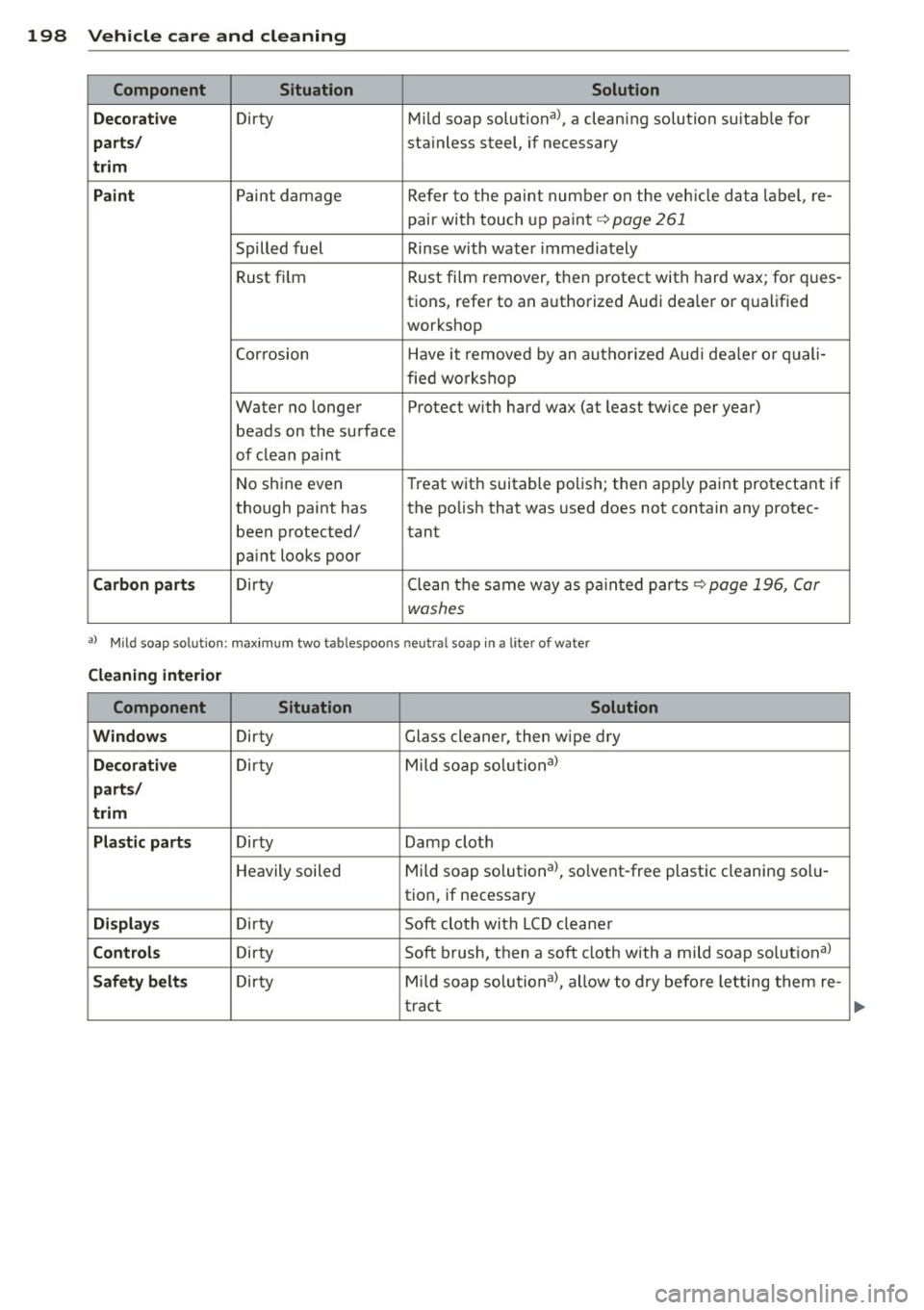
198 Vehicle care and cleaning
Component Situation Solution
Decorative
Dirty Mild soap solutional, a cleaning solution suitab le for
parts/ sta inless steel, if necessary
trim
Paint
Paint damage Refer to the paint number on the vehicle data label, re-
pair with touch up paint
q page 261
Spilled fuel Rinse with water immediately
Rust film Rust
film remover, then protect with hard wax; for ques-
tions, refer to an authorized Audi dea ler or qualified
workshop
Corrosion Have it removed by an autho rized Aud i dealer or quali-
fied workshop
Water no longer Protect with hard wax (at least twice per year)
beads on the surface
of clean paint
No shine even T
reat with suitable polish; then app ly paint protectant if
though paint has the polish that was used does not contain any protec-
been protected/
tant
pa int looks poor
Carbon parts Dirty Clean tlhe same way as painted parts qpage 196, Car
washes
a ) Mild soap so lution: maximum two tablespoons neut ra l soap in a lite r of water
Cleaning interior
Component Situation Solution
Windows
Dirty Glass cleaner, then wipe dry
Decorative Dirty Mild
soap solutional
parts/
trim
Plastic parts
Dirty Damp cloth
Heavily soiled Mild soap solutional, solvent-free plastic cleaning solu-
tion, if necessary
Displays Dirty Soft cloth with LCD cleaner
Controls Dirty Soft brush, then a soft cloth with a mild soap solutional
Safety belts Dirty Mild soap solutional, allow to dry befo re letting them re-
tract
...
Page 202 of 286
200 Vehicle care and cleaning
- Never use abrasive cleaning materials
or alcohol to clean the camera lens.
T his could cause scratches and cracks.
- Windows
- Remove snow and ice on windows and
exterior mirrors with a plastic scraper.
To avoid scratches, move the scraper only in one direction and not back and
forth.
- Never remove snow or ice from win
dows and mirrors using warm or hot
water because this could cause cracks
to form .
- To avoid damage to the rear window
defogger, do not apply any stickers on
the heating wires on the inside of the
window.
- Decorative parts/trim
- Never use chrome care or cleaning
products.
- Paint
-To reduce the risk of scratches, the ve-
hicle must be free of dirt and dust be
fore polishing or waxing.
- To prevent paint damage, do not polish
or wax the vehicle in direct sunlight.
- To reduce the risk of paint damage, do
not polish away rust film .
-Displays
- To avoid scratches, do not use dry
cleaning methods on displays.
- Controls
- Make sure that no fluids enter the con-
trols, because this could cause dam
age.
-Safety belts
- Do not remove the safety belts to clean
them.
- Never clean safety belts or their com
ponents chemically or with corrosive
fluids or solvents and never allow sharp objects to come into contact
with the safety belts. This could cause damage to the belt webbing.
- If there is damage to the webbing , the
connections, the retractors or the buck- Les,
have them replaced by an author
ized Audi dealer or qualified workshop.
- Textiles/Vinyl/Alcantara
- Never treat Vinyl/ Alcantara with leath-
er care products, solvents, floor polish,
shoe polish, stain remover or similar products .
- To avoid damage, have stubborn stains
removed by an authorized Audi dealer
or qualified workshop .
- Never use steam cleaners, brushes, hard sponges, etc. when cleaning .
- Do not turn on the seat heating* to dry
the seat.
- Objects with sharp edges such as zip
pers, rivets on clothing or belts can
cause damage to the surface .
- Open hook and loop fasteners, for ex
ample on clothing, can damage seat
covers. Make sure hook and loop fas
teners are closed .
-Natural leather
- Never treat leather with solvents, floor
polish, shoe polish, stain remover or
similar products.
- Objects with sharp edges such as zip pers, rivets on clothing or belts can
cause damage to the surface.
- Never use steam cleaners, brushes,
hard sponges, etc. when cleaning.
- Do not turn on the seat heating* to dry
the seat.
- To help prevent the leather from fad
ing, do not leave the vehicle in direct
sunlight for long periods of time. If leaving the vehicle parked for long pe
riods of time, you should cover the
leather to protect it from direct sun
light .
(D Tips
-Insects are easier to remove from paint
that has been freshly waxed.
- Regular waxing can prevent rust film from forming.
Page 217 of 286
Do not fill coolant above the "MAX" mark. Ex
cess coolant will be forced out through the pressure relief valve in the cap when the en
gine becomes hot .
_& WARNING
-The cooling system is under pressure and
can get very hot. Reduce the risk of
scalding from hot coolant by following
these steps .
- Turn
off the engine and allow itto cool
down.
- Protect your face, hands and arms from escaping fluid and steam by covering
the cap with a large, thick rag.
- Turn the cap slowly and very carefully in a counter-clockwise direction while
applying light, downward pressure on
the top of the cap .
- To avoid being burned, do not spill an
tifreeze or coolant on the exhaust sys
tem or hot engine parts . Under certain
conditions, the ethylene glycol in en
gine coolant can catch fire.
- Antifreeze is poisonous. Always store an
tifreeze in its original container and well
out of the reach of children.
- If you drain the coolant, it must be
caught and safely stored in a proper con
tainer clearly marked "poison".
(D Note
- Do not add coolant if the expansion tank
is empty. Air could enter the cooling sys
tem and damage the engine. If this is
the case, do not continue driving . Seek
professional assistance.
- Coolant pollutes the environment and
could cause an engine fire . Excess cool
ant will be forced out through the pres
sure relief valve in the cap when the en
gine becomes hot.
- If, in an emergency, only water can be
added, the correct ratio between water
and antifreeze
¢ page 213 must be re
stored as soon as possible.
Checking and filling 215
'
@) For the sake of the environment
Drained coolant should not be reused. Al
ways dispose of used coolant while observ
ing all environmental regulations.
Radiator fan
The radiator fan switches on automatically by
itself .
The radiator fan is driven by the engine via the
V-belt. The viscous clutch regulates the speed
of the fan according to the temperature of the coolant.
An auxiliary electric radiator fan* switches on
and
off depending on coolant temperature
and other vehicle operating conditions.
After you switch the engine
off, the auxiliary
fan can continue running for up to 10 minutes
- even with the ignition
off. It can even switch
on again later by itself ¢.&. , if
- the temperature of the engine coolant rises
du e to the h eat build-up from th e engin e in
the engine compartment, or
- the engine compartment heats up because
the vehicle is parked in intense sunlight.
_& WARNING ~
-To reduce the risk of personal injury nev-
er touch the radiator fan .
- The auxiliary electric fan is temperature
controlled and can switch on suddenly
even when the engine is not running.
- The auxiliary radiator fan switches on au
tomatically when the engine coolant reaches a certain temperature and will
continue to run until the coolant temper
ature drops. •
•
Page 232 of 286
230 Tire s and wheel s
the function of the tire pressure monitor
ing system*.
- Always inflate tires to the recommended
and correct tire pressure before driving
off.
- Driv ing with under inflated tires bend
more, letting them get too hot resu lting
in tread separation, sudden t ire fail ure
and loss of control.
- Excess ive speed and/overloading can
cause heat bui ld-up, sudden t ire failure
and loss of control.
- If the t ire pressure is too low or too high,
the tires w ill wear prematurely and the
vehicle will not hand le we ll.
- If the t i re is not flat and you do not have
to change a wheel immed iate ly, dr ive at
reduced speed to the nearest service sta
t ion to check the tire pressure a nd add
air as required.
0 Note
Dr iving without va lve stem caps can cause
damage to the t ire va lves . To prevent this,
always ma ke sure that facto ry installed
valve stem caps on all wheels a re secu re ly
mou nte d on the valve.
@) For the sake of the environment
Unde rinflated tires will a lso inc reas e the
fue l cons umption .
Tires and vehicle load limits
There are limits to the amo unt of load or
weight that any vehicle and any t ire can carry .
A vehicle that is overloaded w ill not handle
well and is more difficult to stop. Overloading
can not only lead to loss of vehicle contro l,
but c an also damage import ant parts of the
vehicle and can lead to sudde n tire failure, in
cluding a blowout and sudden deflation that
can cause t he veh icle to crash .
Your safety and that of your passengers a lso
depends on making sure that load limits are
not exceeded . Vehicle load includes everybody
and everyth ing in and on the vehicle. These load lim
its are technically referred to as the
vehicle's
Gro ss Vehicle Weight R ating
("GVWR").
T he "GVWR" includes t he weight of the basic
vehicle , a ll f actory installed accessories, a f ull
tank of fuel, oi l, coo lant and other f luids plus
maximum load. The max imum load incl udes
the number of passengers that the vehicle is
intended to carry ("seat ing capac ity ") wi th an
assumed we ight of 150 lbs . (68 kg) for each
passenger at a designated seating posit ion
and the total weight of a ny luggage in the ve
hicle. If you tow a trai le r, the we ight of the
t ra ile r hi tc h and the tongue we ight of the
l oaded tra iler mus t be include d as part of the
vehicle load .
T he
Gro ss Ax le Weight Rating ("GAWR ") is
the max imum load that can be applied a t each
of the veh icle's two axles .
T he Gross Vehicle Weight Rat ing and the
G ross Ax le Weig ht Ra ting are listed on the
sa fety comp lian ce s ticke r label loca ted on the
driver's side B-pillar. Yo ur Audi has 4 seat ing
pos itions , 2 in the front and 2 in the rea r fo r
total seati ng capacity of 4. Each seating posi
t ion has a seat belt c:>
page 129, Safety belts.
T he fact that there is an upper limit to yo ur
vehicle's Gross Vehicle Weight Rating means
t h at the total weight of whatever is being car
ried in the vehicle ( includ ing the weight of a
trailer hitch and the tongue weight of the
loaded tra iler) is lim ited. The more passen
gers in the vehicle or passengers who are
heavier tha n the sta ndard we igh ts assumed
mean that less we ight can be carried as lug
gage.
The tire pressure label o n your Aud i also lists
the max imum combi ned weig ht of all of the
occupants and luggage or other cargo that
t h e vehi cle can carry . Fo r th e lo ca tion of the
l a bel c:>page 226,
fig.168.
8_ WARNING
<=
Over loading a vehicle can cause loss o f ve -
hicl e co ntro l, a c rash or other accident, se-
rious personal injury, and even death. .,.
Page 268 of 286
26 6 Con sum er Inf ormation
-Always make sure the transmission se
lector lever (automatic transmiss ion) is
in "P" (Park position) or Neutral (manual
transmission) and the park brake is firm
ly applied.
@) For the s ake of the environment
-Changing the engine settings will ad
versely affect emission levels. This is det
rimental to the environment and increas
es fuel consumption .
- Always observe environmental regula
tions when disposing of old engine oil,
used brake fluid, dirty engine coolant,
spent batteries or worn out tires.
- Undeployed airbag modules and preten
s ioners might be classified as Perchlo
rate Material -spec ial handling may ap
ply, see www.dtsc.ca .gov/hazardous
waste/perch lorate. When the veh icle or
parts of the restraint system including
airbag modules safety belts with preten
sioners are scrapped, all app licable laws
and regulations must be observed . Your
authorized Audi dealer is familiar with
these requirements and we recommend
that you have your dealer perform this
serv ice for you .
Additional accessories,
modifications and
parts replacement
Additional accessories and parts
replacement
Always consult on authorized Audi dealer be
fore purchasing accessories.
Your veh icle inco rporates the latest safety de
sign featu res ensuring a high standard of ac
tive and passive safety.
This safety could be compromised by non-ap
proved changes to the veh icle. For this reason ,
if pa rts have to be replaced , please observe
the following points when installing addition
a l accessories: Approved Audi accessories and genuine Audi
parts are available from authorized Audi deal
er.
T hese dea lers a lso have the necessary facili
ties, tools and trained specialists to install the parts and acc essories proper ly.
A WARNING
-Using the wrong spare parts or using non-
approved accessories can cause damage to
the veh icle and ser ious personal injury.
- Use on ly accessories expressly approved
by Audi and genuine Audi spare parts
- These parts and accessories have been
specially designed to be used on your ve
h icle .
- Never install accessories such as tele
phone crad les or beverage ho lders on a ir
bag covers or within the airbag deploy
ment zones . Do ing so will increase the
risk of injury if a irbags are triggered in an
accident!
- Before you check anything in the engine
compa rtment, always read and heed a ll
WARNINGS
9 page 206 .
(D Note
-If items other than genu ine Audi spare
parts, add-on equipment and accessory
items are used or if repair work is not
performed accord ing to specified meth
ods, this can resu lt in seve re damage to
your vehicle's eng ine and body (such as
corrosion) and adversely affect yo ur vehi
cle's warranty .
- If emergency repairs must be performed
elsewhere, have the vehicle examined by
an authorized Audi dealer as soon as
possible .
- The manufacturer cannot be held liable
for damage wh ich occ urs due to failure
to comply with these stipu lations.
Page 273 of 286
Child restraints
Dang er of using chi ld rest raints in th e
front seat . . . . . . . . . . . . . . . . . . . . . . . . 138
Where can I get addit ional information
about child restra ints and their use? . . 179
Ch ild restra int system anchors ... .. .. . 175
Ch ild safety .. ................ ... ... 161
Convertible locking retracto r . . . . . . . . . 17 1
I mportant safety instr uctions fo r using
ch ild safety seats ......... .. .. .. .. . 164
I mportant things to know when dr iv ing
with chi ld ren .... ..... ... .. .. .. ... 161
Instal ling a chi ld restraint using the
LATCH system ............ .... .. .. . 176
Lower anchorages ........ .. .. .. .. . 176
Mounti ng and releasing the anchorage
hook .. .. ... ............. ...... .. 176
Tether anchors . . . . . . . . . . . . . . . . . . . . 177
Tet her st raps . . . . . . . . . . . . . . . . . . . . . 177
Ch ild safety seats .......... .... .. .. . 167
Booster seats . ... .. ... ... .. .. .. ... 169
Convertible c hild seats .. ..... .... .. 168
Conver tible locking retracto r .. .. ... .. 171
D anger of using c hild restra ints in the
fro nt sea t .. ............. .... .. .. . 138
H ow do I properly ins tall a child s afety
seat in my vehicle? ..... ... .. .. .. .. . 164
Infant seats . .. .. ..... ... .. .. .. ... 167
Install ing .... .. .. .... ... .. .. .... . 17 1
LATCH system . . . . . . . . . . . . . . . . . . . . . 176
Safety instructions ........ .. .. .. .. . 164
Unused safety belts on the rear seat .. 166
Cigarette lig hter . . . . . . . . . . . . . . . . . . . . . 59
Clea ning .. .. .. ........... .. .. .. ... 196
Climate controls . . . . . . . . . . . . . . . . . . . . . 67
Climate con trol sys tem
Automatic recirculation . . . . . . . . . . . . . . 70
Supp lementary heater .. ... .. .. .. .. .. 70
synchron izing . ........... .. .. .. .... 70
C lo ck . .. .. .. .... ............. .. .. .. 12
Closing Panoramic tilt ing s unroof ...... . ... .. 4 1
P owe r windows . .......... ... ... ... 40
Sun blind .. ............. .... .. .... 41
Closing/open ing
at the lock cylinder ............ ... ... 37
by remote cont ro l ........... .. .... . 35
Inde x 271
with t he centra l locking sw itch ... .. .. . 36
with the conve nience key ..... ... .. .. . 36
Cold tire infla tion p ress ure ............ 226
Coming home . .. .. ................. .
44
Compact spa re tire ... . ... .... ... .. .. 24 3
also refer to Spare tire .. ..... ... .. .. 243
Compartments . . . . . . . . . . . . . . . . . . . . . . 60
Compass in the m irror ............... . 51
Compliance . .. .. .. ................. 267
Consumer Informat ion . . . . . . . . . . 127, 264
Co ntacting NHTSA ... . ... .... ... .. .. 127
Cont rols
Cleaning .. .. .. .. .... ........... .. 198
Convenience key Ind icator lig hts .. .. . .. .. .. ... ... .. . 75
Starting engi ne (S TART E NGINE STOP
bu tton) . .. .. .. .. .. . .............. . 74
Stoppi ng the eng ine (STAR T ENG INE
STOP b utton) . ... .. .. .. ...... ... .. . 75
Switching on ignition . .. ..... ... .. .. . 74
u nlocking/loc king . .. ... .... ... .. .. . 36
Convenie nce opening/clos ing
Convertib le child safety seats
Conve rtib le locking retractor 40
168
Activating ... .... .. . .. .. ..... ... .. 173
Deactivating ... .... . ... ...... ... .. 173
Using to secure a child sa fety seat 1.71, 173
Cool ant system .. .. ............... .. 213
Cooling mode (automat ic climate control) 68
Cooling System Expansion tank . .. .. ............... 213
Corner ing l igh t .. ...... ........... .. . 43
Cruise contro l
Changi ng speed .................. .. 80
Presett ing your speed ............. .. 81
Switch ing off .. .. .... ........... .. . 81
Swi tching on . .. .. .. ............... . 80
Cruising range . .. .. ... ... ...... ..... . 2S
( upholder . ... .... .. . .. .. ..... ... .. . 59
D
Dat a recorde r . . . . . . . . . . . . . . . . . . . . . . 180
Date d isp lay ...... .. ..... ........... 12
Daytime running lights. . . . . . . . . . . . 43 , 44
•
•