ignition AUDI A5 COUPE 2014 Repair Manual
[x] Cancel search | Manufacturer: AUDI, Model Year: 2014, Model line: A5 COUPE, Model: AUDI A5 COUPE 2014Pages: 286, PDF Size: 70.99 MB
Page 168 of 286
166 Child Safet y
range, and as far away from the airbag
as possible before installing the child
restra int.
- Always make sure that nothing pre
vents the front passenger's seat from be ing moved to the rearmost position
in its fore and aft adjustment range.
- Always make sure that the backrest is
in the upright position .
- Always buck le the child safety seat firmly
in place even if a child is not s itting in it.
A loose ch ild safety seat can fly around
dur ing a sudden stop or in a coll is ion.
- Always read and heed all WARNINGS
whenever using a child restrained in ave
hicle is being used
c::> page 129, Safety
belts, c::>page 137, Airbag system
and
c::> page 161, Child Safety.
.,&. WARNING
To reduce the risk of serious injury, make
sure that the
PAS SENGER AIR B AG OFF
light comes on and stays on whenever a
child restraint is installed on the front pas
senger seat and the ignition is switched
on.
- Take the child rest raint off the front pas
senger seat and install it proper ly at one
of the rear seat positions if the
PASSEN
GER AIR BAG OFF
light does not stay on.
- Have the airbag system inspected by
your authorized Audi dealer immediate
ly.
Secure unused safety belts on the rear
seat
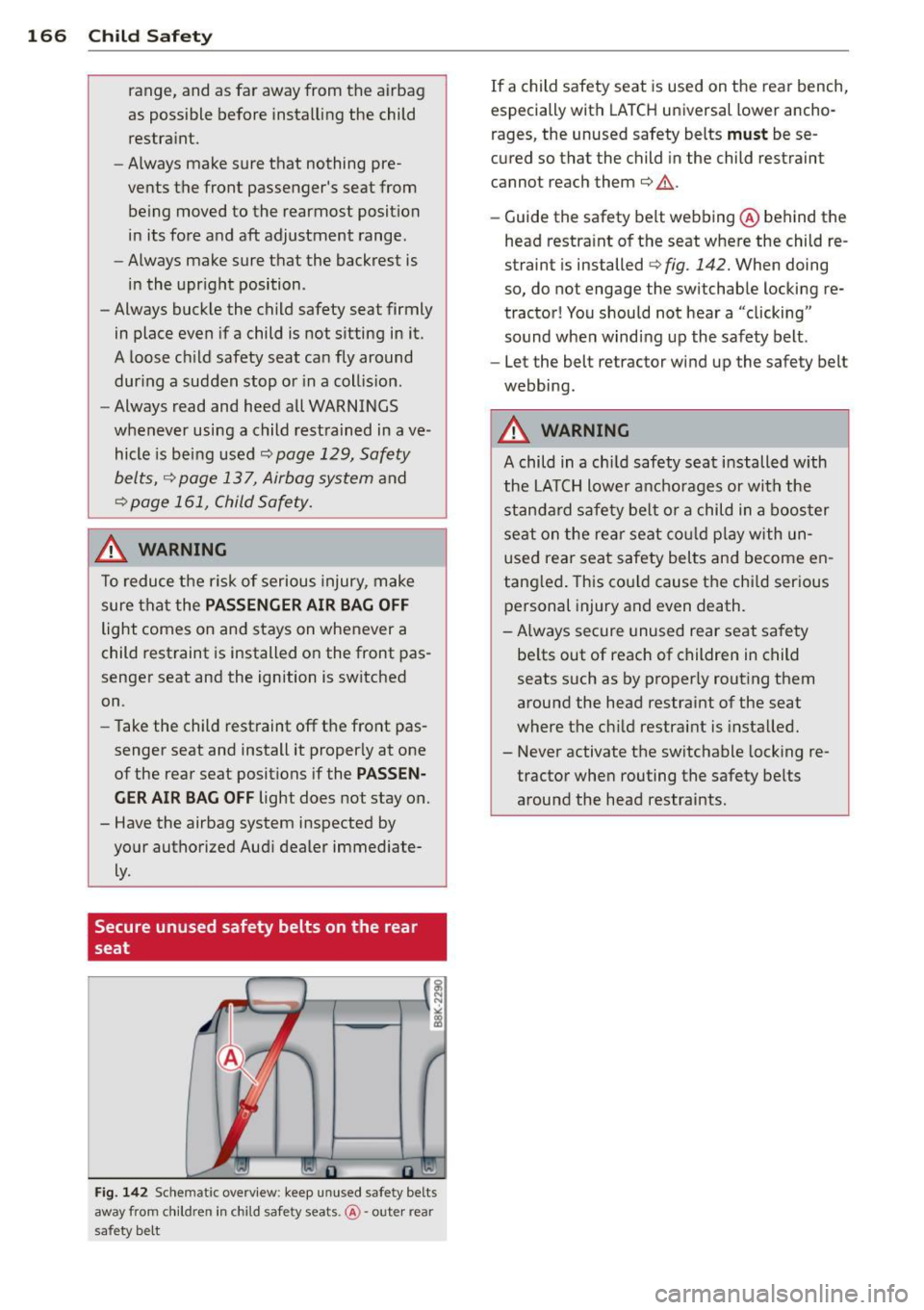
Fig. 1 42 Schematic overview: keep unused safety belts
away from chil dren in child safety seats. @· outer rear
sa fety be lt
.
If a child safety seat is used on the rear bench,
especially with LATCH universal lower ancho
rages, the unused safety belts
must be se
cured so that the child in the child restraint
cannot reach them
c::> &.
-Guide the safety belt webbing @ behind the
head restra int of the seat where the child re
straint is installed
c::> fig . 142. When doing
so, do not engage the switchable locking re
tractor! You should not hear a "clicking"
sound when winding up the safety belt.
- Let the belt retractor wind up the safety belt
webbing.
.,&. WARNING
-A child in a chi ld safety seat installed with
the LA TCH lower a nchorages or with the
standard safety be lt or a child in a boos ter
seat on the rear seat co uld p lay with un
used rear seat safety belts and become en
tang led . This co uld cause the chi ld ser ious
personal injury and even death.
-Always secure unused rear seat sa fety
be lts out of reach of children in child
seats such as by proper ly routing them
around the head restraint of the seat
where the ch ild restraint is installed.
- Never activate the switchable locking re
tractor when routing the safety belts
around the head restraints.
Page 171 of 286
to the backrest on the veh icle seat. Ad
just or remove the rear seat head restraint if it is diff icult to install t he
child seat w ith the head restraint in place
¢ page 57. Install the head restraint
again immed iate ly once the child seat is
removed. Driving without head rest raints
o r with he ad restraints that are not prop
erly adjusted increases the risk of serious
or fatal neck injury dramatica lly.
- Always read and heed all WARN INGS
whenever using a child rest rained in ave
hicle is being used
¢page 129, Safety
belts,
¢ page 13 7, Airbag system and
¢ page 161, Important things to know.
A WARNING
If except ional circumstances requ ire the
use of a forward-facing child restra int on
the front passenger's seat, the ch ild's safe
ty and well-being require that the follow
ing special precautions be taken:
- Make sure the forward-fac ing seat has
been designed and certified by its manu
factur er for use on a front seat with a
passenge r fron t and side airbag.
- Always follow the manufact urer's in
st ruct ions provided with the child safety
sea t or infan t carrier.
- Always mov e the front passenge r sea t in
to the rearmost posit io n of the passen
ger seat's fore and aft ad justment r ange,
and as far away from the airbag as possi
ble before instal ling the child restraint.
- Always make sure that noth ing prevents
the front passenger's seat from bei ng
moved to the rearmost position in its
fore and aft adjustment range .
- Always make sure the backrest is in an upr ight position.
- Make su re that the
PASSENGER AIR BAG
OFF
light comes on and stays on all the
time whenever the ignition is switched
on.
- If the light does not stay on, perform the
checks¢
page 147, Monitoring the Ad
vanced Airbag System.
-
Child S afety 169
- Ta ke the chi ld restraint
off the front pas
senger seat and install it properly at one
of the rear seat positions if the
PASSEN
G ER AIR BAG OFF
light does not stay on
whenever the ignit ion is switched on.
Booster seats and safety belts
Properly used booster seats con help protect
children weighing between about 40 lbs. and
80 lbs . (18 kg and 36 kg) who are less than 4
ft.
9 in . (57 inches/1 .45 meters) tall.
In .... N 0 ±
~
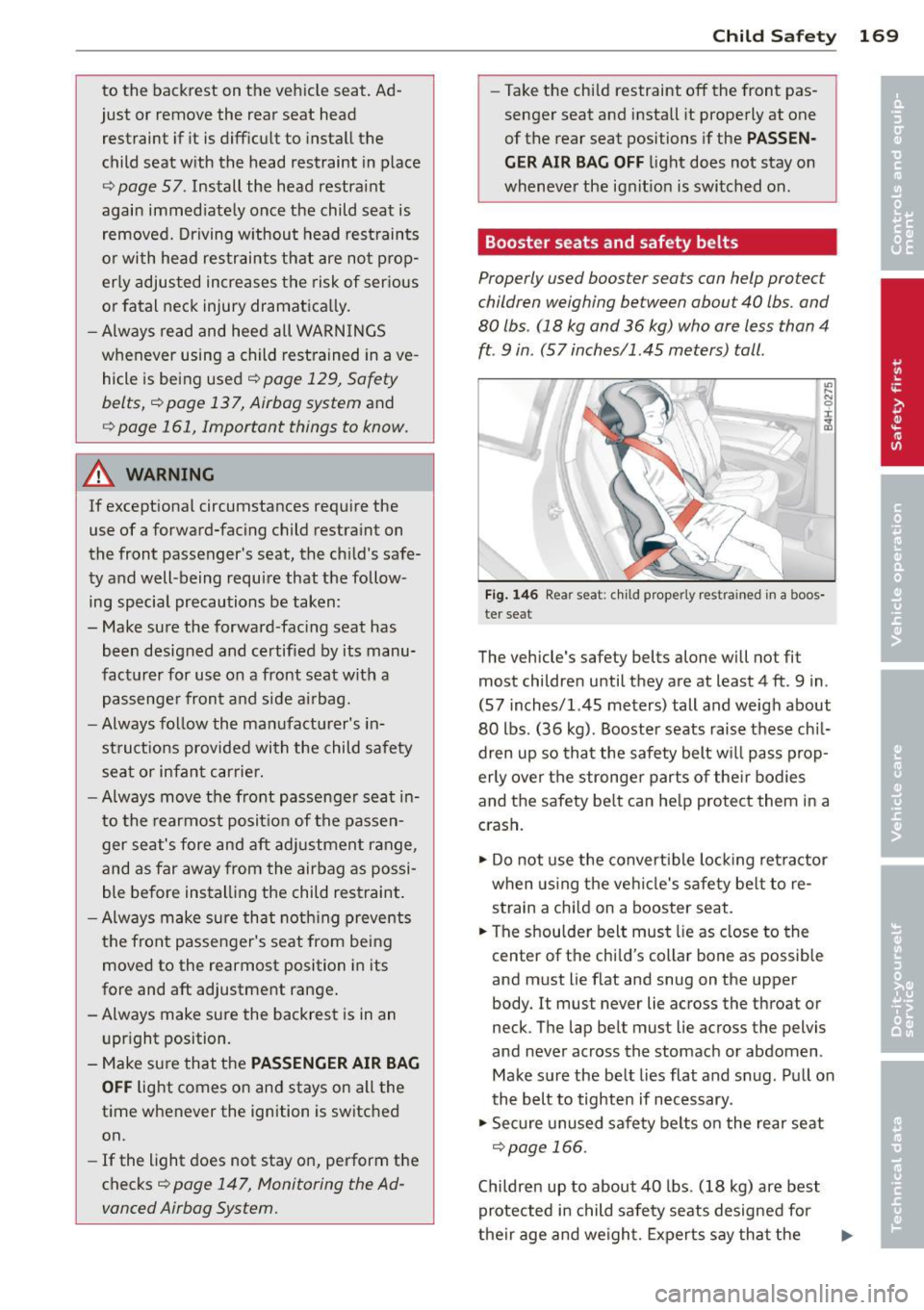
Fi g. 14 6 Rear seat: ch ild properly res trained in a boos
ter seat
The vehicle's safety belts alone w ill not fit
most children until they are at least 4
ft. 9 in .
(57 inches/1.45 me ters) tall and weigh about
80 lbs .
(36 kg). Booster seats rais e these chi l
dren up so tha t the safety belt w ill pass p rop
erly over the stronger parts of the ir bodies
and the safety be lt can he lp protect them in a
crash.
.,. Do not use the convert ible lo cki ng ret ra ctor
when using the ve hicl e's s afety be lt to re
s train a ch ild on a booster seat.
... The shoulde r belt must lie as close to the
center of the ch ild's collar bone as possible
and must lie flat and snug on the upper
body. It must never lie across the throat or
neck . The lap be lt must lie across the pelvis
and never across the stomac h or abdomen .
Make s ure the belt lies flat and sn ug. Pull on
th e belt to tighten if necessary.
.,. Se cure unused safety belts o n the rear seat
¢page 166.
Children up to about 40 lbs . (18 kg) are best
protected in child safe ty seats designed for
their age and we igh t. Experts say th at the
Page 173 of 286
-Never let a child ride in the cargo area of
your vehicle.
- Always remember that a chi ld leaning
forward, sitting sideways or out of posi
t ion in any way during an acc ident can be
struck by a deploying airbag. This will re
sult in serious personal injury or death.
- If you must install a booster seat on the
front passenger seat because of excep
t ional circumstances the
PASSENGER
AIR BAG OFF
light must come on and
stay on, whenever the ignition is switch
ed on.
- If the
PASSENGER AIR BAG OFF light
does not come on and stay on, perform
the checks described
¢ page 147, Moni
toring the Advanced Airbag System.
- Ta ke the child rest rain t off the fron t pas
senger seat and ins tall it proper ly a t one
of the rear seat posi tions if the
PASSEN
GER AIR BAG OFF
light does not stay on
whenever the ignition is switched on .
- Always read and heed all WARNINGS
whenever using a child restrained in ave
hicle is being used
¢page 129, Safety
belts,¢ page 137, Airbag system
and
¢ page 161, Important things to know.
Installing a child safety
seat
Securing a child safety seat using a
safety belt
Safety belts for the rear seats and the front
passenger's seat can be locked with the con
vertible locking retractor to properly secure
child safety seats .
The safety belts emergency lock ing retractors
for the rear seats safety belts and for the
fro nt passenger's seat safety belt have a con
vertible locking retracto r fo r child restra ints .
The safety belt must be locked so that belt
webbi ng cannot unreel. The retracto r can be
activ ated to lock t he safety be lt and p revent
t he safe ty belt webbing from loosening up
d uring normal driving . A child sa fety seat can
only be properly installed when the safety belt
Child Sa fet y 1 71
is loc ked so that the chi ld and child sa fety
seat wi ll stay in place.
A lw ays remember: Even tho ugh yo ur vehicle is
equipped with an Advanced Airbag system, all
c hi ldren, especially those 12 years and young
er, sho uld always ride in the back seat prope r
l y restrained for the ir age and we ight .
A WARNING
Imp roperly installed chi ld safety seats in
crease the risk of serious personal injury
and deat h in a co llision.
- Always make sure that the safety belt re
tracto r is locked when insta lling a child
safety seat. An unlocked safety belt re
trac to r cannot hold the child safety seat
in place dur ing norma l dr iving o r in a
crash.
- Always buckle the child safety seat firmly
in place even if a ch ild i s not si tt ing in it.
A loose child safe ty seat can fly aroun d
du ring a sudden stop or in a collision.
- If the backrest is not securely la tched,
the child and the child re5traint will be
thrown forward togethe r with the bac k
rest and will strike parts of the vehicle
interior. The child can be se riously in
jured or killed.
- Never install rearwa rd-facing child safety
seats or infant ca rrie rs on the front pas
senger seat. A child will be serio usly in
jured and can be killed when the passen
ge r airbag inflates .
- The inflating airbag will h it the ch ild
safety seat or infant carrie r with great
force and will smash the child safety seat and child against the bac krest, center
armrest, doo r or roof.
- Always install rearward-facing chi ld safe
ty seats or infant carriers on the rea r
s eat .
- Forwa rd-facing child safety seats o r in
fa nt car riers installed on the front pas
s enger's seat may in terfere with the de
ployme nt of t he ai rb ag and cause serious
in jury to the child. ..,_ •
•
Page 174 of 286
172 Child Safety
-It is safer to install a forward-facing
child safety seat on the rear seat.
- Always read and heed all WARNINGS
whenever using a child restrained in ave
hicle is being used
c::;, page 161. Special
precautions apply when installing a child
safety seat on the front passenger seat
c::;, page 138, Child restraints on the front
seat -some important things to know.
A WARNING
Always take special precautions if you
must install a forward or rearward-facing
child restraint on the front passenger's
seat in exceptional situations:
- Whenever a forward or rearward-facing
child restraint is installed on the front
passenger seat, the
PASSENGER AIR
BAG OFF
light must come on and stay on
whenever the ignition is switched on.
- If the
PASSENGER AIR BAG OFF light
does not come on and stay on, perform
the checks described
c::;, page 147, Moni
toring the Advanced Airbag System.
- Take the child restraint off the front pas
senger seat and install it properly at one
of the rear seat positions if the
PASSEN
GER AIR BAG OFF
light does not stay on
whenever the ignition is switched on .
- Improper installation of child restraints
can reduce their effectiveness or even
prevent them from providing any protec
tion.
- An improperly installed child restraint
can interfere with the airbag as it de
ploys and seriously injure or even kill the
child.
- Always carefully follow the manufactur
er's instructions provided with the child
safety seat or carrier.
- Never place additional items on the seat
that can increase the total weight regis
tered by the weight-sensing mat and can
cause injury in a crash.
A WARNING
Forward-facing child restraints: -
Always make sure the forward-facing
seat has been designed and certified by
its manufacturer for use on a front seat
with a passenger front and side airbag .
- Never put the forward-facing child re
straint up, against or very near the in
strument panel.
- Always move the passenger seat into its
rearmost position in the seat's fore and
aft adjustment range, as far away from
the airbag as possible before installing
the forward-facing child restraint. The
backrest must be adjusted to an upright
position.
- Make sure that the
PASSENGER AIR BAG
OFF
light comes on and stays on all the
time whenever the ignition is switched
on.
A WARNING ~
Rearward-facing child restraints:
- A child in a rearward-facing child safety
seat installed on the front passenger
seat will be seriously injured and can be
killed if the front airbag inflates - even
with an Advanced Airbag System.
- The inflating airbag will hit the child
safety seat or infant carrier with great
force and will smash the child safety seat
and child against the backrest, center
armrest, door or roof.
- Always be especially careful if you must
install a rearward facing child safety seat
on the front passenger seat in exception
al circumstances .
- A tight tether strap on a rearward -facing
child restraint attached to the front pas
senger seat can put too much pressure
on the weight-mat in the seat and regis
ter a heavier weight in the Advanced Air
bag System. The heavier weight regis
tered can make the system work as
though an adult were on the seat and de
ploy the Advanced Airbag when it must
be suppressed causing serious or even
fatal injury to the child.
Page 175 of 286
-Make sure that the PASSENGER AIR BAG
OFF
light comes on and stays on all the
time whenever the ignition is switched on.
- If the
PASSENGER AIR BAG OFF light
does not come on and stay on, immedi
ately install the rearward -facing child
safety seat in a rear seating position and
have the airbag system inspected by your
authorized Audi dealer.
Activating the convertible locking retractor
Use the convertible locking retractor to se
cure a child restraint .
Always heed the child safety seat manufactur
er's instructions when installing a child re
straint in your vehicle. To activate the conver
tible locking retractor :
.,. Place the child restraint on a seat, prefera
bly on the rear seat.
.,. Slowly pull the belt
all the way out.
.,. Route it around or through the child re
straint belt path¢.&_ .
.,. Push the child safety seat down with your
full weight to get the safety belt really tight.
.,. Inser t the belt tongue into the buckle for
that sea ting position .
.,. Guide the safety belt back into the retractor
until the belt lies flat and snug on the child
safety seat .
.,. You should hear a "clicking " noise as the
belt winds back into the inertia reel. Test the
convertible locking retractor by pulling on
the belt . You should no longer be able to
pull the belt out of the retractor. The con
vertible locking retractor is now activated.
.,. Make sure that the red release button is fac
ing away from the child restraint so that it
can be unbuckled quickly .
.,. Pull on the belt to make sure the safety belt
is properly tight and fastened so that the
seat cannot move forward or sideways more
than one inch (2.5 cm).
Child Safety 173
A WARNING
Using the wrong child restraint or an im
properly installed child restraint can cause
serious personal injury or death in a crash .
- Always make sure that the safety belt re-
tractor is locked when installing a child
safety seat. An unlocked safety belt re
tractor cannot hold the child safety seat in place during normal driving or in a
crash.
- Always buckle the child safety seat firmly
in place even if a child is not sitting in it.
A loose child safety seat can fly around
during a sudden stop or in a crash.
- Always make sure the seat backrest to
which the child restraint is installed is in
an upright position and securely latched
into place and cannot fold forward. Oth
erwise, the seatback with the child safety
seat attached to it could fly forward in
the event of an accident or other emer gency situation.
- Always read and heed all WARNINGS
whenever using a child restrained in ave
hicle is being used ¢
page 161. Special
precautions apply when installing a child
safety seat on the front passenger seat
¢ page 138, Child restraints on the front
seat -some important things to know.
-
Deactivating the convertible locking
retractor
The conv ertibl e locking retractor for child r e
straints will be deactivated automatically when the belt is wound all the way back into
the retractor.
.,. Press the red button on the safety belt buck
le . The belt tongue will pop out of the buck
le .
.,. Guide the s afety belt all the way back into
i t s s towed position .
Always let the safety belt retract completely
into its stowed position. The safety belt can
now be used as an ordinary safety belt with
out the convertible locking retractor for child
restraints.
•
•
Page 191 of 286
A WARNING 1= ~
After driving through water, mud, slush, etc., the brakes may be slow to take effect
because of wet brake rotors and pads. Dry
the brakes first by braking carefully to re
store the full brak ing effect.
([) Note
Vehicle components such as the engine,
transmiss ion, suspension or electrical sys
tem can be severely damaged by driving
through wate r.
@ Tips
- Check the depth of the water before dr iv
i ng through it.
- Do not stop the veh icle, dr ive in reverse
or switch the engine off when driving
th rough water.
- Keep in mind that oncoming vehicles
may create waves that raise the water
level and make it too deep for you r vehi
cle to drive th rough safely.
- Avoid dr iving through sa lt water because
i t can ca use corrosion.
Catalytic converter
It is very important that your emission con
trol system (catalytic converter) is function
ing properly to ensure that your vehicle is run
ning in an environmentally sound manner.
11-Always use lead -free gaso line¢ page 201,
Fuel supply .
"'"Never run the tank down all the way to emp
ty.
11-Never put too much motor oil in your engine
¢ page 211, ~ Adding engine oil .
11-Never try to push -or tow -start your veh icle .
The catalytic converter is an efficient "clean up" device built into the exhaust system of
the vehicle . The catalytic converter burns
many of the pollutants in the exhaust gas be
fore they are released into the atmosphere .
Drivin g and en vironm ent 18 9
The exclusive use of unleaded fuel is critically
important for the life of the catalytic convert
er and proper f unct ion ing of the engine.
A WARNING
- The temperature of the exhaust system
is high, both when driving and after stop
ping the eng ine.
- Never touch the exhaust tail pipes once
they have become hot. This could result in burns.
- Do not park or operate the vehicle in
areas where the hot exhaust system may
come in co ntact with dry grass, br ush,
fue l spill or other material wh ich can
cause a fire .
- Do not apply additional undercoating or
ru stp roof ing on or nea r the exhaust
manifold, exhaust pipes, cataly tic con
ve rter or heat shield s. Dur ing driving, the
substance used for undercoating could
overheat and cause a fire.
(D Note
- Be aware that just o ne tank filling with
leaded fuel w ill already ser iously de
grade the performance of the catalytic
converter .
- Do not exceed the cor rect engine oil level
¢ page 211.
-Do not drive until the f ue l t ank becomes
comple tely empty . The engine co uld m is
fire . Unburned fuel could also get into
the exhaust system and this co uld cause
the catalytic converter to overheat.
- Do not turn off the ignition while the ve
hicle is mov ing.
- Do not continue to operate your vehicle
under these conditions, as othe rwise fuel
can reach the catalyt ic converter. Th is
cou ld result in overheating of the con
verter, requir ing its replacement.
- To assure efficient operation of the Emis -
sion Control System: ..,. •
•
Page 193 of 286
Reducing unnecessary idling
Even when your car is just idling it burns up
fuel.
11-Shut the engine off when you are not driving
the vehicle.
11-Do not warm up the vehicle by letting the
engine run at idle .
It makes sense to shut
off the engine in traffic
jams, when waiting for trains to pass at rail road cross ings, or at traffic lights that have
long wa its on red. Turning the engine
off for
just 30-40 seconds saves more fue l than is
burned s tarting the eng ine again.
It takes a long time for the engine to warm up
fully when it is running at idle . However, wear
and nox ious em issions are especially high
when the engine is warming up. So you should
drive away as soon as you start the engine and
avoid running at high rpms while the engine is
still warming up .
(D Note
Do not leave engine idling unattended af
ter starting . If warning lights should come
on to indicate improper operation, they
wou ld go unheeded. Extended idling also
produces heat, which cou ld result in over
heating or other damage to the vehicle or
other property .
Regular maintenance
A badly tuned engine unnecessarily wastes a lot of fuel .
11-Have your vehicle serviced at regular inter-
vals.
By having your vehicle regular ly serviced by an
authorized Audi dealer he lps to ensure that it
runs properly and economically. The condition
of your vehicle not only affects its safety and
ab ility to hold its value, it also affects fuel
co nsumpt ion .
Ch eck you r oil each time you fill you r ta nk .
Dri vin g and en vironm ent 191
The amount of oi l used is re lated to engine
load and speed.
It i s normal for the oil consumption of a new
engine to reach its lowest value after a certa in
mileage has been driven.
You must drive your veh icle about 3,000 m iles
(S,000 kilometers) before yo u can properly
assess oil consumpt ion.
Th is also app lies to fue l consumption and en
gine output.
(D Note
- Have your veh icle ma inta ined properly
and in accordance with the service rec
ommendations in your Wa rranty
& Ma in
t enance book let. Lack of p roper mainte
nance as well as improper use of the ve
hicle will impair the function of the
emission cont ro l system and could lead
to damage.
- Do not alter or remove any component of
the Emission Control System unless ap
proved by the manufacturer.
- Do not alter or remove any device, such
as heat shie lds, switches, ignition wires,
valves, which are designed to protect
your vehicle's Emission Control System and other important vehicle compo
nents.
Fewer short trips
Fuel consumption will always be relatively
high on short trips .
11-Try to avoid driving short distances w ith a
cold engine.
T he engine and cata lytic converter have to
reach their optimal opera ting temp era ture to
reduce fuel consumpt ion and noxious em is
s ions effectively .
Just after starting, a co ld engine in a mid-size
car on ly achieves a fuel economy of 6-8 mi les
per gallon (30-40 l/100 km). After about a
half a mile, fuel economy climbs to 12 mpg
(20 l/100 km). After about
2 .5 miles (4 km), liJI,
•
•
Page 199 of 286
Vehicl e ca re a nd cl eanin g 197
A WARNING
-Only wash the vehicle when the ignition
is off and follow the instructions from
the car wash operator to reduce the risk of accidents .
- To reduce the r isk of cuts, protect your
self from sharp metal components when
wash ing the underbody or the inside of
t he wheel housings.
- After washing the vehicle, the braking ef
fec t may be delayed due to mo isture on
the brake rotors or ice in the winter. The
brakes must be dried first with a few
careful brake applications.
Q) Note
- If you wash t he vehicle in an automatic
car wash, yo u must fold the exterior m ir
rors in to reduce the r is k of damage to
the mirrors. Power folding exterior mir
rors* must only be folded in and out us
ing the power folding function.
- To prevent paint damage, do not wash
the vehicle in direct sunlight . -
To reduce the risk of damage to the sur
face, do not use insect removing spong
es, kitchen sponges or similar items.
- Matte finish painted vehicle compo
nents:
- To reduce the risk of damage to the surface, do not use polishing agents or hard wax.
- Never use car wash cycles that apply protective wax.
It can destroy the
matte fi nish effect.
- Do not place any stickers or magnet ic
signs on vehicle parts painted w ith
matte fi nish paint. The paint cou ld be
damaged when the stickers o r magnets
are removed.
@ For the sake of the environment
Only wash the vehi cle in facilities spec ial ly
designed for that purpose . This will red uce
the risk of dirty water contam inated with
oil from entering the sewer system.
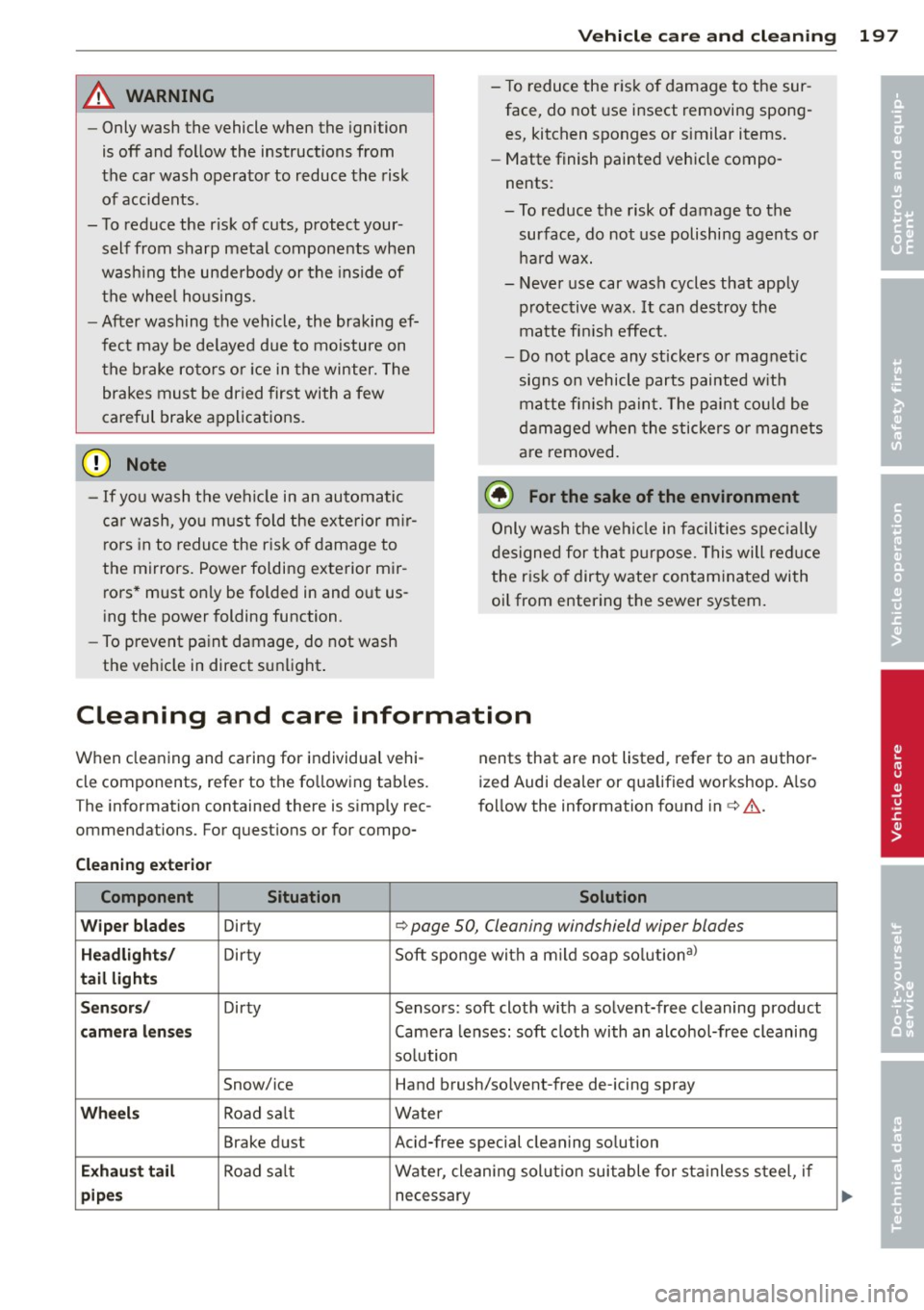
Cleaning and care information
When cleaning and caring for individual vehi
cle components, refer to the fo llow ing tables .
The information contained there is s imply rec
ommendations. For quest ions or for compo- nents
that are not listed, refer to an author
ized Audi dea ler or qualified workshop. A lso
fo llow the information found inc>,& .
Cle anin g exter ior
Component Situation Solution
Wiper b lades
Dirty i=> page 5 0, Cleaning windshield wiper blades
Headligh ts / Dirty Soft
sponge with a m ild soap solutional
tail light s
S ensor s/
Dirty Sensors: soft cloth with a solvent-free cleaning product
camera l enses Camera lenses: soft cloth with an alcohol-free cleaning
solution
Snow/ice Hand brush/solvent-free de-icing spray
Wheels Road sa lt Water
Brake dust Acid-free special cleaning solution
Exhau st t ail Road sa lt Water, cleaning solut ion suitable for sta inless steel, if
pi pes necessary
•
•
Page 206 of 286
204 Fuel suppl y and filli ng your fu el t ank
Refuelling
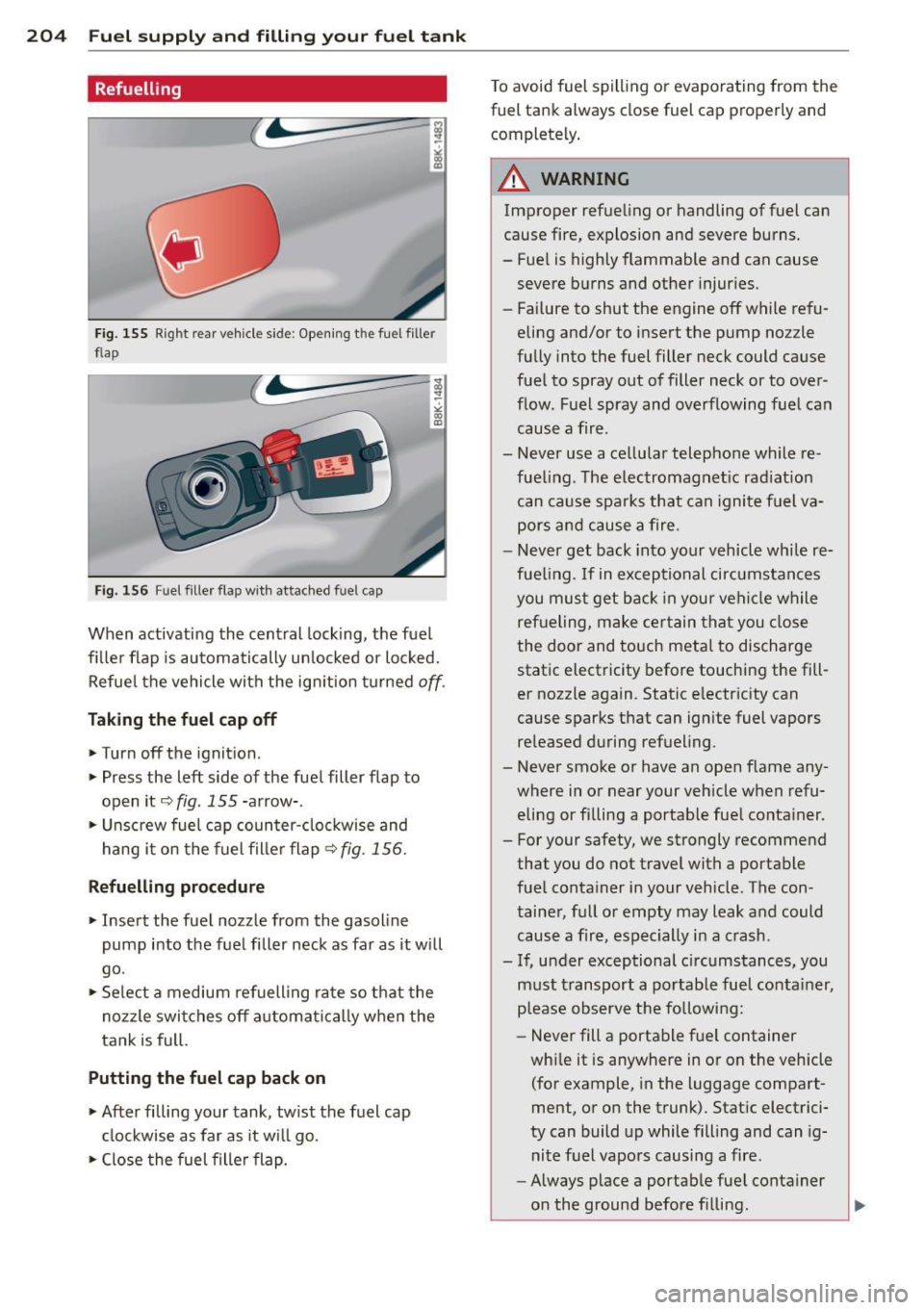
Fig. 155 Rig ht rea r veh icle s ide: Open ing t he fuel fille r
fl ap
Fig. 156 Fu el fi ller fla p w ith attached fuel c ap
When activating the central lock ing, the fuel
fi ller flap is automatically un locked or loc ked.
Refue l the vehicle with the ig nition turned
off .
Tak ing th e fuel cap off
~ Turnoff the ignition .
~ Press the left side of the fuel filler flap to
open it
c::> fig. 155 -arrow- .
~ Unscrew fuel cap counter-clockwise and
hang it on the fuel filler flap~
fig. 156.
Refu elling proc edure
~ Insert the fuel no zzle from the gasoline
pump into the fuel filler nec k as far as it will
go .
~ Select a medium refuelling ra te so that the
nozzle swi tches off a utomatica lly when the
tank is full.
Putting the fuel cap back on
~ After filling your tank , tw ist the fuel cap
clockwise as far as it w ill go .
~ Close the fuel fil le r flap. T
o avoid fuel spill ing or evaporating from the
fuel tank always close fuel cap properly and
completely .
A WARNING
-Im proper refueling or handling of fuel can
cause fire, explosion and severe burns.
- Fue l is highly flammable and can cause
severe burns and other injur ies.
- Failure to shut the engine off while refu
eling and/or to insert the pump noz zle
fully into the fuel filler neck could cause fuel to spray out of filler neck or to over
f low . Fuel spray and overflowing fuel can
cause a fire .
- Never use a cellular telephone while re
fueling . The electromagnet ic rad iat io n
can cause sparks that can ignite fuel va
pors a nd cause a fire .
- Never get back into your vehicle wh ile re
fue ling.
If in exceptional circumstances
you mus t get back in your vehi cle while
ref ueling, make ce rtain that you close
the door and touch meta l to discharge
static electricity before touching the fill
er nozzle again . Static e lectr icity can
cause sparks that can ignite fuel vapors re leased during refueling .
- Never smoke or have an open f lame any
where in or near your veh icle when refu
eling or filling a portable fue l conta iner .
- For your safety, we strongly recommend
that you do not travel with a portable
fue l conta iner in your vehicle . The con
tainer, fu ll o r empty may leak and could
cause a fire, especially in a crash .
- If, u nder exceptional c ircumstances, you
must transport a portable fuel conta iner,
p lease observe t he follow ing:
- Never fill a portable f uel container
whi le it is anywhere in or on the vehicle
(for example, in the luggage compart
ment, or on the trunk). Static electrici
ty can build up while filling and can ig
ni te f uel vapors causing a fire .
- Always place a portab le fue l conta iner
on the ground before fi lling.
Page 208 of 286
206 Checking and filling
Checking and filling
Engine hood
Releasing and opening the engine hood
The engine hood is released from inside the
vehicle .
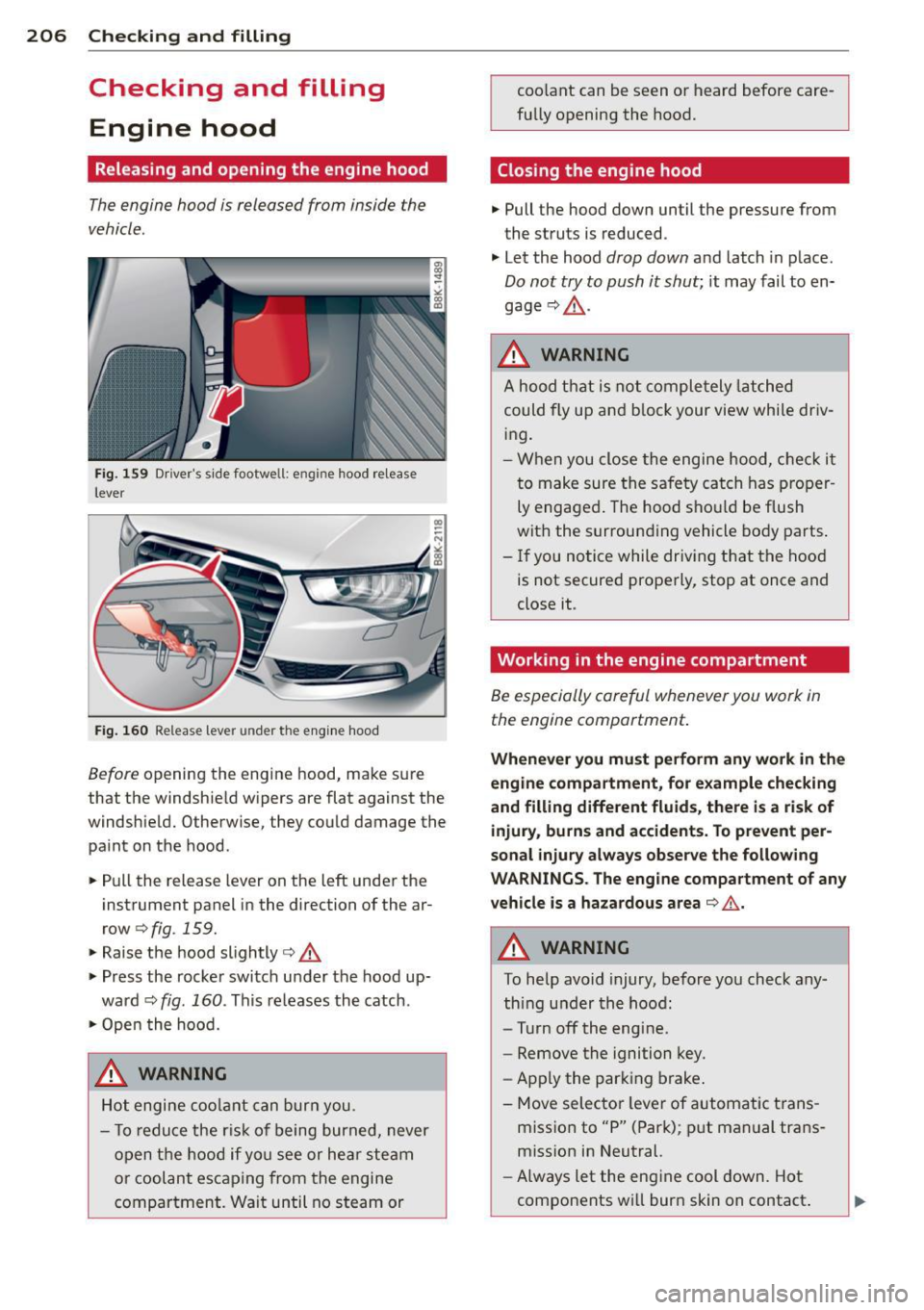
Fig . 159 D river' s side footwe ll: e ngin e hood re lease
lever
F ig. 160 Re lease lever u nde r the eng ine hood
Before openin g the engine hood, ma ke s ure
that the windshie ld w ipers are flat against the
windshield. Otherwise, they co uld damage the
pa int on the hoo d.
... Pull the release lever on the left unde r the
inst rument panel in the direction of the ar
row
c;, fig . 159.
... Raise the hood slightly r::;, .&,
... Press the rocke r swi tch u nder the hood up
ward
c;, fig . 160 . Th is re leases the catch .
... Ope n t he hood.
A WARNING
Hot engi ne co olan t ca n bur n you.
- T o redu ce the r is k o f being burned, never
op en t he ho od if yo u see or hea r steam
or cool an t esc aping from the en gine
c ompartment. Wait unti l no steam or co
olant can be seen or heard before care
fu lly opening the hood.
Closing the engine hood
... Pull the hood down until the pressure from
the struts is reduced .
... Le t the hood
drop down and latch in p lace.
Do not try to push it shut; it may fail to en
gage
r::;, .&, .
A WARNING
-
A ho od th at is not co mpletely latched
could fly u p an d block your view while driv
in g.
- Wh en you close the engi ne ho od, ch ec k it
t o make sure the sa fe ty ca tch has pro pe r
ly engaged . The hood s hould be flush
wit h the surroun ding vehicle body pa rts .
-If you notice while driv in g that t he hood
is not secured prope rly, sto p at once and
close it.
Working in the engine compartment
Be especially ca reful whenever you work in
the engine compartment.
Whenever you must perform any work in the
engine compartment, for example checking
and filling different fluid s, there is a ri sk of
injury , burns and accidents . To prevent per
sonal injury always observe the following
WARNINGS. The engine compartment of any
vehicle is a hazardous area
r::;, ,&. .
A WARNING
-To help avo id injury, before yo u check any-
thing unde r the hoo d:
- Turn off the eng ine.
- Remove the ignition key.
- Ap ply the park ing brake .
- Move selector leve r of automatic t rans -
miss io n to "P" (Par k); pu t man ual trans
miss ion in Neu tral.
- Al ways let the eng ine cool down. Hot
components wi ll burn skin on contact .