air condition AUDI A5 COUPE 2016 User Guide
[x] Cancel search | Manufacturer: AUDI, Model Year: 2016, Model line: A5 COUPE, Model: AUDI A5 COUPE 2016Pages: 264, PDF Size: 66.92 MB
Page 142 of 264

Airbag system
The PASSENGER AIR BAG OFF light is located in
the center of the instrument panel
r::;, fig. 134.
The PASSENGER AIR BAG OFF light will come on
and stay on to tell you when the front Advanced
Airbag on the passenger side has been turned off
by the electronic control unit. Each time you turn
on the ignition, the
PASSENGER AIR BAG OFF
light will flash for a few seconds and:
- will stay on if the front passenger seat is not
occupied,
-will stay on if there is a small child or child re
straint on the front passenger seat,
- will go out if the front passenger seat is occu
pied by an adult as registered by the weight
sensing mat.
The
PASSENGER AIR BAG OFF light must come
on and stay on
if the ignition is on and
- a car bed has been installed on the front seat,
or
- a rearward-facing child restraint has been in
stalled on the front passenger seat , or
- a forward-facing child restraint has been instal
led on the front passenger seat, or
- the weight registered on the front passenger
seat is equal to or less than the combined
weight of a typical 1 year-old restrained in one
of the rear-facing or forward-facing infant re
straints listed in Federal Motor Vehicle Safety
Standard 208 with which the Advanced Airbag
System in your vehicle was certified.
If the front passenger seat is not occupied, the
front airbag will not deploy, and the
PASSENGER
AIR BAG OFF
light will stay on. Never install a
rearward-facing child restraint on the front pas
senger seat, the safest place for a child in any
kind of child restraint is at one of the seating po
sitions on the rear seat
r::;, page 130, Child re
straints on the front seat -some important
things to know
and <=> page 151, Child safety.
If the PASSENGER AIR BAG OFF light comes on
when one of the conditions listed above is met,
be sure to check the light regularly to make cer
tain that the
PASSENGER AIR BAG OFF light
stays on continuously whenever the ignition is
on . If the
PASSENGER AIR BAG OFF light does
140 not appear and not stay on all the
time, stop as
soon as it is safe to do so and
- reactivate the system by turning the ignition
off and then turning it on again ;
- remove and reinstall the child restraint. Make
sure that the child restraint is properly instal
led and that the safety belt for the front pas
senger seat has been correctly routed around
the child restraint as described in the child re
straint manufacturer's instructions;
- make sure that the convertible locking retrac
tor on the safety belt for the front passenger
seat has been activated and that the safety belt
has been pulled tight. The belt must not be
loose or have loops of slack so that the sensor
below the safety belt latch on the seat can do
its job
r::;, page 160 .
-make sure that things that may increase the
weight of the child and child safety seat are not
being transported on the front passenger seat;
- make sure that the safety belt tension sensor is
not blocked . Shake the safety belt latch on the
front passenger seat back and forth;
- If a strap or tether is being used to tie the child
safety seat to the front passenger seat, make
sure that it is not so tight that it causes the
weight-sensing mat to measure more weight
than is actually on the seat.
If the PASSENGER AIR BAG OFF light still does
not come on
and does not stay on continuously
(when the ignition is switched on),
- take the child restraint off the front passenger
seat and install it properly at one of the rear
seat positions. Have the airbag system inspect
ed by your authorized Audi dealer immediately.
- move the child to a rear seat position and make
sure that the child is properly restrained in a
child restraint that is appropriate for its size
and age.
The
PASSENGER AIR BAG OFF light should NOT
come on when the ignition is on and an adult is
sitting in a proper seating position on the front
passenger seat.
If the PASSENGER AIR BAG OFF
light comes on and stays on or flashes for about
5 seconds while driving, under these circumstan-
ces, make sure that:
1111>
Page 153 of 264
.... N
0 I-co ....
Important information
Introduction
The rear seat is generally the safest place in a
collision .
The physical principles of what happens when
your vehicle is in a crash apply also to children
c:> page 122, What happens to occupants not
wearing safety belts? .
But unlike adults their
muscles and bones are not fully developed. In
many respects ch ildren are at greater risk of seri
ous injury in crashes than adults.
Because children's bodies are not fully devel
oped, they require restraint systems especially
des igned for their size, we ight, and body struc
ture. Many countr ies and all states of the United
States and provinces of Canada have laws requir
ing the use of approved child restraint systems
for infants and small children .
I n a frontal crash at a speed of 20-3S mph
(30-56 km/h) the forces acting on a 13-pound
(6 kg) infant will be more than 20 times the
weight of the child. This means the weight of the
child would suddenly be more than 260 pounds (120 kg) . Under these conditions, only an appro
priate child restraint properly used can reduce
the risk of serious injury . Child restraints must be
used properly to be effective. Used improperly,
they can increase the risk of serious injury in an
accident.
Consult the child safety seat manufacturer's in
structions to be sure the seat is right for your
child's size
c:> page 154, Important safety in
structions for using child safety seats.
Please be
sure to read and heed all of the important infor
mation and WARNINGS about child safety, Ad
vanced Airbags, and the installation of chi ld re
straints in this chapter.
There is a lot you need to know about the Ad
vanced Ai rbags in yo ur vehicle and how they work
when infants and children in chi ld restraints are
on the front passenger seat. Because of the large
amount of important information, we cannot re
peat it all here. We urge you to read the detailed
Child safety
information in this owner 's manual about airbags
and the Advanced Airbag System in your vehicle
and the very important information about trans
porting children on the front passenger seat.
Please be sure to heed the WARNINGS - they are
extremely important for your safety and the safe
ty of you r passengers, especially infants and
small ch ildren.
,&. WARNING
-Accident statistics have shown that children
are generally safer in the rear seat area than
in the front seating position. Always restrain
any child age 12 and under in the rear.
- All vehicle occupants and especially children
m ust be restrained properly whenever riding
in a vehicle. An unrestrained or improperly
restrained child could be injured by striking
the interior or by be ing ejected from the ve
hicle dur ing a sudden maneuver or impact.
An unrestrained or improperly restrained
child is also at greater r isk of injury or death
through contact w ith an inf lating a irbag.
- A suitable child restraint properly installed and used at one of the rear seating positions
provides the h ighest degree of protect ion
for infants and small children in most acci
dent situations.
,&. WARNING
Children on the front seat of any car even with
Advanced Airbags can be seriously injured or
even killed when an airbag inflates . A child in
a rearward-facing chi ld safety seat installed
on the front passenger seat will be seriously
i njured and can be killed if the front airbag in
flates.
- The inflating airbag will h it the ch ild safety
seat or infant carr ier with great force and
will smash the child safety seat and child
aga inst the backrest, center armrest or
door .
- Always install rearward-facing child safety
seats on the rear seat.
- If you must install a rearward facing child
safety seat on the front passenger seat in
151
Page 171 of 264
.... N
0 I-co ....
recorded by the Event
Data Recorder and
vehicle control modules
E ve nt Dat a Record er
This vehicle is equipped wi th an Event Data Re
corder (EDR) . The main purpose of an EDR is to
record, in certain crash or near crash-like situa
tions, such as an a irbag deployment or hitting a
road obstacle, data that will assist in understand
ing how a vehicle's systems performed. The EDR
is designed to record data related to vehicle dy
namics and safety systems for a short period of
time, typically 30 seconds or less. The EDR in this
ve hicle is designed to reco rd such data as:
- How various systems in your vehicle were oper
at ing;
- Whether or not the driver and passenger safety
belts were buckled/fastened;
- How far (if at all) the dr iver was depressing the
accelerator and/or brake pedal; and,
- How fast the vehicle was traveling.
These data can he lp provide a better understand
ing of the c ircumstances in which crashes and in
juries occur. NOTE: EDR data are recorded by your
veh icle only if a non-trivia l crash situation occurs;
no data are recorded by the EDR under normal
driving conditions and no personal data (e .g.,
name, gender, age, and crash location) are re
corded. However, other parties, such as law en
forcement, cou ld combine the EDR data w ith the
type of personally identifying data routine ly ac
quired during a crash investigation.
To read data recorded by an EDR, specia l equip
ment is req uired, a nd access to the ve hicle or the
E DR is needed. In add it ion to the vehicle manu
facturer, other parties, such as law enforcement,
that have the specia l equipment, can read the in
formation if they have access to the vehicle or the
EDR .
Some state laws restrict the retr ieval or down
l oading of data stored by ED Rs insta lled in a vehi
cle for the express purpose of retrieving data af-
Intellig ent Technology
ter an accident or crash event without the own
er's consent.
Audi will not ac cess the EDR and/or sim ilar data
o r give it to others -
- unless the vehicle owne r (or lessee if the vehi
cle has been leased) agrees; o r
- upon the official request by the police; or
- upon the order of a court of law or a govern-
ment agency; or
- for the defense of a lawsuit through the judic ial
discovery process.
- Aud i may a lso use the data for research about
veh icle operation and safety performance or
prov ide the data to a third party for research
purposes without identify ing the specific veh i
cle or info rmat io n about the ident ity of its own
er or lessee and only afte r the reco rded veh icle
data has been accessed.
Vehicle control modules
Your vehicle is also equ ipped w ith a number of
electronic control modules for va rious vehicle
systems, such as engine management, emiss io n
contro l, airbags, and s afety be lts.
These electronic control modules record data dur ing norma l vehicle operation that may be
needed by trained tech nicians for diagnost ic and
r epa ir purposes. The re cording capab il ity of these
modules is lim ited to data (no sound is record
ed). Only a sma ll amount of data is actua lly re
corded over a very limited period of time, or stor
ed when a system fault is detected by a control
module . Some of the data stored may relate to
vehicle speed, direction, or braking, as well as re
straint system use and performance in the event
of a crash. Stored data can also on ly be read a nd
down loaded w ith specia l equipment that is d i
rectly connected to the vehicle.
(D Tips
Your vehicle may be equipped w ith Aud i con
nect. Your use of certain Aud i connect fea
tures requi res wire less serv ices that are pro
v ided by a third party wireless telecomm uni
cations provi der. For de tails regarding how in
formation obtained through Aud i connect is
collected, processed, transmitted, used, and ..,.
169
Page 176 of 264
Intelligent Technology
Clean off accumulated salt coating from
brake discs and pads with a few caref ul
brake app lications.
- If you damage the front spoiler, or if yo u in
stall a d ifferent spoiler, be sure the air flow
to the front brakes is not obstructed. Other
wise the brake system could overheat reduc
ing the effectiveness of the entire b rake sys
tem.
- Failure of one brake c ircuit will impair the
bra king capability res ult in g in an increased
stopp ing distance. Avoid driving the vehicle
and h ave i t towe d to the ne arest author ized
Audi dealer or quali fied workshop.
- Never let the vehicle roll to a s to p wi th the
eng ine shut off.
- I f the bra ke booste r is not wor kin g, the
bra ke pe dal m ust be presse d considerably
harder to make up for the lac k of b oos ter
assistance .
Electro-mechanical
power assist, dynamic
steering
The electro-mechanical power assist helps the
driver when steering.
Power steering adapts electronically based on
the vehicle speed .
Indicator lights and mess ages
• Steering defective! Do not dri ve vehicle!
If thi s ind icator light tu rns on and stays o n and
this message appears, t he power steering may
have fa iled.
D o
not conti nue d riving. See yo ur autho riz ed
Aud i dea ler o r a q ua lified repair facility fo r assis
tance.
l;r-ij Dynamic steering : Sy stem fault! You can
c ontinue driving
If t he i ndicator lig ht t urns on and the message
appears, the steering may be more difficult to
move or mo re sens it ive than usual. The steer ing
wheel may also be a t an an gle when dr iv ing
s tra ight .
174
Drive slowly to your a uth orized Audi dea ler or
qualified workshop to have the malfunction cor
r ected.
'I-ij Dynamic steering: initializing
If this d rive r message appea rs and t he in dicator
li ght is flashing on the instr ume nt pa nel, dynam
ic steer ing * is being re ini tiali zed. After s tarting
the e ngine, t he s teer ing whee l w ill move sligh tly.
Re -initializa tion might be necessary if the steer
ing whee l was moved hard to the left and right
whi le the vehicle was not moving . T he d isp lay
goes out as soon as initiali zation is comp lete.
A WARNING
-
H ave the dynamic steering* system malfunc-
tion repaired as soon as poss ible by an au
thor ized Audi dealer or qualified workshop -
risk of acc ident!
@ Tips
- If the . or 'I-ij indicator light only stays on
for a sho rt time, you may cont inue driving.
- The dynamic steerin g* stab ility systems a re
not ava ilable in the event of a system mal
function .
- For add itiona l information on dynamic
steeri ng*, refer to
<=> page 102.
Driving with your
quattro
Applies to vehicles: with all-whee l dr ive
With all-wheel drive, all four wheels are driven.
General informat ion
With a ll-w heel d rive, power is distri buted to a ll
fo ur wheels. This happens automat ica lly depend
i ng on your d riving style a nd the roa d conditions
at the t ime . See also
c> page 170.
A center d ifferen tial d istr ibu tes the dr iving powe r
variab ly to the front and rear ax le.
It works to
gether w it h select ive whee l torque contro l, w hich
ac tiv ates w hen d rivi ng thro ugh curves
<=> page 171. With the spo rt different ial *, power
distribution to the rear wheels is variable and can
be adjusted with drive select<::>
page 102. .,.
Page 199 of 264
.... N
0 Ico ....
er's glycol-basedcoo lant additive Gl3 antifreeze
with anticorrosion additives (50% for USA mod
e ls; 60% for Canadian models). This m ixture
both assures the necessary frost protection and
protects metal components in the engine's cool
ing system from corrosion and scaling.
It also
raises the boiling point of the coolant .
Do not reduce the concentration of the coolant in
the summer by adding plain water.
Th e propor
tion of coolant addit ive must be at l eas t 50° /4
but not more th an 60 %
to maintain antifreeze
p rotection and cooling efficiency. If the coolant
frost protec tion is too low, the coolant co uld
freeze and damage the vehicle heating and en
gine cooling system.
F or yea r-round driving, antifreeze is added at the
factory for temperatures down to:
- -31 °F (- 35 °C) USA
- -40 °F ( - 40 °C) Canada.
If you must add coolant, use a mixture of water
and coolant addit ive. Mixing the coolant additive
with distilled water is recommended.
A WARNING
Before you check anything in the engine com
partment, always read and heed all WARN
INGS
Q &. in Working in the engine compart
ment on page 191.
(D Note
- Before winter sets in, have the coolant
checked to see if the coolant additive in your
vehicle is sufficient to meet the climate con
dit ions. This is especially important if you
li ve in a reg ion where the w inte r is ext reme
l y co ld. If ne cessary, in cre ase the proport io n
of coo lant add itive to 60%.
- When addi ng coolant addit ive to you r cool
i ng system, remember:
- We recommend using only coolant addi
tive Gl2++ or Gl3 for your ve hicle. T his
coolant additive is available at authorized
Audi dea lers. Othe r types of antifreeze can
significant ly reduce cor ros ion p rotection .
Check ing and Filling
The resulting co rrosion can cause a loss of
coolant and serious engine damage.
- Do not add any type of radiator lea k sealant
to your vehicle's engine coolant. Adding ra
diator repair fluid may adversely affect the
function and performance of your cooling
system and could resu lt in damage not cov
ered by your New Veh icle Limited Warranty.
Checking the engine coolant level
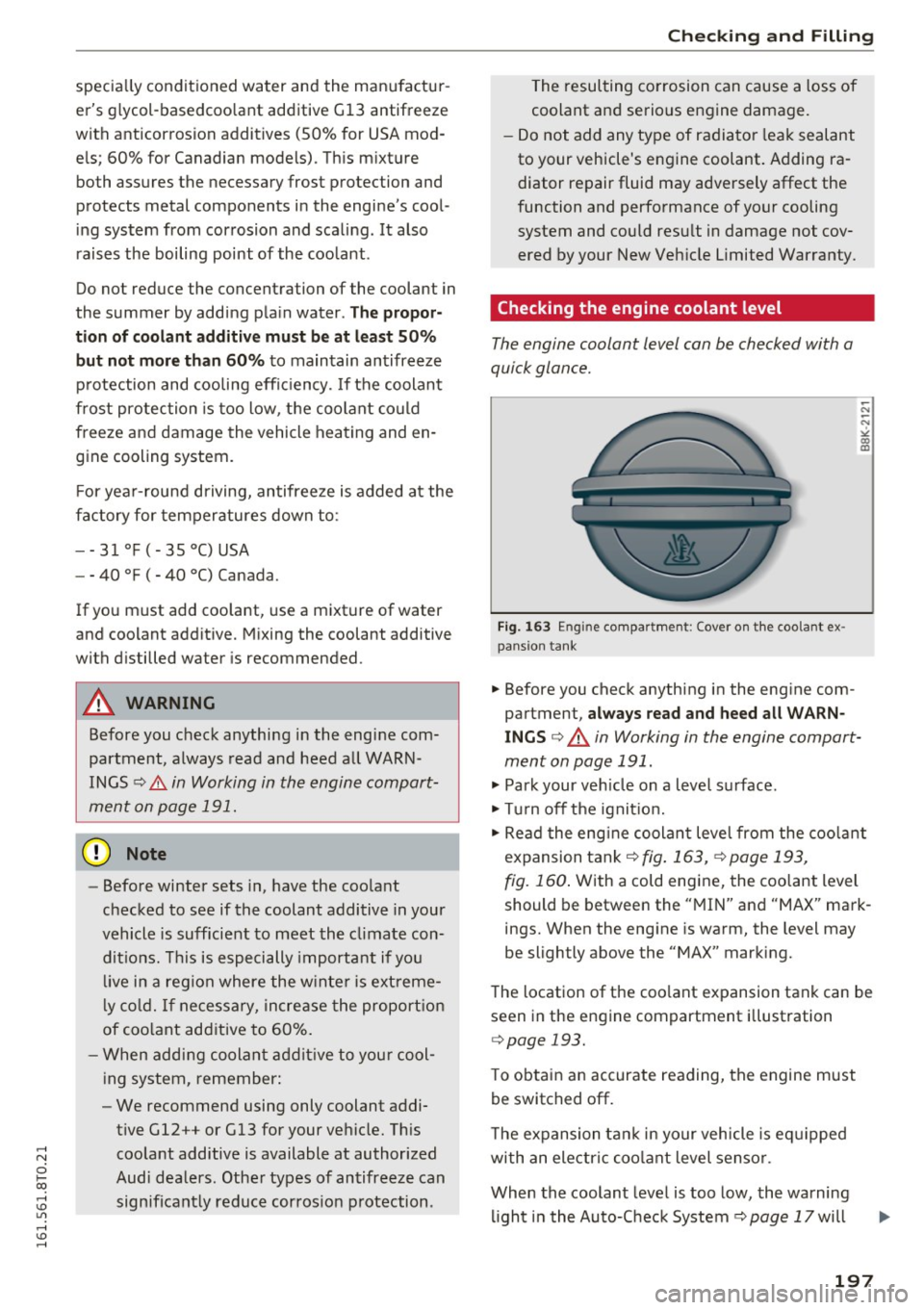
The engine coolant level can be checked with a
quick glance.
F ig. 163 Engine compa rtment: Cover on the coolant ex
pans ion tank
.. Before you check anything in the engine com
partment,
al ways read and heed all WARN
INGS
q ..&. in Working in the engine compart
ment on page 191.
.. Park your ve hicle on a leve l sur face .
.. Tu rn off the ignit io n .
.. Read the eng ine coolan t level from the coo la nt
expansion tank
qfig . 163, Qpage 193,
fig. 160 .
With a cold engine, the coolant level
should be between the " MIN" and "MAX" mark
ings. When the engine is warm, the level may
be slightly above the "MAX" marking.
The location of the coolant expansion tank can be
seen in the engine compartment illustration
qpage 193.
To obtain an accurate reading, the engine must
be switched off.
T he expansion ta nk in your veh icle is eq uipped
with an electric coo lant level senso r.
When the coolant leve l is too low, the warning
light i n the Auto-Check System
Q page 17 will
197
Page 201 of 264
,-1 N
0 1-CX)
,-1 I.Cl U"I
,-1 I.Cl ......
-To avoid being burned, do not spill anti
freeze or coolant on the exhaust system or hot engine parts. Under certain condi
tions, the ethylene glycol in engine cool ant can catch fire.
- Antifreeze is poisonous. Always store anti
freeze in its original container and well out
of the reach of children.
- If you drain the coolant, it must be caught
and safely stored in a proper container
clearly marked "poison".
(D Note
-Do not add coolant if the expansion tank is
empty . Air could enter the cooling system
and damage the engine.
If this is the case,
do not continue driving. Seek professional
assistance.
- Coolant pollutes the environment and could
cause an engine fire. Excess coolant will be
forced out through the pressure relief valve
in the cap when the engine becomes hot.
-If, in an emergency, only water can be add
ed, the correct ratio between water and an
tifreeze c::>
page 196 must be restored as
soon as possible.
@) For the sake of the environment
Drained coolant should not be reused. Always
dispose of used coolant while observing all
environmental regulations.
Radiator fan
The radiator fan switches on automatically by it
self.
The radiator fan is driven by the engine via the V
belt . The viscous clutch regulates the speed of
the fan according to the temperature of the cool
ant.
An auxiliary electric radiator fan* switches on and
off depending on coolant temperature and other
vehicle operating conditions.
After you switch the engine off, the auxiliary fan
can continue running for up to 10 minutes -even
Checking and Filling
with the ignition off. It can even switch on again
later by itself c::>
&, if
- the temperature of the engine coolant rises due
to the heat build-up from the engine in the en
gine compartment, or
- the engine compartment heats up because the
vehicle is parked in intense sunlight.
A WARNING
-To reduce the risk of personal injury never
touch the radiator fan.
- The auxiliary electric fan is temperature
controlled and can switch on suddenly even
when the engine is not running.
- The auxiliary radiator fan switches on auto
matically when the engine coolant reaches a
certain temperature and will continue to run
until the coolant temperature drops.
Brake fluid
Checking brake fluid level
The broke fluid level con be checked with o quick
glance .
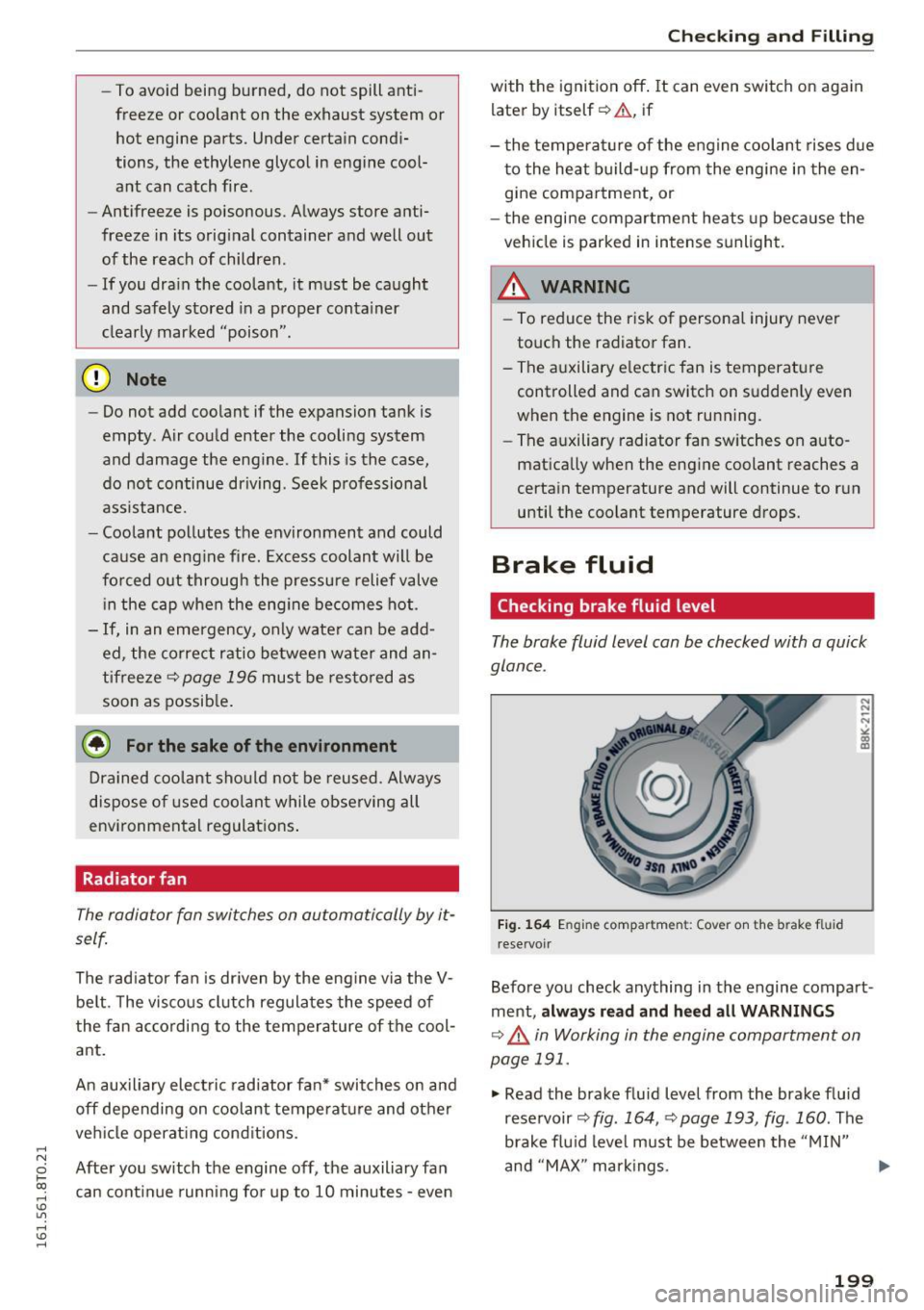
Fig. 164 Engine compartmen t: Cover on the brake flui d
re servoir
Before you check anything in the engine compart
ment,
always read and heed all WARNINGS
c::> _.& in Working in the engine comportment on
page 191.
.,. Read the brake fluid level from the brake fluid
reservoir c::>fig.164,
c::>poge 193, fig .160 . The
brake fluid level must be between the "MIN"
and "MAX" markings.
199
Page 222 of 264
Wheels
and a special procedure. You must not repair or
disassemble them¢&. .
A WARNING
Wheel bolts that are tightened or repaired in
correctly can become loose and result in loss
of vehicle control, which increases the risk of
an accident. For the correct t ightening specifi
cation, refer to ¢
page 22 7, After changing a
wheel .
-Always keep the wheel bolts and the
threads in the wheel hub clean and free of
grease.
- Only use wheel bolts that fit the rim .
- Always have damaged rims repaired by an
authorized Audi dealer or authorized Aud i
Service Facility . Never repair or disassemble
rims yourself, because this inc reases the risk
of an accident.
Winter tires
Winter tires s ignificantly improve the vehicle's
handling when driving in winter conditions . Be
cause of their construction (width, compound,
tread pattern), summer tires provide l ess trac
tion on ice and snow.
.,. Use winter tires on all four wheels.
.,. Only use winter tires that are approved for your
vehicle.
.,. Please note that the maximum permitted
speed may be lower with winter tires
q .&,. . An
authori zed Audi dealer or authori zed Audi Serv
ice Facility can inform you about the maximum
permitted speed for your tires .
.,. Check the tire pressure after install ing wheels
q page 215.
The effectiveness of winter tires is reduced great
ly when the tread is worn down to a depth of
0 .157 in (4 mm). The characteristics of winter
tires also decrease greatly as the tire ages, re
gardless of the remaining tread.
A WARNING
- Never drive faster than the maximum per
mitted speed for your tires. This could cause
the tires to heat up too much. This increases
220
-
the risk of an accident because it can cause
the tire to burst.
- Always adapt your driving to the road and
traffic conditions . Drive carefully and reduce
your speed on icy or slippery roads . Even
winter tires can lose traction on black ice .
@ For the sake of the environment
Reinstall summer tires at the appropriate
time, because they prov ide better handling
when roads are free of snow and ice. Summer
tires cause less road noise, tire wear and fuel
consumpt ion .
(D Tips
You can also use all season tires instead of
winter tires. Please note that in some coun
tries where winter tires are required, only
winter tires w ith the ~ symbol may be per
mitted.
Snow chains
Snow chains improve traction in the snow .
.,. Only install snow chains on the front wheels.
This applies also to vehicles with all wheel
drive* .
.,. Check and correct the seating of the snow
chains if necessary after driving a few feet. Fol
low the instructions from the manufacturer.
.,. Note the maximum permitted speed when dr iv
ing with snow chains. Do not exceed 30 mph (SO km/h).
Snow cha ins not only improve the
driving in win
ter road conditions, but also the
braking .
Use of snow chains is only permitted with certain
rim/tire combinat ions due to technical reasons .
Check with an author ized Audi dealer or author
ized Audi Service Facility to see if you may use
snow chains.
Use
fine-mesh snow chains. They must not add
more than 0.53 inch (13.5 mm) in height, includ
ing the chain lock.
You must remove the chains when driving on
roads that are
free of snow . When roads are free ..,.
Page 223 of 264
.... N
0 Ico ....
damage the t ires, and t he chains will quickly b e
destroyed.
A WARNING
Using incorrect snow chains or installing snow
chains incorrect ly can result in loss of vehicle
co ntrol, which increases the risk of an acc i
dent .
Snow chains can damage the r ims/wheel cov
ers* if the chains come into d irect contact
w ith them . Remove the wheel covers* first.
Use coated snow chains .
@ Tips
When driving with snow cha ins, it may help to
switch on sport mode¢
page 171.
Low aspect ratio tires
Your Aud i is factory-equipped with low aspect ra
t io ti res. These t ires have been tho rough ly tested
a n d been se lected specifically fo r yo ur model for
t he ir superb performance, road feel and handling
under a variety o f driving conditions. Ask your au
thor ized Audi dealer for more details .
The low aspect ratio of these t ires is indicated by
a numera l of
55 or l ess in the tire 's size designa
tion . The numera l represents the rat io o f the
tire's sidewall height in relat ion to its tread width
expressed in pe rc e ntage. Conventional t ir e s hav e
a height/w idth rat io of 60 or more.
The performan ce of low- aspect- ratio tire s is par
ticularl y sensiti ve to imp roper inflat ion pres
sure . It is therefore import ant that low a spect
ratio tires are infl ated to the specified pressure
and that the inflation pre ssure is regularl y
checked and mainta ined . Tire pre ssure s shoul d
be checked at least once a month and alwa ys
befor e a long t rip
¢ page 215.
What you can do to avoid tire and rim
damag e
Low aspect rat io tires can be damaged more easi
ly by impact with potho les, curbs, gull ies or
Wh eel s
ridges on the road, particular ly if the tire is un
deri nflated.
In orde r to min imi ze the occurrence of imp act
damage to the tires of yo ur vehicle , we recom
mend that you observe the following preca u
tions:
- Always ma intain recommended inflat io n pres
sures. Check yo ur ti re pressure every 2,000
miles (3,000 km) and add air if necessary .
- Dr ive ca refully on roads w ith po tholes, deep
gullies or ridges . The impac t from dr iving
through or over such obstacles can damage
your tires. Impact with a curb may a lso cause
damage to your tires.
- After any impact, immediate ly inspect your
tires or have th em inspected by th e nearest au
thorized Audi dealer. Replace a damaged tire as
soon as possible.
- Inspect you r tires every 2,000 m iles (3,000 km)
for damage and wear. Damage is not a lways
easy to see . Damage can lead to loss of air and
underinflation, wh ic h could eventually cause
tire fa ilure. If you believe that a tire may have
been damaged , replace the tire as soon as pos
sib le.
- These tires may wear more quickly than others .
- Please also remember that, while these tires
delive r responsive ha ndling, they may ride less
comfortably a nd make more noise than other
choi ces.
Reduced perfo rmance in winter /cold se ason
conditions
All tires are des igned for certai n purposes. The
low aspect ratio, ultra high performance tires
o rigi na lly installed o n your veh icle are intended
f or maximum dry and wet road per formance and
handling . They are not suitable for co ld, snowy or
icy weather conditions . If you drive under those
c ircumstances, you should equip your vehicle
with all-season or winter tires, which offer better
tract ion under those condi tions. We suggest you
use the recommended snow or all-season tires
spec ified for your veh icle, or their equiva lent .
Refer to¢
page 220 for more detailed informa
t ion regarding winter tires .
221
Page 246 of 264
Consumer information
Consumer information
Warranty coverages
Your Audi is covered by the following warran
ties:
- New Vehicle Limited Warranty
- Limited Warranty Against Corrosion Perfora-
tion
- Emissions Control System Warranty
- Emissions Performance Warranty
- California Emissions Control Warranty (USA
vehicles only)
- California Emissions Performance Warranty
(USA vehicles only)
Detailed information regarding your warranties
can be found in your
Warranty & Maintenance
booklet .
Operating your vehicle
outside the U.S.A. or
Canada
Government regulati ons in the United States and
Canada require that automobi les meet specific
emission regulations and safety standards.
Therefore, vehicles built for the U.S.A. and Cana
da differ from vehicles sold in other countries.
If you plan to take your vehicle outside the conti
nenta l limits of the United States or Canada,
there is the poss ibility that:
- un leaded fue ls for vehicles with catalytic con
verter may not be available;
- fuel may have a considerably lower octane rat
ing . Improper fuel may cause engine damage;
- service may be inadequate due to lack of proper
service facilities, tools or testing equipment;
- r eplacement parts may not be readily available.
- Nav igation systems for veh icles built for the
U.S .A . and Canada will not necessarily work in
Europe, and may not work in other countries
outside of North America.
244
(D Note
Audi cannot be responsib le for mechanical
damage that could result from inadequate
fuel, service or parts ava ilability.
Audi Service Repair
Manuals and Literature
Audi Official Factory Service Manuals and Litera
ture are published as soon as poss ible after mod
el introduction . Service manuals and literature
are available to order from the Audi Technical Lit
erature Ordering Center at :
www.audi.techliterature .com
Maintenance
General '
Your vehicle has been designed to help keep
maintenance requirements to a minimum. How
ever, a certain amount of regular maintenance is
still necessary to assure your vehicle's safety,
economy and reliability . For detailed vehicle
maintenance consult your Warranty & Mainte
nance booklet .
Under difficult operating conditions, for exam
ple at extremely low outside temperatures, in
very dusty regions, when towing a trailer very fre
quently, etc., some service work should be per
formed between the intervals specified. This ap
plies particularly to:
- oil changes, and
- cleaning or replac ing the a ir filter .
'
@) For the sake of the environment
By regularly maintain ing your vehicle, you
help make sure that em iss ion standards are
maintained, thus minimizing adverse effects
on the environment .
Important considerations for you and your
vehicle
The increasing use of electronics, sophisticated
fuel injection and emission control systems, and
the generally increas ing technica l complexity of ..,_
Page 247 of 264
.... N
0 I-co ....
scope of maintenance and repairs which can be
carried out by vehicle owners.
Also, safety and
environmental
concerns place very strict limits
on the nature of repairs and adjustments to en
gine and transmission parts which an owner can perform .
Maintenance, adjustments and repairs usually re
quire special tools, testing devices and other
equipment available to specially trained work
shop personnel in order to assure proper per
formance, reliability and safety of the vehicle and its many systems.
Improper maintenance, adjustments and repairs
can impair the operation and reliability of your
vehicle and even void your vehicle warranty .
Therefore, proof of servicing in accordance with
the maintenance schedule may be a condition for upholding a possible warranty claim made within
the warranty period.
Above all , operational safety can be adversely af
fected, creating unnecessary risks for you and
your passengers.
If in doubt about any servicing, have it done by
your authorized Audi dealer or any properly equipped and qualified workshop. We strongly urge you to give your authorized Audi dealer the
opportunity to perform all scheduled mainte nance and necessary repairs. Your dealer has the
facilities, original parts and trained specialists to keep your vehicle running properly .
Performing limited maintenance yourself
The following pages describe a limited number of
procedures which can be performed on your vehi
cle with ordinary tools, should the need arise and
trained personnel be unavailable. Before per
forming any of these procedures, always thor
oughly read all of the applicab le text and careful
ly follow the instructions given . Always rigorously
observe the
WARNINGS provided .
Before you check anything in the engine com
partment, always read and heed all WARNINGS
c::> .&. and c::> .&. in Working in the engine compart
ment on page 191 .
Consumer information
A WARNING
-Serious personal injury may occur as a result
of improperly performed maintenance, ad
justments or repairs .
- Always be extremely careful when working
on the vehicle. Always follow commonly ac
cepted safety practices and general com
mon sense. Never risk personal injury.
- Do not attempt any of the maintenance,
checks or repairs described on the following pages if you are not fully familiar with these
or other procedures with respect to the ve hicle, or are uncertain how to proceed.
- Do not do any work without the proper tools
and equipment. Have the necessary work
done by your authorized Audi dealer or any
properly equipped and qualified workshop.
- The engine compartment of any motor vehi
cle is a potentially hazardous area. Never
reach into the area around or touch the radi
ator fan. It is temperature controlled and
can switch on suddenly - even when the en
gine is off and the ignition key has been re
moved. The radiator fan switches on auto
matically when the coolant reaches a certain
temperature and will continue to run until
the coolant temperature drops.
- Always remove the ignition key before any
one gets under the vehicle.
-Always support your vehicle with safety
stands if it is necessary to work underneath
the vehicle . The jack supplied with the vehi
cle is not adequate for this purpose and
could collapse causing serious personal in
jury.
- If you must work underneath the vehicle
with the wheels on the ground, always make
sure the vehicle is on level ground, that the
wheels are always securely blocked and that
the engine cannot be started.
- Always make sure the transmission selector
lever (automatic transmission) is in "P"
(Park position) or Neutral (manual transmis-
sion) and the park brake is firmly applied . ..,.
245