airbag AUDI A5 COUPE 2016 Workshop Manual
[x] Cancel search | Manufacturer: AUDI, Model Year: 2016, Model line: A5 COUPE, Model: AUDI A5 COUPE 2016Pages: 264, PDF Size: 66.92 MB
Page 161 of 264
,-1 N
0 1-CX)
,-1 I.Cl U"I
,-1 I.Cl ......
BAG OFF light does not stay on whenever
the ignition is switched on .
Booster seats and safety belts
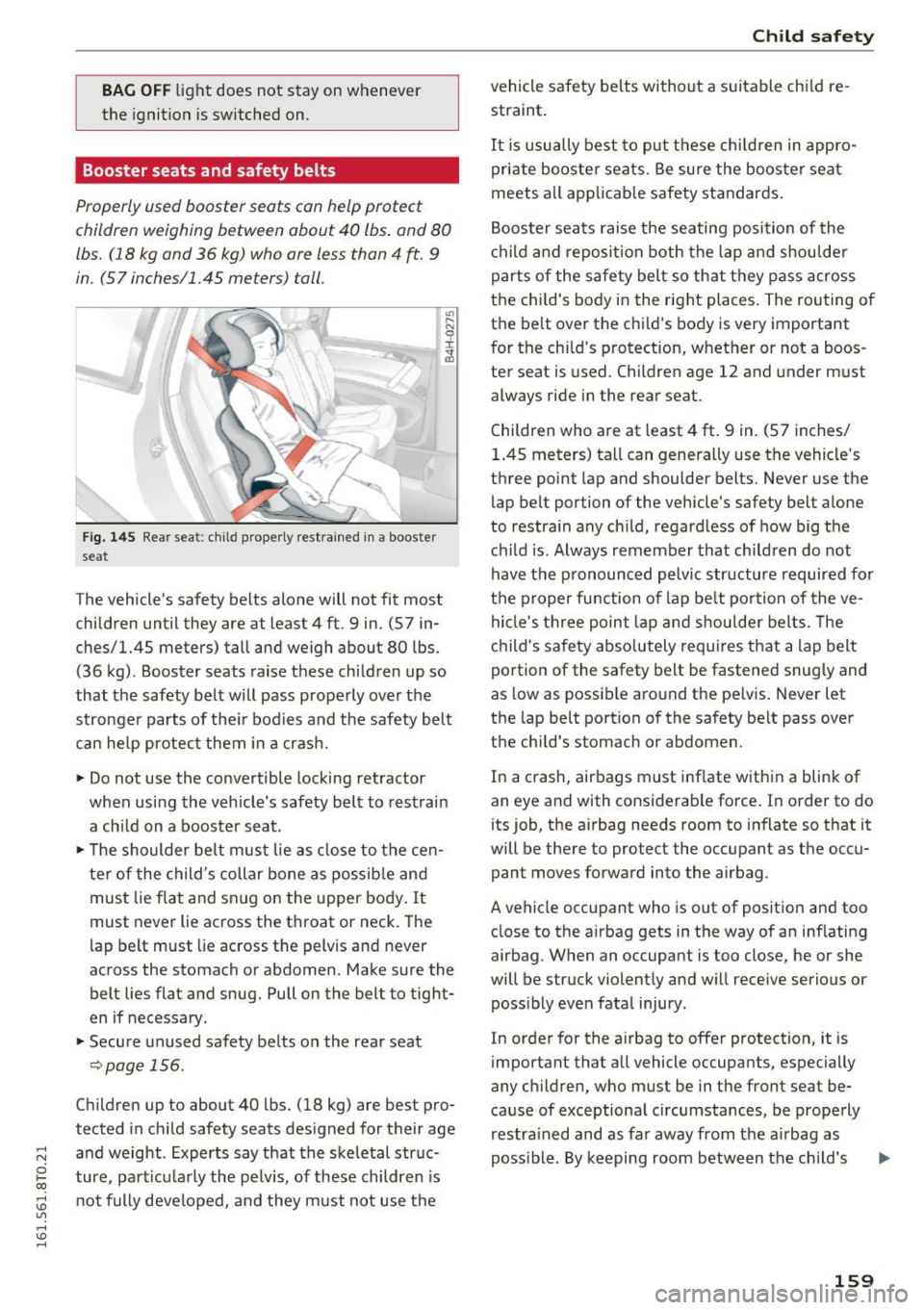
Properly used booster seats can help protect
children weighing between about 40 lbs . and 80
lbs. (18 kg and 36 kg) who are less than 4 ft .
9
in. (57 inches/1.45 meters) tall .
Fig. 145 Rear seat: c hild prope rly rest rai ned in a booste r
sea t
The vehicle's safety belts alone will not fit most
children until they are at least 4
ft. 9 in. (5 7 in
ches/1.45 meters) tall and weigh about 80 lbs.
(36 kg). Booster seats raise these chi ldren up so
that the safety belt will pass properly over the
stronger parts of the ir bodies and the safety belt
can help protec t them in a crash.
.,.. Do not use the convertible locking retractor
when usi ng the vehicle's safety belt to restrain
a ch ild on a booster seat .
.,.. The shoulder belt must lie as close to the cen
ter of the child 's collar bone as possible and
must lie flat and snug on the upper body. It
must never lie across the throat or neck. The
lap belt must lie across the pelvis and never
across the stomach or abdomen. Make sure the
belt lies flat and snug. Pull on the belt to tight
en if necessary .
.,.. Secure unused safety belts on the rear seat
<=>page 156.
Children up to about 40 lbs. (18 kg) are best pro
tected in ch ild safety seats des igned for their age
and weight . Experts say that the skeletal str uc
ture, pa rticular ly the pe lv is , of these children is
no t fully developed, and they must not use the
Child safety
vehicle safety be lts wi thout a suitable child re
straint.
It is usually best to put these childr en in appro
priate booster seats. Be su re the booster seat
meets all applicab le safety standards .
Booster seats raise the seating position of the
child and reposition both the lap and shoulder
parts of the safety belt so that they pass across
the child's body in the right places. The routing o f
the belt over the chi ld's body is very important
for the ch ild's protection, whether or not a boos
ter seat is used. Children age 12 and under must
always ride in the rear seat.
Ch ildren who are at least 4
ft. 9 in. (57 inches/
1.45 meters) tall can generally use the vehicle 's
three point lap and shoulder belts . Never use the
lap belt portion of the vehicle 's safety belt alone
to restrain any ch ild, regard less of how big the
ch ild is. Always remember that childr en do not
have the pronounced pelvic structure required for
the proper function of lap belt portion of the ve
hicle's three point lap and shoulder belts . T he
child's safety absolutely requires that a lap belt
portion of the safety belt be fastened snugly and
as low as possible around the pe lvis. Never let
the lap belt portion of the safety belt pass over
the child 's stomach or abdomen .
In a crash, airbags must inflate within a blink of
an eye and with considerab le force. In order to do
its job, the airbag needs room to inflate so that it
will be there to protect the occupant as the occu pant moves forward into the airbag .
A vehicle occ upant who is out of position and too
close to the a irbag gets in the way of an inflating
airbag. When an occupant is too close , he or she
will be struck violently and w ill receive serious or
possibly even fata l injury .
In order for the airbag to offer protection, it is
important that all vehicle occupants, especially
any children, who must be in the front seat be
cause of exceptiona l circumstances, be properly
restrained and as far away from the airbag as
possible. By keeping room between the child's ..,.
159
Page 162 of 264
Child safety
body and the front of the passenger compart
ment, the airbag can inflate completely and pro
vide supplemental protection in certain frontal
collisions.
.,&. WARNING
Not using a booster seat, using the booster
seat improperly, incorrectly installing a boos
ter seat or using the vehicle safety belt im
properly increases the risk of serious personal
injury and death in a collision or other emer
gency situation. To help reduce the risk of se
rious personal injury and/or death:
- The shoulder belt must lie as close to the
center of the child's collar bone as possible
and must lie flat and snug on the upper
body.
It must never lie across the throat or
neck. The lap belt must lie across the pelvis
and never across the stomach or abdomen .
Make sure the belt lies flat and snug. Pull on
the belt to tighten if necessary .
- Failure to properly route safety belts over a
child's body will cause severe injuries in an
accident or other emergency situation
~ page 121.
-The rear side of the child safety seat should
be positioned as close as possible to the
backrest on the vehicle seat . Adjust or re
move the rear seat head restraint if it is dif
ficult to install the child seat with the head
restraint in place
~page 58. Install the
head restraint again immediately once the
child seat is removed. Driving without head
restraints or with head restraints that are
not properly adjusted increases the risk of
serious or fatal neck injury dramatically.
- Children on the front seat of any car, even
with Advanced Airbags, can be seriously in
jured or even killed when an airbag inflates.
- Never let a child stand or kneel on any seat.
- Never let a child ride in the cargo area of
your vehicle.
- Always remember that a child leaning for
ward, sitting sideways or out of position in
any way during an accident can be struck by
a deploying airbag. This will result in serious
personal injury or death.
160
- If you must install a booster seat on the
front passenger seat because of exceptional
circumstances the
PASSENGER AIR BAG
OFF
light must come on and stay on, when
ever the ignition is switched on .
- If the
PASSENGER AIR BAG OFF light does
not come on and stay on, perform the
checks described~
page 139, Monitoring
the Advanced Airbag System .
-Take the child restraint off the front passen
ger seat and install it properly at one of the rear seat positions if the
PASSENGER AIR
BAG OFF
light does not stay on whenever
the ignition is switched on.
- Always read and heed all WARNINGS when
ever using a child restrained in a vehicle is
being used
~ page 121, Safety belts,
~page 129, Airbag system
and
~ page 151, Important information.
Securing child seats
' Securing a child safety seat using a safety
I _l:>elt
Safety belts for the rear seats and the front pas
senger's seat can be locked with the convertible
locking retractor to properly secure child safety
seats.
The safety belts emergency locking retractors for
the rear seats safety belts and for the front pas senger 's seat safety belt have a convertible lock
ing retractor for child restraints. The safety belt
must be locked so that belt webbing cannot un
reel. The retractor can be activated to lock the
safety belt and prevent the safety belt webbing
from loosening up during normal driving . A child
safety seat can only be properly installed when
the safety belt is locked so that the child and
child safety seat will stay in place.
Always remember : Even though your vehicle is
equipped with an Advanced Airbag system, all
children, especially those 12 years and younger,
should always ride in the back seat properly re-
strained for their age and weight . ..,.
Page 163 of 264
.... N
0 I-co ....
Improperly installed child safety seats in
crease the risk of serious personal injury and
death in a collision.
- Always make sure that the safety belt re
tractor is locked when installing a child
safety seat. An unlocked safety belt retrac
tor cannot hold the child safety seat in place
during no rma l driving or in a crash.
- Always buckle the child safety seat firmly in
place even if a child is not sitting in it. A
loose child safety seat can fly around d uring
a sudden stop or in a collision .
- If the backrest is not securely latched, the
child and the child restrain t will be thrown
forward together with the backrest and will strike parts of the vehicle interior. The ch ild
can be seriously injured or killed.
- Never install rearward -facing child safety
seats or infant carriers on the front passen ger seat. A child will be seriously injured and
can be killed when the passenger airbag in
flates.
- The inflating a irbag will hit the child safety
seat or infant carrier with great force and
will smash the ch ild safety seat and child
against the backrest, center armrest, door or roof .
- Always install rearward-fac ing ch ild safety
seats or infant carriers on the rear seat .
- Forward-fac ing ch ild safety seats or infant
carriers installed on the front passenger's
seat may inte rfere with the deployment of
the a irbag and cause serious injury to the
c hild.
- It is safe r to install a forward-fac ing ch ild
safety seat on the rear seat.
- Always read and heed all WARNINGS when
ever using a child restrained in a veh icle is
being used
¢page 151. Specia l pre caut ions
apply when installing a child safety seat on
the front passenger seat¢
page 130, Child
restraints on the front seat -some impor
tant things to know.
Ch ild safety
A WARNING
Always take special precautions if you must
i nstall a forward or rearward-facing child re
stra int on the front passenger's seat in excep
tional s ituations:
- Whenever a forward or rearward-fac ing
child restraint is installed on the front pas
senger seat, the
PASSENGER AIR BAG OFF
lig ht must come on and stay on w henever
the ignition is switched on.
- If the PASSENGER AIR BAG OFF li ght does
not come on and stay on, perform the
checks desc ribed¢
page 139, Monitoring
the Advanced Airbag System.
- Take the child restr aint off t he front passen
ger seat and install it properly at one of the
rear seat positions if the
PASSENGER AIR
BAG OFF
light does not stay on whenever
the ignition is switched on.
- Improper installation of child restraints can
reduce their effectiveness or even prevent
them from providing any protect ion.
- An imprope rly installed child restraint can
interfere with the airbag as it deploys and
serious ly injure or even kill the chi ld.
- Always care fully follow the manufacturer's
instr uctions provided with the child safety
seat or carr ier.
- Never p lace add itiona l items on the seat
that can increase the total weight registered
by the weight-sensing mat and can cause in
jury in a crash.
A WARNING
-Forward-facing child restra ints:
- Always make sure the forward-facing seat
has been des igned and certified by its man
ufacturer for use on a front seat with a pas
senger front and side airbag .
- Never put the forward-facing child restraint up, against or very nea r the instrument pan
el.
- Always move the passenger seat into its
rearmost posit ion in the seat's fore and aft
-
161
Page 164 of 264
Child safet y
adjustment range, as far away from the air
bag as possib le before insta lling the for
ward-facing child restra int. The backrest
must be adjusted to an upright posit ion.
- Make sure that the
PASSEN GER AIR BAG
OFF
light comes on and stays on all the time
whenever the ignition is switched on .
A WARNING
Rearward-facing child restraints:
- A ch ild in a rearward-facing child safety seat
installed on the front passenger seat will be
seriously injured and can be killed if the
front airbag inflates - even with an Ad
vanced Airbag System.
- The inflating a irbag w ill hit the child safety
seat or infant carrier wi th great force and
will smash the chi ld safety seat a nd child
against the backrest, cen ter armrest, door
or roof.
- Always be especially careful if you must in
sta ll a rearward facing child safety seat on
the front passenger seat in exceptional cir
cumstances .
- A tight tether strap on a rearward-fac ing
child restraint attached to the front passen
ger seat can put too much pressu re on the
weight-mat in the seat and register a heavi er we ight in the Advanced Airbag System.
The heav ier we ight registered can make the
system work as though an adult were on the
seat and deploy the Advanced Airbag when it m ust be s uppressed causi ng serio us or
even fatal injury to the child.
- Make s ure that the
PASSENGER AIR BAG
OFF
light comes on and stays on all the time
whenever the ignition is switched on.
- If the
PASSENGER AIR BAG OFF light does
not come on and stay on , immediately in
sta ll the rearward-facing child safety seat in
a rear seating position and have the a irbag
system inspected by your authorized Audi
dealer .
162
· Activating the convertible locking retractor
Use the convertible locking retractor to secure a
child restraint.
Always heed the ch ild safety seat manufacturer's
i nstruct ions when installing a child restra int in
your vehicle . To activate the convertible locking
retractor:
.. Place the child restraint on a seat, preferably
on the rear seat.
.. Slowly pull the belt
all th e w ay out .
.. Route it around or through the child restra int
be lt path
~ ,&. .
.. Push the ch ild safety sea t down wi th yo ur full
weigh t to get the safety belt really tight.
.. Insert the be lt tong ue into the b uck le for that
seating position .
.. Guide the safety be lt back into the retracto r un
til the belt lies flat and sn ug on the ch ild safety
seat.
.. You should hear a "cl icking" noise as the belt
w inds back into the inertia reel. Test the con
vert ible lock ing retractor by pull ing on the belt.
You shou ld no lo nge r be able to pull the belt
out of the retracto r. T he convertib le locking re
tractor is now activa ted.
.. Make sure that the red release button is facing
away from the chi ld restraint so that it can be
unbuckled quickly .
.. Pull on the belt to make sure the safety belt is
properly t ight and fastened so that the seat
cannot move forward or s ideways more than
one inch (2 .5 cm) .
A WARNING
Using the wrong ch ild restraint or an improp
e rly installed child restra int can ca use serious
personal injury or death in a crash.
- Always make sure that the safety be lt re
tr actor is locked when installing a ch ild
safety seat . An unlocked safety be lt retrac
tor cannot hold the ch ild safety seat in place
during normal driving or in a crash.
- Always buckle the child safety seat firmly in
place even if a chi ld is not sitting in it. A
loose child safety seat can fly around during
a sudden stop or in a crash.
Page 169 of 264
,-1 N
0 1-CX)
,-1 I.Cl U"I
,-1 I.Cl ......
-Never attach two child restraint systems to
one tether strap or tether anchorage.
- Never attach a tether strap to a tie-down
hook in the luggage compartment.
- Never use child restraint tether anchorages
to secure safety belts or other kinds of occu
pant restraints.
- Never secure or attach any luggage or other
items to the LA TCH lower anchorages or to
the tether anchors.
- If a tether or other strap is used to attach a
child restraint to the front passenger seat,
make sure that it is not so tight, that it
causes the weight-sens ing mat to measure
more weight than is actually on the seat .
- The heavier weight registered can make the
Advanced Airbag System work as though an
adult were on the seat and dep loy the Ad
vanced Airbag when it must be supp ressed
ca using se rious o r even fatal injur y to the
c hild.
- If you must install a re arward fac ing ch ild
safety seat on the front passenger seat be
cause of except io na l circumstances and the
PASSENGER AIR BAG O FF light does not
come on and stay on, immediate ly install
the rear-fac ing child safety seat in a rear
seating position and have the airbag system
inspected by your authorized Audi dea ler.
Installing the upper tether strap on the
anchorage
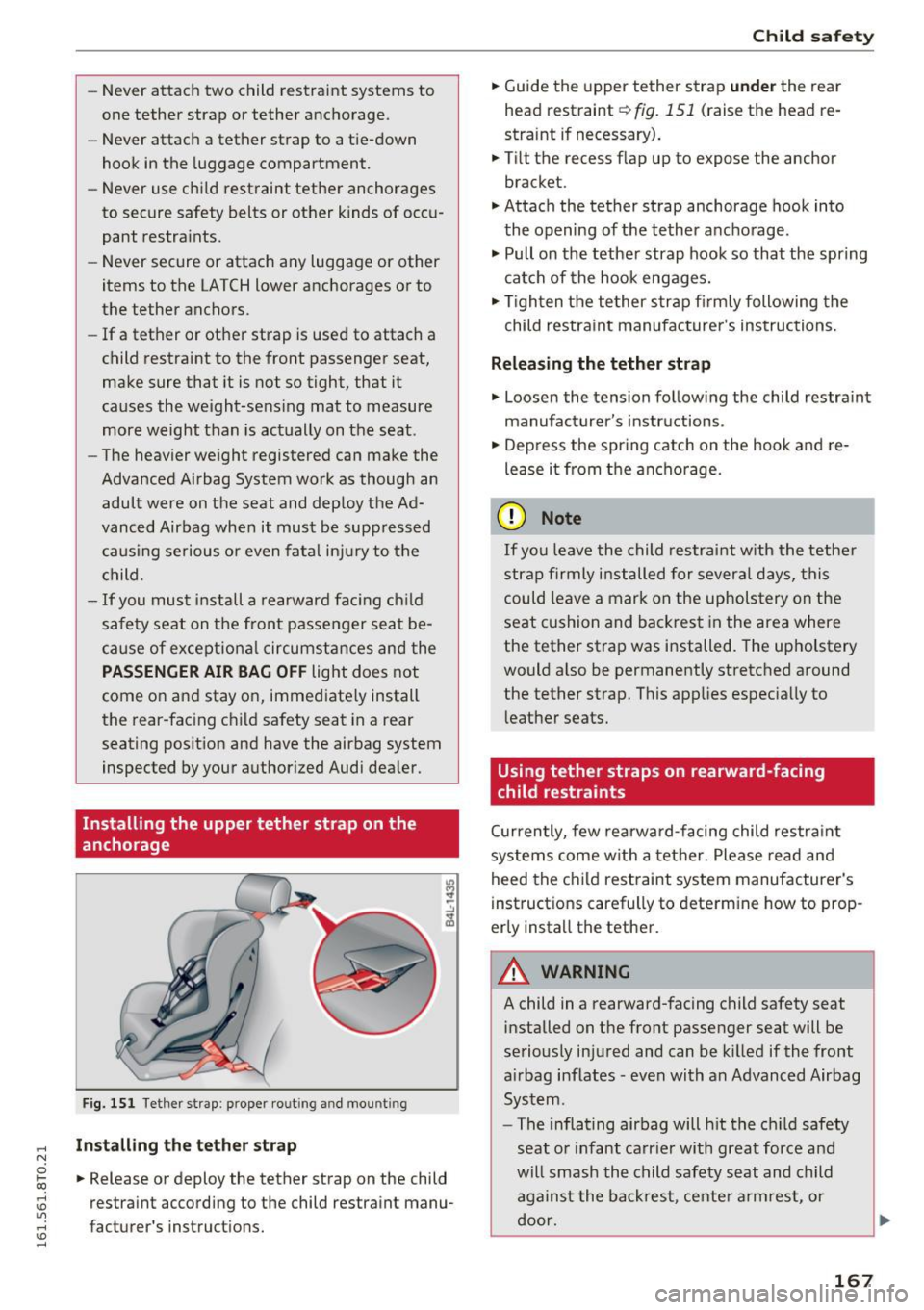
F ig. 151 Tethe r str ap : pro pe r ro uting an d mountin g
Installing th e teth er strap
.,. Release or deploy the tether strap on the child
restra int according to the child restraint manu
fac turer's in struc tions.
Ch ild sa fety
.,. Guide the upper tether strap unde r the rear
head restraint ~
fig. 151 (rais e the head r e
straint if necessary) .
.,. Tilt the recess f lap up to expose the ancho r
bracket .
.,. Attach the tether strap anchorage hook into
the opening of the tether anchorage.
.,. Pull on the tether strap hook so that the spring
catch of the hook engages.
.,. Tighten the te ther s trap fi rm ly following the
child restraint manufacturer 's ins truc tions.
Releasing the tether strap
.,. Loosen the tension follow ing the child restra int
manufact urer 's instr uctions .
.,. Dep ress the spr ing catch on the hook and re
lease it from t he ancho rage.
(D Note
If you leave the child restrai nt w ith the tethe r
stra p firmly i nstalled for several days, this
could leave a mark on the uphols tery on the
seat cushion and back rest in the area where
the tether strap was installed. The upholstery
would a lso be permanently stretched around
the tether strap. This app lies espec ia lly to
l eather seats.
Using tether straps on rearward-facing
child restraints
C urren tly, few rearwa rd-facing child restra int
systems come w ith a tether. Please read and
heed the child restra int system manufacturer's
instructions carefully to dete rm ine how to prop
erly install the tether .
A WARNING
A child in a rearward-facing child safety seat
i nstalled on the front passenger seat will be
seriously inju red and can be k illed if the front
a irbag inflates -even with an Advanced Airbag
System.
- The inflating airbag will h it the c hild safety
seat o r infant ca rr ier with great force and
will smash the child safety seat and child against the back rest , cente r a rm rest, or
door.
167
Page 170 of 264
Child safet y
-A tight tether or other strap on a rearward
facing child restra int attached to the front
passenger seat can put too much pressure
on the we ight-mat in the seat and register a
heavie r weight in the Advanced Airbag Sys
tem . The heav ier weight registered can
make the system wo rk as though an adult
were o n the sea t and deploy the Advanced
Airbag when it must be supp ressed ca using
serious or even fa tal inj ury to the ch ild .
- If you mus t in st all a rearw ard fac ing ch ild
sa fety seat on the front passen ger sea t be
ca use of exceptiona l circumstances and the
PASSENGER AIR BAG OFF light does not
come on and stay on, immed iate ly install
the rearward-facing child safety seat in a rea r seat ing position and have the airbag
system inspected by your author ized Audi
dealer.
Additional information
Sources of information about child
restraints and their use
There are a number of sou rces of addit ional in
formation about child restra int selection, instal
lation and use:
NHTSA advises that the best child safety seat is
the one that fits your chi ld and fits in your vehi
cle, and that you will use correctly and consis
tently .
Try before you buy!
U.S National Highway Traffic Safety Admini stra
tion
Tel.: 1-888-327-4236 (TTY: 1-800-424 -9153)
www.nhtsa.gov
National SAFE KIDS Campaign
Tel.: (202) 662-0600
www .safekids.org
Safety BeltSafe U .S.A
T el.: (800) 745 -SAFE ( English)
Tel.: (800) 74 7-SANO (Span ish)
www .ca rseat .o rg
168
Transport Canada Information Centre
Tel.: 1 -800-333-0371 or ca ll 1-613-998-8616 if
yo u are in the Ottawa area
http://www.tc.gc.ca/ eng/ roadsafety/menu .htm
Audi Customer Relations
Tel.: (800) 822-2834
Page 171 of 264
.... N
0 I-co ....
recorded by the Event
Data Recorder and
vehicle control modules
E ve nt Dat a Record er
This vehicle is equipped wi th an Event Data Re
corder (EDR) . The main purpose of an EDR is to
record, in certain crash or near crash-like situa
tions, such as an a irbag deployment or hitting a
road obstacle, data that will assist in understand
ing how a vehicle's systems performed. The EDR
is designed to record data related to vehicle dy
namics and safety systems for a short period of
time, typically 30 seconds or less. The EDR in this
ve hicle is designed to reco rd such data as:
- How various systems in your vehicle were oper
at ing;
- Whether or not the driver and passenger safety
belts were buckled/fastened;
- How far (if at all) the dr iver was depressing the
accelerator and/or brake pedal; and,
- How fast the vehicle was traveling.
These data can he lp provide a better understand
ing of the c ircumstances in which crashes and in
juries occur. NOTE: EDR data are recorded by your
veh icle only if a non-trivia l crash situation occurs;
no data are recorded by the EDR under normal
driving conditions and no personal data (e .g.,
name, gender, age, and crash location) are re
corded. However, other parties, such as law en
forcement, cou ld combine the EDR data w ith the
type of personally identifying data routine ly ac
quired during a crash investigation.
To read data recorded by an EDR, specia l equip
ment is req uired, a nd access to the ve hicle or the
E DR is needed. In add it ion to the vehicle manu
facturer, other parties, such as law enforcement,
that have the specia l equipment, can read the in
formation if they have access to the vehicle or the
EDR .
Some state laws restrict the retr ieval or down
l oading of data stored by ED Rs insta lled in a vehi
cle for the express purpose of retrieving data af-
Intellig ent Technology
ter an accident or crash event without the own
er's consent.
Audi will not ac cess the EDR and/or sim ilar data
o r give it to others -
- unless the vehicle owne r (or lessee if the vehi
cle has been leased) agrees; o r
- upon the official request by the police; or
- upon the order of a court of law or a govern-
ment agency; or
- for the defense of a lawsuit through the judic ial
discovery process.
- Aud i may a lso use the data for research about
veh icle operation and safety performance or
prov ide the data to a third party for research
purposes without identify ing the specific veh i
cle or info rmat io n about the ident ity of its own
er or lessee and only afte r the reco rded veh icle
data has been accessed.
Vehicle control modules
Your vehicle is also equ ipped w ith a number of
electronic control modules for va rious vehicle
systems, such as engine management, emiss io n
contro l, airbags, and s afety be lts.
These electronic control modules record data dur ing norma l vehicle operation that may be
needed by trained tech nicians for diagnost ic and
r epa ir purposes. The re cording capab il ity of these
modules is lim ited to data (no sound is record
ed). Only a sma ll amount of data is actua lly re
corded over a very limited period of time, or stor
ed when a system fault is detected by a control
module . Some of the data stored may relate to
vehicle speed, direction, or braking, as well as re
straint system use and performance in the event
of a crash. Stored data can also on ly be read a nd
down loaded w ith specia l equipment that is d i
rectly connected to the vehicle.
(D Tips
Your vehicle may be equipped w ith Aud i con
nect. Your use of certain Aud i connect fea
tures requi res wire less serv ices that are pro
v ided by a third party wireless telecomm uni
cations provi der. For de tails regarding how in
formation obtained through Aud i connect is
collected, processed, transmitted, used, and ..,.
169
Page 202 of 264
Check ing and F illing
The brake fluid rese rvoir is located at the rear
partition of the engine compartment on the l eft
side
c!,> pag e 193 .
The fl uid level may drop slightly after some time
due to the automatic adjustment of the brake
pads . This is not cause for alarm.
If th e b rake fl uid level fa lls considerably be low
the "M IN" mark, the b rake warning/ind icator
lig ht ( U.S. mode ls :
1111 , Canadian models:. )
will come on
c!,> page 15 . Do not contin ue to oper
ate the vehicle . T he comp lete brake system
should be thoroughly checked by an authori zed
Aud i dealer or qualified workshop and the cause
corrected . If the brake flu id level is too low, the
b rake warning/indicator light will i llum inate.
Contact a n author ized Audi dealer
immediately .
{D) Tips
The brake fluid reservoir is located under
neath the cover .
Changing brake fluid
Have the brake fluid changed by an experienced
technician .
Brake fluid absorbs mo isture from the air. If the
water content in the b rake fluid is too high, cor
rosion in the brake system may resu lt afte r ape
riod of t ime. The boiling poi nt of the brake flu id
will also decrease cons iderably and decrease
b raking perfo rman ce.
Therefore, the brake fluid must be changed
every
two year s.
Always use new brake fluid wh ic h con
forms to Fede ral Motor Veh icle Standard "FMVSS
1 16 DO T 4".
The brake fluid reservoir can be diff icult to reach,
therefore, we recommend that yo u have the
brake fl uid changed by yo ur autho rized
Audi
dealer .
Your dealer has t he corre ct tools, t he
right brake fluid and the know-how to do this for
you.
A WARNING
- Brake fluid is poisonous. It must be stored
only in the closed orig inal container out of
the reach of chi ldren!
200
- Bra ke fa ilure ca n result from old or inapp ro
priate brake fluid . Observe these precau
tions:
- Use only brake fluid t hat meets SA E speci
fi ca ti on
J 170 3 and con forms to Federa l
Motor Ve hicle Standard 116 . Always check
wi th yo ur autho rized Audi dea le r to make
s ur e yo u are using the correct brake fluid .
The correct type of brake flu id is also ind i
cated on the b rake fluid reservo ir .
- The brake fluid m ust be new . Heavy use of
the brakes can cause a vapo r lock if the
brake fluid is left in the system too long .
This can se riously affect the efficiency of
the b rakes as well as your safety . This
could resu lt in an accident .
(D Note
Brake fluid will damage the paint of your veh i
cle.
@ For the sake of the environment
Because of the problem o f proper d isposa l o f
brake fluid as well as the spec ial too ls re
q ui red a nd the necessary expertise, we rec
omme nd that you have the bra ke f luid
changed by yo ur autho rized Aud i dea le r.
Battery
, General information
U nder normal operating condit ions, the battery
i n your Audi does not need any maintenance.
With
high outside temperatures or long daily
drives we recommend that you have the elect ro
lyte level c hecked by an au thorized Aud i dealer o r
qualified workshop. The electro lyte level shou ld
a lso be che cked each time the battery is c ha rged
c:!,> page 202.
Have the batte ry chec ked when you take yo ur ve
hicle in for service. You are we ll adv ised to re
pla ce a battery tha t is older than 5 yea rs.
With certain types of airbag deployment, t he
batte ry is d iscon nected from the ve hicle electri
ca l system for safety reasons
c!,> .&. in Repair, care
and disposal of the airbags on page 1 42. .,.
Page 235 of 264

..... N
0 1-CX)
rl I.Cl U"I
..... I.Cl ......
Fuse panel @ (black)
No . Consumer
1 Dynamic steering
2 Electronic Stabilization Cont rol (mod ule)
A/C system press ure sensor, elect rome -
chan ica l park ing brake , Homelink, auto-
3 mat
ic dimming interior rear v iew mirror,
air q uality/outside a ir sensor, Electronic
Stabili zation Cont rol (button)
5 Sound actuator
6 Headlight range control/
headlight (cor-
ne ring light)
7 Headlight (corner ing light)
Con trol modules (e lectrom echan ica l par k-
8 ing brake , s hock ab so rbe r, q uattro s port),
DCDC converter
9 Adapt ive cru ise control
1 0 Shift ga te/clu tch se nsor
1 1 Side assist
12 Headlight range control
, p arkin g sys tem
13 Airbag
14 Rear wiper (a
llroad)
1 5 Auxiliary fuse (instrument panel)
1 6 Auxiliary fuse terminal 15 (engine area
)
Fuse panel@ (brown)
No . Consumer
2 Brake light senso r
3 Fuel pump
4 Clutch sensor
5
Left seat heating w it h /w it h out seat venti-
l a tion
6 Electronic Stabili zation Cont rol (e lectr ic)
7 Ho rn
8
F ront left door (window regulator, central
locki ng, mirror, switch, lig hting)
9 Windshield wiper moto r
10 Electronic Stabilization Cont rol (va lves)
Fuses and bulbs
No . Consumer
Two-door mode ls: rear left w indow reg ula-
1 1 tor; Four-door mode
ls: rear left door (w in-
dow regu lator, central locking, switch,
li ght ing)
1 2 Rain and
light sensor
Fuse panel © (red)
No . Consumer
3 Lumbar support
4 Dynam ic steering
5 Inter
io r ligh ting ( Cabr io let)
6 W
indshie ld washer system, headlight
wash er system
7 Vehicle e lectrica l system control module 1
8 Ve hicl e e lec trica l sy stem con trol module 1
9
Left rear window regu lator motor (Cabr io-
l et)/s unroof
1 0 Vehicle e lec tric al system con trol module 1
1 1 R
ight rear window regulator (Cabriolet)/
su n shade motor
1 2 A
nti- theft alarm warning system
Right cockpit fuse assignment
Fig. 183 R ig h t cockp it : f use pane l wit h plast ic cl ip
233
Page 248 of 264
Consumer inf orm ation
@ For the sake of the env ironment
- Changing the engine settings wi ll adversely
affect emission levels. Th is is detrimental to
the environment and increases fuel con
sumption.
- A lways observe environmental regu lations
when disposing of old engine o il, used brake
fl ui d, d irty engine coolant, spent batteries
or worn out tires.
- Undeployed airbag modules and pretension
ers mig ht be classified as Perchlorate Mate
rial -special handl ing may apply, see
www.dtsc .ca.gov/hazardouswaste/perchlo
r ate. When the vehicle or parts of the re
straint system including airbag modu les
safety be lts wi th pretensioners are scrap
ped, all applicab le laws and regulations
must be observed. Your authorized Audi
dealer is familiar with these requirements
and we recommend that you have your deal er perform this service for you.
Accessories and technical changes
Additional accessories and parts replacement
Always consult an authorized Audi dealer before
purchasing accessories.
Your vehicle incorporates the latest safety design
features ensuring a high standard of active and passive safety.
This safety could be comp romised by non-ap
proved changes to the vehicle . For this reason, if
parts have to be replaced, please observe the fo l
lowing points when insta lling addit ional accesso
ries:
Approved Audi accessories and genuine Audi parts are available from author ized Audi dealer.
These dealers also have the necessary facilities,
too ls and trained specialists to install the parts
and accessories properly.
246
A WARNING
-
Using the wrong spare parts or using non-ap-
proved accessories can cause damage to the
vehicle and serious personal injury.
- Use only accessories expressly approved by
Aud i and genuine Audi spare parts
- These parts and accessor ies have been spe
cially designed to be used on your vehicle.
- Never install accessor ies such as telephone
cradles or beverage holders on airbag covers
or w ith in the airbag deployment zones. Do
ing so will increase the risk of injury if a ir
bags are triggered in an accident!
- Before you check anything in the eng ine
compartment, always read and heed all
WARN INGS
Qpage 191.
(D Note
-If items other than genu ine Audi spare
parts, add-on equipment and accessory
items are used or if repair wor k is not per
formed a ccording to specified methods, this
c an resul t in severe damage to you r vehi
cle's eng ine and body (such as corrosion)
and adve rsely af fect your vehicle's war ranty.
- I f emergency repai rs must be performed
elsewhere, have the vehicle exam ined by an
authorized A udi dealer as soon as possib le .
- T he manuf acture r ca nnot be held liable for
damage which occurs d ue to failure to com
ply with these stipulations.
Technical Modifications '
Our guidelines must be complied with when tech
nical modifications are made .
Always consult an a uthorized Audi de aler bef ore
sta rt ing work on any modifica tions.
This will help ensure that vehicle fu nction, per
fo rmance and safety are not impaired
Q ,& .
Attempting to work on electronic components
and the software used with them can cause mal
funct io ns. Because of the way elect ronic compo
nen ts a re interconnected with each othe r, such
malfunc tions c an also have an adverse affect on
othe r systems that are not d irectl y involved. This ..,.