air condition AUDI A5 COUPE 2018 User Guide
[x] Cancel search | Manufacturer: AUDI, Model Year: 2018, Model line: A5 COUPE, Model: AUDI A5 COUPE 2018Pages: 409, PDF Size: 67.63 MB
Page 260 of 409
.,. Observe all traffic laws, rules of the road and
speed limits and plain common sense .
.. ALWAYS adjust your speed to road, traffic and
weather conditions.
.. Take frequent breaks on long trips. Do not drive
for more than two hours at a stretch.
.. Do NOT drive when you are tired, under pres
sure or when you are st ressed.
& WARNING
Impai red dr iv ing safe ty inc reases the risk of
ser ious personal inju ry and death whenever a
vehicle is being used.
Correct passenger
seating positions
Proper seating position for the driver
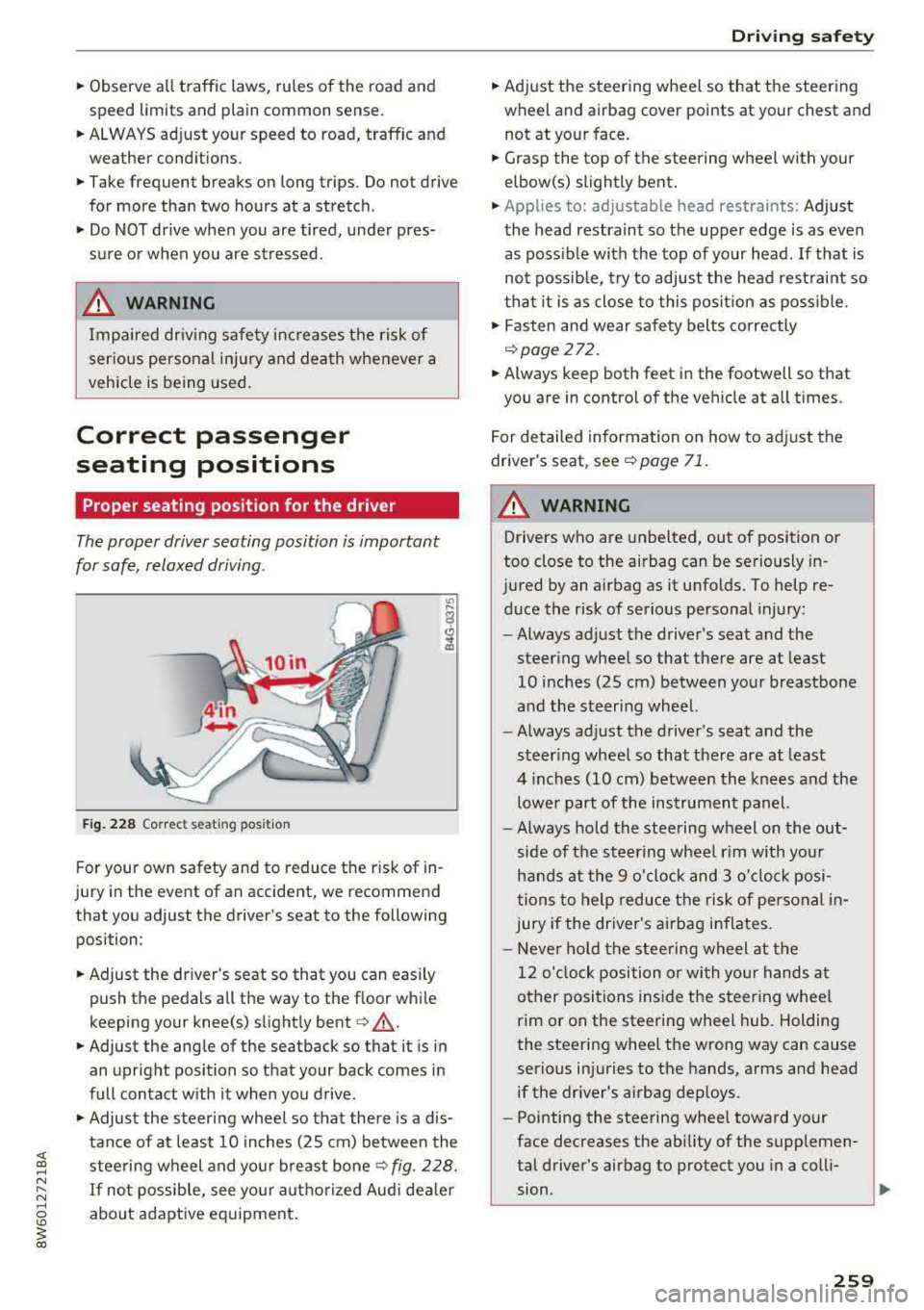
The proper driver seating position is important
for safe, relaxed driving.
F ig . 2 28 Correct seating posit ion
F or your own safety and to reduce the risk of in
jury in the event of an accident, we recommend
that you adjust the driver's seat to the following position:
.. Adjust the dr iver's seat so that you can easily
push the pedals all the way to the floor while
keeping your knee(s) slight ly
bent ¢&_ .
.. Adjust the angle of the seatback so that it is in
an upright position so that your back comes in
full contact w ith it when you drive .
.,. Adjust the steering wheel so that there is a dis
tance of at least 10 in ches (25 cm) between the
steering wheel and you r breast
bone ¢ fig. 228.
If not possib le, see your aut horized Aud i dea le r
about adaptive eq uipment .
Driving safety
.. Adjust the steering wheel so that the steering
wheel and airbag cover points at your chest and
not at yo ur face .
.. Grasp the top of the steering wheel with your
elbow(s) slightly bent .
.,. Applies to: adjustable head restraints: Adjust
the head restraint so the upper edge is as even as poss ible with the top of your head. If that is
not possib le, try to adjust the head rest raint so
t ha t it is as close to this pos ition as poss ible .
.. Fasten and wear safety belts correctly
¢page 272.
.. Always keep both feet in the footwell so that
you are in contro l of the veh icle at a ll times.
F or detailed information on how to adj ust the
drive r's seat, see
¢page 71 .
A WARNING
-
Drivers who are unbelted, out of position or
too close to the airbag can be seriously in
jured by an airbag as it unfolds. To help re d uce the risk of serious personal injury:
- Always ad just the driver's seat and the
steer ing whee l so that there are at least
10 inc hes (25 cm) between you r breastbone
and the steering wheel.
- Always ad just the driver's seat and the
steer ing wheel so that there are at least
4 inches (10 cm) between the knees a nd the
lowe r part of the instrument panel.
- Always hold the steering w heel on the out
s ide of the steering wheel r im with yo ur
hands at the 9 o 'clock and 3 o'clo ck posi
tions to help reduce the risk of personal in
jury if the driver's airbag inflates.
- Never hold the stee ring wheel at the
12 o' clock position o r wi th yo ur hands at
other positions i nside the steer ing whee l
rim or on the steering wheel hub. Holding
the steering wheel the wrong way can cause
serio us injuries to the hands, arms and head
if the dr iver's airbag dep loys.
- Pointing the steering wheel toward your
face decreases the ability of the supplemen
tal driver's airbag to protect you in a coll i·
.,
sion. ..,
259
Page 278 of 409
<( a, .... N ,....
N .... 0 \0
3 a,
Airbag system
Important information
Importance of wearing safety belts and
sitting properly
Airbags are only supplemental restraints. For
airbags to do their job, occupants must always
properly wear their safety belts and be in a prop
er seating position.
For your safety and the safety of your passen
gers, before driving off, always :
.,. Adjust the driver's seat and steering wheel
properly
9 page 259,
.,. Adjust the front passenger's seat properly
¢page 260,
.,. Wear safety belts properly ¢page 271,
.,. Always properly use the proper child restraint
to protect children
¢ page 302.
In a collision, airbags must inflate within the
blink of an eye and with considerable force. The
supplemental airbags can cause injuries if the
driver or the front seat passenger is not seated
properly. Therefore in order to help the airbag to
do its job, it is important, both as a driver and as
a passenger to sit properly at all times.
By keeping room between your body and the
steering wheel and the front of the passenger
compartment, the airbag can inflate fully and
completely and provide supplemental protection in certain frontal collisions
¢ page 259, Correct
passenger seating positions .
For details on the
operation of the seat adjustment controls
¢page 71.
It 's especially important that children are proper
ly
restrained ¢ page 302.
There is a lot that the driver and the passengers
can and must do to help the individual safety fea
tures installed in your Audi work together as a
system.
Proper seating position is important so that the
front airbag on the driver side can do its job. If
you have a physical impairment or condition that prevents you from sitting properly on the driver
seat with the safety belt properly fastened and
Airbag system
reaching the pedals, or if you have concerns with
regard to the function or operation of the Ad
vanced Airbag System, please contact your au
thori zed Audi dealer or qualified workshop, or
call Audi Customer Relations at 1-800-822-2834
for possible modifications to your vehicle.
When the airbag system deploys, a gas generator
will fill the airbags, break open the padded cov ers, and inflate between the steering wheel and
the driver and between the instrument panel and
the front passenger. The airbags will deflate im
mediately after deployment so that the front oc
cupants can see through the windshield again
without interruption.
All of this takes place in the blink of an eye, so
fast that many people don't even realize that the airbags have deployed. The airbags also inflate
with a great deal of force and nothing should be
in their way when they deploy. Front airbags in
combination with properly worn safety belts slow
down and limit the occupant's forward move
ment . Together they help to prevent the driver
and front seat passenger from hitting parts of
the inside of the vehicle while reducing the forces
acting on the occupant during the crash . In this
way they help to reduce the risk of injury to the
head and upper body in the crash. Airbags do not
protect the arms or the lower parts of the body.
Both front airbags will not inflate in all frontal
collisions . The triggering of the airbag system de
pends on the vehicle deceleration rate caused by
the collision and registered by the electronic con
trol unit . If this rate is below the reference value
programmed into the control unit, the airbags
will not be triggered, even though the car may be badly damaged as a result of the collision. Vehi
cle damage, repair costs or even the lack of vehi
cle damage is not necessarily an indication of
whether an airbag should inflate or not.
Since the circumstances will vary considerably between one collision and another, it is not possi
ble to define a range of vehicle speeds that will
cover every possible kind and angle of impact
that will always trigger the airbags . Important
factors include, for example, the nature (hard or
soft) of the object which the car hits, the angle of
impact, vehicle speed , etc. The front airbags will
II>
277
Page 280 of 409
<( a, .... N ,....
N .... 0 \0
3 a,
about children and Advanced Airbags
¢page 302 .
Even though yo ur vehicle is equipped with an Ad
vanced Airbag System, make certain that all chil
dren, especially those 12 years and younger,
a l
ways ride in the back seat properly restrained for
their age and size. The airbag on the passenger
side makes the front seat a potentially dangerous
place for a child to ride. The front seat is not the
safest place for a child in a forward-facing child
safety seat .
It can be a very dangerous place for
a n infant or a child in a rearward-fac ing seat.
T he Advanced Airbag System in your veh icle has
been certified to comply with the requirements
of United States Federal Motor Vehicle Safety
Standa rd (FMVSS) 208, as well as Canada Motor
Veh icle Safety Standa rd (CMVSS) 208 as applica
b le a t the time your veh icle was m an ufact ured.
Accord ing to requirements, the front Advanced
Airbag System on the passenger side has been
certifi ed for "suppression" for infants of about
12 month old and younger and for "low risk
de
ployment" for children aged 3 to 6 years old (as
defined in the standard) .
T he
PASSENGER AIR BAG O FF ~ ; light in the
headliner tells you when the front Advanced Air
bag on the passenger side has been turned off by
the electronic control unit.
Each time yo u turn on the ignition, the
PASSEN
GER AIR BAG OFF
~ ; ON @ light will come on
for a few seconds and:
- PASSENGER AIR BAG OFF ~; will come on if
the front passenger seat is not occupied
- PASSENGER AIR BAG OFF ~; will come on if
the e lectrica l capacitance measured by the
ca
pacitive passenger detection system for the
front passenger seat equa ls the comb ined
ca
pacitance of an infant up to about one year of
age and one of the rearward-facing or forward
facing child restra ints listed i n Federa l Moto r
Vehicle Safety Standard ( FMVSS) 208 with
wh ich the Advanced Airbag System i n your veh i
cl e was certified . Fo r a listing of the child
re
straints that were used to ce rtify you r vehicle 's
compliance with the Safety Standard
¢ page 304 .
Airb ag sys tem
-PAS SENGER AIR BAG OFF ~; will come on if
there is a small chi ld or child restraint on the
front passenger seat
- PASSENGER AIR BAG ON @ will come on if the
front passenger seat is occupied by an ad ult as
registered by the capacit ive passenger detec
tion system
¢ page 289 , Monitoring the Ad
vanced Airbag System .
The PASSENGER AIR BAG OFF ~; light comes on
when e lectrical capacitance registered on the
front passenger seat is equal to or less than the
combined capacitance of a typical 1 year-old
in
fant and one of the rearward-facing or forward
facing child restrai nts listed in Federal Motor Ve
hicle Safety Standard ( FMVSS) 208 with wh ich
the Advan ced Airbag System in yo ur vehicle was
ce rtified.
If the total electr ical capacitance reg istered on
t h e front passenger seat is mo re than that of a
typ ical 1 year -old ch ild but less than the weight
of a sm all adult, the front air bag on the passen
ger side can deploy (the
PASSENGER AIR BAG
OFF ~; light does not come on) .
If the
PASSENGER AIR BAG OFF ~; light does
not come on, the front airbag on the p assenger
s ide has not been turned off by the electronic
contro l unit and can deploy if the contro l unit
senses an impact that meets the conditions stor
ed in its memory .
For example , the airbag may deploy if :
-a small c hild that is heav ier than a typ ica l 1
year -o ld child is on the front passenger se at
(regardless o f whethe r the child is in one o f the
child sa fe ty seats listed
¢ page 304), o r
- a child who has outgrown c hild rest raints is on
t he front passenge r seat .
If the front passenge r airbag is t urned off, the
PASSENGER AIR BAG OFF ~; light comes on i n
t h e headliner a nd stays o n.
If the front passenger a irbag deploys, the Feder
al Standard requi res the airbag to meet the "low
r isk " dep loymen t criteria to redu ce the r isk of
in
j u ry through interaction w it h t he airbag. "Low
risk" deployment oc curs in those crashes that
take place at lowe r decelerations as defined in
Ill>
279
Page 283 of 409
Airbag system
-Never hold the steering wheel at the 12
o'clock position or with your hands any
where inside the steering wheel or on the
steering wheel hub. Holding the steering
wheel the wrong way increases the risk of
severe injury to the arms, hands, and head if
the driver airbag deploys.
,& WARNING
Objects between you and the airbag will in
crease the risk of injury in a crash by interfer
ing with the way the airbag unfolds and/or by
being pushed into you as the airbag inflates.
- Always make sure nothing is in the front air-
bag deployment zone that could be struck
by the airbag when it inflates.
-
- Objects in the zone of a deploying airbag
can become projectiles when the airbag de
ploys and cause serious personal injury.
- Never hold things in your hands or on your
lap when the vehicle is in use.
- Never place accessories or other objects
(such as cup holders, telephone brackets,
note pads, navigation systems, or things
that are large, heavy, or bulky) on the doors;
never attach then to the doors or the wind
shield; never place them over or near or at
tach them to the area marked ,,AIRBAG" on
the steering wheel, instrument panel or the
seat backrests; never place them between
these areas and you or any other person in
the vehicle.
- Never attach objects to the windshield
above the passenger front airbag, such as
accessory GPS navigation units or music
players. Such objects could cause serious in
jury in a collision, especially when the air bags inflate.
- Never recline the front passenger seat to transport objects. Items can also move into
the deployment area of the side airbags or
the front airbag during breaking or in a sud
den maneuver. Objects near the airbags can
fly dangerously through the passenger com partment and cause injury, particularly
when the seat is reclined and the airbags in
flate.
282
,& WARNING
, -
A person on the front passenger seat, espe
cially infants and small children, will receive
serious injuries and can even be killed by be ing too close to the airbag when it inflates .
- Although the Advanced Airbag System in your vehicle is designed to turn off the front passenger airbag if an infant or a small child
is on the front passenger seat, nobody can
absolutely guarantee that deployment un
der these special conditions is impossible in
all conceivable situations that may happen
during the useful life of your vehicle.
- The Advanced Airbag System can deploy in accordance with the
,.low risk" option for 3-
and 6-year-old children under the U.S. Fed
eral Standard if a child with electrical capac
itance greater than the combined capaci
tance of a typical one-year old infant re
strained in one of the forward facing or rear
ward-facing child seats with which your ve hicle was certified is on the front passenger
seat and the other conditions for airbag de
ployment are met.
- Accident statistics have shown that children
are generally safer in the rear seat area than
in the front seating position.
- For their own safety, all children, especially
12 years and younger, should always ride in
the back properly restrained for their age
and size.
Advanced front airbag system
Your vehicle is equipped with a front Advanced
Airbag System in compliance with United States
Federal Motor Vehicle Safety Standard (FMVSS)
208, as well as Canada Motor Vehicle Safety
Standard (CMVSS) 208 as applicable at the time
your vehicle was manufactured .
-
The front Advanced Airbag System supplements
the safety belts to provide additional protection
for the driver's and front passenger's heads and upper bodies in frontal crashes. The airbags in
flate only in frontal impacts when the vehicle de-
celeration is high enough.
ll>
Page 303 of 409
Child safety
Child safety
Important information
Introduction
The rear seat is generally the safest place in a
collision .
The physical principles of what happens when
your vehicle is in a crash apply also to children
¢ page 2 70, What happens to occupants not
wearing safety belts? .
But unlike adults and
teenagers, their muscles and bones are not fully
developed. In many respects children are at
greater risk of serious injury in crashes than
adults .
Because children's bodies are not fully devel
oped, they require restraint systems especially
designed for their size, weight, and body struc
ture. Many countries and all states of the United
States and provinces of Canada have laws requir
ing the use of approved child restraint systems
for infants and small children .
In a frontal crash at a speed of 20 -3 5 mph (30 -
S6 km/h) the forces acting on a 13-pound (6 kg)
infant will be more than 20 times the weight of
the child. This means the weight of the child
would suddenly be more than 260 pounds
(120 kg) . Under these conditions, only an appro
priate child restraint properly used can reduce
the risk of serious injury . Child restraints, like
adult safety belts, must be used properly to be
effective. Used improperly, they can increase the
risk of serious injury in an accident.
All children, especially those 12 years and young
er must always ride in the back seat properly re
strained for their age and size. If you must install
a child restraint on the front passenger seat in
exceptional circumstances, be sure to read and
heed the important information and warnings
¢ page 2 78. Infants and other children who are
properly restrained in an appropriate child re
straint that is for their si ze and age can benefit
from the protection that supplemental side air
bags provide in some kinds of crashes .
For more information please see information
provided by the:
302
-National Highway Traffic Safety Administration
(NHTSA), currently at: http :/ /www.safe
rcar.gov (for the USA)
-Transport Canada Information Centre, current-
ly at: http://www.tc.gc.ca (for Canada)
Consult the child safety seat manufacturer's in
structions in order to be sure the seat is right for
your child's
size ¢ page 306, Important safety
instructions for using child safety seats.
Please
be sure to read and heed all of the important in
formation and WARNINGS about child safety,
Advanced Airbags, and the installation of child
restraints in this chapter .
There is a lot you need to know about the Ad
vanced Airbags in your vehicle and how they work
when infants and children in child restraints are
on the front passenger seat. Because of the large
amount of important information, we cannot re
peat it all here. We urge you to read the detailed
information in this owner's manual about airbags
and the Advanced Airbag System in your vehicle
and the very important information about trans
porting children on the front passenger seat.
Please be sure to heed the WARNINGS
-they are
extremely important for your safety and the safe
ty of your passengers, especially infants and
small children .
A WARNING
-Accident statistics have shown that children
are generally safer in the rear seat area than
in the front seating position. Always restrain
any child age 12 and under in the rear.
-All vehicle occupants and especially children
must be restrained properly whenever riding
in a vehicle. An unrestrained or improperly
restrained child could be injured by striking
the interior or by being ejected from the ve
hicle during a sudden maneuver or impact.
An unrestrained or improperly restrained
child is also at greater risk of injury or death
through contact with an inflating airbag.
-A suitable child restraint properly installed and used at one of the rear seating positions
provides the highest degree of protection
for infants and small children in most acci
dent situations.
Page 358 of 409
<( a, .... N ,....
N .... 0 \0
3 a,
(1400-750 (5 X 150) = 650
lbs.)
5 . De termin e the combined
w eig ht of lugg age and carg o
b eing load ed on the vehicle .
Th at w eight ma y not safel y ex
c e e d th e ava ilabl e c argo and
lu ggag e load ca pacit y ca lculat
ed in Step 4 .
6 . I f you r veh ic le will b e tow ing a
tr aile r, load from your tr ailer
will be tran sferred to y our ve
hi cle . Con sult thi s manual to
de te rmin e how this redu ces
th e av ailabl e car go and lug
ga ge load capa cit y o f your vehi
cle.
..,. Chec k the tire s idewall
(¢ page 34 1, fig . 282) to de ter
min e the de sign ated load r ating
for a speci fic tire.
Wheel bolts and rims
Wheel bolts
Wheel bolts must be clean and loosen/t ighten
eas ily.
Rims
Rims with a bolted rim ring " or with bolted wheel
covers* consist of m ultip le pieces . These compo
n ents were bolted together using specia l bolts
a nd a special procedure . You must not repair or
d isassemble
t h em ¢.&. .
_& WARNING
Wheel bolts tha t are t igh tened or re paired in
c orrectly can be come loose and result in loss
Wh eel s
of vehicle contro l, wh ich increases the risk of
an accident. For the cor rect tighten ing spec ifi
cation, see
c:> page 374, Finishing.
- Always keep the wheel bolts and the
threads in the wheel h ub clean and free of
grease.
- Only use wheel bolts that fit the rim.
- Always have damaged rims repaired by an
author ized Audi dealer or author ized Audi
Serv ice Facility. Never repair o r disassemb le
rims yourself, because th is increases the r isk
of an acc ident .
Winter tires
Winter tires significantly imp rove the vehicle 's
handling when dr iv ing in winter conditions . Be
ca use of their const ruct ion (w idth , compou nd,
t read pattern), s ummer tires prov ide less t rac
t ion on i ce and snow.
.,. Use winter tires on all four wheels .
.,. Only use winter tires that are app roved for yo ur
ve hicle.
.,. Please no te that the max imum permi tted
speed may be lowe r with winter tires
c:> .&_ . An
authoriz ed Audi dealer or authorized A udi Serv
ice Facility can inform yo u about the maximum
permitted speed for your tires .
.,. Check the tire pressure after insta lling wheels
c=> page351 .
The effectiveness of winter tires is reduced great
ly when the tread is worn down to a depth of
0.16 in (4 mm). The characteristics of w inter
tires also decrease greatly as the tire ages, re
gardless of the rema ining t read .
_& WARNING
-
- Never d rive fa ster than the max imum pe r
mitted spee d for your tires. This could c ause
the t ires to he at up too mu ch. This inc reases
the risk of an accident because it can cause
the tire to burst.
- Always adapt your driving to the road and
traffic conditions. Drive carefully and reduce
your spee d on icy or slippery roads . Even
winter t ires can lose t ract ion on black ice.
..,..
357
Page 390 of 409
<( a, .... N ,....
N .... 0 \0
3 a,
Consumer Information
Warranty coverages
Y our Audi is co vered b y the following war ran
tie s:
- New Vehicle Limited Warranty
- Limited Warranty Against Corrosion Perfora-
tion
- Emissions Control System Warranty
- Emissions Performance Warranty
- California Emissions Control Warranty (USA
vehicles only)
- California Emissions Performance Warranty
(USA vehicles only)
Detailed information regard ing your warranties
can be found in yo ur
W arranty & M ainten ance
bookl et.
Operating your vehicle
outside the U.S.A. or
Canada
Government reg ulations in the Un ited States and
Canada require that automobiles meet specific
emission regulations and safety standards.
Therefore, vehicles built for the U .S.A. and Cana
da d iffer from vehicles sold in other countries.
I f you p lan to take your vehicle outside the conti
nenta l limits of the United States or Canada,
there is the poss ibility that:
- u nleaded fue ls for vehicles with cata lytic con
verter may not be available;
- fuel may have a considerably lower octane rat
i ng . Imprope r fuel may ca use engine damage;
- service may be inadequate due to lack of p roper
service facilities, tools or testing eq uipment;
- r eplacement parts may not be readily ava ilable.
- Navigat ion systems for veh icles built for the
U .S .A . and Canada will not necessa rily work in
Eur ope, and may not wo rk in other countries
o utside of North Amer ica.
Consumer Inf ormation
(D Note
Audi cannot be respons ible for mechanical
damage that could resu lt from inadequate
fuel, service or parts ava ilability.
Audi Service Repair
Manuals and Literature
Audi Official Factory Service Manuals and L itera
ture are published as soon as poss ible after mod
el i ntroduction. Service Ma nua ls and literature
are avai lab le to order from the Audi Tec hni cal Lit
erature Orde ring Center at :
www.audi.t e chlit eratur e.com
Maintenance
General
Your vehicle has been designed to he lp keep
maintenance requirements to a min imum. How
ever, a certain amount of regular maintenance is
still necessary to assure your veh icle's safety,
economy and reliab ility . For detailed vehicle
maintenance consult your Wa rranty
& Mainte
nance boo klet .
Und er diff icult op erating condition s, for exam
ple at extremely low outside temperatures, in
very dusty regions, when towing a trai le r very fre
quently, etc., some se rvice work shou ld be pe r
fo rmed between the in terv als specified. This ap
plies particularly to:
- oil changes , and
- cleaning or replac ing the a ir filter .
(® For the sake of the environment
By regularly maintain ing your vehicle, you
help make sure that emiss ion standards are
maintai ned, thus min imizing adverse effects
on the environment .
Important considerations for you and your
vehicle
The increasing use of electronics, sophisticated
fuel injection and emission control systems, and
the genera lly increas ing techn ica l complexity of
""'
389
Page 391 of 409
Consumer Info rmation
today's a utomo biles, have steadily reduced the
scope of maintenance and repairs which can be
carried out by veh icle owners.
Also , sa fet y and
en vironmental
concerns place very strict limits
on the nature of repairs and adjustmen ts to en
g ine and transmission parts wh ich an owner can
perform .
Maintenance, adjustments and repairs usually re
qu ire special tools, testing devices and other
equ ipment available to specially trained work
shop personnel in order to assure proper per
forma nce, re liability and safety of the veh icle and
its many systems .
Improper maintenance, adjustments and repairs
can impair the operation and reliab ility of your
ve hicle and eve n void your vehicle warranty .
Therefo re, proof of se rvicing in a ccordance w ith
the m aintenance sched ule may be a condition for
up ho ld ing a possible wa rranty claim made within
the wa rranty pe riod.
Above all , ope rational safety can be adversely af
fected, cre ating unne cessa ry risks fo r you and
your passengers.
I f in doubt about any servicing, have it done by
your author ized Audi dealer or any other properly
eq uipped and qualified workshop . We strongly
urge you to g ive your author ized Audi dealer the
opportunity to perform a ll scheduled mainte
nance and necessa ry repairs. Your dealer has the
facilities, origina l parts and tra ined specialists to
keep your veh icle runn ing prope rly.
Performing limited maintenance yourself
The fo llow ing pages describe a limited number of
procedures whic h can be performed on your vehi
cle with ordinary tools, should the need arise and
tra ined personnel be unava ilable. Before per
forming any of these procedures, always thor
ough ly read all of the app licab le text and carefu l
ly follow the instructions g iven . A lways rigorously
observe the
WARNINGS prov ided .
Befo re yo u check anything in the engine com
partment, always read and heed all WARNINGS
c::> & and c::> & in Working in the engine compart
ment on page 330 .
390
A WARNING
-
-Ser ious personal in jury may occur as a result
of imp roperly performed maintenance, ad
justments or repairs .
- Always be extreme ly careful when work ing
on the vehicle . Always follow commonly ac
cepted safety practices and general com mon sense. Never r is k personal in jury.
- Do not attempt any of the mainte nance,
checks or repairs described on the following pages if you are no t fu lly fam iliar with these
or other proce dures with respect to the ve
hicle, o r are uncert ain how to p ro ceed.
- Do not do any work wi thout the prope r tools
a nd equi pmen t. H ave the necess ary wo rk
done by your authorized Au di dealer or an
other properly equipped and qualified work
shop.
- The engine compartment of any motor veh i
cle is a potentially hazardous area . Never
reach into the a rea around or touch the radi
ator fan. It is temperature controlled and
can switch on suddenly - even when the en
gine is off and the ignition key has been re
moved. The rad iator fan switches on auto
mat ica lly when the coolant reaches a certain
temperature and will con tinue to ru n until
the coolant temperat ure drops.
- Always remove the igni tion key before any
one gets u nder the vehicle.
- Always support your vehicle with safety
stands if it is necessary to work underneath
the vehicle. The ja ck* s upplied w ith the vehi
cle is no t ad equate fo r thi s pu rpose and
could collapse causing se rious personal in
jury .
- If you must wor k underne ath the vehicle
with the wheels on t he ground, always make
sure the vehicle is on level ground, that the
wheels a re always sec urely blocked and that
the engine cannot be started.
- Always make sure the transmission se lector
lever (automatic t ransm iss ion) is in P (Park
position) and the park b rake is applied.