instrument panel AUDI A5 COUPE 2018 User Guide
[x] Cancel search | Manufacturer: AUDI, Model Year: 2018, Model line: A5 COUPE, Model: AUDI A5 COUPE 2018Pages: 409, PDF Size: 67.63 MB
Page 286 of 409
<( a, .... N ,....
N .... 0 \0
3 a,
Airbag System for the front passenger seat from
doing its job in a crash.
The f ront Ad vanced Airb ag S ystem con sists
of t he follo wing :
-Crash sensors in the front of the vehicle that
measure vehicle acceleration/deceleration to
provide information to the Advanced Airbag
System about the severity of the crash.
-An electronic control un it, with integrated
crash sensors for front and side impacts. The
control unit "decides" whether to fire the front
airbags based on the information received from
the crash sensors. The control unit also
"de
c ides" whether the safety belt pretens ioners
shou ld be activated .
-An Advanced Airbag with gas generator and
contro l valve for the driver ins ide the steer ing
wheel hub.
-An Advanced Airbag with gas generator and contro l valve inside the instrument pane l for
the front passenger.
-A capac itive passenger detect io n system unde r
neath the front passenger seat cover. This sys
tem measures the elect rical capac ita nce of the
person in the seat. The i nformation registe red
is sent continuously to the electron ic control
unit to regulate deployment of the front Ad
vanced Airbag on the passenger side.
-An airbag monitoring system and indicator
light
m in the instrument cluster .
-A sensor in each front seat reg isters the dis
tance between the respective seat and the
steering wheel or instrument panel. The infor
mation reg istered is sent continuously to the
electronic control unit to regulate deployment
of the front Advanced A irbags.
-The PA SS EN GER AIR BAG OFF ~; ON@ light
comes on in the
headliner ¢ page 289,
fig. 248 and tells you the status of the Ad
vanced Airbag on the passenge r side .
-A sensor in the safety belt latch for the dr iver
and for the front seat passenger that senses
whether that safety belt is latched or not and
transm its this info rmat ion to the elect ronic
contro l unit.
Airb ag sys tem
_& WARNING
Damage to the front passenger seat can pre
vent the front airbag from working properly.
- Improper repair or disassembly of the front
passenger and driver seat will prevent the
Advanced Airbag System from funct ion ing
properly.
- Repairs to the front passenger seat must be
performed by qualified and properly trained
workshop personnel.
- Never remove the front passenger or driver seat from the vehicle.
- Never remove the upholstery from the front
passenger seat.
- Never disassemble or remove parts from the
seat or disconnect w ires from it.
- Never carry sharp objects in your pockets or
put them on the seat. The capacit ive pas
senger detect ion mat in the front passenger
seat will not function p roperly if it is punc
tured.
- Never carry things on your lap or carry ob
jects on the front passenger seat. S uch ob
jects can influence the capacitance reg is
tered by the capacitive passenger detection
system, so that incorrect informa tion is pro
vided to the airbag control unit.
- Never store i tems unde r the front passenger
seat . Parts of the Advanced Airbag System
under the passenger seat could be dam
aged, p reventing them and the airbag sys
tem from working proper ly.
- Never p lace seat covers or replacement up
holstery that have not been specifically ap
proved by Audi on the front seats.
- Seat covers can prevent the Advanced A ir
bag System from recognizing chi ld re
stra ints or occupants on the front passenger
seat and prevent the side airbag in the seat
backrest from deploying properly.
- If a seat heater has been retrofitted or oth
erwise added to the front passenger seat,
never install any child restra int system on
this seat.
- Never use cushions, p illows, blankets, or
similar items on the front passenge r seat .
285
Page 293 of 409
Airbag syste m
Make sure that the PASSENGER AIR BAG
OFF
11;; li ght comes on and stays on all t he
t ime whenever the ignition is switched on.
A WARNING
- If the PA SSEN GER AIR BAG OFF 11;; light
does not go out when an adult is si tting on
the front passe nger seat a fter ta king the
steps described above, make sure the adult is p roperly seated and restrained at one of
the rear seating positions.
- Have the airbag system inspected by your
authorized Aud i dealer before transporting
anyone on the front passenger seat.
@ Tips
If the capacitive passenger detection system
determines that the front passenger seat is
empty, the frontal airbag on the passenge r
side w ill be tu rned off, and the
PASSENGER
AIR BAG OFF
11;; light will stay on.
-
Repair , care and disposal of the airbags
Parts of the a irbag system are installed at many
different places on your Audi. Installing, remov ing, servic ing or repa iring a part in an area of the
ve hicle can damage a part of an airbag system
and prevent that system from working properly
i n a collision .
There are some important things you have to
know to make sure that the effectiveness of the
system w ill not be impaired and that discarded
components do not cause injury or pollute the
env ironment.
A WARNING
Improper care, serv icing and repai r proce
dures can increase the r is k of personal injury
and death by preventing an airbag from de
ploying when needed or dep loying an airbag
unexpectedly:
-
- Never cover, obstruct, or change the stee r
ing wheel horn pad or airbag cover or the in
strument pane l or modify them in any way.
292
- Never attach any objects s uch as c upholders
or telephone mountings to the surfaces cov
ering the a irbag un its.
- For cleaning the horn pad or instrument
panel, use only a soft, dry cloth or one mois
tened w ith plain water. Solvents or cleaners
could damage the airbag cover or change
the st iffness or strength of the material so
that the airbag canno t deploy and p rotect
properly.
- Never repair, adjust , or change any parts of
the airbag system.
- All work on the steering wheel, inst rument
panel, front seats or e lectr ica l system ( in
cluding the installation of a udio eq uipment,
cellular telephones and C B radios, etc.)
m ust be perfo rmed by a qualified techn ician
who has the training and specia l equipment
necessary.
- For any work on the airbag system, we strong ly recommend that you see your au
thorized A udi dealer or qualified workshop.
- Never modify the front b umper or parts of
the vehicle body.
- Always make sure that the side a irbag can
inflate w ithout interference:
- Never install seat covers or replacement
u pholstery over the front seatbacks that
have not been specifically approved by
A udi.
- Never use additional seat c ushions that
cover the areas where the side airbags in
flate.
- Damage to the orig inal seat cove rs or to
the seam in the area of the s ide airbag
module mus t always be repaired immedi
ate ly by an autho riz ed Au di dealer.
- The a irbag system can deploy on ly once. Af
ter an airbag h as been deployed, i t m ust be
repla ced with new replacement parts de
signed and approved espec ia lly for your
Audi model version . Replacement of com
plete airbag systems or airbag components
must be perfo rmed by qua lified workshops
only. Make su re that any airbag service ac
tion is entered in your A udi Warranty
&
Ma intenance boo klet under AIRBAG RE-
PLAC EM EN T RECORD.
~
Page 294 of 409
-For safety reasons in severe accidents, the
alternator and starter are separated from
the vehicle battery with a pyrotechn ic circuit
interrupter.
-Work on the pyrotechnic circ uit interrupt
er must only be performed by
a qualified
technicians who have the experience, in
formation and special tools necessary to
perform the work safely.
-I f the vehicle or the circuit interrupter is
scrapped, all app licab le safety precautions
must be followed .
@) For the sake of the environment
Undeployed airbag modu les a nd pretension
ers might be classified as Perch lorate Materi
al
-special handling may apply, see
www.dtsc .ca.gov/hazardouswaste/perchlo
rate. When the vehicle or parts of the re
straint system including airbag modules and
safety belts with pretensioners are scrapped,
all applicable laws and regulations must be
observed. Your authorized Audi dealer is fa
m iliar with these requi rements a nd we recom
mend t hat you have you r dealer perform this
service for you.
Other things that can affect Advanced
Airbag performance
Changing the vehicle's suspension system can
change the way that the Advanced Airbag System performs in a crash . For example, using tire-r im
comb inat ions not approved by Audi, lowering the
ve hicl e, chang ing the stiffness of the suspens io n,
in clud ing the spr ings, suspens ion str uts, shock
absorbers et c. can change the forces that are
measured by the airbag sensors and sent to the
e lectronic contro l unit. Some suspension changes
can, for example, increase the force levels meas
ured by the sensors and make the airbag system
deploy in crashes in wh ich it would not deploy if
the changes had not been made. Other ki nds of
changes may reduce the fo rce levels meas ured by
the sensors and prevent the airbag from deploy
in g when i t should .
Airbag sys tem
A WARNING
-Changing the vehicle's suspension including
use of unapproved tire-rim combinations can
change Advanced Airbag performance and in
crease the risk of serious persona l injury in a
crash.
- Never install suspension components that
do not have the same pe rformance charac
teristics as the components o rigina lly ins tal
led on your vehicle.
- Never use tire-rim combinations t hat have
not been approved by Audi.
Knee airbags
Description of knee airbags
The knee airbag system can provide supplemen
tal protection to prop erly restrained front sea t
occupants.
F ig. 2 49 Driver 's knee a irbag
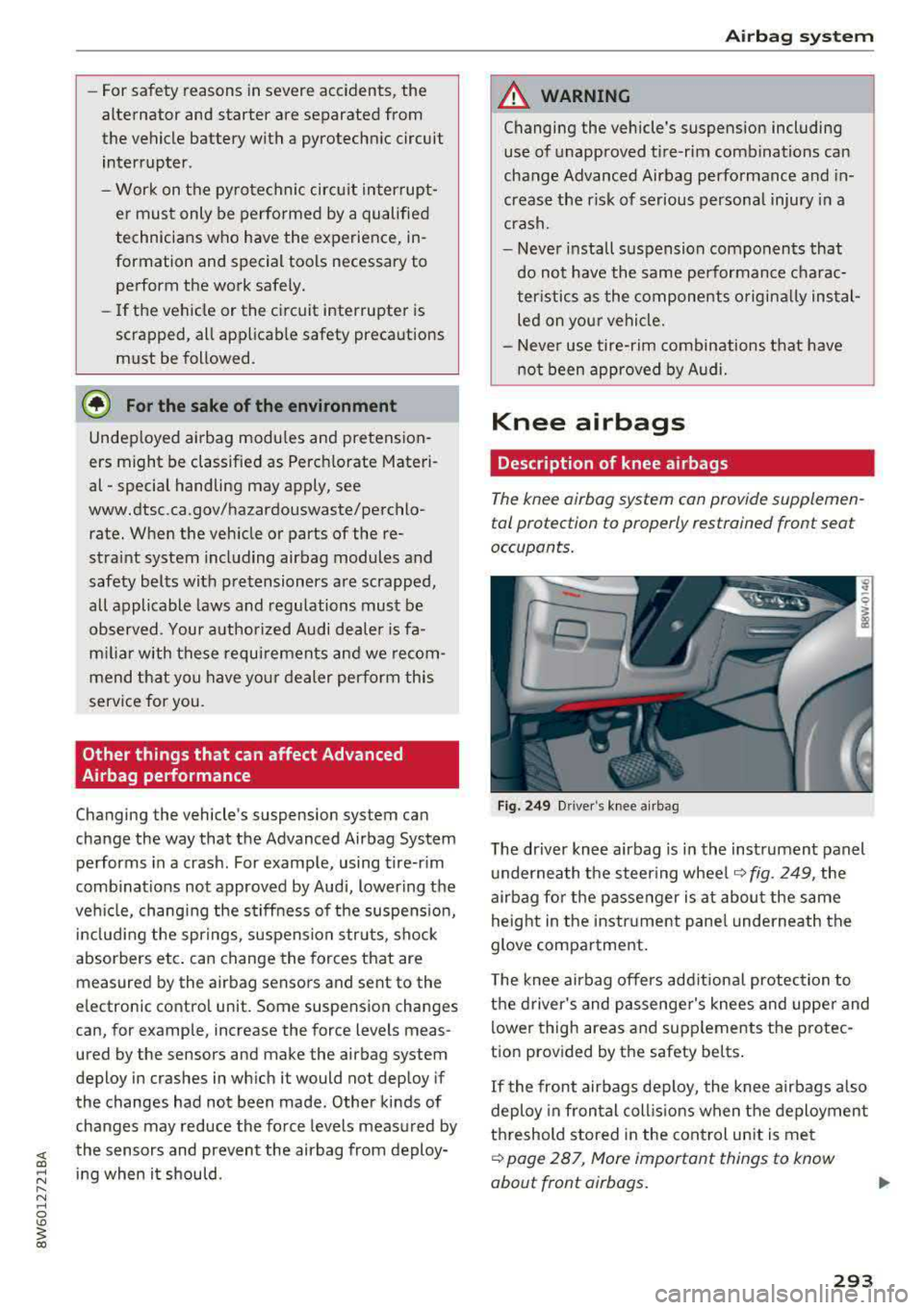
The driver knee airbag is in the instrument panel
u nderneath the steering whee l
~fig. 249, the
airbag fo r the p asse nger is at about the same
height in the instr ument pane l underneath the
glove compa rtment.
T he knee airbag offers add itiona l protection to
the driver's and passenge r's knees and uppe r and
lower thigh areas and supp lements the protec
tion provided by the safety be lts .
If the front airbags deploy, the knee airbags a lso
deploy in fron tal coll is ions when the deploymen t
threshold stored in the cont rol un it is me t
~ page 287, More important things to know
about front airbags.
293
Page 295 of 409
Airbag system
In addition to their normal safety function, safe
ty belts help keep the driver or front passenger in
position in a frontal collision so that the airbags
can provide supplemental protection.
The airbag system is not a substitute for your
safety belt. Rather, it is part of the overa ll occu
pant restraint system in your vehicle. Always re member that the airbag system can only help to
protect you if you are wearing your safety belt
and wearing it properly . This is why you should
always wear your safety belt, not just because
the law requires you to do so ¢
page 268, Gener
al information.
Remember too, airbags will deploy only once and
only in certain k inds of accidents - your safety
belts are always there to offer protection in those
accidents in which airbags are not supposed to
deploy or when they have already deployed, for
examp le when your vehicle str ikes or is struck by
another after the first collision .
This is just one of the reasons why an airbag is
not a substitute for the safety belt. The a irbag
system works most effectively when used with
the safety belts. Therefore, always wear your
safety belts correct ly.
It is important to remember that while the sup
p lemental knee airbag system is designed to re
duce the likelihood of serious injuries, other inju
ries, for example, swe lling, bruising and minor
abrasions and friction burns can also occur when
an airbag inflates .
The knee airbag system basically consists of:
- T he electronic control module
- T wo inflatab le airbags (airbag and gas genera-
tor), one for the driver and one for the front
passenger
- The airbag indicator ligh t in the instrument
panel
The knee airbag system will not deploy:
-whe n the ignition is switched off
- in frontal collisions when the deceleration
measured by the control un it is too low
- in side collisions
- in rear-end collisions
294
- in rollovers
- in the event of a system malfunction (warning/
ind icator light is on)
¢page 32 .
A WARNING
-Safety belts and the airbag system can only
provide protection when occupants are in
the proper seating
position ¢ page 287 .
-If the airbag indicator light ¢ page 32
comes when the veh icle is being used, have
the system inspected immediately by your
author ized Audi dealer. It is possible that
the airbag will inflate when it is not sup
posed to, or will not inflate when it should.
How knee airbags work
The risk of injury to the leg area con be reduced
by fully inflated knee airbags.
Fig. 250 In flated a irbags protect ing in a fro nta l coll ision
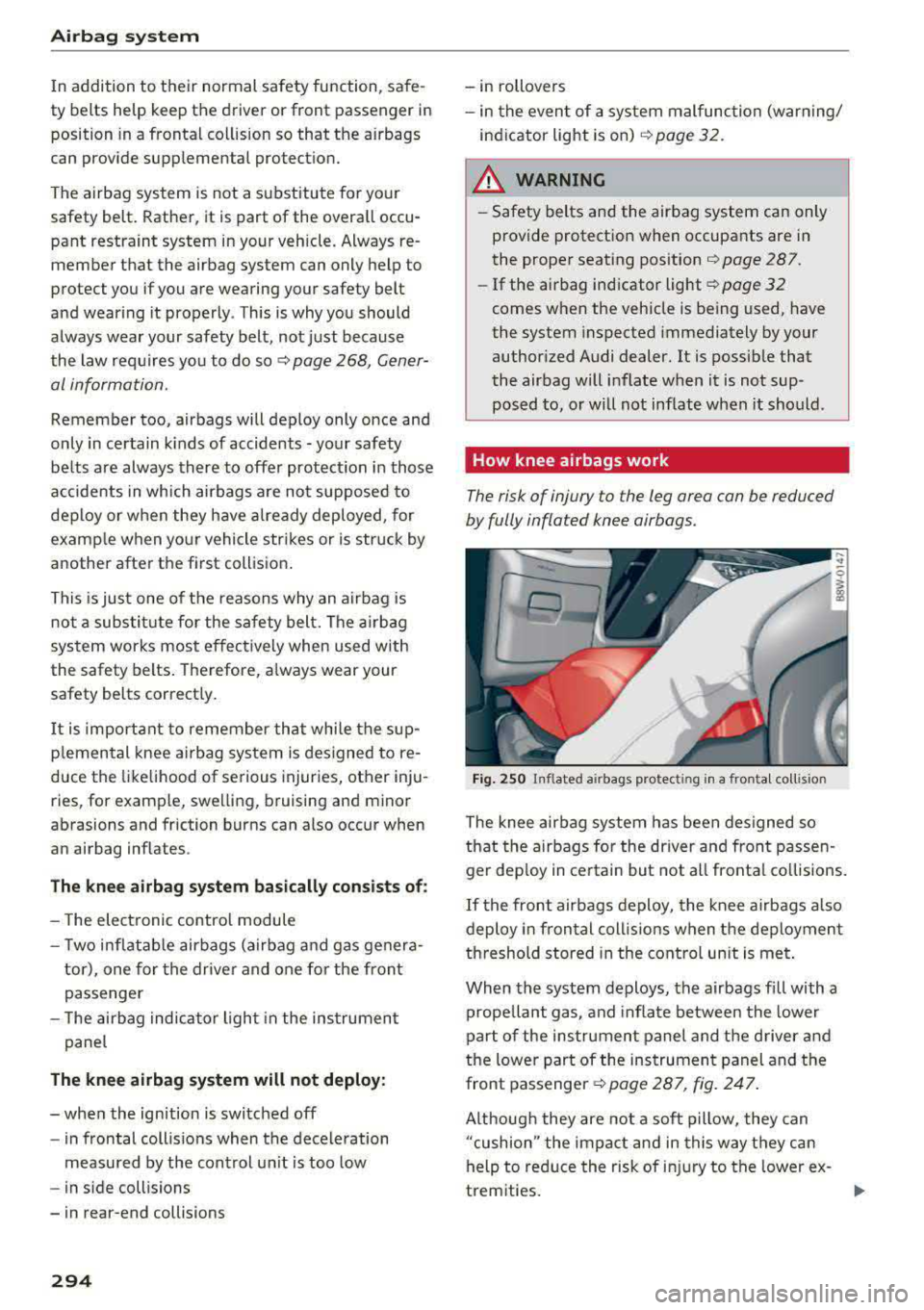
The knee airbag system has been designed so
that the airbags for the dr iver and front passen
ger dep loy in certain but not all fronta l collisions .
If the front airbags deploy, the knee airbags also
deploy in frontal collisions when the deployment
threshold stored in the control unit is met .
When the system deploys, the airbags fill with a
prope llant gas, and inflate between the lower
part of the instrument panel and the driver and
the lower part of the instrument panel and the
front passenger
¢page 287, fig. 247 .
Although they are not a soft pillow, they can
"cushion" the impact and in this way they can
help to reduce the risk of injury to the lower ex
tremities.
Page 296 of 409
All of this takes place in the blink of an eye, so
fast that many people don't even realize that the airbags have deployed . The airbags also inflate
with a great deal of force and it is important for
occupant safety that nothing should be in their
way when they deploy .
Fully inflated airbags in comb ination with proper
ly worn safety belts slow down and limit the oc
cupant 's forward movement and help to reduce
the r isk of injury .
Important safety instructions on the knee
airbag system
Airbags are only supplemental restraints . Always
wear safety belts correctly and ride in a proper
seating position.
There is a lot that you and your passengers must
know and do to help the safety be lts and airbags
to provide s upplemental protection .
,& WARNING
An inflating knee airbag can cause ser ious in
jury. Wearing safety bel ts incor rectly and im
proper seating posit ions increase the r isk o f
serious personal injury and death whenever a
vehicle is being used.
- The knee airbag system cannot protect you
prope rly if you are seated too close to any of
the a irbag locat ions. When ad justing their
seat positions, it is important that both the
dr iver and the front passenger keep their
upper bod ies a nd knees at the following
min imum safe d istances:
- at least 10 inches (25 cm) between the
chest and the steering wheel/instrument
panel.
- at least 4 inc hes (10 cm) between the
knees and the lower part of the instru
ment panel.
- The risk of persona l injury increases if you
lean forward or to the side, or if the seat is
improper ly positioned and you are not wear
ing your safety belt. The risk increases even
more should the a irbag deploy.
- Always make sure that the knee airbag can
inflate without interference. Objects
be-
Airb ag sys tem
tween you and the airbag can increase the
risk of injury in an accident by interfering
wit h the way the airbag deploys or by being
pushed into yo u as the a irbag deploys.
- Never let anybo dy, especi ally children or
anima ls r ide in the footwell i n front of the
passenger seat. If the airbag deploys, this
can result in serious o r fatal in juries.
- Never carry objects of any kind in the foo t
well area in front of the driver's or pas
senger's seat . Bulky objects (shopp ing
bags, for example) can interfere with or
prevent proper dep loyment of the airbag.
Small objects can be thrown th rough t he
vehicle if the airbag deploys and injure you
o r your passengers.
- Make sure the re a re no cracks, deep scratch
es o r othe r damage in the area of the inst ru
ment panel where the knee airbags a re lo
ca ted.
- If ch ildren are incorrectly seated, their risk
of injury inc reases in a coll is ion
~ page 302, Child safe ty.
Side airbags
Description of side airbags
The airbag system can provide supplemental
protection to properly restrained occupants.
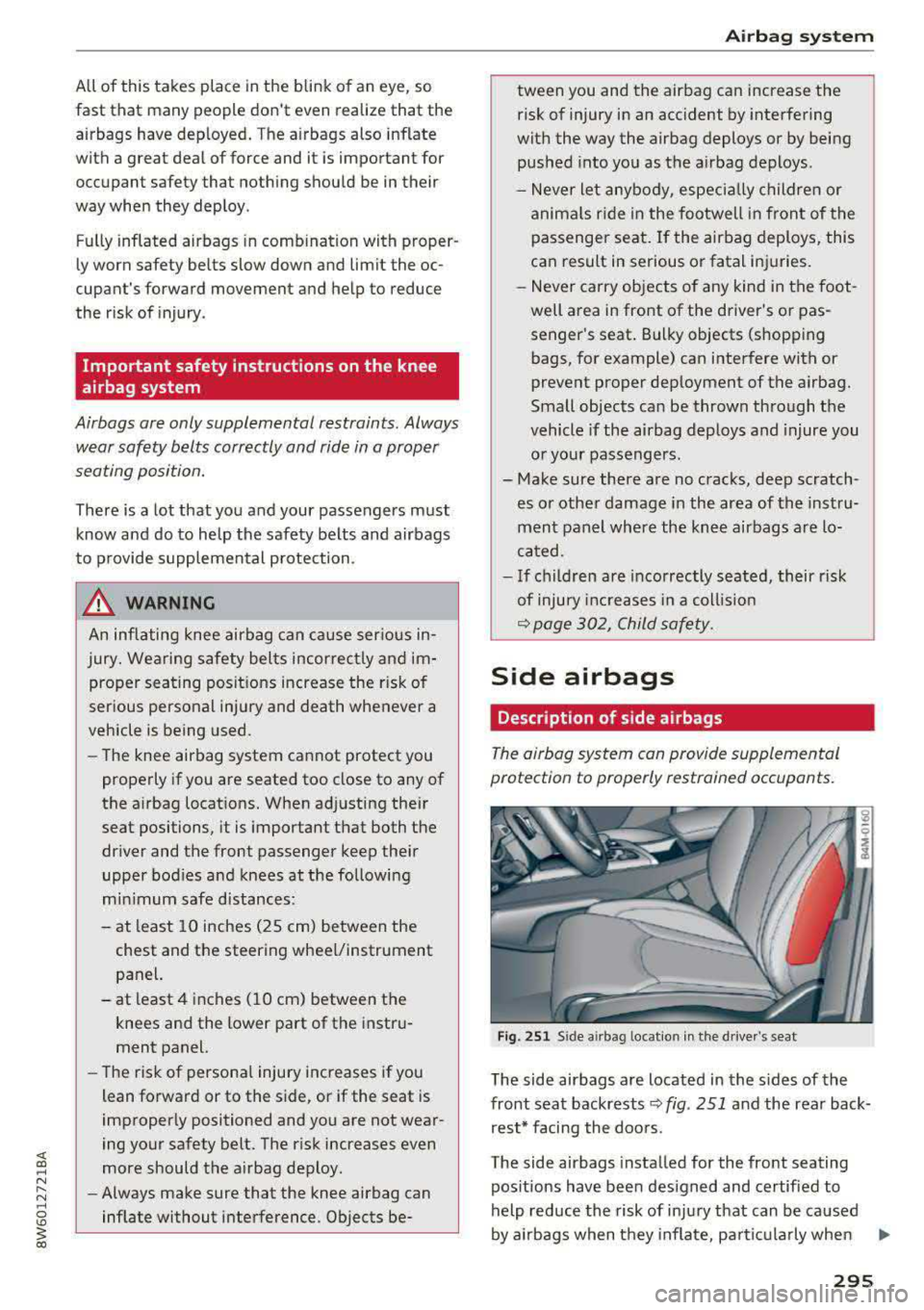
Fi g. 25 1 Side a irbag locat ion in the drive r's sea t
The side airbags are located in the s ides of the
front seat
backrests ~ fig. 251 and the rear back
res t* facing the doo rs.
The side airbags installed for the front seating
pos itions have been des igned and certified to
help reduce the risk of in ju ry that can be caused
by a irbags when they inflate, pa rticul arly when
.,.
295
Page 300 of 409
<( a, .... N ,....
N .... 0 \0
3 a,
interior in certain side impacts and vehicle
ro llovers .
The s ide curtain a irbag system supplements the
safety be lts and can he lp to reduce the risk of
in
jury for occupants' heads and upper torso in a
side col lision . The side curtai n airbag inflates in
side impacts and only when the vehicle accelera
tion reg istered by the control un it is high
enough. If th is rate is below the reference value
programmed into the control unit, the side cur
tain airbag will not be triggered, even though the
car may be badly damaged as a result of the colli
sion.
It is not possib le to define an airbag tr igger
i ng range tha t will cover every possib le ang le of
impact, since the circ ums tances will vary consid
e rably between one co llision and another . Impor
tant factors include, for examp le, the nat ure
(hard or soft) of the impact ing ob ject, the angle
of impact, vehicle speed, etc.
Q page 300, How
side curtain airbags work.
Aside from their normal safety function, safety be lts work to help keep the driver or front pas
senger in posit ion in the event of a collision so
that the side curtain airbags can provide protec
tion .
The airbag system is not a subst itute for your
safety belt. Rather, it is part of the overall occu
pant restraint system in your veh icle. Always
re
member that the airbag system can only help to
protect you if you are wea ring your safety belt
a nd wear ing it properly . T his is anothe r reason
why you should always wear your safety be lts,
n ot j ust because the law requires you to do so
Q page 268, General information.
It is important to remember that wh ile the s ide
curta in a irbag system is des igned to he lp reduce
the l ikel ihood of ser ious injuries, o ther i njuries,
for example, swel ling, b ruising, friction burns
and minor abrasions can also be associated with
these airbags upon deployment. Remember too,
these airbags will deploy only once and only in
certa in kinds of acc idents
-your safety belts are
always there to offer protection .
Airbag sys tem
The side curtain airbag system basically
cons ists of :
-The e lectronic control mod ule and externa l side
impact sensors
- The side curtain airbags above the windows of
the outer seating positions with eject ion mit i
gation features
- The airbag indicator light in the instrument
panel
T he airbag system is mon itored e lectron ica lly to
make certain it is functioning properly at all
times. Each time you turn on the ignition, the air bag system indicator light will come on for a few
seconds (self diagnostics).
The side curtain airbag is not activated :
-if the ignition is turned off
- in side co llisions whe n the ac celeration meas-
ured by the sensor is too low
- in rear -end co llisions.
_&. WARNING
- Safe ty belts and the airbag system will only
provide protect ion when occupants are in
the proper seating position
Q page 71,
Front seats.
- If the ai rbag ind icator light Q page 32
comes when the vehicle is being used, have
the system inspected immediately by your
author ized Audi dealer. It is possib le that
the airbag will inflate when it is not sup
posed to, or w ill not inflate when it should.
299
Page 305 of 409
Child safety
-Always make sure that the PASSENGER
AIR BAG
OFF~; light comes on and stays
on all the time whenever the ignition is
switched on .
- If the
PASSENGER AIR BAG OFF~; light
does not come on and stay on, immediate
ly install the forward-facing child seat in a
rear seating position and have the airbag
system inspected by your authorized Audi
dealer.
- Always buckle the child seat firmly in
place even if a child is not sitting in it. A
loose child seat can fly around during a
sudden stop or in a collision.
-Always read and heed all WARNINGS
whenever using a child restraint in a vehi
cle ¢
page 268, Safety belts , ~ page 2 77,
Airbag system and ~ page 302, Impor
tant information.
(D Tips
Always replace child restraints that were in
stalled in a vehicle during a crash. Damage to
a child restraint that is not visible could cause
it to fail in another collision situation.
Advanced front airbag system and children
Your vehicle is equipped with an "Advanced Air
bag System" in compliance with United St ates
Federal Motor Vehicle Safety Standard (FMVSS)
208, as well as Canada Motor Vehicle Safety
Standard (CMVSS) 208 as applicable at the time
your vehicle was manufactured.
The Advanced Airbag system in your vehicle has
been certified to meet the "low-risk " require
ments for 3- and 6-year old children on the pas
senger side and small adults on the driver side.
The low risk deployment criteria are intended to
reduce the risk of injury through interaction with
the airbag that can occur, for example, by being
too close to the steering wheel and instrument
panel when the airbag inflates. In addition, the
system has been certified to comply with the
"suppression" requirements of the Safety Stand
ard, to turn off the front airbag for infants up to 12 months who are restrained on the front pas-
304
senger seat in child restraints that are listed in
the Standard.
Even though your vehicle is equipped with an Ad
vanced Airbag system, all children, especially
those 12 years and younger, should always ride
in the back seat properly restrained for their age
and size. The airbag on the passenger side makes
the front seat a potentially dangerous place for a child to ride. The front seat is not the safest place
for a child in a forward-facing child safety seat. It
can be a very dangerous place for an infant or a
larger child in a rearward-facing seat.
The vehicle's Advanced Airbag System has a ca pacitive passenger detection system in the front
passenger seat cushion that can detect the pres
ence of a baby or a child in a child restraint sys
tem on this seat.
The capacitive passenger detection system regis
ters the changes that result in an electrical field
when a child, a child restraint , and a baby blanket
are on the front passenger seat. The change in
the measured capacitance due to the presence of
a child, a child restraint, and a baby blanket on
the front passenger seat is related to the child
restraint system resting on the seat. The meas
ured capacitance of a child restraint system var
ies depending on the type of system and specific
make and model.
The electrical capacitance of the various types, makes, and models of child restraints specified
by the U.S.National Highway Traffic Safety Ad
ministration (NHTSA) in the relevant safety
standard are stored in the Advanced Airbag Sys
tem control unit together with the capacitances
typical of infants and a 1-year old child. When a
child restraint is used on the front passenger
seat with a typical 1 year-old infant, the Ad
vanced Airbag System compares the capacitance
measured by the capacitive passenger detection
system with the data stored in the electronic con
trol unit .
Child restraints and Advanced Airbags
Regardless of the child restraint that you use,
make sure that it has been certified to meet Safe -
ty Standards and has been certified by its
..,.
Page 327 of 409
Checking and Filling
an authorized Audi dealer or authorized Audi
Service Facility for assistance .
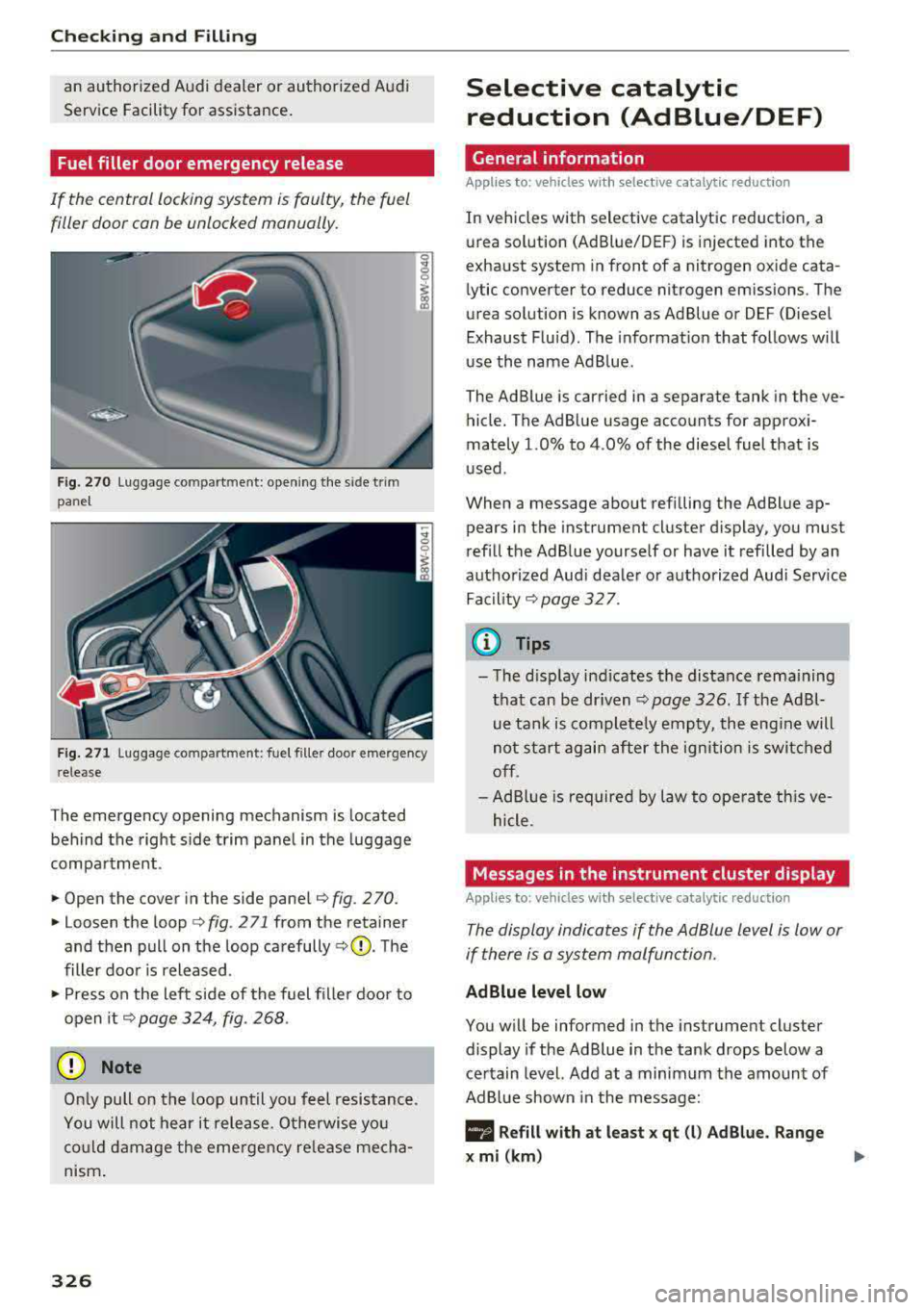
Fuel filler door emergency release
If the central locking system is faulty, the fuel
filler door can be unlocked manually.
F ig. 270 Luggage compartment: open ing the s ide tr im
panel
F ig. 271 luggage compartment: fuel fi ller door emergency
release
The emergency opening mechanism is located behind the right s ide trim panel in the luggage
compartment.
• Open the cover in the side pane l ¢fig. 270.
• Loosen the loop <=>fig . 271 from the retainer
and then pull on the loop carefully
<=> 0 . Th e
filler door is released.
• P ress on the left side of the fuel fi ller door to
open
i t¢ page 324, fig. 268 .
(D Note
Only pull on the loop until you feel resistance .
You will not hear it release. O therwise yo u
co uld damage the eme rgency re lease mecha
nism .
326
Selective catalytic
reduction (AdBlue/DEF)
General information
Applies to: vehicles with selective catalytic reduct ion
In vehicles with selective catalytic reduction, a
urea solution (AdBlue/DE F) is injected into the
exhaust system in front of a nitrogen oxide cata l ytic converter to reduce nitrogen em issions. The
urea solution is known as Ad Blue or DEF (Diesel
Exhaust Flu id) . The informat ion that fo llows w ill
u se the name Ad B lue .
The Ad Blue is carried in a separate tank in the ve
hicle. The Ad Blue usage accounts for approxi
mately 1.0% to 4.0% of the diesel fuel that is
u sed.
When a message about refilling the AdBlue ap pears in the instrument cluster display, you must
refill the Ad B lue yourse lf or have it refilled by an
authorized Aud i dea ler or authorized Audi Serv ice
Fac ility<::>
page 32 7.
(0 Tips
-Th e d isp lay indicates the distance rema ining
that can be
dr iven¢ page 326. If the Ad Bl
ue tank is comple tely emp ty, the eng ine will
not s tart again after the ign ition is switched
off.
-Ad Bl ue is required by law to ope rate th is ve
hicle.
Messages in the instrument cluster display
App lies to: vehicles wi th selective catalyt ic reduct ion
The display indicat es if the Ad Blue level is low or
if there
is a system malfun ction.
AdBlue level low
You w ill be informed in the instrument cluster
display if the AdBlue in the tank drops below a
ce rtain level. Add at a minimum the amount of
AdBlue shown in the message:
II Refill with a t lea st x qt ( l) Ad Blu e. Range
x mi (km )
Page 332 of 409
,&_ WAR NING
California Proposition 65 Warning:
- Engine exhaust, some of its constituents,
and certain vehicle components contain or
emit chemicals known to the State of Cali
fornia to cause cancer and birth defects and reproduct ive harm. In addition, certain flu
ids contained in vehicles and certain prod
ucts of component wear contain or emit
chem icals known to the State of California
to cause cancer and birth defects or other reproduct ive harm.
- Battery posts, terminals and related acces sories contain lead and lead compounds,
chem icals known to the State of California
to cause cancer and reproduct ive harms.
Wash hands after handling.
(D Note
When filling flu ids, be sure not to mix the flu
ids up . Otherwise severe ma lf u nctions and en
gine damage w ill occur.
@) For the sake of the environment
You shou ld regularly check the ground under
your vehicle in o rder to detect leaks qu ickly .
If
there a re visible spots from oil or other fluids,
bring your vehicle to an authorized Aud i dea l
er or authorized Audi Service Facility to be
checked.
Opening and closing the hood
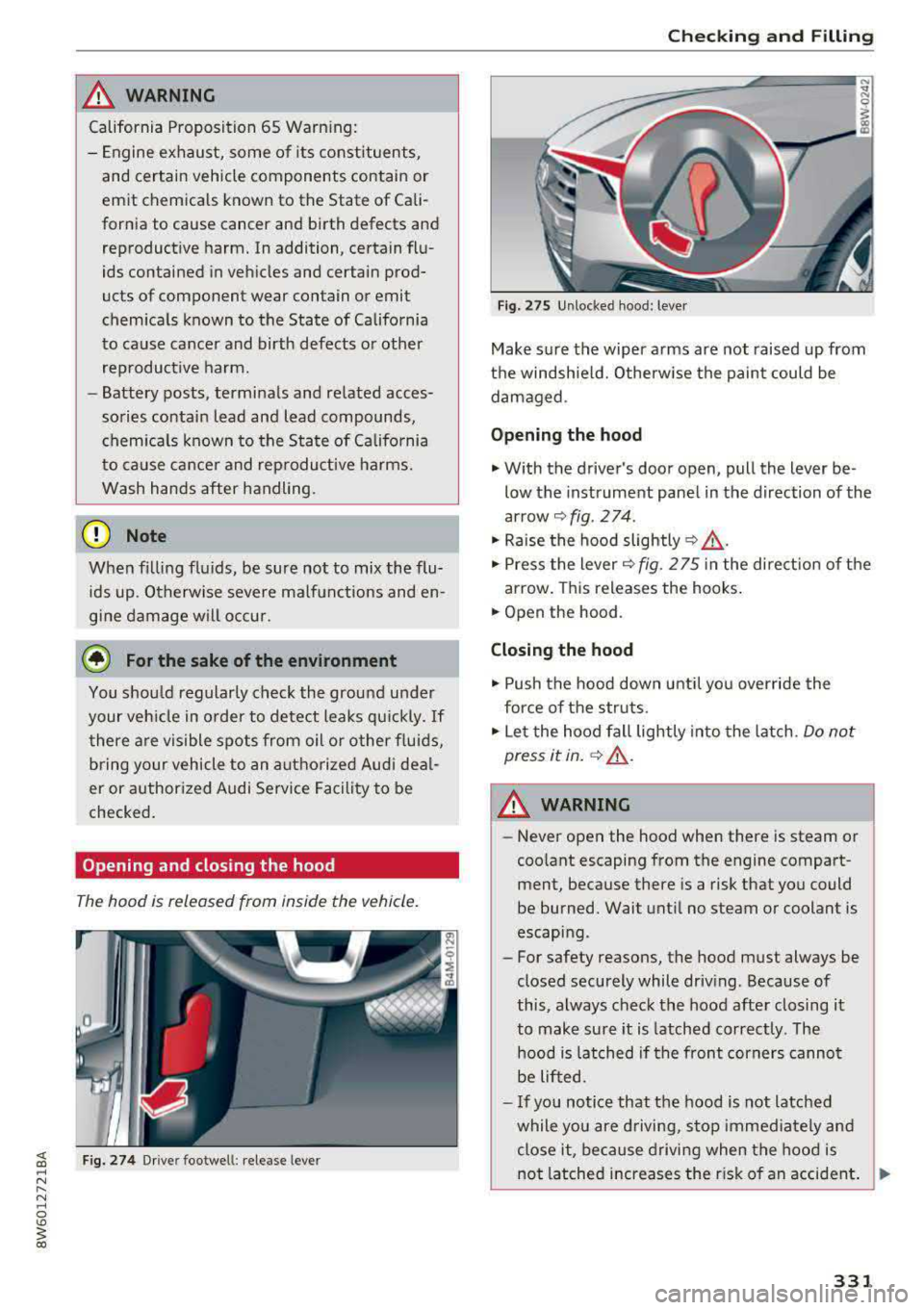
The hood is released from inside the vehicle.
Fig. 274 Driver footwell: release leve r
Checki ng an d Fill in g
Fig. 275 Unlocked hood : lever
Make sure the wiper arms are not raised up from
the windshield. Otherwise the paint could be damaged .
Opening the hood
" With the driver's doo r open, pull the lever be
low the instrument panel in the direction of the
arrow
r:;, fig . 2 7 4.
" Ra ise the hood slightly ¢.&_ .
"Press the lever ¢ fig. 275 in the direct ion of the
arrow. This releases the hooks .
"Open the hood .
Closing the hood
" Push the hood down until you override the
force of the str uts.
" Let the hood fall lightly into the latch . Do not
press it
in. ¢ .&_ .
A WARNING ,..___
-Never open the hood when there is steam or
coo lant escaping from the engine compart
ment, because there is a risk that you could
be burned. Wait until no steam or coolant is
escaping.
- For safety reasons, the hood must always be
closed securely while driv ing. Because of
this, always check the hood after closing it
to make sure it is latched correctly . The
hood is latched if the front corners cannot
be lifted.
- I f you notice that the hood is not latched
while you are d riving, s top immed iately and
close it, because driving when the hood is not latched increases the r isk of an accident . .._
331
Page 379 of 409
Fuses a nd bul bs
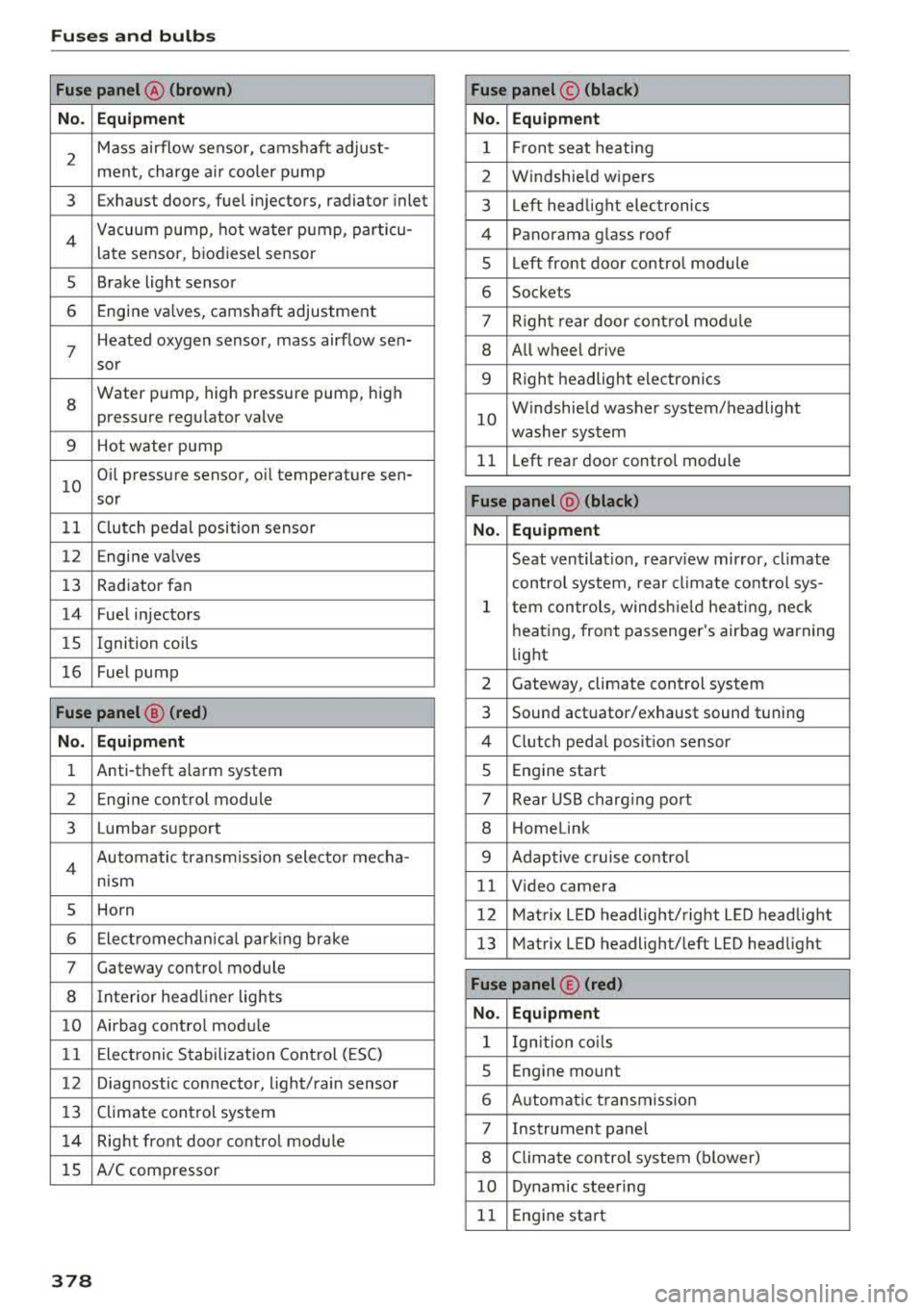
Fuse panel @ (brown) Fuse panel© (blac k)
No. Equip ment No. Equipm ent
2
Mass airflow sensor, camshaft adjust-
ment, charge air cooler pump 1 F ront seat heating
2 Windshield wipers
3 Exhaust doors, fuel injectors, radiator inlet 3 Left head light electronics
4 Vacuum pump , hot water pump, particu-
late sensor, biodiesel sensor 4 Panorama glass roof
s Left front door contro l module
5 Brake light sensor 6 Sockets
6 Engine valves, camshaft adjustment 7 Right rear door control mod ule
7
Heated oxygen sensor, mass airflow sen-8 All wheel drive
sor
8
Water pump, high pressure pump, high
pressure regulator valve
9 Hot water pump
9 Right headlight electronics
10
Windshield washer system/headlight
washer system
11 L eft rear door control module
10
Oil pressure sensor, oil temperature sen-
sor
Fu se panel @ (blac k)
11 Clutch pedal position sensor No. Equipmen t
12 Engine valves
Seat ventilation, rearv iew mirror, climate
13 Rad iator fan control system, rear climate control sys-
14 Fuel injectors
15 Ignition
coils
16 Fuel pump
1 tern controls , windsh ie ld heat ing , neck
heating, front passenger 's airbag warning
light
2 Gateway, climate control system
Fuse panel@ (red ) 3 Sound actuator/exhaust sound tuning
No. Equ ip me nt 4 Clutch pedal posit ion sensor
1 Anti-theft alarm system 5 Engine start
2 Engine control module 7 Rear USB charg ing port
3 Lumbar support 8 Homelink
4 Automatic transmission selector mecha-
nism 9 Adaptive cruise contro l
11 Video camera
5 Horn 12 Matrix LED headlight/right L ED headlight
6 Electromechan ica l park ing brake 13 Matrix LED headlight/left LED headlight
7 Gateway control module
8 Interior headl iner lights
10 Airbag control module
11 Electronic Stabilization Control (ESC)
Fuse panel © (red )
N o. Equ ipmen t
1 Ign ition co ils
12 Diagnostic connector, light/rain sensor
13 Climate control system
14 Right front door control module
lS A/C compressor
5 Engine mount
6 Automatic transmission
7 Instrument panel
8 Climate control system (blower)
10 Dynamic steering
11 Engine start
378