ESP AUDI A6 2011 Owners Manual
[x] Cancel search | Manufacturer: AUDI, Model Year: 2011, Model line: A6, Model: AUDI A6 2011Pages: 370, PDF Size: 87.15 MB
Page 299 of 370

________________________________________________ T_i_re _ s_ a _ n_d_ w_ h_ e_ e_l_s __ l!'II
Groove
means the spa ce between two ad jacen t tread ribs .
Load rating (code)
mea ns the max imu m load th at a tir e is ra te d to c arry fo r a give n infla
tion pressure. You may not find this information on all t ires beca use
i t is no t required by law .
Maximum load rat ing
me ans the load r ati ng for a t ire at th e maxi mum p ermis sib le in flation
pressure for that tire.
Maximum loaded vehicle weight
means the sum of:
(a) Curb weight
(b) Accessory weig ht
(c) Vehicle ca pacity we ight, and
(d) Pro duct ion op tions weigh t
Maximum (permissible) inflation pressure
means the m aximu m cold infla tio n pr essur e to whi ch a t ire may be
inflated . Also called "maximum inflat ion press ure."
Normal occupant weight
means 150 lbs. (68 k ilog rams) times t he num ber of occupants seate d
in t he vehi cle up to the total sea ting cap aci ty of yo ur vehicl e.
Occupant distribution
means d is tribut ion of occ upan ts i n a vehicle.
Outer diameter
means the ove rall d iameter of an inflated new tire.
Overall width
means the linear distance betwee n the exter iors of the s idewalls of
a n in flated tire, in cludi ng eleva tions due to la beling, dec ora tions, o r
protective bands or ribs.
Safety first
Ply
means a layer o f rubbe r-coate d para llel co rds.
Production options we ight
me ans the co m bine d we ight of tho se in stalled regu lar pr oduction
options weighi ng over 5 lbs. (2.3 kg) in excess of t hose standard
i t ems w hic h they replace, not previously considere d in c urb we igh t o r
accessory weight, includ ing heavy duty brakes , ride levelers, roof
rack, heavy duty battery, and s pecial tr im.
Radial ply tire
me ans a pneuma tic tir e in wh ich the pl y cords that extend to t he
beads are laid at substantially 90 degrees to the centerline of the
t rea d.
Recommended inflation pressure
see => page 296, "C old tire in fla tion pr essu re".
Reinforced tire
mea ns a t ire designe d to ope rate at hig her loads an d at higher infla
tion pressures than the co rresponding standard ti re. Reinforced t ires
my be i de ntified as "X L" , "xi", "EX TRA LOA D", o r "RF " on the sidewall.
Rim
mea ns a metal suppo rt fo r a tire or a tire and tube assemb ly up on
wh ic h the t ire beads are seated.
Rim diameter
means nom inal d iameter of the bead seat . If you change yo ur whee l
si ze, yo u w ill have to purchase new tires to ma tc h the new r im diam
eter .
Rim size designation
means r im diamete r and width.
Rim width
mea ns nom inal dis tance be twee n rim flanges.
Vehicle care Technical data
Page 301 of 370

________________________________________________ T_ i_ re _ s_ a_ n_d_ w_ h_ e_ e_l _s _ ........
Occupant loading and distribution for vehicle normal load for various designated seat ing capacities
Designated seating capacity, num- Vehicle normal load, number of Occupant distribution in a nor
mally loaded vehicle
ber
of occupants occupants
5 3 2 in front, 1 in back seat
Co ld tire inf lation pressure
Tire pr essur e affects the overall handling, performance and safety of a vehicle .
Fig. 216 Tire pressure
label : lo cated o n
dr iver 's sid e B·pillar
Tire pressure generally refers to t he amo unt of a ir i n a tire tha t it
needs it to do its job and safe ly carry the comb ined load of t he entire
vehicle and its contents . Tire p ressure is measured in kilopasca ls
(kPa), the inte rnationa l measur ing unit and in poun ds per squar e in ch
(PSI). Tire press ure is based in part on the ve hicle 's design and load
limit -the greatest a mount of weight that the vehi cle can c arry safe ly
and the tire s ize. The proper tire pressure is frequently refer red to as
the "re commen ded cold t ire inflation p ressure. " Air in t he tires
expands when the tire heats up because of internal friction when it
flexes in use. T he tire press ure is hig her w hen the tir e h as warme d up
than whe n it is "cold." It is the inflation pressure in a "cold" tire that
c o unts. The refo re, you sho uld never let air o ut of a warm t ire to
match "cold ti re inflation pressure " recommendations . The t ires
wou ld then be under in flated and could fail s uddenly.
------------------.. ,::
.(
... TINGc.worv TOTAA. I """" I .... I)(··-) :& NOMBAE DE P\.ACES TOTAi. 4VANT ARAIERE _,, rt-.oomblNd-...glllolOCCIUPll"Matlll~liio.Mn ~a:.u•d •"'M _ .. Uooldt IOUol -~ Ill du dltH-gt11'Nffl N dolt j._11, cibtl-loo !IQ lb.
TIRE SClE COI.O TIN! PMSSUAE PN(U DIMfN 5'0NS NW:S.St()N OU PNEUS A fflOIO
""""
SUOWN'EA'S MANUAl F
INFORMATION
VOIR U MANUEL DU PROJl'RIETAIRE
POUR PLUS OE
RENS£1Gf\1£MENTS Fig . 217 Tire pre ssur e
label
Ma intain ing prope r tire pressure is one o f the most importa nt things
you can do to he lp avoid sudde n tir e fa il u re . Under inflated tires are a
majo r ca use of sudden tire fa ilure . Keeping t ires at the rig ht pressure
is a lso important for safe and responsive vehicl e ha nd ling , traction,
braki ng an d load ca rryi ng.
Tire pressures are particularly impo rtant
when the vehicle is being driven at higher speed s, and then espe·
cially when heav ily loaded even within the permissible load ·
carrying capacities approved for your vehicle .
The recommended tire pressures for your Audi depend on the kind of
t ires on your vehicle and the num be r of passengers and/or amou nt o f
luggage you will be tra nspo rt ing .
The t ire pressure labe l is located on t he dr iver's side B-pilla r. The tire
pressure labe l lists th e recommended cold tire inflat ion p ress ures for
the vehicle at its maximum capacity weight and t ires t hat were on
•
your vehicle at the time it was manu fact ured. _,,,
Vehicle OP-eration Vehicle care Do-it-yourselt service iTechnical data
Page 302 of 370
-~_T_ i_ re _ s_ a_n _ d_ w_ h _e_ e_ ls _________________________________________________ _
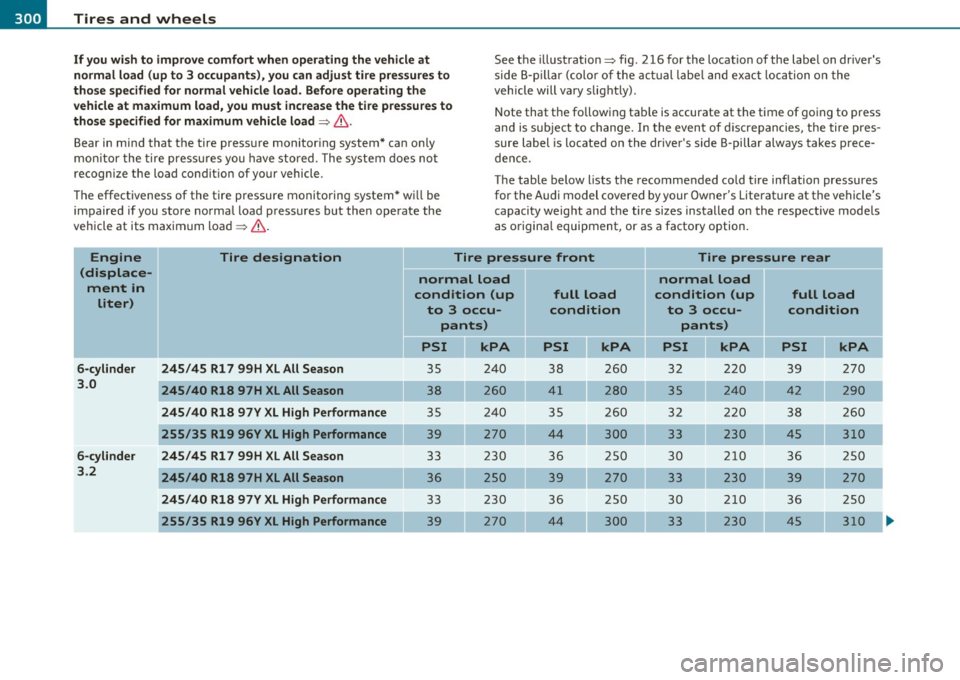
If you wish to improve comfort when operating the vehicle at
normal load (up to 3 o ccupants ), you can adjust tire pre ssures to
those specified for normal vehicle load . Before operating the
vehicle at maximum load, you must inc rease the tire pressures to
those specified for maximum vehicle load
=> & .
Bear in mind that the tire press ure monitoring system* can on ly
m oni tor the tire pressu res you have sto red . The system does no t
recogn ize the load condit ion of your vehicle.
T he effectiveness of the tire pressure monitoring system * w ill be
impaired if you store norma l load p ressu res b ut the n operate th e
vehicle at its maxim um loa d=> & .
Tire designation
See the illustration=> fig. 216 for the locat ion of the labe l on dr iver's
side B-p illar (colo r of the actu al labe l and ex act loc ation o n the
veh icle will vary slight ly) .
N ote that the following tab le is accurate at the time of going to press
and i s su bje ct to change. I n the even t of discrepancie s, t he tire pres
sure label is located on the driver's side B-pillar always takes prece
de nce.
The table below lists the recommended co ld tire inf lation pressures
fo r the Audi mode l covered by your Owner 's Literat ure at the vehicle's
capacity weight and t he tire sizes installed on the respective mode ls
as o rigina l equipment, or as a factory option.
Tire pressure front Tire pressure rear
Engine
(displace
ment in liter) normal load
normal load
6-cylinder
3.0
6-cylinder
3 .2
245 /45 Rl 7 99H XL All Season
245 /40 R18 97H XL All Season
245/40 R18 97Y XL High Performance
255 /35 R19 96Y XL High Performance
245/ 45 Rl 7 99 H XL All Season
245 /40 R18 97H XL All Season
245 /40 R18 97Y XL High Performance
255 /35 R19 96Y XL High Performance
condition (up
to 3 occu- pants)
PSI
35
38
3 5 24 0
39 270
33 230
36
33
39
full load
condition
PSI kPA
38 260
41 280
3 5 260
44 300
36 250
39 270
36 250
44 300
condition (up
full load
to 3 occu- condition
pants)
PSI kPA kPA
32 220 270
35 240 42
290
3 2 220 38 260
33 230 45 310
30 210 36 250
33 230 39 270
30 210 36 250
33 230 45
310
Page 303 of 370

__________________________________________________ T_i_ r _e _s_ a_ n_ d_ w_ h_e_ e _ l_s __ _
Engine Tire designation Tire pressure front II Tire pressure rear
(displace- normal load normal load
ment
in
liter) condition (up full load condition (up full load
to 3 occu-condition to 3 occu- condition
pants) pants)
PSI II kPA PSI II kPA II PSI ll kPA PSI II kPA
a-cylinder 245/45 Rl 7 99H X L All Season 36 250 39 270 33 230 39 270
4
.2
245/40 R18 97H XL All Season 39 270 42 29 0 35 2 40 42 290
245 /40 R18 97Y XL High Performance 36 250
39 270
33 230
39 270
255
/35 R19 96Y XL High Performance 39 4 4 300 33 230 45 310
XL = reinf orced or extr a load t ire. It m ay a lso ap pear a s xl, EXTRA LOAD , or RF on the tire sidewa ll.
The correct tir e press ure for th e
spare wh eel is l ocat ed on a labe l on
the driver 's s ide B-pillar.
B eca u se technical c hanges may be ma de to vehicle e quipment dur ing
the model year, always compare the tire s ize des ignation on the tire
pressu re la b el on yo ur vehicle with the t ires on your veh icle. Make
sure that the tire size in forma tion on the vehicle labe l is the same as
the s ize of the t ires on the vehicle. This is especially important i f the
vehicle belongs to someone else or you bought the vehicle with
different r ims/tires or you bought the vehicle as a previously owned
vehicle. that the vehicle can carry.
For the loc atio n of t he ti re p ressure label
~ page 299, fig. 216 .
_& WARNING
Overloading a vehicle can cause loss of vehicle control , a cra sh or
other accident, serious personal injury, and even death .
• Carrying more weight than your vehicle wa s de signed to carr y
will prevent the veh icle from handling properly and increase the
risk of a los s of vehicle control.
• The brakes on a vehicle that has been overloaded may not be
able to stop the vehicle within a safe di stan ce.
• Tires on a vehicle that has been overloaded can fail suddenly
c ausing lo ss of control and a crash .
• Always make sure that the total load being transported -
including the weight of a trailer hitch and the tongue weight of a
loaded trailer -does not make the vehicle heavier than the
I
I
Remember, your safety and that of your passengers also depends on
m aki ng sure th at lo ad lim its are no t ex ceeded. Vehicle lo ad includes
everybody and everything in and on the veh icle. These load limits are
t echnically re fer red to as t he ve hicle's G ross Vehicle Weig ht Ra ting
("GVWR") . The Gross Axle Weight Rat ing ("GA WR") is the max imum
load that can be applied at each of the veh icle's two ax les. The Gross
Vehicle Weight Rat ing and the G ross Ax le We ight Ra ting are listed on
the safety comp liance sticke r label located on the driver's side B
pillar. The tire p re ssur e label on your Audi lists the maxim um
combined weight of a ll of th e occ upants and luggage or other cargo
vehicle 's Gros s Vehicle Weight Rating. ._
Safety first Vehicle care Technical data
Page 305 of 370

________________________________________________ T_i_re _ s_ a _ n_d_ w_ h_ e_ e_l_s __ _
• Adjust the tire press ure to the load you are ca rry ing .
• Reins tall the valve s te m ca p on the v alve .
When should I check the tire pressure?
The cor rect tire p ress ure is especially importa nt a t hi gh s peeds . The
pressu re s ho ul d therefore be c hecked at least once a month and
always befor e sta rt ing a jou rney . Do not fo rget to ch eck the tire pr es
sure for the spare wheel=>
page 319.
When should I adjust the tire pressures?
Adjust t he tire pressure to the loa d you are ca rry ing . After chan ging a
w hee l or replac ing w heels yo u hav e to adjust the t ire press ures on all
w heels. I n add it io n, you m ust then store th e new t ire pressures in the
t ire press ure moni toring system *=>
page 31 6.
& WARNING
Incorrect tire pressures and /or underinflation can lead sudden tire
failure , loss of control , collision , serious personal injury or even
death .
• When the warning symbol appears in the instrument
cluster, stop and inspect the tires. • Incorrect tire pressure and/or underinflation can cause
increased tire
wear and can affect the handling of the vehicle and
stopping ability.
• Incorrect tire pressures and /or underinflation can also lead to
sudden tire failure , including a blowout and sudden deflation ,
causing loss of vehicle control.
• The driver is responsible for the correct tire pressures for all
tires on the vehicle. The applicable pressure values are located on
a sticker on the driver 's side 8-pillar.
• Only when all tires on the vehicle are filled to the correct pres
sure, the tire pressure monitoring system* can work correctly .
• The use of incorrect tire pressure values can lead to accidents or
other damage . Therefore it is e ssential that the driver observe the
Safety first
& WARNING (co ntinued )
specified tire pressure values for the tires and the correct pres
sures for the function of the tire pres sure monitoring system*.
• Always inflate tires to the recommended and correct tire pres
sure before driving off.
• Driving with underinflated tires bend more , letting them get
too hot re sulting in tread separation, sudden tire failure and loss
of control.
• Excessive speed and /overloading can cause heat build-up,
sudden tire failure and loss of control.
• If the tire pressure is too low or too high, the tires will wear
prematurely and the vehicle will not handle well.
• If the tire is not flat and you do not have to change a wheel
immediately, drive at reduced speed to the nearest service station
to check the tire pressure and add air as required .
0 Note
Driv ing witho ut valve stem caps can cause damage to the t ir e valves.
T o preven t this, a lways make sure th at fa ct o ry insta lled va lve stem
caps on all wheels are s ecure ly m ou nted on t he v alve .
<£> For the sake of the environment
Under infla ted ti res will also increase t he fue l cons umption .•
Tires and vehicle load limits
Th ere a re limits to the amo unt of load or weight that a ny vehicle and
any tire can ca rry . A veh icle t hat is overloaded w ill not handle well and
is mo re diffic ult to s top . Ove rloading can no t only lead to loss of
vehicle contro l, but can also damage important parts o f the ve hicle
a nd can le ad t o sud de n tir e fa ilure, incl uding a blowout and su dden
deflation t hat can cause the vehicle to crash . .,_
Vehicle care Technical data
Page 309 of 370
________________________________________________ T_ i_ re _ s_ a_ n_d_ w_ h_ e_ e_l _s _ ....... JIII
Incorrect wheel alignment
In correct whee l al ignme nt can ca use excessive tir e wea r, impairing
th e sa fety o f the vehicl e. If t ires show excessive w ear, hav e the w heel
alignment checked by a n authorized A udi dea ler or qualifie d work
shop.
All Wheel Drive
Vehicles wi th quattro® must always have tires of the same size ,
con st ruct ion an d tread type . For details see~
page 248.
& WARNING
Sudden tire failure can lead to los s of control, a cra sh and serious
personal injury!
• Never drive a vehicle when the tread on any tire is worn down
to the wear indicators.
• Worn tires are a safety hazard, they do not grip well on wet
roads and increase your risk of "hydroplaning" and loss of control.
• Always keep chemicals that can cause t ire damage, such as
grease , oil, gasoline and brake fluid away from tires.
• Tires age even if they are not being used and can fail suddenly,
especially at high speeds. Tires that are more than 6 years old can
only be used in an emergency and then with special care and at
lower speeds.
• Never mount used tires on your vehicle if you are not sure of
their "previous history. " Old used tires may have been damaged
even though the damage cannot be seen that can lead to sudden
tire failu re and loss of vehicle control. •
Vehicle OP-eration
New tires and replacing tires and whee ls
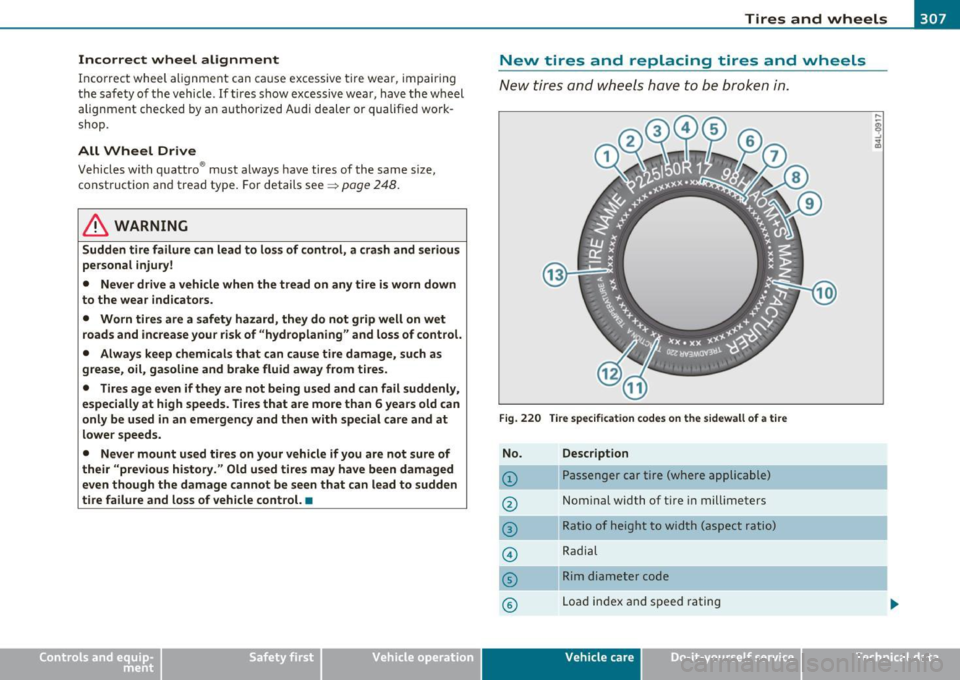
N ew t ires an d w hee ls have to be brok en in .
Fig. 220 Tire specificat ion codes on th e sidewall of a tire
No.
©
®
®
©
©
©
Description
Passenger car tire (where applicable)
Nom inal wid th of ti re in mil limeters
Ratio of hei9ht to width (aspect ratio)
Radial
jj Rim diameter code
L oa d index and speed rating
Vehicle care Do-it-yourselt service iTechnical data
Page 312 of 370
-~_T_ i_ re _ s_ a_n _ d_ w_ h _e_ e_ ls _________________________________________________ _
& WARNING (conti nu ed )
• Alway s use tire s, rim s and wheel bolts that meet the specifica
tions of original factory-installed tires or other combinat ions that
have been specifically approved by the vehicle manufacturer .
• Tires age even if they are not being used and can fail suddenly,
especially at high speed s. Tires that are more than 6 years old can
only be used in an emergency and then with special care and at
lower speeds.
• Never mount used tir es on your vehicle if you are not sure of
their "previous history. " Old used t ires m ay have been damaged
even though the damage cannot be seen that can lead to sudden
tire failure and loss of vehicle control.
• All four wheels must be fitted with radial tires of the same
type , size (rolling circumference) and the same tread pattern .
Driving with different tire s reduces vehicle handling and can lead
to a loss of control.
• If the spare tire is not the same as the tires that are mounted
on the vehicle - for example w ith winter tires - only use the spare
tire for a short period of time and drive with extra care. Refit the
normal road wheel as soon as safely possible.
• Never drive fa ster than the maximum speed for which the tires
on your vehicle are rated because ti re s that are driven faster than
their rated speed can fail suddenly.
• Overloading tire s cause heat build-up, sudden tire failure,
including a blowout and sudden deflation and loss of control.
• Temperature grades apply to tires that are properl y inflated
and not over or underinflated.
• For technical reasons it is not always possible to u se wheels
from other veh icles- in some cases not even wheels from the same
vehicle model.
• If you install wheel tr im discs on the vehicle wheels , make sure
that the air flow to the brakes i s not blocked . Reduced airflow to
the brakes can them to overheat, increasing stopping distances
and cau sing a collision.
& W ARNING (continued )
• Run flat ti res may only be used on vehicles that were equipped
with them at the factory. The vehicle must have a chassi s designed
fo r run flat tires. Inco rrect use of run flat tires can lead to vehicle
damage or accidents. Che ck with an author ized Audi dealer or tire
specialist to see if your vehicle can be equipped with run flat tires .
If run flat tire s are u sed, they must be installed on all four wheels.
M ixing t ire types is not permitted.
0 Note
• For tech nica l reasons, it is not generally poss ible to use the wheel
r ims from o ther veh icles . T his ca n hold t rue for w heels of the same
veh icle type.
• If the sp are tire is different fr om the tires t hat yo u have mo unted
on your vehicle (for example w inter t ires or wide profile tires), then
use the s pare tire for a shor t perio d of tim e on ly and drive wi th ext ra
care. Replace t he flat tire w ith the tire matching the others on your
vehicle as soon as possible.
• Never dr ive witho ut the valve stem cap . The valves could get
damage d.
~ For the sake of the environment
Dispose of old t ires in accor dance with the loca l req uiremen ts .•
Uniform tire quality grading
• Tr ead we ar
• Tract ion AA A B C
• T emperat ure A B C
Quality g rades can be fo und where applicable on the tire s ide wall
between t re ad sho ulder and m aximum se ct io n w idth =>
page 30 7,
fig.220 . ~
Page 313 of 370

Tires and wheels Ill
----------------
For example: Tread wear 200, Traction AA, Temperature A.
All passenger car tires must conform to Federal Safety Requirements
in addition to these grades.
Tread wear
The tread wear grade is a comparative rating based on the wear rate
of the tire when tested under controlled conditions on a specified
government test course .
For example, a tire graded 150 would wear one and one half (1 1/2)
times as well on the government course as a tire graded 100.
The relative performance of tires depends upon the actual conditions
of their use, however, and may depart significantly from the norm
due to variations in driving habits, service practices and differences in
road characteristics and climate.
Traction
The traction grades, from highest to lowest, are AA, A, Band C. Those
grades represent the tire's ability to stop on wet pavement as
measured under controlled conditions on specified government test
surfaces of asphalt and concrete . A tire marked C may have poor trac
tion performance ~& .
Temperature
The temperature grades are A (the highest), B, and C, representing
the tire's resistance to the generation of heat and its ability to dissi
pate heat when tested under controlled conditions on a specified
indoor laboratory test wheel.
Sustained high temperature can cause the material of the tire to
degenerate and reduce tire life, and excessive temperature can lead
to sudden tire failure~&.
The grade C corresponds to a level of performance which all
passenger car tires must meet under the Federal Motor Vehicle
Safety Standard No. 109 . Grades Band A represent higher levels of
performance on the laboratory test wheel than the minimum
required by law .
Safety first
& WARNING
The traction grade assigned to this tire is based on straight-ahead
braking traction tests, and does not include acceleration,
cornering, hydroplaning or peak traction characteristics.
& WARNING
The temperature grade for this tire is established for a tire that is
properly inflated and not overloaded. Excessive speed, underinfla
tion, or excessive loading, either separately or in combination, can
cause heat buildup and possible tire failure. •
Winter tires
Winter tires can improve vehicle handling on snow and
ice . At temperatures below 45 °F (7 °C) we recommend
changing to winter tires.
In some heavy snow areas, local governments may require true
winter or "snow" tires, those with very deeply cut tread. These tires
should only be used in pairs and be installed on all four wheels. Make
sure you purchase snow tires that are the same size and construction
type as the other tires on your vehicle.
If your vehicle is equipped with all-wheel drive*, this will improve
traction during winter driving,
even with the standard tires. However,
we strongly recommend that you always equip all four wheels on your
vehicle with correctly fitted winter tires or all-season tires, when
winter road conditions are expected. This also improves the vehicle's
braking performance and reduces stopping distances.
Summer tires provide less grip on ice and snow .
Winter tires (snow tires) must always be fitted on all four wheels .
Ask your authorized Audi dealer or qualified workshop for permitted
winter tire sizes. Use only radial winter tires. ..,_
Vehicle care Technical data
Page 316 of 370
___ T_ ir_e_ s _ a_ n _ d_ w_ h_e_ e_ ls _______________________________________________ _
After changing a wheel, the torque must be checked as soon as
possible with a torque wrench -preferably by an authorized Audi
dealer or qualified workshop. •
Low aspect ratio tires
Your Audi is factory-equipped with low aspect ratio tires. These tires
have been thoroughly tested and been selected specifically for your
model for their superb performance, road feel and handling under a
variety of driving conditions. Ask your authorized Audi dealer for
more details.
The low aspect ratio of these tires is indicated by a numeral of
55 or
less
in the tire's size designation. The numeral represents the ratio of
the tire's sidewall height in relation to its tread width expressed in
percentage. Conventional tires have a height/width ratio of 60 or
more.
The performance of low-aspect-ratio tires is particularly sensitive to
improper inflation pressure. It is therefore important that low
aspect ratio tires are inflated to the specified pressure and that the
inflation pressure is regularly checked and maintained. Tire pres
sures should be checked at least once a month and always before a
long trip=>
page 302, "Checking tire pressure" .
What you can do to avoid tire and rim damage
Low aspect ratio tires can be damaged more easily by impact with
potholes, curbs, gullies or ridges on the road, particularly if the tire is
underinflated.
In order to minimize the occurrence of impact damage to the tires of
your vehicle, we recommend that you observe the following precau
tions:
• Always maintain recommended inflation pressures. Check your
tire pressure every 2,000 miles (3,000 km) and add air if necessary.
• Drive carefully on roads with potholes, deep gullies or ridges. The
impact from driving through or over such obstacles can damage your
tires. Impact with a curb may also cause damage to your tires. •
After any impact, immediately inspect your tires or have them
inspected by the nearest authorized Audi dealer. Replace a damaged
tire as soon as possible.
• Inspect your tires every 2,000 miles (3,000 km) for damage and
wear . Damage is not always easy to see. Damage can lead to loss of
air and underinflation, which could eventually cause tire failure. If
you believe that a tire may have been damaged, replace the tire as
soon as possible.
• These tires may wear more quickly than others.
• Please also remember that, while these tires deliver responsive
handling, they may ride less comfortably and make more noise than
other choices.
Reduced performance in winter/cold season
conditions
All tires are designed for certain purposes. The low aspect ratio, ultra
high performance tires originally installed on your vehicle are
intended for maximum dry and wet road performance and handling.
They are not suitable for cold, snowy or icy weather conditions. If you
drive under those circumstances, you should equip your vehicle with
all-season or winter tires, which offer better traction under those
conditions. We suggest you use the recommended snow or all-season
tires specified for your vehicle, or their equivalent.
Refer to=>
page 311 for more detailed information regarding winter
tires. •
Tire pressure monitoring system
Applies to veh icles: w ith tire pressure monitoring system
General notes '
Each tire, including the spare (if provided), should be checked
monthly when cold and inflated to the inflation pressure recom
mended by the vehicle manufacturer on the vehicle placard or tire
inflation pressure label. (If your vehicle has tires of a different size .,
Page 317 of 370

Tires and wheels Ill _______________ _____.
than the size indicated on the vehicle placard or tire inflation pressure
label , you sho uld determine the proper tire infla tion pressure fo r
those tires.)
As an added safety feature, your vehicle has been equipped with a tire pressu re monitoring sys tem (TPMS) that illuminates a low tire pres
sure telltale when one o r more of your t ires is s ignificantly under
inflated. Accord ingly, when the low tire pressure tellta le illumi nates,
you should stop and check your tires as soon as possib le, and inflate
them to the proper p ress ure. D riving on a sign ificantly under-inflated
tire causes the tire to overheat and can lead to tire fa ilure . Under
inflation also reduces f uel efficiency and tire tread life, and may
affect the vehicle's handling and stopping ability .
Please note that the TPMS is not a substitute for proper tire mainte
nance, and it is the d river's responsibility to mainta in correct tire
pressure, even if under-inflation has not reached the level to trigger
ill umination of the TPMS low tire press ure te lltale.
Your vehicle has also been equipped w ith a TPMS malfunction indi
cato r to indica te when the system is not operating properly . The
TP MS ma lf u nction indicator is combined with the low tire p ress ure
telltale. When the system detects a malfunct ion, the telltale will
fl ash for approximate ly one minute and then rema in continuously
illuminated. This sequence will continue upon subsequent vehicle
sta rt-ups as long as the malfunction exists.
When the ma lfunction indicator is illum inated, the system may not
be able to de tect or signa l low ti re pressure as intended . TPMS
ma lfunctions may occur fo r a var iety of reaso ns, includ ing the instal
lation of replacement o r alternate tires or wheels on the vehi cle that
prevent the T PMS from functioning properly . Always check the TPMS
ma lfunction tellta le after replacing one or more tires or whee ls on
yo ur vehicle to ensure that the replacement o r alte rnate t ires and
wheels allow the TPMS to continue to funct ion proper ly .•
Vehicle OP-eration
App lies to vehicles : wi th t ire p ressu re mon it ori ng system
Tire pressure indicator appears
The tire pressure indicator in the instrument cluster
informs you if the tire pressure is too low or if there is a
system malfunction.
Fi g. 221 D is pl ay:
un der infl ation
wa rning
Fi g. 2 22 Display :
Sys tem malfun ction
Us ing the ABS sensors, the tire pressure monitor ing system compares
the t ire tread c ircumference and vibration characteristics of the ind i
vidual tires .
If the pressure decreases in one or more tires, this is indi -
cated in the instrument cl uster with a warning symbol and a
message ~ fig. 221. The d river message in the display goes o ut after
5 seconds . The driver message can be displayed again by p ressing the
!C HECK ] button. If on ly one t ire is affected, the display will ind icate
its position. ._
Vehicle care Do-it-yourselt service iTechnical data