Capacity AUDI A6 2011 User Guide
[x] Cancel search | Manufacturer: AUDI, Model Year: 2011, Model line: A6, Model: AUDI A6 2011Pages: 370, PDF Size: 87.15 MB
Page 302 of 370
-~_T_ i_ re _ s_ a_n _ d_ w_ h _e_ e_ ls _________________________________________________ _
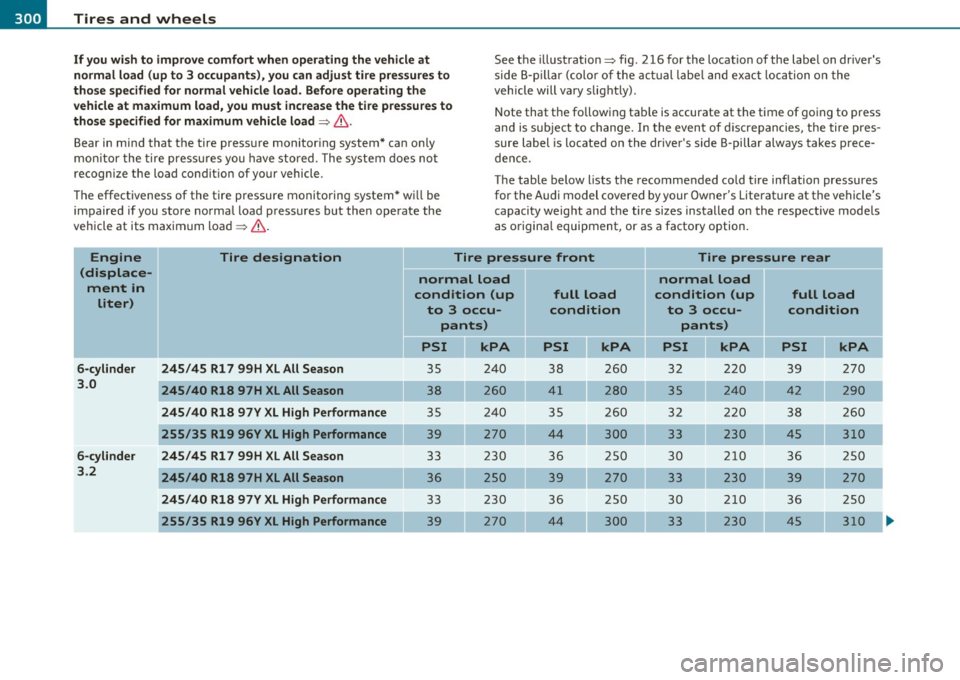
If you wish to improve comfort when operating the vehicle at
normal load (up to 3 o ccupants ), you can adjust tire pre ssures to
those specified for normal vehicle load . Before operating the
vehicle at maximum load, you must inc rease the tire pressures to
those specified for maximum vehicle load
=> & .
Bear in mind that the tire press ure monitoring system* can on ly
m oni tor the tire pressu res you have sto red . The system does no t
recogn ize the load condit ion of your vehicle.
T he effectiveness of the tire pressure monitoring system * w ill be
impaired if you store norma l load p ressu res b ut the n operate th e
vehicle at its maxim um loa d=> & .
Tire designation
See the illustration=> fig. 216 for the locat ion of the labe l on dr iver's
side B-p illar (colo r of the actu al labe l and ex act loc ation o n the
veh icle will vary slight ly) .
N ote that the following tab le is accurate at the time of going to press
and i s su bje ct to change. I n the even t of discrepancie s, t he tire pres
sure label is located on the driver's side B-pillar always takes prece
de nce.
The table below lists the recommended co ld tire inf lation pressures
fo r the Audi mode l covered by your Owner 's Literat ure at the vehicle's
capacity weight and t he tire sizes installed on the respective mode ls
as o rigina l equipment, or as a factory option.
Tire pressure front Tire pressure rear
Engine
(displace
ment in liter) normal load
normal load
6-cylinder
3.0
6-cylinder
3 .2
245 /45 Rl 7 99H XL All Season
245 /40 R18 97H XL All Season
245/40 R18 97Y XL High Performance
255 /35 R19 96Y XL High Performance
245/ 45 Rl 7 99 H XL All Season
245 /40 R18 97H XL All Season
245 /40 R18 97Y XL High Performance
255 /35 R19 96Y XL High Performance
condition (up
to 3 occu- pants)
PSI
35
38
3 5 24 0
39 270
33 230
36
33
39
full load
condition
PSI kPA
38 260
41 280
3 5 260
44 300
36 250
39 270
36 250
44 300
condition (up
full load
to 3 occu- condition
pants)
PSI kPA kPA
32 220 270
35 240 42
290
3 2 220 38 260
33 230 45 310
30 210 36 250
33 230 39 270
30 210 36 250
33 230 45
310
Page 306 of 370
lffllL-_T.:..:..: ir:....:e~ s=---= a~ n:..:..: d:......: w..:....:.. h:....:e~ e= ls=--------------------------------------------------
Yo ur sa fety and that of your passengers also depends o n mak ing s ure
t h at loa d limits are no t ex ceede d. Vehicle lo ad incl udes eve rybody
and everyth ing in and on the vehicle. These load limits are tech nica lly
referred to as the ve hicle 's
Gross Vehicle Weight Rating ("G VW R").
T he "G VWR" includes the we igh t of the b asic ve hicl e, all fa ctory
installe d accesso ries, a fu ll tank of fue l, o il, coo lant and other fluids
p lu s m aximu m lo ad. Th e maxi mum lo ad include s th e num ber of
passengers that the vehicle is intended to carry ("seating capacity")
w ith a n assu med we ight of 150 l bs (6 8 kg) for e ach p assenger at a
designated seating position and the tota l weight of any luggage in
t he vehicle . If you tow a trai le r, t he weight o f the t railer hitch and t he
tongue we ig ht of the loaded trailer must be included as pa rt of the
veh icle load .
T he
Gross Axle Weight Rating ("GAWR") is the m aximum load tha t
can be applied at each of the vehicle's two ax les.
Th e Gross Vehi cle We ight Ratin g a nd the Gross Axle Weigh t Ra ting
are listed o n the safety compliance sticker label located on the
dr ive r's side B-pillar. You r A udi has 5 sea ting positions, 2 in the fron t
and 3 in the rear fo r tota l seati ng ca pac ity of 5 . Eac h seat ing position
has a safety belt ~
page 18 7, "Safety belts".
T he fa ct t hat t here is an upper lim it to your ve hicle's G ross Veh icle
We ight Rating means that t he total weight of whatever is being
c arried in t he ve hicle (includi ng the wei ght of a tra ile r hit ch an d the
tongue weig ht of the loaded tra iler) is limited. The more passengers
i n th e ve hicl e or p assenge rs who are heavier th an the stan dard
we igh ts assumed mean that less we igh t can be ca rried as luggage.
The tire pressure label on yo ur A udi a lso lists the max imum combined
w eight of all of th e occ upants and luggag e or o ther cargo that th e
vehicle ca n car ry. Fo r the location o f the labe l~
page 299, fig . 216.
& WARNING
Overloading a vehicle can cause loss of vehicle control , a crash or
other accident, serious personal injury, and even death.
& WARNING (co ntinued )
• Carrying more weight than your vehicle was de signed to carry
will prevent the vehicle from handling properly and increase the risk of the loss of vehicle control.
• The brakes on a vehicle that has been overloaded may not be
able to stop the vehicle within a safe di stance.
• Tires on a vehicle that has been overloaded can fail suddenly,
including a blowout and sudden deflation, causing loss of control
and a crash .
• Always make sure that the total load being transported -
including the weight of a trailer hitch and the tongue weight of a
loaded trailer -does not make the vehicle heavier than the
vehicle's Gros s Vehicle Weight Rating. •
Determining correct load limit
Use the example below to calculate the
total weight of the passengers and luggage or other things that you plan to transport so
that you can make sure that your vehicle
will not be overloaded. .-.
Page 307 of 370

Steps for Determining Correct Load Limit
1.Locate the statement "THE COMBINED WEIGHT OF OCCUPANTS AND CARGO
SHOULD NEVER EXCEED XXX KG OR XXX LBS"on your vehicle's placard (tire infla
tion pressure label) =>
page 299,
fig. 216.
2. Determine the combined weight of the driver and passengers that will be riding in your vehicle.
3. Subtract the combined weight of the driver and passengers from
"XXX" kilo
grams or
"XXX" pounds shown on the
sticker =>
page 299, fig. 216.
4. The resulting figure equals the available amount of cargo and luggage load
capacity. For example, if the
"XXX"
amount equals 1400 lbs. and there will be five 150 lbs . passengers in your
vehicle, the amount of available cargo
and luggage load capacity is 650 lbs.
(1400-750 (5
X 150) = 650 lbs.)
Safety first
Tires and wheels -
5. Determine the combined weight of
luggage and cargo being loaded on the
vehicle. That weight may not safely exceed the available cargo and luggage
load capacity calculated in Step 4.
6. If your vehicle will be towing a trailer ,
load from your trailer will be transferred
to your vehicle. Consult this manual to
determine how this reduces the available cargo and luggage load capacity of your
vehicle.
- Check the tire sidewall(=>
page 307,
fig. 220) to determine the designated load rating for a specific tire . •
Vehicle care Technical data
Page 334 of 370
-Emergency situations Pf":11..--=---=;..._-------------
Emergency situations
General
This chapter is intended for t rained emergency crew s and working
pe rsonnel who have the necessary tool s and equipment to perform
the se operation s. •
Starting by pushing or towing
0 Note
Yo ur vehicle is equipped with an automatic t ransmission . Conse
quently, the engine ca nnot be started by push ing or tow ing .•
Starting with jumper cables
I f necessary, the engine can be started by connectin g it to
the bat tery of another vehicle.
If the eng ine shou ld fa il to start because of a discharged or weak
battery, the battery can be connected to t he battery of
another
veh icle, us ing a pair of jumper cables to start the engine .
Jumper cables
Use only jumper cables of suffic iently large cross section to carry the
sta rter cur rent s afely . Refer to the m an ufa ct ur er's specificat ions.
Use only j umpe r cab les with
insulated te rm inal clamps wh ich are
distinct ly marked :
plu s(+) cable i n most cases colored red
minus (-) cable i n most cases colored black .
& WARNING
Batterie s contain el ectricity, acid, and gas . Any of the se can cause
very serious or fatal injury. Follow the inst ructions below for safe
handling of your vehicle 's battery.
• Always shield your eyes and avoid leaning over the battery
whenev er po ssible .
• A discharged battery can freeze at temperatures just below
32 °F (0 °C ). Before connecting a jumper cable, you must thaw the
frozen battery completely, otherwise it could explode.
• Do not allow battery acid to contact eyes or sk in . Flush any
contacted area with water immedi ately .
• Improper use of a booste r battery to start a vehicle may cause
an explosion .
• Vehicle batteries generate e xplosive gases. Keep sparks, flame
and lighted cigarettes away from batterie s.
• Do not try to jump start any vehicle with a low acid level in the
battery.
• The voltage of the booster battery must also have a 12-Volt
rating. The capacity (Ah) of the booster battery should not be
lower than that of the discharged battery . Use of batteries of
different voltage or substantially different "Ah " rating may cau se
an e xplosion and personal injury.
• Never charge a frozen battery . Gas trapped in the ice may cause
an explosion.
• Never charge or use a battery that has been frozen. The battery
case may have be weakened .
• Use of batteries of different voltage or substantially different
capacity (Ah) rating may cause an explosion and injury . The
capacity (Ah) of the booster battery should not be lower than that
of the discharged battery. .,_
Page 340 of 370
lffll.___E_ m_ e_ r-' g=- e_n_ c=-y _ s_it _ u _ a_t_ i_ o _ n_ s ______________________________________________ _
in. WARNING
• To reduce the risk of serious injury and vehicle damage.
-Always lift the vehicle only at the special workshop hoist and
floor jack lift points illustrated=>
page 337, fig. 243 and
=>
page 337, fig. 244.
- Failure to lift the vehicle at these points could cause the
vehicle to tilt or fall from a lift if there is a change in vehicle
weight distribution and balance. This might happen, for
example, when heavy components such as the engine block or
transmission are removed.
• When removing heavy components like these, anchor vehicle
to hoist or add corresponding weights to maintain the center of
gravity. Otherwise, the vehicle might tilt or slip off the hoist,
causing serious personal injury.
0 Note
• Be aware of the following points before lifting the vehicle :
-The vehicle should never be lifted or jacked up from under
neath the engine oil pan, the transmission housing, the front or
rear axle or the body side members. This could lead to serious
damage.
- To avoid damage to the underbody or chassis frame, a rubber
pad must be inserted between the floor jack and the lift points.
- Before driving over a workshop hoist, check that the vehicle
weight does not exceed the permissible lifting capacity of the hoist.
- Before driving over a workshop hoist, ensure that there is sufficient clearance between the hoist and low parts of the
vehicle. •
Page 343 of 370
________________________________________________ G_e_ n_e_ r _a_ l_i_n _f_ o_ r_m _ a_t_ i_ o _ n __ _
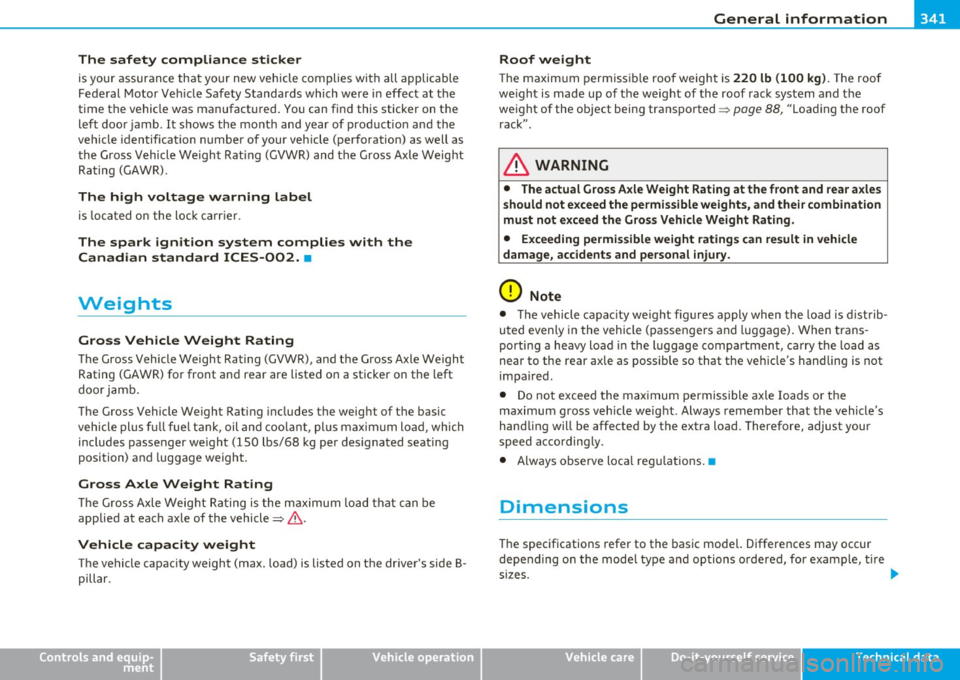
The safety compliance sticker
is your assurance that yo ur new vehicle complies with all applicable
Fede ral Motor Veh icle Safe ty Standards which were i n effect at the
time the vehicle was manufact ured . Yo u can fi nd this sticker on the
left doo r jamb.
It shows the mont h and year of prod uct io n and the
vehicle identification number of your veh icle (perforation) as well as
the Gross Vehicle Weight Rating (GV WR) and the Gross Axle Weight
Rating (GAWR).
The high voltage warning label
is located o n the loc k carrier.
The spark ignition system complies with the
Canadian standard ICES-002. •
Weights
Gross Vehicle Weight Rating
The Gross Vehicle Weight Rating (GVWR), and the Gross Axle Weight
Rating (GAWR) for front and rear are listed on a sticker on the left
door jamb.
T he Gross Vehicle Weight Rating includes the weight of the basic
vehicle pl us f ull f uel tank, oil and coo la nt, plus max im um load, whi ch
includes passenger we ight (150 lbs/68 kg per des ignated seating
position) and luggage weight.
Gross Axle Weight Rating
Th e Gross Axle Weight Ra ting is the maximum lo ad that can be
applied at each axle of the vehicle~&.
Vehicle capacity weight
The vehicle capacity weight (max. load) is listed on the dr iver's side B
pillar.
Safety first
Roof weight
Th e maxim um permiss ib le roof weight is 220 lb (100 kg ). T he roof
we ight is made up of the weight of the roof rac k system and t he
we ight of the object being transported~
page 88, "Loading the roof
rack".
& WARNING
• The actual Gross A xle Weight Rating at the front and rear a xles
s hould not exceed the permis sible weights , and their combination
must not exceed the Gros s Vehicl e Weight Rat ing .
• Exceeding permi ssible weight ratings can result in vehicle
damage, accidents and personal injury.
0 Note
• T he vehicle capac ity we ight figures apply when the load is distrib
uted evenly i n the vehicle (passengers and lug gage). When trans
porting a heavy load i n the luggage compartment, ca rry the load as
near to the rear axle as possible so that the ve hicle's handling is not
impa ired.
• Do not exceed the max imum permissible axle loads o r the
maximum gross veh icle weight. Always remember that the vehicle's
handling will be affecte d by the extra load. Therefore, adjust your
speed according ly .
• Always observe loca l reg ulat ions. •
Dimensions
The specifications refe r to the basic mode l. Differences may occur
depe nd ing on the mode l type a nd options ordered, for exam ple, t ire
sizes. .,_,
Do-it,yourself service Technical data
Page 345 of 370

____________________________________________________ D_ a_t_ a __ _
Data
Applies to vehicles: with 3 .0 lit er 6-c ylin der engine
300 hp, 3.0 liter, 6-cylinder engine
Engine data
Maximum outpu t SA E net
Maximum torque SAE net
No. of cy linders
Displacement
St roke
Bore
Compression ratio
Fu el
Dimensions (approx. )
Length
W idth
He igh t (u nloaded)
Turning circle diameter (curb to curb)
Capacities (approx .)
Fu el tank
- Tota l capacity
- Rese rve (of to tal cap aci ty)
Windshield and headlight* washer fluid container
Engine oil
with filter c hange
Safety first
hp@rpm
lb-ft@ rpm
C ID (cm
3
)
in (mm)
in (mm) 30
0@ 5100-6800
310@ 2500-5100
6 cylinder 183 (2995)
3.50 (89.0)
3 .33 (84 .5)
10.5 : 1
Premium unleaded (91 AKI) Recomm end ed for maximum engin e perfo rmanc e. Fur
ther details =>
page 2 73, "Gasoline"
i n (mm)
i n (mm)
i n (mm)
ft (m) 193.5 (4916)
79 .2 (2012)
57. 4 (1459)
39.0 (11.9)
gal (liters)
gal ( liters)
quarts (liters)
quarts ( liters) 21.1 (80.0)
1. 8-2.4 (7-9)
5 .1(4.8)
6.9 (6.5)
•
Do-it,yourself service Technical data
Page 346 of 370
___ D_ a_t _a _____________________________________________________ _
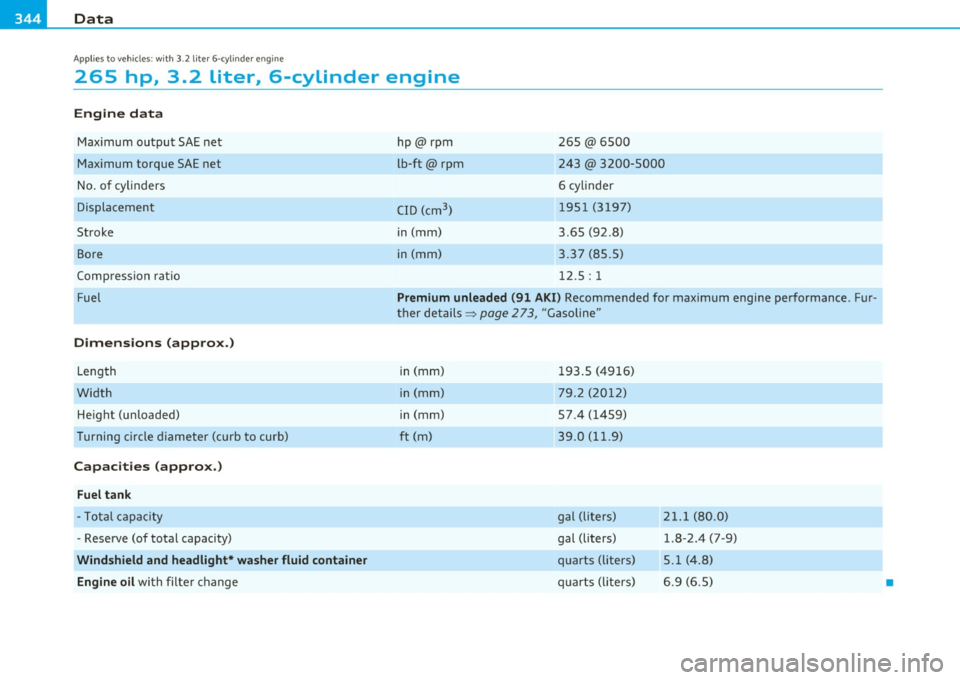
Applies to vehicles : w ith 3.2 lite r 6 -cylin der engine
265 hp, 3.2 Liter, 6-cylinder engine
Engine dat a
Max imum output SAE net
Max imum torque SAE net
No . of cylinders
Displacement
Stroke
Bore
Comp ression ratio
Fuel
Dimen sions (appro x.)
Length
Width Height (unloaded)
Turning circle diameter (curb to curb)
Capacities (appro x.)
Fuel t ank
- Total capac ity
- Reserve (of total capacity)
Wind shield and headlight* was her flu id c ontainer
Engin e oil
with filter change hp@rpm
lb-ft@ rpm
CID (cm
3
)
in (mm)
in (mm) 265 @6500
243 @ 3200-5000
6 cylinder
195 1 (3 197)
3 .65 (92 .8)
3 .37 (85.5)
12 .5: 1
Premium un leaded (91 A KI) Recommended for maximum engine performance . Fur
ther details =>
page 273, "Gasoline"
in (mm)
in (mm)
in (mm)
ft (m) 193.5 (4916)
79.2 (2012)
57.4 (1459)
39 .0 (11.9)
gal (liters)
gal (liters)
quarts (liters)
quarts ( liters) 21.1 (80
.0)
1. 8-2 .4 (7 -9)
5.1 (4 .8)
6.9 (6.5)
•
Page 347 of 370
____________________________________________________ D_ a_t_ a __ _
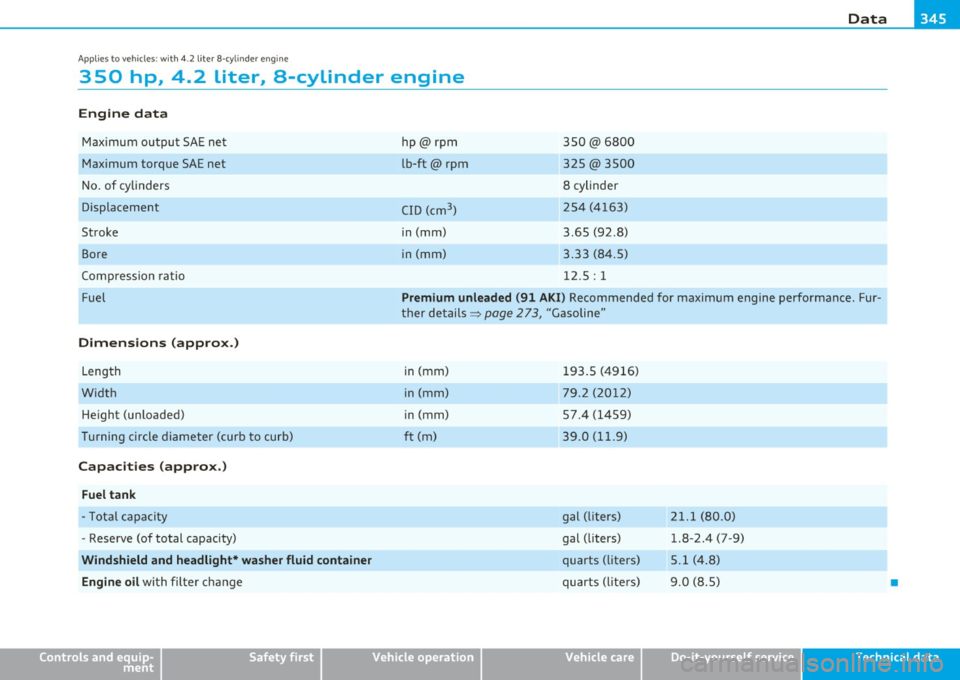
App lies to ve hicles : with 4.2 li ter 8 -cy linder engine
3 50 hp, 4.2 liter, a-cylinder engine
Engine data
Max imum output SAE net
Maximum torque SAE net
No . of cy linders
Displacement
Stroke Bore
Comp ression ra tio
Fuel
Dimensions (approx. )
Length
W idth
He ight (un loaded)
Tu rning circle diameter (curb to curb)
Capacities (app ro x. )
Fuel tank
-Tota l capacity
- Reserve (of total capacity)
Windshield and headlight* washer fluid container
Engine oil
with filter change
Safety first
hp@rpm
lb-ft@ rpm
CID (cm
3
)
in (mm)
in (mm) 350@ 6800
325 @3500
8 cylinder
254 (4163)
3
.65 (92.8)
3 .33 (84 .5)
12.5: 1
Premium unl eaded (91 AKI) Recommended for maximum engine performance . Fur
ther details => page
273, "Gasoline"
in (mm)
i n (mm)
i n (mm)
ft (m) 1
93.5 ( 4916)
79 .2 (2012)
57 .4 (1459)
39.0 (11.9)
gal ( liters)
gal (liters)
quarts (liters)
quarts ( lite rs) 21.1 (80.0)
1.8 -2 .4 ( 7-9)
5 .1 (4 .8)
9.0 (8.5)
•
Do-it,yourself service Technical data
Page 359 of 370
___________________________________________ A_ l::.. p _h _a_ b_ e_t _ic _a_ l_ in_ d _ e_x __ ffllll
Unleaded fuel .... .... ... .. .. . .. . 273
What should I do with an old battery? ...
294
EPC
See E lectronic power control ........ 14
ESP
See Electronic stabilizat ion program (ESP)
14
Event Data Recorder (EDR) ............ 242
Exhaust tail pipes
Cleaning ................ .... .... 266
Expansion tank ..................... 286
Ex terior lighting in the mirror housing ... 61
Eyeglass es compa rtment .............. 9S
F
Fan
Radiator ............... .. .. .. .. . 288
Fastening Booster seats .................... 227
Convertible child safety seats .. ..... 225
Infant seats .............. .... .. . 224
Fastening eyelets .................... 84
Flat tire Changing . .. ........... ...... .. . 320
Floor mats ......................... 182
Fog lights ................. ........ . 60
Folding master key with remote control .. 3 7
Foot pedals .. .. ... ........ .. .. .. .. . 182
For the sake of the environment
Gasoline fumes and the environment 27S
Letting your engine warm up ...... . 109
Controls and equip
ment Safety first
Reducing engine noise
by early upshifting
8
Refueling . .. ..... .. .. .. ......... 2 7 5
Saving fuel by early upshifting ........ 8
Using the rear window defogger ..... 101
Front airbags Descript ion . ...... .. .. .. .. ....... 201
How they work ................. .. 206
Front ashtray ........................ 91
Front fog lights .. ................. .. . 60
Front seats ... .. ..... ...... ...... .. . 75
Adjusting .. .. .. ........ ......... 179
Chi ld restraints in the front seat . ... 199
Fro nta l collisions and the laws of physics 188
Fuel Additives .... .. .... .. .. ......... 273
Blended gasoline ................. 273
Consumption ............ .... .. .. . 34
Filler neck ....................... 274
Fuel gauge ...... ............. .... 10
Gasoline ..................... ... 273
Gasoline additives ................ 274
Low fuel leve l . . . . . . . . . . . . . . . . . 10, 30
Octane rating . .. ................. 273
Recommendation . ......... .... .. 273
Refuelling ....... .... .. .. ....... 275
Reserve .................. ... .. .. . 10
T ank capacity .................... 343
Unlocking the fuel filler flap by hand . 277
Fuses Replacing ....................... 327
G
Garage door opener (Homelink ®) ...... 171
Gas discharge lamps ................. 330
Gauges Engine coolant temperature .......... 8
Fuel gauge .. .... .. .. .. ........... 10
Speedometer ............ ... ... ... 10
T achometer ... .................... 9
T rip odometer .................. .. 10
General illust ration
Instruments and controls ... .. . ... .. . 7
Glossary of tire and loading terminology 296
Glove compartment ... ... ... ..... .... 94
cd changer .... .. .. ............... 94
emergency unlocking ........... ... 94
Valet key function .. .... ........... 40
Gross Veh icle We ight Rating (GVWR) ... 341
H
Head restraints .................. .. . 181
Adjusting ............... ... ... .. 181
Front seats ... .................... 81
Rear seats ....... ................ 81
Headlight washer reservoir . .......... 294
Headlights .................. .. .. .. .. 58
Adaptive Light ...... ...... .. .. .. .. 61
Defective . .. .. .... ............... 21
Front fog lights ....... ..... .... ... 60
Headlight range control defect ive .... 31
Switching off .............. ....... 58
Switching on ................... .. 58
Vehicle operation Vehicle care Do-it-yourself service Technical data