oil level AUDI A6 2011 User Guide
[x] Cancel search | Manufacturer: AUDI, Model Year: 2011, Model line: A6, Model: AUDI A6 2011Pages: 370, PDF Size: 87.15 MB
Page 257 of 370

Driving and environment
------------------------------------------------'
The amount of oil used is related to engine load and speed.
It is normal for the oil consumption of a new engine to reach its
lowest value after a certain mileage has been driven .
You must drive your vehicle about 3,000 miles (5,000 kilometers)
before you can properly assess oil consumption.
This also applies to fuel consumption and engine output .
0 Note
• Have your vehicle maintained properly and in accordance with the
service recommendations in your Warranty
& Maintenance booklet.
Lack of proper maintenance as well as improper use of the vehicle w ill
impair the function of the emission control system and cou ld lead to
damage.
• Do not alter or remove any component of the Emission Control
System un less approved by the manufacturer.
• Do not a lter or remove any device, such as heat shie lds, switches,
ignition wires, valves, which are designed to protect your vehicle's Emission Contro l System and other important vehicle components. •
Fewer short trips
Fuel consumption will always be relatively high on short
trips .
-Try to avoid driving short distances with a cold engine.
The eng ine and catalytic converter have to reach thei r optima l oper
ating temperature
to reduce fuel consumption and noxio us em is
sions effectively.
Just after starting, a cold engine in a mid -size car only achieves a fuel
economy of 6-8 miles per gallon (30-40 l/l00km). After about a half
a mile, fuel economy climbs to 12 mpg (20 l/100 km). After about
2.5 miles (4 km), the engine is at its proper operating temperature
Controls and equip
ment Safety first Vehicle operation
and fuel economy has
reached a normal level. So you can see that you
should avoid short trips whenever possible.
The
outside temperature is also cr it ical in th is regard . Your car
consumes more fuel in the winter than in the summer. •
Vehicle care Do-it-yourself service Technical data
Page 283 of 370
___________________________________________ C_ h_e _c _k_ i_n ~g_ a_n_ d_ f_ i_ll _i_n _g __ _
& WARNING
Before you check anything in the engine compartment , always
read and heed all WARNINGS~
& in "Working in the engine
compartment " on
page 279. •
Engine oil
Engine oil specifications
The engin e oil used in your Audi needs the right kind of oil.
Th e e ng ine in your Aud i is a sophis ticated powerplant that was bui lt
to exacting spec ificat ions. This engine needs the r ight kind of engine
oil t hat meets spec ifi cat ions regarding qu ality a nd viscosity so t hat it
can run smooth ly and re liably. Choosing the right o il and changing oil
with in the time and mileage intervals pr in ted in your veh icle 's
Warranty
& Maintena nce book let matters a lot more today than it did
years ago . Audi has developed a specia l quality standard for engine oil
that w ill help assure that your veh icle's engine will get t he lubr ication
it needs fo r prope r operation.
M ode rn engine lubr ication has taken a quan tum leap in the last few
years. Many synthet ic oils available today provide better engine lubri
c at ion th at c an outlast tradit ional petro le u m-based o ils, making
them a smart choice for use throughout the life of your Aud i.
Whethe r you use synthetic or petroleum -based engine oi l, the o il th at
yo u use mus t confo rm to Aud i's oi l quality standa rd VW 502 00 to
help keep your ve hicle's engine runn ing smooth ly and help prevent
the format ion of ha rmfu l deposits, somet imes called "sludge," t hat
over time can lead to expens ive repairs.
A t the time o f pr int ing , engine o ils avai lab le in the U.S . and Can ad a
that meet the exact ing spec ificat io ns of A udi o il standard VW 502 00
are syn the tic engine o ils . Thi s does not mean, however, that every
syn the tic engine o il will meet Aud i o il sta ndard VW 502 00. So a lways
be s ure that you use an app roved o il.
Safety first
To help prevent the format io n of harmfu l deposits use only oi l with
t he follow ing s peci ficati ons p rin ted on the oil con tainer:
Audi oil standard VW 502 00
Oil container labe ls may carry the specification s ingly or in comb ina
t ion wi th o ther d esigna tions and o il quali ty stand ards.
Viscosity
Engine oils are g raded acco rdi ng to the ir viscosity . The proper
viscos ity grade oi l for your eng ine depends o n climac tic or seasona l
conditions where you drive. Yo u can use oi l with a v iscosity grade o f
SA E SW 40 acros s all t empe rature range s fo r no rma l dr iving con di
tions.
However, if engine oil v iscosity grade SAE SW 40 is not ava ilab le, yo u
can a lso use viscos ity grade SAE SW -30 or SAE OW -40 as long as it
meets Audi oi l quality stan dard VW 502 00 specifications .
Be ca use e ngine o il th at mee ts the Aud i oil st andar d m ay not be avail
able everywhere when you need it, we strongly recommend that you
alw ays car ry w it h you an ex tra quart (lite r) o f oil that expressly
conforms to the VW 502 00 specification, in case you have to top off
t he o il w hil e on the road.
Only if t he level of the oil is at o r below t he min imum mark on the o il
dipstic k -and no oil that exp ress ly conforms to A udi oi l standar d
VW 50 2 00 sp ec ificat ions i s available -may you top off w it h a high
quality engine o il, preferably synthetic-based, that meets ACEA A3,
ACEA AS or AC EA BS or A PI SL sp eci fi cations, but even t he n, only in
viscos ity grades SAE SW-40, SAE SW-30, or SAE OW-40 . However,
dur ing t he enti re time between o il change intervals, neve r top o ff
with more than a tota l of 0.5 qt/liter engine oil that does not
c on form to A udi o il specif ic a tion VW 5 02 00.
For mo re informa tion about eng ine o il that has been approved fo r
your vehicle, p lease contact either your author ized A ud i deale r or
Audi Cus tomer Relat io ns at 1 (800) 822-2834 or v is it our w eb si te a t
www.audiusa.com or www.audicanada.ca. Here you w ill also f ind a
cu rrent list of oil s (m anu fact ur ers, brand na mes e tc.) tha t co nform to
Audi oil standard VW 502 00. ..,.
Vehicle care Technical data
Page 284 of 370
lffl) __ C_ h_e _c_ k_ i_ n _ g_ a_ n _ d_ f_il _l _in ____ g ___________________________________________ _
Changing the engine oil
The engine oil and oil fi lter must be changed according to the mileage
(kilometers) and t ime intervals specified in your vehicle 's Warranty
&
Maintenance booklet . Do not exceed these interva ls -harmful
deposits from o ld engine oil can reduce engine performance and can
lead to expensive engine repairs .
Changing the oil at the recommended intervals is so very impo rtant
because the lubricating properties of o il decrease gradually during
normal vehicle use. If you are not sure when you have your oil
changed, ask your author ized Audi Service Adv isor .
Under some circumstances the engine oil should even be changed
mo re frequently. Change oil more often if you drive mostly short
distances, operate the vehicle in dusty areas or mostly under stop
and-go traffic conditions, or when you use your vehicle where temper
atures stay be low freezing point for long periods.
Detergent addit ives in the oi l wi ll make fresh oil look dark after the
engine has been running for a short t ime. This is normal and is not a
reason to change the oil more often than recommended .
Damage or malfunctions due to lack of maintenance
It is essential that you change your oil at the recommended intervals
using only engine oi l that complies with Audi oil standard
VW 502 00. Your Limited New Vehicle War ranty does not cover
damage or malfunctions due to fai lure to follow recommended main
tenance and use requirements as set forth in the Audi Owner 's
Manual and Warranty
& Maintenance booklet. Your dealer will have
to deny warranty coverage unless you present to the dealer proof in
the form of Serv ice or Repair Orders that all scheduled maintenance
was performed in a time ly manner. •
Engine oil consumption
The engine in your vehicle depends on an adequate
amount of oil to lubricate and cool all of its moving parts.
In order to provide effective lubrication and cooling of internal
eng ine components, all inte rnal combustion engines consume a
certain amount of oil. Oil consumption varies from engine to engine
and may change sign ifican tly over the lif e of the engine. Typically,
engines with a specified break- in period (see~
page 251) consume
more oil during the break-in period than they consume after oil
consumption has stab ilized .
Under normal conditions, the rate of oil consumption depends on the
quality and viscosity of the oil, the RPM (revolutions per minute) at
which the engine is operated, the ambient temperature and road
conditions. Further factors are the amount of oil dilution from water
condensation or fuel residue and the ox idation level of the oil. As any
eng ine is subject to wear as mileage builds up, the oil consumption
may increase over time until replacement of worn components may
become necessary.
With all these variab les coming into play, no standard rate of oil
consumption can be established or specified . There is no alternative
to regular and frequent checking of the oil level , see
Note .
If the yellow engine oil leve l warning symbol in the instrument
cl uster lights up, you should chec k the oil level as soon as possible
with the oil dipstick~ page 283. Top off the oil at your earliest
convenience ~
page 284.
& WARNING
Before you check anything in the engine compartment, always
read and heed all WARNINGS~
& in "Working in the engine
compartment" on
page 279.
Page 285 of 370

___________________________________________ C_ h _ e_c _k _ i_n -=g .._ a_n _ d_ f_i _ll _i _ n -=g '-- ....... JIII
0 Note
Driv ing with an insufficient oil level is likely to cause severe damage
to the engine .
[ i ] Tips
• The oil pressure warning display~ is not an indicator of the oil
level. Do not rely on it. Instead , check the oil level in your engine at
regular intervals, preferably each time you refuel, and always
before going on a long trip .
• If you have the impression your engine consumes excessive
amounts of oil, we recommend that you consult your Audi dealer to
have the cause of you r concern properly diagnosed. Keep in mind that
the accurate measurement of oil consumpt ion requires great care
and may take some time . Your Audi dealer has instructions about how
to measure oil consumption accurately .•
Checking the engine oil leve l
Fig. 208 Ill ustra tion
o f principle 1: Markers
on oil dipstick
Vehicle OP-eration
Fig. 209 Illustrat ion
of prin ciple 2: Markers
on oil dipst ic k
Before you check anything in the engine compartment,
always read and heed all WARNINGS => & in "Working in
the engine compartment" on
page 2 79.
Determining oil level
-Park your vehicle so that it is horizontally level.
- While at operating state temperature, briefly let the
engine run at idle and then shut it off.
- Wait approx. two minutes.
Pull out the oil dipstick. Wipe off the oil dipstick with a
clean cloth, and slide it back in as far as it will go .
- Pull it back out and read off the oil level ::::> fig. 208 or
~ fig. 209. Top off the engine oil, if applicable
~ page 284.
Oil Level within range @
-Do not add oil.
Oil Level within range ®
-You can add oil. Afterwards, the oil level should be within
range @. _,,,
Vehicle care Do-it-yourselt service iTechnical data
Page 286 of 370
lffll __ C_h_ e_c_ k_i_n -=g :a,__ a_n_ d_ f_ i_ l _li _n _,g;._ __________________________________________ _
Oil level within range
©
- You must add oil. Afterwards, the oil level should be
within range@.
The oil level needs to be checked at regular intervals . The best times
to do this are whenever you refuel and prior to long trips.
Depending on the way the vehicle is driven and the operating condi
tions, oil consumption can be up to 1 quart per 1.200 miles
(l liter
per 2,000 km). Consumption may be higher within the first 3 ,000
miles (5,000 km) .•
Adding engine oil 9=::11
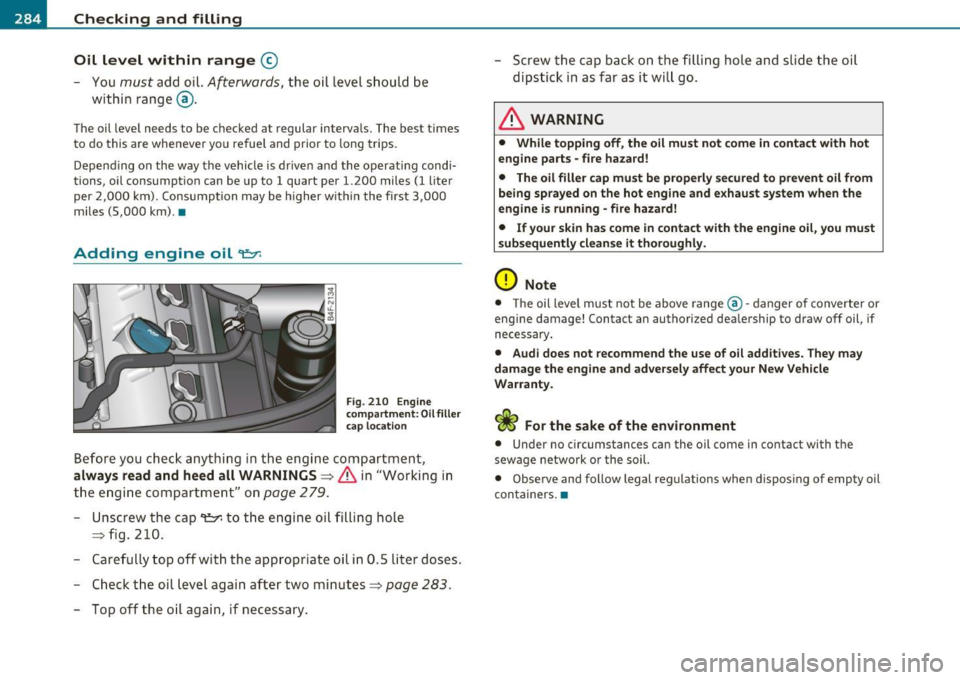
Fig . 210 Engine
compa rtment: Oil filler
cap locatio n
Before you check anything in the engine compartment,
always read and heed all WARNINGS =>
& in "Working in
the engine compartment" on
page 279.
-Unscrew the cap
- Carefully top off with the appropriate oil in 0.5 liter doses.
- Check the oil level again after two minutes=>
page 283.
-Top off the oil again, if necessary . -
Screw the cap back on the filling hole and slide the oil
dipstick in as far as it will go.
& WARNING
• While topping off, the oil must not come in contact with hot
engine parts -fire hazard!
• The oil filler cap must be properly secured to prevent oil from
being sprayed on the hot engine and ex haust system when the
engine is running -fire hazard!
• If your skin has come in contact with the engine oil, you must
subsequently cleanse it thoroughly.
0 Note
• The oil level must not be above range@- danger of converter or
engine damage! Contact an authorized dealership to draw off oil, if
necessary .
• Audi does not recommend the use of oil additives. They may
damage the engine and adversely affect your New Vehicle
Warranty.
sewage network o r the soil.
• Observe and follow legal regulations when disposing of empty oil
containers. •
Page 288 of 370
lffll __ C_h_ e_c _k _i_n -=g ,.,__ a_n_ d_ f_ i_ l _li _n _,g:,_ __________________________________________ _
Engine cooling system
Coolant
The engine coolant performs two functions: it keeps the
engine from o ve rheat ing and it prote cts the engine from
free zing in the winter .
The cooling system is sealed and genera lly requ ires little attention .
Th e cooling system has been fi lled a t the factory w it h a permanent
coo lant which does not need to be changed. The coolant consists of a
mixture of water and the man ufacturer's glycol-basedcoo lant add i
tive Gl2++ a ntifreeze with ant i corrosion additives (50% for USA
mode ls; 60% for Canadian mode ls). This mixture bot h assures the
necessary frost protec tion and p rotects metal components i n the
engine's cooling system from corrosion and scaling . It a lso ra ises the
boiling point of the coolant.
Do not reduce the concentration of the coolant in the summer by
adding p lai n water . The proport ion of coolant additive must be at
least 50 % but not more than 60 % to maintain ant ifreeze protection
and coo ling efficiency. If the coolant frost protect ion is too low, the
coo lant co uld freeze and damage the veh icle heating and eng ine
cooling system .
For year-ro und d riving, antifreeze is added at t he factory for temper
atures down to:
• - 31°F( -35°C)USA
• - 40 °F ( -40 °C) Canada .
You can mix the G12 ++ coo lant additive with other add it ives (G12 + or
G 12) . Always check with yo ur a utho rized Aud i dea ler .
& WARNING
Before you check anything in the engine compartment, always
read and heed all WARNINGS=>
& in "Working in the engine
compartment " on
page 279.
0 Note
• Before winter sets in, have the coolant checked to see if the
coo lant additive in you r vehicle is s ufficient to meet the climate
condi tions. This is especially important if you live in a region where
the winter is extreme ly cold. If necessary, increase the proport ion of
c oo lan t add it ive to 60%.
• When adding coolant additive to your cooling system, remember:
- We recommend using only coo lant add it ive G 12++ (check the
label) for your vehicle . This coolant additive is available at autho
r ized A ud i deale rs. Othe r ty pes of antifreeze can s ignifica ntly
reduce corrosion protection. The resulting corrosion can cause a
loss o f coolant and serious engine damage .
• Do not add any type of radiator leak sealant to you r vehicle's
eng ine coolant. Adding rad iator repair fl uid may adversely affect the
function and performa nce of your coo ling system and could resu lt in
d a mage not covered by your New Vehicle Limi ted W arranty. •
Checking the engine coolant level
The engine coolant level can be checked with a quick
glance .
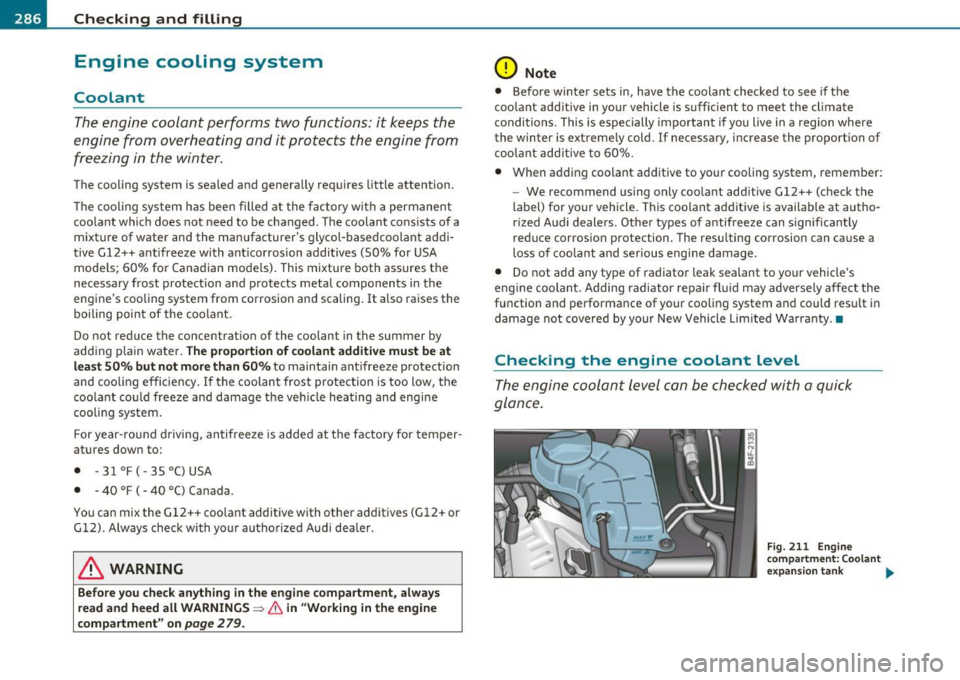
Fig. 211 En gine
compa rtm ent : C oolant
ex pa nsio n tank ..
Page 291 of 370

___________________________________________ C_ h _ e_c _k _ i_n -=g .._ a_n _ d_ f_i _ll _i _ n -=g '-- ........
Brake fluid
Checking brake fluid level
The b rake f lu id l eve l can be checke d wit h a qui ck g lanc e.
Fig . 212 E ngine
compartment : Br ake
fluid re se rv o ir
Before you c heck a nythi ng in the eng ine compartment ,
always read and heed all WARNINGS~ & in "Working in
the e ngi ne comp art ment" on
page 279.
- Read t he bra ke flu id level from the bra ke fluid reservoir
~ page 289, fig . 212. The brake flu id level must be
between the " MIN" and " MAX" mar kings.
The brake fluid reservoir is locate d at the rear pa rtition of the engine
compartmen t on the left s ide=>
page 280 .
The f luid leve l may drop slightly after some time d ue to the auto
m atic a dju stment of t he b rake pads. This is not c ause for ala rm.
If the brake flu id level falls
considerably be low the "M IN" mark, the
brake warni ng/ind icator light (U .S. models :
BRAKE, Canadia n mo dels:
(0) ) will come on=> page 18 and=> page 26. Do not continue to
operate t he vehicle. The complete brake system sho uld be thoroug hly
chec ked by an au thor ized A ud i d eale r or othe r qualified fac ility and
the cause corrected.
If the brake fluid level is too low, the brake
Vehicle OP-eration
warning/ind icator light will illum inate . Contact an au thoriz ed Aud i
de aler
immediately .•
Changing brake fluid
H av e the b rake fluid chang ed by an expe rie nc ed t echni
CJ an.
B ra ke flui d abso rb s moi stur e from the air. If the wa te r c on ten t in t he
brake fl uid is too high, corros ion in the b rake system may res ult after
a pe riod of time. The boili ng po int of the brak e flu id will also decrea se
co nsiderab ly and decrease brak ing perfo rmance.
Th erefore, the brake f lui d m ust be c hanged
every two years . Always
use new brake fluid w hich conforms to Fede ral Motor Veh icle Stan
dard "F MVSS 1 16 DOT 4" .
Th e br ake f luid reserv oir can be diffi cult to rea ch, there fore, we
recommend that you have the brake fluid changed by your authori zed
Audi dealer . Your deal er h as th e correc t tools, the rig ht bra ke flui d
and the know-how to do th is for you.
& WARNING
• Brake fluid is poisonous. It must be stored only in the closed
original container out of the rea ch of children!
• Brake
failure can result from old or inappropriate brake fluid .
Observe these precaution s:
- Use only b rake fluid that meets SAE specification
J 1703 and
conforms to Federa l Motor Vehicle Standard 116. Alway s check
with you r authorized Audi dealer to make sure you are using
the correct brake fluid. The corre ct type of brake fluid is also
indicated on the brake fluid rese rvoir.
- The brake fluid must be new . Heavy use of the brakes can
c ause a vapor lo ck if the brake fluid is left in the system too
long . Thi s can seriously affect the efficiency of the brakes as
well as your safety. This could result in an accident .
~
Vehicle care Do-it-yourselt service Technical data
Page 315 of 370

Tires and wheels -________________ Effll
& WARNING (co ntinued )
• Snow chain s are available in different sizes. Always make sure
to follow the instructions provi ded by the snow chain manufac
turer.
• Wh en driving with snow cha in s never drive fa ster than the
speed permitted for your specific snow chains .
• Always observe local regulations.
0 Note
• Remove snow chains before d riving on roads not cove red w it h
snow to avoid damaging t ires and wearing t he snow chains down
unnecessar ily.
• Snow chains, which come into direct contact wi th the wheel rim,
can scratch or damage it. The refore, make s ure that the snow chai ns
are sui tably covered. Chec k the pos it ion o f the snow cha ins afte r
driving a few yards and correct if necessary . Follow the instructions
from t he snow chain man ufacturer when doing so .
• If the Adaptive A ir Suspension* sho uld ma lfunct ion, do no t mount
or use snow cha ins because t he ve hicle will be ex tremely low . If you
do drive w ith snow chains o n while the veh icle is at t his level, the
snow c hains m ight severe ly damage the whee lhouse and other parts
o f the ve hicl e.
[I) Tips
W he re snow c ha ins a re mandato ry on certain ro ads, this no rm ally
also applies to ve hicles with A ll W hee l Dr ive. •
Safety first
Wheel bolts
Wheel bol ts mus t alwa ys be tigh tened to the co rrect
torque .
The design of wheel bolts is matched to the factory installed rims. If
differe nt rims a re fitte d, the correc t wheel bolt s wi th the r ig ht length
and co rrectly s haped bolt heads must be used. Th is ensures that
w heels are fitte d se cu rely and that the br ake system fun ctions
correctly .
In certain circumstances, yo u may not use wheel bolts from a
different veh icle -even if it is the same model~
page 348.
& WARNING
Improperly tightened or ma intained wheel bolts can become
loose causing los s of control, a collision and seriou s per sonal
injury .
• Always keep the wheel bolts and the thread s in the wheel hub s
clean so the wheel bolts can turn easily and be properly tightened .
• Never grease or oil the wheel bolts and the threads in the wheel
hubs. They can become loose while driving if greased or oiled , even
if tightened to the specified torque.
• Only use wheel bolts that belong to the rim being installed.
• Never use different wheels bolts on your vehicle .
• Always maintain the correct tightening torque for the wheel
bolts to reduce the risk of a wheel loss . If the tightening torque of
the wheel bolts is too low , they can loosen and come out when the
vehicle is moving . If the tightening torque i s too h igh, the wheel
bolts and threads can be damaged and the wheel can become
loose .
0 Note
The specified tor que fo r th e wheel bolt s i s 90 ft lb (120 Nm) wi th a
tolerance of ± 7,4 ft lb( ± 10 Nm). Torque wheel bo lts diagonally. .,_
Vehicle care Technical data
Page 330 of 370

-L_!F~U:!_:S~ e~ s ~ a~ n~ d~b~ u~l~b ~s ~-------------------------------------------
Fuse assignment, cockpit driver's side
Fig. 234 Cockpit
driver's side: fuse
panel layout
No. Consume r
3 Engine management
4
5
6
7
8
9
10
12
13
Oil level sensor
Climate control, tire pressure monitoring sys
tem Electronic Stabilization Program (ESP), clutch
sensor
Diagnostic connector
Homelink control unit
Automatic dimming interior mirror
Adaptive Cruise Control Diagnostic connector
Switch module steering column
15 Instrument cluster, control module Gateway
16 Telephone, cell phone
17 Electronic Stabili zation Program (ESP)
18 Headlight electronics, left-side
Amps
5
5
5
5
5
5
s
5
10
10
10
5
10
5
No. Con sum er
19 Rain sensor
20 Heated washer nozzles
21 Seat adjustment (driver)
22 MMI display
23 Electromechanical park ing brake
31
32
33
34
36
37
38
39
40
41
42
43
Back-up light switch, transmission, engine com
ponents
I ntelligent power module driver (footwell light
and front headlights , horn, wiper system, elec
trically adjustable steering wheel)
Intelligent power module driver (lights left-side)
I ntelligent power module driver
(lights right-side)
Headlight washer system
Electronic Stabilization Program (ESP)
Wiper system Door control module left-side
Horn
Heater fan
Control module electronic ignition lock/elec tri
cally adjustable steering wheel
Rear windshield wiper (Avant)
44 Power window opener (left-side)
Amps
5
5
10
5
5
15
30
25
25
30
25
30
15
25
40
30
15
35
-
•
Page 356 of 370
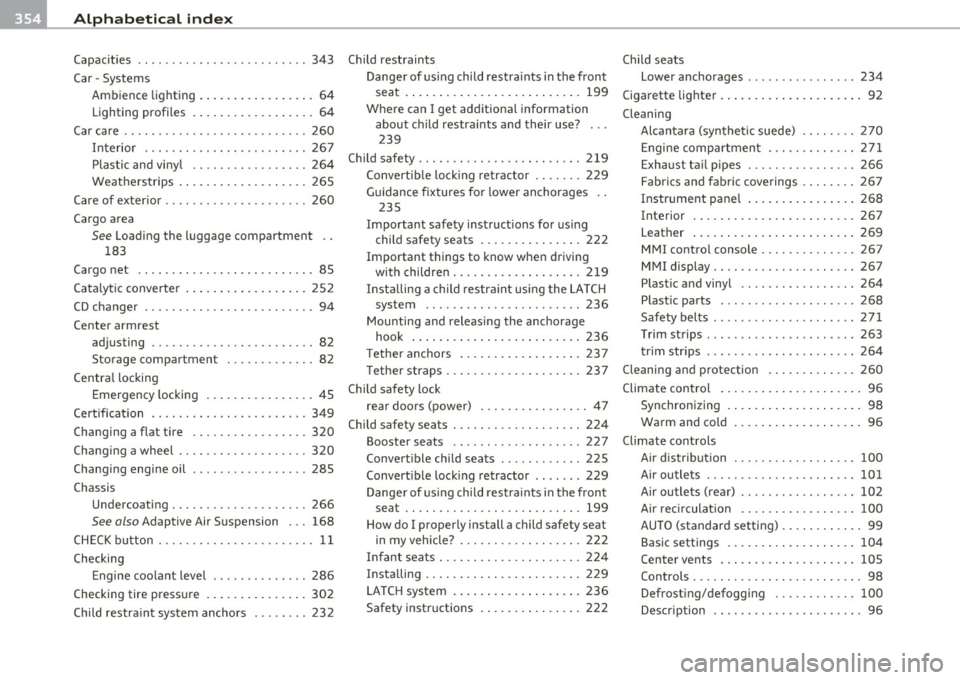
___ A_ l_. p_ h _ a_b_ e_ t_ic _a_ l_ in_ d_e _ x ____________________________________________ _
Capacities .... ..................... 343
Car -Systems
Ambience lighting ... .............. 64
Lighting profiles . ................. 64
Car care .. .. .. ..................... 260
Interior ..... ............. .... .. 267
Plastic and vinyl .. .. .. .. ......... 264
Weatherstrips ................ ... 26S
Care of exterior .. .... .. .. ..... ... ... 260
Cargo area
See Loading the luggage compartment ..
183
Cargo net .. .. ...... .... .. .. .. ..... . 85
Catalytic converter .................. 252
CD changer ............ .... .. .... ... 94
Center armrest adjusting .. .... .. .. .... .......... 82
Storage compartment ... .......... 82
Centra l locking
Emergency locking ............ .... 45
Cert ification .... ...... .... ......... 349
Changing a flat tire .. .. .. .. ......... 320
Changing a wheel ........... ...... .. 320
Changing engine oil .. .. ... ....... .. . 285
Chassis Undercoating . ................. .. 266
See also Adaptive Air Suspension . .. 168
CHECK button . .. .. ........ .......... 11
Checking Engine coolant level . ........... .. 286
Checking tire pressure ............ ... 302
Child restra int system anchors . ... .... 232 Child restraints
Danger of us ing child restraints in the front
seat . ... ............... .. ... .. 199
Where can I get additional information
about child restraints and their use? .. .
239
Child safety ....... ...... ... . .. .. .. . 219
Convert ible locking retractor .... .. . 229
Guidance fixtures for lower anchorages
235
Important safety instructions for using
child safety seats ......... ... .. . 222
Important things to know when driving with children ............ .. .. .. . 219
Installing a child restraint using the LATCH
system .................. ..... 236
Mounting and releasing the anchorage hook .............. .... ....... 236
T ether anchors ...... ... .. .. .... . 237
Tether straps .............. ... .. . 23 7
Child safety lock rear doors (power) ........ .. .. .. .. 47
Child safety seats ............ .. ..... 224
Booster seats .... .. .. .. .. .. .. .. . 22 7
Convertible child seats .......... .. 225
Convertible lock ing retractor ....... 229
Danger of us ing child restraints in the front
seat .. .... .. ........... .. .. .. . 199
How do I properly install a child safety seat in my vehicle? ........... .. .. .. . 222
In fant seats .............. .. .... . 224
Insta lling ...... .... .. .. .. ....... 229
LATCH system ....... ..... ....... 236
Safety instructions . ... .... ....... 222 Child seats
Lower anchorages . ...... ........ . 234
Cigarette lighter ................... .. 92
Cleaning Alcantara (synthetic suede) .. .. .. .. 270
Engine compartment .......... ... 271
Exhaust tail pipes . .. .. .. ......... 266
Fabrics and fabric coverings . ....... 267
Instrument pane l ... ............. 268
Interior ............. .... ..... .. 267
Leather ....... ... ... ... ..... ... 269
MMI control console .............. 267
MMI display .. .... .. ......... .... 267
Plastic and vinyl .. .. ............. 264
Plastic parts ... .. .. .......... ... 268
Safety belts .............. ... .. .. 2 71
Trim strips ..................... . 263
tr im strips . .. ................. .. 264
Cleaning and protection ....... .. .. .. 260
Climate control . . . . . . . . . . . . . . . . . . . . . 96
Synchronizing . ................. .. 98
Warm and cold ....... ... .. .. .. ... 96
Climate controls Air distr ibut ion ...... ...... ...... 100
Air outlets . .. ....... ...... .. .. .. 101
Air outlets (rear) ................. 102
Air recirculation . ... ............. 100
AUTO (standard setting) ............ 99 Basic settings ............ ... .. .. 104
Center vents . ............... .... 105
Controls . . . . . . . . . . . . . . . . . . . . . . . . . 98
Defrosting/defogging ............ 100
Description .. .. ... ...... ..... .. .. 96