engine oil AUDI A6 2011 Owner's Manual
[x] Cancel search | Manufacturer: AUDI, Model Year: 2011, Model line: A6, Model: AUDI A6 2011Pages: 370, PDF Size: 87.15 MB
Page 287 of 370

___________________________________________ C_ h_e _c _k_ i_n ~g_ a_n_ d_ f_ i_ll _i_n _g __ _
Changing the engine oil
We recommend that have your oil changed by an autho
ri ze d Audi dealer or a qualified service station.
Before you check anything in the engine compartment, alway s read
and heed all WARNINGS:::::,
& in "Working in t he eng ine compart
ment" on page 279.
T he eng ine oil mus t be changed acco rding to the intervals specifie d in
your Warranty
& Maintenance book let . This is very important because
the lub ricating properties of oil diminish gradually during norma l
vehicle use .
Under some circumstances the eng ine o il sho uld be changed more
frequently. Ch ange oi l more ofte n if you drive mos tly short distan ces,
operate the vehicle in dusty areas or under predominant ly stop-and
go tr affic condi tions , or have yo ur vehicl e where temperat ures rem ain
below freezing for extended per iods.
Detergent a dditives in the o il w ill make fres h oil look dark after the
eng ine has been ru nning for a s hort ti me. Th is is normal an d is not a
reason to change the oil mo re often than recommended.
B eca u se of the proble m of pr oper di sp o sal, along w ith the s pe cial
too ls and necessary expertise required , we strong ly recommend that
yo u have your o il changed by an a uth o rized
Audi dealer o r a qua lified
service stat io n.
If you choose to change your oil yourself , please note the following
i m po rtan t informatio n:
& WARNING
To reduce the risk of personal injury if you must change the engine
oil in your vehicle your self:
• Wear eye protection.
• To reduce the risk of burns from hot engine oil, let the engine
cool down to the touch.
Safety first
& WARNING (co ntinued )
• When removing the oil drain plug with your fingers , stay as far
away as possible. Always keep your forearm parallel to the ground
to help prevent hot oil from running down your arm .
• Drain the oil into a container designed for this purpose, one
large enough to hold at least the total amount of oil in your
engine .
• Engine oil is poisonous. Keep it well out of the reach of chil
dren.
• Continuous contact with used engine oil is harmful to your
skin. Always protect your sk in by washing oil off thoroughly with
soap and w ater.
(D Note
N ever m ix o il additives w it h your engine oil. These a dditives can
damage your engine and adversely affect your Audi L imited New
Vehicle Warranty .
For the sake of the environment
• Before changing yo ur oil, first ma ke sure you know w he re you ca n
pro pe rly dispose of the use d oil.
• Always dispose of used eng ine oil prope rly . D o not dum p it on
garden soi l, wooded a reas, into open st reams or down sewag e drains .
• Recy cl e used en gine o il by taking it to a use d eng ine oil collection
facili ty in your area, or contac t a serv ice stat io n.•
Vehicle care Technical data
Page 288 of 370
lffll __ C_h_ e_c _k _i_n -=g ,.,__ a_n_ d_ f_ i_ l _li _n _,g:,_ __________________________________________ _
Engine cooling system
Coolant
The engine coolant performs two functions: it keeps the
engine from o ve rheat ing and it prote cts the engine from
free zing in the winter .
The cooling system is sealed and genera lly requ ires little attention .
Th e cooling system has been fi lled a t the factory w it h a permanent
coo lant which does not need to be changed. The coolant consists of a
mixture of water and the man ufacturer's glycol-basedcoo lant add i
tive Gl2++ a ntifreeze with ant i corrosion additives (50% for USA
mode ls; 60% for Canadian mode ls). This mixture bot h assures the
necessary frost protec tion and p rotects metal components i n the
engine's cooling system from corrosion and scaling . It a lso ra ises the
boiling point of the coolant.
Do not reduce the concentration of the coolant in the summer by
adding p lai n water . The proport ion of coolant additive must be at
least 50 % but not more than 60 % to maintain ant ifreeze protection
and coo ling efficiency. If the coolant frost protect ion is too low, the
coo lant co uld freeze and damage the veh icle heating and eng ine
cooling system .
For year-ro und d riving, antifreeze is added at t he factory for temper
atures down to:
• - 31°F( -35°C)USA
• - 40 °F ( -40 °C) Canada .
You can mix the G12 ++ coo lant additive with other add it ives (G12 + or
G 12) . Always check with yo ur a utho rized Aud i dea ler .
& WARNING
Before you check anything in the engine compartment, always
read and heed all WARNINGS=>
& in "Working in the engine
compartment " on
page 279.
0 Note
• Before winter sets in, have the coolant checked to see if the
coo lant additive in you r vehicle is s ufficient to meet the climate
condi tions. This is especially important if you live in a region where
the winter is extreme ly cold. If necessary, increase the proport ion of
c oo lan t add it ive to 60%.
• When adding coolant additive to your cooling system, remember:
- We recommend using only coo lant add it ive G 12++ (check the
label) for your vehicle . This coolant additive is available at autho
r ized A ud i deale rs. Othe r ty pes of antifreeze can s ignifica ntly
reduce corrosion protection. The resulting corrosion can cause a
loss o f coolant and serious engine damage .
• Do not add any type of radiator leak sealant to you r vehicle's
eng ine coolant. Adding rad iator repair fl uid may adversely affect the
function and performa nce of your coo ling system and could resu lt in
d a mage not covered by your New Vehicle Limi ted W arranty. •
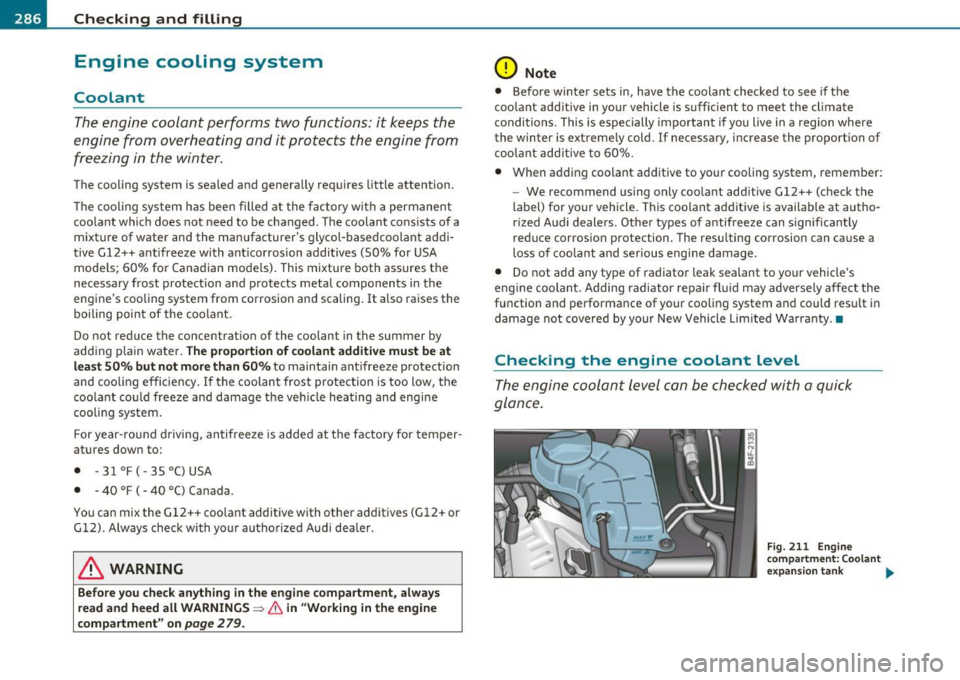
Checking the engine coolant level
The engine coolant level can be checked with a quick
glance .
Fig. 211 En gine
compa rtm ent : C oolant
ex pa nsio n tank ..
Page 291 of 370

___________________________________________ C_ h _ e_c _k _ i_n -=g .._ a_n _ d_ f_i _ll _i _ n -=g '-- ........
Brake fluid
Checking brake fluid level
The b rake f lu id l eve l can be checke d wit h a qui ck g lanc e.
Fig . 212 E ngine
compartment : Br ake
fluid re se rv o ir
Before you c heck a nythi ng in the eng ine compartment ,
always read and heed all WARNINGS~ & in "Working in
the e ngi ne comp art ment" on
page 279.
- Read t he bra ke flu id level from the bra ke fluid reservoir
~ page 289, fig . 212. The brake flu id level must be
between the " MIN" and " MAX" mar kings.
The brake fluid reservoir is locate d at the rear pa rtition of the engine
compartmen t on the left s ide=>
page 280 .
The f luid leve l may drop slightly after some time d ue to the auto
m atic a dju stment of t he b rake pads. This is not c ause for ala rm.
If the brake flu id level falls
considerably be low the "M IN" mark, the
brake warni ng/ind icator light (U .S. models :
BRAKE, Canadia n mo dels:
(0) ) will come on=> page 18 and=> page 26. Do not continue to
operate t he vehicle. The complete brake system sho uld be thoroug hly
chec ked by an au thor ized A ud i d eale r or othe r qualified fac ility and
the cause corrected.
If the brake fluid level is too low, the brake
Vehicle OP-eration
warning/ind icator light will illum inate . Contact an au thoriz ed Aud i
de aler
immediately .•
Changing brake fluid
H av e the b rake fluid chang ed by an expe rie nc ed t echni
CJ an.
B ra ke flui d abso rb s moi stur e from the air. If the wa te r c on ten t in t he
brake fl uid is too high, corros ion in the b rake system may res ult after
a pe riod of time. The boili ng po int of the brak e flu id will also decrea se
co nsiderab ly and decrease brak ing perfo rmance.
Th erefore, the brake f lui d m ust be c hanged
every two years . Always
use new brake fluid w hich conforms to Fede ral Motor Veh icle Stan
dard "F MVSS 1 16 DOT 4" .
Th e br ake f luid reserv oir can be diffi cult to rea ch, there fore, we
recommend that you have the brake fluid changed by your authori zed
Audi dealer . Your deal er h as th e correc t tools, the rig ht bra ke flui d
and the know-how to do th is for you.
& WARNING
• Brake fluid is poisonous. It must be stored only in the closed
original container out of the rea ch of children!
• Brake
failure can result from old or inappropriate brake fluid .
Observe these precaution s:
- Use only b rake fluid that meets SAE specification
J 1703 and
conforms to Federa l Motor Vehicle Standard 116. Alway s check
with you r authorized Audi dealer to make sure you are using
the correct brake fluid. The corre ct type of brake fluid is also
indicated on the brake fluid rese rvoir.
- The brake fluid must be new . Heavy use of the brakes can
c ause a vapor lo ck if the brake fluid is left in the system too
long . Thi s can seriously affect the efficiency of the brakes as
well as your safety. This could result in an accident .
~
Vehicle care Do-it-yourselt service Technical data
Page 330 of 370

-L_!F~U:!_:S~ e~ s ~ a~ n~ d~b~ u~l~b ~s ~-------------------------------------------
Fuse assignment, cockpit driver's side
Fig. 234 Cockpit
driver's side: fuse
panel layout
No. Consume r
3 Engine management
4
5
6
7
8
9
10
12
13
Oil level sensor
Climate control, tire pressure monitoring sys
tem Electronic Stabilization Program (ESP), clutch
sensor
Diagnostic connector
Homelink control unit
Automatic dimming interior mirror
Adaptive Cruise Control Diagnostic connector
Switch module steering column
15 Instrument cluster, control module Gateway
16 Telephone, cell phone
17 Electronic Stabili zation Program (ESP)
18 Headlight electronics, left-side
Amps
5
5
5
5
5
5
s
5
10
10
10
5
10
5
No. Con sum er
19 Rain sensor
20 Heated washer nozzles
21 Seat adjustment (driver)
22 MMI display
23 Electromechanical park ing brake
31
32
33
34
36
37
38
39
40
41
42
43
Back-up light switch, transmission, engine com
ponents
I ntelligent power module driver (footwell light
and front headlights , horn, wiper system, elec
trically adjustable steering wheel)
Intelligent power module driver (lights left-side)
I ntelligent power module driver
(lights right-side)
Headlight washer system
Electronic Stabilization Program (ESP)
Wiper system Door control module left-side
Horn
Heater fan
Control module electronic ignition lock/elec tri
cally adjustable steering wheel
Rear windshield wiper (Avant)
44 Power window opener (left-side)
Amps
5
5
10
5
5
15
30
25
25
30
25
30
15
25
40
30
15
35
-
•
Page 340 of 370
lffll.___E_ m_ e_ r-' g=- e_n_ c=-y _ s_it _ u _ a_t_ i_ o _ n_ s ______________________________________________ _
in. WARNING
• To reduce the risk of serious injury and vehicle damage.
-Always lift the vehicle only at the special workshop hoist and
floor jack lift points illustrated=>
page 337, fig. 243 and
=>
page 337, fig. 244.
- Failure to lift the vehicle at these points could cause the
vehicle to tilt or fall from a lift if there is a change in vehicle
weight distribution and balance. This might happen, for
example, when heavy components such as the engine block or
transmission are removed.
• When removing heavy components like these, anchor vehicle
to hoist or add corresponding weights to maintain the center of
gravity. Otherwise, the vehicle might tilt or slip off the hoist,
causing serious personal injury.
0 Note
• Be aware of the following points before lifting the vehicle :
-The vehicle should never be lifted or jacked up from under
neath the engine oil pan, the transmission housing, the front or
rear axle or the body side members. This could lead to serious
damage.
- To avoid damage to the underbody or chassis frame, a rubber
pad must be inserted between the floor jack and the lift points.
- Before driving over a workshop hoist, check that the vehicle
weight does not exceed the permissible lifting capacity of the hoist.
- Before driving over a workshop hoist, ensure that there is sufficient clearance between the hoist and low parts of the
vehicle. •
Page 345 of 370

____________________________________________________ D_ a_t_ a __ _
Data
Applies to vehicles: with 3 .0 lit er 6-c ylin der engine
300 hp, 3.0 liter, 6-cylinder engine
Engine data
Maximum outpu t SA E net
Maximum torque SAE net
No. of cy linders
Displacement
St roke
Bore
Compression ratio
Fu el
Dimensions (approx. )
Length
W idth
He igh t (u nloaded)
Turning circle diameter (curb to curb)
Capacities (approx .)
Fu el tank
- Tota l capacity
- Rese rve (of to tal cap aci ty)
Windshield and headlight* washer fluid container
Engine oil
with filter c hange
Safety first
hp@rpm
lb-ft@ rpm
C ID (cm
3
)
in (mm)
in (mm) 30
0@ 5100-6800
310@ 2500-5100
6 cylinder 183 (2995)
3.50 (89.0)
3 .33 (84 .5)
10.5 : 1
Premium unleaded (91 AKI) Recomm end ed for maximum engin e perfo rmanc e. Fur
ther details =>
page 2 73, "Gasoline"
i n (mm)
i n (mm)
i n (mm)
ft (m) 193.5 (4916)
79 .2 (2012)
57. 4 (1459)
39.0 (11.9)
gal (liters)
gal ( liters)
quarts (liters)
quarts ( liters) 21.1 (80.0)
1. 8-2.4 (7-9)
5 .1(4.8)
6.9 (6.5)
•
Do-it,yourself service Technical data
Page 346 of 370
___ D_ a_t _a _____________________________________________________ _
Applies to vehicles : w ith 3.2 lite r 6 -cylin der engine
265 hp, 3.2 Liter, 6-cylinder engine
Engine dat a
Max imum output SAE net
Max imum torque SAE net
No . of cylinders
Displacement
Stroke
Bore
Comp ression ratio
Fuel
Dimen sions (appro x.)
Length
Width Height (unloaded)
Turning circle diameter (curb to curb)
Capacities (appro x.)
Fuel t ank
- Total capac ity
- Reserve (of total capacity)
Wind shield and headlight* was her flu id c ontainer
Engin e oil
with filter change hp@rpm
lb-ft@ rpm
CID (cm
3
)
in (mm)
in (mm) 265 @6500
243 @ 3200-5000
6 cylinder
195 1 (3 197)
3 .65 (92 .8)
3 .37 (85.5)
12 .5: 1
Premium un leaded (91 A KI) Recommended for maximum engine performance . Fur
ther details =>
page 273, "Gasoline"
in (mm)
in (mm)
in (mm)
ft (m) 193.5 (4916)
79.2 (2012)
57.4 (1459)
39 .0 (11.9)
gal (liters)
gal (liters)
quarts (liters)
quarts ( liters) 21.1 (80
.0)
1. 8-2 .4 (7 -9)
5.1 (4 .8)
6.9 (6.5)
•
Page 347 of 370
____________________________________________________ D_ a_t_ a __ _
App lies to ve hicles : with 4.2 li ter 8 -cy linder engine
3 50 hp, 4.2 liter, a-cylinder engine
Engine data
Max imum output SAE net
Maximum torque SAE net
No . of cy linders
Displacement
Stroke Bore
Comp ression ra tio
Fuel
Dimensions (approx. )
Length
W idth
He ight (un loaded)
Tu rning circle diameter (curb to curb)
Capacities (app ro x. )
Fuel tank
-Tota l capacity
- Reserve (of total capacity)
Windshield and headlight* washer fluid container
Engine oil
with filter change
Safety first
hp@rpm
lb-ft@ rpm
CID (cm
3
)
in (mm)
in (mm) 350@ 6800
325 @3500
8 cylinder
254 (4163)
3
.65 (92.8)
3 .33 (84 .5)
12.5: 1
Premium unl eaded (91 AKI) Recommended for maximum engine performance . Fur
ther details => page
273, "Gasoline"
in (mm)
i n (mm)
i n (mm)
ft (m) 1
93.5 ( 4916)
79 .2 (2012)
57 .4 (1459)
39.0 (11.9)
gal ( liters)
gal (liters)
quarts (liters)
quarts ( lite rs) 21.1 (80.0)
1.8 -2 .4 ( 7-9)
5 .1 (4 .8)
9.0 (8.5)
•
Do-it,yourself service Technical data
Page 349 of 370

_____________________________________________ C_o_ n_s _u_ m __ e_r _ I_ n_ f_o _r_ m_ a_ t_ i _o_ n __ __
• oil cha nges, and
• cl ea ning or re placing th e air fi lter.
W For the sake of the environment
By regu larly ma intaini ng yo ur vehicl e, y ou h elp m ake su re th at em is
sion standards a re mainta ined, t hus mi nimizing adverse effects o n
t he enviro nmen t. •
Important considerations for you and your
vehicle
Th e increas ing use of elect ronics, s ophistica ted fuel inje ct io n and
em ission cont rol systems, and t he generally increasing tec hnical
c omplex ity o f today' s automobile s, have s tea dil y re duced t he s cope
of maintena nce and repairs w hic h can be carr ied out by ve hicle
ow ners.
Also, safety and environmental c o nce rn s plac e very s trict
limits o n the nature of repa irs and adjustments to engine an d tra ns
mission parts w hich an owner can pe rform .
M ain te nance, ad justm ents and r epairs us ua lly re quir e spec ia l t ools,
test ing devices an d other e quipment availab le to s pecia lly trained
wo rksh op pe rsonnel in order to assure pro per perfor mance, re li
ability and safety of the vehicle and its many systems.
Impro per ma inte nance, adjustments and rep airs can im pa ir the ope r
ation and reliability of your ve hicle and even void your veh icle
wa rranty . Therefo re, p ro of of se rvicing in a ccordance wi th t he ma in
t enance sch edul e may be a co nd it io n fo r u phold ing a possib le
wa rranty claim made w it h in the wa rranty pe riod.
Above all, operat io nal safety ca n be adve rsely affec ted, c reat ing
unnecessary r is ks for you and your passe ngers.
If in doubt abou t any serv ic ing, have it done by your authorized Audi
dealer or a ny o ther pro perly equipped a nd qualified workshop . W e
st rong ly ur ge you to give yo ur auth oriz e d Aud i dea ler the opportu nity
t o pe rform all sc heduled mainte na nce and necessary repairs. Yo ur
Safety first
dealer has the facilities, o rigina l parts and trained spec ia lists to keep
your vehi cle runni ng properly.
Performing limited maintenance yourself
The foll ow ing page s descr ibe a lim ite d num ber of proced ures whi ch
can be perfo rmed on your vehicle w it h ordina ry tools, shou ld the need
ar ise and tr ained pe rsonnel be u navailabl e. Befo re pe rforming any of
t hese p rocedures, always t horoughly read all of the applicable text
and ca ref ull y follow the ins tru ction s given . Alw ays rigoro usly o bserve
t he
WARNINGS prov ided .
Before you check anything in the engine compartment, always read
and heed all WARNINGS=>
& and=> & in "W orking in the engine
compartment" on
page 279.
& WARNING
• Serious personal injury may occur as a result of improperly
performed maintenance, adjustments or repairs.
• Always be extremely careful when working on the vehicle.
Always follow commonly accepted safety practices and general
common sense . Never risk personal injury .
• Do not attempt any of the maintenance, checks or repairs
described on the following pages if you are not fully familiar with
these or other procedures with respect to the vehicle, or are uncer
tain how to proceed.
• Do not do any work without the proper tools and equipment .
Have the necessary work done by your authorized Audi dealer or
another properly equipped and qualified workshop .
• The engine compartment of any motor vehicle is a potentially
hazardous area. Never reach into the area around or touch the
radiator fan. It is temperature controlled and can switch on
suddenly -even when the engine is off and the ignition key has
been removed. The radiator fan switches on automatically when
the coolant reaches a certain temperature and will continue to run until the coolant temperature drops. ..
Do-it,yourself service Technical data
Page 354 of 370
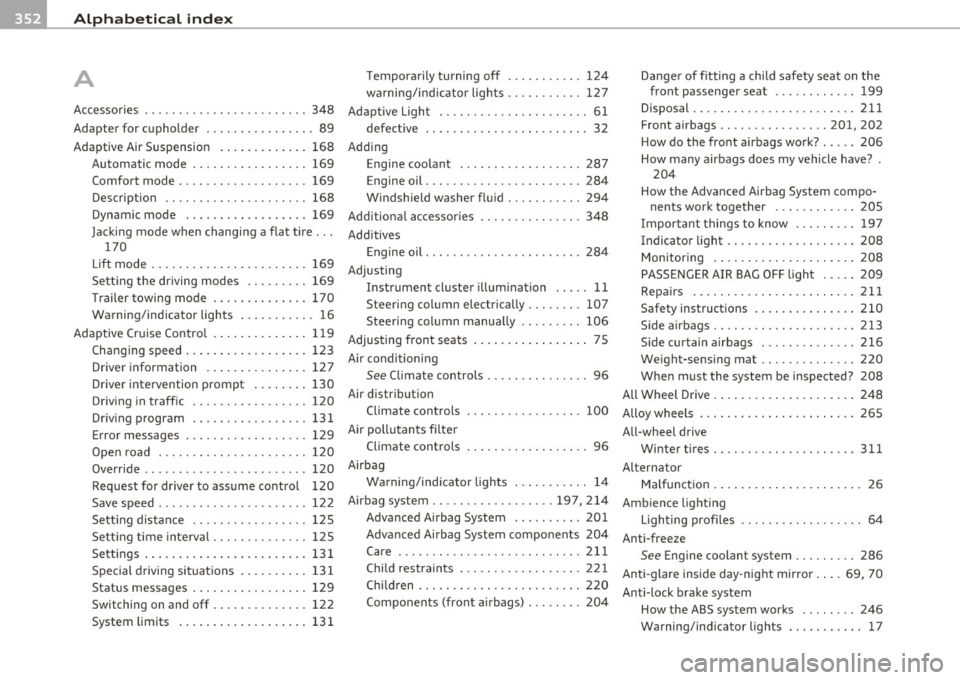
___ A_l_,_ p _ h_ a _ b_e _ t_ i_c __ a _l _i_n :...::d __ e::..: x:...::...,_ _________________________________________ _
A Temporarily turning off .......... . 124
warning/indicator lights .... ...... . 127
Danger of fitting a child safety seat on the
front passenge r seat ............
199
Accessories ..... ................... 348 Adaptive Light ......... ....... .. .. .. 61 Disposal .................. .. .... 211
Adapter for cupholder ................ 89 defective ........................ 32 Front airbags ......... ... .... 201, 202
Adaptive Air Suspension ............. 168
Automatic mode .. .. ... .... ...... 169
Comfort mode ................... 169
Description ..................... 168
Dynamic mode ... .. ... ...... .... 169
Jacking mode when changing a flat tire ...
170
Lift mode ....................... 169
Setting the driving modes ......... 169
Trailer towing mode .............. 170
Warning/indicator lights .... ....... 16
Adaptive Cruise Control ......... ... .. 119
Changing speed ....... ........... 123
Driver information .............. .
Driver intervention prompt ...... . . Adding
Engine coolant ........... ...... .
287
Engine oil ............ ...... ..... 284
Windshield washer fluid ........... 294
Additional accessories ............... 348
Additives
Engine oil ............ .. .........
284
Adjusting
Instrument cluster illum ination .....
11
Steering column electrically ........ 107
Steering column manually .. .. .. .. . 106
Adjus ting front seats ................. 75
Air conditioning
See Climate controls ...............
96
Air distribution How do the front airbags work?
.....
206
How many airbags does my vehicle have? .
204
How the Advanced Airbag System compo-
nents work together ............
205
Important things to know ... .. .. .. 197
Indicator light ................... 208
Monitoring ... .................. 208
PASSENGER AIR BAG OFF light ..... 209
Repairs ............ .. .. .. ...... 211
Safety instructions ............... 210
Side airbags .... .... ............. 213
Side curtain airbags .............. 216
Weight-sensing mat ..............
220
When must the system be inspected? 208
All Wheel Drive ... ... ............... 248 Dr iv ing in traffic ................ .
Driving program .. ...... ........ .
127
130
120
131
Climate controls 100 Alloy wheels ................. .... .. 265
Error messages . .. .. .... ........ .
Open road ... .. .. .. .. ....... ... . 129 Air pollutants filter
120 Climate controls .................. 96
All-wheel drive
Winter tire s .....................
311
Override ...................... .. 120 Airbag
Alternator
Request for driver to assume control
120 Warning/indicator lights ..... ...... 14 Malfunction ........ .............. 26
Save speed . ...... .. .. ........... 122 Airbag system .................. 197,214 Ambience lighting
Setting distance .. ...... ...... .. .
125 Advanced Airbag System .......... 201 Lighting profiles .. .. .............. 64
Setting time interval .............. 125 Advanced Airbag System components 204 Anti-freeze
Settings ...................... ..
131 Care ... .. .......... ....... .. .. . 211 See Engine coolant system ......... 286
Special driving situations .......... 131
Status messages ................. 129
Switching on and off .............. 122
System limits ................... 131
Child restraints .................. 221
Children ........................ 220
Components (front airbags) ... ..... 204
Anti-glare inside day-night mirror .... 69, 70
Anti-lock brake system
How the ABS system works ...... ..
246
Warning/indicator lights ........... 17