roof AUDI A6 2011 Owner's Manual
[x] Cancel search | Manufacturer: AUDI, Model Year: 2011, Model line: A6, Model: AUDI A6 2011Pages: 370, PDF Size: 87.15 MB
Page 227 of 370

-Push the child safety seat down with your full weight to
get the safety belt really tight so that the seat cannot
move forward or sideways more than one inch (2.5 cm).
Infants up to about one year (20 lbs. or 9 kg) are best protected in
special infant carriers and chi ld safety seats designed for t heir age
group. Many experts believe that infants and small childr en should
r ide only in spec ia l restra ints in w hich the child faces the back of the
vehicle. These infant seats support the baby's back, neck and head in
a crash=> fig. 189.
The airbag on the passenger side makes the front seat a potentially
dangerous place for a child to ride. The front seat is not the safest
place for a ch ild in a forward-facing child seat.
It is a very dangerous
place for an infant or a large r child in a rear ward-fac ing seat.
& WARNING
Not using a child safety seat, using the wrong child safety seat or
improperly installing a child restraint increases the risk of serious
personal injury and death in a crash.
• Never install rear-facing child safety seats or infant carriers on
the front passenger seat· even with an Advanced Airbag System.
A child will be seriously injured and can be killed when the
inflating airbag hits the child safety seat or infant carrier with
great force and smashes the child safety seat and child against the
backrest, center armrest, door or roof=>
page 199, "Child
restraints on the front seat -some important things to know".
• Always install rear-facing child safety seats or infant carriers
on the rear seat.
• Never install a rear-facing child rest raint in the forward-facing
direction. Such restraints are designed for the special needs of
infants and very small children and cannot protect them properly
if the seat is forward-facing.
• If you must install a rearward facing child safety seat on the
front passenger seat because of exceptional circumstances and
the PASSENGER AIR BAG
OFF light does not come on and stay on,
Safety
first Vehicle OP-eration
Child Safety
& WARNING (continued)
immediately install the rear-facing child safety seat in a rear
seating position and have the airbag system inspected by your
Audi dealer.
• Always read and heed all WARNINGS whenever using a child
restrained in a vehicle is being used=>
page 187, "Safety belts",
=>
page 197, "Airbag system" and=> page 219, "Important
things to know ".•
Convertible child safety seat:s
Properly used convertible child safety seats can help
protect toddlers and children over age one who weigh
b etween 20 and 40 lbs. (9 and 18 kg) in a crash.
Vehicle care
Fig . 190 Schematic
overview: installation
of the attachments
applicable to a LATCH
seat
ti,
Do-it-yourselt service iTechnical data
Page 228 of 370
-Child Safety
__ .,.___ ____________
_
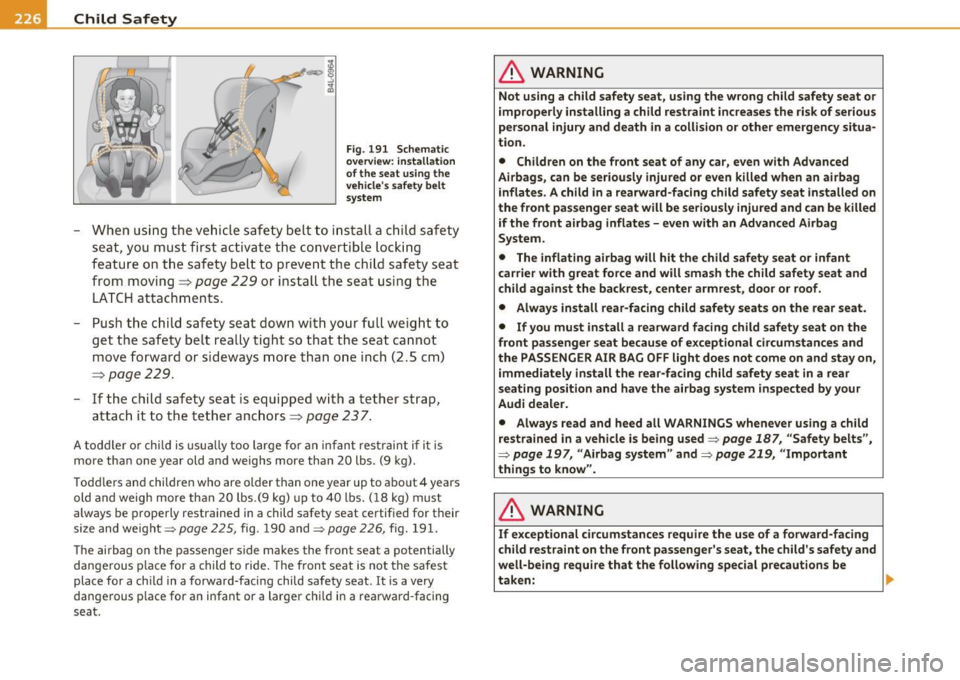
Fig. 191 Schematic
overview: installation
of the seat using the
vehicle's safety belt
system
- When using the vehicle safety belt to install a child safety
seat, you must first activate the convertible locking
feature on the safety belt to prevent the child safety seat
from moving~
page 229 or install the seat using the
LATCH attachments.
- Push the child safety seat down with your full weight to get the safety belt really tight so that the seat cannot
move forward or sideways more than one inch
(2.5 cm)
=>
page 229.
- If the child safety seat is equipped with a tether strap, attach it to the tether anchors=>
page 237.
A toddler or child is usually too large for an infant restraint if it is
more than one year old and weighs more than 20 lbs . (9 kg) .
Toddlers and children who are older than one year up to about 4 years old and weigh more than 20 lbs .(9 kg) up to 40 lbs. (18 kg) must
always be properly restrained in a child safety seat certified for their
size and weight~
page 225, fig. 190 and~ page 226, fig. 191.
The airbag on the passenger side makes the front seat a poten tially
dangerous place for a child to ride. The front seat is not the safest
place for a child in a forward-facing child safety seat . It is a very
dangerous place for an infant or a larger child in a rearward-facing
seat .
& WARNING
Not using a child safety seat, using the wrong child safety seat or
improperly installing a child restraint increases the risk of serious
personal injury and death in a collision or other emergency situa
tion.
• Children on the front seat of any car, even with Advanced
Airbags, can be seriously injured or even killed when an airbag
inflates. A child in a rearward-facing child safety seat installed on
the front passenger seat will be seriously injured and can be killed
if the front airbag inflates -even with an Advanced Airbag
System.
• The inflating airbag will hit the child safety seat or infant
carrier with great force and will smash the child safety seat and
child against the backrest, center armrest, door or roof.
• Always install rear-facing child safety seats on the rear seat.
• If you must install a rearward facing child safety seat on the
front passenger seat because of exceptional circumstances and
the PASSENGER AIR BAG OFF light does not come on and stay on,
immediately install the rear-facing child safety seat in a rear
seating position and have the airbag system inspected by your
Audi dealer.
• Always read and heed all WARNINGS whenever using a child
restrained
in a vehicle is being used~ page 187, "Safety belts",
~ page 197, "Airbag system" and~ page 219, "Important
things to know".
& WARNING
If exceptional circumstances require the use of a forward-facing
child restraint on the front passenger's seat, the child's safety and
well-being require that the following special precautions be
taken:
11'-
Page 232 of 370
• .___C_ h_ il_d _ S_a _ f_ e _ t--= y '------------------------------------------------
& WARNING (cont inued)
• If the backrest is not securely latched, the child and the child
restraint will be thrown forward together with the backrest and
will strike parts of the vehicle interior. The child can be seriously
injured or killed.
• Never install rear-facing child safety seats or infant carriers on
the front passenger seat. A child will be seriously injured and can be killed when the passenger airbag inflates.
• The inflating airbag will hit the child safety seat or infant
carrier with great force and will smash the child safety seat and
child against the backrest, center armrest, door or roof .
• Always install rear-facing child safety seats or infant carriers
on the rear seat.
• Forward-facing child safety seats or infant carriers installed on
the front passenger's seat may interfere with the deployment of
the airbag and cause serious injury to the child.
• It is safer to install a forward -facing child safety seat on the
rear seat.
• Always read and heed all WARNINGS whenever using a child
restrained in a vehicle is being used~
page 219. Special precau
tions apply when installing a child safety seat on the front
passenger seat~
page 199, "Child restraints on the front seat -
some important things to know".
L1}. WARNING
Always take special precautions if you must install a forward or
rearward -facing child restraint on the front passenger's seat in
exceptional situations:
• Whenever a forward or rearward-facing child restraint is
installed on the front passenger seat, the PASSENGER AIR BAG
OFF light must come on and stay on whenever the ignition is
switched on.
& WARNING (co ntinued )
• If the PASSENGER AIR BAG OFF light does not come on and
stay on, perform the checks described
~ page 208, "Monitoring
the Advanced Airbag System".
• Take the child restraint off the front passenger seat and install
it properly at one of the rear seat positions if the PASSENGER AIR
BAG OFF light does not stay on whenever the ignition is switched
on.
• Improper installation of child restraints can reduce their effec
tiveness or even prevent them from providing any protection.
• An improperly installed child restraint can interfere with the
airbag as it deploys and seriously injure or even kill the child.
• Always carefully follow the manufacturer's instructions
provided with the child safety seat or carrier.
• Never place additional items on the seat that can increase the
total weight registered by the weight-sensing mat and can cause injury in a crash.
L1}. WARNING
Forward-facing child restraints:
• Always make sure the forward-facing seat has been designed
and certified by its manufacturer for use on a front seat with a
passenger front and side airbag .
• Never put the forward-facing child restraint up, against or very
near the instrument panel.
• Always move the passenger seat into its rearmost position in
the seat's fore and aft adjustment range, as far away from the airbag as possible before installing the forward-facing child
restraint . The backrest must be adjusted to an upright position.
• Make sure that the PASSENGER AIR BAG OFF light comes on
and stays on all the time whenever the ignition is switched on . _.
Page 233 of 370

Child Safety -
-------------------"'---
& WARNING
Rearward-facing child restraints:
• A child in a rearward-facing child safety seat installed on the
front passenger seat will be seriously injured and can be killed if
the front airbag inflates -even with an Advanced Airbag System.
• The inflating airbag will hit the child safety seat or infant
carrier with great force and will smash the child safety seat and
child against the backrest, center armrest, door or roof.
• Always be especially careful if you must install a rearward
facing child safety seat on the front passenger seat in exceptional
circumstances.
• A tight tether strap on a rearward-facing child restraint
attached to the front passenger seat can put too much pressure on
the weight-mat in the seat and register a heavier weight in the
Advanced Airbag System. The heavier weight registered can make
the system work as though an adult were on the seat and deploy
the Advanced Airbag when it must be suppressed causing serious
or even fatal injury to the child.
• Make sure that the PASSENGER AIR BAG OFF light comes on
and stays on all the time whenever the ignition is switched on.
• If the PASSENGER AIR BAG OFF light does not come on and
stay on, immediately install the rear-facing child safety seat in a
rear seating position and have the airbag system inspected by
your Audi dealer. •
Activating the convertible Locking retractor
Use the convertible locking retractor to secure a child
restraint.
Always heed the child safety seat manufacturer's instruc
tions when installing a child restraint in your vehicle. To acti
vate the convertible locking retractor:
Controls and equip
ment Safety first Vehicle operation
-
Place the child restraint on a seat, preferably on the rear
seat.
- Slowly pull the belt
all the way out.
- Route it around or through the child restraint belt path
=>& .
- Push the child safety seat down with your full weight to
get the safety belt really tight.
- Insert the belt tongue into the buckle for that seating
position.
- Guide the safety belt back into the retractor until the belt
lies flat and snug on the child safety seat.
- You should hear a "clicking" noise as the belt winds back
i nto the inertia reel. Test the convertible locking retractor
by pulling on the belt. You should no longer be able to pull
the belt out of the retractor. The convertible locking
retractor is now activated.
- Make sure that the red release button is facing away from
the child restraint so that it can be unbuckled quickly.
- Pull on the belt to make sure the safety belt is properly
tight and fastened so that the seat cannot
move forward
or sideways more than one inch (2.S cm).
& WARNING
Using the wrong child restraint or an improperly installed child
restraint can cause serious personal injury or death in a crash.
• Always make sure that the safety belt retractor is locked when
installing a child safety seat. An unlocked safety belt retractor
cannot hold the child safety seat in place during normal driving or
in a crash. ._
Vehicle care Do-it-yourself service Technical data
Page 255 of 370

Driving and environment
------------------------------------------------'
-Nev er p ut too much motor oil in yo ur eng ine=:> pag e 284 ,
"A dd ing eng ine o il 't=:r.".
- N ever try to push- or tow-star t your ve hicle.
Th e catalyt ic conve rter is an eff ic ient "clean-up" device built into the
ex ha ust system of the vehicle . The catalytic converter burns many of
t he pollu tan ts i n the exhaust gas be fore they are re leased into the
atmosphere.
Th e excl usive use o f un leaded fuel is crit ic all y import ant for the lif e of
the catalytic converter and proper funct io ni ng of the engine.
& WARNING
• Do not park or ope rate the vehicle in areas where the hot
exhaust sy stem may come in conta ct with dry grass, bru sh, fuel
spill or othe r materi al which can cause a fire .
• Do not apply additional undercoating or rustproofing on or
near the exhaust manifold , exhaust p ipes , catalytic converter or
heat shi eld s. During driving, the sub stance u sed for und ercoating
could o verheat and cause a fire.
0 Note
• Be aware that just one tank filling w it h leaded fuel will already
ser iously degr ade the performance of the catalyt ic converter.
• Do not exceed the correct engine oi l level =>
page 284.
• Do not dr ive until t he fuel tank becomes com plete ly em pty. The
engine could misfire. Unbu rned fue l co uld also get into the exhaust
sys tem and t his co ul d cause t he ca talyt ic converter to ove rheat.
• Do not turn off the ignition while the vehicle is moving.
• Do not continue to operate your vehicle under these conditions, as
otherwise fuel can reac h the cata lyti c conve rter. This co ul d res ult in
over heat ing of the converter, requir ing its rep lacement.
• T o ass ure eff icient operat ion of the Emission Cont rol System:
Controls and equip
ment Safety first Vehicle operation
-
Have your vehicle maintained properly and in accordance with
t he se rvi ce recom menda tions i n your W arran ty
& Mai ntenan ce
booklet.
- Lac k of proper mai nte nance as well as im proper use o f th e
veh icle w ill impair the function of the emiss io n cont rol system and
c o uld lead to d amage.
~ For the sake of the environment
Even when the Emiss ion Contro l System is operating properly, the
exhaust gas can have a s ulfur-like exhaust gas smell under some
operating states . This depends on the sulfur content of the fue l being
used. Using a differe nt brand of fuel may help, or filli ng the tank with
lead-free super g rade gasoline. •
Operate your vehicle economically
and minimize pollution
General
Yo ur p ersonal sty le o f driving will determine the eco nom y
of your vehicle, as well as exhaust and noise levels .
Fuel economy, envi ronmenta l impact, and wear on your engine,
bra kes and tires la rgely depend on t hree fac to rs:
• your persona l dr iv ing style
• operati ng conditio ns
• technical limitations
If you an tici pat e wh at yo u nee d to do nex t an d drive eco no m ic ally,
you can easily cut your fuel consumpt io n by 10-15 percent. This
se ct io n w ill give you s ome tips on how yo u can he lp the env ironme nt
and your pocketbook .
Vehicle care Do-it-yourself service Technical data
Page 263 of 370

____________________________________________ C_l_e _a_ n_ i n--= g=--- a_n_ d----' p,__ r_o _t_ e_ c_ t_ i _o_ n __ _
Under certain circumstances, weekly washing may be necessary .
Under other conditions, a monthly washing and waxing may be
adequate.
After the winter, the underside of the vehicle shou ld be thoroughly
washed, p referably in a profess ional car wash.
& WARNING
Always read and heed all WARNINGS and other information
~page 260. •
Automatic car wash
The vehicle can be washed in almost any modern auto
matic car wash.
Th e vehicle paint is so durable that the vehicle can normally be
washed without problems in an automatic car wash . However, the
effect on the paint depends to a lar ge exten t on the design of the
facility, the filtering of the wash water, the type of wash and care material, etc. If the paint has a dull appearance after going through
the car wash or is scratched, bring this to the attention of the oper
ator immediately . If necessary, use a different car wash.
Before going thro ugh a car wash, be sure to take the usual precau
tions such as closing the windows and power roof. Factory installed
antennas must not be removed.
If you have installed additional accessories on the vehicle -such as
spoilers, roof rack, etc. - it is best to ask the car wash operator if these
should be removed.
& WARNING
Always read and heed all WARNINGS and other information
~page 260. •
Safety first
Washing the vehicle by hand
A lot of water is needed when washing a vehicle by hand.
-Before you star t washing, make sure you have read and
understood the WARNINGS~
& in "General informa
tion" on
page 260.
- First soak all dried dirt until it is soft, then rinse it off .
- As you clean your vehicle, start with the roof and work your
way down to the bottom, using a sponge, a sponge glove
or a clean brush.
- Rinse the sponge or the sponge glove often, flush ing it
clean each time .
- Use special car shampoo only for very persistent dirt.
- Rinse the car thoroughly with water.
- Use a chamois leather to gently wipe the exterior dry.
Use a separate sponge for cleaning the wheels, door sills and other
regions exposed to road dirt. In this way, you will not scratch the
paint with coa rse particles imbedded in the sponge the next time you
wash the car.
& WARNING
• Do not clean the underside of the chassis, fenders, wheel
covers, or other hard to reach parts without protecting your hands
and arms. You may cut yourself on sharp-edged metal parts.
• Always read and heed all WARNINGS and other information
~page 260. _..
Vehicle care Technical data
Page 268 of 370

-~_C_ le_ a_n_ i_ n_ g=- a_ n_d___. p_ ro_ t_e _c_ t_ i_o _n ___________________________________________ _
Use only special acid-free cleaners formulated for a lloy r ims . Sa fe
pro ducts are availabl e at your A udi de aler. Never leave t he cle aner on
the rims longe r tha n spec ified on the label. If not rinsed off promptly,
the ac id contained in some cleaners can attack the t hreads on the
w heel bolts.
Never use abrasive or metal po lish ing cleaning agents.
If the protec
t ive coa ting ha s been ch ipped, e.g. by k icked up road dirt, touch it up
as soon as possible.
& WARNING
• Moisture and ice on brakes may affect braking efficiency
=> page 245, "General information ". Test the brakes carefully
each time you wash the vehicle.
• Always read and heed all WARNINGS and other information
=:>page 260 . •
Body cavity sealing
The body cavity sealing does not need to be checked .
All body cavit ies which cou ld be affected by corrosion have been thor
oughly p rotected at the factory .
Th is sea ling does not require any inspection or additiona l treatment.
If any wax sho uld seep ou t of the cavi ty when the ambien t tempera
ture is h igh, it can be removed w it h a plastic scraper and a suitable
so lvent .
& WARNING
Solvents can be dangerous.
• Benzine is flammable and toxic. If you use benzine for
removing the wa x, keep sparks, flame and lighted cigarettes
away. Never dump benzine on the ground, into open st reams or
down sewag e drains.
& WARNING (co ntinued )
• Be su re to observe all safety and environmental regulations.
Follow all instructions on the container.
• Always read and heed all WARNINGS and other information
=:>page 260 . •
Chassis
Hav e the undercoa ting checked fo r damage f rom time to
ti me.
The lower body shell of your Audi is a lso thoroughly protected against
c orrosion .
Any damage to the u nde rcoat ing caused by road ha za rds sho uld be
repaire d promptly.
& WARNING
Too mu ch undercoating in the wrong places can caus e a fire.
• Do not apply additional undercoating or rustp roofing on or
near the exhau st manifold , exhaust pipes, catalytic converter or
heat shields. While dr iving, the substance used for undercoating
c ould overheat and cau se a fire.
• Always read and heed all WARNINGS and other info rmation
=:>page 260 . •
E x haust tail pipes
Road s alt and ot her c orrosive mater ials w ill damage the m ate rial in
the exhaust ta il pipes if they a re not cleaned regularly. Do not clean
t he t ail pipes w ith w heel cleaner, p aint polish, chrome po lish or o ther
abrasive cleaners. C lean the tail pipes with car care products that are
sui table for sta inless s teel.
~
Page 284 of 370
lffl) __ C_ h_e _c_ k_ i_ n _ g_ a_ n _ d_ f_il _l _in ____ g ___________________________________________ _
Changing the engine oil
The engine oil and oil fi lter must be changed according to the mileage
(kilometers) and t ime intervals specified in your vehicle 's Warranty
&
Maintenance booklet . Do not exceed these interva ls -harmful
deposits from o ld engine oil can reduce engine performance and can
lead to expensive engine repairs .
Changing the oil at the recommended intervals is so very impo rtant
because the lubricating properties of o il decrease gradually during
normal vehicle use. If you are not sure when you have your oil
changed, ask your author ized Audi Service Adv isor .
Under some circumstances the engine oil should even be changed
mo re frequently. Change oil more often if you drive mostly short
distances, operate the vehicle in dusty areas or mostly under stop
and-go traffic conditions, or when you use your vehicle where temper
atures stay be low freezing point for long periods.
Detergent addit ives in the oi l wi ll make fresh oil look dark after the
engine has been running for a short t ime. This is normal and is not a
reason to change the oil more often than recommended .
Damage or malfunctions due to lack of maintenance
It is essential that you change your oil at the recommended intervals
using only engine oi l that complies with Audi oil standard
VW 502 00. Your Limited New Vehicle War ranty does not cover
damage or malfunctions due to fai lure to follow recommended main
tenance and use requirements as set forth in the Audi Owner 's
Manual and Warranty
& Maintenance booklet. Your dealer will have
to deny warranty coverage unless you present to the dealer proof in
the form of Serv ice or Repair Orders that all scheduled maintenance
was performed in a time ly manner. •
Engine oil consumption
The engine in your vehicle depends on an adequate
amount of oil to lubricate and cool all of its moving parts.
In order to provide effective lubrication and cooling of internal
eng ine components, all inte rnal combustion engines consume a
certain amount of oil. Oil consumption varies from engine to engine
and may change sign ifican tly over the lif e of the engine. Typically,
engines with a specified break- in period (see~
page 251) consume
more oil during the break-in period than they consume after oil
consumption has stab ilized .
Under normal conditions, the rate of oil consumption depends on the
quality and viscosity of the oil, the RPM (revolutions per minute) at
which the engine is operated, the ambient temperature and road
conditions. Further factors are the amount of oil dilution from water
condensation or fuel residue and the ox idation level of the oil. As any
eng ine is subject to wear as mileage builds up, the oil consumption
may increase over time until replacement of worn components may
become necessary.
With all these variab les coming into play, no standard rate of oil
consumption can be established or specified . There is no alternative
to regular and frequent checking of the oil level , see
Note .
If the yellow engine oil leve l warning symbol in the instrument
cl uster lights up, you should chec k the oil level as soon as possible
with the oil dipstick~ page 283. Top off the oil at your earliest
convenience ~
page 284.
& WARNING
Before you check anything in the engine compartment, always
read and heed all WARNINGS~
& in "Working in the engine
compartment" on
page 279.
Page 299 of 370

________________________________________________ T_i_re _ s_ a _ n_d_ w_ h_ e_ e_l_s __ l!'II
Groove
means the spa ce between two ad jacen t tread ribs .
Load rating (code)
mea ns the max imu m load th at a tir e is ra te d to c arry fo r a give n infla
tion pressure. You may not find this information on all t ires beca use
i t is no t required by law .
Maximum load rat ing
me ans the load r ati ng for a t ire at th e maxi mum p ermis sib le in flation
pressure for that tire.
Maximum loaded vehicle weight
means the sum of:
(a) Curb weight
(b) Accessory weig ht
(c) Vehicle ca pacity we ight, and
(d) Pro duct ion op tions weigh t
Maximum (permissible) inflation pressure
means the m aximu m cold infla tio n pr essur e to whi ch a t ire may be
inflated . Also called "maximum inflat ion press ure."
Normal occupant weight
means 150 lbs. (68 k ilog rams) times t he num ber of occupants seate d
in t he vehi cle up to the total sea ting cap aci ty of yo ur vehicl e.
Occupant distribution
means d is tribut ion of occ upan ts i n a vehicle.
Outer diameter
means the ove rall d iameter of an inflated new tire.
Overall width
means the linear distance betwee n the exter iors of the s idewalls of
a n in flated tire, in cludi ng eleva tions due to la beling, dec ora tions, o r
protective bands or ribs.
Safety first
Ply
means a layer o f rubbe r-coate d para llel co rds.
Production options we ight
me ans the co m bine d we ight of tho se in stalled regu lar pr oduction
options weighi ng over 5 lbs. (2.3 kg) in excess of t hose standard
i t ems w hic h they replace, not previously considere d in c urb we igh t o r
accessory weight, includ ing heavy duty brakes , ride levelers, roof
rack, heavy duty battery, and s pecial tr im.
Radial ply tire
me ans a pneuma tic tir e in wh ich the pl y cords that extend to t he
beads are laid at substantially 90 degrees to the centerline of the
t rea d.
Recommended inflation pressure
see => page 296, "C old tire in fla tion pr essu re".
Reinforced tire
mea ns a t ire designe d to ope rate at hig her loads an d at higher infla
tion pressures than the co rresponding standard ti re. Reinforced t ires
my be i de ntified as "X L" , "xi", "EX TRA LOA D", o r "RF " on the sidewall.
Rim
mea ns a metal suppo rt fo r a tire or a tire and tube assemb ly up on
wh ic h the t ire beads are seated.
Rim diameter
means nom inal d iameter of the bead seat . If you change yo ur whee l
si ze, yo u w ill have to purchase new tires to ma tc h the new r im diam
eter .
Rim size designation
means r im diamete r and width.
Rim width
mea ns nom inal dis tance be twee n rim flanges.
Vehicle care Technical data
Page 329 of 370

______________________________________________ F _u_s _e_ s_ a_ n_ d _ b _u_l_b _ s _ ___.9I
Fuses and bulbs
Electrical fuses
Replacing fuses
Fuses that have blown will have metal strips that have
burned through .
Fig. 233 Left cockpi t:
f use panel cover
The fuses are located at the front left and right of the cockpit
and behind the trim on the right side of the luggage compart
ment .
- Turn off the ignition and the affected electr ical
consumers.
- Check the following table to see which fuse belongs to the
consumer.
- Remove the appropriate cover.
- To remove the purple plastic clip if necessary
4
), hold onto
it at the small side and pull it out of the fuse panel.
4J You can dispose of the p last ic cli p after remov ing it .
Vehicle OP-eration
- Remove the clamp from the rear side of the fuse cover
=> fig. 233.
-Remove the fuse using the clamp and replace the blown
fuse with an identical new one.
& WARNING
Do not repair fuses and never replace a blown fuse with one that
has a higher amp rating. This can cause damage to the electrical
system and a fire.
0 Note
If a new fuse burns out again after shortly have you have installed it,
have the electrical system checked by your authorized Aud i dea ler.
[I) Tips
• The follow ing tab le does not list fuse locations that are not used .
• Th e crank in the cover is used for emergency operation of the
power roof*.•
Vehicle care Do-it-yourself service iTechnical data