Oil AUDI A6 2011 Owner's Guide
[x] Cancel search | Manufacturer: AUDI, Model Year: 2011, Model line: A6, Model: AUDI A6 2011Pages: 370, PDF Size: 87.15 MB
Page 297 of 370

________________________________________________ T_i_re _ s_ a _ n_d_ w_ h_ e_ e_l_s __ _
Tires and wheels
Tires
General notes
Tires may be the least appreciated and most abused
parts of a motor vehicle.
T ir es may be the least appreciated and most abused pa rts of a motor
vehicle . Tires are, however, one of the most important parts of a
vehicle , pa rticul arly conside ring the comparat ive ly small patch of
rubber on eac h tire that assures that all-important contact between
you, your veh icle and the road.
Maintai ning t he cor rect tire pressu re, mak ing su re that your veh icle
and i ts tires do not have to carry more weight t han they can safely
hand le, avoid ing damage from road ha za rds and regularly inspecting
tires for damage includ ing cuts, s lashes irregular wea r and ove rall
condi tion a re the mos t important th ings that you can do to help avoid
sudden t ire failure including tread separation and blowouts.
Avoiding damage
If you have to d rive ove r a cur b or sim ilar obstacle, d rive very slowly
and as close as possible at a rig ht angle to the curb .
Always keep chemicals incl ud ing grease, oil, gaso line and brake f luid
o ff t he t ires .
Ins pect the ti res regularly for damage (cu ts, cracks o r blisters, e tc.) .
Remove any foreign bodies embe dded in the treads.
Storing tires
M ark tires w hen yo u remove t hem to indica te t he d ire ct io n of rota
tion . This ensures you to be ab le to mount them correctly when you
re insta ll them.
Whe n removed, t he wheels or tires should be sto red in a cool, dry and
preferably da rk p lace.
Safety first
Store tires in a v ertica l pos it io n if they a re not mount ed on rims, in a
hor izonta l posit ion if they are mounted on r ims.
New tires
N ew tires have to be broken in~ & .
Th e tre ad d epth of new ti res may v ary, accor ding t o th e type an d
make of t ire and the tread pattern .
Hidden damage
Damage to tires and rims is often not readi ly visible. If yo u notice
unu sual vib ra ti on o r the ve hicle pulls to one side, t his may in dica te
that one of the t ires has been damaged. The tires must be checked
im media tely by an auth oriz ed A ud i d eale r or qual ifie d wor ks hop.
Unidirectional tires
A un id irectional tire can be identified by arrows o n th e sidewall , th at
point in the direct ion the t ire is designed to rotate. You must fo llow
t he s peci fied dire ction o f ro tat io n . This is neces sary so t hat t hese
tires can deve lop their optimum cha racte ristics regard ing g rip, road
noise, we ar an d hy dropl aning res ist an ce. F o r more informat ion
~page 325 .
& WARNING
New tires or tires that are old , worn or damaged cannot provide
maximum control and braking ability.
• New tires tend to be slippery and must be broken in. To reduce
the risk of losing control, a collision and serious personal injuries, dri ve with special care for the first 350 miles (560 km).
• Driving with worn or damaged tires can lead to loss of control,
sudden tire failure , including a blowout and sudden deflation ,
crashes and serious personal injuries . Have worn or damaged tires
replaced immediately. _..
Vehicle care Technical data
Page 298 of 370
-~_T_ ir_e_ s_ a_ n_ d_ w_ h_e_ e_ ls _______________________________________________ _
& WARNING (conti nu ed )
• Tire s age even if they are not being used and can fail suddenly ,
especially at high speeds . Tires that are more than 6 year s old can
only be used in an emergency and then with special care and at low
s peed .
Glossary of tire and loading terminology
Accessory weight
means the combined we ight (in excess of those sta nda rd items which
may be rep lace d) of automatic transmission, power steering, power
bra kes, powe r w indows , power seats, radio, and heater, to the extent
that these items are avai lab le as factory- installed equipment
(w het he r i nsta lled or no t).
Aspect ratio
me ans the ratio of t he he ight to t he w id th of the tir e in percent .
Numbe rs of 55 o r lower indicate a low sidewa ll for improved steer ing
respo nse an d be tter overa ll handling on dry p avemen t.
Bead
means the part o f the tire that is made of stee l w ires , wrap ped o r
re in forced by ply cords and that is shaped to fit the rim.
Bead separation
means a brea kdown of the bon d between components in the bead .
Cord
means the st rands forming the plies in the tire.
& W ARNING (continued )
• Never mount used tire s on your vehicle if you are not sure of
their "previous hi story ." Old used tires may have been damaged
eventhoughthedamagecannotbeseenthatcanleadtosudden
tire failure and lo ss of vehicle control.
• If you notice unu sual vibration or if the vehicle pull s to one side
when driving, alway s stop as soon as it is safe to do so and check
the wheels and tires for damage. •
Cold tire inflation pressure
means the tire pressure recommended by the vehicle ma nufa cturer
for a tire of a des ignated size t hat has not been driven for more than
a couple of m iles ( kilomete rs) a t low speeds in the t hree ho ur period
before the tire pressure is measured or ad justed.
Curb weight
mea ns the weig ht of a motor vehicle wit h standard equ ipment
including the max imum cap aci ty of f ue l, oil, and coo lan t, air condi
tioning and additiona l weight of optional equipment.
Extra load tire
means a t ire designe d to operate at higher loads and at higher infla
t ion p ressures than the co rrespo nd ing standard t ire. Ext ra load tires
my be identified as "XL", "xl", "EXTRA LOAD", or "RF" on the sidewall.
Gross Axle Weight Rating ( "GAWR ")
means the load -ca rry ing capacity of a s ingle ax le system, measured at
t he t ire-grou nd inte rfaces .
Gross Vehicle Weight Rating ("GVWR")
means the max imum total loaded we ight of the vehicle .
Page 309 of 370
________________________________________________ T_ i_ re _ s_ a_ n_d_ w_ h_ e_ e_l _s _ ....... JIII
Incorrect wheel alignment
In correct whee l al ignme nt can ca use excessive tir e wea r, impairing
th e sa fety o f the vehicl e. If t ires show excessive w ear, hav e the w heel
alignment checked by a n authorized A udi dea ler or qualifie d work
shop.
All Wheel Drive
Vehicles wi th quattro® must always have tires of the same size ,
con st ruct ion an d tread type . For details see~
page 248.
& WARNING
Sudden tire failure can lead to los s of control, a cra sh and serious
personal injury!
• Never drive a vehicle when the tread on any tire is worn down
to the wear indicators.
• Worn tires are a safety hazard, they do not grip well on wet
roads and increase your risk of "hydroplaning" and loss of control.
• Always keep chemicals that can cause t ire damage, such as
grease , oil, gasoline and brake fluid away from tires.
• Tires age even if they are not being used and can fail suddenly,
especially at high speeds. Tires that are more than 6 years old can
only be used in an emergency and then with special care and at
lower speeds.
• Never mount used tires on your vehicle if you are not sure of
their "previous history. " Old used tires may have been damaged
even though the damage cannot be seen that can lead to sudden
tire failu re and loss of vehicle control. •
Vehicle OP-eration
New tires and replacing tires and whee ls
N ew t ires an d w hee ls have to be brok en in .
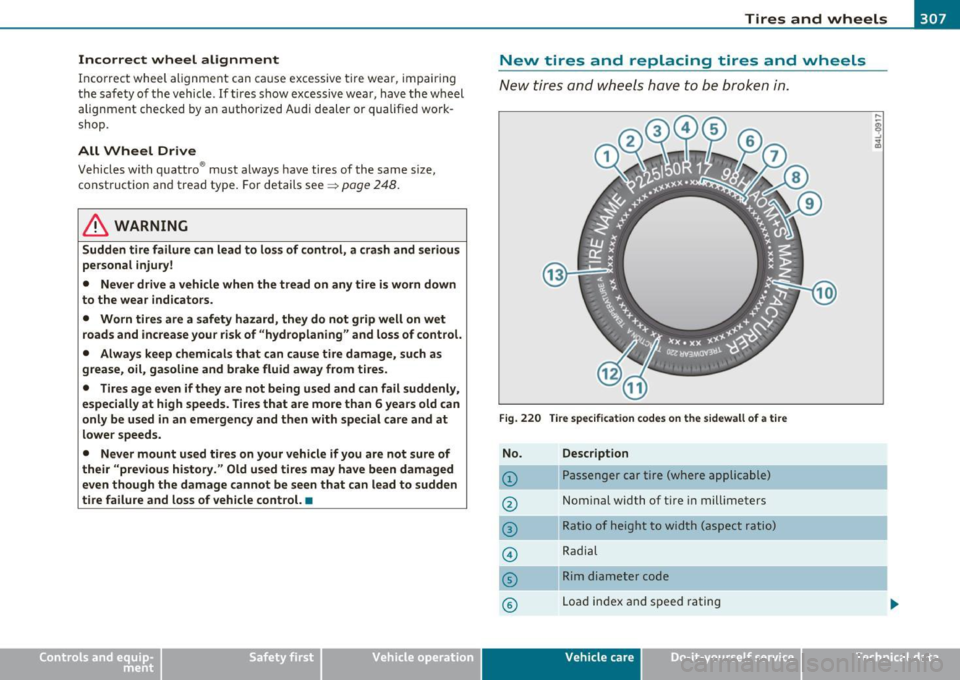
Fig. 220 Tire specificat ion codes on th e sidewall of a tire
No.
©
®
®
©
©
©
Description
Passenger car tire (where applicable)
Nom inal wid th of ti re in mil limeters
Ratio of hei9ht to width (aspect ratio)
Radial
jj Rim diameter code
L oa d index and speed rating
Vehicle care Do-it-yourselt service iTechnical data
Page 315 of 370

Tires and wheels -________________ Effll
& WARNING (co ntinued )
• Snow chain s are available in different sizes. Always make sure
to follow the instructions provi ded by the snow chain manufac
turer.
• Wh en driving with snow cha in s never drive fa ster than the
speed permitted for your specific snow chains .
• Always observe local regulations.
0 Note
• Remove snow chains before d riving on roads not cove red w it h
snow to avoid damaging t ires and wearing t he snow chains down
unnecessar ily.
• Snow chains, which come into direct contact wi th the wheel rim,
can scratch or damage it. The refore, make s ure that the snow chai ns
are sui tably covered. Chec k the pos it ion o f the snow cha ins afte r
driving a few yards and correct if necessary . Follow the instructions
from t he snow chain man ufacturer when doing so .
• If the Adaptive A ir Suspension* sho uld ma lfunct ion, do no t mount
or use snow cha ins because t he ve hicle will be ex tremely low . If you
do drive w ith snow chains o n while the veh icle is at t his level, the
snow c hains m ight severe ly damage the whee lhouse and other parts
o f the ve hicl e.
[I) Tips
W he re snow c ha ins a re mandato ry on certain ro ads, this no rm ally
also applies to ve hicles with A ll W hee l Dr ive. •
Safety first
Wheel bolts
Wheel bol ts mus t alwa ys be tigh tened to the co rrect
torque .
The design of wheel bolts is matched to the factory installed rims. If
differe nt rims a re fitte d, the correc t wheel bolt s wi th the r ig ht length
and co rrectly s haped bolt heads must be used. Th is ensures that
w heels are fitte d se cu rely and that the br ake system fun ctions
correctly .
In certain circumstances, yo u may not use wheel bolts from a
different veh icle -even if it is the same model~
page 348.
& WARNING
Improperly tightened or ma intained wheel bolts can become
loose causing los s of control, a collision and seriou s per sonal
injury .
• Always keep the wheel bolts and the thread s in the wheel hub s
clean so the wheel bolts can turn easily and be properly tightened .
• Never grease or oil the wheel bolts and the threads in the wheel
hubs. They can become loose while driving if greased or oiled , even
if tightened to the specified torque.
• Only use wheel bolts that belong to the rim being installed.
• Never use different wheels bolts on your vehicle .
• Always maintain the correct tightening torque for the wheel
bolts to reduce the risk of a wheel loss . If the tightening torque of
the wheel bolts is too low , they can loosen and come out when the
vehicle is moving . If the tightening torque i s too h igh, the wheel
bolts and threads can be damaged and the wheel can become
loose .
0 Note
The specified tor que fo r th e wheel bolt s i s 90 ft lb (120 Nm) wi th a
tolerance of ± 7,4 ft lb( ± 10 Nm). Torque wheel bo lts diagonally. .,_
Vehicle care Technical data
Page 330 of 370

-L_!F~U:!_:S~ e~ s ~ a~ n~ d~b~ u~l~b ~s ~-------------------------------------------
Fuse assignment, cockpit driver's side
Fig. 234 Cockpit
driver's side: fuse
panel layout
No. Consume r
3 Engine management
4
5
6
7
8
9
10
12
13
Oil level sensor
Climate control, tire pressure monitoring sys
tem Electronic Stabilization Program (ESP), clutch
sensor
Diagnostic connector
Homelink control unit
Automatic dimming interior mirror
Adaptive Cruise Control Diagnostic connector
Switch module steering column
15 Instrument cluster, control module Gateway
16 Telephone, cell phone
17 Electronic Stabili zation Program (ESP)
18 Headlight electronics, left-side
Amps
5
5
5
5
5
5
s
5
10
10
10
5
10
5
No. Con sum er
19 Rain sensor
20 Heated washer nozzles
21 Seat adjustment (driver)
22 MMI display
23 Electromechanical park ing brake
31
32
33
34
36
37
38
39
40
41
42
43
Back-up light switch, transmission, engine com
ponents
I ntelligent power module driver (footwell light
and front headlights , horn, wiper system, elec
trically adjustable steering wheel)
Intelligent power module driver (lights left-side)
I ntelligent power module driver
(lights right-side)
Headlight washer system
Electronic Stabilization Program (ESP)
Wiper system Door control module left-side
Horn
Heater fan
Control module electronic ignition lock/elec tri
cally adjustable steering wheel
Rear windshield wiper (Avant)
44 Power window opener (left-side)
Amps
5
5
10
5
5
15
30
25
25
30
25
30
15
25
40
30
15
35
-
•
Page 340 of 370
lffll.___E_ m_ e_ r-' g=- e_n_ c=-y _ s_it _ u _ a_t_ i_ o _ n_ s ______________________________________________ _
in. WARNING
• To reduce the risk of serious injury and vehicle damage.
-Always lift the vehicle only at the special workshop hoist and
floor jack lift points illustrated=>
page 337, fig. 243 and
=>
page 337, fig. 244.
- Failure to lift the vehicle at these points could cause the
vehicle to tilt or fall from a lift if there is a change in vehicle
weight distribution and balance. This might happen, for
example, when heavy components such as the engine block or
transmission are removed.
• When removing heavy components like these, anchor vehicle
to hoist or add corresponding weights to maintain the center of
gravity. Otherwise, the vehicle might tilt or slip off the hoist,
causing serious personal injury.
0 Note
• Be aware of the following points before lifting the vehicle :
-The vehicle should never be lifted or jacked up from under
neath the engine oil pan, the transmission housing, the front or
rear axle or the body side members. This could lead to serious
damage.
- To avoid damage to the underbody or chassis frame, a rubber
pad must be inserted between the floor jack and the lift points.
- Before driving over a workshop hoist, check that the vehicle
weight does not exceed the permissible lifting capacity of the hoist.
- Before driving over a workshop hoist, ensure that there is sufficient clearance between the hoist and low parts of the
vehicle. •
Page 343 of 370
________________________________________________ G_e_ n_e_ r _a_ l_i_n _f_ o_ r_m _ a_t_ i_ o _ n __ _
The safety compliance sticker
is your assurance that yo ur new vehicle complies with all applicable
Fede ral Motor Veh icle Safe ty Standards which were i n effect at the
time the vehicle was manufact ured . Yo u can fi nd this sticker on the
left doo r jamb.
It shows the mont h and year of prod uct io n and the
vehicle identification number of your veh icle (perforation) as well as
the Gross Vehicle Weight Rating (GV WR) and the Gross Axle Weight
Rating (GAWR).
The high voltage warning label
is located o n the loc k carrier.
The spark ignition system complies with the
Canadian standard ICES-002. •
Weights
Gross Vehicle Weight Rating
The Gross Vehicle Weight Rating (GVWR), and the Gross Axle Weight
Rating (GAWR) for front and rear are listed on a sticker on the left
door jamb.
T he Gross Vehicle Weight Rating includes the weight of the basic
vehicle pl us f ull f uel tank, oil and coo la nt, plus max im um load, whi ch
includes passenger we ight (150 lbs/68 kg per des ignated seating
position) and luggage weight.
Gross Axle Weight Rating
Th e Gross Axle Weight Ra ting is the maximum lo ad that can be
applied at each axle of the vehicle~&.
Vehicle capacity weight
The vehicle capacity weight (max. load) is listed on the dr iver's side B
pillar.
Safety first
Roof weight
Th e maxim um permiss ib le roof weight is 220 lb (100 kg ). T he roof
we ight is made up of the weight of the roof rac k system and t he
we ight of the object being transported~
page 88, "Loading the roof
rack".
& WARNING
• The actual Gross A xle Weight Rating at the front and rear a xles
s hould not exceed the permis sible weights , and their combination
must not exceed the Gros s Vehicl e Weight Rat ing .
• Exceeding permi ssible weight ratings can result in vehicle
damage, accidents and personal injury.
0 Note
• T he vehicle capac ity we ight figures apply when the load is distrib
uted evenly i n the vehicle (passengers and lug gage). When trans
porting a heavy load i n the luggage compartment, ca rry the load as
near to the rear axle as possible so that the ve hicle's handling is not
impa ired.
• Do not exceed the max imum permissible axle loads o r the
maximum gross veh icle weight. Always remember that the vehicle's
handling will be affecte d by the extra load. Therefore, adjust your
speed according ly .
• Always observe loca l reg ulat ions. •
Dimensions
The specifications refe r to the basic mode l. Differences may occur
depe nd ing on the mode l type a nd options ordered, for exam ple, t ire
sizes. .,_,
Do-it,yourself service Technical data
Page 344 of 370
___ G_ e_n_ e_r_a _ l_ in_ f_o _r_ m_ a_ t_io _ n _______________________________________________ _
0 Note
When d riving up steep ramps, on rough roads, over c urbs, etc. it is
important to remember that some parts of yo ur vehicle, such as
spoilers or ex haust sys tem componen ts, may be close to t he grou nd.
Be careful not to damage them. •
Page 345 of 370

____________________________________________________ D_ a_t_ a __ _
Data
Applies to vehicles: with 3 .0 lit er 6-c ylin der engine
300 hp, 3.0 liter, 6-cylinder engine
Engine data
Maximum outpu t SA E net
Maximum torque SAE net
No. of cy linders
Displacement
St roke
Bore
Compression ratio
Fu el
Dimensions (approx. )
Length
W idth
He igh t (u nloaded)
Turning circle diameter (curb to curb)
Capacities (approx .)
Fu el tank
- Tota l capacity
- Rese rve (of to tal cap aci ty)
Windshield and headlight* washer fluid container
Engine oil
with filter c hange
Safety first
hp@rpm
lb-ft@ rpm
C ID (cm
3
)
in (mm)
in (mm) 30
0@ 5100-6800
310@ 2500-5100
6 cylinder 183 (2995)
3.50 (89.0)
3 .33 (84 .5)
10.5 : 1
Premium unleaded (91 AKI) Recomm end ed for maximum engin e perfo rmanc e. Fur
ther details =>
page 2 73, "Gasoline"
i n (mm)
i n (mm)
i n (mm)
ft (m) 193.5 (4916)
79 .2 (2012)
57. 4 (1459)
39.0 (11.9)
gal (liters)
gal ( liters)
quarts (liters)
quarts ( liters) 21.1 (80.0)
1. 8-2.4 (7-9)
5 .1(4.8)
6.9 (6.5)
•
Do-it,yourself service Technical data
Page 346 of 370
___ D_ a_t _a _____________________________________________________ _
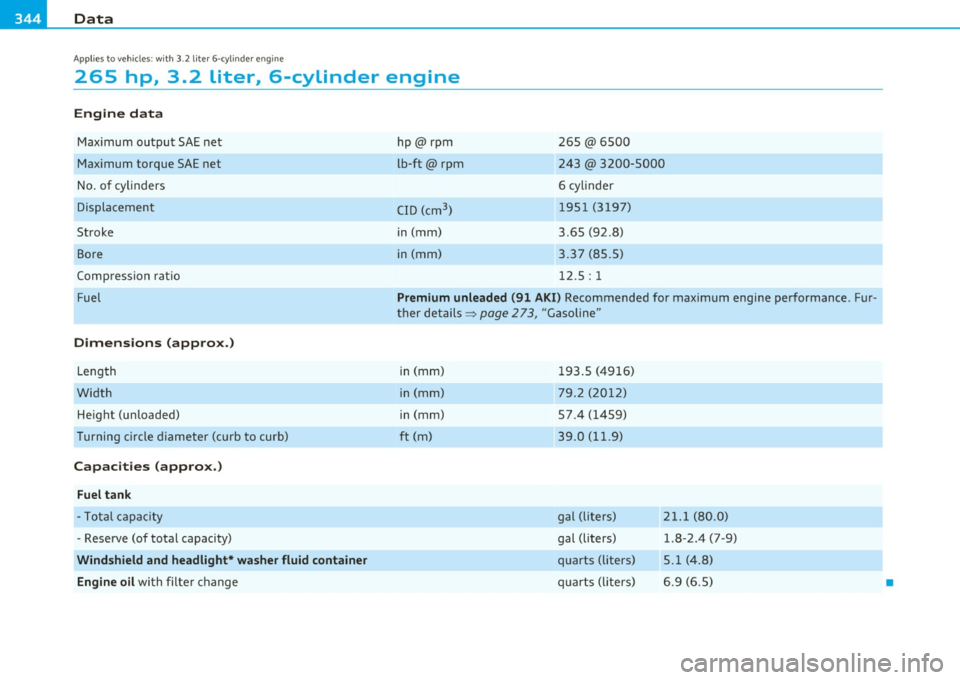
Applies to vehicles : w ith 3.2 lite r 6 -cylin der engine
265 hp, 3.2 Liter, 6-cylinder engine
Engine dat a
Max imum output SAE net
Max imum torque SAE net
No . of cylinders
Displacement
Stroke
Bore
Comp ression ratio
Fuel
Dimen sions (appro x.)
Length
Width Height (unloaded)
Turning circle diameter (curb to curb)
Capacities (appro x.)
Fuel t ank
- Total capac ity
- Reserve (of total capacity)
Wind shield and headlight* was her flu id c ontainer
Engin e oil
with filter change hp@rpm
lb-ft@ rpm
CID (cm
3
)
in (mm)
in (mm) 265 @6500
243 @ 3200-5000
6 cylinder
195 1 (3 197)
3 .65 (92 .8)
3 .37 (85.5)
12 .5: 1
Premium un leaded (91 A KI) Recommended for maximum engine performance . Fur
ther details =>
page 273, "Gasoline"
in (mm)
in (mm)
in (mm)
ft (m) 193.5 (4916)
79.2 (2012)
57.4 (1459)
39 .0 (11.9)
gal (liters)
gal (liters)
quarts (liters)
quarts ( liters) 21.1 (80
.0)
1. 8-2 .4 (7 -9)
5.1 (4 .8)
6.9 (6.5)
•