child seat AUDI A6 2011 Workshop Manual
[x] Cancel search | Manufacturer: AUDI, Model Year: 2011, Model line: A6, Model: AUDI A6 2011Pages: 370, PDF Size: 87.15 MB
Page 235 of 370

mance requirements make a tether necessary on most new ch ild
seats.
Installing a child restra int that requires a top tether w ithout one can
seriously impair the performance of the chi ld restrai nt and its ability
to prote ct the child in a collision. Insta lling a child restraint tha t
requires a top tether without the top tether may be a violation of
state law.
Child restraint manufacturers offer LATCH lower anchorages on the ir
child seats with hook -on or push-on connectors attached to adjust
able straps .
In addition to the LATCH lower anchorages, these child restraint
systems usually require the use of tet he r straps to he lp keep the child
restra int firm ly in place.
& WARNING
Improper installation of child restraints will increase the risk of
injury and death in a crash.
• Always follow the instructions provided by the manufacturer
of the child restraint you intend to install in your vehicle.
• Never install a child restraint without a properly attached top
tether strap if the child restraint manufacturer 's instructions
require the top tether strap to be used.
• Improper use of child restraint LATCH lower anchorage points
can lead to injury in a collision . The LATCH lower anchorage points
are designed to withstand only those loads imposed by correctly
fitted child restraints .
• Never mount two child restraint systems on one LATCH lower
anchorage point .
• Never secure or attach any luggage or other item to the LATCH
lower anchorages .
Safety first Vehicle OP-eration
Child Safety
(I) Tips
• In Canada, the terms "top tether" with "lower universal anchor
ages" (or " lower universal anchorage bars") are used to describe the
system.
• In other countries the term "ISOFIX" is used to describe the lower
anchorages. •
Location
Fig. 193 Schematic
overview: LATCH
a nchorage point loca-
tions
Th e illustrat io n shows the seat ing locat ions in your vehicle whic h are
equipped with the lower anchorages system. •
Vehicle care Do-it-yourselt service iTechnical data
Page 236 of 370
Ill Child Safety __ .,.___ ____________ _
Description
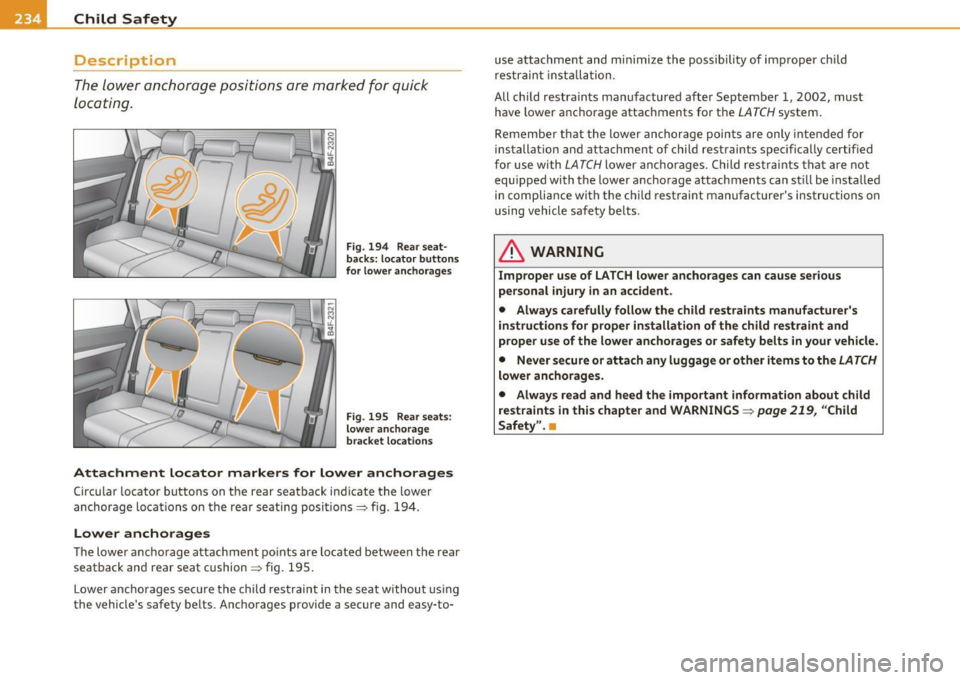
The lower anchorage positions are marked for quick
locating.
Fig. 194 Rear seat
backs: locator buttons
fo r lower anchorages
Fig . 195 Rear seats:
lower anchorage
bracket locations
Attachment locator markers for lower anchorages
Circu lar locator buttons on the rear seatback indicate the lower
anchorage locations on the rear seating positions:::;, fig. 194 .
Lower anchorages
The lower anchorage attachment points are located between the rear
seatback and rear seat cushion:::;, fig . 195.
Lower anchorages secure the child restraint in the seat without using
the vehicle's safety belts. Anchorages prov ide a secure and easy-to- use attachme
nt and minimize the possibility of improper child
restrain t installat ion.
All ch ild restraints manufactured after September 1, 2002, must
have lower anchorage attachments for the
LATCH system.
Remember that the lower anchorage points are only intended for
installat ion and attachment of ch ild restraints specifically certif ied
for use with
LATCH lower anchorages . Child restraints that are not
equ ipped with the lower anchorage attachments can st ill be installed
in compliance with the ch ild restraint manufact urer's instructions on
using vehicle safety belts .
& WARNING
Improper use of LATCH lower anchorages can cause serious
per sonal injury in an accident.
• Always carefully follow the child restraints manufacturer 's
instructions for proper installation of the child restraint and
proper use of the lower anchorages or safety belts in your vehicle.
• Never secure or attach any luggage or other items to the
LATCH
lower anchorages.
• Always read and heed the important information about child
restraints in this chapter and WARNINGS :::;,
page 219, "Child
Safety". •
Page 237 of 370

Guidance fixtures for Lower anchorages
Special guidance fixtures increase the convenience of the lower anchorages and are available from your authorized
Audi dealer .
Fig. 196 Outer rear
seats: installing the
guidance fixtures
Fig. 197 Close-up:
fitting the guidance
fixture over the lower
anchorage bracket
The lower anchorage attachment points are located on the
rear seats between the seatback and the seat cushion.
Special guidance fixtures increase the convenience of the lower anchorages and help protect the seat material from
possible damage when installing child restraints.
Safety first Vehicle OP-eration
Child Safety
Installing the guidance fixtures
- Push down on the seat cushion so that the lower anchor
ages are visible .
- Hold the guidance fixture with the part number facing
downward and push it in the direction of the arrow onto
the anchorage ~ fig . 197 .
- Make sure that each of the two guidance fixtures per seat
snaps into place .
Removing the guidance fixtures
-Remove the child restraint according the child restraint
manufacturer's instructions.
- Push down on the seat cushion so that the lower anchor
ages are visible.
- Pull off the guidance fixtures from the lower anchorages .
- Always remove the guidance fixtures and keep them in a
safe place when not in use.
You may find it easier to install child restraints equipped with hooks
attached to straps without the guidance fixtures in place.
If this is the
case, remove the guidance fixtures by pulling them off the anchor
ages . However, the guidance fixtures can help you to locate the
LATCH anchorages.
& WARNING
Improper use of tether anchorages or lower anchorages can cause
serious personal injury in a crash.
• Always carefully follow the child restraint manufacturer's
instructions for proper installation and use of child restraint
systems.
II>
Vehicle care Do-it-yourselt service iTechnical data
Page 238 of 370
lffll.___C_ h_ il_d _ S_a _ f_ e _ t--= y '------------------------------------------------
& WA RNING (conti nued)
• Never u se the LATCH or tether anchorages to attach safety
belt s or other kinds of occupant re straints .
• Child restraint tether attachments and lower attachment s are
only designed to se cure a child restraint that has been equipped to
u se the se anchorages.
• Tether anchorages and lower anchorages are designed to with ·
stand only tho se loads imposed by correctly fitted child re straints.
Under no circumstances can they be used safely for adult or child
s afety belts or harnesses .
• Never mount more than one child restraint to a s ingle tether or
to a lower anchorage point. Attaching two child restraint s to a
single anchorage point can cause the anchorage to fail and cause
seriou s personal injury in a crash.
0 Note
• Remove the g uidance fixtures before folding the rear seatback to
preven t damaging the seat cushion .
• If you leave t he gui dance fix tures ins talled for severa l days, they
co uld leave a mark o n th e upholste ry on t he seat c ushi on and bac krest
in th e area t hat the guidance fixt ures w ere install ed. The upholstery
wou ld also be permane ntly stretc hed a round the gu idance fixtures .
Th is applies especially to leathe r seats. •
Installing a child restraint with LATCH
lower anchorages
Whenev er you install a child restraint always f ollo w the
child restraint manufacturer's instructions.
Mounting
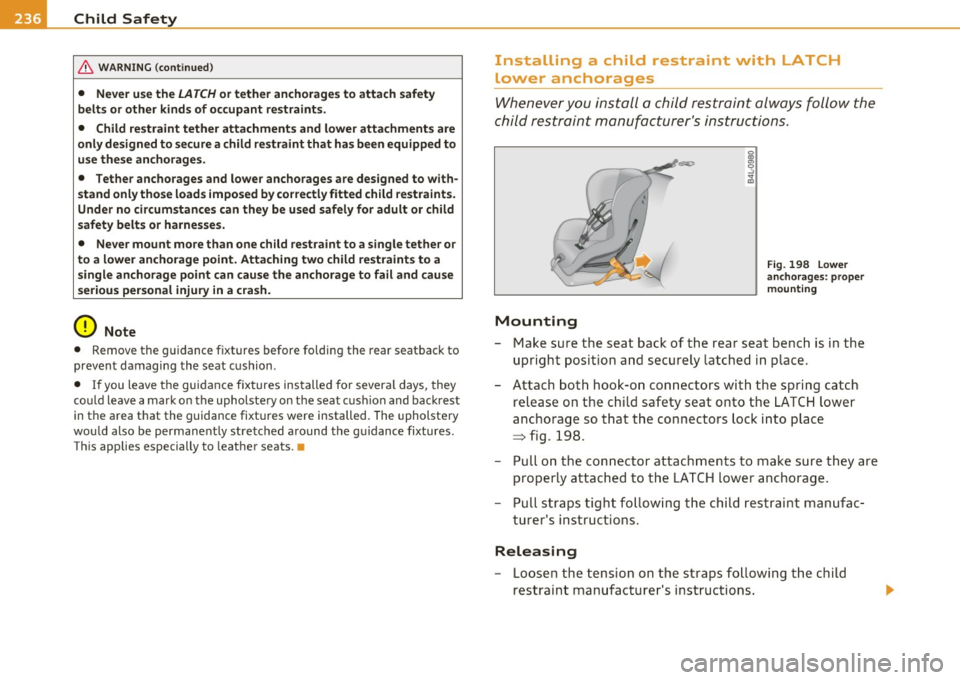
Fig. 19 8 Lower
anch ora ges : pr op er
mounting
- M ake sure the seat back of the re ar seat bench is in the
u prigh t position a nd securely latche d in p lace .
- Att ach both hook-o n con nectors wi th th e spring catc h
release on t he ch ild sa fety se at o nto the LATC H lower
anchorage so t hat th e connectors lock i nto place
~ fi g. 198 .
-Pull o n the con nec tor attac hmen ts to ma ke s ure they are
properly attac hed to t he LAT CH lower anchorage.
- Pull st ra ps t ig ht fo llow ing t he child r est raint manufa c
t u re r's instr uct io ns.
Releasing
- Loose n the tens ion on t he straps fo llowing t he child
restrain t man ufacture r's i nst ructions.
Page 239 of 370

-Depress the spring catches to release the anchorage hooks
from the lower anchorages.
Remember: Use tether straps to help keep the child restraint firmly
in place.
& WARNING
Improper use of the LATCH system can increase the risk of serious
personal injury and death in an accident.
• These anchors were developed only for child safety seats using
the "LATCH " system.
• Never attach other child safety seats, belts or other objects to
these anchors.
• Always make sure that you hear a click when latching the seat
in place. If you do not hear a click the seat is not secure and could
fly forward and hit the interior of the vehicle, or be ejected from
the vehicle.
& WARNING
Improper installation of child restraints will increase the risk of
injury in an accident.
• Always follow the child restraint system manufacturer's
instructions for proper installation of the child restraint system
and proper use of tether straps as well as the lower anchorages or
safety belts in your vehicle.
• Always read and heed the important information and WARN·
INGS about child safety and the installation of child restraint
systems~ page
219, "Child Safety".•
Safety first Vehicle OP-eration
Child Safety
Tether anchors and tether straps
Fig. 199 Tether
an chors : recess flaps
behind the rear seat·
backs
The tether anchors for the rear seating positions are located in recesses in the rear window shelf~ fig . 199.
A tether is a straight or V-shaped strap that attaches the top part of
a child restraint to special anchorage points in the vehicle.
Th e pu rpose of the tether is to reduce the forward movement of the
child restraint in a crash, in order to help reduce the risk of head injury
that could be caused by striking the veh icle inter ior.
Forward fac ing ch ild restraints manufact ured after September 1,
1999, are required by U.S. federa l regulations to comply with new
child head movement performance requirements. These new perfor·
mance requirements make a tether necessary on most new child
safety seats.
& WARNING
Improper installation of child restraints will increase the risk of
injury and death in a crash.
• Always follow the instructions provided by the manufacturer
of the child restraint you intend to install in your Audi.
• Improper use of child restraint anchors (including tether
anchors) can lead to injury in a collision . The anchors are designed •
Vehicle care Do-it-yourselt service iTechnical data
Page 240 of 370
___ C_h _i_ld _ S_ a_ f_ e_ t_,, y'-----------------------------------------------
& WARNING (cont inued )
to withstand only those loads imposed by correctly fitted child
restraints.
• Never mount two child restraint systems on one LATCH lower
anchor point .
• Never attach two child restraint system s to one tether strap or
tether anchorage.
• Never attach a tether strap to a tie-down hook in the luggage
compartment.
• Never u se child restraint tether anchorages to secure safety
belts or other kinds of occupant restraints .
• Never se cure or attach any luggage or other items to the LATCH
lower anchorages or to the tether anchors.
• If a tether or other strap i s used to attach a child restraint to
the front passenger seat, make sure that it is not so tight, that it
c auses the weight -sensing mat to mea sure more weight than is
actually on the seat .
• The heavier weight regi stered can make the Advan ced Airbag
System work as though an adult were on the seat and deploy the
Advanced Airbag when it must be suppre ssed causing serious or
e ven fatal injury to the child.
• If you must install a rearward facing child safety seat on the
front passenger seat because of e xceptional circumstances and
the PASSENGER AIR BAG OFF light does not come on and stay on,
immediately install the rear-facing child safety seat in a rear
seating position and have the airbag system inspected by your
Audi dealer. •
Installing the upper tether strap on the
anchorage
Installing the tether strap
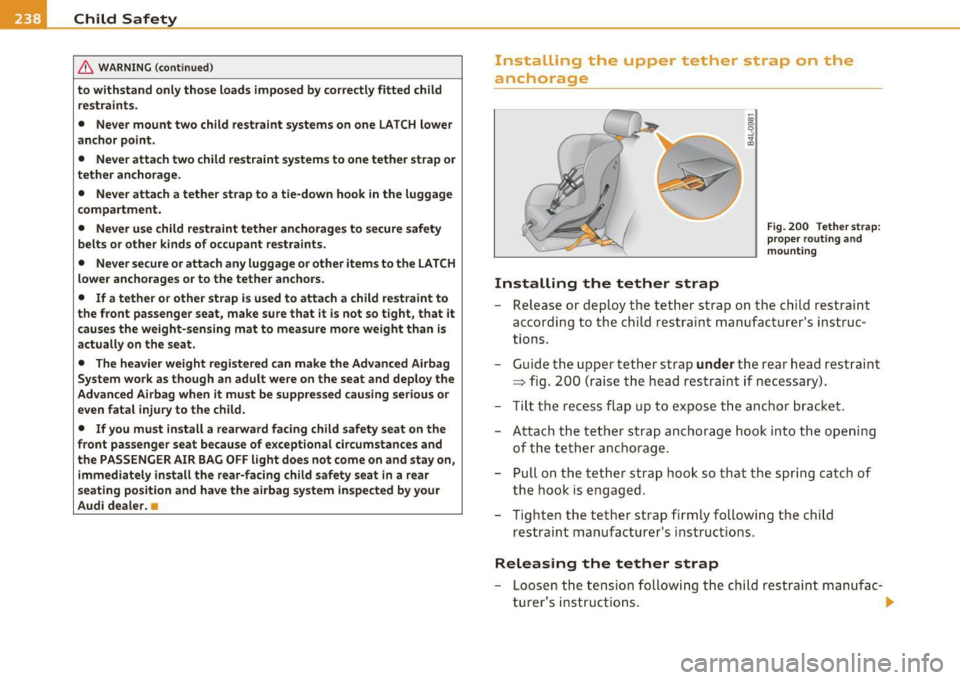
Fig. 2 00 Tet her s tra p :
prop er rou ting and
mounting
- Release or deploy the tet her strap on the ch ild restrai nt
according to the c hild restrain t manufac ture r's instruc
tions .
- Guide t he u pper tet her strap
under th e rear head rest raint
=> fi g. 20 0 (raise t he head restraint if necessary).
- T ilt the recess fla p up to ex pose t he anc hor brac ke t.
- Attach the teth er st ra p anchora ge hoo k in to the openi ng
of t he t eth er anchora ge.
- Pu ll on the tet her s trap hoo k so that the s pri ng catch of
th e h ook is e ngag ed .
- Tighte n the te ther s trap firm ly followi ng the chi ld
res traint manufactu re r's i nstruc tio ns.
Releasing the tether strap
- Loos en the ten sion follow ing th e ch ild restr aint man ufac -
t u re r's instru ctio ns.
~
Page 241 of 370

_____________________________________________ C _h_i_ld _ S_ a_ f_ e_ t ... Y'--- __
- Depress the spring catch on the hook and re lease it from
the anchorage .
0 Note
If you leave the child restra int with the tether strap firmly insta lled
for several days, th is could leave a mark on the upho lstery on the seat
cus hion and backrest in the area where the tether strap was insta lled.
Th e upho lstery wou ld also be perma nent ly stretched a round the
tether strap. This applies espec ially to leather seats .•
Using tether straps on rearward-facing
child restraints
Currently, few rear-fac ing c hild restrai nt systems come w it h a t ether.
Please read and heed the c hild restraint system manufacturer's
instructions carefully to determine how to proper ly install the tether .
& WARNING
A child in a rearward-facing child safety seat installed on the front
pa ssenger s eat w ill be seriously injured and can be killed if the
front airbag inflates· even with an Advanced Airbag System.
• The inflat ing airbag w ill hit the child safety seat or infant
c arrier with great for ce and will sma sh the child safety seat and
c hild against the backrest, center armrest , or door.
• A tight tether
or other strap on a rearward -facing child
restraint attached to the front passenger seat can put too much
pre ssure on the weight-mat in the sea t and regi ster a heavier
weight
in the Advan ced Airbag System. The heavier weight regis
tered can make the sy stem work as though an adult were on the
seat and deploy the Advan ced A irbag when it mu st be suppressed
causing ser ious or even fatal injury to the child.
• If you must install a rearward facing child safety seat on the
front passenger seat becau se of exceptional circum stances and
Controls and equip ment Safety first Vehicle operation
& WARNING
(co ntinued )
the PASSENGER AIR BAG OFF light does not come on and stay on,
imm ediately install the rear -facing child safety s eat in a rear
seating position and have the airbag system inspected by your
Audi dealer. •
Additional Information
Sources of information about child
restraints and their use
Th ere are a numbe r of sources o f addi tional in forma tion abo ut child
restra int select ion, installation and use:
N HTSA adv ises that the best chi ld safety seat is the one that f its your
child and fits in your vehicle, a nd that you w ill use cor rectly and
cons istent ly .
Tr y before you buy!
U.S National H ighway Traffic Safety Administration
Tel. : 1-888-3 27- 4236 (T TY: 1-800- 424-91S3)
www.nhtsa.gov
Nat ional SAFE KIDS Campaign
Tel. : (20 2) 662 -060 0
www.safekids .org
Safety BeltSafe U .S.A
Tel. : (800) 745 -SAF E (English)
T el. : (80 0) 74 7-SA NO (Sp anish)
www.carseat.org
Transport Canada Information Centre
T el. : 1 ( 80 0) 333 -037 1 or ca ll 1 (613 ) 99 8-86 16 if you are i n the
O ttawa area
www.tc .gc .ca/roadsafety
Vehicle care Do-it-yourself service Technical data
Page 271 of 370

____________________________________________ C_l_e _a_ n_ i n--= g=--- a_n_ d----' p,__ r_o _t_ e_ c_ t_ i _o_ n __ _
consider if childre n, animals or other factors might prove to be partic
ularly hard on the leathe r.
By contrast, leather types that are covered by a colored fin ish layer
are more durable . This has a positive effect on the leath er's resistance
to wear and so iling in daily use. On the othe r hand, the typical charac
teristics of natura l leathe r are barely or not apparent . However, this
does not mean that the leathe r itself is of infer io r quality.
C are and handling
Because of the exclusive nature of the types of leather that Audi uses
and the ir unique p roperties (such as sensitivity to oils, grease, so iling,
etc.), yo u will need to be somewhat ca refu l with these leat he rs , a nd
a certain type of care is required. For example, dark clothing mate
r ials ca n disco lor leather seats (especially if such clothi ng is d amp and
was not dyed correctly) . Dust and dirt particles in pores, folds, and
seams can have an abrasive effect and c an damage the le athe r
surface as well as weaken seams .
The leather s houl d be cleaned regularly as needed . After having been
used for a relatively long time, your leather sea ts w ill acquire a rich
aged finis h. This is a characteristic of natura l leather and a sign of
true quality.
I n order to maintain the value of this natural product over the life of
your vehicle, you sho uld fo llow the recommendations below :
0 Note
• To keep you r leather from b leaching out, do not allow it to be
exposed to bright sunl ight for long periods of time . If you have to
leave t he veh icle parked outside for long pe riods, cover the leather to
protect it from direct exposure to sunlig ht.
• Sharp objects on clothing, such as zippers, rivets or sha rp pieces
on belts can leave permanent scratches or scrape marks on the
s u rface of the leather.
Safety first
(I] Tips
• After each time you clean the leathe r and at regular inte rvals , u se
a leather preservative creme that contains UV-blockers and that
works into the leather. This creme will nou rish and mo istur ize the
leather, helping it to breathe and stay supp le. It also helps to build up
a p ro tect ive coa ting on the surfa ce.
• Clean the leather every 2 -3 months, and clean any areas that get
soiled.
• Remove fresh marks made by ballpoint pens, ink, lipstick, shoe
polish, etc. as soon as poss ible.
• Preserve the color of t he leather as needed by using a specia l
co lored leather ca re creme to touch up areas of uneven color .•
Ap plies to vehi cles : w it h nat ural leat her
Cleaning and caring for leather upholstery
and trim
Natural leather requires special care and attention.
Normal cleaning
- Clean so iled areas wit h a slightly mois tened cotton or
woolen cloth .
More stubborn dirt
-More stubborn d irt can be removed using a clot h satu
rated w ith a mild soap solution (2 ta blespoons m ild liq ui d
soap) .
- Never allow the soap solution to saturate the leather, and
make certa in that no water soaks i nto the seams .
- Wipe off the soap solution w ith a soft, dry c loth. .,,
Vehicle care Technical data
Page 354 of 370
___ A_l_,_ p _ h_ a _ b_e _ t_ i_c __ a _l _i_n :...::d __ e::..: x:...::...,_ _________________________________________ _
A Temporarily turning off .......... . 124
warning/indicator lights .... ...... . 127
Danger of fitting a child safety seat on the
front passenge r seat ............
199
Accessories ..... ................... 348 Adaptive Light ......... ....... .. .. .. 61 Disposal .................. .. .... 211
Adapter for cupholder ................ 89 defective ........................ 32 Front airbags ......... ... .... 201, 202
Adaptive Air Suspension ............. 168
Automatic mode .. .. ... .... ...... 169
Comfort mode ................... 169
Description ..................... 168
Dynamic mode ... .. ... ...... .... 169
Jacking mode when changing a flat tire ...
170
Lift mode ....................... 169
Setting the driving modes ......... 169
Trailer towing mode .............. 170
Warning/indicator lights .... ....... 16
Adaptive Cruise Control ......... ... .. 119
Changing speed ....... ........... 123
Driver information .............. .
Driver intervention prompt ...... . . Adding
Engine coolant ........... ...... .
287
Engine oil ............ ...... ..... 284
Windshield washer fluid ........... 294
Additional accessories ............... 348
Additives
Engine oil ............ .. .........
284
Adjusting
Instrument cluster illum ination .....
11
Steering column electrically ........ 107
Steering column manually .. .. .. .. . 106
Adjus ting front seats ................. 75
Air conditioning
See Climate controls ...............
96
Air distribution How do the front airbags work?
.....
206
How many airbags does my vehicle have? .
204
How the Advanced Airbag System compo-
nents work together ............
205
Important things to know ... .. .. .. 197
Indicator light ................... 208
Monitoring ... .................. 208
PASSENGER AIR BAG OFF light ..... 209
Repairs ............ .. .. .. ...... 211
Safety instructions ............... 210
Side airbags .... .... ............. 213
Side curtain airbags .............. 216
Weight-sensing mat ..............
220
When must the system be inspected? 208
All Wheel Drive ... ... ............... 248 Dr iv ing in traffic ................ .
Driving program .. ...... ........ .
127
130
120
131
Climate controls 100 Alloy wheels ................. .... .. 265
Error messages . .. .. .... ........ .
Open road ... .. .. .. .. ....... ... . 129 Air pollutants filter
120 Climate controls .................. 96
All-wheel drive
Winter tire s .....................
311
Override ...................... .. 120 Airbag
Alternator
Request for driver to assume control
120 Warning/indicator lights ..... ...... 14 Malfunction ........ .............. 26
Save speed . ...... .. .. ........... 122 Airbag system .................. 197,214 Ambience lighting
Setting distance .. ...... ...... .. .
125 Advanced Airbag System .......... 201 Lighting profiles .. .. .............. 64
Setting time interval .............. 125 Advanced Airbag System components 204 Anti-freeze
Settings ...................... ..
131 Care ... .. .......... ....... .. .. . 211 See Engine coolant system ......... 286
Special driving situations .......... 131
Status messages ................. 129
Switching on and off .............. 122
System limits ................... 131
Child restraints .................. 221
Children ........................ 220
Components (front airbags) ... ..... 204
Anti-glare inside day-night mirror .... 69, 70
Anti-lock brake system
How the ABS system works ...... ..
246
Warning/indicator lights ........... 17
Page 356 of 370
___ A_ l_. p_ h _ a_b_ e_ t_ic _a_ l_ in_ d_e _ x ____________________________________________ _
Capacities .... ..................... 343
Car -Systems
Ambience lighting ... .............. 64
Lighting profiles . ................. 64
Car care .. .. .. ..................... 260
Interior ..... ............. .... .. 267
Plastic and vinyl .. .. .. .. ......... 264
Weatherstrips ................ ... 26S
Care of exterior .. .... .. .. ..... ... ... 260
Cargo area
See Loading the luggage compartment ..
183
Cargo net .. .. ...... .... .. .. .. ..... . 85
Catalytic converter .................. 252
CD changer ............ .... .. .... ... 94
Center armrest adjusting .. .... .. .. .... .......... 82
Storage compartment ... .......... 82
Centra l locking
Emergency locking ............ .... 45
Cert ification .... ...... .... ......... 349
Changing a flat tire .. .. .. .. ......... 320
Changing a wheel ........... ...... .. 320
Changing engine oil .. .. ... ....... .. . 285
Chassis Undercoating . ................. .. 266
See also Adaptive Air Suspension . .. 168
CHECK button . .. .. ........ .......... 11
Checking Engine coolant level . ........... .. 286
Checking tire pressure ............ ... 302
Child restra int system anchors . ... .... 232 Child restraints
Danger of us ing child restraints in the front
seat . ... ............... .. ... .. 199
Where can I get additional information
about child restraints and their use? .. .
239
Child safety ....... ...... ... . .. .. .. . 219
Convert ible locking retractor .... .. . 229
Guidance fixtures for lower anchorages
235
Important safety instructions for using
child safety seats ......... ... .. . 222
Important things to know when driving with children ............ .. .. .. . 219
Installing a child restraint using the LATCH
system .................. ..... 236
Mounting and releasing the anchorage hook .............. .... ....... 236
T ether anchors ...... ... .. .. .... . 237
Tether straps .............. ... .. . 23 7
Child safety lock rear doors (power) ........ .. .. .. .. 47
Child safety seats ............ .. ..... 224
Booster seats .... .. .. .. .. .. .. .. . 22 7
Convertible child seats .......... .. 225
Convertible lock ing retractor ....... 229
Danger of us ing child restraints in the front
seat .. .... .. ........... .. .. .. . 199
How do I properly install a child safety seat in my vehicle? ........... .. .. .. . 222
In fant seats .............. .. .... . 224
Insta lling ...... .... .. .. .. ....... 229
LATCH system ....... ..... ....... 236
Safety instructions . ... .... ....... 222 Child seats
Lower anchorages . ...... ........ . 234
Cigarette lighter ................... .. 92
Cleaning Alcantara (synthetic suede) .. .. .. .. 270
Engine compartment .......... ... 271
Exhaust tail pipes . .. .. .. ......... 266
Fabrics and fabric coverings . ....... 267
Instrument pane l ... ............. 268
Interior ............. .... ..... .. 267
Leather ....... ... ... ... ..... ... 269
MMI control console .............. 267
MMI display .. .... .. ......... .... 267
Plastic and vinyl .. .. ............. 264
Plastic parts ... .. .. .......... ... 268
Safety belts .............. ... .. .. 2 71
Trim strips ..................... . 263
tr im strips . .. ................. .. 264
Cleaning and protection ....... .. .. .. 260
Climate control . . . . . . . . . . . . . . . . . . . . . 96
Synchronizing . ................. .. 98
Warm and cold ....... ... .. .. .. ... 96
Climate controls Air distr ibut ion ...... ...... ...... 100
Air outlets . .. ....... ...... .. .. .. 101
Air outlets (rear) ................. 102
Air recirculation . ... ............. 100
AUTO (standard setting) ............ 99 Basic settings ............ ... .. .. 104
Center vents . ............... .... 105
Controls . . . . . . . . . . . . . . . . . . . . . . . . . 98
Defrosting/defogging ............ 100
Description .. .. ... ...... ..... .. .. 96