change wheel AUDI A6 2013 User Guide
[x] Cancel search | Manufacturer: AUDI, Model Year: 2013, Model line: A6, Model: AUDI A6 2013Pages: 306, PDF Size: 76.92 MB
Page 163 of 306
-Have the airbag system inspected by
your Audi dealer before transporting
anyone on the front passenger seat.
(D Tips
If the capacitive passenger detection sys
tem determines that the front passenger
seat is empty, the frontal airbag on the
passenger side will be turned off, and the
PASSENGER AIR BAG OFF light will stay
on .
Repair, care and disposal of the airbags
Parts of the airbag system are installed at
many different places on your Audi. Installing,
removing, servicing or repairing a part in an
area of the vehicle can damage a part of an
airbag system and prevent that system from
working properly in a collision.
There are some important things you have to know to make sure that the effectiveness of
the system will not be impaired and that dis
carded components do not cause injury or pol
lute the environment.
A WARNING
Improper care, servicing and repair proce
dures can increase the risk of personal in
jury and death by preventing an airbag from deploying when needed or deploying
an airbag unexpectedly:
- Never cover, obstruct, or change the
steering wheel horn pad or airbag cover
or the instrument panel or modify them
in any way .
- Never attach any objects such as cup
holders or telephone mountings to the
surfaces covering the airbag units.
- For cleaning the horn pad or instrument
panel, use only a soft, dry cloth or one
moistened with plain water. Solvents or
cleaners could damage the airbag cover
or change the stiffness or strength of the
material so that the airbag cannot de
ploy and protect properly.
Airbag system 161
- Never repair, adjust, or change any parts
of the airbag system.
- All work on the steering wheel, instru
ment panel, front seats or electrical sys
tem (including the installation of audio
equipment, cellular telephones and CB radios, etc .) must be performed by a
qualified technician who has the training
and special equipment necessary.
- For any work on the airbag system, we
strongly recommend that you see your
authorized Audi dealer or qualified work
shop.
- Never modify the front bumper or parts
of the vehicle body.
- Always make sure that the side airbag
can inflate without interference:
- Never install seat covers or replace
ment upholstery over the front seat
backs that have not been specifically
approved by Audi.
- Never use additional seat cushions that
cover the areas where the side airbags
inflate.
- Damage to the original seat covers or
to the seam in the area of the side air
bag module must always be repaired
immediately by an authorized Audi
dealer.
- The airbag system can deploy only once .
After an airbag has been deployed, it
must be replaced with new replacement
parts designed and approved especially
for your Audi model version. Replace ment of complete airbag systems or air
bag components must be performed by
qualified workshops only. Make sure that
any airbag service action is entered in
your Audi Warranty
& Maintenance book
let under
AIRBAG REPLACEMENT RE
CORD .
-For safety reasons in severe accidents,
the alternator and starter are separated
from the vehicle battery with a pyrotech
nic circuit interrupter.
- Work on the pyrotechnic circuit inter
rupter must only be performed by a
qualified technicians who have the ...
L..._ _____________ _j ...
•
•
Page 164 of 306
162 Airbag system
experience, informat ion and specia l
too ls necessary to perform the work
safely.
- If the vehicle or the circuit interrupter
is scrapped, all applicable safety pre
cautions must be followed.
@ For the sake of the environment
Undeployed airbag modu les and preten
sioners might be classified as Perchlorate Material - special handling may apply, see
www.dtsc.ca.gov/haza rdouswaste/per
chlorate. When the vehicle or parts of the
restraint system including airbag modules
and safety belts w it h pretens ioners are
s crapped, a ll applicable laws and regula
tions mus t be observed. Your au thori zed
Audi dea le r is familiar with these requi re
ments and we recommend that you have
your dea ler perfo rm this serv ice for you.
Other things that can affect Advanced
Airbag performance
Changing the vehicle's suspension system can
change the way that the Advanced A irbag Sys
tem pe rforms in a crash. For example, us ing
tire-r im combinations not app roved by Aud i,
lowering the vehicle, ch anging the stiffness o f
the suspension, including the springs, suspen
sion struts, shock absorbers etc. can change
the forces that are measured by the a irbag
sensors and sent to the electronic control
un it. Some suspension changes can, for exam
p le, increase the force levels measured by the
sensors a nd make the airbag system deploy in
crashes in w hich it would not dep loy if the
changes had not been made . Other kinds of
ch an ges may reduce the force levels meas
u red by the sensors and prevent the airbag
from deploying when it sho uld .
The senso rs in the safety belt buckle fo r th e
d river a nd front passe nger sea t tell the elec
tronic control module if the safety belt is
l atched or not .
If the safety belt is being used,
the front airbag will dep loy at a slightly high
er rate of vehicle deceleration than if the safe
ty belt is not being used. Therefore, in a par- t
icu lar collision, it is possible that an airbag
will not dep loy at a seat ing position where the
safety belt is be ing used b ut w ill inflate at the
pos ition where the safety belt is not be ing
used. It is important that nothing interfere
with t he safety be lt buckles so that the sen
sors can send the correct info rmation about
safety belt use to the electronic control un it .
_&. WARNING
Changi ng the vehicle's suspension includ
i ng use of unapp roved tire-rim combina
tions can change Advanced Airbag per
formance and increase the risk of serious pe rsonal injury in a crash .
- Never install suspension components that do not have the same pe rformance
characteristics as the components o rigi
na lly installed on your vehicle.
- Never use tire-rim combinations that
have not been approved by Audi.
Knee airbags
Description of knee airbags
App lies to vehicles : wi th knee airbags
The knee airbag system can provide supple
mental protection to properly restrained
front seat occupants .
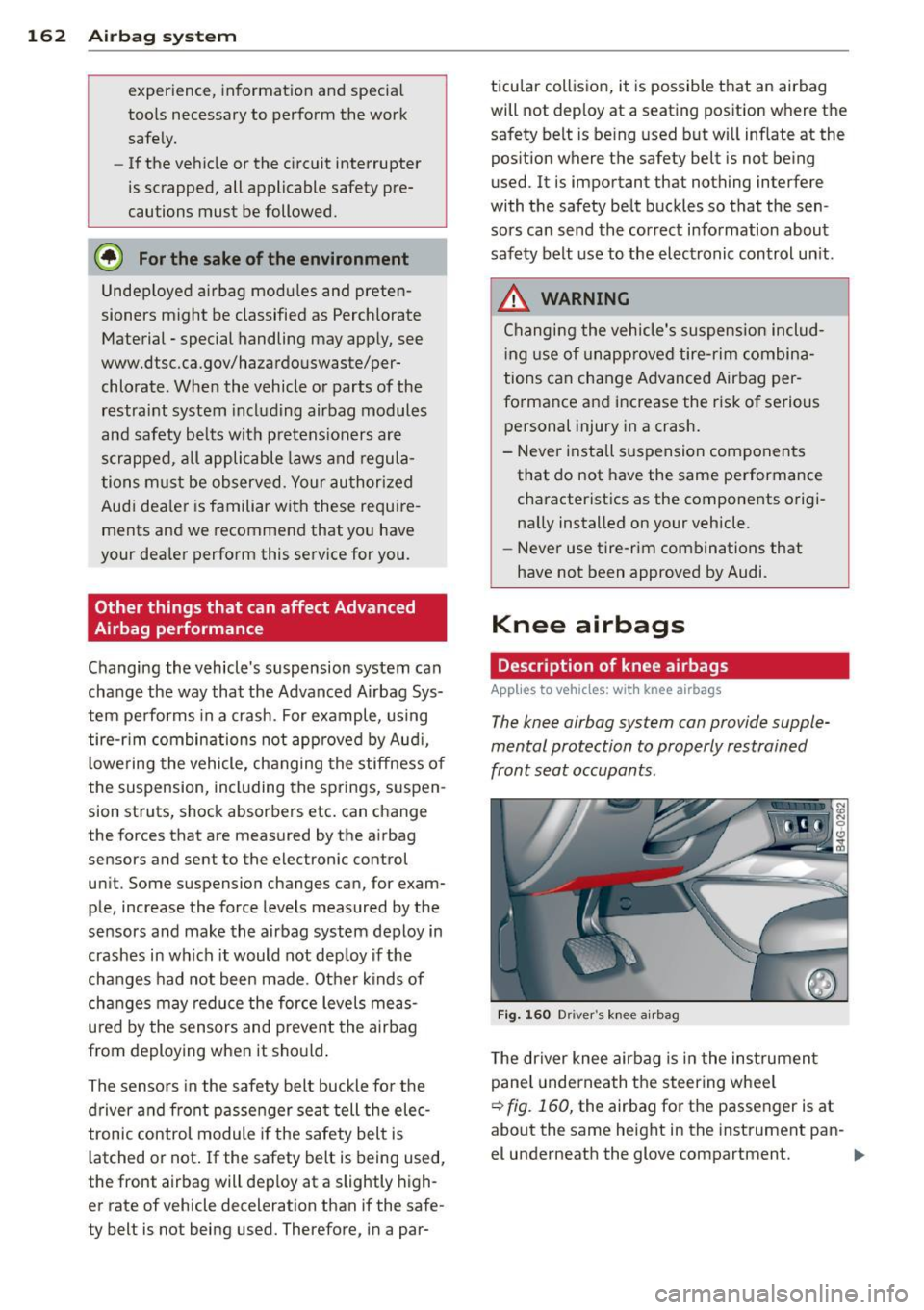
Fig . 1 60 Driver 's knee a irbag
T he dr iver knee airbag is in the ins trument
pane l underneath the steering wheel
~ fig. 160, the airbag for the passenger is at
about the same height in the instrument pan-
el underneat h the glove compartment. .,.
Page 175 of 306
~ page 171, Important things to
know.
(D Tips
Always replace child restraints that were
installed in a vehicle during a crash. Dam
age to a child restraint that is not visible
could cause it to fail in another collision
situation.
Advanced front airbag system and children
Your vehicle is equipped with a front "Ad
vanced Airbag System" in compliance with United States Federal Motor Vehicle Safety
Standard (FMVSS) 208 as applicable at the
time your vehicle was manufactured.
The Advanced Airbag system in your vehicle
has been certified to meet the "low-risk" re
quirements for 3- and 6-year old children on
the passenger side and small adults on the
driver side. The low risk deployment criteria
are intended to reduce the risk of injury
through interaction with the airbag that can
occur, for example, by being too close to the
steering wheel and instrument panel when
the airbag inflates. In addition, the system
has been certified to comply with the "sup
pression" requirements of the Safety Stand
ard, to turn off the front airbag for infants up
to 12 months who are restrained on the front passenger seat in child restraints that are list
ed in the Standard.
Even though your vehicle is equipped with an
Advanced Airbag system, all children, espe
cially those 12 years and younger, should al
ways ride in the back seat properly restrained
for their age and size. The airbag on the pas
senger side makes the front seat a potentially
dangerous place for a child to ride. The front
seat is not the safest place for a child in a for
ward-facing child safety seat. It can be a very
dangerous place for an infant or a larger child
in a rearward-facing seat.
The vehicle 's Advanced Airbag System has a
capacitive passenger detect ion system in the
Child Safety 173
front passenger seat cushion that can detect
the presence of a baby or a child in a child re
straint system on this seat.
The capacitive passenger detection system
registers the changes that result in an electri
cal field when a child, a child restraint, and a
baby blanket are on the front passenger seat .
The change in the measured capacitance due
to the presence of a child, a child restraint,
and a baby blanket on the front passenger
seat is related to the child restraint system resting on the seat . The measured capacitance
of a child restraint system varies depending
on the type of system and specific make and
model.
The electrical capacitance of the various
types, makes, and models of child restraints
specified by the U.S.National Highway Traff ic
Safety Administration (NH TSA) in the relevant
safety standard are stored in the Advanced
Airbag System control unit together with the
capacitances typical of infants and a 1-year
old child. When a child restraint is used on the
front passenger seat with a typical
1 year-old
infant, the Advanced Airbag System compares
the capacitance measured by the capacitive passenger detection system with the data
stored in the electronic control unit.
Child restraints and Advanced front
airbag system
Regardless of the child restraint that you use,
make sure that it has been certified to meet
United States Federal Motor Vehicle Safety
Standards and has been certified by its manu
facturer for use with an airbag. Always be sure
that the child restraint is properly installed at
one of the rear seating positions. If in excep
tional circumstances you must use it on the
front passenger seat, ca refully read all of the
information on child safety and Advanced Air
bags and heed all of the applicable WARN
INGS. Make certain that the chi ld and child re
straint are correctly recognized by the capaci
tive passenger detection system in the front passenger seat, that the front passenger air
bag is turned off, and that the airbag status is ..,.
•
•
Page 195 of 306
ESC includes and/or works together with the
anti-lock brake system (ABS) , brake assist sys
tem, anti -slip regulation (ASR) , electronic dif
ferential lock (E DL) and e lectronic interaxle
d ifferential lock*. ESC is swi tched on all the
time. In certain situat ions when you need less
traction , you can switch off ASR by pressing
the button
[ru ~ fig . 177 . Be sure to switch
ASR on again when you no longer need less
traction.
Anti-lock braking system (ABS)
ABS prevents the wheels from locking up
when braking. The vehicle can still be steered even during hard braking . Apply steady pres
sure to the brake pedal. Do not pump the ped
al. A puls ing in the brake pedal indicates that
the system is he lping you to brake the vehicle.
Brake assist system
The brake assist system can decrease brak ing
d istance.
It increases braking power when the
driver presses the brake pedal quickly in emer
gency situations. You must press and hold the
brake pedal until the situation is over . In
vehicles with adaptive cruise control* , the
brake assist system is more sensitive if the
d istance detected to the vehicle ahead is too
small.
Anti-slip regulation (ASR)
ASR reduces engine power when the drive
wheels begin to spin and adapts the force to
the road condit ions. This makes it eas ier to
s tart, accelerate and drive up hills.
Electronic differential lock (EDL)
The EDL brakes wheels that are spinn ing and
transfers the drive power to the other drive
wheel or whee ls if the vehicle is equipped with
all-whee l drive*. This function is available up
to about 75 mph (120 km/h).
I n extreme cases , EDL automatically switches
off to help keep the brake on the braked wheel
from overheating. EDL wi ll switch on again au
tomatically when conditions have returned to
normal.
Intelligent technology 193
Electronic interaxle differential lock*/
selective wheel torque control*
The electronic interaxle differential lock (front
whee l drive) or the se lective wheel torque
cont rol (all-wheel dr ive) operates when dr iv
ing through curves . The front wheel on the in
s ide of the curve or both wheels on the inside
of the curve are braked selectively as needed .
T his min imizes sliding in the front wheels and
allows for more precise driving through
curves . Th e applicable system may no t acti
vate when driv ing in wet or snowy conditions.
A WARNING
-
-ESC, ABS, ASR, EDL and the electronic in
teraxle differential lock function* cannot
overcome the laws of physics. This is es
pecially important on slippery or wet
roads . If the systems begin acting to sta
bilize your vehicle, you should immedi
ately change your speed to match the
road and traffic conditions. Do not let
the increased safety provided by these
systems tempt you to t.;1ke risks. Doing
so will increase the risk o f a loss of vehi
cle control, collision and serious personal
injuries.
-Always adapt your speed to road, traffic
and weather conditions . The risk of los
ing control of the vehicle increases when
driving too fast, espec ially through
curves and on slippery or wet roads, and
when dr iving too close to vehicles up
ahead . ESC, ABS, the brake assist sys
tem, EDL, ASR and the elec tronic inter
axle differential lock function* cannot
prevent collisions .
- Always accelerate with special care on
even, smooth surfaces such as those that
are wet or covered with ice and snow.
The drive wheels can spin even with
these assistance systems that cannot al
ways he lp to red uce the risk of loss of ve -
hicle control. .,.
•
•
Page 208 of 306
206 Trailer towing
Always apply brakes early. When driving
downhill, shift into a lower gear to use the en
g ine braking effect to slow the vehicle . Use of
the brakes alone can cause them to overheat
and fail.
Coolant temperature
The coolant temperature gauge¢ page 11
must be observed carefully. The coolant tem
perature can increase if you drive on long in
clines in a low gear at high engine speeds. Re
duce your speed immediately if the LEDs in
the top part of the display turn on .
For more information about indicator lights,
refer to. ¢
page 16 .
A WARNING
Anyone not properly restrained in a mov
ing vehicle is at a much greater risk in an
accident . Never let anyone r ide in your car
who is not properly wear ing the restraints
provided by Aud i.
Trailer towing tips
Important to know
Your vehicle handles differently when towing
a trailer because of the additional weight and
different weight distribution . Safety, perform
ance and economy w ill greatly depend on how
carefully you load your trailer and operate
your rig .
Before you actually tow your trailer, practice
turn ing, stopp ing and back ing up in an area
away from traffic. Keep practicing until you
have become comp lete ly familiar with the way
your ve hicle-trai ler comb ination behaves and
responds.
Backing up is difficult and requires practice .
Backing up with a tra iler generally requi res
steering act ion opposite to that when backing
up your vehicle without a trailer.
Maintain a greater distance between your ve
hicle and the one in front of you. You will need
more room to stop. To compensate for the trailer, you wi
ll need a larger than normal
turning radius.
When passing, remember that you cannot ac
celerate as fast as you norma lly would be
cause of the added load. Make sure you have
enough room to pass . After passing, a llow
plenty of room for your trailer before chang
ing lanes again.
Avoid jerky starts , sharp turns or rapid lane
changes.
(D Tips
- Do not tow a trailer during the break-in
period of your vehicle.
- If you tow a trailer, your Audi may re
quire more frequent maintenance due to
the extra load¢
page 285.
Parking on a slope
Do not park on o slope with a trailer. If it can
not be avoided, do so only after doing the fol
lowing:
When parking:
.,. App ly the foot brake .
.. Have someone pla ce chocks under both the
vehicle and the trailer wheels.
.. With chocks in place, slowly release the
brakes until the whee l chocks absorb the
load .
.. Turn the wheels towards the curb .
.. Apply the parking brake.
.. Select the P selector lever posit ion .
When restarting after parking:
.. Apply the foot brake.
.. Start the engine.
.. Select the D/S selector lever position .
.. Release the parking brake and slowly pull
out and away from the wheel chocks .
.,. Stop and have someone retr ieve the wheel
chocks .
Ill-
Page 244 of 306
242 Tire s and wheels
Groove
means the space between two adjacent tread
ribs .
Load rating (code)
means the maximum load that a tire is rated
to carry for a given inflation pressure. You
may not find this informat ion on all tires be
cause it is not req uired by law.
Maximum load rating
means the load rating for a t ire at the max i
mum permissible inflation pressure for that
tire.
Maximum loaded vehicle weight
means the sum of:
(a) Curb weight
(b) Accessory weight
(c) Vehicle capacity we ight, and
(d) Production options weight
Maximum (permissible) inflation pressure
means the maximum cold inflation pressure
to which a tire may be inflated. Also called
"maximum inflation pressure ."
Normal occupant weight
means 150 lbs. (68 kilograms) times the
number of occupants seated in the vehicle up
to the total seating capacity of your vehicle .
Occupant distribution
means distribution of occupants in a vehicle.
Outer diameter
means the overa ll diameter of an inflated new
tire.
Overall width
means the linear distance between the exteri
ors of the sidewalls of an inflated tire, includ
ing elevations due to labeling, decorations, or
protective bands o r ribs .
Ply
means a layer of rubber-coated parallel cords.
Production options weight
means the combined weight of those insta lled
regular production options weighing over 5
lbs. (2.3 kg) in excess of those standard items
which they replace, not previously considered
in curb weight or accessory we ight, including
heavy duty brakes, ride levelers, roof rack,
heavy duty battery, and special tr im .
Radial ply tire
means a pneumat ic tire in which the ply cords
that extend to the beads are laid at substan
t ia lly 90 degrees to the center line of the
tread .
Recommended inflation pressure
see<=> page 241, Cold tire inflation pressure.
Reinforced tire
means a t ire design to operate at higher loads
and at h igher inflation pressures than the cor
responding standa rd tire. Reinforced tires
may be identified as "XL" "xl" "EXTRA LOAD"
' ' '
or "RF" on the sidewa ll.
Rim
means a metal support for a tire or a tire and
tube assembly upon which the tire beads are
seated.
Rim diameter
means nom inal d iameter of the bead seat. If
you change your wheel s ize, you will have to
purchase new tires to match the new rim di
ameter.
Rim size designation
means r im diameter and width .
Rim width
means nominal distance between rim flanges.
Sidewall
means that portion of a tire between the
t read and bead.
Page 248 of 306
24 6 T ire s and whee ls
The correct tire pressure for the spare wheel is
located on a label on the driver's side B-pillar.
Because tec hnical changes may be made to
vehicle equ ipment dur ing the model year, a l
ways compare the tire size designation on the
tire pressure labe l on your vehicle with the
tires on your vehicle . Make sure that the tire
si ze information on the vehicle label is the
same as the si ze of the tires on the vehicle.
This is especially important if the vehicle be
longs to someone else or you bought the veh i
cle with different rims/tires or you bought the
vehicle as a p reviously owned vehicle.
Remember, your safety and that of your pas
sengers also depends on mak ing sure that
l oad limits are not exceeded. Vehicle load in
cludes everybody and everything in and on the
ve hicl e. These load limits are technically refer
red to as the vehicle's Gross Vehicle Weight
Rating ("GVWR") . The Gross Ax le Weight Rat
ing ("GAWR") is the maximum load that can
be applied at each of the veh icle's two axles.
The Gross Vehicle Weight Rating and the
Gross Axle Weight Rating are listed on the
safety compliance st icker labe l located on the
driver 's side B-p illar . The tire pressure label on
your Aud i lists the maximum combined
weight of all of the occupants and luggage or
o ther cargo that the vehicle can carry. For the
l ocation of the tire pressu re labe l
i=:> fig. 191.
A WARNING
Overloading a vehicle can cause loss of ve
hicle control, a cras h or other accident, se
r ious personal injury, and even death.
- Carrying more weight than yo ur vehicle
was designed to carry will prevent the
vehicle from handling properly and in
crease the risk of a loss of veh icle con
trol.
- The brakes on a veh icle that has been
overloaded may not be able to stop the
vehicle within a safe distance.
- Tires on a vehicle that has been overload
ed can fail suddenly causing loss of con
trol and a crash . -
Always make sure that the total load be
ing transported - including the weight of
a trailer hitch and the tongue we ight of a
loaded trailer -does not make the vehi
cle heavier than the vehicle's G ross Vehi
cle Weight Rating.
A WARNING
-- I ncorrect tire pressures and/or underin-
flation can lead to a serious or fatal acci
dent.
- I nco rrect tire pressures and/or underin
flation cause increased ti re wear and can
affec t the handling of the vehicle .
- I nco rrect tire pressures and/or underin
flation can a lso lead to s udden t ire fail
ure, including a blowou t and sudden de
flation, ca using loss of veh icle cont ro l.
Checking tire pressure
The correct tire pressure for the tires original
ly installed on your vehicle is listed on the tire
pressur e label located on driver's side 8-pil
lar .
The recommended tire pressures are on the
t ir e pressure label and in the table
i=:> page 244, Cold tire inflation pressure.This
means that the pressure m ust be checked and
adjusted when the t ire has not been dr iven for
more than a couple of miles (kilometers) at
low speeds during the previous three hours.
Air in the tires expands when the tire heats up as a result of inter nal frict ion as it flexes in
u se . T he t ire pressure is higher when the tire
has warmed up t han whe n it is "co ld. "
It is the inflation pressure in a "co ld" t ire that
counts . The refore, you should never let a ir out
of a wa rm tire to match "Cold t ire inflat ion
pressure" recomme ndat ions
i=:, page 244 . The
t ir es wo uld then be unde rinflated and co uld
fail suddenly .
T he t ire pressure label on your Audi lists the
recommended co ld tire inflation pressures at
m aximum cap acity for the new, or ig inal
equipmen t tires tha t were on your vehicle at ..,.
Page 250 of 306
248 Tire s and whee ls
- Only when all tires on the vehicle are fi l
led to the correct pressure, the tire pres
sure monitoring* system can work cor rectly.
- The use of incorrect tire pressure values
can lead to accidents or other damage.
Therefore it is essential that the driver observe the specified tire pressure values
for the tires and the correct pressures for
the funct ion of the tire pressure mon itor
ing system*.
- Always inflate t ires to the recommended
and correct tire pressure before driving
off.
- Driv ing with under inflated ti res bend
more, letting them get too hot resu lting
in tread separation, sudden ti re fail ure
and loss of control.
- Excess ive speed and/overloading can
cause heat bui ld -up, sudden ti re fail ure
and loss of control.
- If the tire press ure is too low or too high,
the tires wi ll wear prematurely and the
vehicle will not hand le we ll.
- If the tire is not flat and you do not have
to change a wheel immediate ly, drive at
reduced speed to the nearest service sta
t ion to check the tire pressure and add
air as required.
Driving without va lve stem caps can cause
damage to the tire va lves. To prevent this,
always make sure that factory installed
valve stem caps on all wheels are securely mounted on the valve.
@) For the sake of the environment
Underinf lated tires will a lso increase the
fuel consumption.
Tires and vehicle load limits
There are limits to the amount of load or weight that any veh icle and any t ire ca n carry.
A veh icle that is overloaded w ill not handle
well and is more difficult to stop. Over load ing
can not on ly lead to loss of veh icle contro l, but can also damage important parts of the
vehicle and can lead to sudden tire fai lure, in
clud ing a b lowout and sudden deflation that
can cause the vehicle to crash.
Your safety and that of your passengers also depends on making sure that load limits are
not exceeded. Vehicle load includes everybody
and everything in and on the veh icle. These
load lim its are technically referred to as the
vehicle's
G ro ss Vehicl e We ight R ating
("GVWR").
The "GVWR" includes the weight of the basic
vehicle, all factory installed accessories, a full
tank of fuel, o il, coolant and other fluids plus
maximum load. The max imum load includes
the number of passengers that the vehicle is
intended to car ry ("seat ing capac ity") with an
ass umed we ight of 150 lbs (68 kg) for each
passenge r at a designated seating position
and the total weight of any luggage in the ve
hicle . If you tow a trai ler, the weight of the
trailer hitch and the tongue weight of the
loaded tra iler must be included as part of the
vehicle load.
The
G ro ss Axle We ight R ating ("GAWR") is
the maximum load that can be applied at each of the vehicle's two axles.
The Gross Vehicle Weight Rating and the Gross Axle Weight Rating are listed on the
safety comp liance sticker label located on the
driver's side B-pillar . Your Audi has 5 seat ing
pos itions, 2 in the front and 3 in the rear for
total seating capacity of 5 . Each seating posi
t ion has a safety belt
Q page 136, Safety
belts.
The fact that there is an upper limit to your
vehicle's Gross Vehicle Weight Rating means
that the total weight of whatever is being car
ried in the vehicle ( includ ing the weight of a
t ra ile r hi tch and the tongue weigh t of the
loaded tra iler) is lim ited. The more passen
gers in the vehicle or passengers who are
heavier than the standard weights assumed
mean that less weight can be carried as lug-
gage.
~
Page 261 of 306
When the malfunction indicator is illuminat
ed, the system may not be able to detect or
signal low tire pressure as intended. TPMS
malfunctions may occur for a variety of rea
sons, including the installation of replace ment or alternate tires or wheels on the vehi
cle that prevent the TPMS from function ing
properly . Always check the TPMS malfunction
tellta le after replacing one or more tires or
wheels on your vehicle to ensure that the re
placement or alternate tires and wheels allow
the TPMS to continue to function properly.
Tire pressure indicator appears
Applies to vehicles: with tire pressure monitoring system
The tire pressure indicator in the instrument
cluster informs you if the tire pressure is too
low or if there is a system malfunction.
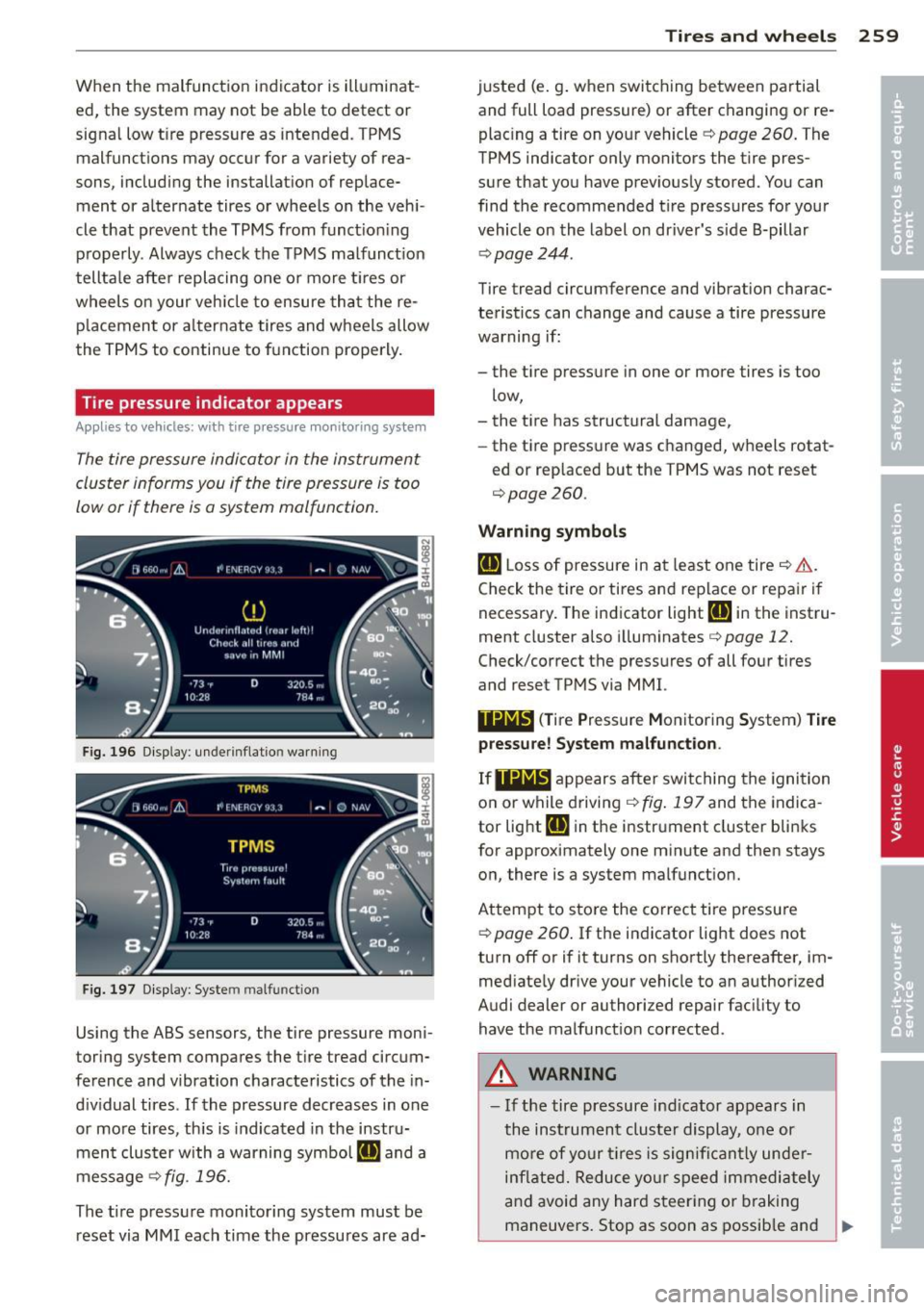
Fig. 196 Display : underinflatio n warning
Fig. 197 Display : Syste m malfun ctio n
Using the ABS sensors, the tire pressure moni
toring system compares the tire tread circum
ference and vibration characteristics of the in
dividual tires . If the pressure decreases in one
or more tires , th is is indicated in the instru
ment cluster with a warning symbol
RE and a
message
¢fig . 196.
The tire pressure monitoring system must be
reset via MMI each time the pressures are ad-
Tires and wheels 259
justed (e.g. when switching between partial
and full load pressure) or after changing or re
plac ing a tire on your vehicle¢
page 260. The
TPMS indicator only monitors the tire pres
sure that you have previously stored. You can
find the recommended tire pressures for your
vehicle on the label on dr iver's side B-pillar
~page 244.
Tire tread circumference and vibration charac
teristics can change and cause a tire pressure
warning if :
- the tire pressure in one or more tires is too
low,
- the tire has structural damage,
- the tire pressure was changed, wheels rotat-
ed or replaced but the TPMS was not reset
¢page 260.
Warning symbols
RE Loss of pressure in at least one tire¢.&. .
Check the tire or tires and replace or repair if
necessary. The indicator light
RE in the instru
ment cluster also illuminates
¢ page 12.
Check/correct the pressures of all four tires
and reset TPMS via MMI.
11;;~, ( T ire Pressure Monitoring System) Tire
pressure! System malfunction.
If11NIS, appears after switching the ignition
on or while driving¢
fig. 197 and the indica
tor light
RE in the instrument cluster blinks
for approximately one minute and then stays
on, there is a system malfunction.
Attempt to store the correct tire pressure
¢
page 260 . If the indicator light does not
turn off or if it turns on shortly thereafter, im
mediately drive your vehicle to an authorized
Audi dealer or authorized repair facility to have the malfunction corrected .
A WARNING
-If the tire pressure ind icator appears in
the instrument cluster display, one or
more of your tires is significantly under
inflated. Reduce your speed immediately
and avoid any hard steering or braking
maneuvers. Stop as soon as possib le and .,.
Page 262 of 306
260 Tire s and wheel s
check the tires and their pressures. In
flate the tire pressure to the proper pres
sure as indicated on the vehicle's tire pressure label
c> page 244. Driving on a
significantly under-inflated tire causes
the tire to overheat and can lead to tire
failure. Under-inflation also is likely to impair the vehicle's handling and stop
ping ability.
- T he driver is responsible for ma inta ining
the correct tire pressures. You must check the t ire pressures regular ly .
- Under certain cond itions (such as a spor
ty driving s tyle, win ter condit ions or un
paved roads), the pressure monitor indi
cator may be de layed .
- Ask your author ized Audi dealer if r un
flat tires may be used on your vehicle .
You r vehicle regist ration becomes invalid
if yo u use these tires when not permit
ted. Damage to your veh icle or accidents
cou ld also resu lt.
- The tire pressure monitoring system
stops wor king when there is an ESC/ABS
malfunction .
- Using snow chains may result in a system
malfunction.
- The tire pressure monitoring system on
your A udi was developed using tires with
the "AO" or "RO" identif ication on the
tire sidewall <:>page 251. We recom
mend using these t ires.
Reset tire pressure monitoring system
App lies to vehicles: with tire pressure monito ring system
If the tire pressure is adjusted, wheels are ro
tated or changed, the TPMS must be reset via
MMI.
., Switch on the ignition .
., Se lect in the MMI: !CAR !function button>
(Car )* syst ems contro l butto n > Serv icing &
checks > Tire pres sure mon itoring > Store
tire pre ssure s> Yes, store n ow .
(D Tips
Do not store the tire pressure if there are
snow cha ins on the tire .