ABS AUDI A6 2013 Owner's Manual
[x] Cancel search | Manufacturer: AUDI, Model Year: 2013, Model line: A6, Model: AUDI A6 2013Pages: 306, PDF Size: 76.92 MB
Page 217 of 306
when the cleaning solution when cleaning the
display .
The MMI/RS E* contro ls must be cleaned firs t
with a brush so that dirt does no t ente r the
unit or enter between the buttons and the
housing . Then wiping the controls with a cloth
dampened with dish detergent and water is
recommended.
(D Note
- To avoid scratching the disp lay, you
shou ld never clean it dry.
- To prevent damage, make sure fl uids do
not enter the controls .
Head-up Display
Applies to vehicles: with Head-up Display
The Head-up Display may be cleaned with a
damp cloth. The cloth should be free from
dust and lint, like a m icrofiber cloth for exam
ple.
(D Note
- To prevent scratches, do not clean the
display when it is dry.
- To prevent damage, make sure that flu
i ds do not enter the disp lay.
Aluminum trim
Use only n eutral -pH products to remove spots
and depos its from alum inum surfaces .
Chrome ca re produ cts and alkaline cleaners
will a ttac k alum in um s urfaces and can dam
age them over time.
A WARNING
Always read and heed a ll WARNINGS and
other information
~ page 208 .
Fabrics and fabric coverings
Fabrics and fabric coverings (e .g. seats, door
tr im panels, etc.) should be cleaned at reg ular
intervals with a vacuum cleaner. T his removes
surface dirt particles which could become em bedded in the fabr ic through use. Steam
Cleaning and protec tion 215
cleaners sho uld not be used, beca use the
steam tends to p ush the dirt deeper into the
fabric and lock it there .
Normal cleaning
Generally, we recommend using a soft sponge
o r a lint-free microfibe r cloth to the clean fab
ric. Brushes shou ld only be used for carpets
and floor mats, since other fabr ic surfaces
could be harmed by brushes.
Norma l surface stains can be cleaned using a
commercially availab le foam cleaner . Spread
the foam on the s urface of t he fabric with a
soft sponge and work it in gently. Do not satu
rate the fabric. T hen pat the foam dry us ing
absorbent, dry cloths (e.g. m icrofiber cloth)
and vacuum it after it has dried completely.
Cle aning sta in s
Stains caused by beverages (e .g. coffee, fr uit
juice, etc.) can be treated with a mild deter
gent solution. Apply the detergent solution
with a sponge. In the case of stubborn stains,
a detergent paste can be applied directly to
the stain and worked into the fabric. After
wards, use copious amounts of clean water to remove the rema ining de terge nt. App ly the
water wit h a damp cloth or sponge and pat
the fabric dry with an absorbent, dry cloth .
Stai ns from choco late or ma keup should have
de tergent paste (e.g. ox-gall soap) rubbed in
to them. Afterwa rds, remove the soap wi th
wa ter (damp sponge) .
Alcohol can be used to treat stai ns from
grease, o il, lipstick or a ballpoin t pen. Melted
grease o r dye mus t be patted
off using ab
sorbent mater ia l. It may be necessary to re
treat the areas with detergent paste and wa
ter .
In the case of genera l soiling of the upho ls
tery and cover material, we recommend hir ing
a specia list t hat has the eq uipment to clean
the seat covers and other fabric surfaces by
shampooing and spray extraction. •
•
Page 219 of 306
and can damage the leather surface as well as
weaken seams .
The leather sho uld be cleaned reg ularly as
needed. After having been used for a re latively
l ong time, your leather seats will acquire a
rich aged finish. This is a characteristic of nat
ura l leather and a sign of true quality .
I n o rder to maintain the va lue of th is natura l
p roduct over the life of your vehicle, you
should follow the recommendations below :
(D Note
-To keep yo ur leather from bleach ing out,
do not a llow it to be exposed to bright
sunlight for long periods of time. If you
have to leave the vehicle parked outside
for long periods, cover the leather to
protect it from d irect exposure to sun
light.
- Sharp objects on clothing, such as zip
pers, rivets or sharp pieces on be lts can
leave permanent scratches or scrape
marks on the surface of the leather .
- After each time you clean the leather and
at regu lar inte rva ls, use a leather preser
vat ive creme that conta ins UV-blockers
and that wor ks into the leather. This
c reme will no urish and moistur ize the
l eather, helping i t to brea the and stay
supple .
It also helps to b uild up a protec
tive coating on the s urface .
- Clean the lea ther every 2 -3 months,
and clean any areas that get soiled.
- Remove fresh mar ks made by ba llpoint
pens, ink, lipstick, shoe polish, e tc. as
soon as possib le .
- Preserve the colo r of the lea ther as need
ed by using a special colored leather care
creme to to uch up areas of uneven co lor.
Cleaning and protec tion 217
Cleaning and caring for leather
upholstery and trim
App lies to vehicles : with natural lea ther
Natural leather requires special care and at
tention .
Normal cleaning
.. Clean so iled areas with a slightly moistened
cotton or woolen cloth .
More stubborn dirt
.. More st ubborn dirt can be removed using a
cloth saturated with a mild soap solut ion (2
tablespoons mild liquid soap).
.. Never allow the soap solution to saturate
the leather, and make certain that no water soaks into the seams.
.,. Wipe off the soap so lution with a soft, dry
cloth.
Cleaning spots
.. Remove fresh wat er-based spots (such as
coffee, tea, juices, blood) with an absorbent
cloth or pape r towel.
.. Remove fresh
greas e or oil-ba sed spot s
(such as bu tte r, mayonnaise, chocola te) with
an absorbent cloth or paper towel, or use
the cleaner from the leather care kit if the
spot has not yet penetrated into the surface
of the leather.
.. Use an oil/grease dissolving spray, if
oil/
grease spot s ha ve dried on.
.. Remove specific k inds of spots (ballpoint
pen, felt marker, fingerna il polish, water
based pa int, shoe po lish, etc.) with a spot
remover specifically fo rmu lated for leather.
Leather care
.. Every half year use an approved leather care
product (available from your Audi dealer) to
care for the leather .
.,. App ly the product very spar ingly.
.. Wipe it off with a damp clot h.
If you have any q uestions about clean ing and
caring for the leather in your vehicle, it is best
to contact you r authorized Audi dea ler, who
will be g lad to help you and tell you abo ut o ur
full range of leather care prod ucts, such as : .,..
•
•
Page 237 of 306
The location of the brake fl uid reservo ir can be
seen in the engine compartment illustration
c::> page227.
The fl uid level may drop slightly after some
time due to the automatic adjustment of the
brake pads. This is not cause for alarm .
If the brake fluid level falls considerably be
l ow the "MIN" mark, the bra ke wa rning/ind i
cator light
1111 (U .S . models)/ . (Canadian
models) will come on
c::> page 15. Do not con
tinue to operate the vehicle. The comp lete
brake system sho uld be thoroughly checked
by an author ized Audi dealer or other quali
fied fac ility and the cause corrected . If the
brake fluid level is too low, the brake warn ing/
i ndicator light w ill illuminate . Contact an au
thor ized Audi dealer
imm ediately .
Changing brake fluid
Have the brake fluid changed by an experi
enced technician .
Brake fluid absorbs moisture from the a ir. If
the water content in the brake fluid is too
h igh, corrosion in the brake system may result
after a per iod of t ime . The bo iling po int of t he
brake fluid w ill also decrease consider ably and
dec rease b raking per formance.
Therefore, the brake flu id must be changed
ever y two years . Always use new b rake fluid
whi ch confo rms to Fede ral Motor Vehicle
Standard "FMVSS 1 16 DO T 4".
The brake flu id rese rvoir ca n be difficult to
r eac h, therefo re , we re commend that yo u
have the brake fl uid changed by y our autho r
i z ed
Audi dealer . Your deale r has the correct
too ls, the right brake fluid and the know -how
to do this for you .
A WARNING
-Brake fluid is po isonous . It must be stor
ed only in the closed orig inal container
out of t he reac h of children!
- Brake fa ilure can result from old o r inap
propr iate brake fluid. Observe these pre
caut ions:
Checkin g and fillin g 235
-Use only brake f luid that meets SAE
spec ificat ion
J 1703 and conforms to
Federal Motor Ve hicle Standard 116.
Always check with your autho rized Audi
dealer to make sure yo u are using the
correct brake fluid . The correct type of
brake f lu id is also ind icated on the
brake flu id rese rvoi r.
- The bra ke fluid must be new. Heavy us e
of the brakes can cause a vapo r lock if
the b ra ke fluid is left i n the system too
l ong . This can se riously affec t the effi
ciency of the b rakes as well as your
safety . This co uld resu lt in an accident.
(D Note
B rak e fluid wi ll damage the pa int o f you r
vehicle .
~ For the sake of the environment
Because o f the p rob lem of pro per disposal
of bra ke fluid as well as the spe cial too ls
r equired an d the necessary exper tise, we
r ecommend that yo u have the brake flu id
changed by yo ur authorized Aud i dea le r.
Battery
General information
U nder normal ope ra ti ng cond itions , the bat
te ry in yo ur Audi doe s not need any ma inte
nance. With
high outside tempera tures or
l ong daily drives we recommend that you have
the e lectrolyte level checked by a service fa
c ili ty. The electrolyte leve l should a lso be
checked each t ime the battery is charged
c:> page 237.
Have the battery checked when yo u take your
vehicle in for service. You are well advised to
replace a batte ry that is older than 5 years .
Wi th certain types of airbag deployment, the
battery is disconnected from the vehicle elec
trical system for safety reasons
c> & in Re
pair , care and disposal of the airbags on
page 161.
~
•
•
Page 238 of 306
236 Check ing and filling
Di sconnect ing the batt ery terminal s
Some vehicle functions (power window regu
l ators, for example) are lost if the battery ter
minals are disconnected . These functions have
to be re learned after the battery terminals are
connected again. To prevent this, the battery
should only be disconnected from the vehicle
electrical system when absolutely necessary
for repairs .
Vehicles not dri ven fo r lo ng period s
If you do not drive your vehicle over a period
of several days or weeks, electrical compo
nents are gradually cut back or switched off.
This reduces energy consumption and main
tains starting capab ility over a longer period
¢ page 19 7 . Some of the convenience func
tions may not operate, such as the inte rior
lights or powe r seat adjustme nt. The conven
ience functions will be ava ilable again when
you switch on the ignition and start the en
gine.
Winter operati on
During the winter months, battery capacity
tends to decrease as tempe ratures drop . This
is because more powe r is also consumed while
start ing, and the headlights, rear window de
fogger, etc., are used more often.
Avoid unnecessary power consumption, par
ticularly in c ity traffic or when trave ling on ly
short distances. Let your authorized Audi
dea ler check the capacity of the vehicle bat
tery before winter sets in
¢ page 237. A well
charged battery w ill not only prevent starting
prob lems when the weather is cold, but will
also last longer .
(D Tips
If your vehicle is left standing for several
weeks at extremely low temperatures, the
veh icle battery should be removed and
sto red where it will not freeze. This w ill
prevent it from being damaged and hav ing
t o be replaced.
Working on the battery
Be especially careful when working on or near
the battery.
The battery is located in the luggage compart
ment under the floor. Before you check any
th ing in the luggage compartment,
read and
h ee d all WARNINGS
¢ ,&,
Always heed the safet y warnings , when work
ing on the vehicle battery or the vehicle e lec
trical system to prevent injury.
The following WARNINGS are very
important wh en wor king on the battery :
Alway s heed the following WARNING S YM
BOLS and safety prec autions when working
on the battery .
®
Always wear eye protection.
Battery acid contain s sulfuric acid.
Alwa ys wear glove s and ey e protec
tion.
No
- sparks
-flames
- smoking .
1
When a b atter y is charged, it pr odu
ces hydrogen gas which i s ex plosive
and could cau se per sonal injury.
Always keep the battery well out of reach of children .
.&_ WARNING ~
Whenever working on the battery or on
the electrical system, there is the risk of
i njury, accident and even fire. Read and
heed the following WARNINGS:
- Always wear eye protection. Do not let
battery ac id or any lead particles get on
your skin or clothing. Shield your eyes. Exp losive gases can cause blindness or
other inju ry.
- Battery acid conta ins sulfuric acid. Sulfu
ric acid can cause blindness and severe
burns.
Page 261 of 306
When the malfunction indicator is illuminat
ed, the system may not be able to detect or
signal low tire pressure as intended. TPMS
malfunctions may occur for a variety of rea
sons, including the installation of replace ment or alternate tires or wheels on the vehi
cle that prevent the TPMS from function ing
properly . Always check the TPMS malfunction
tellta le after replacing one or more tires or
wheels on your vehicle to ensure that the re
placement or alternate tires and wheels allow
the TPMS to continue to function properly.
Tire pressure indicator appears
Applies to vehicles: with tire pressure monitoring system
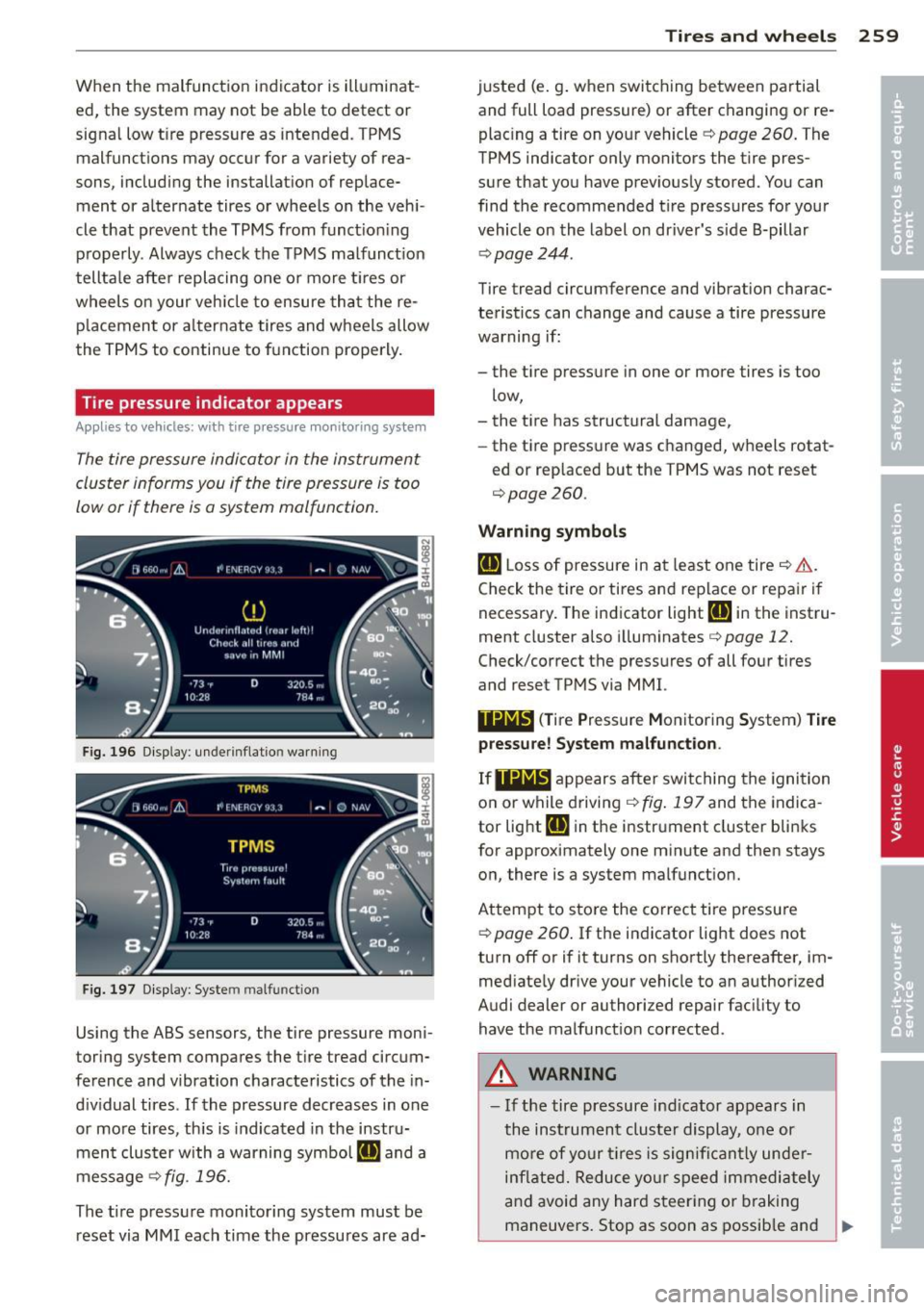
The tire pressure indicator in the instrument
cluster informs you if the tire pressure is too
low or if there is a system malfunction.
Fig. 196 Display : underinflatio n warning
Fig. 197 Display : Syste m malfun ctio n
Using the ABS sensors, the tire pressure moni
toring system compares the tire tread circum
ference and vibration characteristics of the in
dividual tires . If the pressure decreases in one
or more tires , th is is indicated in the instru
ment cluster with a warning symbol
RE and a
message
¢fig . 196.
The tire pressure monitoring system must be
reset via MMI each time the pressures are ad-
Tires and wheels 259
justed (e.g. when switching between partial
and full load pressure) or after changing or re
plac ing a tire on your vehicle¢
page 260. The
TPMS indicator only monitors the tire pres
sure that you have previously stored. You can
find the recommended tire pressures for your
vehicle on the label on dr iver's side B-pillar
~page 244.
Tire tread circumference and vibration charac
teristics can change and cause a tire pressure
warning if :
- the tire pressure in one or more tires is too
low,
- the tire has structural damage,
- the tire pressure was changed, wheels rotat-
ed or replaced but the TPMS was not reset
¢page 260.
Warning symbols
RE Loss of pressure in at least one tire¢.&. .
Check the tire or tires and replace or repair if
necessary. The indicator light
RE in the instru
ment cluster also illuminates
¢ page 12.
Check/correct the pressures of all four tires
and reset TPMS via MMI.
11;;~, ( T ire Pressure Monitoring System) Tire
pressure! System malfunction.
If11NIS, appears after switching the ignition
on or while driving¢
fig. 197 and the indica
tor light
RE in the instrument cluster blinks
for approximately one minute and then stays
on, there is a system malfunction.
Attempt to store the correct tire pressure
¢
page 260 . If the indicator light does not
turn off or if it turns on shortly thereafter, im
mediately drive your vehicle to an authorized
Audi dealer or authorized repair facility to have the malfunction corrected .
A WARNING
-If the tire pressure ind icator appears in
the instrument cluster display, one or
more of your tires is significantly under
inflated. Reduce your speed immediately
and avoid any hard steering or braking
maneuvers. Stop as soon as possib le and .,.
Page 262 of 306
260 Tire s and wheel s
check the tires and their pressures. In
flate the tire pressure to the proper pres
sure as indicated on the vehicle's tire pressure label
c> page 244. Driving on a
significantly under-inflated tire causes
the tire to overheat and can lead to tire
failure. Under-inflation also is likely to impair the vehicle's handling and stop
ping ability.
- T he driver is responsible for ma inta ining
the correct tire pressures. You must check the t ire pressures regular ly .
- Under certain cond itions (such as a spor
ty driving s tyle, win ter condit ions or un
paved roads), the pressure monitor indi
cator may be de layed .
- Ask your author ized Audi dealer if r un
flat tires may be used on your vehicle .
You r vehicle regist ration becomes invalid
if yo u use these tires when not permit
ted. Damage to your veh icle or accidents
cou ld also resu lt.
- The tire pressure monitoring system
stops wor king when there is an ESC/ABS
malfunction .
- Using snow chains may result in a system
malfunction.
- The tire pressure monitoring system on
your A udi was developed using tires with
the "AO" or "RO" identif ication on the
tire sidewall <:>page 251. We recom
mend using these t ires.
Reset tire pressure monitoring system
App lies to vehicles: with tire pressure monito ring system
If the tire pressure is adjusted, wheels are ro
tated or changed, the TPMS must be reset via
MMI.
., Switch on the ignition .
., Se lect in the MMI: !CAR !function button>
(Car )* syst ems contro l butto n > Serv icing &
checks > Tire pres sure mon itoring > Store
tire pre ssure s> Yes, store n ow .
(D Tips
Do not store the tire pressure if there are
snow cha ins on the tire .
Page 303 of 306
Unlocking Power lock ing switch ... ... ... ... .. .. 36
Remote control . . . . . . . . . . . . . . . . . . . . 34
Us ing the key ... .. .... ... .... .. .. .. 36
V
Va let parking ...... ..... ... .. .. .. .. .. 39
Vanity mirrors .... ......... .... .. .. .. 45
Vehicle-care produ cts ....... .. .. .. .. . 208
Vehicle e lectrica l system . . . . . . . . . . . . . . 17
Vehicle ident ificat ion label ....... ... .. 280
Vehicle Identification N umber (VIN) . .. . 280
Vehicle jack . . . . . . . . . . . . . . . . . . . 262, 266
Vehicle literature . . . . . . . . . . . . . . . . . . . . . 5
Vehicle transport .. ..... ... .. .. .. .. . 278
Vent ilation .. .. .. .. .. .... ... .. .. .. .. 64
w
Warn ing/ indicator lights ......... .... . 12
A irbag system ............ ... ... ... 19
Anti-loc k braking system (ABS) .. .. .. .. 20
Brake system . ........... .. .. .. .. .. 15
C ruise control . . . . . . . . . . . . . . . . . . . . . . 23
Elect romechanical park ing brake . ... .. 1 6
Electronic power contro l . . . . . . . . . . . . . 21
Electronic Stabilization Control (ESC) ... 19
Generator . . . . . . . . . . . . . . . . . . . . . . . . . 17
Instrument cluster. . . . . . . . . . . . . . . . . . 11
Malfunct ion Indicator Lamp (MI L) ... .. 21
Safety belt . . . . . . . . . . . . . . . . . . . . . . . . 17
Turn signa ls ... ........... ... ... ... 23
Warn ing/Ind icator lights
A irbag system . . . . . . . . . . . . . . . 157, 158
PASS ENG ER A IR BAG OFF ...... ... .. 158
Warranty coverages ..... ... .. .. .. .. . 285
Washer reservoir . ...... ... .... .. ... 239
Washing .. .. ................. .. ... 208
Automatic car wash ....... .. .. .. .. . 209
by hand . ... .. .... .... ..... ... ... . 209
Matte fin is h pa int ........... .... .. 210
with a powe r washe r ... ... .. .. .. .. . 210
Waxing ... .. ................. .. ... 212
Wear ind icator ............ .... .. .. . 250
Weights . .. ... ................... .. 280
W hat happens if you wear your safety belt
too loose? . .. .. ........... .. .. .. ... 140
Inde x 301
What happens to unbe lted occupants? . . 137
What impairs d riving safety? .......... 127
What should I do after changing a
whee l? ..... .. .. .. ................. 247
What shou ld I do after replac ing whee ls? 247
Wheel bolts To rque ...... .. .... .......... ..... 257
Wheels ...... .. .. ................. 240
Cast alloy . .. .. .. .... ............. 213
Check ing t ire pressu re ............. . 246
Co ld t ire inflation p ressure ..... ... .. 244
General notes .. ... ...... .......... 240
G lossary of tire and loading term inolo-
gy ....... .. .. .. .. .. ........... .. 241
New tires and wheels . ... .... ... .. .. 251
Tires and vehicle load limits .. ... .. .. 248
When must a safety belt be replaced? .. 139
When must the airbag system be inspect- ed? ........ .. .. .. ................. 157
When should I adjust the t ire pressures? 247
When should I check the tire p ressu res? . 247
Whe re are lower anchorages located? . .. 186
Where can I find the t ire p ress ures for my
car? .. ... .. .. .. .. .. . .. ... .... ... .. 246
Why safety belts? . . . . . . . . . . . . . . 136, 137
Windows Cleaning .. .. .. .. ................. 213
defrosting (automatic climate control) . 68
defrosting (climate control) . . . . . . . . . . 66
Windshie ld
Cleaning . ... .... .. . .. .. ..... ... .. . 46
defrosting (automatic climate control) . 68
defrosting (climate control) . . . . . . . . . . 66
Windshie ld washer system .... ... .. .. . 46
Washer fl uid level . .. .. ..... ... .. .. . 22
Washer reservoir ... . ... .... ... .. .. 239
Windshie ld wipers
F o ld ing up .. .. .. ................. . 47
Ind icator light ..... . .. .. ..... ... .. . 22
Rep lacing windsh ield wiper b lades . ... . 47
Switching on/off .... .. ..... ... .. .. . 46
Win ter operation
Battery . .. .. .. .. .... ........... .. 235
Cooling system ... .. .. ... ..... ... .. 232
Defrost ing windows (automatic climate
control) . . . . . . . . . . . . . . . . . . . . . . . . . . . 68
Defrost ing windows (climate control) . . 66
•
•