Fluid AUDI A6 2014 User Guide
[x] Cancel search | Manufacturer: AUDI, Model Year: 2014, Model line: A6, Model: AUDI A6 2014Pages: 304, PDF Size: 76.32 MB
Page 223 of 304
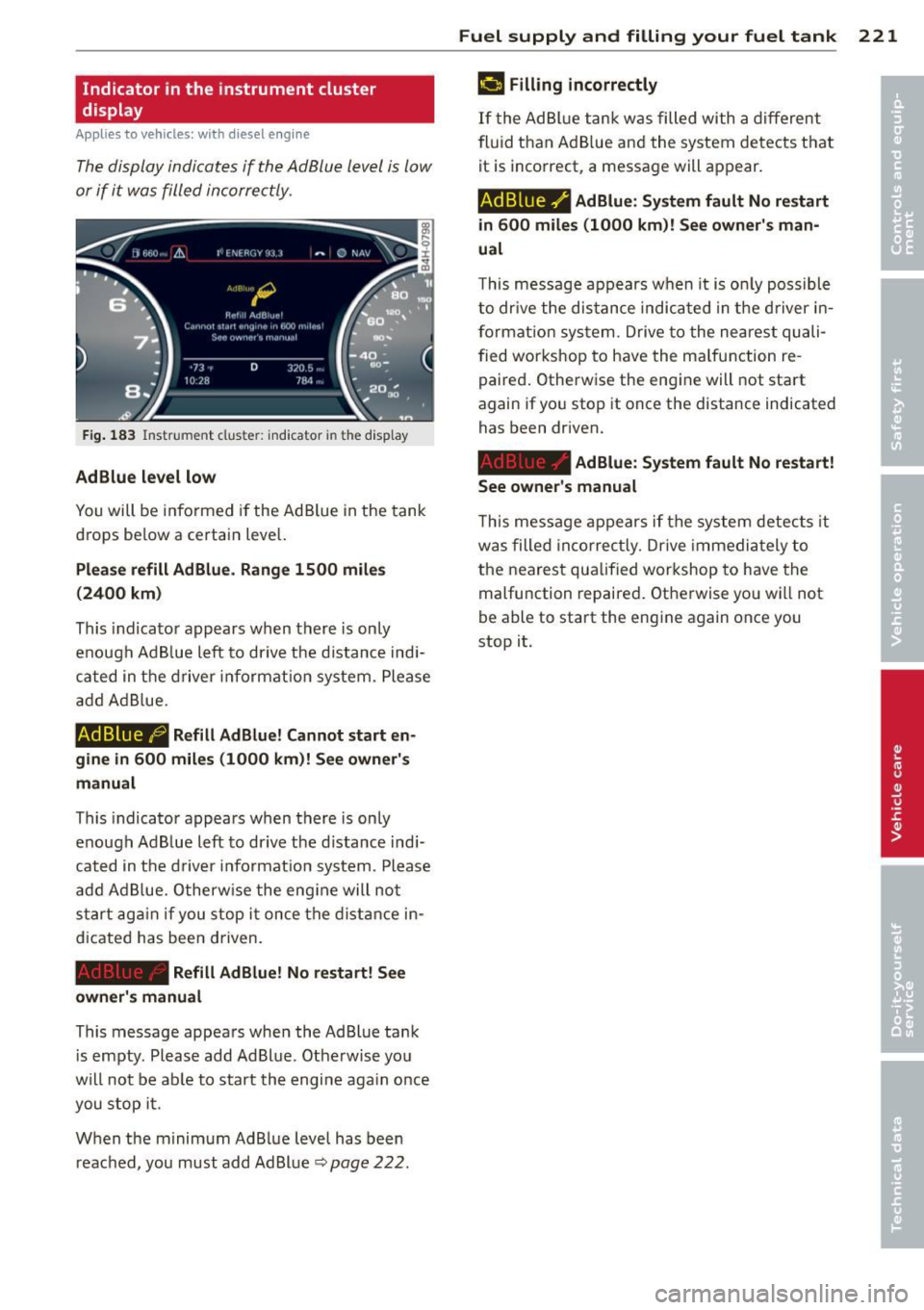
Indicator in the instrument cluster
display
Applies to vehicles: with diesel e ngine
The display indicates if the Ad Blu e level is low
or if it was filled incorre ctly.
Fig . 183 In strument clus te r: indica tor in th e display
AdBlue l evel low
You will be informed if the Ad Blue in the tank
drops be low a certain level.
Plea se refill Ad B lu e. Rang e 1500 miles
(2400 km)
This indicato r appears when there is on ly
enough Ad B lue left to drive the d istance ind i
cated in the driver i nformat ion system . Please
a dd AdB lue.
AdBlue ,0 Refill Ad Blue! Cannot start en
gine in
600 miles (1000 km )! See owner's
manual
This indicato r appears when there is only
e nough Ad B lue left to dr ive t he d istance ind i
cat ed in t he d rive r in format ion system . Please
add Ad Blue. O therw ise the eng ine will not
start ag ai n if you stop i t once the distan ce in
d icated has been driven.
Refill Ad Blue! No r estart! S ee
owner 's manual
This message appears when the AdBlue ta nk
i s empty . Please add Ad Blue. Otherwise you
will not be ab le to s tart th e engi ne aga in o nce
you stop i t.
W hen the minimum AdBlue level has been
reac hed, you must add Ad Bl ue
q page 222 .
Fuel suppl y and filli ng your fuel t ank 221
¢4 Filling incorrectly
If the AdBl ue tank was filled with a different
fluid than Ad B lue and the system dete cts t hat
it is incorrect, a message will appear.
AdBlue ./ AdBlue: Sy stem fault No restart
in
6 00 mile s (1000 km)! See owner 's man
ual
T his message appears w hen it is on ly possible
to dr ive the dis tance indicated in the d river in
format ion sys tem . Drive to the nea rest quali
fied wor kshop to have the ma lfunction re
paired. Otherwise the eng ine will not start
again if yo u stop it once the distance indicated
has been driven.
AdBlue: System fault No re start!
See owne r's manual
Th is message appears if the system detects it
was filled in co rrec tly. Drive immedia tely to
the nearest qua lified workshop to have the
malfu nction repaired . Otherwise yo u wi ll not
be able to start the engine again once you
stop it.
Page 224 of 304
222 Fuel supply and filling your fuel tank
Filling AdBlue
Applies to vehicles: with diesel engine
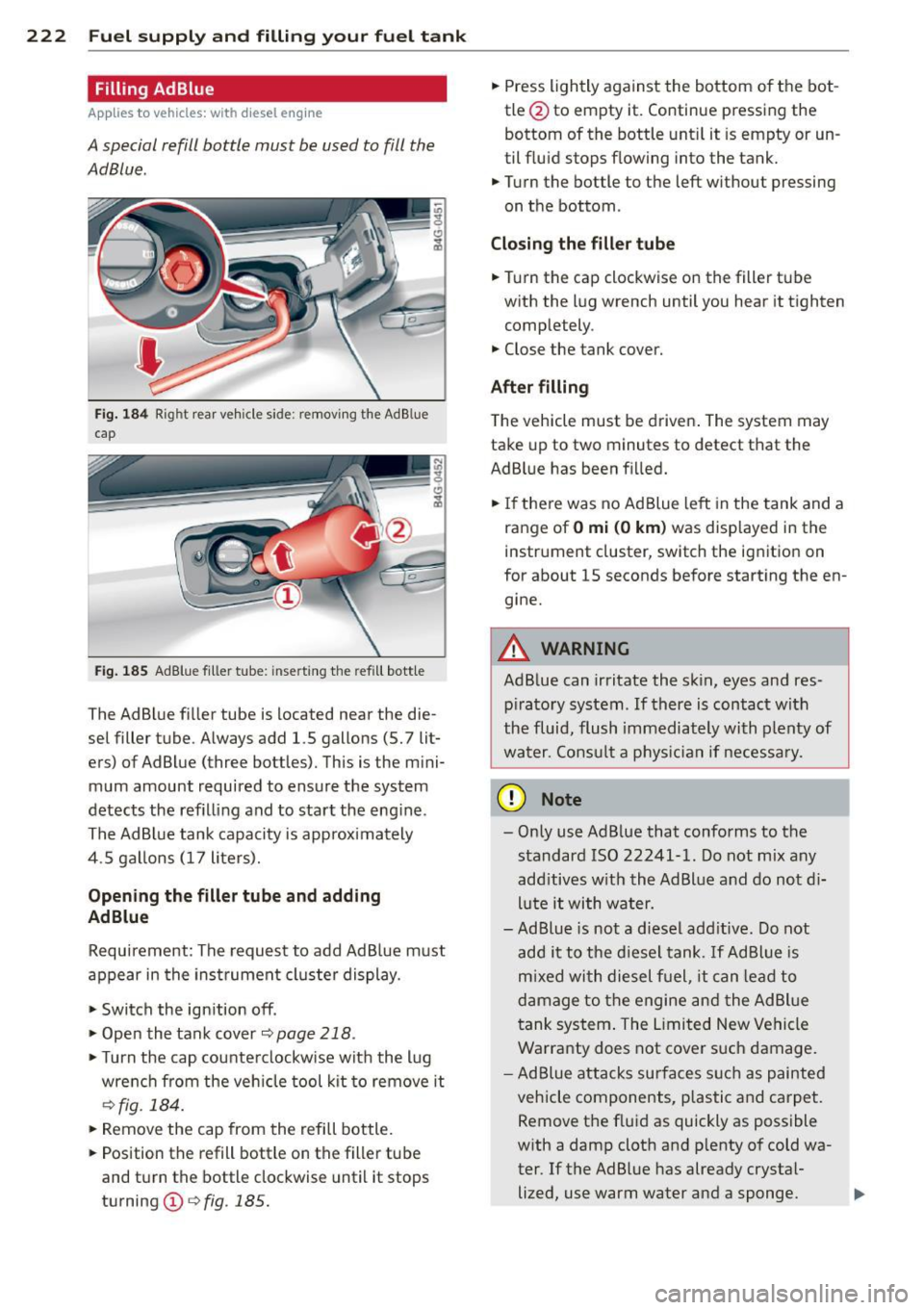
A special refill bottle must be used to fill the
AdBlue .
Fig. 184 Rig ht rear vehicle side: remov ing the Ad B lue
cap
Fig . 185 Ad Blue filler tube: inse rting the refill bottle
The AdBlue fi ller tube is located near the die
sel filler tube . Always add 1.5 gallons (5. 7 lit
ers) of AdBlue (three bottles). This is the mini
mum amount required to ensure the system
detects the refilling and to start the eng ine.
The AdBlue tank capacity is approximately
4 .5 gal lons (17 liters).
Opening the filler tube and adding
AdBlue
Requirement : The request to add Ad Blue must
appear in the instrument cluster display.
• Switch the ignition off .
• Open the tank cover
¢page 218.
• Turn the cap counterclockw ise with the lug
wrench from the vehicle tool kit to remove it
¢fig. 184.
• Remove the cap from the refill bottle.
• Position the refill bottle on the filler tube
and turn the bottle clockwise until it stops
turning
(D ¢ fig . 185.
• Press lightly against the bottom of the bot
tle @to empty it. Continue pressing the
bottom of the bottle until it is empty or un
til fluid stops flowing into the tank.
• Turn the bottle to the left without pressing
on the bottom .
Closing the filler tube
• Turn the cap clockwise on the filler tube
with the lug wrench until you hear it tighten
completely .
• Close the tank cover.
After filling
The vehicle must be driven. The system may
take up to two minutes to detect that the
AdBlue has been f illed.
• If there was no Ad Blue left in the tank and a
range of
O mi (0 km) was displayed in the
instrument cluster, switch the ignition on
for about 15 seconds before starting the en gine.
A WARNING
= Ad Blue can irritate the sk in, eyes and res-
piratory system. If there is contact with
the fluid, flush immediately with plenty of
water. Consult a physician if necessary.
(D Note
- Only use Ad Blue that conforms to the
standard ISO 22241-1. Do not mix any
additives with the AdBlue and do not d i
lute it with water.
-A d Blue is not a diesel add itive . Do not
add it to the diesel tank. If Ad Blue is
m ixed with diesel fuel, it can lead to
damage to the engine and the AdBlue
tank system . The Limited New Vehicle
Warranty does not cover such damage.
- Ad Blue attacks surfaces such as painted
vehicle components, plastic and carpet.
Remove the fluid as quickly as possible
w ith a damp cloth and p lenty of cold wa
ter. If the AdBlue has already crystal-
lized, use warm water and a sponge. .,..
Page 225 of 304
AdBlue residue that is not removed will
crystallize and can damage the affected
surface.
- Do not store the refill bott le in the vehi
cle.
If it leaks, the escaping Ad Blue could
damage the vehicle interior.
- Do not allow AdBlue to come into con
tact with clothing. If there is contact
with the fluid, flush immediately with plenty of water.
(D Tips
- You can obtain refill bott les from any au
thorized Audi dealer or other qualified
workshop.
- Follow the AdBlue manufacturer's in
structions for usage and storage.
Fuel supply and filling your fuel tank 223
•
•
Page 226 of 304
224 Checking and filling
Checking and filling Engine hood
Releasing the engine hood
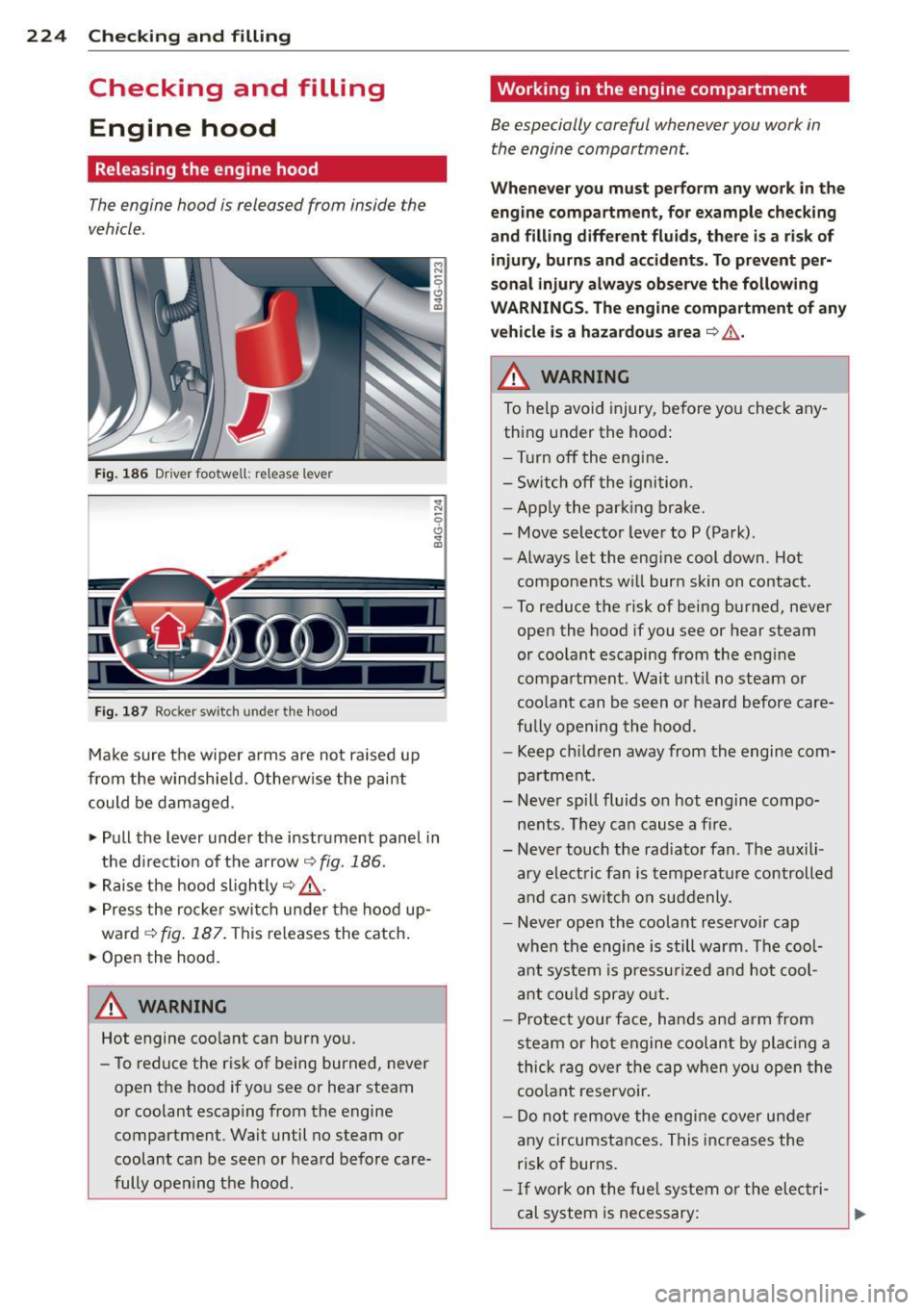
The engine hood is released from inside the
vehicle .
Fig. 186 Driver foo twell: release lever
Fig. 187 Rocker switch un der the hood
Make sure the wiper arms are not raised up
from the windshield. Otherwise the paint
could be damaged .
.,. Pull the lever under the instrument panel in
the direction of the arrow
¢ fig. 186.
.,. Raise the hood slightly¢,&. .
... Press the rocker switch under the hood up
ward
~ fig. 187. This releases the catch.
• Open the hood.
&_ WARNING
Hot engine coolant can burn you.
- To reduce the risk of being burned,
never
open the hood if you see or hear steam
or coolant escaping from the engine compartment . Wait until no steam or
coolant can be seen or heard before care
fully opening the hood .
'Working in the engine compartment
Be especially careful whenever you work in
the engine compartment.
Whenever you must perform any work in the
engine compartment, for example checking
and filling different fluids, there is a risk of injury, burns and accidents. To prevent per
sonal injury always observe the following
WARNINGS. The engine compartment of any
vehicle is a hazardous area
¢ ,&. .
A WARNING
To help avoid injury, before you check any
thing under the hood:
- Turn off the engine.
- Switch off the ignition .
- Apply the parking brake.
- Move selector lever to P (Park).
- Always let the engine cool down. Hot
components will burn skin on contact.
- To reduce the risk of being burned, never
open the hood if you see or hear steam
or coolant escaping from the engine
compartment. Wait until no steam or
coolant can be seen or heard before care
fully opening the hood.
- Keep children away from the engine com
partment.
- Never spill fluids on hot engine compo
nents . They can cause a fire .
- Never touch the radiator fan. The auxili
ary electric fan is temperature controlled
and can switch on suddenly .
- Never open the coolant reservoir cap
when the engine is still warm . The cool
ant system is pressurized and hot cool
ant could spray out.
- Protect your face, hands and arm from
steam or hot engine coolant by placing a
thick rag over the cap when you open the
coolant reservoir.
- Do not
remove the engine cover under
any circumstances. This increases the
risk of burns.
- If work on the fuel system or the electri
cal system is necessary:
Page 227 of 304
-Always disconnect the battery.
- Never smoke or work near heaters or open flames. Fluids in the engine com
partment could start a fire.
- Keep an approved fire extinguisher im
mediately available.
- To avoid electrical shock and personal in
jury while the engine is running or being
started, never touch :
- Ignition cables
- Other components of the high voltage
electronic ignition system.
- If you must perform a check or repair
with the engine running:
- First, fully apply the parking brake,
move selector lever to P (Park).
- Always use extreme caution to prevent
clothing, jewelry, or long hair from get
ting caught in the radiator fan, V-belts
or other moving parts, or from contact ing hot parts. Tie back hair before
starting, and do not wear clothing that
will hang or droop into the engine.
- Minimize exposure to emission and
chemical ha zards c:::> & .
A WARNING
California Proposition 65 Warning:
- Engine exhaust, some of its constituents,
and certain vehicle components contain
or emit chemicals known to the State of
California to cause cancer and birth de
fects and reproductive harm. In addition ,
certain fluids contained in vehicles and
certain products of component wear con
tain or emit chemicals known to the
State of California to cause cancer and
birth defects or other reproductive harm .
Checking and filling 225
-Battery posts, terminals and related ac
cessories contain lead and lead com
pounds, chemicals known to the State of
California to cause cancer and reproduc
tive harms. Wash hands after handling.
(D Note
When adding fluids, always make sure that
they are poured into the proper container
or filler opening, otherwise serious dam
age to vehicle systems will occur.
(® For the sake of the environment
To detect leaks in time, inspect the vehicle
floor pan from underneath regularly . If
you see spots from oil or other vehicle flu ids, have your vehicle inspected by an au
thorized Audi dealer.
Closing the engine hood
.,. Pull the hood down until the pressure from
the struts is reduced.
"'Let the hood
drop down and latch in place.
Do not try to push it shut; it may fail to en
gage
c:::> ,A .
A WARNING
-
A hood that is not completely latched
could fly up and block your view while driv
ing .
- When you close the engine hood, check it
to make sure the safety catch has proper ly engaged. The hood should be flush
with the surrounding vehicle body parts.
- If you notice while driving that the hood
is not secured properly , stop at once and
close it. •
•
Page 228 of 304
226 Checking and filling
Engine compartment
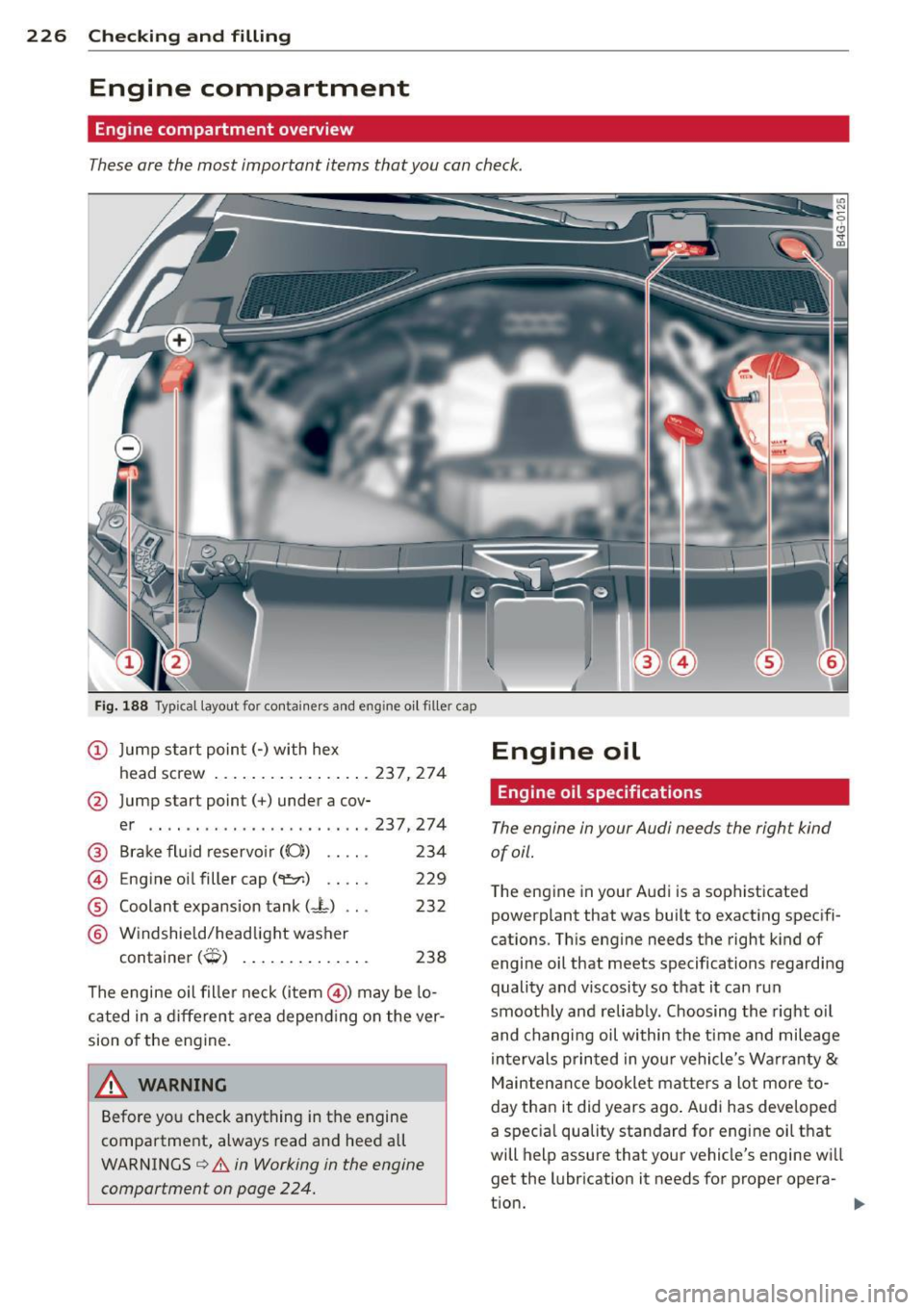
Engine compartment overview
These are the most important items that you can check .
Fig. 188 Typi cal layout for conta iner s and en gine o il filler cap
(D Jump start point(-) with hex
head screw .................
237,274
@ Jump start point(+) under a cov-
er .. .. .. .. ........ .. ..... .
237,274
®
©
®
®
Brake fluid reservoir ((0)) . . . . . 234
Engine oi l fille r cap (
Windshield/headlight washer
232
t . (.'R ) con ainer ,,.., ...... ....... . 238
The engine oil filler neck (item @) may be lo
cated in a different area depending on the ver
sion of the engine.
~ WARNING
Before yo u check anything in the engine
compartment, always read and heed all
WARNINGS
¢ &. in Working in the engine
compartment on page 224.
-
Engine oil
Engine oil specifications
The engine in your Audi needs the righ t kind
of oil.
The engin e in your Audi is a sophisticated
powerpl ant that was bu ilt to exacting spe cifi
cations . Thi s engine needs the righ t kind of
engine oil that meets specification s regarding
quality and v iscosity so that it can run
smoothly and reliably . Choosing the right oil
and changing oil within the tim e and mileage
intervals printed in you r vehicle's Warra nty
&
Maintenance booklet matters a lot more to
day than it did years ago . Audi has developed
a special quality standard for engine oil that
will h elp assur e that your vehicle's engine wi ll
get the lubr ication it need s for proper opera -
tion. ..,.
Page 234 of 304
232 Check ing and filling
Checking the engine coolant level
The engine coolant level can be checked with
a quick glance .
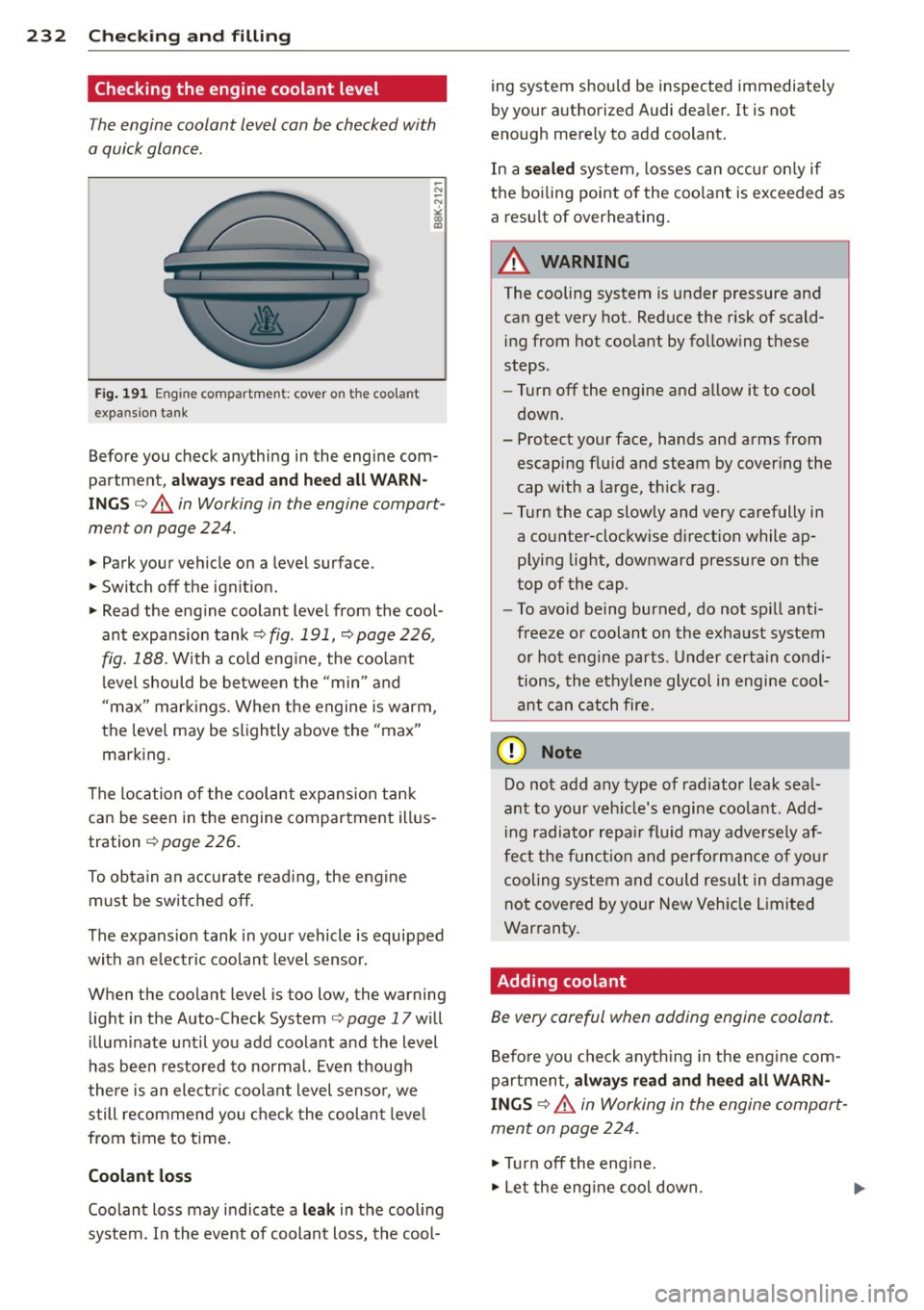
Fig . 191 Eng ine compartment: cover on the coolant
expa nsion tank
Before you check anything in the engine com
partment,
a lwa ys re ad and h eed a ll WA RN
INGS o .A in Working in the engine compart
ment on page 224 .
., Park your vehicle on a level surface.
., Switch
off the ignit io n.
., Read the eng ine coolant level from the cool
ant expans ion tank
o fig . 191, o page 226,
fig. 188. With a cold eng ine, the coolant
level should be between the "min" and
"max" markings. When the engine is warm,
the leve l may be slightly above the "max"
marking.
The location of the coolant exp ans ion tank
can be seen in the engine compartment illus
tration
o page 226.
To obtain an accurate read ing, the engine
must be switched
off.
The expans ion tank in your vehicle is equipped
with an e lectric coolant level sensor .
When the coolant level is too low, the warning
light in the Auto-Check System
o page 17 will
illum inate unt il you add coolant and the level
has been restored to normal. Even though
there is an electric coolant level senso r, we
still recommend you check the coolant leve l
from time to time.
Coolant loss
Coolant loss may indicate a leak in the cool ing
system. In the event of coolant loss, the cool- ing system shou
ld be inspected immediately
by your authorized Audi dea ler . It is not
enough mere ly to add coolant .
In a
sea le d system, losses can occur on ly if
the boiling point of the coo lant is exceeded as
a resu lt of overheating.
A WARNING
-The cooling system is under pressure and
can get very hot . Red uce the risk of scald
i ng from hot coolant by fo llow ing these
steps.
- Turn
off the engine and allow it to cool
down.
- Protect your face, hands and arms from
escaping flu id and steam by covering the
cap with a large, th ick rag .
- Turn the cap slowly and very carefully in
a counter-clockwise d irect ion while ap
plying light, downward pressure on the
top of the cap .
- To avo id being burned, do not sp ill anti
freeze or coolant on the exhaust system
or hot engine parts . Under certa in cond i
tions, the ethylene glycol in engine cool
ant can catch fire.
0 Note
Do not add any type of radiator leak seal
ant to your veh icle's engine coolant . Add
i ng radiator repa ir fluid may adverse ly af
fe ct the funct io n and performance of your
cooling system and could result in damage not covered by your New Vehicle Limited
Warranty.
Adding coolant
Be very careful when adding engine coolant .
Befo re you check anyth ing in the eng ine com
partment ,
alway s re ad and h eed all WARN
IN GS o .A in Working in the engine compart
ment on page 224.
., Tu rn
off the engi ne.
., Let the eng ine cool down.
Page 236 of 304
234 Checking and filling
continue to run until the coolant temper
ature drops.
Brake fluid
Checking brake fluid level
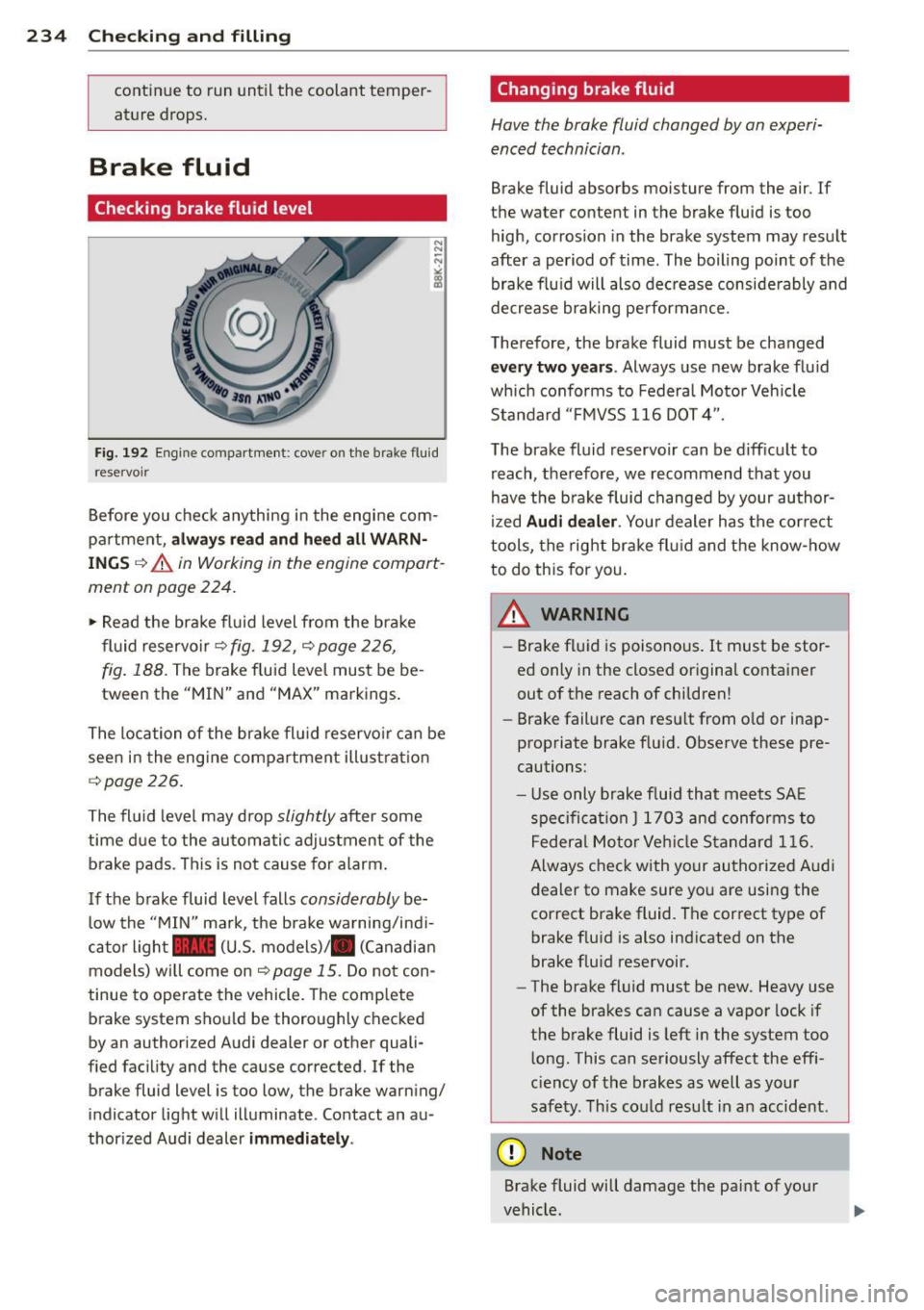
Fig. 192 Engine compartment : cove r on the brake fl uid
reservo ir
Before you check anything in the engine com
partment,
always read and heed all WARN
INGS ~ .&. in Working in the engine compart
ment on page 224.
.,. Read the brake fluid level from the brake
fluid reservoir~
fig. 192 , ~ page 226,
fig.
188. The brake fluid leve l must be be
tween the "MIN" and "MAX" markings .
The location of the brake flu id reservoir can be
seen in the engine compartment illustrat ion
~ page 226.
The fluid level may drop slightly after some
time due to the automatic adjustment of the
brake pads . Th is is not cause for alarm.
I f the brake fluid level falls
considerably be
lo w the "MIN" mark, the brake wa rning/indi
cator light
1111 (U.S. models)/ . (Canadian
models) will come on~
page 15. Do not con
tinue to operate the vehicle. The comp lete
brake system should be thoroughly checked
by an authorized Audi dealer or other quali
fied facility and the ca use corrected. If the
brake fluid level is too low, the brake warning/
indicator light w ill illuminate . Contact an au
thorized Audi dealer
immediately .
Changing brake fluid
Have the brake fluid changed by an experi
enced technician .
Brake fluid absorbs moisture from the air. If
the water content in the brake fluid is too
high, corrosion in the brake system may result
after a period of time . The boiling point of the
brake fluid will also decrease considerably and
decrease braking pe rformance .
Therefore, the brake fluid must be changed
every two years. Always use new brake flu id
which conforms to Federal Motor Vehicle
Standard "FM VSS 116 DOT 4".
The brake fluid reservoir can be diff icult to
reach, therefore, we recommend that you
have the brake fluid changed by your author
ized
Audi dealer . Your dealer has the correct
tools, the right brake fluid and the know-how
to do this for you.
A WARNING
- Brake fluid is poisonous . It must be stor
ed only in the closed original container
out of the reach of children!
- Brake failure can resu lt from o ld or inap
propriate brake fluid. Observe these pre
cautions:
- Use only brake fluid that meets SA E
specification
J 1703 and conforms to
Federal Motor Vehicle Standard 116.
Always check with your authorized Audi
dealer to make sure you are using the
correct brake fluid. The correct type of
brake flui d is also ind icated on the
brake fluid reservoir.
- The brake fluid must be new. Heavy use
of the brakes can cause a vapor lock if
the brake fluid is left in the system too
long. This can seriously affect the effi
c ie ncy of the brakes as well as your
safety. This could result in an accident.
(D Note
Brake fluid will damage the paint of your
vehicle .
Page 237 of 304
@ For the sake of the environment
Because of the pr oblem of proper d isposa l
of brake flu id as we ll as the special tools
requ ired and the necessary expert ise, we
recommend that you have the brake fluid
changed by your author ized Audi dealer .
Battery
General information
Under normal operating conditions, the bat
tery in your Audi does not need any mainte
nance. With
high outside temperatures or
long daily dr ives we recommend that you have
the electro lyte level checked by a service fa
cility . The electrolyte level shou ld also be
checked each time the battery is charged
¢ page 237.
Have the battery checked when you take your
ve hicle in for service . Yo u are well adv ised to
replace a battery that is older than 5 yea rs .
W ith certa in types of a irbag deployment, t he
b attery is d isconnected from the vehicle elec
tr ica l system for safety reasons¢.&.
in Re
pair, core and disposal of the airbags on
page 163.
Disconnecting the battery terminals
Some vehicle functions (power w indow regu
lators , for example) are lost if the battery ter
m inals a re d isconnected. These func tions have
to be re lea rned after the batte ry term inals a re
connected agai n. T o prevent this , the bat tery
should only be d isconnec ted from the vehicle
e lec tric al system when absolu tely necessa ry
for repairs .
Vehicles not driven for long periods
If you do not drive you r vehicle over a period
of severa l days or weeks, ele ctrical compo
nen ts are gr adually cut b ack o r swi tched off .
This redu ces energy cons umption and main
tains starting capab ility over a longer per io d
¢
page 199. Some of the co nvenience func
tions may not operate, s uch as the inte rior
lights or power seat adjustme nt. The conven-
Checkin g and fillin g 235
ience funct ions w ill be available again when
yo u sw itch on the ign ition an d start the en
gine.
Winter operation
D ur ing the w inte r mon ths, bat tery ca pa city
tends to decrease as tempera tures drop . This
is beca use more power is a lso consumed wh ile
starting, and the headlights, rear window de
fogger, etc., are used mo re often.
Avoid unnecess ary powe r consumpt ion, pa r
ticu lar ly in city traffic o r when traveling only
sho rt distances. Let yo ur authorized A udi
dealer check the capacity of the vehicle bat
tery before w inter sets in¢
page 23 7. A well
charged battery will no t on ly prevent star tin g
problems w hen the weather is cold, but w ill
also last longer .
@ Tips
If your vehicle is left standing for seve ral
weeks at extremely low temperatures, the
vehicle battery s hou ld be removed and
stored where it will not freez e. This will
p reve nt it from be ing dam aged and having
to be repl aced .
Working on the battery
Be especially careful when working on or near
the bat tery.
The battery is located in the luggage compar t
ment under the floor . B efo re you che ck any
thi ng in the luggage compartment,
read and
heed all WARNINGS
¢ .&, .
Always heed the safety warnings , when work
i ng on the veh icle batte ry or t he vehicle e lec
t rical sys tem to p reven t inju ry.
The following WARNINGS are very
important when working on the battery:
Always heed the following WARNING SYM· BO LS and safety precautions when working
on the battery .
®
Always wear eye protection.
•
•
Page 241 of 304
The washer fluid container is marked with the
symbol~ on its cap
¢fig . 194, ¢page 226,
fig. 188 .
.,. Before you check anyth ing in the engine
compartment,
always read and h eed all
WARNINGS ¢ A in Working in the engine
compartment on page 224 .
.,. Lift the filler cap tongue to add washer flu
id. You can fill the container to the top .
.,. Press the cap back onto the filler neck after
fill ing the container .
You can f ind the reservoir
capa city in the table
in
¢ page 281.
C lean water sho uld be used when filling up. If
possible, use soft water to prevent sca ling on
washer jets. Always add a glass cleaner solu
tion (with frost protection in the winter).
CJ) Note
Do not mix engine coolant antifreeze or
any other add itives to fill up the wind
shie ld washer reservoir.
Checkin g and fillin g 239
•
•