coolant AUDI A6 2014 User Guide
[x] Cancel search | Manufacturer: AUDI, Model Year: 2014, Model line: A6, Model: AUDI A6 2014Pages: 304, PDF Size: 76.32 MB
Page 234 of 304
232 Check ing and filling
Checking the engine coolant level
The engine coolant level can be checked with
a quick glance .
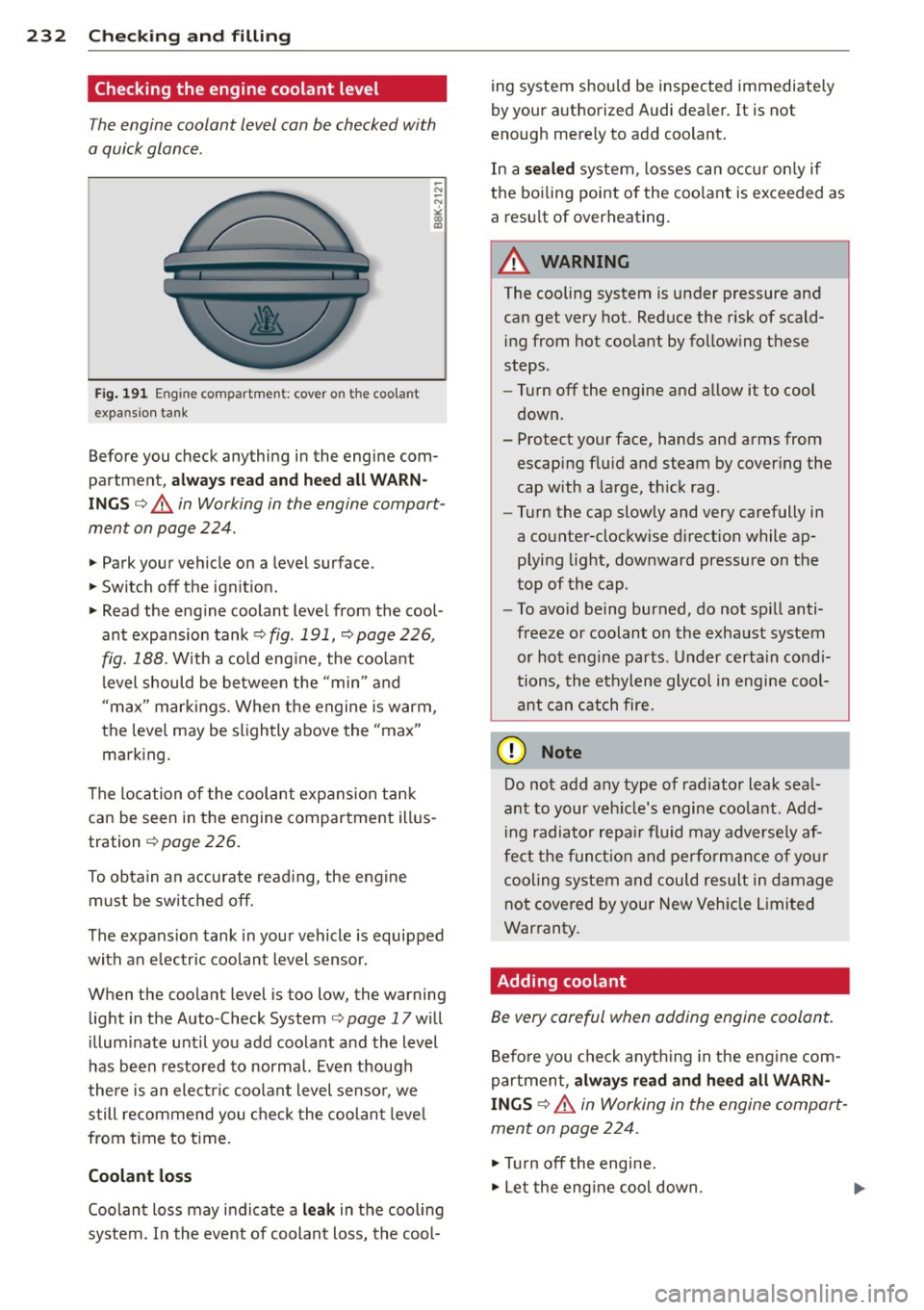
Fig . 191 Eng ine compartment: cover on the coolant
expa nsion tank
Before you check anything in the engine com
partment,
a lwa ys re ad and h eed a ll WA RN
INGS o .A in Working in the engine compart
ment on page 224 .
., Park your vehicle on a level surface.
., Switch
off the ignit io n.
., Read the eng ine coolant level from the cool
ant expans ion tank
o fig . 191, o page 226,
fig. 188. With a cold eng ine, the coolant
level should be between the "min" and
"max" markings. When the engine is warm,
the leve l may be slightly above the "max"
marking.
The location of the coolant exp ans ion tank
can be seen in the engine compartment illus
tration
o page 226.
To obtain an accurate read ing, the engine
must be switched
off.
The expans ion tank in your vehicle is equipped
with an e lectric coolant level sensor .
When the coolant level is too low, the warning
light in the Auto-Check System
o page 17 will
illum inate unt il you add coolant and the level
has been restored to normal. Even though
there is an electric coolant level senso r, we
still recommend you check the coolant leve l
from time to time.
Coolant loss
Coolant loss may indicate a leak in the cool ing
system. In the event of coolant loss, the cool- ing system shou
ld be inspected immediately
by your authorized Audi dea ler . It is not
enough mere ly to add coolant .
In a
sea le d system, losses can occur on ly if
the boiling point of the coo lant is exceeded as
a resu lt of overheating.
A WARNING
-The cooling system is under pressure and
can get very hot . Red uce the risk of scald
i ng from hot coolant by fo llow ing these
steps.
- Turn
off the engine and allow it to cool
down.
- Protect your face, hands and arms from
escaping flu id and steam by covering the
cap with a large, th ick rag .
- Turn the cap slowly and very carefully in
a counter-clockwise d irect ion while ap
plying light, downward pressure on the
top of the cap .
- To avo id being burned, do not sp ill anti
freeze or coolant on the exhaust system
or hot engine parts . Under certa in cond i
tions, the ethylene glycol in engine cool
ant can catch fire.
0 Note
Do not add any type of radiator leak seal
ant to your veh icle's engine coolant . Add
i ng radiator repa ir fluid may adverse ly af
fe ct the funct io n and performance of your
cooling system and could result in damage not covered by your New Vehicle Limited
Warranty.
Adding coolant
Be very careful when adding engine coolant .
Befo re you check anyth ing in the eng ine com
partment ,
alway s re ad and h eed all WARN
IN GS o .A in Working in the engine compart
ment on page 224.
., Tu rn
off the engi ne.
., Let the eng ine cool down.
Page 235 of 304
~ Place a thick rag over the coolant expansion
tank ¢
page 232, fig . 191 and ca refull y
twist the cap counter-clockwise ¢ ,A.
~ Add coolant mixed in the correct ratio
¢page 231, Coolant.
~ Twist the cap on again tightly .
Replacement engine coolant must conform to
exact specifications ¢
page 231, Coolant .
We recommend using on ly coolant addi-
tive
Gl2++, Gl3 or in an emergency G l2+ . Do
not use a different add itive. In an emergency
use plain water unti l you can get the correct
addit ive and ca n restore the correct ratio. This
should be done as soon as possible .
If you have lost a considerable amount of
coolant, then you should add co ld a ntifree ze
and cold water only when the eng ine is co ld.
A lways use
new engine coolant when ref illing.
D o no t fill coolan t above the "M AX " mar k. Ex
cess coolan t will be forced ou t th rough the
p ress ure re li ef va lve i n the cap when the en
gin e becomes hot .
&_ WARNING
- The coo ling system is under press ure and
can get very hot. Reduce the risk of
sca ld ing from hot coolant by f ollowing
these steps .
-Tu rn off the engine and allow i tto cool
down.
- P rote ct your f ace, han ds an d ar ms from
escaping f lu id and ste am by cover ing
the cap with a large, thick rag.
- Tu rn the ca p slowly and very ca re fully
in a counte r-clockwise direct ion wh ile
ap plying light, downwa rd p ress ure on
the top of the cap.
- To avo id being burned, do not sp ill an
tifreeze or coolant on the exhaust sys
tem or hot engine parts . Under certa in
conditions, the ethylene glyco l in en
g ine coolant can catc h fire.
- Antifreeze is poisonous. Always store an
t ifreeze in its or iginal conta iner and well
o ut of the reac h of c hildren .
Checkin g and fillin g 233
-If you dra in the coo lant, it m ust be
caught and safely stored in a pr oper con
tainer clearly marked "poison".
([) Note
-Coo lant poll utes the environment a nd
co uld cause an engine fi re . Excess cool -
ant will be forced out th ro ugh the pres
sure relief valve in the cap when the en
gine becomes hot .
- If, in an eme rgency, on ly wate r can be
added, the co rrect ratio between water
and antifreeze ¢
page 231 must be re
s tored as soon as poss ible.
@) For the sake of the environment
Drained coola nt sho uld not be reused. A l
ways d ispose of used coolant while observ
i ng all env iro nmental regula tions .
Radiator fan
The radiator fan switches on automatically by
itself .
An auxiliary electric radiator fan switches on
and off depending on coolant temperature
and othe r vehicle ope rat ing cond it io ns.
After you switch the engine off, the aux iliary
fan can continue running for up to 10 m inutes
- even w ith the ignition off . It can even switch
o n aga in later by itself¢.& , if
- the temperature of the engine coo lant r ises
due to the heat build- up from the engine in
the engi ne compa rtment, or
- the engine compa rtment heats up because
the vehicle is parked in intense sunlig ht.
&_ WARNING
- To reduce the risk of perso nal in jury nev
er touch the rad iator fan .
- The a uxiliary electric fan is temperat ure
controlled a nd can switch on suddenly
e ven when the engine is not ru nning.
- The a uxiliary radiator fa n sw itches on a u
tomatically wh en the engine coo lant
reaches a certa in tem pera tu re and w ill ..,
•
•
Page 236 of 304
234 Checking and filling
continue to run until the coolant temper
ature drops.
Brake fluid
Checking brake fluid level
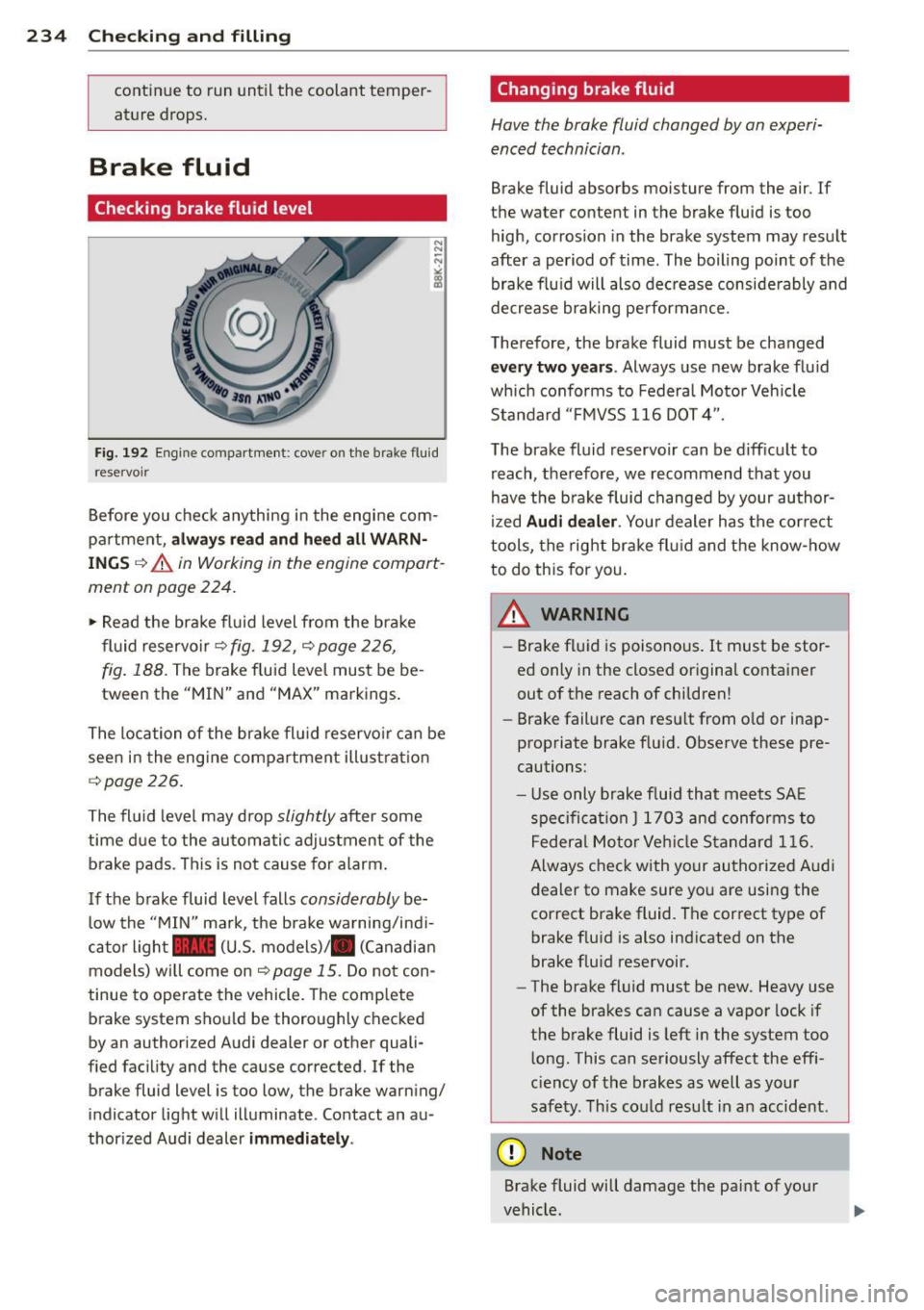
Fig. 192 Engine compartment : cove r on the brake fl uid
reservo ir
Before you check anything in the engine com
partment,
always read and heed all WARN
INGS ~ .&. in Working in the engine compart
ment on page 224.
.,. Read the brake fluid level from the brake
fluid reservoir~
fig. 192 , ~ page 226,
fig.
188. The brake fluid leve l must be be
tween the "MIN" and "MAX" markings .
The location of the brake flu id reservoir can be
seen in the engine compartment illustrat ion
~ page 226.
The fluid level may drop slightly after some
time due to the automatic adjustment of the
brake pads . Th is is not cause for alarm.
I f the brake fluid level falls
considerably be
lo w the "MIN" mark, the brake wa rning/indi
cator light
1111 (U.S. models)/ . (Canadian
models) will come on~
page 15. Do not con
tinue to operate the vehicle. The comp lete
brake system should be thoroughly checked
by an authorized Audi dealer or other quali
fied facility and the ca use corrected. If the
brake fluid level is too low, the brake warning/
indicator light w ill illuminate . Contact an au
thorized Audi dealer
immediately .
Changing brake fluid
Have the brake fluid changed by an experi
enced technician .
Brake fluid absorbs moisture from the air. If
the water content in the brake fluid is too
high, corrosion in the brake system may result
after a period of time . The boiling point of the
brake fluid will also decrease considerably and
decrease braking pe rformance .
Therefore, the brake fluid must be changed
every two years. Always use new brake flu id
which conforms to Federal Motor Vehicle
Standard "FM VSS 116 DOT 4".
The brake fluid reservoir can be diff icult to
reach, therefore, we recommend that you
have the brake fluid changed by your author
ized
Audi dealer . Your dealer has the correct
tools, the right brake fluid and the know-how
to do this for you.
A WARNING
- Brake fluid is poisonous . It must be stor
ed only in the closed original container
out of the reach of children!
- Brake failure can resu lt from o ld or inap
propriate brake fluid. Observe these pre
cautions:
- Use only brake fluid that meets SA E
specification
J 1703 and conforms to
Federal Motor Vehicle Standard 116.
Always check with your authorized Audi
dealer to make sure you are using the
correct brake fluid. The correct type of
brake flui d is also ind icated on the
brake fluid reservoir.
- The brake fluid must be new. Heavy use
of the brakes can cause a vapor lock if
the brake fluid is left in the system too
long. This can seriously affect the effi
c ie ncy of the brakes as well as your
safety. This could result in an accident.
(D Note
Brake fluid will damage the paint of your
vehicle .
Page 241 of 304
The washer fluid container is marked with the
symbol~ on its cap
¢fig . 194, ¢page 226,
fig. 188 .
.,. Before you check anyth ing in the engine
compartment,
always read and h eed all
WARNINGS ¢ A in Working in the engine
compartment on page 224 .
.,. Lift the filler cap tongue to add washer flu
id. You can fill the container to the top .
.,. Press the cap back onto the filler neck after
fill ing the container .
You can f ind the reservoir
capa city in the table
in
¢ page 281.
C lean water sho uld be used when filling up. If
possible, use soft water to prevent sca ling on
washer jets. Always add a glass cleaner solu
tion (with frost protection in the winter).
CJ) Note
Do not mix engine coolant antifreeze or
any other add itives to fill up the wind
shie ld washer reservoir.
Checkin g and fillin g 239
•
•
Page 243 of 304
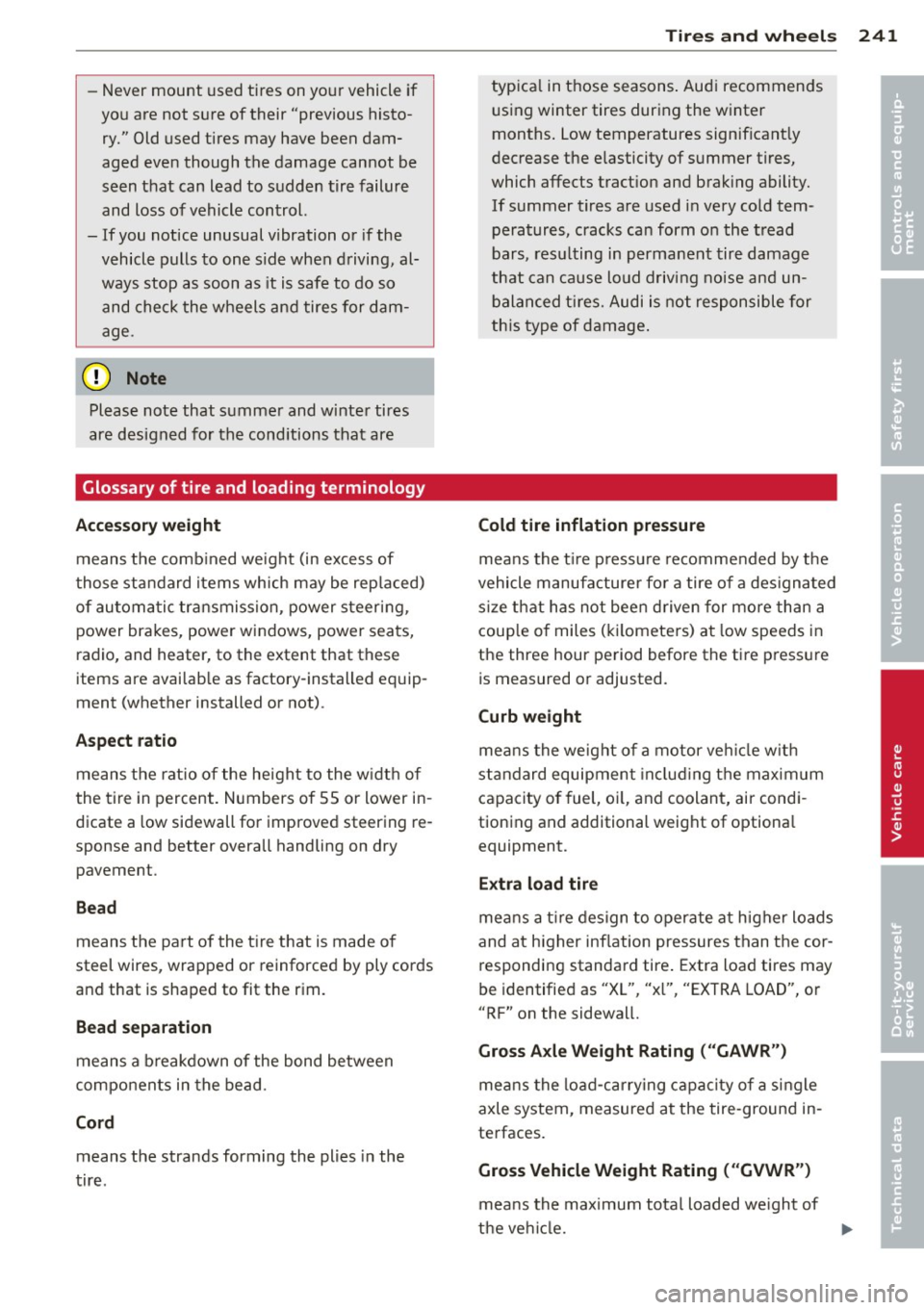
-Never mount used tires on yo ur vehicle if
yo u are not sure of their "previous histo
ry." Old used tires may have been dam
aged even though the damage cannot be
seen that can lead to sudden tire failure
and loss of vehicle control.
- If you notice unusual vibration or if the
vehicle pulls to one side when d riving, al
ways stop as soon as it is safe to do so
and check the wheels and tires for dam
age .
(D Note
Please note that summe r and wi nte r tires
are designed for the cond itions that are
Glossary of tire and loading terminology
Accessory weight means the comb ined weight (in excess of
those sta ndard items which may be rep laced)
of au toma tic transmission, power steer ing ,
power brakes, power windows, power seats,
radio, and heater, to the extent that these
items are availab le as factory-installed equip
ment (whether installed or not) .
Aspect ratio
means the rat io o f the height to the w idth of
the tire in percent . Numbers of 55 or lower in
dicate a low sidewall for improved steering re
sponse and better overa ll handling on dry
pavement .
Bead
means the part of the t ire t hat is made o f
steel wires, wrapped or reinforced by ply cords
and that is shaped to fit the r im.
Bead separation
means a b reakdown of the bond between
components in the bead .
Cord means the strands forming the plies in the
tire.
Tire s an d wheel s 241
typica l in those seasons . Aud i recommends
using winter tires during the winter
months . Low temperatures signif icant ly
dec rease the e lasticity of summer t ires,
which affects tract ion and brak ing ability.
If summer t ires are used i n very co ld tem
peratures, cracks ca n form o n the tread
bars , res ulting in perma nen t tire damage
that can cause loud driving noise and un
bala nced ti re s. Audi i s not respon sible for
th is type of damage .
Cold tire inflation pressure
means the t ire p ress ure recommended by t he
vehicle manufacture r fo r a tire o f a des ignated
s ize t hat has not bee n driven for more than a
coup le o f miles (k ilometers) at low speeds in
the three hour period before the tire press ure
is m easured or adjusted.
Curb weight
me ans the we ight of a motor ve hicle with
st andard equipmen t incl ud ing the max imum
capacity of fuel, oi l, and coolant, air condi
tioning and additional weig ht of optiona l
equipment.
Extra load tire
means a t ire design to oper ate a t higher load s
and at higher inflation pressures than the cor
responding standa rd tire . Extra load tires may
be identified as "XL", "x l", "EXTRA LOAD", o r
"RF" on the sidewal l.
Gross Axle Weight Rating ("GAWR")
me ans the load-ca rry ing capac ity of a single
axle system , measured at the tire -ground in
te rfaces.
Gross Vehicle Weight Rating ( "GVWR ")
mea ns the maximum total loaded we ight of
the ve hicl e. .,..
•
•
Page 250 of 304
248 Tire s and whee ls
- Only when all tires on the vehicle are fi l
led to the correct pressure, the tire pres
sure monitoring* system can work cor rectly.
- The use of incorrect tire pressure values
can lead to accidents or other damage.
Therefore it is essential that the driver observe the specified tire pressure values
for the tires and the correct pressures for
the funct ion of the tire pressure mon itor
ing system*.
- Always inflate t ires to the recommended
and correct tire pressure before driving
off.
- Driv ing with under inflated ti res bend
more, letting them get too hot resu lting
in tread separation, sudden ti re fail ure
and loss of control.
- Excess ive speed and/overloading can
cause heat bui ld -up, sudden ti re fail ure
and loss of control.
- If the tire press ure is too low or too high,
the tires wi ll wear prematurely and the
vehicle will not hand le we ll.
- If the tire is not flat and you do not have
to change a wheel immediate ly, drive at
reduced speed to the nearest service sta
t ion to check the tire pressure and add
air as required.
Driving without va lve stem caps can cause
damage to the tire va lves. To prevent this,
always make sure that factory installed
valve stem caps on all wheels are securely mounted on the valve.
@) For the sake of the environment
Underinf lated tires will a lso increase the
fuel consumption.
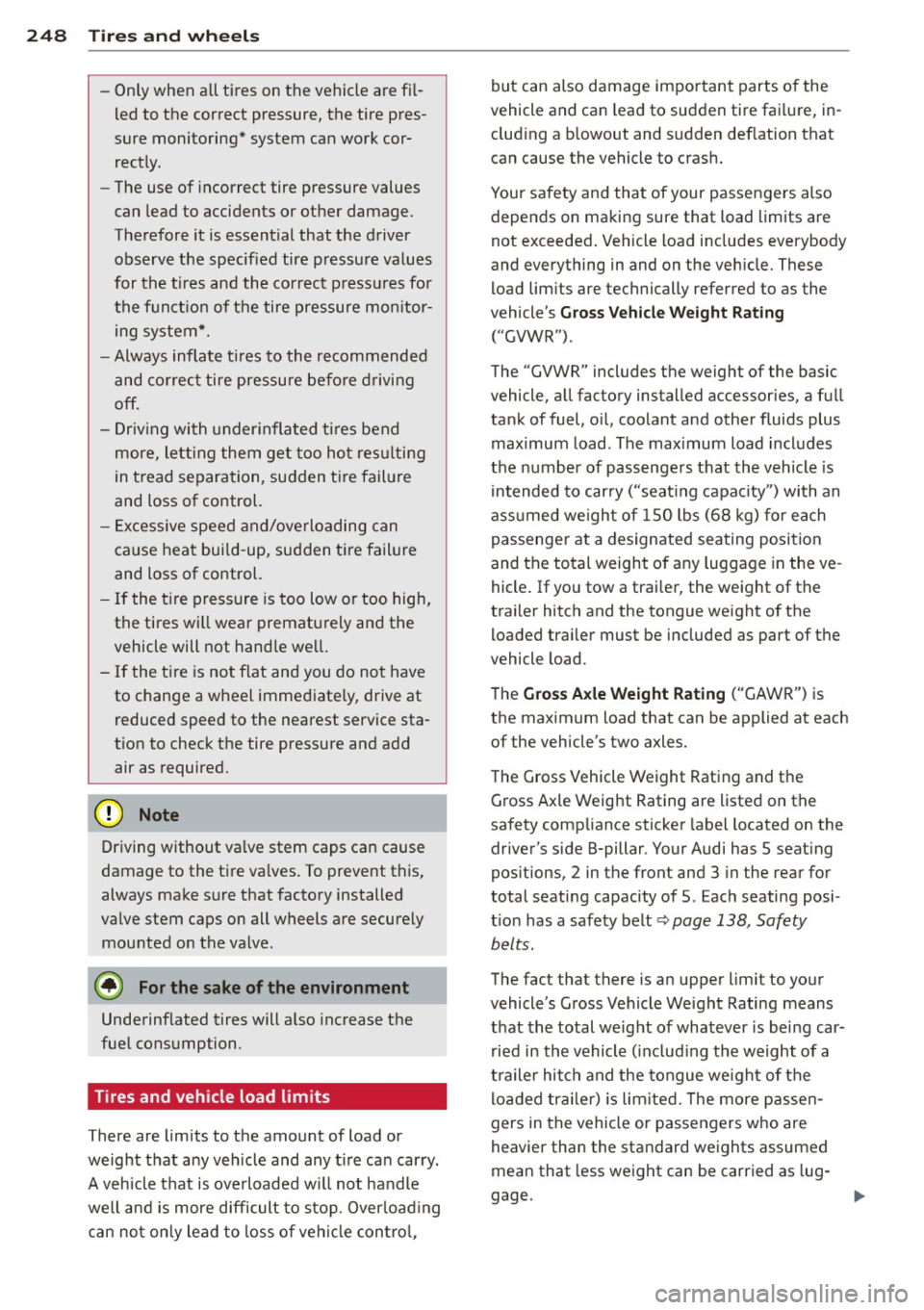
Tires and vehicle load limits
There are limits to the amount of load or weight that any veh icle and any t ire ca n carry.
A veh icle that is overloaded w ill not handle
well and is more difficult to stop. Over load ing
can not on ly lead to loss of veh icle contro l, but can also damage important parts of the
vehicle and can lead to sudden tire fai lure, in
clud ing a b lowout and sudden deflation that
can cause the vehicle to crash.
Your safety and that of your passengers also depends on making sure that load limits are
not exceeded. Vehicle load includes everybody
and everything in and on the veh icle. These
load lim its are technically referred to as the
vehicle's
G ro ss Vehicl e We ight R ating
("GVWR").
The "GVWR" includes the weight of the basic
vehicle, all factory installed accessories, a full
tank of fuel, o il, coolant and other fluids plus
maximum load. The max imum load includes
the number of passengers that the vehicle is
intended to car ry ("seat ing capac ity") with an
ass umed we ight of 150 lbs (68 kg) for each
passenge r at a designated seating position
and the total weight of any luggage in the ve
hicle . If you tow a trai ler, the weight of the
trailer hitch and the tongue weight of the
loaded tra iler must be included as part of the
vehicle load.
The
G ro ss Axle We ight R ating ("GAWR") is
the maximum load that can be applied at each of the vehicle's two axles.
The Gross Vehicle Weight Rating and the Gross Axle Weight Rating are listed on the
safety comp liance sticker label located on the
driver's side B-pillar . Your Audi has 5 seat ing
pos itions, 2 in the front and 3 in the rear for
total seating capacity of 5 . Each seating posi
t ion has a safety belt
Q page 138, Safety
belts.
The fact that there is an upper limit to your
vehicle's Gross Vehicle Weight Rating means
that the total weight of whatever is being car
ried in the vehicle ( includ ing the weight of a
t ra ile r hi tch and the tongue weigh t of the
loaded tra iler) is lim ited. The more passen
gers in the vehicle or passengers who are
heavier than the standard weights assumed
mean that less weight can be carried as lug-
gage.
~
Page 287 of 304
-Always make sure the transm ission se
lector lever (automatic transmiss ion) is
in P (Park position) and the park brake is
applied.
@) For the sake of the environment
- Changing the eng ine settings w ill ad
versely affect em ission levels. This is det
rimental to the environment and increas
es fuel consumption .
- Always observe env ironmental regula
tions when d isposing of old engine oil,
used brake fluid, dirty engine coolant,
spent batter ies or worn out t ires.
- Undeployed airbag modules and preten
s ioners might be classified as Perchlo
rate Material -specia l hand ling may ap
ply, see www.dts c.ca .gov/hazardous
waste/perch lorate. When the veh icle or
parts of the restraint system includ ing
airbag modules safety belts wit h preten
sioners are scrapped, all applicable laws
and regulations must be observed. Your
a uthorized Audi dea ler is familiar w ith
these requirements and we recommend
that you have your dea ler perform this
serv ice for you .
Additional accessories,
modifications and
parts replacement
Additional accessories and parts
replacement
Always consult an authorized Audi dealer be
fore purchasing accessories.
Your veh icle incorporates the latest safety de
sig n featu res ensu ring a high standard of ac
tive and passive safety.
This safety could be compromised by non-ap proved changes to the veh icle. For this reason,
if parts have to be replaced, please observe
the following points when install ing addition
a l accessories:
Con sumer In formation 285
Approved Audi accesso ries and genuine Audi
parts are available from authorized Audi deal
ers.
T hese dea lers a lso have the necessary facili
ties, tools and trained specialists to install the
parts and accessories proper ly.
A WARNING
Using the wrong spare parts or using non
approved accessories can cause damage to
the vehicle and serious persona l injury.
- Use on ly accessories express ly approved
by Audi and genu ine Audi spare parts
- These parts and accessories have been
specially designed to be used on your ve
hicle .
- Never install accessories such as tele
phone cradles or beverage holders on air
bag covers or within the airbag deploy
ment zones . Do ing so will increase the
risk of injury if a irbags are triggered in an
accident!
- Before you check anything in the engine
compa rtment, always read and heed all
WARNINGS ~
page 224.
(D Note
-If items other than genuine Audi spare
parts, add-on equipment and accessory
items are used or if repair work is not
performed accord ing to spe cified meth
ods, this can result in severe damage to
yo ur vehicle's engine and body (such as
corrosion) and adversely affect your vehi
cle's warranty .
- If emergency repairs must be performed
elsewhere, have the vehicle examined by
an authorized Audi dealer as soon as
possible.
- The manufacturer cannot be held liable
for damage wh ich occurs due to failure
to comply with these stipulations.
•
•
Page 290 of 304
288 Index
A
Accessories ....... ......... ... .... . 285
Active lane ass ist . . . . . . . . . . . . . . . . . . . . 93
Activating and deactivating . . . . . . . . . . . 94
C leaning the camera area .. .. .. .. .. . 211
Description .............. .. .. .... .. 93
I nstrument cluster indicator light . . . . . 94
Messages . . . . . . . . . . . . . . . . . . . . . . . . . 94
Notes on instrument cluster display . . . . 94
Setting the steering wheel vibration . . . . 95
AC (automatic climate control) . .. .. .. .. 70
AC (climate control) . . . . . . . . . . . . . . . . . . 68
Adaptive air suspension/sport . ... .. .. . 100
Adapt ive cruise control . . . . . . . . . . . . . . . . 84
C leaning the senso r ....... .. .. .... . 211
Messages . . . . . . . . . . . . . . . . . . . . . . . . . 91
Request for driver intervention . . . . . . . . 89
Stop-and-go traffic . . . . . . . . . . . . . . . . . 88
Adapt ive Light (defective) ... .. .. .... .. 23
AdBlue .. .. .. .. . .......... .. .. .... . 220
Filling . .. .. ............... .. .... . 222
Messages in the instrument cluster dis-
play ... .. .. ... .... ...... .. .. .. .. . 22 1
Adding Engine coolant ........... .. .. .. .. . 232
Engine oil ................. .. .... . 229
Windshield washer fluid . ...... .. .. . 238
Additives Engine oil ............... .. .. .... . 229
Adjusting Air distribution (automatic climate con-
trol) . . . . . . . . . . . . . . . . . . . . . . . . . . . . . . 71
air distribution (climate control) ... .. .. 68
Front seats . . . . . . . . . . . . . . . . . . . . . . . . 52
Instrument illumination ..... .. .... .. 46
Steering column electrically .. .. .... .. 73
Steering column manually ... .. .. .. . . 73
Temperature (automat ic climate control) 71
Temperature (climate control) .... .. .. 68
Airbag system . . . . . . . . . . . . . . . . . 147, 168
Advanced Airbag System ... .. .. .... . 151
Advanced Airbag System components . 155
Care ..... .. ................ ... ... 163
Children ... ... .... ...... .. .. .. .. . 175
Ch ild restraints ........... .. .. .. .. . 175
Components (front airbags) .. .. .. .. . 155 Danger of fitting a chi
ld seat on the front
passenger seat ... ................ . 149
Disposa l .. .. .. .. ................ . 163
Front airbags . . . . . . . . . . . . . . . . 151, 153
How do the front airbags work? .. .... 157
How many airbags does my vehicle
have? ...... .. .. .. ...... ....... .. 155
How the Advanced Airbag System com-
ponents work together ......... .. .. 157
Important safety instructions on the
knee airbag system ................ 166
Important things to know ....... .. .. 147
Knee airbags ..... ................ . 164
Monitoring .... .. ............. .... 159
PASSENGER AIR BAG OFF light ... .... 160
Repairs ... .... .. ............. .... 163
Safety instructions ................. 162
S ide airbags ... .. ....... ...... .. .. 167
S ide curtain airbags ... ...... ... .. .. 170
Warning/ind icator lights ........ .. .. . 19
Warning/Indicator lights ....... .. .. 159
When must the system be inspected? 159
Aircraft Transporting your vehicle
Alcantara 278
Cleaning .. .... .. ............. .... 213
All-wheel drive .... ................ . 198
Winter tires ..... ................ . 255
Alternator . . . . . . . . . . . . . . . . . . . . . . . . . . 17
Ambience lighting .............. .... . 46
Anti-freeze
refer to Engine coolant ............ . 231
Anti-lock braking system ............. 194
Warning/indicator lights . . . . . . . . . 19, 20
Anti-slip regulation ............. .. .. 194
Warning/indicator lights ..... ... .. .. . 19
Anti-theft systems Electronic immobilizer ............... 33
Ashtray .... .... ................... . 58
Audi braking guard
refer to brak ing guard ............. .. 84
Audi drive select
refer to drive select ............ .... 100
Audi Serv ice Repair Manuals and Litera-
tu re .............................. 283
Page 292 of 304
29 0 Index
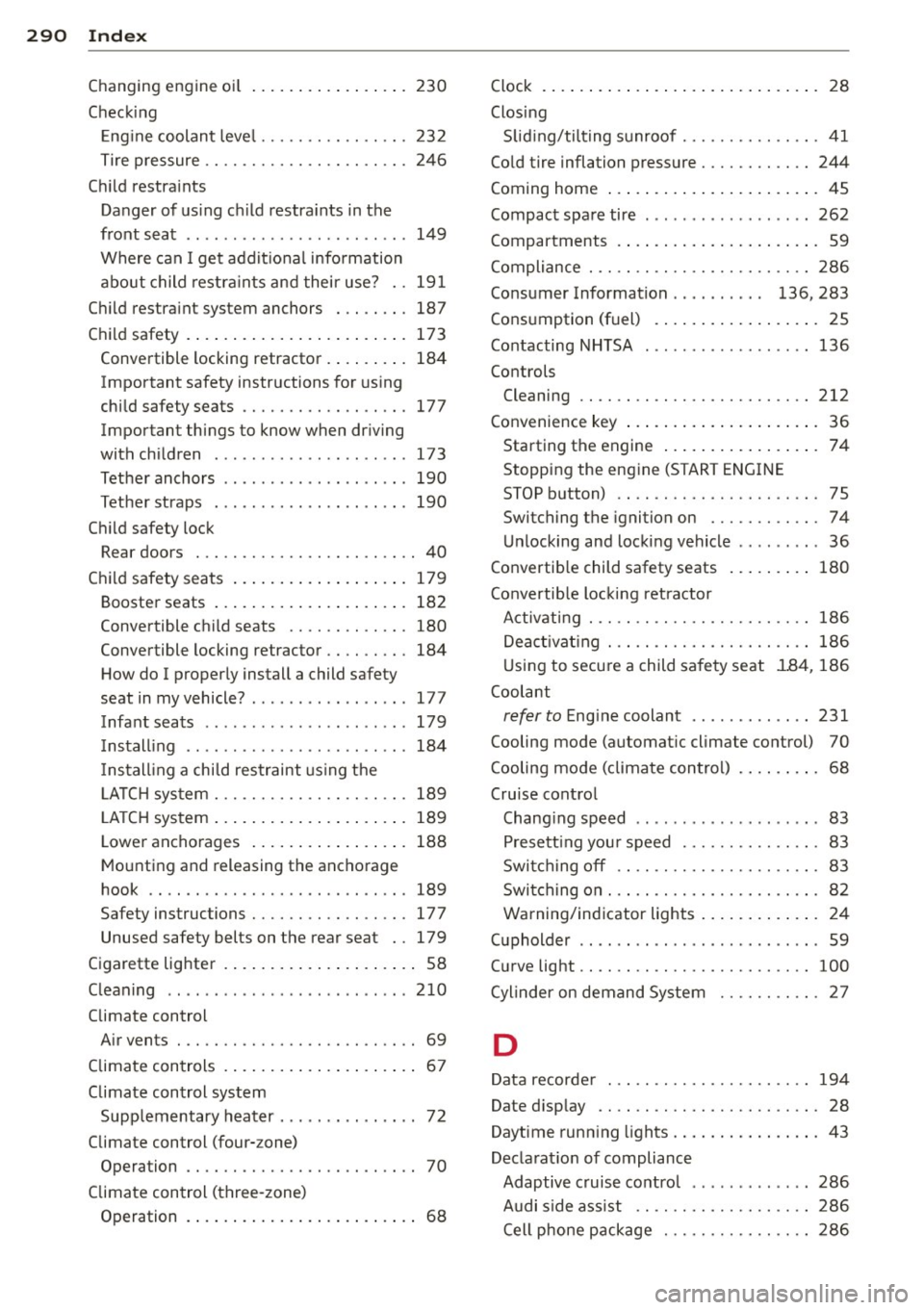
Changing engine oil
Check ing 230
E ng ine coolan t leve l ....... .... .... . 23 2
T ire pre ssure .......... .... ... .. .. . 24 6
C hi ld restra ints
Danger of us ing child restra ints in the
front s eat . . . . . . . . . . . . . . . . . . . . . . . . 149
Where can I get add it ional information
about child restra ints and thei r use? . . 19 1
Ch ild restra int system anchors ... .. .. . 187
C hild safety .. ... .. ..... ... .. .. .... . 173
Convertible locking retractor .... .. ... 184
Important safety instructions for using
child safety seats . . . . . . . . . . . . . . . . . . 17 7
Important things to know when dr iving
with chi ldren ............. ... .. ... 173
Tether anchors ................ .... 190
Tether straps ..................... 190
C hi ld safety lock
Rear doors ... ........... .... .... .. 40
C hild safety seats ....... ... .. .. .... . 179
Booster seats .. .. ..... ... .. .. .... . 182
Convertible child seats . . . . . . . . . . . . . 180
Convertible locking retractor . . . . . . . . . 184
H ow do I properly install a child safety
seat in my vehicle? ............. .... 177
Infant seats . . . . . . . . . . . . . . . . . . . . . . 179
I nstall ing .. ................ ... ... 184
I nstall ing a chi ld res traint using the
L A T C H sys tem ............ .. .. .... . 189
L A T CH sys tem .. .. ..... ... .. .. .... . 189
Lower ancho rages ..... ... .. .. .... . 188
M ounting and releasing the anchorage
hook .. .. .. ............. .. .. .. ... 189
Safety instructions . . . . . . . . . . . . . . . . . 177
Unused safety belts on the rear seat . . 179
Cigarette lig hte r . . . . . . . . . . . . . . . . . . . . . 58
C lean ing .......................... 210
Climate control
A ir vents ..... ........... .. .. .... .. 69
Climate controls . . . . . . . . . . . . . . . . . . . . . 67
Climate control system Supp lementary heater . . . . . . . . . . . . . . . 72
Climate control (four-zone)
Opera tion . . . . . . . . . . . . . . . . . . . . . . . . . 70
Climate control (three -zone)
Operation . . . . . . . . . . . . . . . . . . . . . . . . . 68 Clock .
. . . . . . . . . . . . . . . . . . . . . . . . . . . . . 28
Closing Slid ing/tilting s unroof .......... .... . 41
Co ld tire inflation pressure ........ .... 244
Coming home ..... .. ... ..... ... .. .. . 45
Compact spa re tire ................. . 262
Compartments . . . . . . . . . . . . . . . . . . . . . . 59
Compliance . .. .. .. ............. .. .. 286
Consumer Information . . . . . . . . . . 136, 283
Consumption (fuel) . .. .. ..... ... .. .. . 25
Contacting NHTSA ................. . 136
Controls Cleaning ...... .. ............. .... 212
Convenience key ... .. ... ..... ... .. .. . 36
Starting the engine .. .. ..... ... .. .. . 74
Stopping the engine (START ENGINE
STOP b utton) ...................... 75
Switching the ignition on ............ 74
Unlocking and locking vehicle .. ..... .. 36
Co nvertib le child safety seats ... .. .. .. 180
Co nvertib le locking retractor
A ctivat ing . .. .. .. .. ... ........ .. .. 186
Deact ivat ing ..... ............. .... 186
U sing to secure a child sa fety seat 1B4, 18 6
Coolant
r e fer to E ng ine coolant .......... ... 231
Cooling mode (automat ic climate control) 70
Cooling mode (cl imate control) . . . . . . . . . 68
Cruise cont ro l
Changi ng speed .. ................ .. 83
Presett ing you r speed .......... .. .. . 83
Swi tching off .. .. ............. .. ... 83
Swi tch ing on ..... ............... .. . 82
Warning/indicator lights ..... ... .. .. . 24
( u pholder .......................... 59
C u rve light ......................... 100
Cylinder on demand System ........... 27
D
Data recorde r . . . . . . . . . . . . . . . . . . . . . . 194
Date d isp lay .... .. ... .......... .... . 28
Daytime runn ing lights . ... .... ... .. .. . 43
Declarat io n of compliance
Adaptive c ruise control ............. 286
Audi s ide ass ist .. ... .......... .... 286
Cell phone pack age . . . . . . . . . . . . . . . . 28 6
Page 293 of 304
-----------------------------~I~n~d~e~x 291
Convenience key ................... 286
Electronic immobilizer ........ ... .. . 286
Homelink universal remote control ... 286
Remote control key . . . . . . . . . . . . . . . . 286
Decorative parts/trim
C leaning ... ................ ... ...
212
DEF
What does this mean when it appears in
the trip odometer display? . .. .. .. .. .. 27
Defective light bulb warning . . . . . . . . . . . 23
Defrosting (windows)
automatic climate control ... ... .. .. ..
71
climate control . . . . . . . . . . . . . . . . . . . . . 69
Determining correct load limit ... .. .. . 249
Diesel fuel . . . . . . . . . . . . . . . . . . . . . . . . .
216
Diesel particulate filter . . . . . . . . . . 22, 202
D. . 1mens1ons .. ............. .... .. ... 281
Dimming the rearview mirror .. .. .. .. .. 51
Displays
Cleaning ... ................ ... ...
212
Distance . . . . . . . . . . . . . . . . . . . . . . . . . . . 25
Door/rear lid warning . . . . . . . . . . . . . . . . .
24
Doors
Power child safety lock ....... ... .. ..
40
Driver information system
CD/radio display . . . . . . . . . . . . . . . . . . . . 24
Door/rear lid warning . . . . . . . . . . . . . . . 24
Efficiency program . . . . . . . . . . . . . . . . . .
26
Exterior temperature display ... .. .. .. 24
On-board computer . . . . . . . . . . . . . . . . . 25
Driver seating position ...... .. .. .. .. .
drive select
. . ............. .... .. ...
adaptive air suspension/sport . .. .. .. .
Adaptive dampers ........... .... . .
Curve light .... .. .. ...... .. .. .. .. .
Engine sound ............... ... .. .
Safety belt tensioner ...... .. .. .. .. .
Sport differential ......... .. .. .. .. .
Driving safely
Driving through water
129
100
100
100
100
100
100
100
128
203
Driving time
Duplicate key ·
· · · · · · · ...... .... .. .... 25
32
Dust filter
refer to Pollutant filter ....... ... .. .. 67
E
Easy entry feature .... ................ 74
Efficiency program . . . . . . . . . . . . . . . . . . .
26
Fuel economy messages . ....... .... . 27
Other equipment . .. . .......... .....
26
Electrical accessories (sockets) ......... 59
Electro-mechanical powe r assist .......
198
Electromechanical parking brake
Emergency braking ............ .. .. . 79
Operation . . . . . . . . . . . . . . . . . . . . . . . . . 77
Parking ....... .. ................. . 78
Releasing and closing ............... 77
Starting assist . . . . . . . . . . . . . . . . . . . . . 78
Starting from rest . . . . . . . . . . . . . . . . . . 78
Starting off with a trailer . . . . . . . . . . . . . 78
Warning/indicator lights ........ .... .
16
Electronic differential lock
Warning/indicator lights .............
19
Electronic differential lock (EDL) ..... .. 194
Warning/indicator lights ............ . 20
Electronic immobilizer . . . . . . . . . . . . 27, 33
Electronic power control (EPC)
warning/indicator light ............ ..
21
Electronic speed limiter . . . . . . . . . . . . . . . 31
Elec tronic Stabilization Control (ESC) . .. 194
Warning/indicator lights .... .... .... . 19
Emergency actuation
Doors ..... ... .... ................ 38
Power sunroof . .. ................. .
42
Emergency braking .............. .... . 79
Emergency flasher . ..... ....... .... .. 44
Warning/indicator lights . .......... ..
24
Emergency release
Selector lever . . . . . . . . . . . . . . . . . . . . .
113
Emergency starting
Emergency towing
Emergency unlocking 274
276
Rear lid ... .. .. .. .. ............... . 39
Emergency warning triangle ........ . .
Energy management .. .... .. .... ... .
Engine Compartment .. .. .... ........... . .
Coolant
..... .. .. .. . ..............
Data ....... .. ...... .............
261
199
226
231
282
Start-Stop -System . . . . . . . . . . . . . . . . . . 79
starting ......... .. ................ 74
•
•