fold AUDI A6 2014 Owners Manual
[x] Cancel search | Manufacturer: AUDI, Model Year: 2014, Model line: A6, Model: AUDI A6 2014Pages: 304, PDF Size: 76.32 MB
Page 37 of 304
-Applies to vehicles with power side door
closer*:
- When closing a door, make sure noth ing can interfere w ith the door. This
could cause ser ious personal inj ury.
- You can stop the door from clos ing at
any time by pulling on the inside or
outside doo r handle.
(D Tips
- In the event of a crash with airbag de
ployment a ll locked doors will be auto
ma tically unlocked to g ive access to the
vehicle occupants from the outside .
- If the power locking system should ma l
f unct ion, you can lo ck the dr iver's door
us ing the mechanical key¢
page 38.
-If the power lo cking system should fail,
you can still open the fuel tank flap in a n
emergency ¢
page 220.
- You are we ll advised not to keep valua
bles inside an unattended vehicle, visib le
or not. Even a properly locked vehicle
cannot provide the security of a safe.
- If the L ED in the upper edge o f the driv
er's door panel comes on for abo ut 30
seconds after the vehicle is locked, there
is a ma lfunction in the power locking or
the anti-theft warning system. Have the
malfunction corrected by an author ized
Audi dealersh ip or qua lified repair fac il i
ty.
Setting power locking
The driver can determine the functions for
power locking in the MMI.
• Select : I CARI function button > (C ar)* sy s
tems
control button > Vehicle se tti ngs >
Central lock ing .
Unlock door s -You can decide if All doors or
only the
Driv er should unlock . The rear lid al
so unlocks when
All is selected . If you select
Driv er in a vehicle with a convenience key*,
only the door whose handle you pull will un l ock.
Op enin g an d clos ing 35
If you select Driver , all the doors and rear lid
will unlock if you press the
ffi button on the re
mote control master key twice.
Loc k exterior trunk handl e -If yo u se lect On ,
the rear lid handle is locked . In this case the
rear lid can be opened with the b utton
cs on
the master key or with the
cs button in the
driver's door. In veh icles with a convenience
key*, you can still open the rear lid using the
handle if an authorized master key is near the
proxim ity sensor.
Fold m irrors * -If you select On, the exterior
rearview mirrors fold in automatically when
you press the
ff! button on the remote control
master key or touch the sensor* in the ha ndle.
To ne when lock ing -When you select On, a
confirmation tone sounds when you lock the
vehicle .
locking and unlocking the vehicle with
the remote control
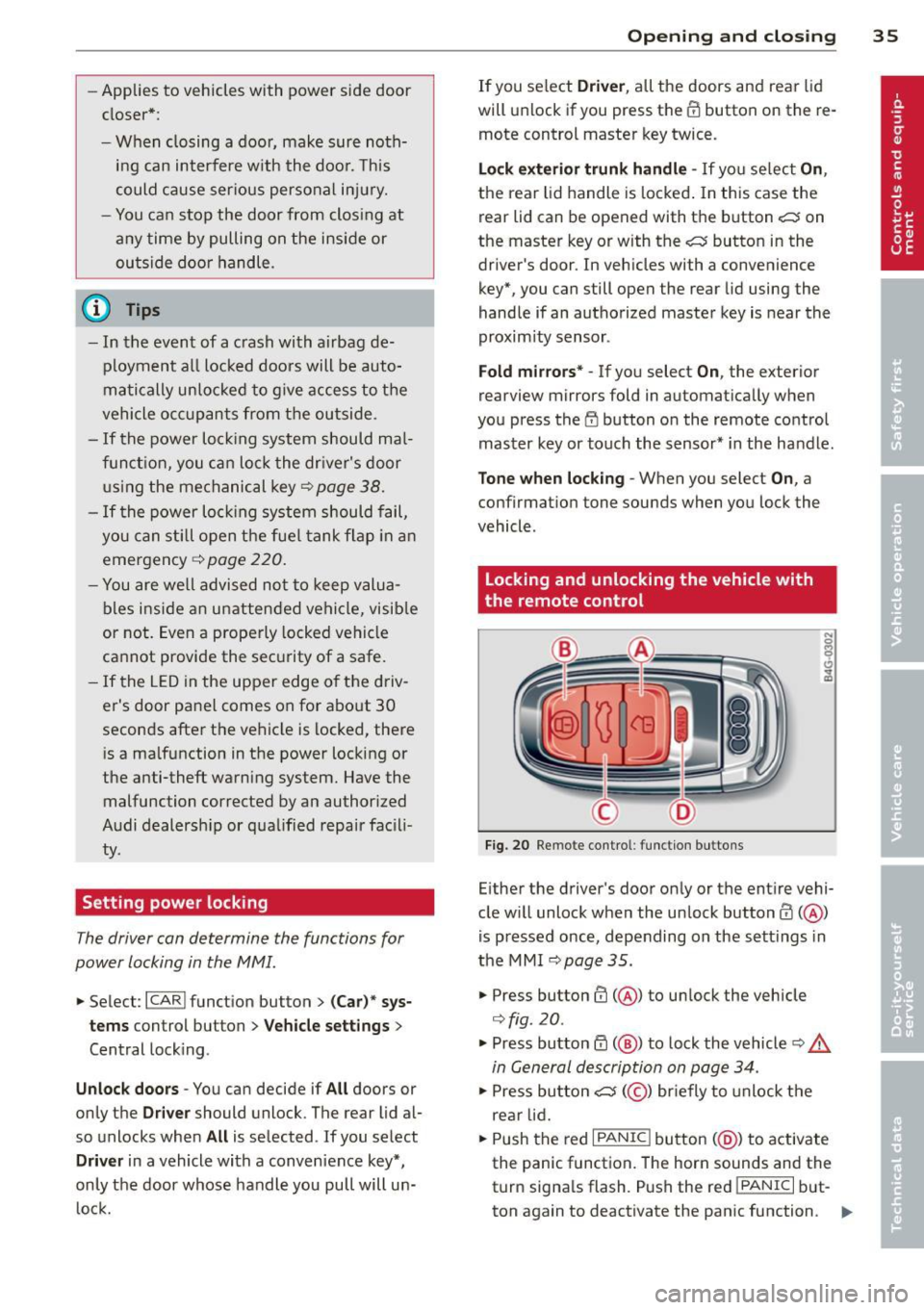
Fig. 20 Remote cont rol : function buttons
Either the driver's door only or the entire vehi
cle w ill unlock when the unlock button
ffi ( @ )
is pressed once, depending on the sett ings in
the MMI
¢page 35.
• Press button ffi (@ ) to unlock the vehicle
¢fig . 20 .
• Press button ff! (@ ) to lock the vehicle ¢ &.
in General description on page 34.
• Press button cs( @) briefly to unlock the
rear lid.
• Push the red
I PANIC ! button (@ ) to activate
the panic function. The horn sounds and the
turn signa ls flash . P ush the red
!PANIC I but
ton again to deactivate the panic function. ..,.
Page 51 of 304

rain sensor function. Check your
windshield wiper b lades regularly.
- The washer fluid nozzles of the wind
sh ield washer system are heated at low
temperatures when the ignit ion is on .
- When stopping temporarily, e .g . at a
traffic light , the set speed of the wind
shield wipers is automatically red uced by
one speed.
Cleaning windshield wiper blades
Clean the wind shield wiper bl ades when they
begin to leafe streaks .
~ Place the windshield wiper arms in the serv
ice position . Re fer to
q page 49 .
~ Use a soft clo th and gl ass cleaner to clean
the windsh ield w iper blades .
A WARNING
Dirty windshie ld w iper blades can impa ir
your view. This can lead to a cc idents.
Replacing windshield wiper blades
F ig. 44 Removing wi nds hield w ipe r blades
-
-
-
~
I
Wiper se rvice po sition /blade replac ement
po sit ion
~ Switch the ign ition off and move the w ind
shield wiper lever to posit ion ©
q page 48,
fig. 43 . The windshield wipers move into the
serv ice position .
~ To bring the wipe rs back into the orig inal
pos ition, switch the ignition on and press
the windshie ld wiper lever .
You ca n also turn the service pos it ion on o r off
in the
MM I:
Clear v is ion 49
~ Switch the windshie ld wipers off (position
@ ¢page 48, fig. 43) .
~ Select: !CAR ! function button > (Car)* s ys
tems
cont rol button > Se rvicing & checks >
Wiper ser vice position > On .
Remo ving the wiper blade
~ Lift the windshield wiper arm up from the
windshie ld.
~ Press the locking knob@ q fig. 44 on the
wiper blade. Hold the wiper blade firmly.
~ Remove the wiper bl ade in the direction of
the arrow .
Attaching the w iper blade
~ Insta ll the new wiper blade in the retainer
on the wiper arm @unti l you hear it click in
to place on the w iper a rm .
~ Place the wiper arm back on the windshield.
~ Turn the service position off .
A WARNING
-
For your safety, you should rep lace the
wiper b lades once o r twice a yea r. See your
a uthorized Audi de aler fo r repla cement
b lades .
(D Note
- The windshie ld w iper blades must on ly
be folded away when i n the service posi
t ion! Otherwise, yo u ris k damaging the
paint on the hood o r the windshie ld wip
er motor.
- Yo u should not move your vehicle or
press the windsh ield wiper lever when
the wiper arms are folded away from the
windshield. The windshield wipers wou ld
move back into their original position
and could damage the hood and wind
shield.
- To help prevent damage to the w iper sys
tem, always loosen blades wh ich are fro
zen to the windshield before operating
w ipers .
- To help prevent damage to wiper blades,
do not use gasoline, kerosene, paint
thinne r, or other solvents on o r near the
w iper blades.
Page 52 of 304
50 Clear vis ion
- To he lp prevent damage to the wiper
arms or other components, do not at
tempt to move the wipers by hand .
@ Tips
-Commercial hot waxes applied by auto
matic car washes affect the cleanability
of the windshield .
- You can a lso use the service position, for
example, if you want to protect the
windshield from icing by using a cover .
- You cannot activate the service position
when the hood is open.
Mirrors
Adjusting the exterior mirrors
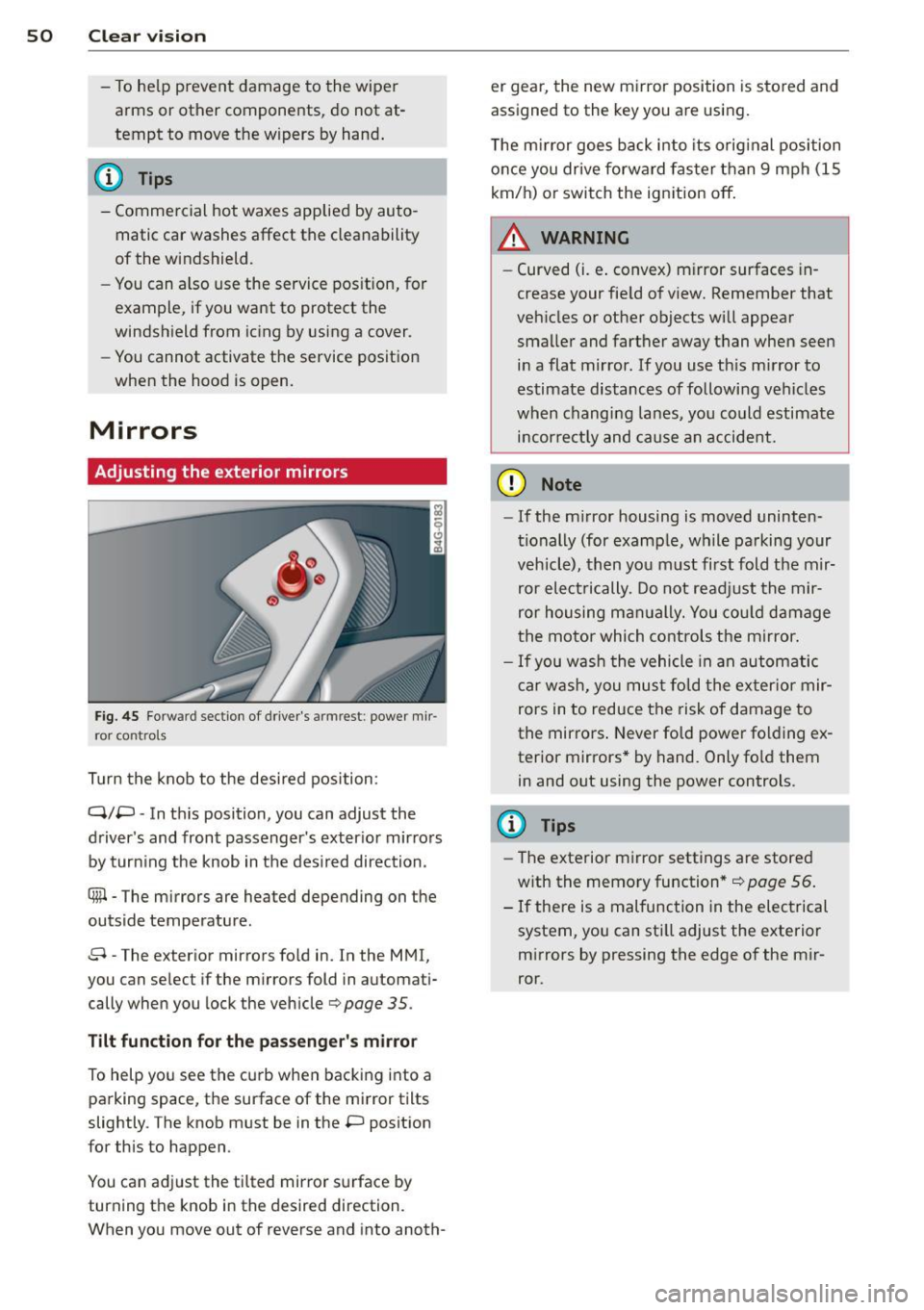
Fig. 45 Fo rwa rd section of driver's a rmrest: powe r mir
ror controls
Turn the knob to the desired position :
Q/P -In t his position, you can adjust the
driver's and front passenger's exter ior mirrors
by turning the knob in the des ired direction.
Ciiil-The mirrors are heated depending on the
outside temperature.
8 -The exterior mirrors fo ld in. In the MMI,
you can select if the mirrors fold in automati cally when you lock the vehicle
c> page 35 .
Tilt function for the passenger's mirror
To help you see the curb when backing into a
parking space, the surface of the mirror tilts
slightly . The knob must be in the P position
for this to happen .
You can adjust the tilted mirror surface by turning the knob in the desired direction .
When you move out of reverse and into anoth- er gear,
the new mirror position is sto red and
assigned to the key you are using.
T he m irror goes back into its orig inal position
once you drive forward fas ter than 9 mph (15
km/h) or switch the ignition off.
A WARNING
-Curved (i.e . convex) m irror surfaces in
crease your fie ld of view. Remember that
vehicles or other objects will appear smaller and farther away t han when seen
in a flat mirror . If you use th is m irror to
estimate distances of following vehicles
when changing lanes, you could estimate
incor rectly and cause an accident.
(D Note
-
-If the m irror housing is moved uninten
tionally (for examp le, while parking your
vehicle), then you must first fold the mir ror electrically. Do not readjust the mir
ror housing manually. You could damage
the motor which controls the mirror.
-If you wash the vehicle in an automatic
car was h, you must fold the exter ior mir
rors in to reduce the risk of damage to
the mir rors . Never fold power folding ex
terior mirrors * by hand. Only fo ld them
in and out using the power controls.
@ Tips
- The exterior mirror settings are stored
w ith the memory function* ¢page
56.
-If there is a malfunction in the electrical
system, you can sti ll adjust the exterior
mirrors by pressing the edge of the mir
ror.
Page 57 of 304
Armrest
There is a storage compartment under the
armrest .
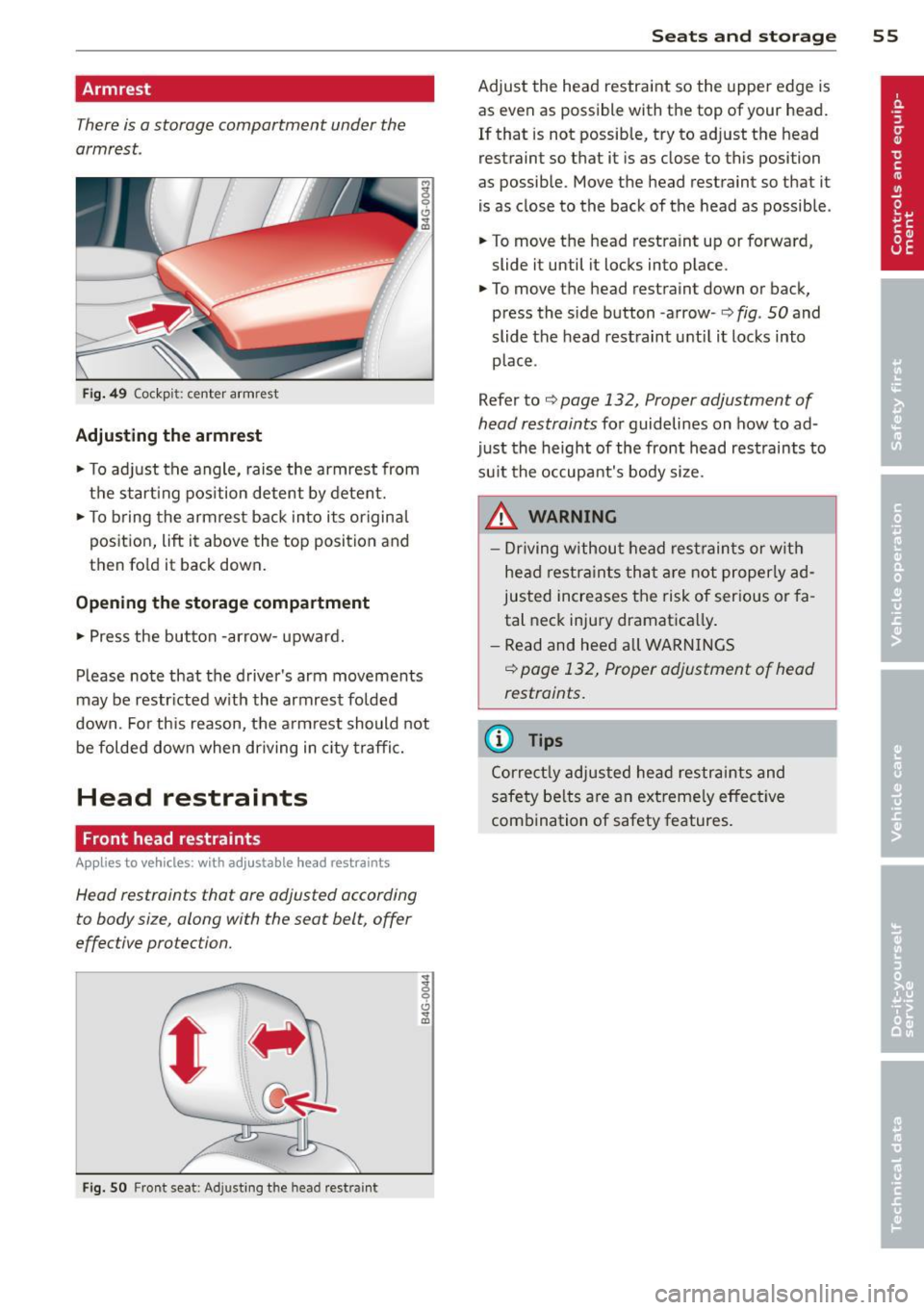
Fig. 49 Cockp it : center armrest
Adjusting the armrest
.. To adjust the angle, raise the armrest from
the starting position detent by detent.
.. To b ring the armrest back into its origina l
position, lift it above the top position and
then fold it back down.
Opening the storage compartment
.. Press the button -arrow- upward.
Please note that the driver's arm movements
may be restr icted w ith the armrest folded
down. For this reason, the armrest should not
be folded down when driving in city traffic.
Head restraints
Front head restraints
Applies to vehicles: with adjustable head restraints
Head restraints that ore adjusted according
to body size, along with th e seat belt, offer
effective protection.
F ig. 50 Front seat: Ad justing t he head restraint
Seats and storage 55
Adjust the head restraint so the upper edge is
as even as possible with the top of your head.
If that is not possible, try to adjust the head
restraint so that it is as close to this position
as possible. Move the head restraint so that it
is as close to the back of the head as possible .
.. To move the head restraint up or forward,
slide it until it locks into p lace .
.. To move the head restraint down or back,
press the side button -arrow -
c:> fig. SO and
slide the head restraint until it locks into
place .
Refer to
c:> page 132, Proper adjustment of
head restraints
for guidelines on how to ad
just the height of the front head restraints to
su it the occupant's body size.
.&_ WARNING
- Driving without head restraints or with
head restraints that are not properly ad
justed increases the risk of serious or fa
tal neck injury dramatica lly .
- Read and heed all WARNINGS
i=> page 132, Proper adjustment of head
restraints.
(D Tips
Correctly adjusted head restraints and
safety be lts are an extreme ly effective
combination of safety features.
-
Page 66 of 304
64 Seats and storage
Enlarging cargo capacity of the vehicle
interior
The seat backs can be folded forward to en
large the cargo capacity .
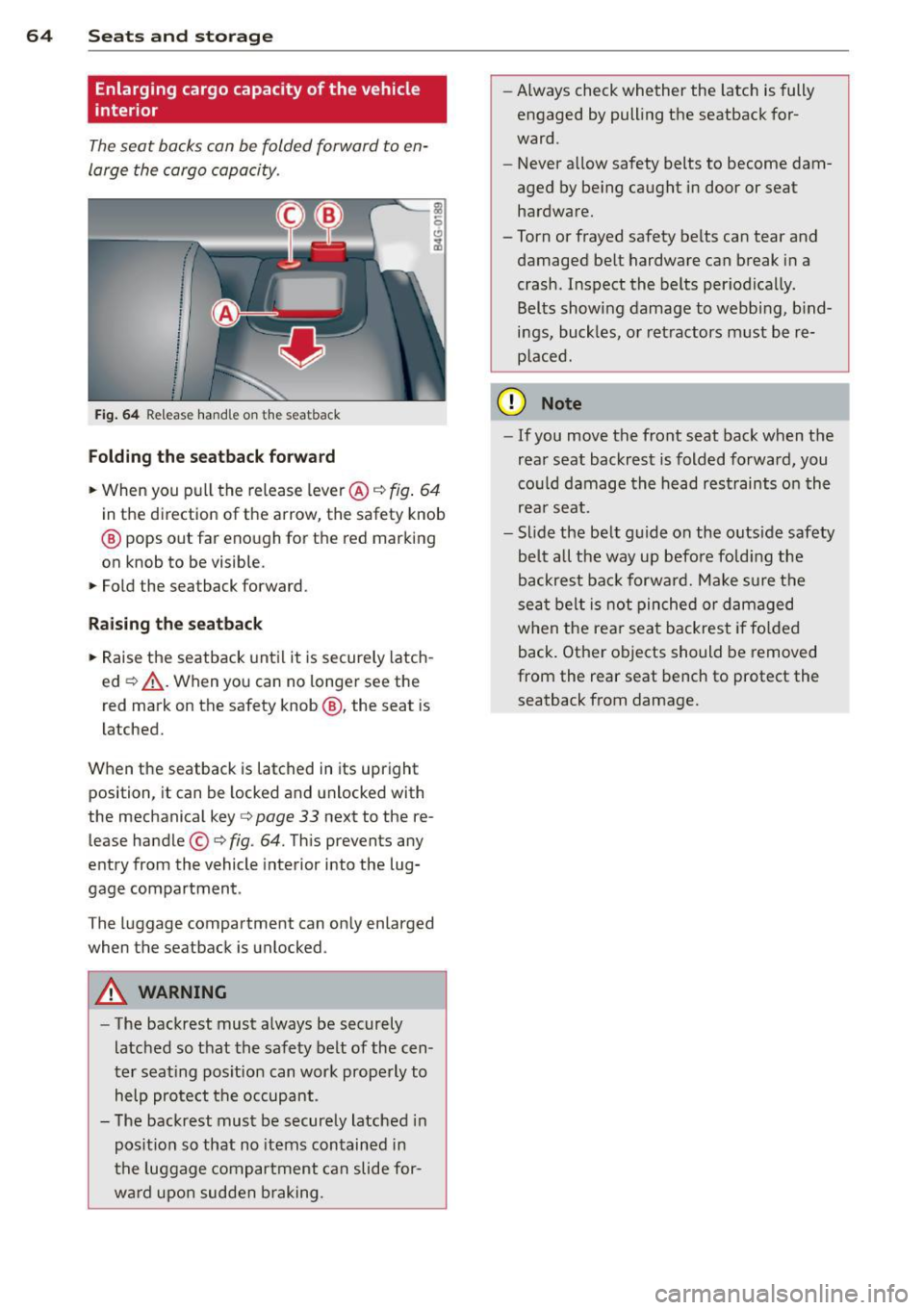
Fig . 6 4 Re lease hand le on the seatback
Folding th e seatback forward
.. When you p ull the release lever @c:::> fig. 64
in the d irection o f the arrow, the safety knob
@ pops out far enough for the red marking
on knob to be visible.
.. Fold the seatback forward.
Rai sing th e seatback
.. Raise the seatback until it is securely latch
ed
c:::> &_ . When you can no longer see the
red mark on the safety knob @, the seat is
l atched.
When the seatback is latched in its upright position, it can be locked and unlocked with
the mechanical key
c:::> page 33 next to the re
lease handle ©
c:::>fig. 64. This prevents any
entry from the vehicle interior into the lug
gage compartment .
The luggage compartment can only enlarged when the seatback is unlocked .
A WARNING
-
-The backrest must a lways be securely
latched so that the safety belt of the cen
ter seating pos ition can work properly to
help protect the occupant .
- The backrest must be securely latched in
posit ion so that no items contained in
the luggage compar tment can slide for
wa rd upo n sudden b raking . -
Always check whether the latch is fully
engaged by pull ing the seatback for
ward.
- Never allow safety belts to become dam
aged by be ing caught in door or seat
hardware.
-Torn or frayed safety be lts can tear and
damaged be lt hardware can break in a
crash . Inspect the belts periodica lly.
Belts show ing damage to webb ing, b ind
ings, buckles, o r retractors must be re
p laced.
(D Note
- If you move the front seat back when the
rear seat backrest is folded forward, you
cou ld damage the head r estraints on th e
rea r seat.
- Slide the be lt guide on the outside safety
be lt a ll the way up befo re fold ing the
backrest bac k forward. Make sure the
se at belt is not pinched or damaged
when the rear seat backrest if fo lded
back. Other objects should be removed
from the rear seat bench to protect the
seatback from damage.
Page 67 of 304
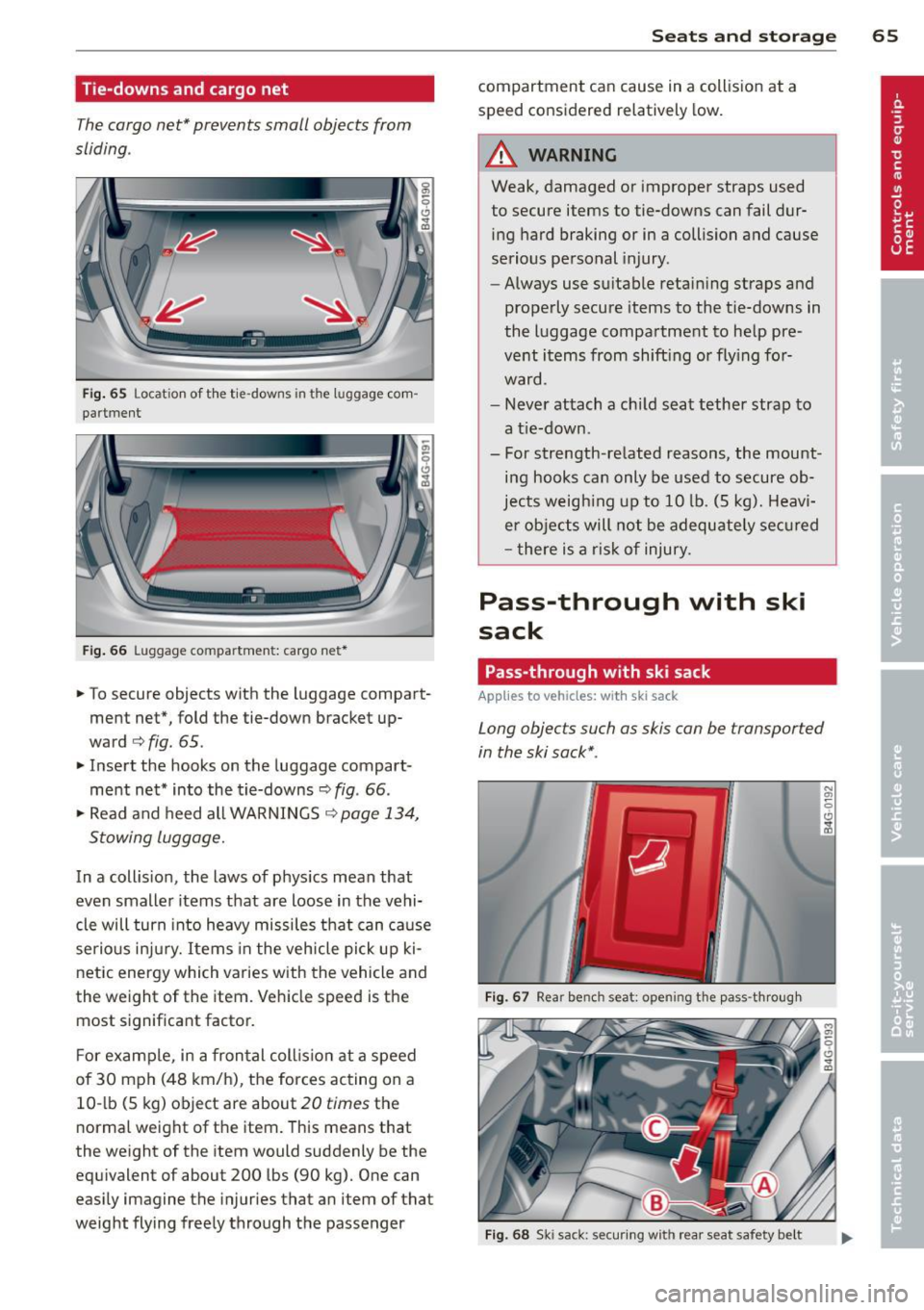
Tie-downs and cargo net
The cargo net* prevents small objects from
sliding .
Fig. 65 Location of th e tie -downs in the luggage com
partment
Fig. 66 Lugg age compartment: cargo net•
.. To secure objects with the luggage com part·
ment net*, fold the tie-dow n bracket up
ward
c:;, fig. 65.
.. Insert the hooks on the luggage compart
ment net* into the tie-downs
c:;, fig . 66 .
.. Read and heed all WARNINGS c:;,page 134,
Stowing luggage.
In a collis ion, the laws of phys ics mean that
even smaller items that are loose in the vehi
cle will turn into heavy missiles that can cause
serious injury. Items in the veh icle pick up ki
netic energy which varies with the vehicle and
the weight of the item. Vehicle speed is the
most significant factor.
F or example, in a frontal coll is ion at a speed
of 30 mph (48 km/h), the forces acting on a
10- lb (5 kg) object are about
20 times the
normal weight of th e item. This means that
the weight of the item would suddenly be the
equivalent of about 200 lbs (90 kg). One can
easi ly imagine the injuries that an item of that
weight flying freely through the passenger
Seats and storage 65
compartment can cause in a collision at a
speed considered relatively low.
A WARNING
Weak, damaged or improper straps used
to secure items to tie-down s can fail dur
ing hard braking or in a collision and cause
serious personal injury.
- Always use suitable retaining straps and
properly secure items to the tie-downs in
the luggage compartment to help pre
vent items from shifting or flying for
ward.
- Never attach a child seat tether strap to
a t ie-down .
- For strength-related reasons, the mount
ing hooks can only be used to secure ob
jects weigh ing up to 10 lb. (5 kg). Heavi
er objects will not be adequately secured
- there is a risk of injury.
Pass-through with ski
sack
Pass-through with ski sack
App lies to vehicles : wi th ski sack
Long objects such as skis can be transported
in the ski sack* .
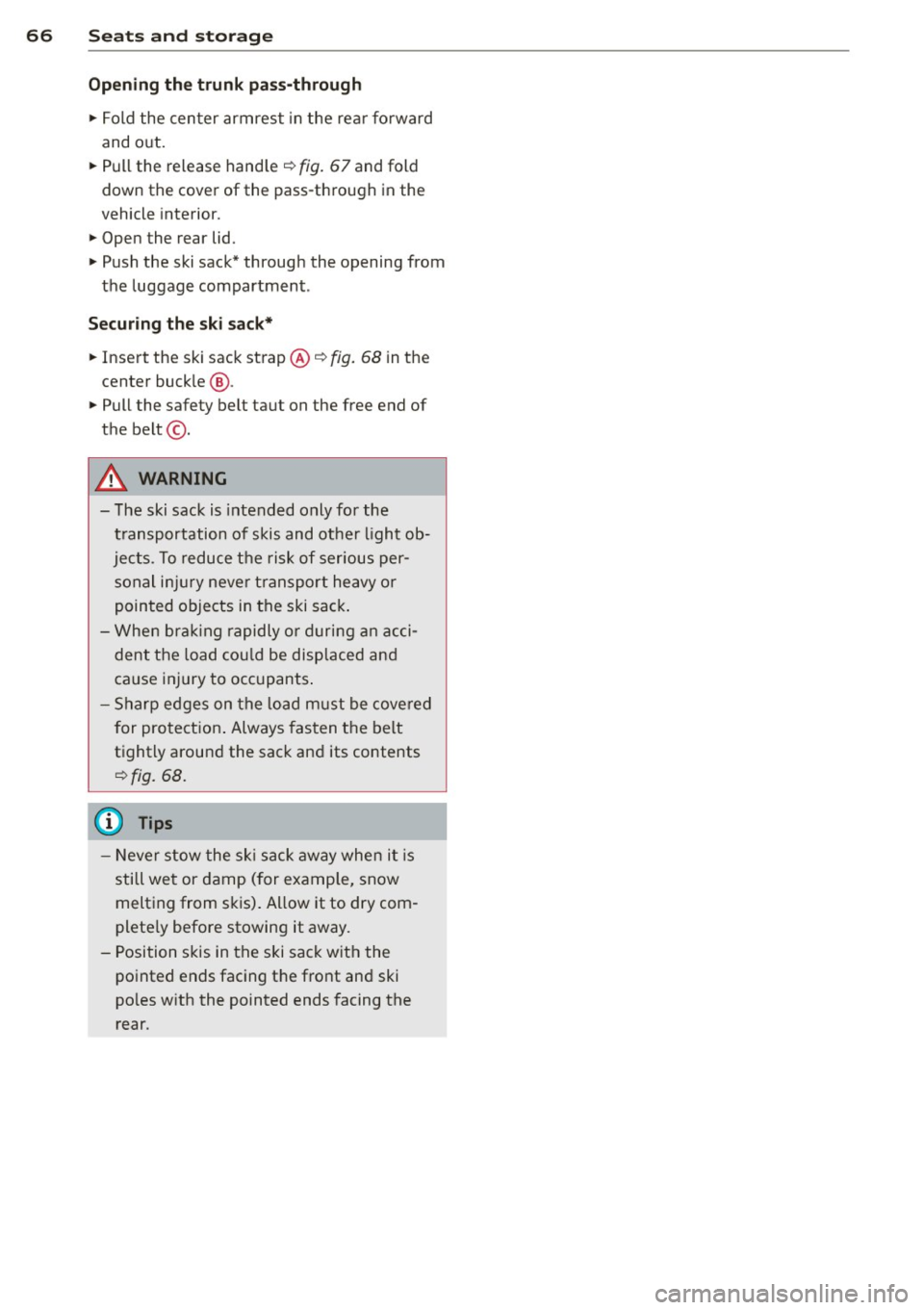
Fig. 67 Rear bench seat: opening the pass -through
Fig. 68 Sk i sack: secu ring with rea r seat safety belt
Page 68 of 304
66 Seats and storage
Opening the trunk pass-through
.. Fold the center armrest in the rear forward
and out .
.. Pull the release handle ¢
fig. 67 and fold
down the cover of the pass -through in the
vehicle interior .
.. Open the rear lid .
.. Push the ski sack* through the opening from
the luggage compartment .
Securing the ski sack*
.. Insert the ski sack strap @¢ fig. 68 in the
center buck le @ .
.. Pull the safety belt taut on the free end of
the belt @.
A WARNING
-The ski sack is intended only for the
t ransportation of skis and other light ob
jects . To reduce the risk of serious per
sonal inj ury never t ransport heavy o r
pointed objects in the ski sack .
- When brak ing rapidly or during an acci
dent the load could be displaced and
cause injury to occupants .
- Sharp edges on the load must be covered
for protection . Always fasten the belt
tightly around the sack and its contents
¢ fig. 68.
(D Tips
- Never stow the ski sack away when it is
still wet or damp (for example, snow
melting from skis). Allow it to dry com
pletely before stowing it away.
- Position skis in the ski sack with the
pointed ends facing the front and ski
poles with the pointed ends facing the
rear.
Page 132 of 304
130 Driving Safely
• Fasten and wear safety belts correctly
9 page 141.
• Always keep both feet in the footwell so
that you are in control of the vehicle at all
t imes.
Fo r detailed information on how to adjust the
driver's seat, see
<=>page 53.
A WARNING
Drivers who are unbelted, out of position
or too close to the airbag can be seriously
injured by an airbag as it unfolds . To help
reduce the risk of serious personal injury:
- Always adjust the driver's seat and the
steering wheel so that there are at least 10 inches (25 cm) between your breast
bone and the steering wheel.
- Always adjust the driver's seat and the
steering wheel so that there are at least
4 inches (10 cm) between the knees and
the lower part of the instrument panel.
- Always hold the steering wheel on the
outside of the steering wheel rim with
your hands at the 9 o'clock and 3 o'clock
positions to help reduce the risk of per
sonal injury if the driver's airbag inflates.
- Never hold the steering wheel at the
12 o'clock position or with your hands at
other positions inside the steering wheel
rim or on the steering wheel hub. Hold
ing the steering wheel the wrong way
can cause serious injuries to the hands,
arms and head if the driver's airbag in
flates.
- Pointing the steering wheel toward your
face decreases the ability of the supple
mental driver's airbag to protect you in a
collision.
- Always sit in an upright position and nev
er lean against or place any part of your
body too close to the area where the air
bags are located.
- Before driving, always adjust the front
seats and head restraints properly and
make sure that all passengers are prop
erly restrained. -
Never adjust the seats while the vehicle
is moving. Your seat may move unexpect
edly and you could lose control of the ve
hicle .
- Never drive with the backrest reclined or
tilted far back! The farther the backrests
are tilted back, the greater the risk of in
jury due to incorrect positioning of the safety belt and improper seating posi
tion .
- Children must always ride in child seats
<=> page 173. Special precautions apply
when installing a child seat on the front
passenger seat
c:> page 147.
Proper seating position for the front
passenger
The proper front passenger seating position
is important for safe, relaxed driving.
For your own safety and to reduce the risk of
injury in the event of an accident, we recom
mend that you adjust the seat for the front
passenger to the following position:
• Adjust the angle of the seatback so that it is
in an upright position and your back comes
in full contact w ith it whenever the vehicle is
moving.
• Adjust the head restraint so the upper edge
is as even as possible with the top of your
head. If that is not possible, try to adjust
the head restraint so that it is as close to
this position as possible
<=> page 132. Move
the head restraint so that it is as close to the
back of the head as possible.
• Keep both feet flat on the floor in front of
th e front passenger seat.
• Fasten and wear safety belts correctly
<=> page 141.
For detailed information on how to adjust the
front passenger's seat, see
9 page 52.
WARNING
Front seat passengers who are unbelted,
out of position or too close to the airbag
Page 133 of 304
can be seriously injured or killed by the air
bag as it unfolds. To help reduce the risk of
serious personal injury:
- Passengers must always sit in an upright
position and never lean against or place
any part of their body too close to the area where the airbags are located.
- Passengers who are unbelted, out of po
sition or too close to the airbag can be seriously injured by an airbag as it un
folds with great force in the blink of an eye .
- Always make sure that there are at least
10 inches (25 cm) between the front
passenger's breastbone and the instru
ment panel.
- Always make sure that there are at least
4 inches (10 cm) between the front pas
senger's knees and the lower part of the
instrument panel.
- Each passenger must always sit on a seat
of their own and properly fasten and
wear the safety belt belonging to that
seat.
- Before driving, always adjust the front passenger seat and head restraint prop
erly.
- Always keep your feet on the floor in front of the seat. Never rest them on the seat, instrument panel, out of the win
dow, etc. The airbag system and safety
belt will not be able to protect you prop
erly and can even increase the risk of in
jury in a crash .
- Never drive with the backrest reclined or
tilted far back! The farther the backrests
are tilted back, the greater the risk of in
jury due to incorrect positioning of the
safety belt and improper seating posi
tion.
- Children must always ride in child seats
r::, page 173. Special precautions apply
when installing a child seat on the front
passenger seat¢
page 147.
Driving Safely 131
Proper seating positions for passengers
in rear seats
Rear seat passengers must sit upright with
both feet on the floor consistent with their
physical size and be properly restrained
whenever the vehicle is in use.
To reduce the risk of injury caused by an incor
rect seating position in the event of a sudden
braking maneuver or an accident , your pas
sengers on the rear bench seat must always
observe the following:
.,.. Adjust the head restraint so the upper edge
is as even as possible with the top of your
head. If that is not possible , try to adjust
the head restraint so that it is as close to
this position as possible
¢ page 132 .
.,.. Keep both feet flat in the footwell in front of
the rear seat .
.,.. Fasten and wear safety belts properly
¢ page 141 .
.,.. Make sure that children are always properly
restrained in a child restraint that is appro
priate for their size and ager::,
page 173.
_& WARNING
..-
Passengers who are improperly seated on
the rear seat can be seriously injured in a
crash.
- Each passenger must always sit on a seat
of their own and properly fasten and
wear the safety belt belonging to that seat .
- Safety belts only offer maximum protec
tion when the safety belts are properly
positioned on the body and securely
latched . By not sitting upright, a rear
seat passenger increases the risk of per
sonal injury from improperly positioned
safety belts!
- Always adjust the head restraint properly
so that it can give maximum protection.
•
•
Page 138 of 304
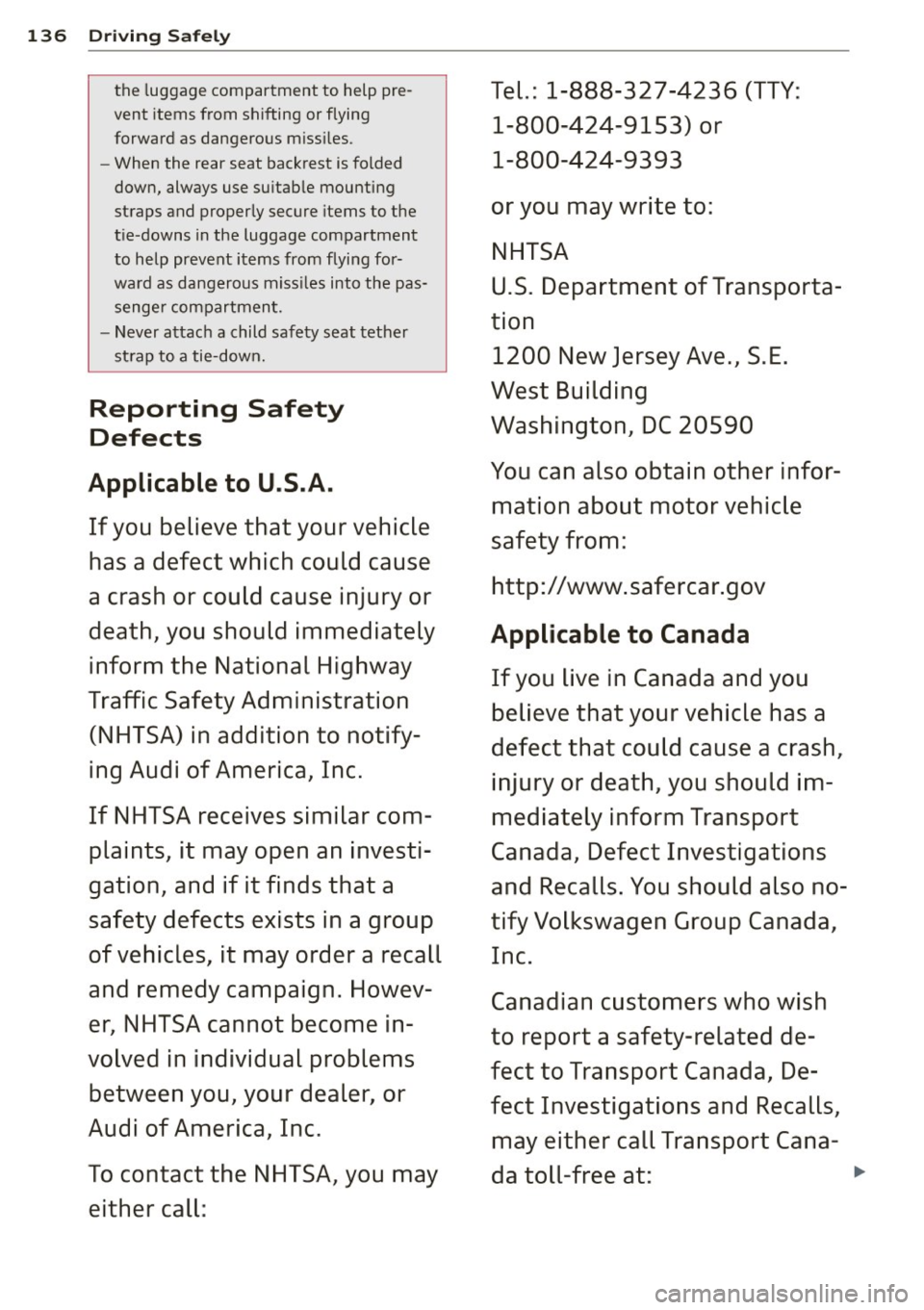
136 Driving Safely
the luggage compartment to help pre-Tel.: 1-888-327-4236 (TTY:
vent items from shifting or flying
1-800-424-9153) or forward as dangerous missiles.
- When the rear seat backrest is folded
1-800-424-9393
down, always use suitable mounting
straps and properly secure items to the
or you may write to:
tie-downs in the luggage compartment
NHTSA to help prevent items from flying for-
ward as dangerous missiles into the pas-
U.S. Department of Transporta-
senger compartment.
tion - Never attach a child safety seat tether
strap to a tie-down.
1200 New Jersey Ave., S. E.
Reporting Safety
West Building
Washington, DC 20590
Defects
Applicable to U.S.A.
You can also obtain other infor- mation about motor vehicle
If you believe that your vehicle safety from:
has a defect which could cause
a crash or could cause injury or http:/ /www. safe rca r. gov
death, you should immediately
Applicable to Canada
inform the National Highway If you live in Canada and you
Traffic Safety Administration believe that your vehicle has a
(NHTSA) in addition to notify- defect that could cause a crash,
ing Audi of America, Inc. injury or death, you should im-
If NHTSA receives similar com- mediately inform Transport
plaints, it may open an investi- Canada, Defect Investigations
gation, and if it finds that a and Recalls. You should also no-
safety defects exists in a group tify Volkswagen Group Canada,
of vehicles, it may order a recall Inc.
and remedy campaign. Howev- Canadian customers who wish
er, NHTSA cannot become in-
to report a safety-related de-
volved in individual problems feet to Transport Canada, De-
between you, your dealer, or feet Investigations and Recalls,
Audi of America, Inc. may either call Transport Cana-
To contact the NHTSA, you may da toll-free at:
....
either call: