brakes AUDI A6 2015 User Guide
[x] Cancel search | Manufacturer: AUDI, Model Year: 2015, Model line: A6, Model: AUDI A6 2015Pages: 314, PDF Size: 77.57 MB
Page 110 of 314
108 Automatic Transmission
N -N eutr al
The transmission is in neutral in this position.
Shift to this position for stand ing with the
brakes applied
q .&. in Driving the automatic
transmission on page 11 O.
When the ve hicle is stationary o r at speeds
be low 1 mph (2 km/h), you must always apply
the footbrake befo re and while moving the
l ever out of N.
D IS -Normal position for driving forward
In the D/S position, the transmiss io n can be
operated e ither in the normal mode Dor i n
the sport mode S. To select the sport mode S,
pu ll the se lector lever back briefly . Pulling the
lever back aga in will select the normal mode
D. The instrument cluster display shows the
selected driving mode.
In the normal mode D, the transmission a uto
mat ica lly selects the suitab le gea r ratio.
It de
pends on engine load, veh icle speed and driv
ing style.
Select the sport mode S for sporty driving .
The vehicle makes fu ll u se of the engine's
power. Shifting may become noticeable when
accelerating.
When the ve hicle is stationary o r at speeds
be low 1 mph (2 km/h), you must always apply
the foot brake before and while moving the lever to D/S out of N.
A WARNING
Read and follow all WARNINGS q .&. in
Driving the automatic transmission on
page 110.
(D Note
-
Coast ing downh ill with the transmission in
N and the e ngine not r unning w ill result in
damage to the automatic transm iss io n
and possib ly the catalyt ic converter.
@ Tips
- Audi drive select : you ca n adj ust the
sporty s hift c haracte ristics in th e
Dy-
namic driving mode.Swi ll appea r in the
instrument cluster display instead of D.
-If you a cc iden tally selec t N whi le driving,
take your foot off the accelerato r pedal
immediately and wa it for the engine to
slow down to idle before select ing D/S.
- If there is a power fai lure, the selector
lever w ill not move out of the P position.
The emergency release can be used if
this happens
qpage 113.
Automatic Shift Lock (ASL)
The Automatic Shift Lock safeguards you
against accidentally shifting into a forward or the reverse gear and causing the vehicle to
move unintentionally.
0, N ! ' g
i
) ( )
-
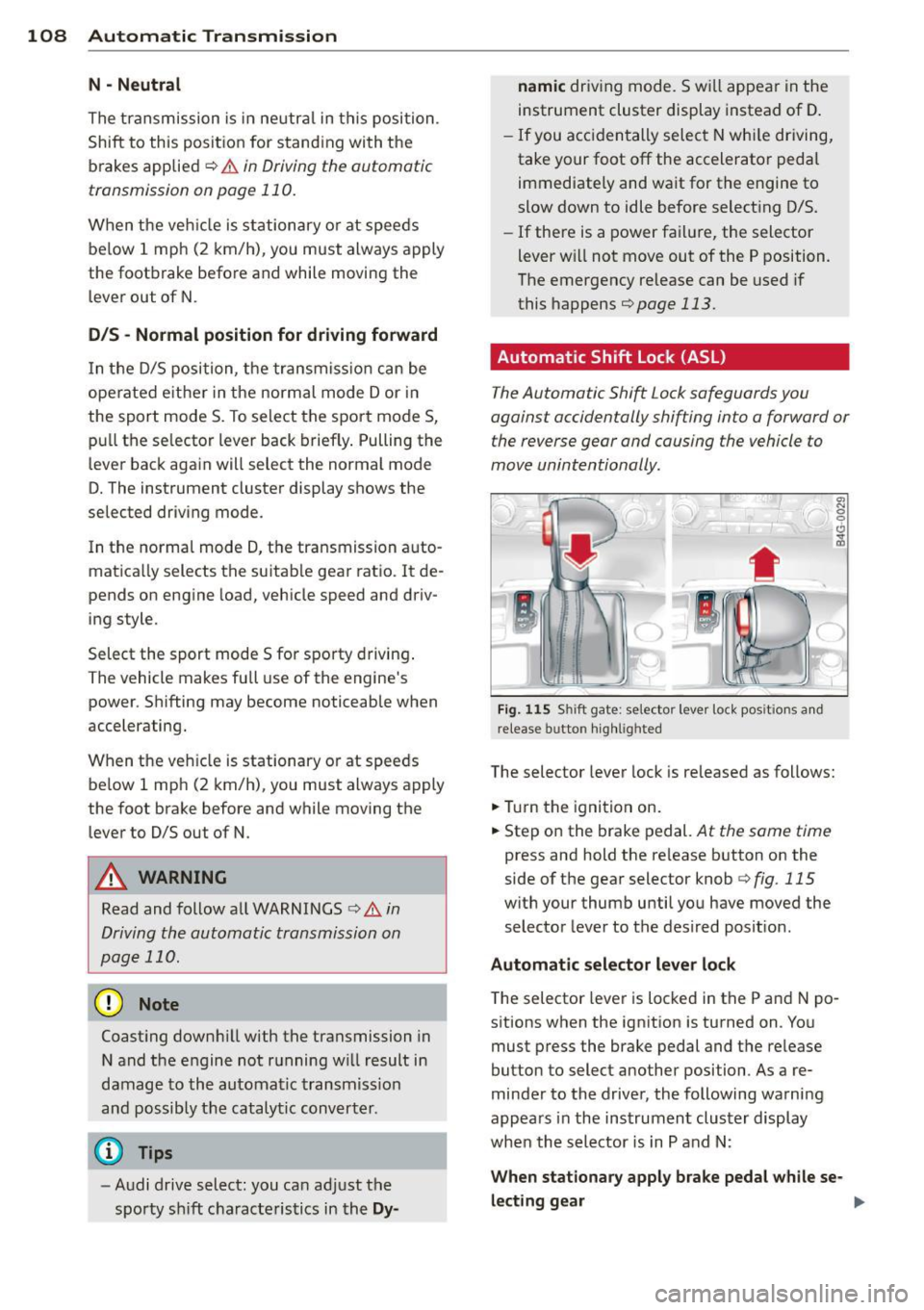
Fig. 1 15 Shift gate: selector leve r lock positions a nd
r e lease button highl ighted
The selector lever lock is released as follows:
... Tur n the igni tion on.
... Step o n the brake pedal.
At the same time
press and hold the re lease button on the
side of the gear selector knob
¢ fig. 115
with your thumb until yo u have moved the
selector lever to the desired posit ion.
Automat ic selector leve r lo ck
The selector lever is locked in the P and N po
sitions when the ignition is turned on. Yo u
must press the brake pedal and t he re lease
button to select another position . As a re
minder to the driver, the following warni ng
appears in the instrument cluster display
when the selector is in P and N:
When stationary apply brake pedal while se -
lecting gear
ll>
Page 112 of 314
110 Automatic Tran sm iss ion
multitronic transmission : Your vehicle is
equipped with
hill hold assist allowing you to
start while on an incline. The system is acti
vated when the brake pedal is pressed down
and held
f o r a few s econds . The brake pres
sure will hold for
a moment after the brake
pedal loosens to prevent the veh icle from roll
ing backwards whi le starting up .
A WARNING
- The veh icle can also roll when the engine
is stopped.
- Unintended veh icle movement can cause
serious injury .
- Never leave your vehicle with the eng ine
running wh ile in gea r. If you must leave
yo ur vehicle when the engine is running,
act ivate the park ing brake and move the
selector lever to P .
- Power is st ill transmitted to the whee ls
when the engine is running at idle . To
prevent the vehicle from "creeping", you
must keep your foot on the brake when
the engine is running and the selector
lever is in D/S or R or "tiptronic" mode is
selected.
- Do not press the accelerator pedal when
changing the selector lever pos ition
wh ile the vehicle is stat io nary and the
engine is running .
- Never shift into R or P wh ile driving .
- Before driv ing down a steep slope, re-
duce your speed and shift into a lower
gear with "tiptronic" .
- Do not ride the brakes or press the brake
pedal too often or too long when dr iving
down a hill. Constant braking causes the
brakes to overheat and substant ially re
duces b raking performance, inc reases
braking distance or causes comp lete fail
ure of the brake system.
- T o prevent the veh icle from rolling back
when stoppi ng on incl ines, always hold it
in place with the brake peda l or parking
brake.
- Never hold the veh icle on an incl ine with
a slipping clutch. The clutch opens auto
matically when it becomes too hot from the overload. An indicato
r lamp
ml illu
minates and a driver message appears
¢ page 112 when the clutch is overload
ed.
- If the engine must remain running, never
have any driving posit io n engaged when
checking under the hood . Make sure the
selector lever has securely engaged and is locked in P w it h the park ing brake set
¢ page 222 . Otherwise, any increase in
eng ine speed may set the vehicle in mo
tion, even with the parking brake ap plied .
(D Note
-S tronic- and tiptronic transmission :
When stopping on an incl ine , do not try
t o hold the vehicle in place by pressing
the acce lerator pedal while a driving gear
is se lected. This can cause the transmis
sion to overheat and can damage it. Acti
vate the parking brake or press the brake
peda l to prevent the vehicle from roll ing.
- S tronic- and tiptronic transmission : A l
lowing the vehicle to ro ll when the en
gine is stopped and the selector lever is
in N will damage the transmission be
cause it is not l ubricated unde r those cir
cumstances.
{!) Tips
For safety reasons, the parking brake is re
l eased automatically only when the d riv
er's safety belt is engaged in the buckle.
Hill descent control
The hill descent control system assists the
driver when driving down declines.
Hill descent contro l is activated when these
lector lever is in D/S and you press the brake
pedal. The transmission automatically selects
a gear that is su itable fo r the incline. H ill de
scent contro l tries to ma inta in the speed ach
ieved at the time o f braking, within phys ica l
and technical limitations. If may sti ll be nec -
essary to adj ust the speed with the brakes . ..,..
Page 113 of 314
M N
0 I.J "". rl I.O
"' rl
"' rl
Hill descent control switches off once the de
cline levels out or you press the accelerator pedal.
On vehicles with the cruise control system*
¢ page 82, hill descent control is also activat
ed when the speed is set.
A WARNING
Hill descent control cannot overcome
physical limitations, so it may not be able
to maintain a constant speed under all
conditions. Always be ready to apply the
brakes .
Manual shift program
Using the manual shift program you can
manually select gears.
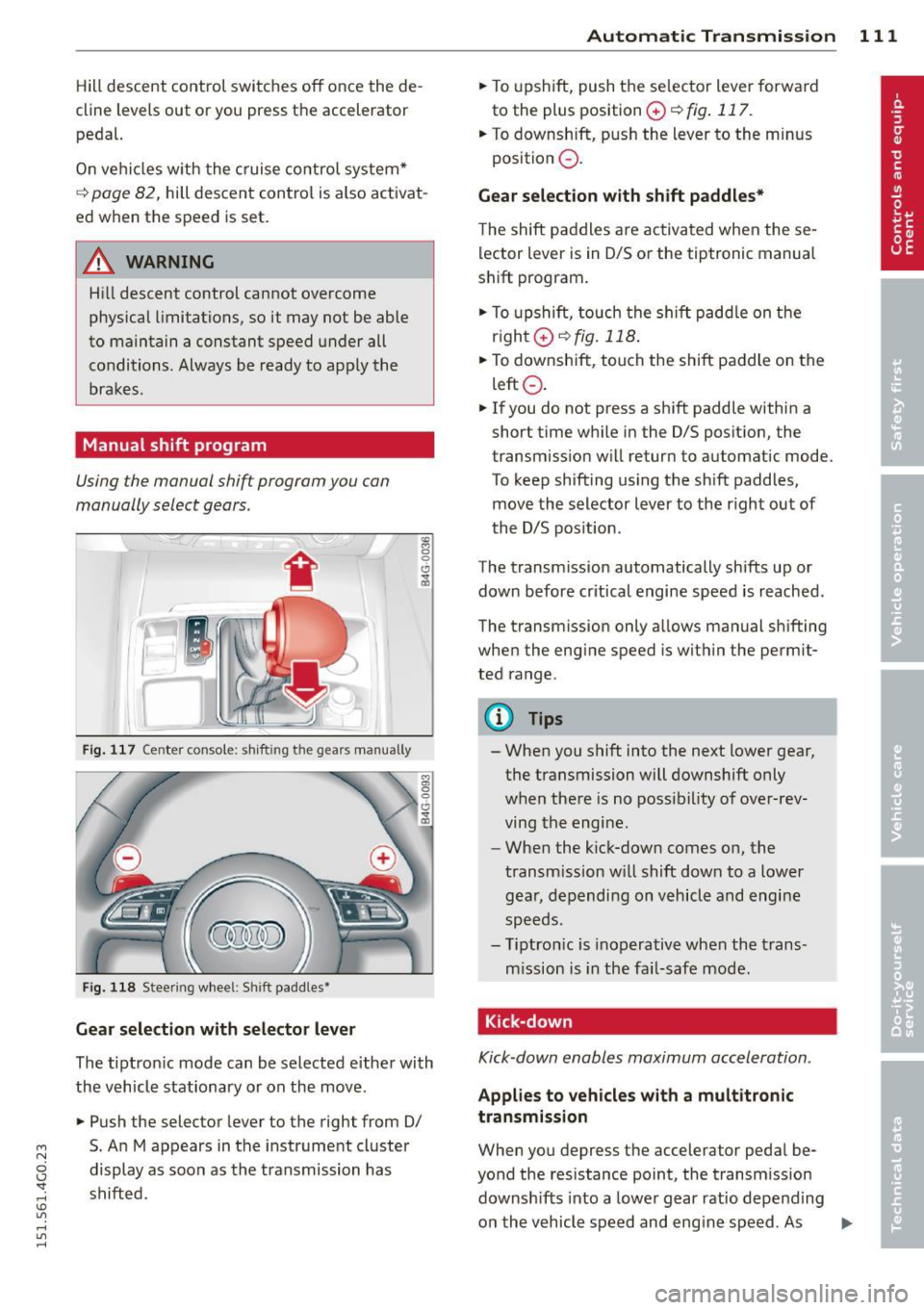
Fig. 117 Center console; shift ing the gears manually
Fig. 118 Steering wheel: Shift paddles•
Gear selection with selector lever
The tipt ron ic mode can be selected either with
the vehicle stationary or on the move.
.,. Push the selector lever to the right from 0/
5. An M appears in the instrument cluster
display as soon as the transmission has
shifted.
Automatic Transmission 111
.,. To upshift, push the se lector lever forwa rd
to the plus position
0 ¢ fig . 117.
.,. To downshift, push the lever to the minus
position
0 .
Gear selection with shift paddles*
The shift paddles are activated when these
lector lever is in 0/S or the tiptronic manual
shift program.
.,. To upshift, touch the shift paddle on the
right 0¢fig.118 .
.,. To downshift, touch the shift paddle on the
left
0 .
.,. If you do not press a shift paddle within a
short time while in the 0/S position, the
transm iss ion will return to automatic mode.
To keep shifting using the shift paddles,
move the selector lever to the r ight out of
the 0/S position.
The transmission automatically shifts up or
down before critical engine speed is reached.
The transm ission only allows manual sh ifting
when the engine speed is with in the permit
ted range.
@ Tips
- When you shift into the next lower gear,
the transmission will downshift only
when there is no possibility of over-rev
ving the engine.
- When the kick-down comes on, the
transmission will shift down to a lower
gear, depending on vehicle and engine
speeds.
- Tiptronic is inoperative when the trans
mission is in the fai l-safe mode.
, Kick-down
Kick-down enables maximum acceleration.
Applies to vehicles with a multitronic
transmission
When you depress the accelerator pedal be
yond the resistance point, the transmission
downshifts into a lower gear ratio depend ing
on the vehicle speed and engine speed. As .,.
Page 196 of 314
194 Intelligent technology
vehicles with adaptive cruise control*, the
brake assist system is more sensitive if the
d istance detected to the vehicle ahead is too
smal l.
Anti -slip regulati on (ASR )
ASR reduces engine power when the drive
wheels begin to spin and adapts the force to
the road conditions. This makes it easier to
start, accelerate and drive up hills.
Electronic diffe rential lock (EDL )
The EDL brakes wheels that are spinn ing and
transfers the drive power to the other wheels .
This function is available up to abo ut 75 mph
(120 km/h) .
I n extreme cases , ED L automat ic all y switches
off to help keep the brake on the braked whee l
from overheating . EDL will switch on again au
tomatically when conditions have returned to normal.
Dynamic st eering*
On vehicles with dynamic steering* , ESC helps
stabilize the steering in critical situations .
Electronic interaxle differential lock */
s elective whe el torque control *
The electronic in teraxle d iffe ren tial lock (fro nt
wheel drive) or the select ive whee l torq ue
control (a ll-wheel drive) operates when driv
ing throug h curves . The front whee l on the in
side of the curve or both wheels on the inside
of the curve are braked selectively as needed.
T his minimizes sliding in the front wheels and
allows for more precise driving through
curves . The applicable system may not acti
vate when d rivi ng in wet or snowy conditions.
_& WARNING
- E SC, ABS, ASR, EDL, dynamic steering*
and the E lec tronic interaxle differentia l lock
*/se lective whee l torque control*
cannot overcome the laws of physics.
This is especially important on slippery
or wet roads .
If the systems beg in acting
to stabilize your veh icle, you should im
mediately chang e you r speed to match
the road and t raffi c conditions. Do not
let the increased safety provided by
these systems temp t you to take risks.
Doing so will increase the risk of a loss of
veh icle cont ro l, collision and serio us per
sonal injur ies.
- Always adapt your speed to road, traffic
and weather conditions . The risk of los
ing control of the vehicle increases when
driving too fast, espec ially through
curves and o n slippery or wet roads, and
when dr iv ing too close to vehicles up
a head . ESC, ABS, the brake ass ist sys
tem, ED L, ASR, dynam ic steeri ng* and
the Electronic in terax le different ial
loc k*/se lective whee l torque control*
cannot prevent collisions .
- Always accelerate wi th spe cial care on
even, smooth s urfaces such as those that
are wet or covered with ice and snow.
The drive wheels can spin even with
these assistance systems that cannot al
ways he lp to reduce the risk of loss of ve
hicle control.
(D Tips
- ABS and ASR only wo rk correctly when
all four wheels are equipped with identi
cal tires . D ifferent tire si zes can lead to a
reduction in engine powe r.
- You may hear noises when the systems descr ibed are working.
- If the ind icator light
Bl or fJl1 (USA
mode ls)l iiJ (Canada models) appears,
there may be a malfunction
¢ page 19,
¢page 19 .
Page 197 of 314
M N
0 I.J "". rl I.O
"' rl
"' rl
Intelligent technology 195
Switching on and off
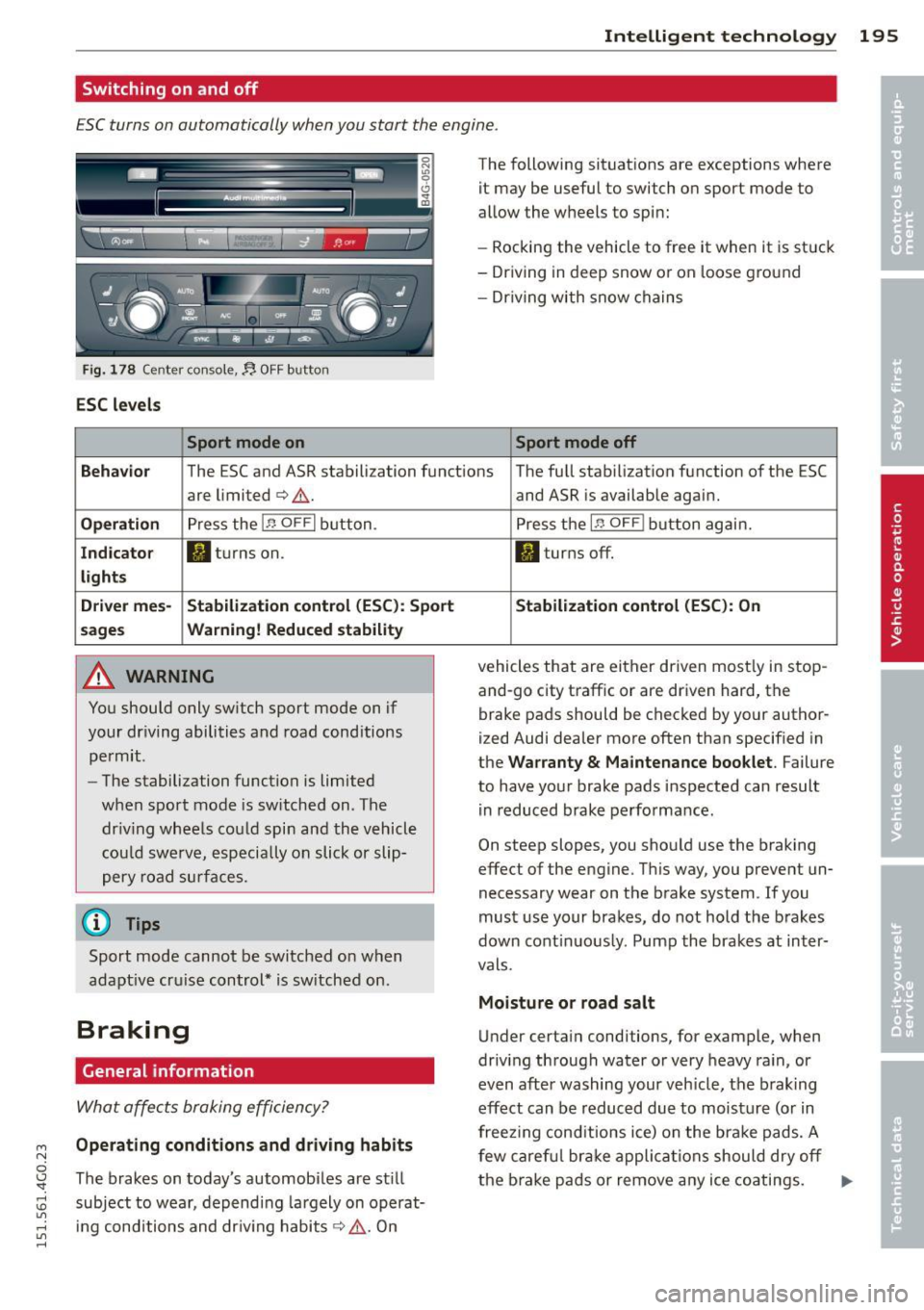
ESC turns on automatically when you start the engine.
Fig. 178 Center console,:, OFF button
ESC levels
Sport mode on
The following situations are exceptions where it may be useful to switch on sport mode to
allow the wheels to spin:
- Rocking the vehicle to free it when it is stuck
- Driving in deep snow or on loose ground
- Dr iv ing with snow chains
Sport mode off
Behavior
The ESC and ASR stabilization functions The fu ll stab ilizat ion function of the ESC
are limited¢ ,&.
Operation Press the I~ OFFI button .
Indicator II turns on.
lights
Driver mes- Stabilization control (ESC): Sport
sages Warning! Reduced stability
A WARNING
You should only switch sport mode on if
your dr iving abilities and road conditions
permit.
- The stabilization function is limited
when sport mode is sw itched on . The
dr iv ing wheels could spin and the vehicle
cou ld swerve, especially on slick or slip
pery road surfaces.
@ Tips
Sport mode cannot be switched o n when
adapt ive cru ise control* is sw itched on.
Braking
General information
What affects braking efficiency?
-
Operating conditions and driving habits
The brakes on today's automobiles are st ill
subject to wear, depending largely on operat
in g conditions and driv in g habits ¢.&,. . On and
ASR is available again.
Press the
I S'} OFF I button again.
Iii turns off.
Stabilization control (ESC): On
vehicles that are either driven mostly in stop
and-go city traffic or are driven hard, the
brake pads should be checked by your author
ized Audi dealer more often than specified in
t he
Warranty & Maintenance booklet . Failure
to have your brake pads inspected can result
in reduced brake performance .
On steep slopes, you should use the braking
effect of the engine. This way, you prevent un
necessary wear on the brake system. If you
must use your brakes, do not hold the brakes
down cont inuous ly. Pump the brakes at inter
vals.
Moisture or road salt
Under certain cond itions, for example, when
driving through water or very heavy rain, or
even after washing your veh icle, the braking
effect can be reduced due to moisture (or in
freezing conditions ice) on the brake pads. A
few careful brake applications should dry off
the brake pads or remov e any ice coatings. .,._
Page 198 of 314
196 Intellig ent technolog y
When you are driving at higher speeds with
the windshield wipers on, the brake pads will
briefly touch the brake d iscs in regular inter
vals so as to improve reaction t ime when brak
ing on wet surfaces. You the driver will not no
tice anything .
The effectiveness of the brakes can be reduced
when the vehicle is dr iven on a salt-covered
road and the brakes are not used. Here too,
you should clean
off accumulated salt coat ing
from brake d iscs and pads with a few careful
applications of the brake¢.&. .
Cor ro sion
There may be a tendency for dirt to build up
on the brake pads and corrosion to form on
the discs if the car is not dr iven regularly or
only for short trips with l ittle use of the
brakes .
If the brakes are not used frequently, or if cor rosion has formed on the discs, it is advisable
to clean
off the pads and discs by braking
firm ly a few times from a mode rately high
speed ¢.& .
Faults in the brake system
If you should notice a sudden increase in
brake pedal travel, then one of the two brake
circu its may have failed¢.&. .
Low brake fluid le vel
Malfunct ions can occur in the brake system if
the brake fluid level is too low. The brake fluid
level is monitored electronically .
Brake boost er
The brake booster works with vacuum pres
sure which is created only when the engine is
running ¢ .&. .
Brake lining w ear status
Brake lining wea r may be checked by vis ual in
spection of the condition of the brake pads
through the openings in the whee l. If neces
sary, the whee l may be removed for this in
spection
¢ page 272, Changing a wheel.
_& WARNING
- You shou ld perform braking maneuvers
for the purpose of cleaning the brake
system only if road conditions permit .
Other road users must not be put at risk -
you may ca use an accident!
- Before descend ing a steep grade, reduce
speed and sh ift transmission into a lower
gear o r lower dr iving range. Do not ride
the br akes or ho ld the pedal down too
long o r too often . Th is could cause the
brakes to get hot and diminish braking
efficiency .
- Do not "ride the brakes" by resting your foot on the pedal when you do not intend
to brake. This may cause the brakes to
overheat, premature wear and increased
stopping distance.
- Under certain climatic and ope rat ing
conditions such as passing through wa
ter , dr iving in heavy rain or after washing
the vehicle, the effectiveness of the b rakes can be reduced . In winte r, ice can
accumu late on the bra ke pads, lin ings,
d iscs and drum s. Carefully app ly bra kes
for a test. Brakes will dry and ice coa t
ings wi ll be cleaned
off after a few care
fu l brake applicat ions.
- Driving for an extended period of t ime on
salt -covered roads without using your
brakes can a lso affect braking efficiency .
Clean
off accum ulated salt coating from
brake discs and pads with a few careful
brake applications.
- If you damage the front spoiler, or if you
install a different spoiler, be sure the a ir
f low to the front brakes is not obstruct
ed. Otherwise the brake system could
overheat reducing the effective ness of
the entire brake system.
- Failure of one brake circuit will impa ir
the braking capab ility result ing in an in
creased stopping distance . Avoid driving
the vehicle and have it to wed to the near
est A udi dealer or qualif ied workshop .
- Never let the vehi cle roll to a s top with
the eng ine shut
off.
Page 202 of 314
200 Driving and environment
Driving and
environment
The first 1,000 miles
(1,500 km) and
afterwards
New engine
The engine needs to be run-in during the first
1,000 miles (1,500 km).
For the fir st 600 miles (1,000
kilometers ):
.,. Do not use full throttle.
... Do not d rive at engine speeds that are more
than 2/3 of the max imum permitted RPM.
... Avoid high engine speeds.
From 600 to 1,000 mile s (1 ,000 to
1,500 kilometers):
... Speeds can gradually be increased to the
max imum pe rm iss ible road or eng ine speed .
During and after break-in period
.,. Do not rev the eng ine up to high speeds
when it is cold. Th is app lies whether the
transm ission is in N (Neutra l) or in gear.
After the break-in period
... Do not exceed maximum engine speed un
der any circumstances.
.,. Upshift into the next hig her gear
before
reaching the red area at the end of the tach
ometer scale
c:> page 11.
During the first few hours of driving, the en
g ine's interna l friction is higher than later
when all the moving parts have been broken
in . How well this break- in process is do ne de
pends to a conside rable extent on th e way the
ve hicl e is driven during the first 1,0 00 miles
(1, 500 k ilome ters).
0 Note
E xtremely high engi ne speeds are auto
mat ica lly reduced. However, these rpm
lim its are progr amme d for an engine well
r u n- in, not a new engine .
{® For the sake of the environment
Do not drive with unnecessarily high en
g ine speeds - upshifting ear ly saves fuel,
reduces no ise and protects the environ
ment.
, New tires
If your vehicle is runni ng on new tires, drive
part icularly caref ul for the first 350 miles
(500 kilomete rs) afte r fitt ing.
A WARNING
N ew tires tend to be sl ippery and mus t al
so be "b roken -in" . Be s ure to remember
this dur ing the fi rst 350 mi les ( 500 kilo
meters) . Brake gently . Avoid fo llow ing
closely behind other vehicles or other sit
uations that m ight require sudden, hard
braking .
New brake pads
Remember that new brake pads do not have a
full bra king effect dur ing the fi rst 250 m iles
(400 kilomete rs) afte r they a re insta lled.
New brake pads have to be "burnished in" be
fo re t hey have optima l grab
c:> A .
During the break- in period, you should avoid
putting severe loads on the brakes. Severe
l oads include, for example, sudden hard brak
i ng, in particular at very high speeds or, for
example, on mounta in passes .
A WARNING
New b rake pa ds don't have t he bes t stop
pi ng power and mus t be "broke n-in " dur
i ng the in iti al 1 00 to 150 mi les (150 to
20 0 k ilometers) of no rma l city driving . You
can compensate for this by pressing the
br ake peda l mo re f irm ly . This also applies
l ater when new pads are installed.
Page 203 of 314
M N
0 <.J 'SI: ,...., \!) ..,.,
,...., ..,., ,....,
Avoid damaging the
vehicle
When you are driving on poor roads, or over
curbs, steep ramps, etc., make certain that
low-lying parts such as spoilers and exhaust
system parts do not bottom out and get dam
aged.
This is especially true for vehicles with low
slung chassis (sports chassis) * and fully load
ed veh icles.
Driving through water
on roads
Note the following to avoid vehicle damage
when driving through water, for example on
flooded roads:
- T he water must not be any h igher than the
bottom of the veh icle body.
- Do not d rive faster than wa lking speed.
..&, WARNING
After driving through wate r, m ud, slush,
etc., the brakes may be slow to take effect
because o f wet brake rotors and pads . Dry
the brakes first by braking carefully to re
store the full braking effect.
(D Note
- Vehicle components such as the eng ine,
transmission, suspension or e lectrical
system can be severely damaged by driv
ing thro ugh water.
- Always switch
off the Start-Stop-System
when driving through water¢
page 79 .
@ Tips
-Check the depth o f the wate r before driv
ing through it.
- Do not s top the veh icle, dr ive i n reverse
or switc h the engine off when driving
through water.
- Keep in mind that oncom ing vehicles
may create waves that raise the water
l eve l and make it too deep for you r vehi
cle to drive through safely .
-
Dri vin g and en vironm ent 201
- Avo id driving through salt wate r because
it can cause corrosion .
Catalytic converter
Applies to vehicles: w ith gasoline engine
It is very important that your emission con
trol system (catalytic converter) is function
ing properly to ensure that your vehicle is run
ning in an environmentally sound manner.
... Always use lead-free gasoline ¢ page 214,
Fuel supply.
... Never run the tank down all the way to emp
ty.
.,. Never put too much motor o il in your engine
¢ page 226, Adding engine oil~-
... Never try to push- or tow-sta rt your vehicle.
The catalytic converter is an efficient "clean
up" dev ice bui lt into the exhaust system of
the ve hicle. The cata lytic conve rter bu rns
many of the pollutants in the exha ust gas be
fore they are re leased into the atmosphere .
The exclusive use of unleaded fuel is c ritically
important for the life of the ca talyt ic convert
er and proper f unct ion ing of the engine.
A WARNING
The temperature of the exhaust system is
high, both when driving and after s topping
the engine.
- Never touch the exhaust tail pipes once
they have become hot . This cou ld result
in burns .
- Do not park or operate the vehicle in
areas where the hot exha ust system may
come in contact with dry grass, brush,
fue l spill or other material which can
cause a fire.
- Do not apply additional undercoating or
rustproof ing on or near the exhaust
manifold, exhaust pipes, catalytic con
verter or heat shields . Dur ing driv ing, the
substance used fo r undercoating could
overheat and cause a fire.
~
•
•
Page 207 of 314
M N
0 <.J 'SI: ,...., \!) ..,.,
,...., ..,., ,....,
Trailer towing Driving with a trailer
General information
Your Audi was designed primarily for passen
ger transportation .
If you plan to tow a tra iler, p lease remember
that the addit ional load will affect durab ility,
economy and performance .
Trailer towing not on ly places more stress on
the vehicle, it also calls for more concentra
tion from the driver.
F or this reason, a lways fo llow the operating
and driving instructions provided and use
common sense.
(D Note
If you are going to tow a trai le r, you must
ac tivate the trailer operation mode
c::> page 205, Operating instructions.
Technical requirements
Trailer hitch
Use a weig ht-carrying hitch conforming to the
gross trailer we ight. The hitch must be suita
b le for your veh icle and trailer and must be
mounted secure ly on t he ve hicle's chassis at a
technically sound location . Use only a trail er
hi tch w ith a removab le ball moun t. A lways
check wi th t he tra ile r hi tch man ufactur er to
make sure that you are using the cor rect
h itch.
Do not us e a bumper hitch.
The hitc h m ust be installed in such a way that
i t does not interfe re with the impac t-absorb
i ng bumper syst em. No mod ificat ions should
b e made to the vehi cle e xhaus t and br ake sys
tems . From t ime to time, check th at a ll hitc h
mo unt ing bo lts rem ain securely fas tened.
When you are not towing a trail er, remove the
tra ile r hi tch ball moun t. T h is prevents the
hi tch from causing damage sho uld your ve hi
cle be str uck from behind~ .& .
Trailer towin g 205
Trailer brakes
If your trailer is equippe d wi th a bra king sys
tem, check to be s ure that i t conforms to all
regulations .
T he trailer hyd ra u lic bra ke sys tem mus t not be
d irec tly connec ted to the vehicle's hydraulic
brake system .
Safety chains
Always use safety chains be tween your ve hicle
and t he tra ile r.
Trailer lights
Trai ler lights must meet all reg ulations. Be
su re to c heck with your Audi dea ler for correct
wir ing, switches and relays .
Mirrors
If you a re unable to see the traffic behind you
u sing the regula r outside mirrors, then you
must insta ll extended mir rors. It is important
t h at you
always have clea r vis io n to the rear.
_&. WARNING
-
Afte r removi ng the t railer hitch , do no t
stor e it in yo ur v ehicl e. In case of sudden
b raki ng, the hi tch co ul d fly forwar d and in
j ur e you o r yo ur pass enge rs.
Operating instructions
Maximum trailer weight
A tra ile r fo r you r vehi cle is l imited to a typi cal
cla ss 1 o r class 2 tr ailer.
Trailer load distribution
Be sure the load in the tra ile r is held secure ly
in place to p revent it from shift ing fo rward,
ba ckward or sideways.
Never allow a passenger to ride in a trailer
c::> .& in Driving instructions on page 207 .
Eng ine cooling sy stem
Towing a t railer ma kes the engine wor k hard
er . It is impo rtant that the cooling system's
performance is up to the additional load.
•
•
Page 208 of 314
206 Trailer towing
Make sure that the cooling system has enough
fluid .
Tire pressure
When towing a traile r, inflate the tir es of your
vehi cle to the cold tire pressure listed under
"Full load" on the label located on the driver's
side B-pillar (visible when the door is open) .
Inflate trailer t ires to trai ler and tire manufac
turers' specifications.
Lights
Check to make sure both vehicle and trailer
lights are working properly.
Safety chains
Be sure tra iler safety cha ins are properly con
nected from the trailer to the hitch on the ve
hicle. Leave enough slack in the chains to per
mit turning corners. When you install safety
cha ins, make sure they wi ll not drag on the
road when you are driving.
The chains should cross under the trailer
tongue to prevent it from dropping in case of
separation from the hitch.
Adjusting the Audi drive select
Make sure the vehicle is on a level su rface be
fore
hitching up the traile r and before adjust
ing the tongue weight. The vehicle must be in
auto or comfort driving mode and not raised
q page 100, q(D _
Make sure that the vehicle is lowered. In Info
tainment , se lect:
ICARI f unc tion button> Low
er
control button.
I f you must dr ive under poor road condit ions,
you can raise the vehicle
after coupling the
tra iler or
after adjusting the tongue weight
qpage 102.
-Changes in temperature or load can af
fect the height of the vehicle.
- Always se lect
auto or comfort mode.
Otherwise, the tongue load specified for
your vehicle will no longer be applicable.
Driving instructions
Driving with a trailer always requires extra
care and consideration .
To obtain the best possible handling of vehicle
and trailer, please note the follow ing:
.,. Do not tow a loaded trailer when your car it
self is not loaded.
.,. Be especially careful when passing other
veh icles.
.,. Observe speed limits .
.,. Do not dr ive at the max imum permissib le
speed.
.,. Always apply brakes early .
.,. Mon itor the temperature gauge.
Weight distribution
Towing a loaded trailer with an empty car re
su lts in a highly unstable distribution of
we ight. If this cannot be avoided, drive at very
low speeds only to avoid the risk of losing
steering control.
A "ba lanced " rig is easier to operate and con
t ro l. This means that the tow vehicle should
be load ed to the extent possible and permissi
ble , while keeping the trailer as light as possi
ble under the circumstances . Whenever possi
ble , transfer some cargo to the luggage com
partment of the tow veh icle while observing
tongue load requirements and vehicle load ing
considerations.
Speed
The higher the speed, the more difficult it be
comes for the driver to control the rig . Do not
drive at the maximum permissible speed. Re
duce your speed even more if load, weather or
wind conditions are unfavorable -particularly
whe n going downhill.
Red uce vehicle speed
immediately if the trail
er shows the slightest s ign of sway ing .
Do not
try to stop the swaying by accelerating.
Observe speed limits. In some areas, speeds
for vehicles towing tra ilers are lower than for
regular veh icles . .,.