open hood AUDI A6 2016 User Guide
[x] Cancel search | Manufacturer: AUDI, Model Year: 2016, Model line: A6, Model: AUDI A6 2016Pages: 294, PDF Size: 73.88 MB
Page 218 of 294
Checking and Filling
Checking and Filling
Hood
Releasing the engine hood
The engine hood is released from inside the vehi
cle .
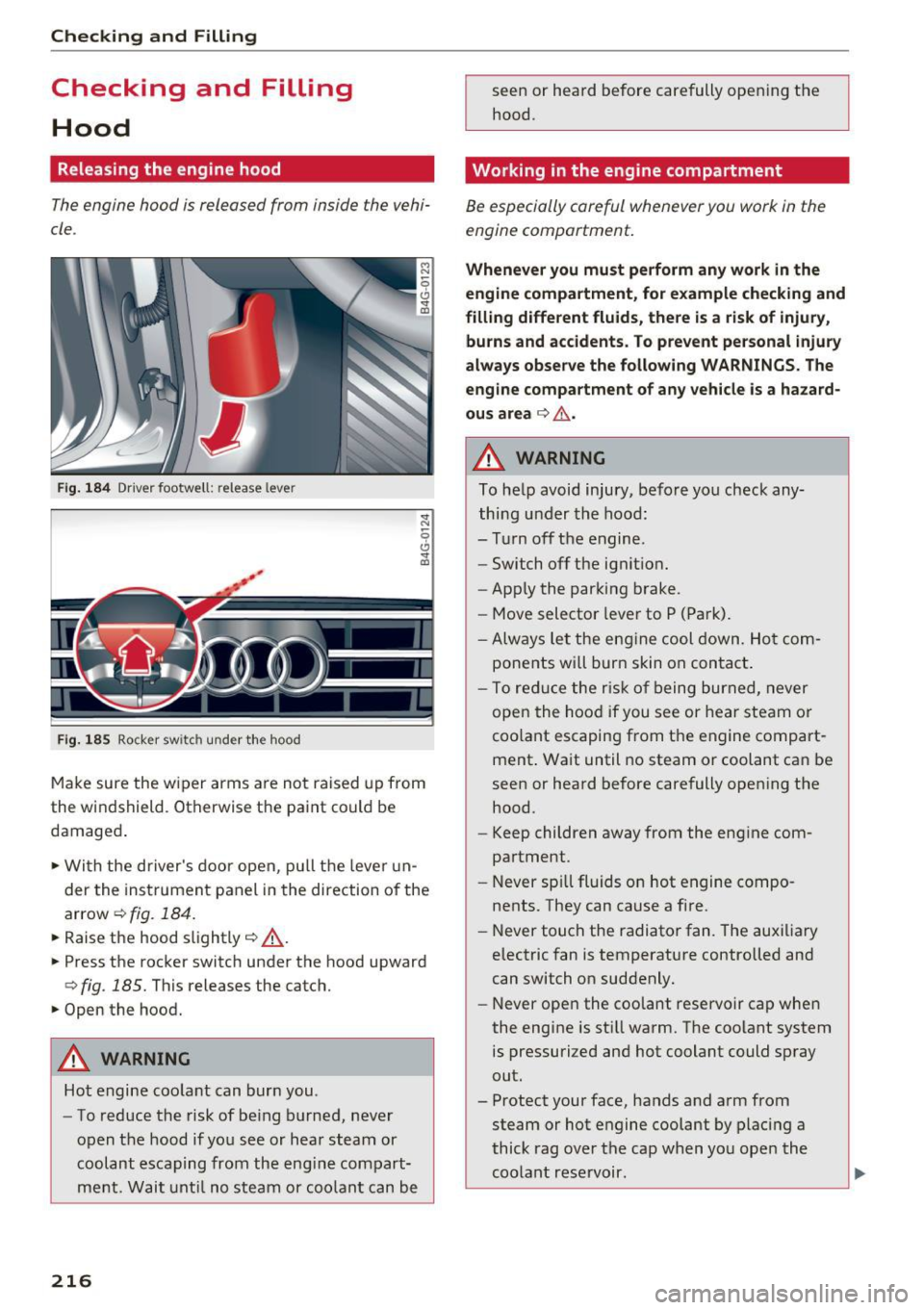
Fig. 184 Driver footwell: release leve r
Fig . 185 Rocker switch under the hood
Make sure the wiper arms are not raised up from
the windshield . Otherwise the paint could be
damaged .
.. With the driver's door open, pu ll the lever un
der the instrument panel in the direction of the
arrow ¢
fig. 184.
.. Raise the hood slightly Q _A .
.. Press the rocker switch under the hood upward
Q fig. 185. This releases the catch.
.. Open the hood.
A WARNING
Hot engine coo lant can burn you .
- To reduce the risk of be ing burned, never
open the hood if you see or hear steam or
coolant escaping from the eng ine compart
ment. Wait unt il no steam or coolant can be
216
seen or heard before carefully open ing the
hood.
Working in the engine compartment
Be especially careful whenever you work in the
engine comportment.
Whenev er yo u mu st perform an y work in the
engin e compartment , for example ch ecking and
filli ng d iffe rent fl uids , the re is a risk of injury ,
bu rn s and a ccid ents . To pre ve nt p erso nal injur y
a lway s obse rve the foll owing WARNING S. The
e ng ine compartment o f an y v ehicl e is a haz ard
ou s a rea
Q _6 .
A WARNING
To he lp avoid injury, before you check any
thing under the hood:
- Turn off the engine .
- Switch off the ignit ion.
- Apply the parking brake.
- Move selector lever to P (Park).
- Always let the eng ine cool down. Hot com-
ponents will burn skin on contact .
-
-To redu ce the risk of being burned, never
open the hood if you see or hear steam or
coo lant escaping from the engine compart
ment . Wait until no steam or coolant can be
seen or heard before carefully open ing the
hood.
- Keep children away from the engine com
partment .
- Never sp ill fluids on hot engine compo
nents. They can cause a fire.
- Never touch the radiator fan. The auxiliary
electric fan is temperature controlled and
can switch on suddenly.
- Never open the coolant reservoir cap when
the engine is sti ll warm. The coolant system
is pressurized and hot coolant could spray
out.
- Protect your face, hands and arm from
steam or hot engine coolant by placing a
thick rag over the cap when you open the
coolant reservoir .
Page 219 of 294
-Do not remove the engine cover under any
circumstances. This increases the risk of
burns.
- If work on the fuel system or the electrical
system is necessary:
- Always d isconnect the battery.
- Never smoke or work near heaters or open
flames. Flu ids in the engine compartment
could start a fire.
- Keep an app roved fire ext inguisher imme
d iate ly availab le.
- To avo id electr ical shock and personal injury
wh ile the eng ine is running or being started,
never touch:
- Ignition cables
- Other components of the high voltage
electronic ignition system.
- If you must perform a check or repa ir with
the engine running:
- First, fully apply the parking brake, move
selector lever to P (Park) .
- Always use extreme caution to prevent
cloth ing, jewelry, or long hair from get
ting caught in the radiator fan, V-belts or
other mov ing parts, or from contacting
hot parts. Tie back ha ir before starti ng,
and do not wear clothi ng that will hang or
d roop into t he engine.
- Min imize exposu re to emission and chem i
cal hazards¢ .&.-
_& WARNING
California Proposition 65 Warn ing:
- E ngine exhaust, some of its constituents,
and certain vehicle components contain or
em it chem ica ls known to the St ate of C ali
f orn ia to cause cancer and bi rth de fects and
reproductive harm . In addition, certain flu
ids contained in ve hicles and certain prod
ucts of component wear contain or emit
Ch eck ing and Filling
chemicals known to the State of California
to cause cancer and birth defects or other
reproductive harm.
- Battery posts, term inals and related acces
sories contain lead and lead compounds,
chemicals known to the State of Californ ia
to cause cancer and reproductive harms.
Was h hands afte r handling .
([) Note
When adding flu ids, always make sure that
they are poured into the proper co nta iner or
fille r opening, otherwise serious damage to
vehicle systems w ill occur.
® For the sake of the environment
To detect leaks in time, inspect the veh icle
floor pan from unde rneath regularly. If you
see spots from oil or other veh icle fluids, have
your vehicle inspected by an authorized Audi
dealer.
Closing the engine hood
.,.. Pull the hood down un til the press ure from the
struts is reduced.
.,.. Let the hood
drop down and latch in p lace . Do
not try to push it shut;
it may fail to engage
¢ _& .
_& WARNING
--A hood that is not completely latched co uld
fly up and block your view while driv ing.
- When you close the engine hood, check it to
make sure the safety catch has properly en
gaged . The hood s hou ld be flush with the
sur rounding vehicle body parts.
- If you notice while driv ing that the hood is
not secured properly, stop at once and close
it.
-
217
Page 222 of 294
Checking and Filling
@ Tips
-The oil pressure warning display. is not
an indicator of the oil level. Do not rely on
it. Instead, check the oil level in your en
gine at regular intervals, preferably each
time you refuel, and always before going
on a long trip.
- If you have the impression your engine con
sumes excessive amounts of oil, we recom
mend that you consu Lt your Audi dealer to
have the cause of your concern properly di
agnosed . Keep in mind that the accurate
measurement of oil consumption requires
great care and may take some time. Your
Audi dealer has instructions about how to
measure oil consumption accurately.
Checking the engine oil level
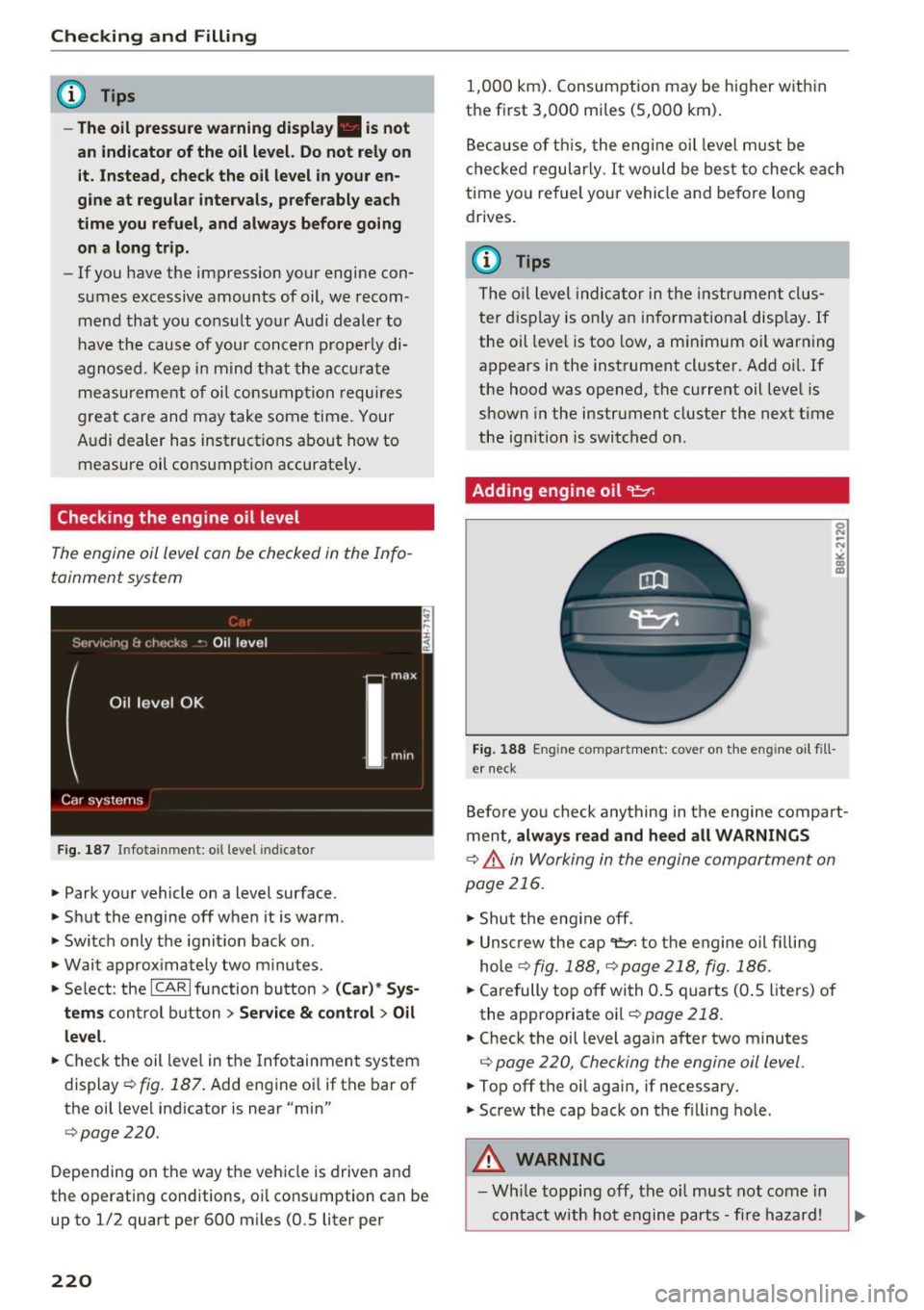
The engine oil level can be checked in the Info
tainment system
Fig. 187 I n fo tai nme nt: oil level indic a to r
• Park your vehicle on a level surface.
" Shut the engine off when it is warm .
.. Switch only the ignition back on.
.. Wait approximately two minutes.
" Select : the
ICAR I function button > (Car)* Sys
tems
control button > Service & control > Oil
level.
.. Check the oil level in the Infotainment system
display ¢
fig. 187. Add engine oil if the bar of
the oil level indicator is near "min"
¢page 220.
Depending on the way the vehicle is driven and
the operating conditions, oil consumption can be
up to 1/2 quart per 600 miles (0 .5 liter per
220
1,000 km). Consumption may be higher within
the first 3,000 miles (5,000 km).
Because of this, the engine oil level must be
checked regularly. It would be best to check each
time you refuel your vehicle and before long
drives.
{!) Tips
The oil level indicator in the instrument clus
ter display is only an informational display. If
the oil level is too low, a minimum oil warning
appears in the instrument cluster. Add oil. If
the hood was opened, the current oil level is
shown in the instrument cluster the next time
the ignition is switched on.
Adding engine oil 'l:::1:
Fig. 188 En g in e compartment : cover on the engine oil fill
er neck
Before you check anything in the engine compart
ment,
always read and heed all WARNINGS
¢ .&. in Working in the engine compartment on
page 216.
"Shut the engine off .
"Unscrew the cap~ to the engine oil filling
hole
¢ fig. 188, ¢page 218, fig. 186.
.. Carefully top off with 0.5 quarts (0.5 liters) of
the appropriate oil ¢
page 218.
.. Check the oil level again after two minutes
¢ page 220, Checking the engine oil level.
"Top off the oil again, if necessary.
"Screw the cap back on the filling hole.
_&. WARNING
- While topping off, the oil must not come in
contact with hot engine parts - fire hazard!
Page 230 of 294
Checking and Filling
will be d amage d and will then have to be re
placed.
Battery charging
Starting the engine requires a w ell charged bat
tery.
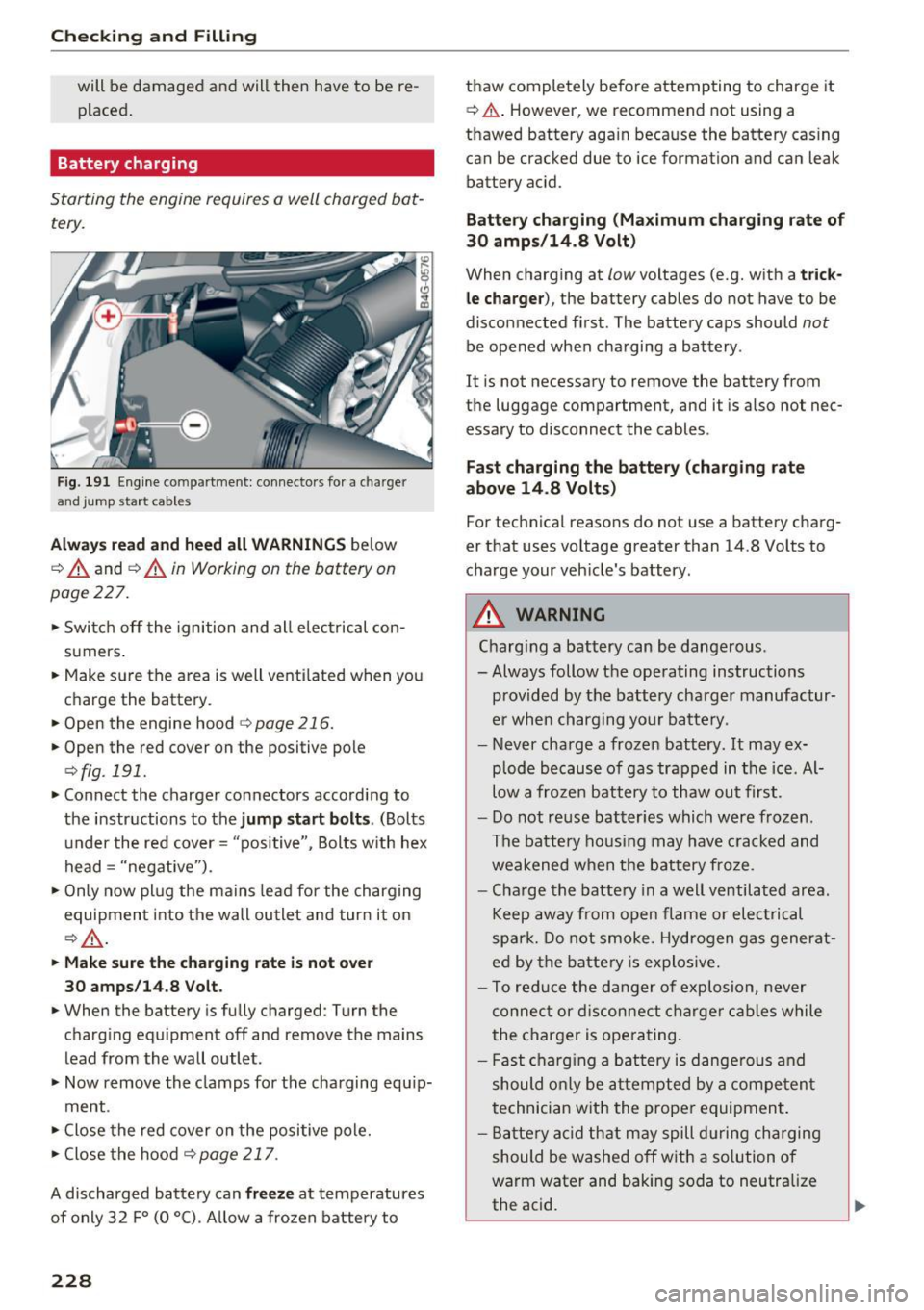
F ig. 191 Eng ine co mpartmen t: connecto rs for a cha rge r
and jump start cab les
Alwa ys re ad and h eed all WARNINGS below
¢ A and ¢ A in Working on the battery on
page 227.
• Switc h off the ignition and all elec trical con
sumers .
• Make sure the area is well venti lated when you
charge the battery .
• Open the engine hood
c> page 216.
• Open the red cover on the positive pole
¢ fig. 191.
• Connect the charger connectors according to
the instructions to the
j um p sta rt bo lt s . (Bolts
u nder the red cover= "positive" , Bolts w ith hex
head = "negative ") .
• Only now pl ug the mains lead for the charging
equipment into the wall outlet and tur n it on
¢£ .
• Make sure the charg ing rate is not o ver
30 a mps/14 .8 Volt .
• When the battery is fully charged: Turn the
charging equipment off and remove the mains
lead from the wall outlet .
• Now remove the clamps for the charging equ ip-
ment .
• Close the red cover on the positive pole.
• Close the hood
c> page 217 .
A discharged battery can free ze at temperatures
of only 32 F
0 (0 °C). A llow a frozen battery to
228
thaw completely before attempting to charge it
c> & . However, we recommend not using a
thawed battery aga in because the battery cas ing
can be cracked due to ice formation and can leak
battery ac id.
Batte ry cha rging (M ax imum charg ing rate of
30 amps /14 .8 V olt)
When charging at low voltages (e.g. with a tric k
le ch arger ),
the battery cables do not have to be
disconnected first . The battery caps should
not
be opened when charging a battery .
It is not necessary to remove the battery from
the luggage compartment, and it is also not nec
essary to disconnect the cables.
Fa st cha rging the batt ery (charg ing rat e
above 14 .8 Volt s)
For techn ical reasons do not use a battery charg
er that uses voltage greater than 14.8 Volts to
charge your veh icle's battery.
&_ WARNING
Charg ing a battery can be dangerous .
- Always follow the operating instructions
provided by the battery cha rger manufactur
er when charging your ba tte ry .
- Never charge a frozen battery . It may ex
plode because of gas trapped in the ice. Al
low a froze n battery to thaw out first.
- Do not reuse batter ies which were frozen.
The battery hous ing may have c racked and
weakened when the battery fro ze.
- Cha rge the batte ry in a well ventilated area .
Keep away from open flame or elect rical
sp ark. Do not smoke. Hydrogen gas generat
ed by the batte ry is e xplosive.
- To red uce the da nger of explosion, never
connect or d isconnect c harger c ables while
the charger is ope ra ting.
- Fa st c harg ing a bat tery is dange rous and
should o nly be atte mpted by a compe ten t
technician w ith the proper equipment .
- Ba tte ry a cid that may spill d uring charging
should be washed off w it h a so lution of
warm water and baking soda to neutralize
the acid.
Page 283 of 294
Starting . . . . . . . . . . . . . . . . . . . . . . . . . . . . 7 4
Starting with jumper cables . . . . . . . . . . . 264
Stopping . . . . . . . . . . . . . . . . . . . . . . . . . . . . 7 5
E ng ine compartment ......... .. .. .... . 218
C losing the hood . . . . . . . . . . . . . . . . . . . . 217
Opening the hood ................... 216
Safety instructions .................. . 216
Working in the engine compartment .... 216
Index
Event Data Recorder (EDR) . . . . . . . . . . . . . 186
Expansion tank . . . . . . . . . . . . . . . . . . . . . . . 222
Exterior lighting . . . . . . . . . . . . . . . . . . . . . . . 44
Exterior mirrors
Adjusting . . . . . . . . . . . . . . . . . . . . . . . . . . . 48
Dimming ... ... .. .. ................ .. 49
Heating.... ... .. .. ................. . 48
Exterior temperature d isplay . . . . . . . . . . . . . 23
E ng ine coolant . . . . . . . . . . . . . . . . . . . . . . . 222
Adding coolant . . . . . . . . . . . . . . . . . . . . . . 223
F
Checking the engine coolant level. . . . . . . 222
Expansion tank . . . . . . . . . . . . . . . . . . . . . . 222
Malfunction symbol . . . . . . . . . . . . . . . . . . . 15
Radiator fan . . . . . . . . . . . . . . . . . . . . . . . . 224
Temperature gauge . . . . . . . . . . . . . . . . . . . 10
Engine oil ... .. ................ ..... . 218
Adding . . . . . . . . . . . . . . . . . . . . . . . . . . . . 220
Additives . . . . . . . . . . . . . . . . . . . . . . . . . . . 220
Changing . . . . . . . . . . . . . . . . . . . . . . . . . . 221
Checking oil level . . . . . . . . . . . . . . . . . . . . 220
Consumption . . . . . . . . . . . . . . . . . . . . . . . 220
Indicator light . . . . . . . . . . . . . . . . . . . . . . . 17
O il consumption . . . . . . . . . . . . . . . . . . . . . 219
Pressure malfunction . . . . . . . . . . . . . . . . . 17
Sensor defective . . . . . . . . . . . . . . . . . . . . . . 21
Specification and viscos ity.... .. .. .. .. . 218
Engine sound . . . . . . . . . . . . . . . . . . . . . . . . 100
Engine speed limitation (indicator light) 21
E ng ine Start-Stop mode
refer to Start-Stop-System . . . . . . . . . . . . . 81
Engine warm-up request Indicator light . . . . . . . . . . . . . . . . . . . . . . . 21
Environment Catalytic converter . . . . . . . . . . . . . . . . . . . 195
Diesel particulate filter . . . . . . . . . . . . . . . 196
Disposing of your vehicle battery . . . . . . . 229
Driving at high speeds . . . . . . . . . . . . . . . . 196
Fue l .. ... ... ...... ............. ... . 210
L eaks under your veh icle ....... .. .. .. . 216
L ett ing the veh icle stand and wa rm up . . . 197
Proper disposal of drained brake fluid . . . 225
Proper disposal of drained engine coolant 223
Proper disposal of drained engine oi l 220,221
Recycling used engine oil . . . . . . . . . . . . . 220
Unleaded fuel . . . . . . . . . . . . . . . . . . . . . . . 208
What should I do with an old battery? . . . 229
ESC Automatic post-collision braking system . 188 Fastening
Booster seats . . . . . . . . . . . . . . . . . . . . . . . 17 S
Convertible child safety seats . . . . . . . . . . 173
Infant seats . . . . . . . . . . . . . . . . . . . . . . . . 172
Floor mats . . . . . . . . . . . . . . . . . . . . . . . . . . . 130
Foot pedals . . . . . . . . . . . . . . . . . . . . . . . . . . 130
For the sake of the env ironment
Environmentally-friendly driving . . . . . . . 196
Gasoline fumes and the env ironment .. .. 210
Reducing engine noise by early upshifting . 10
Refueling . . . . . . . . . . . . . . . . . . . . . . . . . . 210
Saving fuel by early upshifting . . . . . . . . . . 10
Warming up the engine . . . . . . . . . . . . . . . . 74
Four-zone automatic climate control
Air vents . . . . . . . . . . . . . . . . . . . . . . . . . . . . 71
Auxiliary heater . . . . . . . . . . . . . . . . . . . . . . 72
Basic settings . . . . . . . . . . . . . . . . . . . . . . . . 72
Operating . . . . . . . . . . . . . . . . . . . . . . . . . . . 70
Recirculation mode . . . . . . . . . . . . . . . . . . . 72
Residual heat . . . . . . . . . . . . . . . . . . . . . . . . 71
Synchronizing .. .. .. .................. 71
Front airbags Description . . . . . . . . . . . . . . . . . . . . . . . . . 146
How they work . . . . . . . . . . . . . . . . . . . . . . 151
Frontal collisions and the laws of physics . . 135
Front seats . . . . . . . . . . . . . . . . . . . . . . . . . . . 54
Adjusting . . . . . . . . . . . . . . . . . . . . . . . . . . 127
Child restraints in the front seat . . . . . . . . 143
Fuel Additives . . . . . . . . . . . . . . . . . . . . . . . . . . . 208
Blended gasoline . . . . . . . . . . . . . . . . . . . . 208
Current consumption . . . . . . . . . . . . . . . . . . 24
Fuel filler neck . . . . . . . . . . . . . . . . . . . . . . 210
Fuel gauge .. .. .. ............... .. 10 , 11
Gasoline . . . . . . . . . . . . . . . . . . . . . . . . . . . 208
Gasoline additives . . . . . . . . . . . . . . . . . . . 209
Indicator light . . . . . . . . . . . . . . . . . . . . . . . 21
281
Page 284 of 294
Index
Octane rating Recomm endation ................ ... .
Refuelling .. .. .. ................ ... .
Saving fuel . .. ...... .. ... .... .... .. . 208
208
210 196
T ank cap acit y . .... ...... ..... .... .. . 271
F ueling
Fuel filler door emergency release . . . . . . 212
Fue l gauge . . . . . . . . . . . . . . . . . . . . . . . . . . 11
Fuses Assignment . . . . . . . . . . . . . . . . . . . . . . . . 260
Replacing . . . . . . . . . . . . . . . . . . . . . . . . . . 259
G
Garage door opener (Homelink) . . . . . . . . . . 42
Garment hooks . . . . . . . . . . . . . . . . . . . . . . . . 61
Gas discharge lamps . . . . . . . . . . . . . . . . . . . 263
Gauges Engine coolant temperature . . . . . . . . . . . . 10
General illustration . . . . . . . . . . . . . . . . . . . . . 8
Generator (warning/indicator lights) . . . . . . 16
Glossary of tire and loading terminology . . 233
Glove compartment (cooled) . . . . . . . . . . . . . 61
Glow plug system Indicator light . . . . . . . . . . . . . . . . . . . . . . . 20
Gross Vehicle Weight Rating (GVWR) . . . . . 270
H
Head-up display . . . . . . . . . . . . . . . . . . . . . . . 27
Headlight Assistant . . . . . . . . . . . . . . . . . . . . . . . . . . . . 45
Headlight range control system . . . . . . . . . . 44
Headlights Cleaning . . . . . . . . . . . . . . . . . . . . . . . . . . . 204
Headlight range control . . . . . . . . . . . . . . . 22
Headlight range control system . . . . . . . . . 44
Washer reservoir . . . . . . . . . . . . . . . . . . . . 229
Washer system . . . . . . . . . . . . . . . . . . . . . . 51
Head restraints . . . . . . . . . . . . . . . . . . . . . . . 128
Adjusting . . . . . . . . . . . . . . . . . . . . . . . . . . 128
Front seats . . . . . . . . . . . . . . . . . . . . . . . . . . 56
Rear seats . . . . . . . . . . . . . . . . . . . . . . . . . . . 57
Removing . . . . . . . . . . . . . . . . . . . . . . . . . . . 57
Heated Exterior mirrors . . . . . . . . . . . . . . . . . . . . . . 48
Rear window (four-zone automatic climate
control) . . . . . . . . . . . . . . . . . . . . . . . . . . . . . 71
282
Rear window (three-zone climate control) . 69
Seats (four-zone automatic climate control) .7.1
Seats(three-zone climate control) . . . . . . . 69
Washe r no zzles . . . . . . . . . . . . . . . . . . . . . . 51
Heating . . . . . . . . . . . . . . . . . . . . . . . . . . . . . . 67
Heavy clothing and safety belts . . . . . . . . . . 1 36
High beam . . . . . . . . . . . . . . . . . . . . . . . . . . . . 45
High voltage warning label . . . . . . . . . . . . . 270
Hill de scent control . . . . . . . . . . . . . . . . . . . 109
Homelink (garage door opener) . . . . . . . . . . 42
Hood (release lever) . . . . . . . . . . . . . . . . . . . 216
Horn . . . . . . . . . . . . . . . . . . . . . . . . . . . . . . . . . 8
How are child restraint system anchors relat-
ed to child safety . . . . . . . . . . . . . . . . . . . . . 179
How many airbags does my vehicle have? . . 149
How safety belt pr ete nsioners work . . . . . . 140
I
Ignition
Indicator light ... .. .. ................ 17
Switching on/off . . . . . . . . . . . . . . . . . . . . . 74
Imbalance (wheels) . . . . . . . . . . . . . . . . . . . 239
Immobilizer . . . . . . . . . . . . . . . . . . . . . . . . . . 26
Important things to do before driving . . . . 125
Improperly worn safety belts . . . . . . . . . . . 140
Indic ator lights .. .. .. .. .... .. .. ....... . 11
also refer to Warning/indicator lights . . . . 11
Infant seats . . . . . . . . . . . . . . . . . . . . . . . . . 172
Inflation pressure (t ires) . . . . . . . . . . . . . . . 241
Inspection interval . . . . . . . . . . . . . . . . . . . . . 26
Installing child safety seats
Safety belts . . . . . . . . . . . . . . . . . . . . . . . . 176
Installing the upper tether strap on the an
chorage . . . . . . . . . . . . . . . . . . . . . . . . . . . . . 182
Instrument cluster . . . . . . . . . . . . . . . . . . . . . 10
Indicato r lights .. .. .. ............. .. . 11
Messages . . . . . . . . . . . . . . . . . . . . . . . . . . . 11
Instruments . . . . . . . . . . . . . . . . . . . . . . . . . . 10
Adjusting illumination . . . . . . . . . . . . . . . . . 48
Instruments and controls
General illustration . . . . . . . . . . . . . . . . . . . . 8
Interior lighting Ambient lighting . . . . . . . . . . . . . . . . . . . . . 47
Front and rear . . . . . . . . . . . . . . . . . . . . . . . 47
Inte rmittent (windshield wipers) . . . . . . . . . 51
Page 286 of 294
Index
Mirrors dimming ... .... ................ ..... 49
Exterior mirrors . . . . . . . . . . . . . . . . . . . . . . 48
Mon itor ing the Advanced Airbag System . . 153
Multifunction steering wheel . . . . . . . . . . . . . 24
N
Natural leather care/cleaning
NHTSA 206
Contacting . . . . . . . . . . . . . . . . . . . . . . . . . 132
Night vision assist . . . . . . . . . . . . . . . . . . . . 103
Cleaning the camera . . . . . . . . . . . . . . . . . 204
Nitrogen oxide (NOx) catalytic converter
refer to AdBlue .... .................. 212
Number of seats . . . . . . . . . . . . . . . . . . . . . . 134
0
Occupant seating positions . . . . . . . . . . . . . 126
Octane rating . . . . . . . . . . . . . . . . . . . . . . . . 208
Odometer . . . . . . . . . . . . . . . . . . . . . . . . . . . . 26
OFF (four-zone automat ic cl imate control) . . 70
OFF (three- zone climate control) . . . . . . . . . . 68
Oil
refer to Engine oil . . . . . . . . . . . . . . . . . . . 218
Oil change interval . . . . . . . . . . . . . . . . . . . . . 26
On-board computer . . . . . . . . . . . . . . . . . . . . 24
On-Board Diagnostic System (OBD)
Data Link Connector (DLC) . . . . . . . . . . . . . . 28
Electronic speed limiter . . . . . . . . . . . . . . . . 29
Malfunction Indicator Lamp (MIL) . . . . . . . 28
Open door/hood/rear lid warn ing . . . . . . . . . 23
Opening..... .. .. ..................... 30
Hood . . . . . . . . . . . . . . . . . . . . . . . . . . . . . . 216
Luggage compartment lid . . . . . . . . . . . . . . 37
Sunroof .. .. .. .. ............. .. .. .. .. 41
W indows .. .. .... ............. ...... 40
Other consumers (efficiency program) . . . . . 25
Outlet . . . . . . . . . . . . . . . . . . . . . . . . . . . . . . . 59
Owner 's Literature
5
p
Paint damage 205
Paint No. . . . . . . . . . . . . . . . . . . . . . . . . . . . . 270
284
Parking
Automatic transmission . . . . . . . . . . . . . . 108
Valet parking . . . . . . . . . . . . . . . . . . . . . . . . 41
Parking aid Cleaning sensors/camera . . . . . . . . . . . . . 204
Parking brake . . . . . . . . . . . . . . . . . . . . . . . . . 77
Emergency braking function . . . . . . . . . . . . 78
Parking . . . . . . . . . . . . . . . . . . . . . . . . . . . . . 77
Start ing from a stop . . . . . . . . . . . . . . . . . . 78
Start ing to drive w ith a trailer . . . . . . . . . . . 78
also refer to Electromechanical
parking brake . . . . . . . . . . . . . . . . . . . . . . . . 77
Parking lights . . . . . . . . . . . . . . . . . . . . . . . . . 44
Parking system Adjusting the display/warning tone . . . . . 123 Cleaning the rearview camera . . . . . . . . . . 115
Malfunction . . . . . . . . . . . . . . . . . . . . . . . . 123
Parking system plus . . . . . . . . . . . . . . . . . . 114
Peripheral cameras . .. ............. .. 118
Peripheral display . . . . . . . . . . . . . . . . . . . 114
Trailer hitch . . . . . . . . . . . . . . . . . . . . . . . . 123
also refer to Parking systems . . . . . . 114, 115
Parking systems . . . . . . . . . . . . . . . . . . . . . . 113
Rearv iewcamera ..... ............... 115
Parts replacement . . . . . . . . . . . . . . . . . . . . 275
Pass-through with ski sack . . . . . . . . . . . . . . . 66
PASSENGER AIR BAG OFF light . . . . . . . . . . 154
Passenger protection . . . . . . . . . . . . . . . . . . 184
Pedals . . . . . . . . . . . . . . . . . . . . . . . . . . . . . . 130
Pedestrian detection . . . . . . . . . . . . . . . . . . 103
Peripheral display. ... ................. 114
Physical principles of a frontal co llision . . . 135
Polishing . . . . . . . . . . . . . . . . . . . . . . . . . . . . 205
Po llen filter
refer to Pollutant filter . . . . . . . . . . . . . . . . 67
Pollutant filter . . . . . . . . . . . . . . . . . . . . . . . . 67
Power Windows . .... .. .. .. ............. ... 40
Power locking system Locking/unlocking the vehicle from inside . 35
Rear lid . . . . . . . . . . . . . . . . . . . . . . . . . . . . . 36
Unlocking and locking vehicle . . . . . . . . . . . 33
Power seat adjustment . . . . . . . . . . . . . . . . . 54
Power windows Child safety lock . . . . . . . . . . . . . . . . . . . . . . 39
Convenience opening . . . . . . . . . . . . . . . . . . 40
Malfunction . . . . . . . . . . . . . . . . . . . . . . . . . 41