power steering AUDI A6 2016 User Guide
[x] Cancel search | Manufacturer: AUDI, Model Year: 2016, Model line: A6, Model: AUDI A6 2016Pages: 294, PDF Size: 73.88 MB
Page 120 of 294
Parking system s
CD Note
Keep enough distance from the curb to avoid
damage to the rims .
@ Tips
The left or right orientation lines and surfaces
wi ll be displayed, depending on the turn sig
nal being used .
Peripheral cameras
Introduction
Applies to vehicles: with peripheral cameras
With this equipment, die parking system plus* is
supp lemented with var io us peripheral cameras
qpage 114. Depending on vehicle equipment,
you are provided with the following views: Around the vehicle, front corner and rear corner,
in front of the vehicle and behind the vehicle.
General information
Applies to veh icles: with peripheral cameras
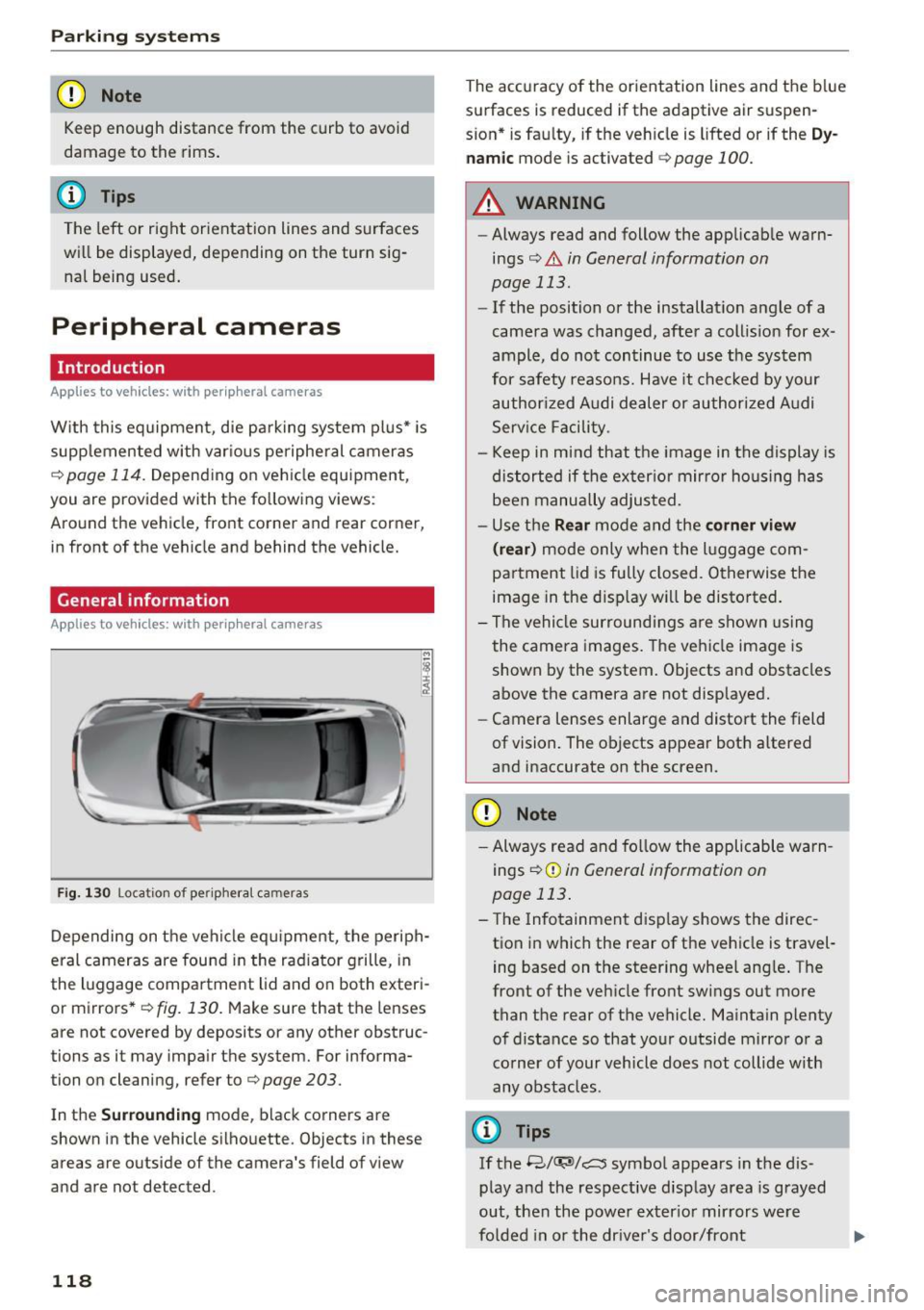
F ig . 1 30 Location of periphe ral cameras
Depending on the vehicle eq uipment, the periph
eral cameras are fou nd in the radiator grille, in
the luggage compa rtment lid and on both exteri
or mirrors *
q fig. 130. Make sure that the lenses
are not covered by deposits or any other obstruc
tions as it may impair the system. For informa
tion on cleaning, refer to¢
page 203.
In the Surrounding mode, black corners are
shown in the vehicle silhouette. Objects in these
areas are outside of the camera's field of v iew
and are not detected.
118
The accuracy of the orientation lines and the b lue
surfaces is reduced if the adaptive air suspen
s ion* is fau lty, if the veh icle is lifted or if the
D y
nam ic mode is activated qpage 100.
A WARNING
-Always read and follow the applicab le warn
ings¢ .&
in General information on
page 113.
- If the position or the installat ion angle of a
camera was changed, after a collis ion for ex
ample, do not continue to use the system
for safety reasons. Have it chec ked by your
authorized Audi dealer or authori zed A udi
Serv ice Facility.
- Keep in mind that the image in the display is
distorted if the exter ior mir ror ho using has
been manually adjusted.
- Use the
Rear mode and the corner view
( rear )
mode only when the l uggage com
partment lid is fu lly closed. Otherwise the
image in the disp lay will be disto rted.
- The vehicle surroundi ngs a re shown using
the camera images. The veh icle image is
shown by the system. Objects and obstacles
above the camera are not displayed.
- Camera lenses enlarge and distort the field
of vision. The objects appear both a ltered
and inaccurate on the screen.
CD Note
- Always read and fo llow the applicable warn
ings
¢ (Din General information on
page 113 .
-The Infotainment d isp lay shows the direc
tion in which the rear of the vehicle is travel
ing based on the steering wheel ang le . The
front of the vehicle front sw ings out more
than the rear of the vehicle. Maintain plenty of distance so that your o utside mirror or a
corner of your vehicle does not collide with
any obstacles.
(I} Tips
If the 8/(J;(SJ/c:, symbol appears in the dis
play and the respective display area is grayed
out, then the power exter io r mir rors we re
fo lded in or the dr ive r's door/front
Page 152 of 294
Airbag system
-An Advanced Airbag with gas generator and
control valve for the driver inside the steering
wheel hub.
- An Advanced Airbag with gas generator and
control valve inside the instrument panel for
the front passenger.
- A capacitive passenger detection system under
neath the front passenger seat cover. This sys
tem measures the electrical capacitance of the
person in the seat. The information registered
is sent continuously to the electronic control
unit to regulate deployment of the front Ad
vanced Airbag on the passenger side.
- An airbag monitoring system and indicator
light in the instrument cluster~
page 153.
-A sensor in each front seat registers the dis
tance between the respective seat and the
steering wheel or instrument panel. The infor
mation registered is sent continuously to the
electronic control unit to regulate deployment
of the front Advanced Airbags.
- The
PASSENGER AIR BAG OFF light comes on
and stays on in the center of the instrument
panel
~ pag e 154, fig. 159 and tells you when
the front Advanced Airbag on the passenger side has been turned
off.
- A sensor in the safety belt latch for the driver
and for the front seat passenger that senses
whether that safety b elt is latched or not and
transmits this information to the electronic control unit.
A WARNING
Damage to the front passenger seat can pre
vent the front airbag from working properly .
- Improper repair or disassembly of the front
passenger and driver seat will prevent the
Advanced Airbag System from functioning properly.
- Repairs to the front passenger seat must be
performed by qualified and properly trained
workshop personnel.
- Never remove the front passenger or driver
seat from the vehicle.
- Never remove the upholstery from the front
passenger seat.
- Never disassemble or remove parts from the
seat or disconnect wires from it.
150
- Never carry sharp objects in your pockets or
put them on the seat. The capacitive pas
senger detection mat in the front passenger
seat will not function properly if it is punc
tured .
- Never carry things on your lap or carry ob
jects on the front passenger seat . Such ob
jects can influence the capacitance regis
tered by the capacitive passenger detection
system, so that incorrect information is pro
vided to the airbag control unit.
- Never store items under the front passenger
seat . Parts of the Advanced Airbag System
under the passenger seat could be dam
aged, preventing them and the airbag sys
tem from working properly.
- Never place seat covers or replacement up
holstery that have not been specifically ap
proved by Audi on the front seats.
- Seat covers can prevent the Advanced Air
bag System from recognizing child re
straints or occupants on the front passenger
seat and prevent the side airbag in the seat
backrest from deploying properly.
- If a seat heater has been retrofitted or oth
erwise added to the front passenger seat,
never install any child restraint system on
this seat.
- Never use cushions, pillows, blankets, or
similar items on the front passenger seat.
The additional layers prevent the capacitive
passenger detection system from accurately
measuring the capacitance of the child safe
ty seat and/or the person on the seat and
thus keep the Advanced Airbag System from
working properly.
- Never place or use any electrical device
(such as a laptop, CD player, electronic
games device , power inverter or seat heater
for child seats) on the front passenger seat
if the device is connected to the 12-volt
socket or the cigarette lighter socket. Such
devices can influence the capacitance regis
tered by the capacitive passenger detection
system, so that incorrect information is pro
vided to the airbag control unit.
- If you must use a child restraint on the front
passenger seat and the child restraint
~
Page 189 of 294
shared, please see your contract with the
wireless telecommunications provider and the
"About Aud i connect" tab in your vehicle's
MMI:
! MENUI button> Aud i connect > About
Audi conn ect.
Electronic Stabilization
Control (ESC)
Description
ESC helps to improve road ho ld ing and vehicle
dynamics to help reduce the probability of skid
d ing and loss of vehicle control. It works only
when the engine is runn ing . E SC detects certain
d ifficult dr iving sit uat ions, including when t he
ve hicl e is begin ning to spin (yaw) out of contro l
and helps you to ge t the veh icle back under con
tro l by se lective ly braking the wheels, and/or re
ducing engine powe r and provid ing steering as
sistance to help hold the vehicle on the dr iver's
intended course. The indicator light
GJ in the in
strument cluster blinks when ESC is taking action
to help you co ntrol the vehicle.
ESC has limitations. It is important to remember
that ESC cannot overcome the laws of physics. It
will not a lways be able to help out under all con
d itions you may come up aga inst. For example,
ESC may not always be able to help you master
situations where there is a sudden change in the
coeff icient of friction of the road surface. When
there is a section of dry road that is sudde nly cov
e red with water, slush o r snow, ESC cannot pe r
form the same way it wo uld on the dry s urface . If
the vehicle hydrop lanes (rides on a cushion of wa
ter i nstead of the road su rface), ESC wi ll not be
ab le to he lp you steer the veh icle because contact
with the pavement has been interrupted and the
ve hicle cannot be braked or steered. Dur ing fast
cornering, pa rticula rly on w inding roads, ESC
cannot always deal as effect ively w it h difficult
d riving si tuations tha n at lowe r speeds.
Always adjust your speed and driving style to road , traffic and weather cond itions . ESC cannot
override the vehicle's physical lim its, increase the
ava ilab le traction, o r keep a ve hicle on the road if
road departure is a resu lt of driver in attention .
I nstead, ESC imp roves the possibi lity of keep ing
Intellig ent Technology
the vehicle under contro l and on the road d uring
extreme mane uvers by using the driver's steering
i nputs to help keep the vehicle go ing in the in
tended direction. If you are traveling at a speed
that causes you to run off the road before ESC
can provide any assistance, you may not exper i
ence the benefits of ESC.
ESC is switched on all the time. In certain s itua
tions when you need less tract ion, you can sw itch
off ASR by press ing the button
lm c> page 188,
fig . 177 . Be sure to switc h ASR on again whe n
you no longer need less traction.
The following systems are integrated in the ESC:
Anti-lock braking sy stem (ABS )
ABS prevents the wheels from locking when brak
ing. The vehicle can still be steered even dur ing
hard braking. Apply steady pressure to the brake
pedal. Do not pump the pedal. A pulsing in the
brake pedal ind icates that the system is acting to
stab ilize the veh icle .
Brake assist system
The brake assist system can decrease braking dis
tance. It increases braking power when the dr iver
presses the brake peda l quickly in emergency sit
uat ions. You must press and ho ld the brake pedal
unt il the dange rous situation is over . In vehicles
with adaptive c ruise cont rol*, the b rake ass ist
system is more se nsitive if the distance detected
to the ve hicle ahead is too sma ll.
Anti-slip regulation (ASR)
ASR reduces engine power whe n the dr ive wheels
begin spin ning and adapts the force to the road
co ndit ions. This makes it eas ier to s tart, acce ler
ate a nd d rive up incl ines.
Electronic differential lock (EDL)
The EDL brakes wheels that are spinning and
transfers the drive power to the other dr ive
wheel or wheels if the vehicle is equ ipped with all
whee l drive*) . This function is not available a t
highe r speeds .
In extreme cases, EDL automat ica lly switches off
to keep t he brake o n the braked wheel from over
hea ting . T he veh icle is still working co rrectly. EDL
IJJ>
187
Page 190 of 294
Intelligent Technology
will switch on again automat ically when condi
tions have returned to normal.
Steering recommendation
The ESC helps to stabilize the veh icle by changing
the steering torque.
In vehicles with dynam ic steering*, ESC also
helps to stabilize the steering in critical situa
tions.
Selective wheel torque control
Selective wheel torque control is used when driv
ing on curves . The front wheel on the inside of
the curve or both wheels on the inside of the
curve are braked selectively as needed. This al
lows more precise driving in curves.
Automatic post-collision braking system
The "Automatic post-collision braking system"
can help to reduce the risk of slid ing and of other
coll is ions after an accident . If the airbag control
module detects a collision above a certain vehicle
speed, the vehicle is braked by the ESC.
The vehicle does not brake automat ically if:
- the driver presses the accelerator pedal, or
- the braking force generated by the pressed
brake pedal is greater than the braking force
that would be initiated by the system, or
- the ESC, the brake system or the vehicle electri
cal system are not functioning.
Switchin on/off
A WARNING
- The ESC and its integrated systems cannot
overcome the limits posed by natural physi
cal laws. This is especially important on slip
pery or wet roads. If the systems beg in act
ing to stabilize your vehicle, yo u should im
mediately alter your speed to match the
road and traffic conditions . Do not let the
increased safety provided tempt you into
taking risks. This could increase your risk of
a co llision.
- Please note the risk of a collision increases
when driving fast, especially through curves
and on slippery or wet roads, and when driv
ing too close to objects ahead. The ESC and
its integrated systems cannot always pre
vent collisions -there is still a risk of acci
dents!
- Press the accelerator pedal carefully when
accelerating on even, slippery surfaces such
as ice and snow. The drive wheels can spin
even when these control systems are instal
led and this can affect driving stability and
increase the risk of a collision.
{l) Tips
-ABS and ASR only function correctly when
all four wheels are equipped with identical
tires. Different tire sizes can lead to a reduc
tion in engine power.
- You may hear noises when the systems de
scribed are working.
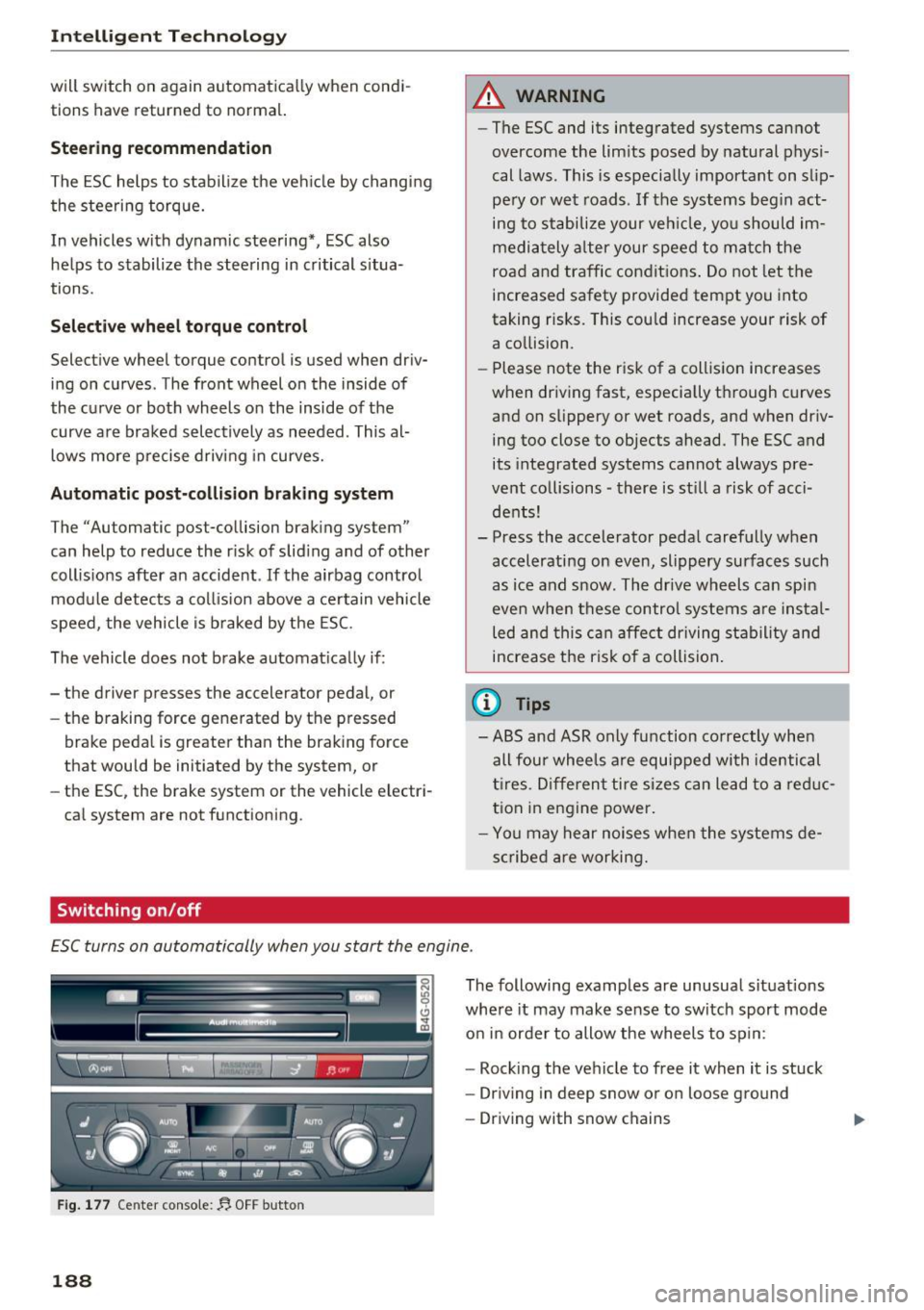
ESC turns on automatically when you start the engine.
Fig. 177 Center conso le; !j. OFF button
188
The following examples are unusual situations
where it may make sense to switch sport mode
on in order to allow the wheels to spin:
- Rock ing the vehicle to free it when it is stuck
- Driving in deep snow or on loose ground
- Driving with snow chains
Page 192 of 294
Intelligent Technology
if the car is not driven regularly or only for short
trips with little use of the brakes.
If the brakes are not used frequently , or if corro
sion has formed on the discs, it is advisable to
clean off the pads and discs by braking firmly a
few times from a moderately high speed¢& .
Faults in the brake system
If you should notice a sudden increase in brake
pedal travel, then one of the two brake circuits
may have failed ¢
&..
Low brake fluid level
Malfunctions can occur in the brake system if the
brake fluid level is too low. The brake fluid level
is monitored e lectronically .
Brake booster
The brake booster works with vacuum pressure
which is created only when the engine is running
c:;> &, .
Brake lining wear status
Brake lining wear may be checked by visual in
spection of the condition of the brake pads
through the openings in the wheel. If necessary,
the wheel may be removed for this inspection
c;> page 253, Replacing wheels .
A WARNING
-New brake pads don't have the best stop
ping power and must be "broken- in" dur ing
the initial 250 miles (400 km) . You can
compensate for this by pressing the brake
pedal more firmly. This also applies later
when new pads are installed.
- You should perform braking maneuvers for
the purpose of cleaning the brake system
only if road conditions permit. Other road
users must not be put at risk -you may
cause an accident!
-
- Before descending a steep grade, reduce
speed and shift transmission into a lower
gear or lower driving range. Do not ride the
brakes or hold the pedal down too long or
too often . This could cause the brakes to get
hot and diminish brak ing efficiency.
190
- Do not "ride the brakes" by resting your foot
on the pedal when you do not intend to brake. This may cause the brakes to over
heat, premature wear and increased stop
ping distance.
- Under certain climatic and operating condi
tions such as passing through water, driving in heavy rain or after washing the vehicle,
the effectiveness of the brakes can be re
duced. In winter, ice can accumulate on the
brake pads, linings, discs and drums. Care
fully apply brakes for a test. Brakes will dry
and ice coatings will be cleaned off after a
few careful brake applications .
- Driving for an extended period of time on
salt-covered roads without using your
brakes can also affect braking efficiency .
Clean off accumulated salt coating from brake discs and pads with a few careful
brake applications.
- If you damage the front spoiler, or if you in
stall a different spoiler, be sure the air flow
to the front brakes is not obstructed. Other
wise the brake system could overheat reduc
ing the effectiveness of the entire brake sys
tem.
- Fa ilure of one brake circuit will impair the
braking capability resulting in an increased
stopping distance. Avoid driving the vehicle
and have it towed to the nearest Audi dealer
or qualified workshop.
- Never let the vehicle roll to a stop with the
engine shut off.
- If the brake booster is not working, the
brake pedal must be pressed considerably
harder to make up for the lack of booster
assistance.
Electromechanical
steering, dynamic
steering
The electromechanical steering supports the
driver's steering movements.
Power steering adapts electronically based on
the vehicle speed.
Page 193 of 294
Indicator lights and m essa ges
• Do not dri ve v ehicle : steerin g defe ctive
If th is ind icator light turns on and stays on and
this message appears, the power steer ing may
h ave fa iled.
Stop the vehicle in a safe locat ion as soon as pos
sib le . Do
not continue dr iving. See an authorized
Aud i deale r or autho rized Aud i Serv ice Facility fo r
assistance .
'1:I Stee ring: System fau lt You ca n continu e
dri ving
If the indicator light turns on and the message
appears, the steering may be more difficult to
move or more sensit ive tha n usual. The steering
wheel may also be at an angle when driving
stra ight.
Drive s lowly to your author ized Audi dealer or au
thor ized Audi Service Fac ility to have the mal
function corrected.
kr.ij D ynam ic steering : Ini tializing
If the indicator lig ht ls b link ing and th is message
appears, dynamic steering* is being initialized.
Once you start the engine after this is finished,
the steering wheel will be easy to move. Re-in iti
alization m ight be necessary if the steering wheel
was moved hard to the left and right wh ile the
ve hicle was not moving . The display turns off if
the initialization was successfu l.
{D) Tips
-If the . or '1:I indicator light only stays on
for a short time, you may continue driving .
- The dynamic steering stability systems
¢ page 187 are not available in the event of
a system ma lf u nction.
- For additional informat io n on dynamic
steering, refer to¢ page 100.
Intelligent Technology
All wheel drive (quattro)
Applies to vehicles: with all wheel drive
In all wheel drive, all four wheels are powered.
General informat ion
In all whee l dr ive, the dr iving power is div ided be
tween all fou r wheels . This happens automatical
ly depending on yo ur driving behavior as we ll as
the cur rent road conditions . Refer to ¢ page 187,
E lectronic Stabilization Control (ESC).
A center d ifferential d istribu tes the driving power
variab ly to the front and rear axle. It works to
gether with selective whee l torque contro l, w hich
activates when driving through curves
¢ page 188. With the sport d ifferential*, power
distribution to the rear wheels is variable and can
be adjusted with drive select¢ page 100 .
The all wheel drive concept is designed for high
engine power. Your vehicle is except ionally pow
erfu l and has excellent driv ing characteristics
both under normal driving conditions and on
snow and ice . Always read and follow safety pre
cautions ¢
..1:)..
Winter tires
By using all wheel dr ive, your veh icle has good
forward motion with standard tires in w inter con
ditions. However, in w inter we recommend using
winter or all seaso n tires on all four wheels, be
ca use this will improve the brak ing effect.
Snow chains
If there are snow chain laws, snow cha ins must
also be used on veh icles w ith all wheel dr ive
¢ page 246 , Snow chains .
Replacing tires
For vehicles with a ll wheel drive, on ly wheels with
the same roll ing circumference should be used.
Avo id whee ls with different tread depths
¢ page 238, New tires or wheels .
Offroad vehicle?
Your Audi is not an offroad vehicle - there is not
enough ground clearance. For this reason, avoid
difficult terrain. ..,.
191
Page 263 of 294
..... N
0 CJ '
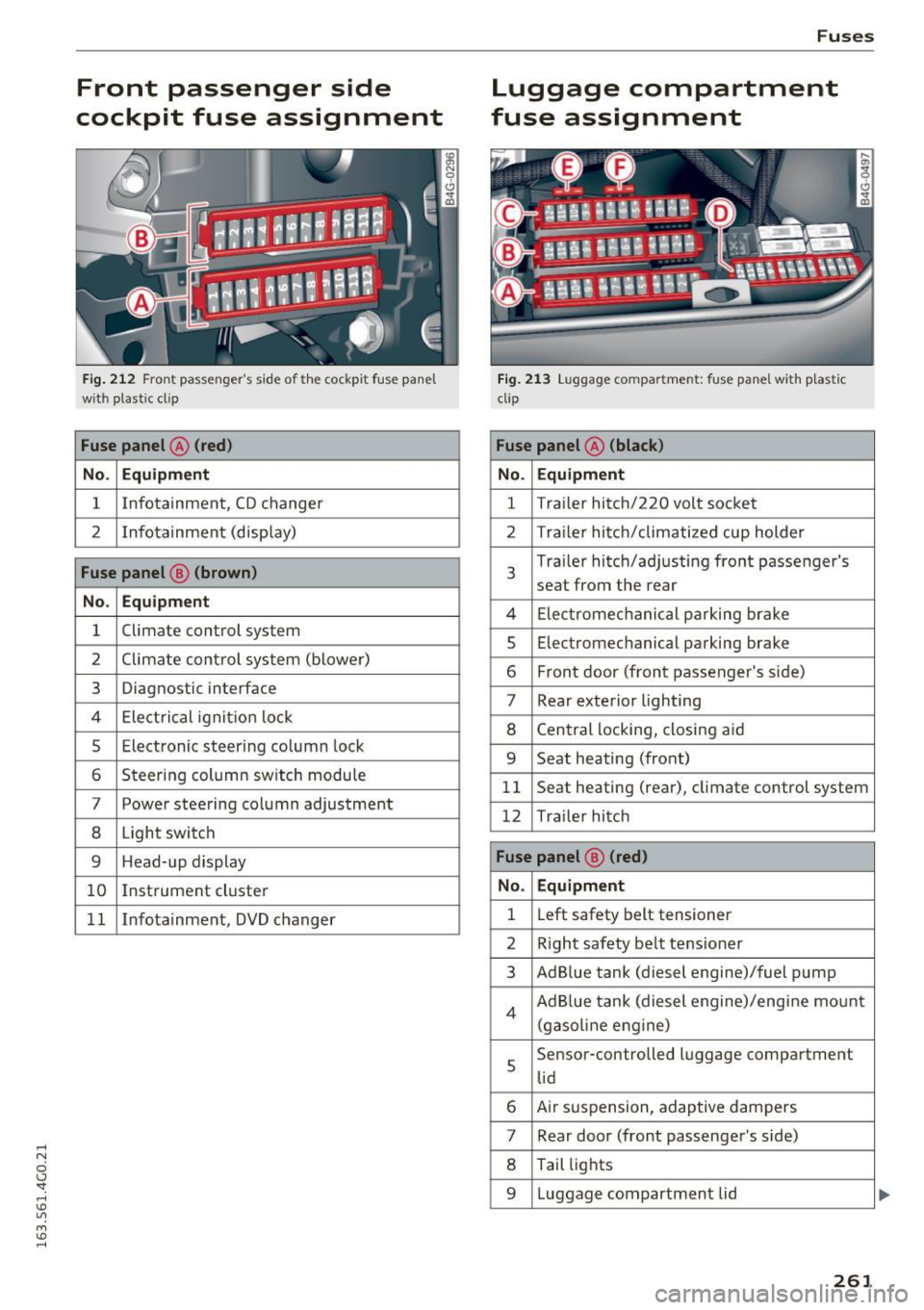
Front passenger side
cockpit fuse assignment
Fig. 212 Front passenger's sid e of t he cockpit fuse pane l
with plastic cl ip
Fuse panel @ (red)
No. Equipment
1 Infotainment, CD changer
2 Infotainment
(display)
Fuse panel@ (brown)
No . Equipment
1 Climate
control system
2 Climate control
system (blower)
3 Diagnostic interface
4 Electrical ignition lock
5 Electronic steering column lock
6 Steering column sw itch module
7 Power steering column adjustment
8 Light switch
9 Head-up display
10 I
nst rument cluster
1 1 Infotainment, DVD changer
Fuses
Luggage compartment
fuse assignment
Fig. 213 Luggage compartment: fuse panel with plastic
clip
Fuse panel @ (black )
No. Equipment
1 Tra
iler hitch/220 volt socket
2 Tra ile r hitch/climatized cup holder
3
Tra iler hitch/adjusting front passenger's
seat from the rear
4 Elec trom echan ica l parking brake
5 Electromec hanical parking brake
6 Front door (front passenger's side)
7 Rear exterior lighting
8 Central locking, closing aid
9 Seat heating (front)
1 1 Seat heating
(rear), climate control system
12 Tra iler hitch
Fuse panel @ (red)
No . Equipment
1 Left
safety belt tensioner
2 R ight safety belt tensioner
3 Ad Blue tank (diesel engine)/fuel pump
4 Ad Blue tank (diesel engine)/engine mount
(gasoline eng ine)
s
Sensor-controlled luggage compartment
lid
6 Air suspension, adaptive dampers
7 Rear door (front passenger's side)
8 Tail lights
9 Luggage compartmen t lid
261
Page 282 of 294
Index
Date display . . . . . . . . . . . . . . . . . . . . . . . . . . 26
Daytime running lights . . . . . . . . . . . . . . . . . 44
Declaration of compliance Adaptive cruise control . . . . . . . . . . . . . . .
276
Audi side assist . . . . . . . . . . . . . . . . . . . . . 276
Cell phone package . . . . . . . . . . . . . . . . . . 276
Convenience key . . . . . . . . . . . . . . . . . . . . . 276
Electronic immob ilizer. . . . . . . . . . . . . . . . 276
Garage door opener (HomeLink) . . . . . . . . 276
Remote control key . . . . . . . . . . . . . . . . . . 276
Defective light bulb warning
Indicator light . . . . . . . . . . . . . . . . . . . . . . .
21
Defrosting (windows)
Four- zone automatic climate control . . . . .
71
Three-zone climate control . . . . . . . . . . . . . 68
DEF (instrument cluster) . . . . . . . . . . . . . . . . 26
Determining correct load limit . . . . . . . . . . 245
Diesel Indicator light . . . . . . . . . . . . . . . . . . . . . . .
20
Prewarming . . . . . . . . . . . . . . . . . . . . . . . . . 74
Diesel fuel . . . . . . . . . . . . . . . . . . . . . . . . . . .
209
Diesel particu late filter . . . . . . . . . . . . . . . . 196
Dimensions .. .. ............... .... ... 271
Dimming the rearview mirror . . . . . . . . . . . . 49
Distance . . . . . . . . . . . . . . . . . . . . . . . . . . . . . 24
Door/rear lid warning . . . . . . . . . . . . . . . . . . . 23
Doors Ch ild safety lock . . . . . . . . . . . . . . . . . . . . . . 39
Driver information system . . . . . . . . . . . . . . . 23
CD/radio display . . . . . . . . . . . . . . . . . . . . . . 23
Door/rear lid warn ing . . . . . . . . . . . . . . . . . 23
E ff iciency program . . . . . . . . . . . . . . . . . . . .
25
E xterior temperature display . . . . . . . . . . . 23
On-board computer . . . . . . . . . . . . . . . . . . . 24
Service interval display . . . . . . . . . . . . . . . .
26
Driver seating posit ion . . . . . . . . . . . . . . . . . 126
drive select
adaptive air suspension/sport . . . . . . . . . .
100
Adaptive dampers . . . . . . . . . . . . . . . . . . . 100
Curve light . . . . . . . . . . . . . . . . . . . . . . . . . 100
Engine sound . . . . . . . . . . . . . . . . . . . . . . . 100
Safety belt tensione r . . . . . . . . . . . . . . . . . 100
Sport differential . . . . . . . . . . . . . . . . . . . . 100
Drive select . . . . . . . . . . . . . . . . . . . . . . . . . . 100
Driving economically
Driving safely .. .. ... .......... .. .. .. .
Driving through water .......... .. .. .. .
280
196
125
194
Driving time
Duplicate key ...
... .. .. ................ 24
30
Dust filter
refer to Pollutant filter . . . . . . . . . . . . . . . . 67
Dynamic steering
Indicator light
E
190
Easy seat entry . . . . . . . . . . . . . . . . . . . . . . . . 7 4
Economy tips (efficiency program) . . . . . . . . 25
Eff · 1c1ency program . . . . . . . . . . . . . . . . . . . . . 25
Electromechanical parking brake
Operat ion . . . . . . . . . . . . . . . . . . . . . . . . . . . 77
Releasing and closing . . . . . . . . . . . . . . . . . 77
Warning/indicator lights . . . . . . . . . . . . . . .
15
Electromechanical steering . . . . . . . . . . . . . 190
Indicator light . . . . . . . . . . . . . . . . . . . . . . 190
Electronic differential lock
Indicator light . . . . . . . . . . . . . . . . . . . . . . .
18
Electronic Differential Lock . . . . . . . . . . . . . 187
Electronic differential lock (EDL)
Warning/indicator lights . . . . . . . . . . . . . . .
19
Electronic immobili zer . . . . . . . . . . . . . . . . . . 31
E lectronic power control (EPC)
warning/indicator light . . . . . . . . . . . . . . . .
20
Electronic speed limiter . . . . . . . . . . . . . . . . . 29
Electronic stabilization control
Indicator light . . . . . . . . . . . . . . . . . . . . . . .
18
E lectronic Stabilization Control . . . . . . . . . . 187
Sport mode . . . . . . . . . . . . . . . . . . . . . . . . 188
Emergency actuation
Doors . . . . . . . . . . . . . . . . . . . . . . . . . . . . . . 36
Emergency flasher . . . . . . . . . . . . . . . . . . . . . 47
Warning/indicator lights . . . . . . . . . . . . . . .
22
Emergency operation
Emergency braking function (parking brake) .7.8
Fuel filler door . . . . . . . . . . . . . . . . . . . . . .
212
Luggage compartment lid . . . . . . . . . . . . . . 39
Selector lever . . . . . . . . . . . . . . . . . . . . . . .
112
Sunroof . . . . . . . . . . . . . . . . . . . . . . . . . . . . . 42
Emergency starting . . . . . . . . . . . . . . . . . . .
264
Energy management . . . . . . . . . . . . . . . . . . 192
Engine
Compartment. ... .. .. ... ..... ..... ..
218
Coolant . . . . . . . . . . . . . . . . . . . . . . . . . . . . 222
Prewarming . . . . . . . . . . . . . . . . . . . . . . . . . 74
Page 286 of 294
Index
Mirrors dimming ... .... ................ ..... 49
Exterior mirrors . . . . . . . . . . . . . . . . . . . . . . 48
Mon itor ing the Advanced Airbag System . . 153
Multifunction steering wheel . . . . . . . . . . . . . 24
N
Natural leather care/cleaning
NHTSA 206
Contacting . . . . . . . . . . . . . . . . . . . . . . . . . 132
Night vision assist . . . . . . . . . . . . . . . . . . . . 103
Cleaning the camera . . . . . . . . . . . . . . . . . 204
Nitrogen oxide (NOx) catalytic converter
refer to AdBlue .... .................. 212
Number of seats . . . . . . . . . . . . . . . . . . . . . . 134
0
Occupant seating positions . . . . . . . . . . . . . 126
Octane rating . . . . . . . . . . . . . . . . . . . . . . . . 208
Odometer . . . . . . . . . . . . . . . . . . . . . . . . . . . . 26
OFF (four-zone automat ic cl imate control) . . 70
OFF (three- zone climate control) . . . . . . . . . . 68
Oil
refer to Engine oil . . . . . . . . . . . . . . . . . . . 218
Oil change interval . . . . . . . . . . . . . . . . . . . . . 26
On-board computer . . . . . . . . . . . . . . . . . . . . 24
On-Board Diagnostic System (OBD)
Data Link Connector (DLC) . . . . . . . . . . . . . . 28
Electronic speed limiter . . . . . . . . . . . . . . . . 29
Malfunction Indicator Lamp (MIL) . . . . . . . 28
Open door/hood/rear lid warn ing . . . . . . . . . 23
Opening..... .. .. ..................... 30
Hood . . . . . . . . . . . . . . . . . . . . . . . . . . . . . . 216
Luggage compartment lid . . . . . . . . . . . . . . 37
Sunroof .. .. .. .. ............. .. .. .. .. 41
W indows .. .. .... ............. ...... 40
Other consumers (efficiency program) . . . . . 25
Outlet . . . . . . . . . . . . . . . . . . . . . . . . . . . . . . . 59
Owner 's Literature
5
p
Paint damage 205
Paint No. . . . . . . . . . . . . . . . . . . . . . . . . . . . . 270
284
Parking
Automatic transmission . . . . . . . . . . . . . . 108
Valet parking . . . . . . . . . . . . . . . . . . . . . . . . 41
Parking aid Cleaning sensors/camera . . . . . . . . . . . . . 204
Parking brake . . . . . . . . . . . . . . . . . . . . . . . . . 77
Emergency braking function . . . . . . . . . . . . 78
Parking . . . . . . . . . . . . . . . . . . . . . . . . . . . . . 77
Start ing from a stop . . . . . . . . . . . . . . . . . . 78
Start ing to drive w ith a trailer . . . . . . . . . . . 78
also refer to Electromechanical
parking brake . . . . . . . . . . . . . . . . . . . . . . . . 77
Parking lights . . . . . . . . . . . . . . . . . . . . . . . . . 44
Parking system Adjusting the display/warning tone . . . . . 123 Cleaning the rearview camera . . . . . . . . . . 115
Malfunction . . . . . . . . . . . . . . . . . . . . . . . . 123
Parking system plus . . . . . . . . . . . . . . . . . . 114
Peripheral cameras . .. ............. .. 118
Peripheral display . . . . . . . . . . . . . . . . . . . 114
Trailer hitch . . . . . . . . . . . . . . . . . . . . . . . . 123
also refer to Parking systems . . . . . . 114, 115
Parking systems . . . . . . . . . . . . . . . . . . . . . . 113
Rearv iewcamera ..... ............... 115
Parts replacement . . . . . . . . . . . . . . . . . . . . 275
Pass-through with ski sack . . . . . . . . . . . . . . . 66
PASSENGER AIR BAG OFF light . . . . . . . . . . 154
Passenger protection . . . . . . . . . . . . . . . . . . 184
Pedals . . . . . . . . . . . . . . . . . . . . . . . . . . . . . . 130
Pedestrian detection . . . . . . . . . . . . . . . . . . 103
Peripheral display. ... ................. 114
Physical principles of a frontal co llision . . . 135
Polishing . . . . . . . . . . . . . . . . . . . . . . . . . . . . 205
Po llen filter
refer to Pollutant filter . . . . . . . . . . . . . . . . 67
Pollutant filter . . . . . . . . . . . . . . . . . . . . . . . . 67
Power Windows . .... .. .. .. ............. ... 40
Power locking system Locking/unlocking the vehicle from inside . 35
Rear lid . . . . . . . . . . . . . . . . . . . . . . . . . . . . . 36
Unlocking and locking vehicle . . . . . . . . . . . 33
Power seat adjustment . . . . . . . . . . . . . . . . . 54
Power windows Child safety lock . . . . . . . . . . . . . . . . . . . . . . 39
Convenience opening . . . . . . . . . . . . . . . . . . 40
Malfunction . . . . . . . . . . . . . . . . . . . . . . . . . 41