weight AUDI A6 2016 Owner's Manual
[x] Cancel search | Manufacturer: AUDI, Model Year: 2016, Model line: A6, Model: AUDI A6 2016Pages: 294, PDF Size: 73.88 MB
Page 202 of 294
Trailer mod e
Tire pr essure
When tow ing a tra iler, inflate the tires of you r
veh icle to the cold tire pressure listed under "Fu ll
load" on the label located on the driver's side B
pillar (visib le when the door is open) . Inflate
trai ler tires to trailer and tire manufacturers'
specifications.
Light s
Check to make sure both vehicle and trailer lights
are working proper ly.
Safet y chains
Be sure t railer safety chains are properly connect
ed from the trailer to the h itch on the veh icle.
L eave enough slack in the chains to permit turn
ing corners . When yo u install safety chains, make
sure they wi ll not drag on the road when you are
driving.
The chains shou ld cross under the trailer tongue
to prevent it from dropping in case of separation
from the hitch .
Adjusting the Audi d rive select
Make sure the vehicle is on a level surface bef ore
hitching up the t railer and bef ore adjust ing the
tongue we ight . The vehicle must be in
auto or
comf ort driving mode and not raised
r::!> page 100, r::!> 0 .
Make sure that the vehicle is lowered. In Info
tainment, select:
ICARI function button > Lower
control button .
I f you m ust dr ive under poor road condit ions, you
can ra ise the vehicle
afte r coup ling the t rai ler or
after adjusting the tongue weight r:!> page 102.
(D Note
-Changes in tempe rature or load can affect
the he ight of the vehicle.
- Always se lect
auto or comfort mode. Othe r
wise, the tongue load spec ified for yo ur ve
hicle w ill no longer be applicable .
200
· Driving instructions
Driving with a trailer always requires extra care
and consideration .
To obtain the best possible hand ling of veh icle
and trailer, please note the following:
.,. Do not tow a loaded trailer when your car itself
is not loaded .
.,. Be especially careful when passing other
vehicles .
.,. Observe speed limits .
.,. Do not dr ive at the maximum permissible
speed.
.,. Always app ly brakes ea rly.
.,. Monitor the temperat ure gauge.
Weight distribution
Towing a loaded trai ler with an empty car results
i n a h ighly unstab le distribution of weight . If this
cannot be avoided, drive at very low speeds only
to avoid the risk of losing steer ing contro l.
A "balanced" rig is easier to operate and control.
This means that the tow vehicle shou ld be loaded
to the extent possible and permissib le, wh ile
k eeping the trailer as l ight as poss ible under the
c ircu mstances . Wheneve r possib le, transfer
some ca rgo to the luggage compartment of the
tow vehicle while observing tongue load require
ments and vehicle loading considerations.
Speed
The higher the speed, the mo re diff icu lt i t be
comes fo r the driver to con trol the r ig . Do not
drive at the maximum permissible speed. Reduce
your speed even more if load, weather or wind
cond itions are unfavorab le -particularly when
go ing downh ill.
Reduce vehicle speed
i mmed iatel y if the trailer
shows the slightest sign of swaying.
Do not tr y
to stop the swaying by accelerating.
Observe speed limits . In some areas, speeds for
vehicles towing trailers are lower than for regular
vehicles .
Always apply bra kes early. Whe n driving down -
hill, shift into a lower gear to use the engine .,..
Page 203 of 294
braking effect to slow the vehicle. Use of the
brakes alone can cause them to overheat and fail.
Air suspension*
When driving with a tra ile r, activate the trailer
mode of the air suspension. Switch the air sus
pension trailer mode on when you are towing a
trailer. This will limit the regulation by the air
suspension while driving. Select in the MMI :
ICARI function button > (Car)* systems control
button>
Vehicle settings> Air susp.: towing>
On.
Coolant temperature
The coolant temperature gauge¢ page 10 must
be observed carefully . The coolant temperature
can increase if you drive on long inclines in a low
gear at high engine speeds. Reduce your speed immediately if the LEDs in the top part of the dis
play turn on .
For more information about ind icator lights, re
fer to. ¢
page 15.
A WARNING
Anyone not properly restrained in a moving
vehicle is at a much greater risk in an acci
dent. Never let anyone ride in your car who is
not p roperly wearing the restraints p rovided
by Audi.
Trailer mode notes
Important to know -
Your vehicle handles differently when towing a
trailer because of the additional weight and dif
ferent weight distribution. Safety, performance
and
economy will greatly depend on how careful
ly you load your trailer and operate your rig .
Before you actually tow your trailer, practice
turning, stopping and backing up in an area away
from traff ic. Keep practicing until you have be
come comp letely fami liar with the way your vehi
cle-trailer comb inat ion behaves and responds.
Backing up is difficult and requires practice.
Backing up with a trailer generally requires steer-
Trailer mode
ing action opposite to that when backing up your
vehicle without a trailer .
Maintain a greater distance between your vehicle
and the one in front of you. You will need more
room to stop . To compensate for the trailer, you
will need a larger than normal turning radius .
When passing, remember that you cannot accel
erate as fast as you normally wo uld because of
the added load . Make sure you have enough room
to pass. After passing, allow p lenty of room for
your trailer before changing lanes again .
Avo id jerky starts, sharp turns or rapid lane
changes.
(D Tips
- Do not tow a trailer during the break-in peri
od of your veh icle.
-If you tow a trailer, your Audi may require
more frequent maintenance due to the ex
tra load ¢
page 2 73.
Parking on a slope
Do not pork on a slope with a trailer. If it cannot
be avoided, do so only ofter doing the following:
When parking:
"Apply the foot brake .
" Have someone place chocks under both the ve
hicle and the trailer wheels.
"W ith chocks in place, slowly release the brakes
until the wheel chocks absorb the load.
" Turn the whee ls towards the curb.
" App ly the parking brake.
" Select the P selector lever position.
When restarting after parking:
"App ly the foot brake.
" Start the engine .
"S elect the D/S se lector lever position.
" Release the parking brake and slowly pull out
and away from the wheel chocks.
" Stop and have someone retrieve the wheel
chocks.
201
Page 235 of 294
® Mud and snow capability
"M/5" or "M+S" indicates the tire
has characteristics that make it
suitable for driving on mud and
snow .
& indicates a winter tire .
@ Composition of the tire cord
and materials
The number of plies indicates the
number of rubber ized fabric lay
ers in the t ire. In general : the
more layers, the more weight a
tire can carry . Tire manufacturers
must also specify the materials
used in the ti re . These incl ude
stee l, nylon, polyester and other
materials .
@Maximum permitted load
This number indicates the maxi
mum load in kilograms and
pounds that the tire can carry .
@ Uniform tire quality grade
standards for treadwear,
traction and temperature resistance
Treadwear , traction and tempera
ture ranges¢
page 248.
@ Running direction
The arrows indicate the running
direction of unidirectional t ires .
You must always follow the speci- fied running direction
¢
page 258.
€3) Maximum permitted
inflation pressure
Wheels
This number indicates the max i
mum pressure to which a tire can
be inflated unde r normal operat
ing conditions.
Glossary of tire and loading
terminology
Accessory weight
means the combined we ight (in
excess of those standard items
wh ich may be replaced) of auto
matic transmission, power steer
ing, power brakes, power win
dows, power seats, radio, and
heater, to the extent that these
items are available as factory-in
stalled equipment (whether in
stalled or not).
Aspect ratio
means the ratio of the height to
the w idth of the tire in percent .
Numbers of 55 or lower indicate a
low s idewall for improved steer
ing response and better overall
handling on dry pavement . .,.
233
Page 236 of 294
Wheels
Bead
means the part of the tire that is
made of steel wires, wrapped or
reinforced by ply cords and that is
shaped to fit the rim .
Bead separation
means a breakdown of the bond
between components in the bead.
Cord
means the strands forming the
plies in the tire.
Cold tire inflation pressure
means the tire pressure recom
mended by the vehic le manufac
turer for a tire of a des ignated
size that has not been driven for more than a couple of miles (kilo
meters) at low speeds in the
three hour period before the tire pressure is measured or adj usted.
Curb weight
means the weight of a motor ve
hicle w ith standard equipment in
cluding the maximum capacity of
fuel, oil, and coolant, air condi
tioning and additiona l weight of
op tional equipment.
E x tra load tire
means a tire des igned to operate
at higher loads and at h igher in -
234
flation pressures than t he corre
spond ing standa rd tire. Extra load
tires may be identified as "XL",
"xl" , "EXTRA LOAD" , or "RF" on
the sidewall.
Gross A xle Weight Rating
("GAWR ")
means the load-carrying capacity
of a single axle system , measured
at the ti re-gro und interfaces.
Gross Vehicle Weight Rating
("GVWR")
means the max imum total loaded
weight of the vehicle .
Groove
means the space between two ad
jacent tread ribs .
Load rating (code)
means the maximum load tha t a
tire is rated to carry for a given in
flation pressure. You may not find
this informat ion on all ti res be
cause it is not required by law .
Maximum load rating
means the load rating for a tire at
the maximum permissible infla
tion p ressure for that ti re .
Maximum loaded vehicle
weight
means the sum of: ...
Page 237 of 294
(a) Curb weight
(b) Accessory weight
(c) Vehicle capacity weight, and
(d) Production options we ight
Ma ximum (permissible)
inflation pressure
means the maximum cold infla
tion pressure to which a t ire may
be inflated. Also called "maxi
mum inflation pressure."
Normal occupant weight
means 150 lbs. (68 kilograms)
times the number of occupants
seated in the veh icle up to the to
tal seating capacity of your vehi c le.
Occupant distribution
means distribution of occupants
in a vehicle.
Outer diameter
means the overall diameter of an
inflated new tire.
Overall width
means the linear distance be
tween the exteriors of the side
walls of an inflated tire, including elevations due to labeling, deco
rations, or protective bands or
ribs .
Wheels
Ply
means a layer of rubber-coated
parallel cords .
Production options weight
means the combined weight of
those installed regular production
options weighing over 5 lbs. (2.3 kg) in excess of those standard
items which they replace, not pre
viously considered in curb weight
or accessory weight, including heavy duty brakes , ride levelers,
roof rack, heavy duty battery, and
special trim .
Radial ply tire
means a pneumatic tire in which
the ply cords that extend to the beads are laid at substantially 90
degrees to the centerline of the
tread.
Recommended inflation
pressure
see ~ page 234, Cold tire infla
tion pressure .
Reinforced tire
means a tire designed to operate
at higher loads and at higher in
flation pressures than the corre sponding standard tire. Rein
forced tires may be identified as
235
Page 239 of 294
Uniform Tire Quality Grading
is a tire information system devel
oped by the United States Nation
al Highway Traffic Safety Admin
istration (NHTSA) that is designed
to help buyers make relat ive com
parisons among tires . The UTQG
is not a safety rating and not a
guarantee that a tire will last for
a prescribed number of mi les
(kilometers) or perform in acer
tain way. It simply gives t ire buy
e rs add itional informa tion to
combine with other considera
tions, such as p rice, brand loya lty
and dealer recommendations . Un
der UTQG, tires are graded by t he
tire manufacturers in th ree areas:
treadwear, traction, and tempera
ture res istance. The UTQG infor
mation on the tires, molded into
the s idewalls .
U.S. DOT Tire Identification
Number (TIN)
This is the tire's "serial number".
It beg ins with the le tters "DO T"
and indicates that the tire meets
all federal standards . T he nex t
two numbers or letters indicate
the plant where it was manufac
tured , and the last fo ur numbers
represent the week and yea r of
manufacture. For examp le,
Wheels
DOT ... 2214 ...
means that the tire was produced
in the 22nd week o f 201 4. The
other numbers are marketing co des that may or may not be used
by the t ire manufact urer. This in
formation is used to contact con sumers if a tire defec t req uires a
reca ll.
Vehicle capacity weight
means the rated cargo and lug
gage load plus lS0 lbs . (68 k ilo
grams) t imes the vehicle's desig
na ted seating capacity.
Vehicle maximum load on the
tire
means that load on an ind iv idual
tire tha t is determined by dist rib
ut ing to eac h ax le its share of the
maximum loaded vehic le weight
and dividing by two.
Vehicle normal load on the tire
means that load on a n individual
tire that is determined by dist rib
uting to each ax le its share of the
curb weight , accessory weight ,
and normal occupant weigh t (dis
tributed in accordance wit h
c:::> ta
ble on page 243) and dividing by
two.
23 7
..
Page 245 of 294
Wheels
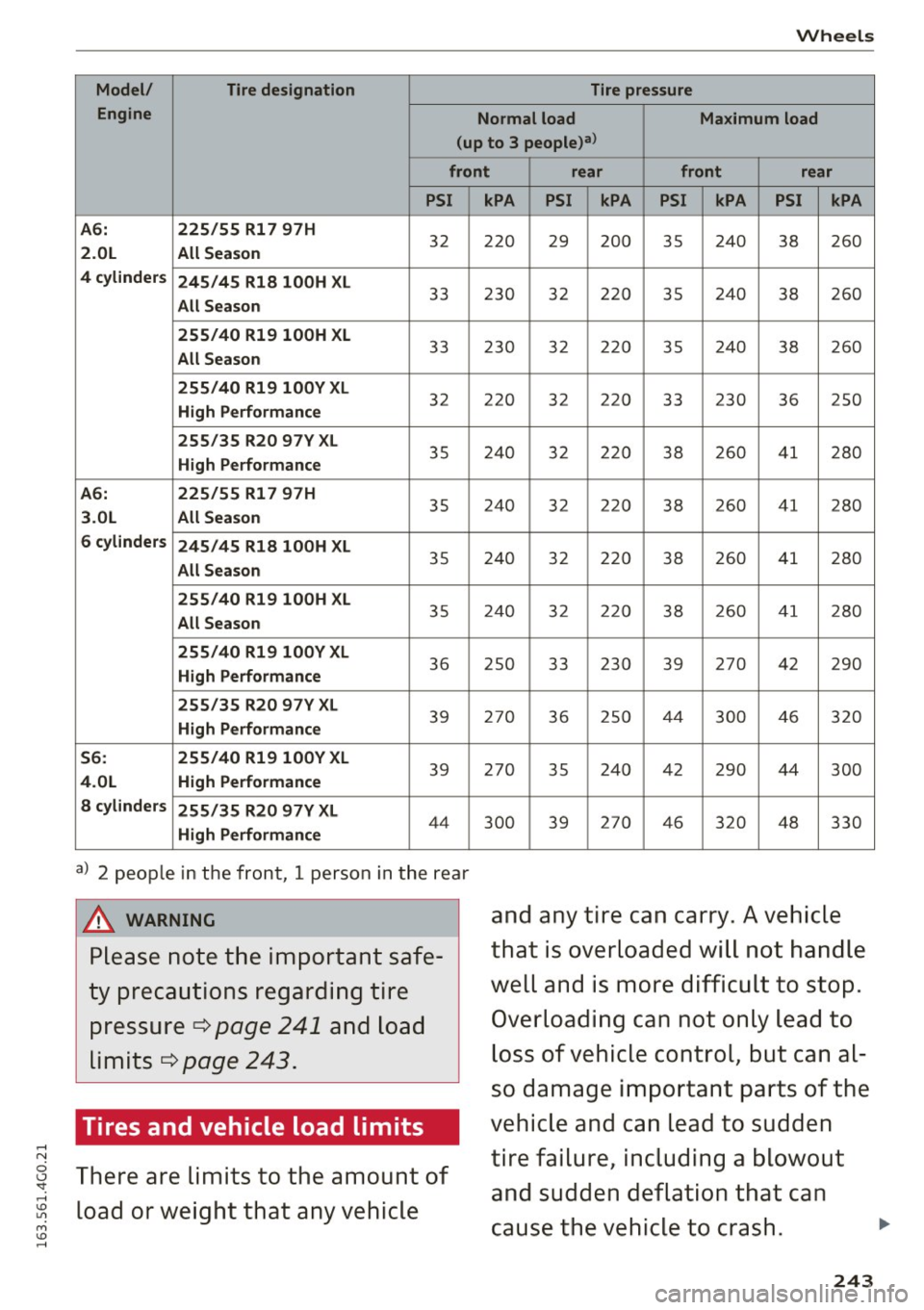
Model/ Tire designation Tire pressure
Engine Normal load Maximum load
(up to 3 people)a)
front rear front rear
PSI
A6: 225/55 Rl 7 97H 2.0L All Season
32
4 cylinders 245/45 Rl8 l00H XL
All Season
33
255/40 Rl9 l00H XL
All Season 33
255/40 Rl9 l00Y XL
High Performance
32
255/35 R20 97V XL
High Performance
35
A6: 225/55 Rl 7 97H
3.0L All Season
35
6 cylinders 245/45 Rl8 l00H XL
All Season
35
255/40 Rl9 l00H XL
All Season
35
255/40 R19 l00Y XL
High Performance
36
255/35 R20 97V XL
High Performance
39
56: 255/40 Rl9 l00Y XL
4.0L High Performance 39
8 cylinders
255/35 R20 97V XL
High Performance
44
a) 2 people in the front, 1 person in the rear
A WARNING
Please note the important safe
ty precautions regarding tire pressure
c::> page 241 and load
limits
c::>page 243.
Tires and vehicle load limits
There are limits to the amount of load or weight that any vehicle
kPA PSI kPA PSI kPA PSI kPA
220 29 200 35 240
38 260
230 32 220 35 240 38 260
230 32 220 35 240 38 260
220 32 220 33 230 36 250
240 32 220 38 260 41 280
240 32 220 38 260
41 280
240 32 220 38 260 41 280
240 32 220 38 260 41 280
250 33 230 39 270 42
290
270 36 250 44
300 46 320
270 35 240 42 290 44 300
300 39 270
46
320 48
330
and any tire can carry. A vehicle
that is overloaded will not handle
well and is more difficult to stop.
Overloading can not only lead to loss of vehicle control, but can al
so damage important parts of the
vehicle and can lead to sudden
tire failure, including a blowout and sudden deflation that can
cause the vehicle to crash.
243
Page 246 of 294
Wheels
Your safety and that of your pas
sengers also depends on making
sure that load limits are not ex
ceeded. Vehicle load includes ev
erybody and everything in and on
the vehicle. These load limits are
technically referred to as the vehi
cle's
Gross Vehicle Weight Rat
ing
("GVWR") .
The "GVWR" includes the weight of the basic vehicle, all factory in
stalled accessories, a full tank of
fuel, oil, coolant and other fluids
plus maximum load . The maxi
mum load includes the number of
passengers that the vehicle is in
tended to carry ("seating capaci
ty") with an assumed weight of 1 SO lbs. (68 kg) for each passen
ger at a designated seating posi
tion and the total weight of any
luggage in the vehicle. If you tow
a trailer, the weight of the trailer hitch and the tongue weight of
the loaded trailer must be includ
ed as part of the vehicle load.
The
Gross Axle Weight Rating
("GAWR") is the maximum load
that can be applied at each of the
vehicle's two axles.
The fact that there is an upper limit to your vehicle's Gross Vehi-
244
cle Weight Rating means that the
total weight of whatever is being carried in the vehicle (including
the weight of a trailer hitch and
the tongue weight of the loaded
trailer) is limited. The more pas
sengers in the vehicle or passen
gers who are heavier than the
standard weights assumed mean
that less weight can be carried as
luggage.
The Gross Vehicle Weight Rating
and the Gross Axle Weight Rating
are listed on the safety compli
ance sticker label located on the
driver's side B-pillar
¢ page 241,
fig. 195.
&_ WARNING ~
Overloading a vehicle can cause
loss of vehicle control, a crash
or other accident, serious per
sonal injury, and even death.
-Carrying more weight than your vehicle was designed to carry will prevent the vehicle
from handling properly and increase the risk of the loss of
vehicle control.
-The brakes on a vehicle that has been overloaded may not
be able to stop the vehicle
within a safe distance.
Page 247 of 294
-Tires on a vehicle that has
been overloaded can fail sud
denly, including a blowout and
sudden deflation, causing loss
of control and a crash.
-Always make sure that the to tal load being transported -
including the weight of a trail
er hitch and the tongue
weight of a loaded trailer - does not make the vehicle
heavier than the vehicle's
Gross Vehicle Weight Rating.
Determining correct load
limit
Use the example below to calcu
late the total weight of the pas
sengers and luggage or other
things that you plan to transport so that you can make sure that
your vehicle will not be overload
ed.
Steps for Determining Correct Load Limit
1. Locate the statement "THE
COMBINED WEIGHT OF OCCU
PANTS AND CARGO SHOULD
NEVER EXCEED XXX KG OR XXX
LBS "on your vehicle's placard
(tire inflation pressure label)
¢ page 241, fig. 195.
Wheels
2. Determine the combined
weight of the driver and pas sengers that will be riding in
your vehicle.
3. Subtract the combined weight of the driver and passengers
from "XXX" kilograms or "XXX"
pounds shown on the sticker
¢ page 241, fig . 195 .
4. The resulting figure equals the
available amount of cargo and
luggage load capacity. For ex
ample, if the "XXX " amount
equals
1400 lbs. and there will
be five
150 lbs . passengers in
your vehicle, the amount of
available cargo and luggage
load capacity is 650 lbs.
(1400-750 (5 X 150) = 650
lbs .)
5. Determine the combined
weight of luggage and cargo
being loaded on the vehicle.
That weight may not safely ex ceed the available cargo and
luggage load capacity calculat
ed in Step 4.
6. If your vehicle will be towing a trailer, load from your trailer
will be transferred to your ve
hicle. Consult this manual to
determine how this reduces ..,
245
Page 271 of 294
-Before driving over a workshop hoist,
check that the vehicle weight does not
exceed the permissible lifting capacity of
the hoist.
- Before driving over a workshop hoist, en
sure that there is sufficient clearance be
tween the hoist and low parts of the ve hicle.
Emergency situations
269